Advanced Fulfillment and
Supply Orchestration – SCM
Cloud
Presenter: Mahesh Naalla
@NexInfoSolution
06/20/2019
2
Who Is NexInfo?
SUMMARY
• Consulting company focused on helping clients achieve Operational Excellence via an optimal blend of Business
Process & Software consulting services
• Deep domain expertise, including: Integrated Business Planning (IBP/S&OP), Enterprise Resource Planning (ERP),
Product Lifecycle Management (PLM), Customer Relationship Management (CRM), Enterprise Planning Management
(EPM), Human Capital Management (HCM), Predictive Data Analytics, Security, & Business Transformations
• Founded in 1999 and managed by computer industry & business process professionals
• Clients include emerging companies and Fortune 1000 corporations
• Recognized in the industry, including features in Gartner Reports, The Silicon Review (50 Smartest Companies of the
Year 2016 and 10 Fastest Growing Oracle Solution Providers 2017), and CIO Review (100 Most Promising Oracle
Solution Providers 2015)
PARTNERS
CORPORATE INFO
• HQ in Orange County, CA with offices in Redmond, WA, Chicago, IL, Bridgewater, NJ, Dublin, Ireland,
Chennai & Bangalore, India
• Operations across the United States, Europe (Ireland, UK, Switzerland, Belgium) & India
Presenter Information
Name: Mahesh Naalla
Experience:
10+ Years of Industry and IT Experience
• 10+ years of experience as Oracle supply chain and procurement consultant
• Fusion Certified Implementation Specialist
• Multiple Oracle Fusion Implementations experience
• Business Process mapping and design experience across industries
Agenda
 Fulfillment complexities
 Advance Fulfillment Process
 Advance Fulfillment Techniques
 Supply Chain Orchestration overview
 Automated Change Management
 Advance fulfillment process flows in Cloud
 Tracking Supply Lines in Supply Orchestration
5
Reminder Submitting Questions
6
Use Case – Client’s Scope/Challenges
Scope
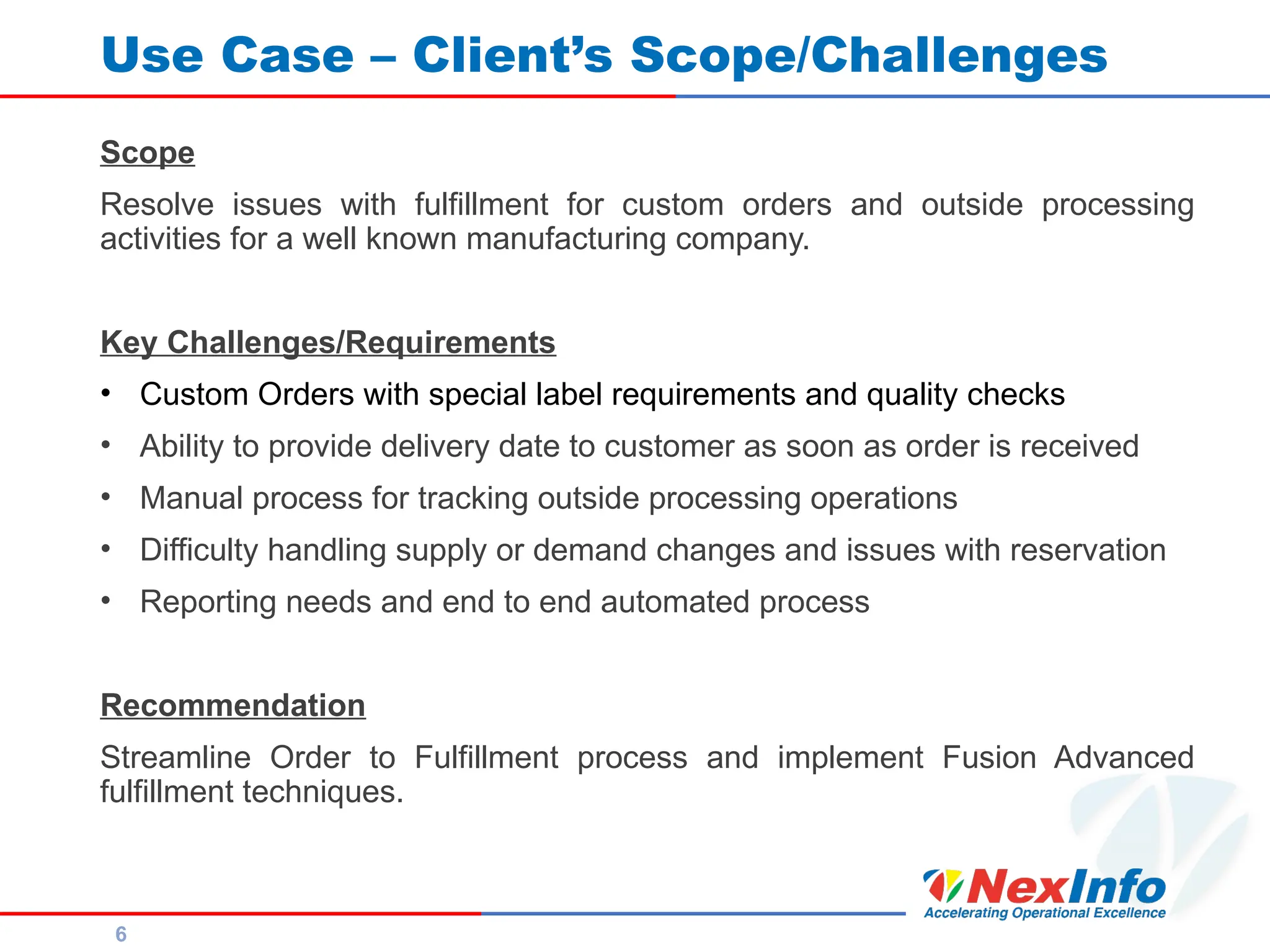
Resolve issues with fulfillment for custom orders and outside processing
activities for a well known manufacturing company.
Key Challenges/Requirements
• Custom Orders with special label requirements and quality checks
• Ability to provide delivery date to customer as soon as order is received
• Manual process for tracking outside processing operations
• Difficulty handling supply or demand changes and issues with reservation
• Reporting needs and end to end automated process
Recommendation
Streamline Order to Fulfillment process and implement Fusion Advanced
fulfillment techniques.
Fulfillment Complexities
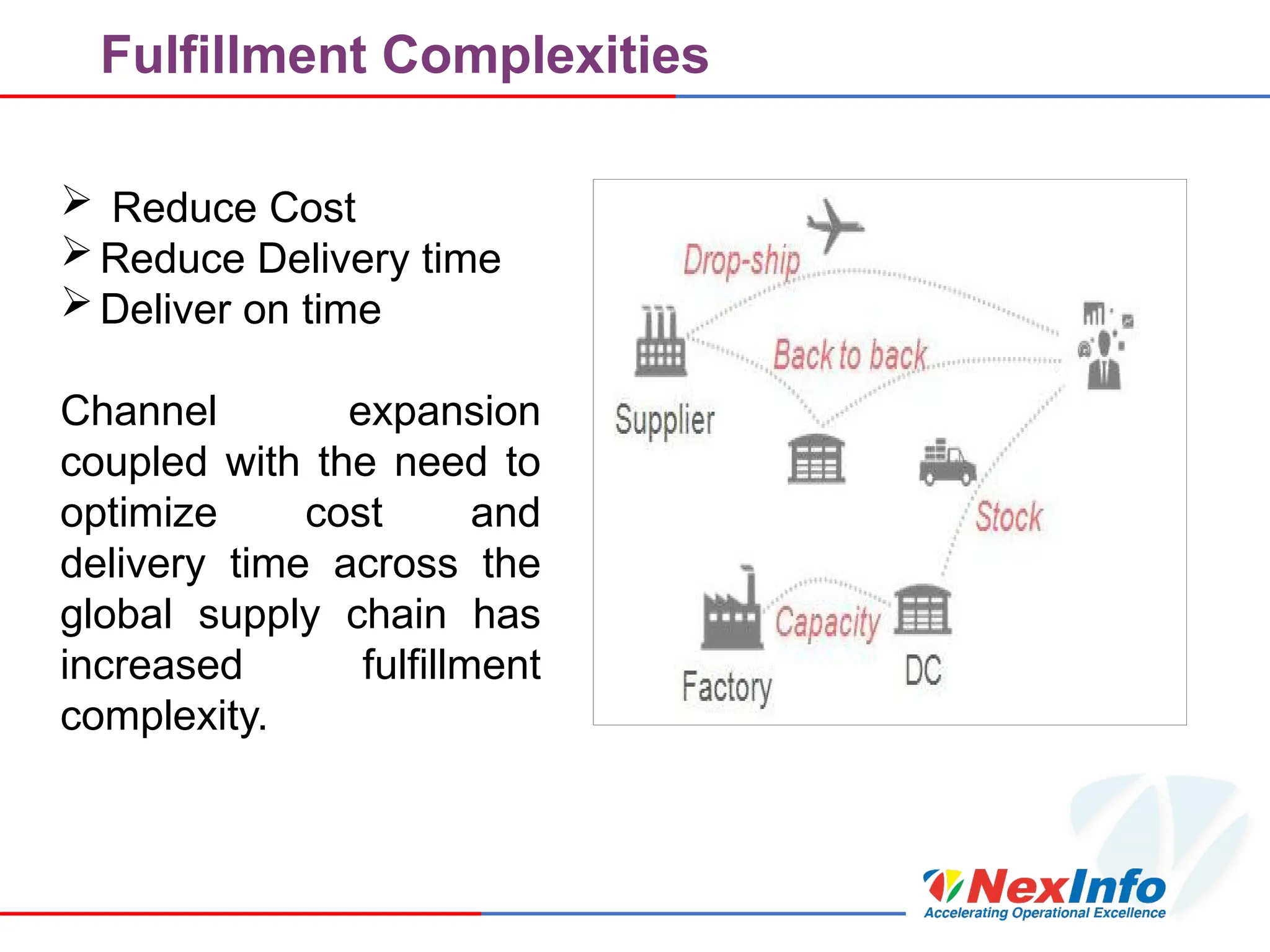
 Reduce Cost
Reduce Delivery time
Deliver on time
Channel expansion
coupled with the need to
optimize cost and
delivery time across the
global supply chain has
increased fulfillment
complexity.
Advanced Fulfillment Process
Advanced Fulfillment Techniques
The following advance fulfillment processes can be
handled in fusion
• Back to Back Supply creation and fulfillment
• Drop ship
• Internal material transfer
• Consigned inventory
• Contract manufacturing
• Outside Processing
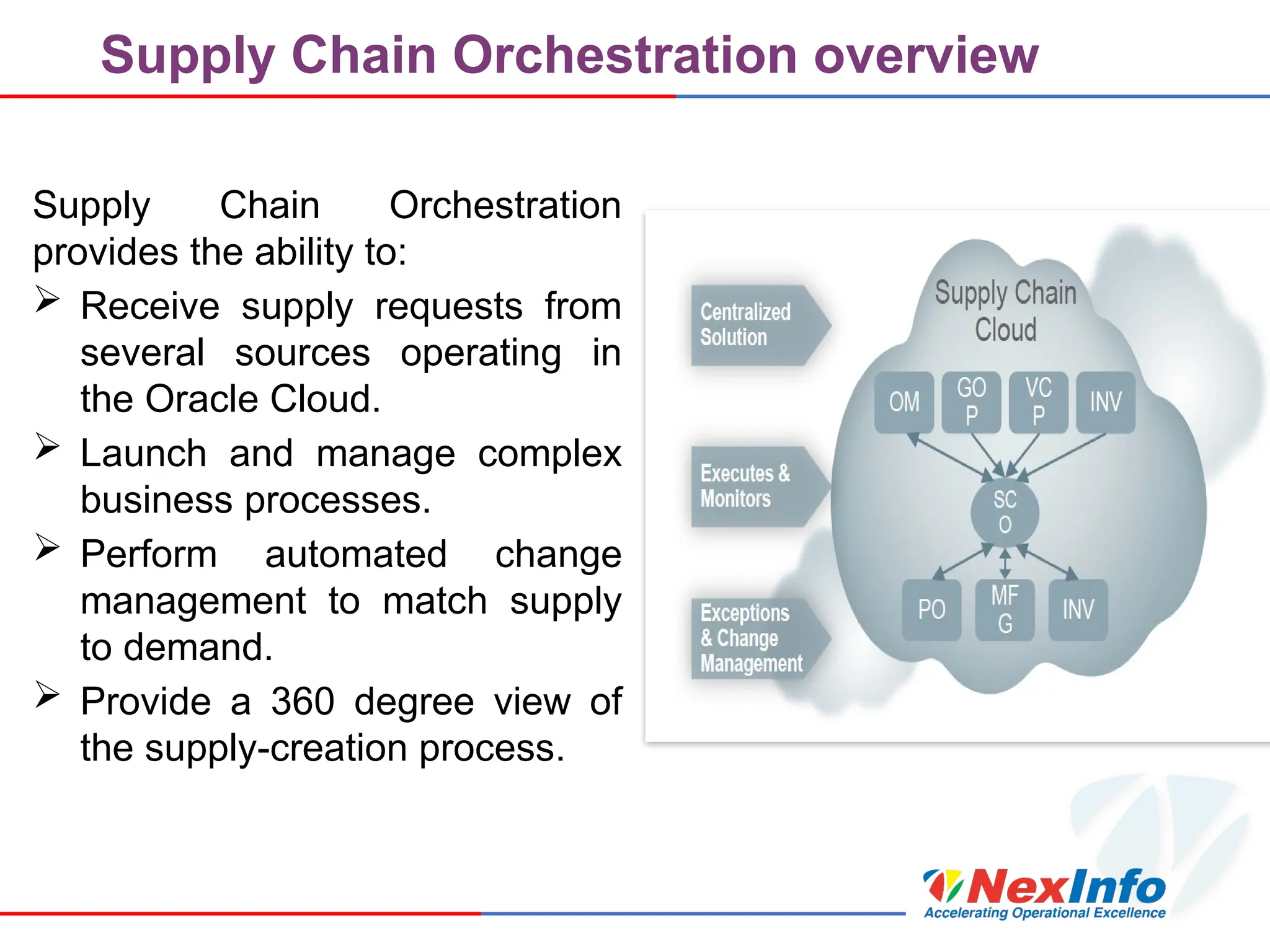
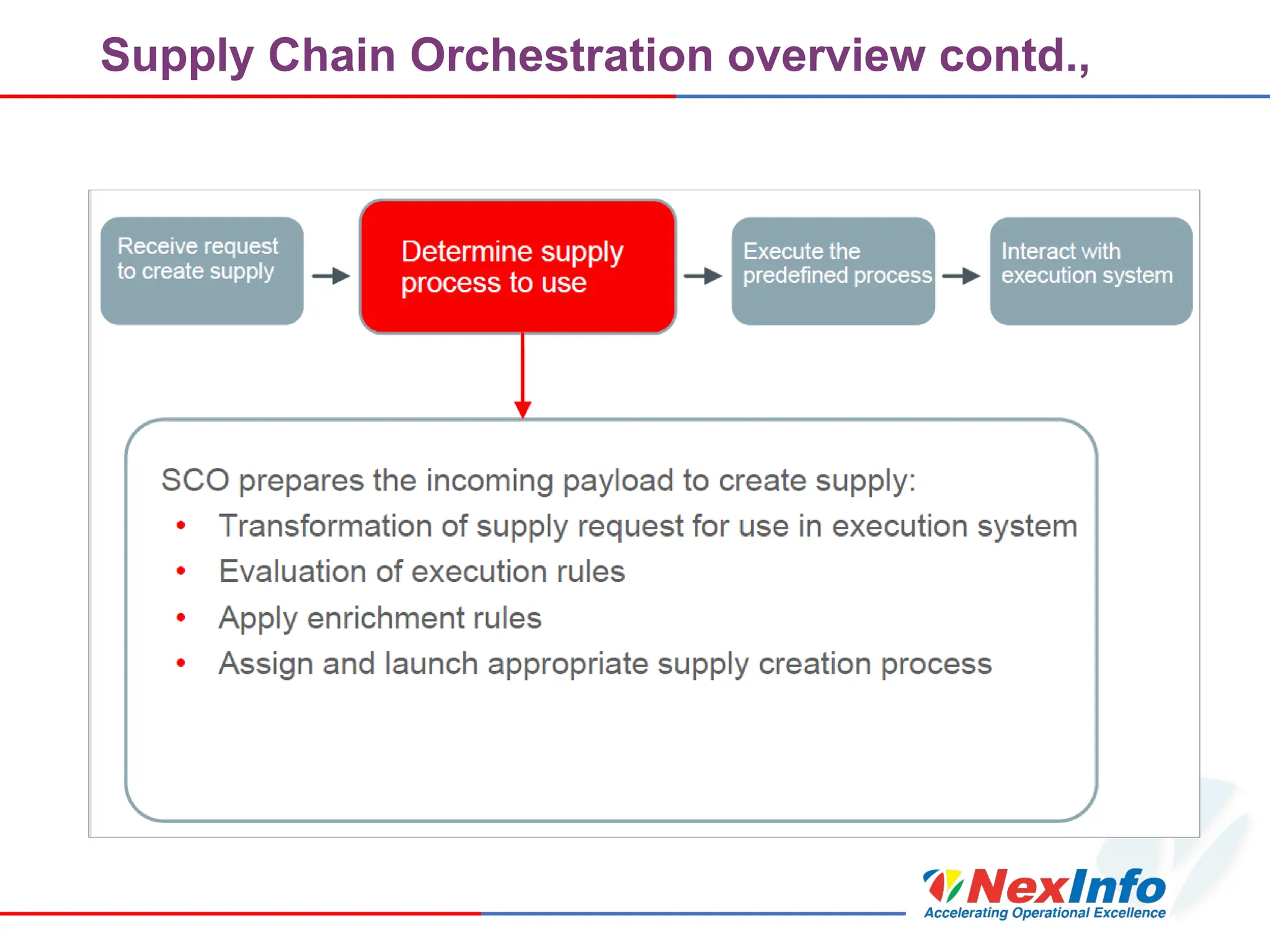
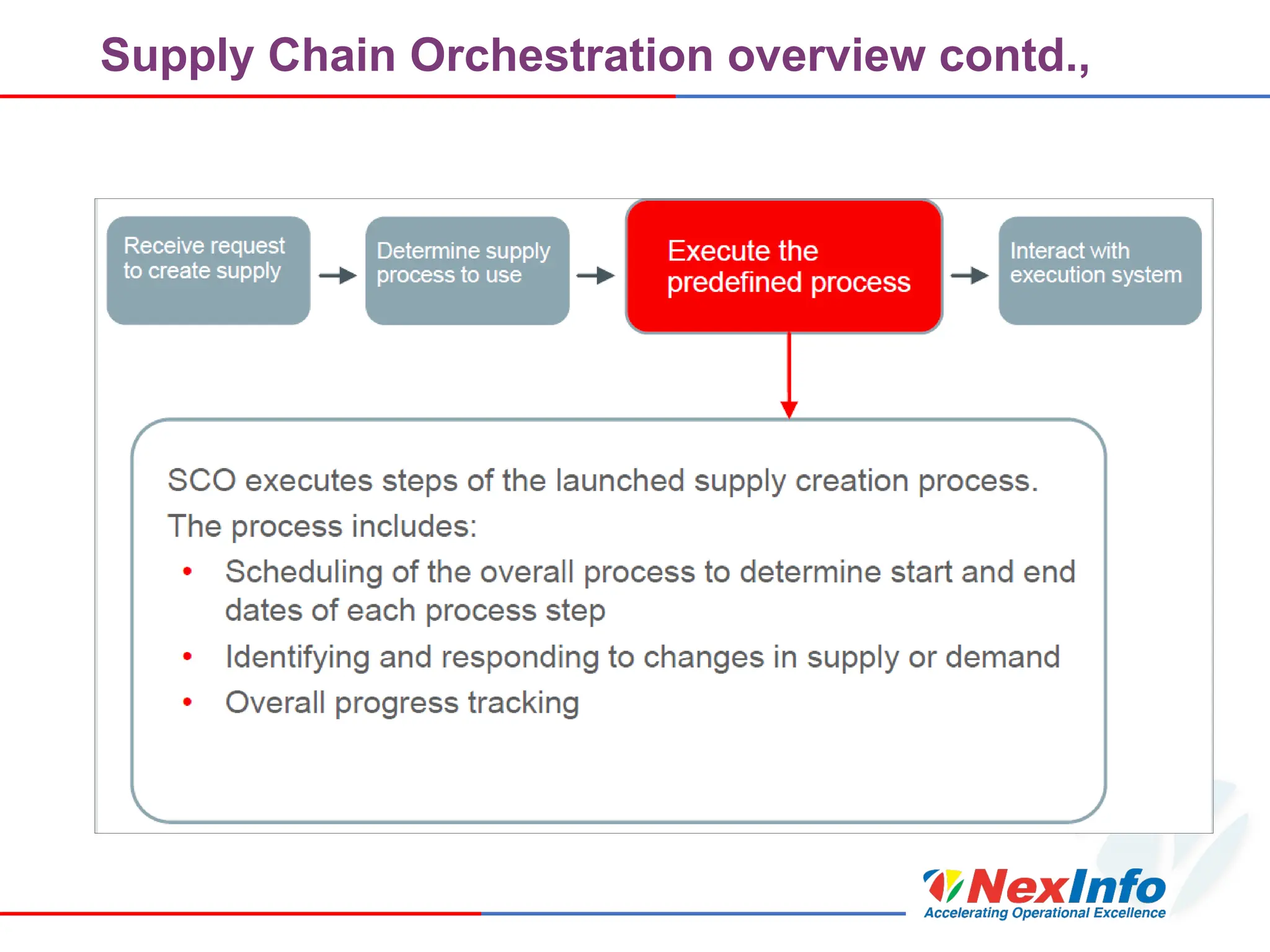
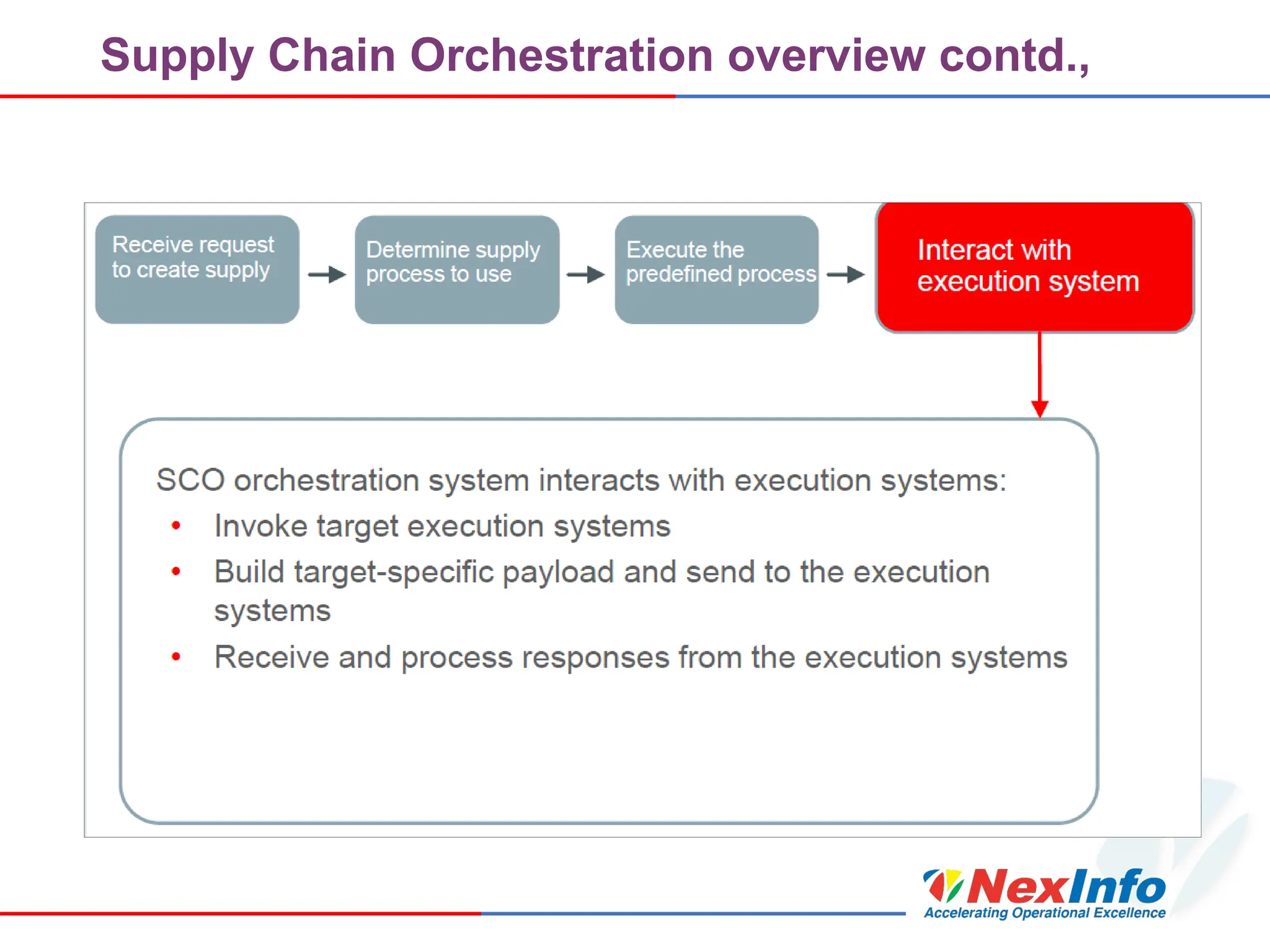
Supply Chain Orchestration overview
Supply Chain Orchestration
provides the ability to:
 Receive supply requests from
several sources operating in
the Oracle Cloud.
 Launch and manage complex
business processes.
 Perform automated change
management to match supply
to demand.
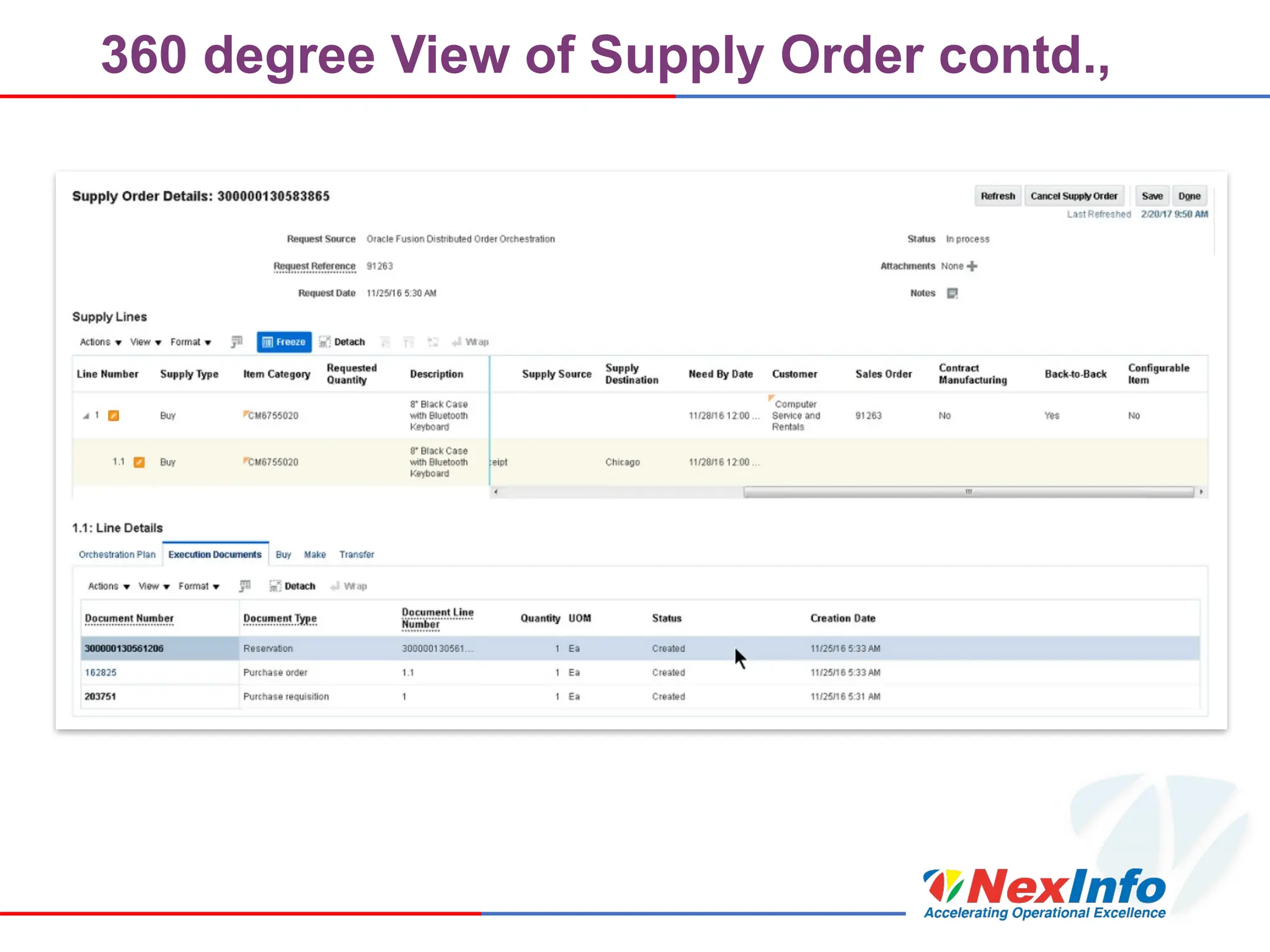
 Provide a 360 degree view of
the supply-creation process.
Supply Lines overview
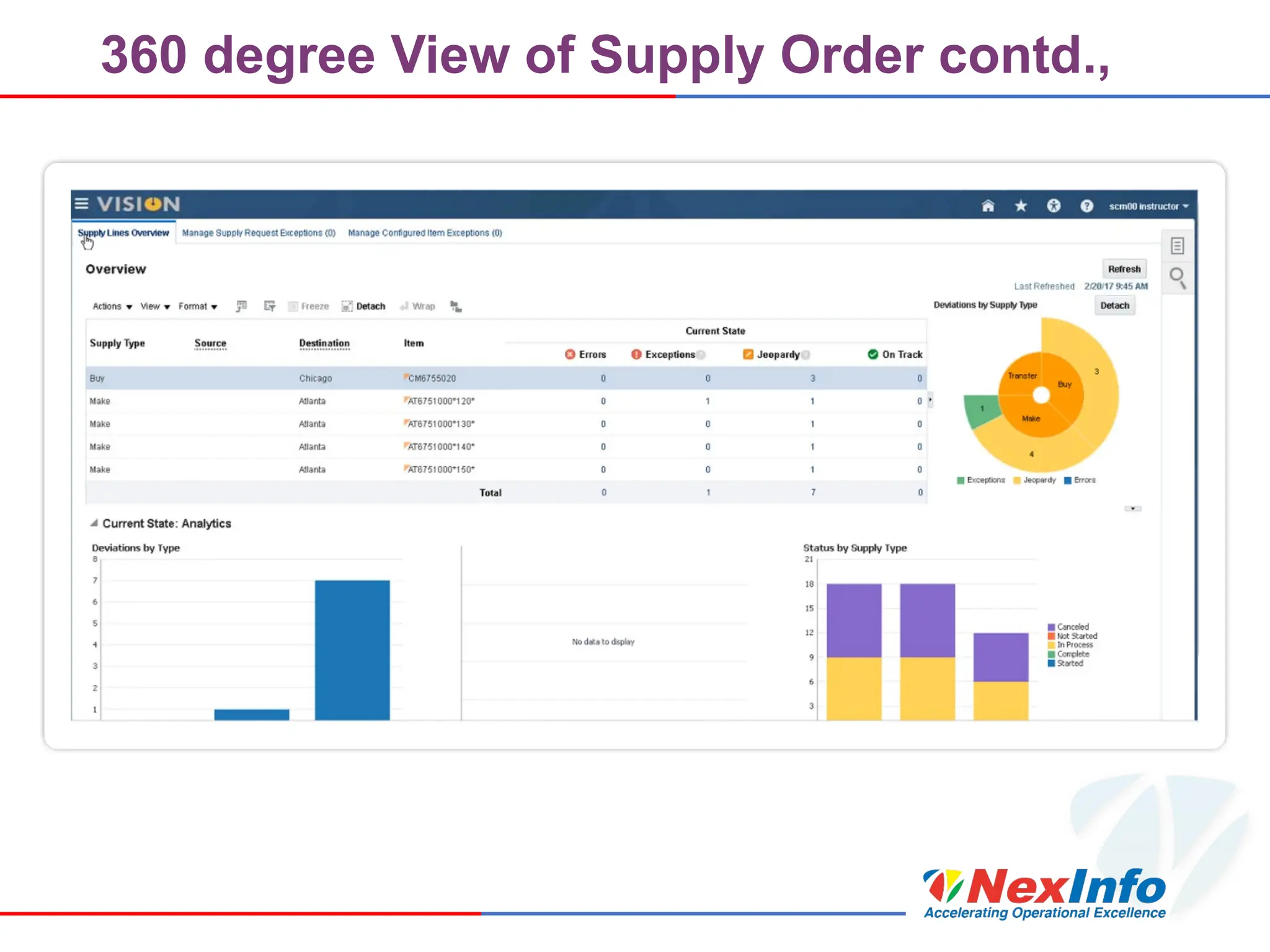
 The Supply Lines Overview page is the landing page or dashboard that
gives a comprehensive view of the supply lines being processed and
their current status.
 Supply requests are captured as supply lines and supply tracking lines.
What's a Supply Line?
• Supply lines capture key information that identifies the supply request,
such as supply source, supply request type, item details, quantity
details, and supply status.
What's a Supply Tracking Line?
• Supply tracking lines capture key attributes and, in addition, also
capture the attributes used in the supply request execution.
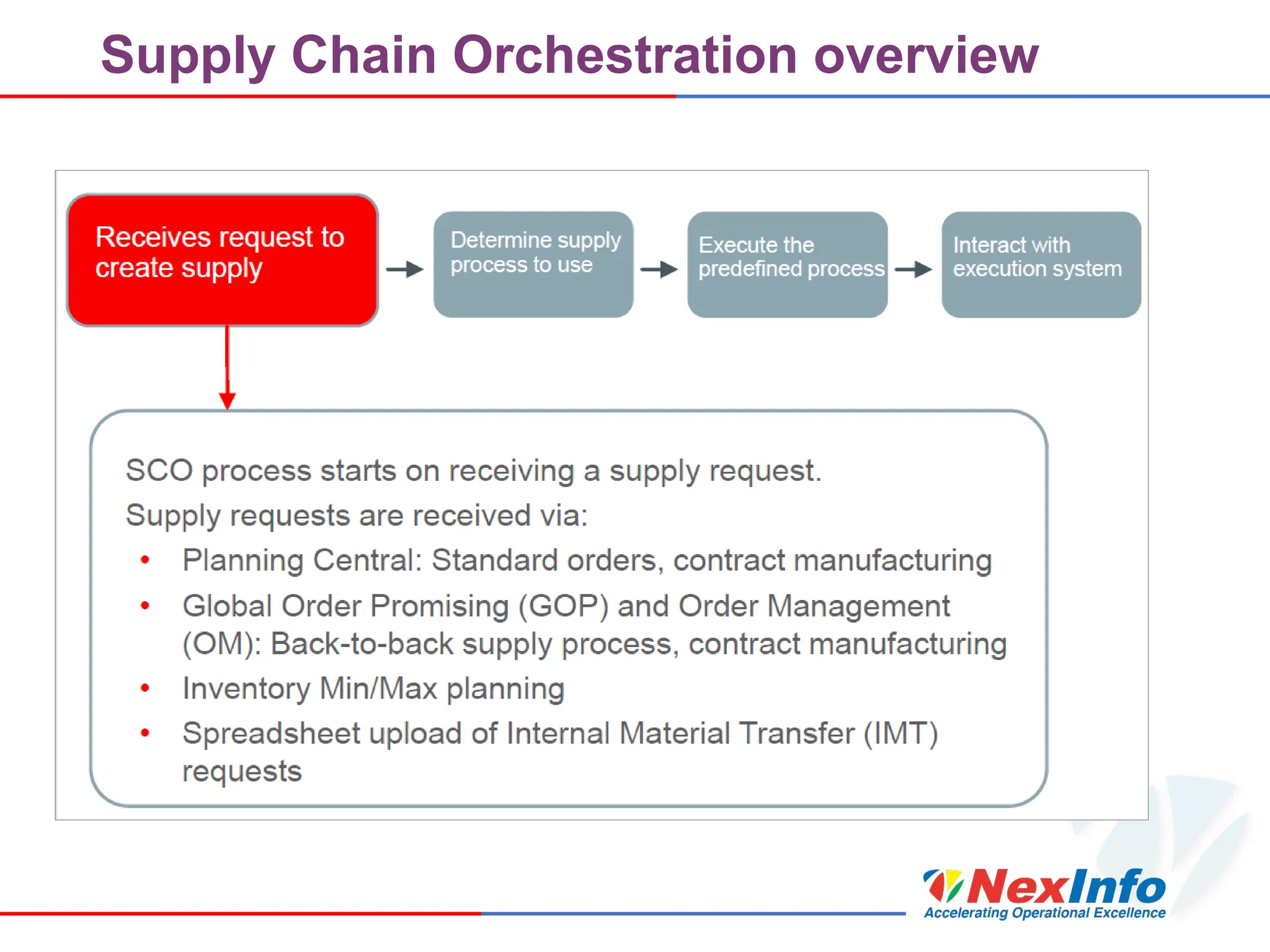
Supply Chain Orchestration overview
Supply Chain Orchestration overview contd.,
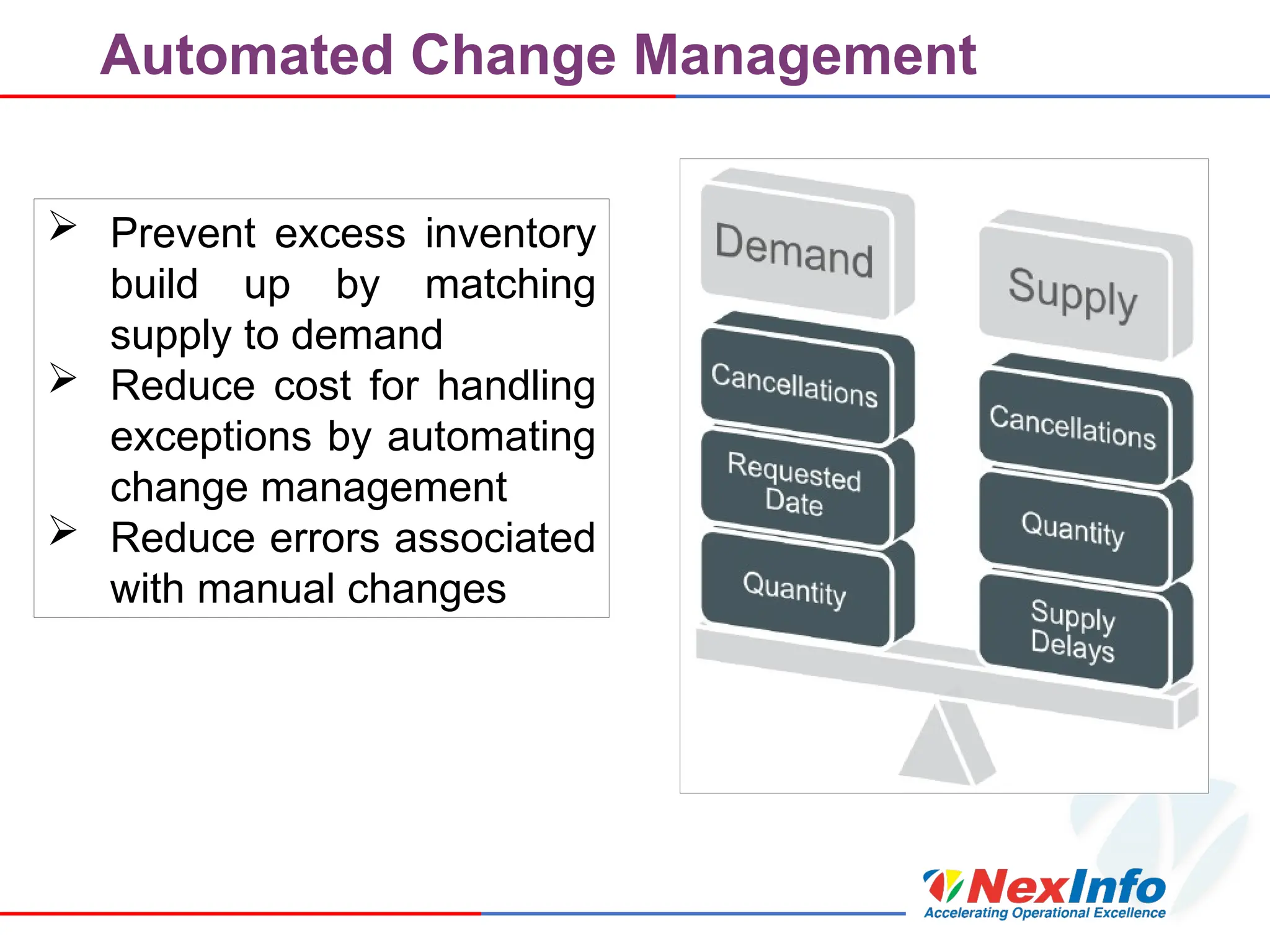
Automated Change Management
 Prevent excess inventory
build up by matching
supply to demand
 Reduce cost for handling
exceptions by automating
change management
 Reduce errors associated
with manual changes
Automated Change Management contd.,
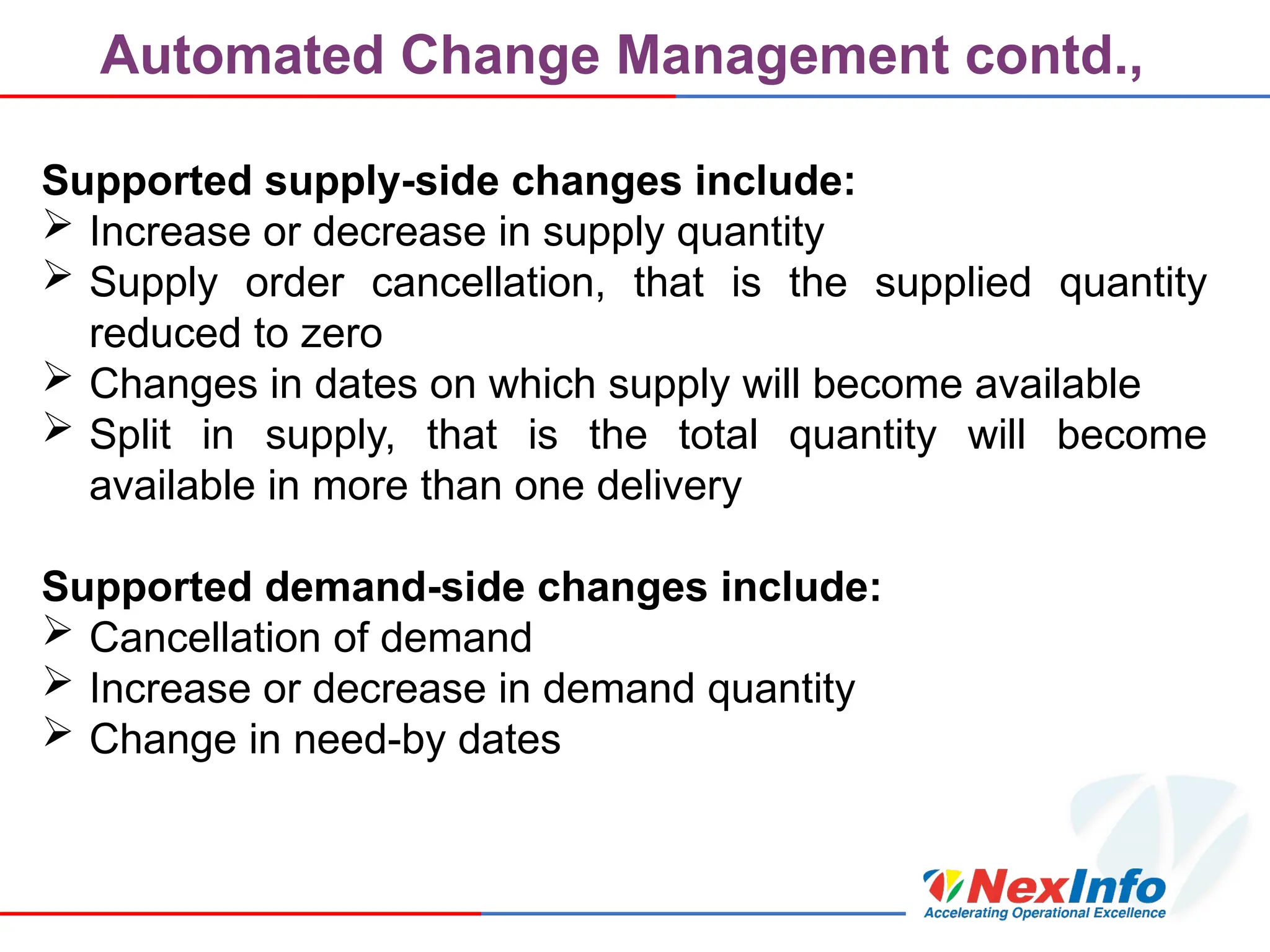
Supported supply-side changes include:
 Increase or decrease in supply quantity
 Supply order cancellation, that is the supplied quantity
reduced to zero
 Changes in dates on which supply will become available
 Split in supply, that is the total quantity will become
available in more than one delivery
Supported demand-side changes include:
 Cancellation of demand
 Increase or decrease in demand quantity
 Change in need-by dates
Back to Back Overview
Back to Back Overview contd.,
Internal Material Transfer Overview
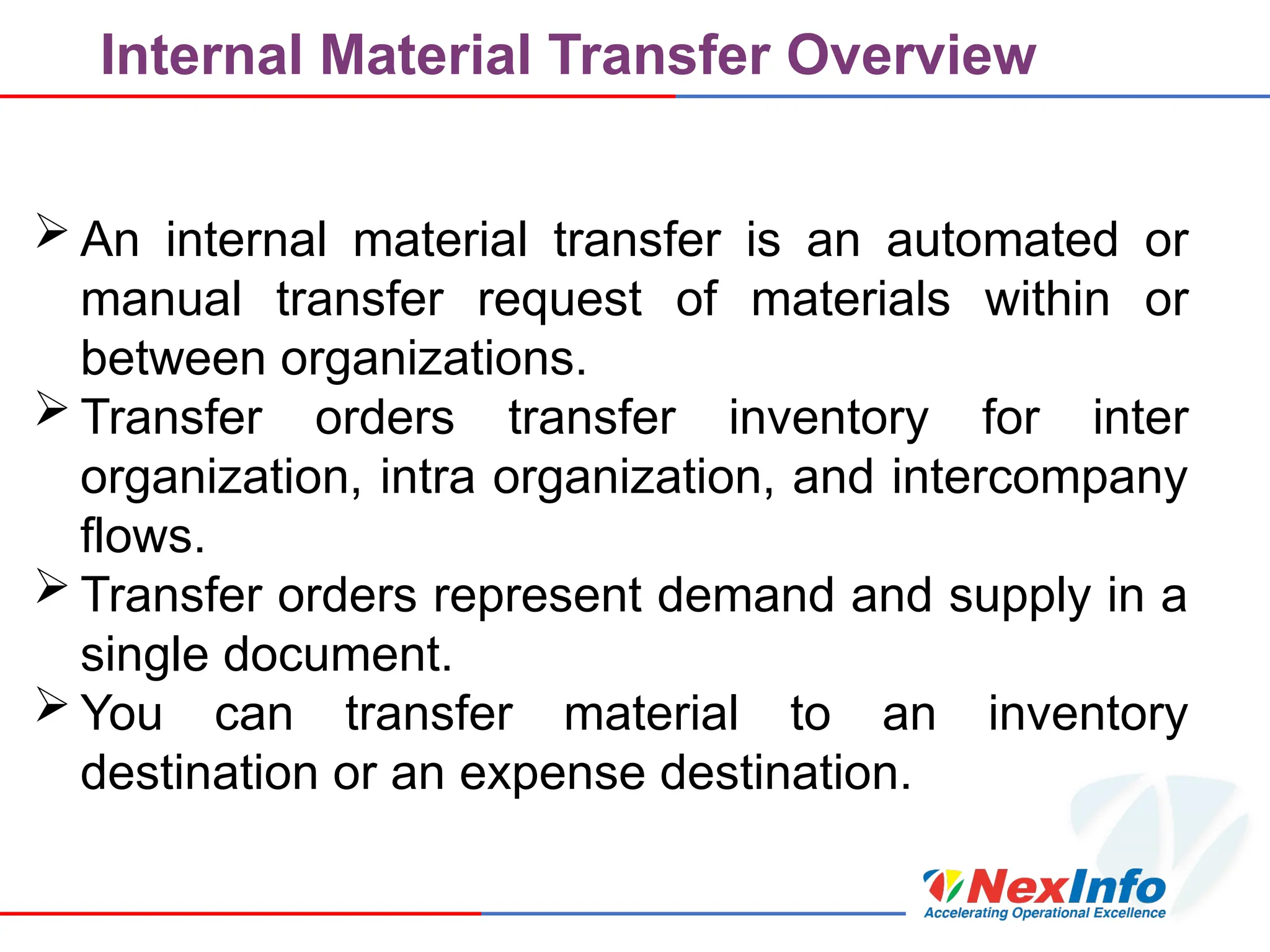
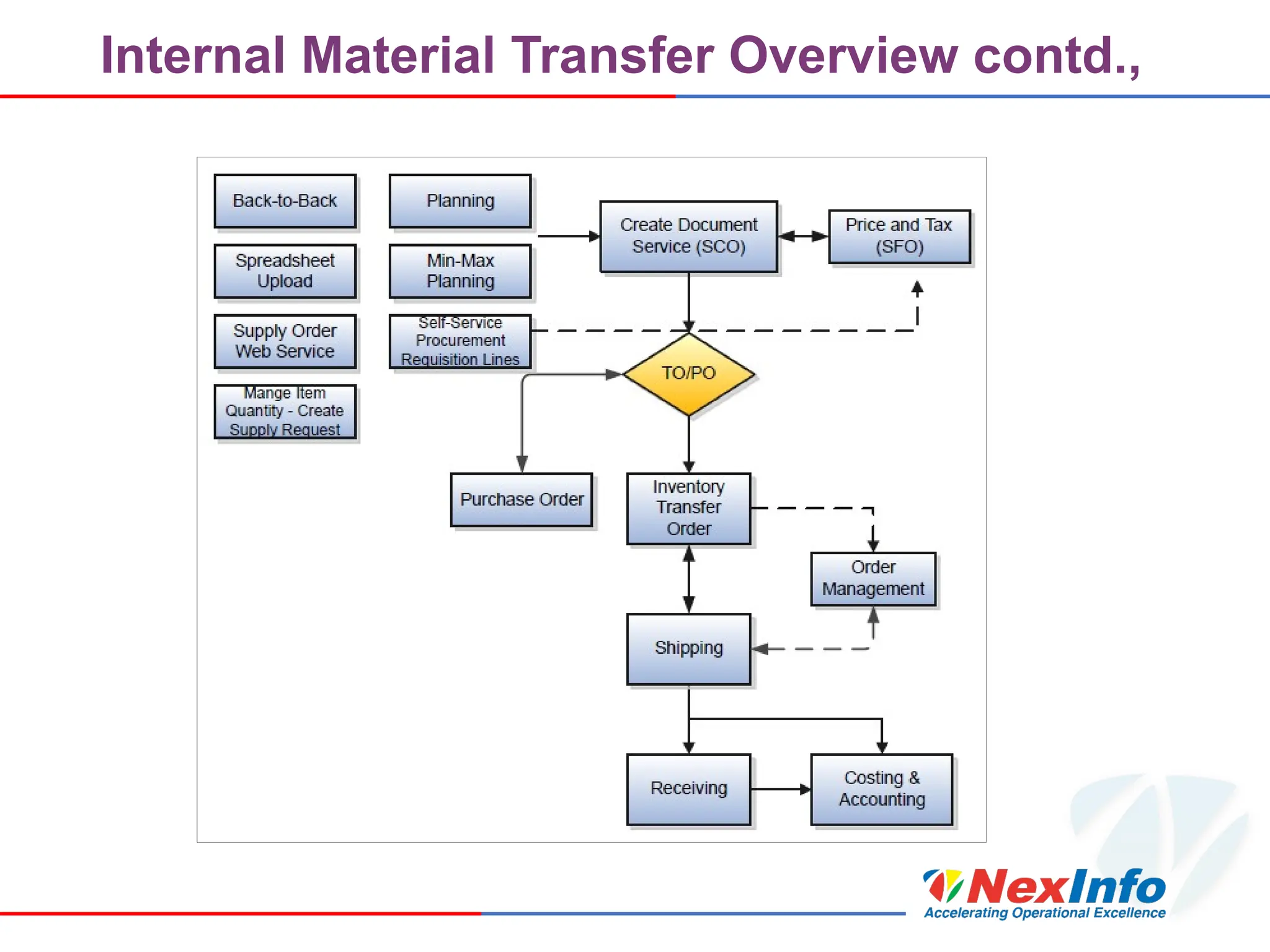
 An internal material transfer is an automated or
manual transfer request of materials within or
between organizations.
 Transfer orders transfer inventory for inter
organization, intra organization, and intercompany
flows.
 Transfer orders represent demand and supply in a
single document.
 You can transfer material to an inventory
destination or an expense destination.
Internal Material Transfer Overview contd.,
Contract Manufacturing Overview
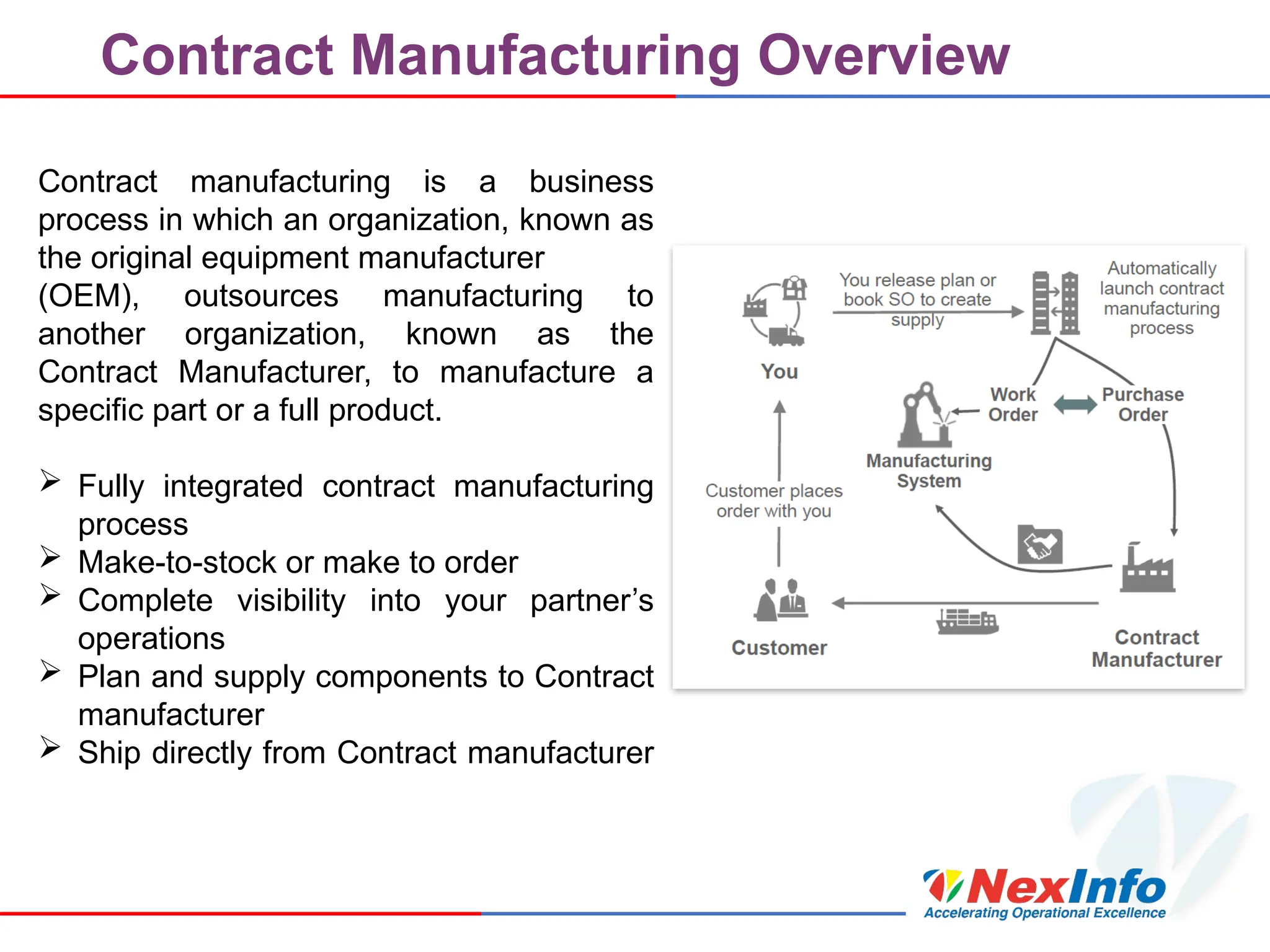
Contract manufacturing is a business
process in which an organization, known as
the original equipment manufacturer
(OEM), outsources manufacturing to
another organization, known as the
Contract Manufacturer, to manufacture a
specific part or a full product.
 Fully integrated contract manufacturing
process
 Make-to-stock or make to order
 Complete visibility into your partner’s
operations
 Plan and supply components to Contract
manufacturer
 Ship directly from Contract manufacturer
Contract Manufacturing Overview contd.,
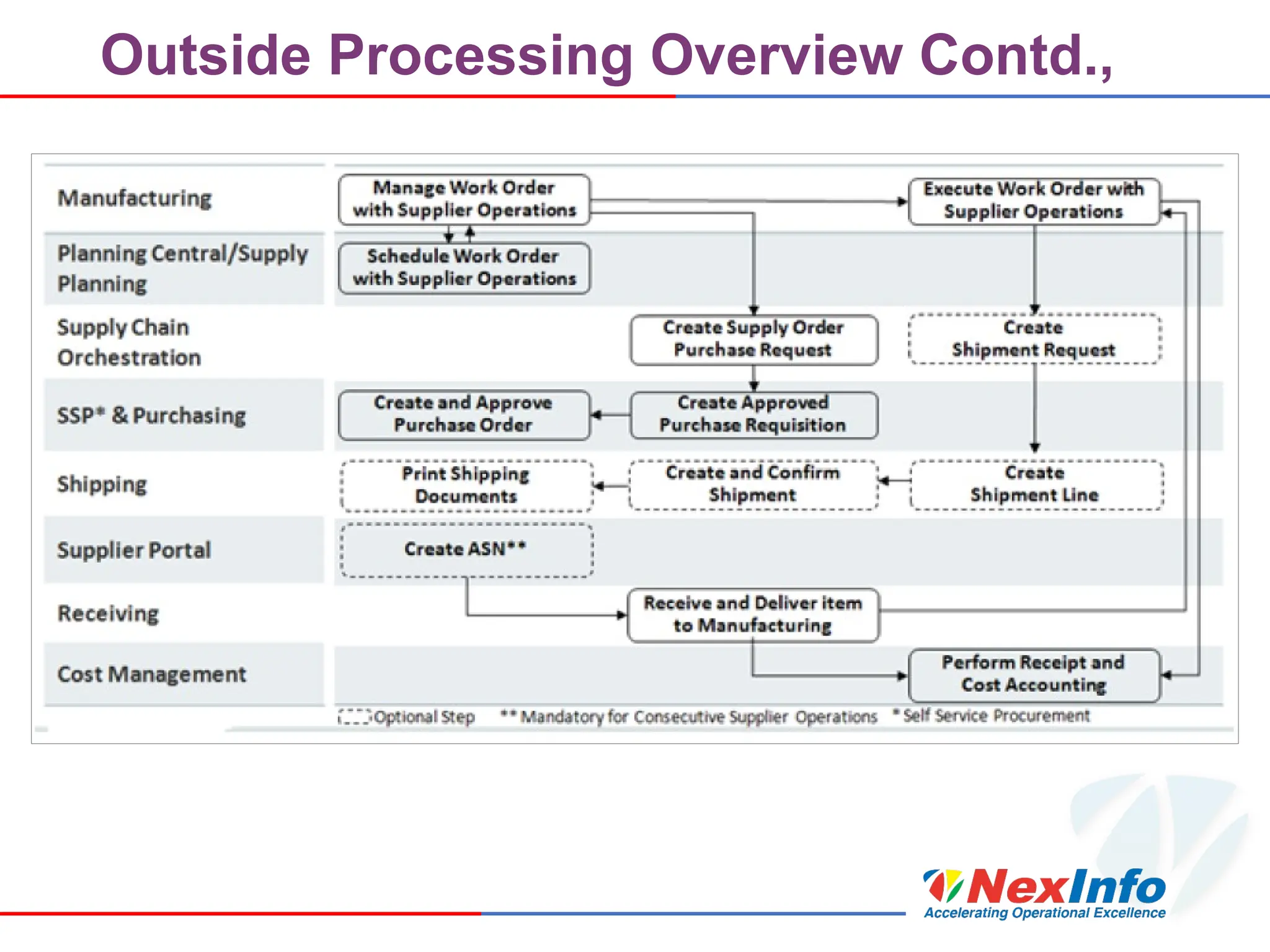
Outside Processing Overview
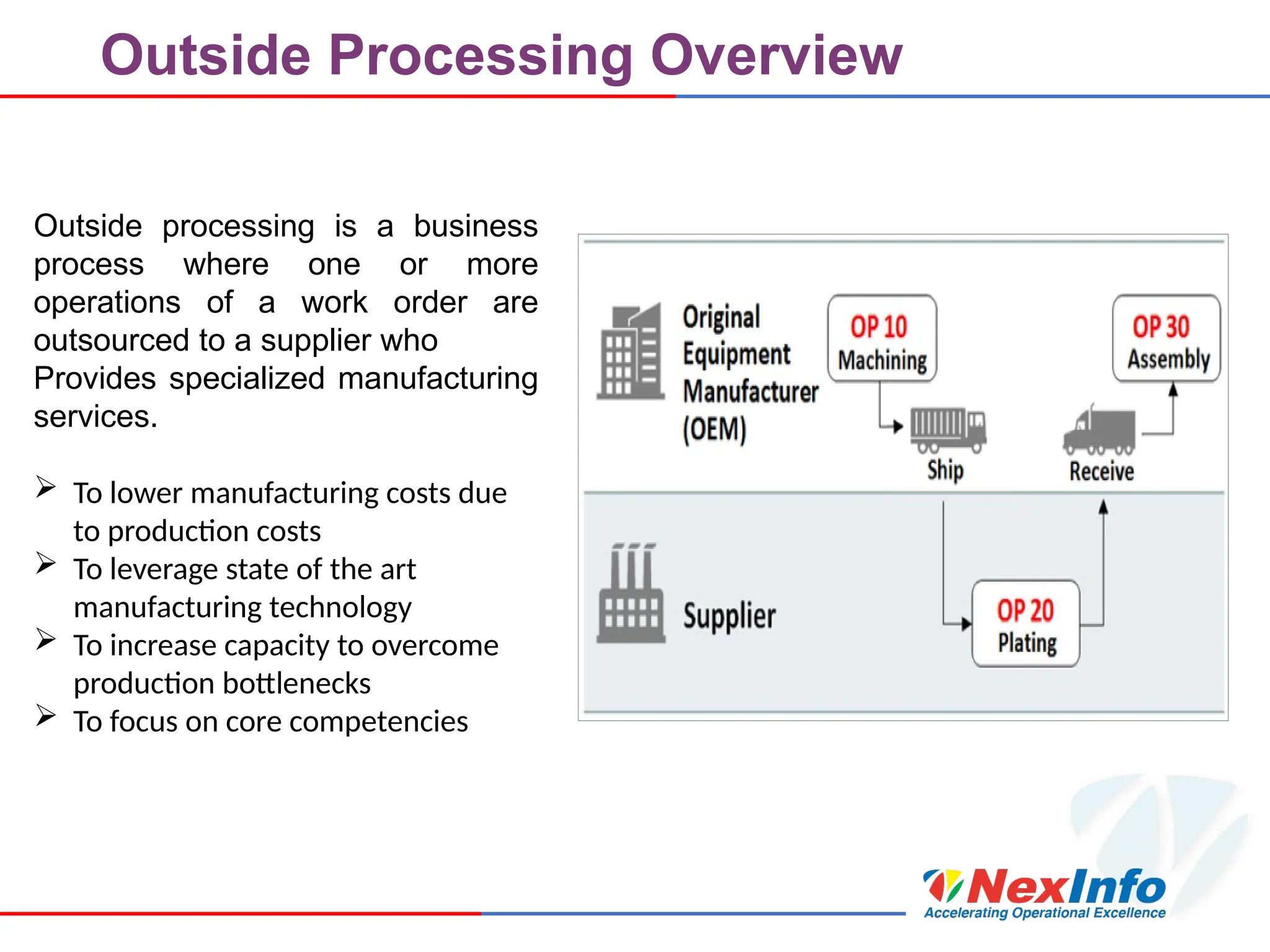
Outside processing is a business
process where one or more
operations of a work order are
outsourced to a supplier who
Provides specialized manufacturing
services.
 To lower manufacturing costs due
to production costs
 To leverage state of the art
manufacturing technology
 To increase capacity to overcome
production bottlenecks
 To focus on core competencies
Outside Processing Overview Contd.,
Tracking Supply Orders in
Supply Chain Orchestration
Supply Orchestration Work area overview
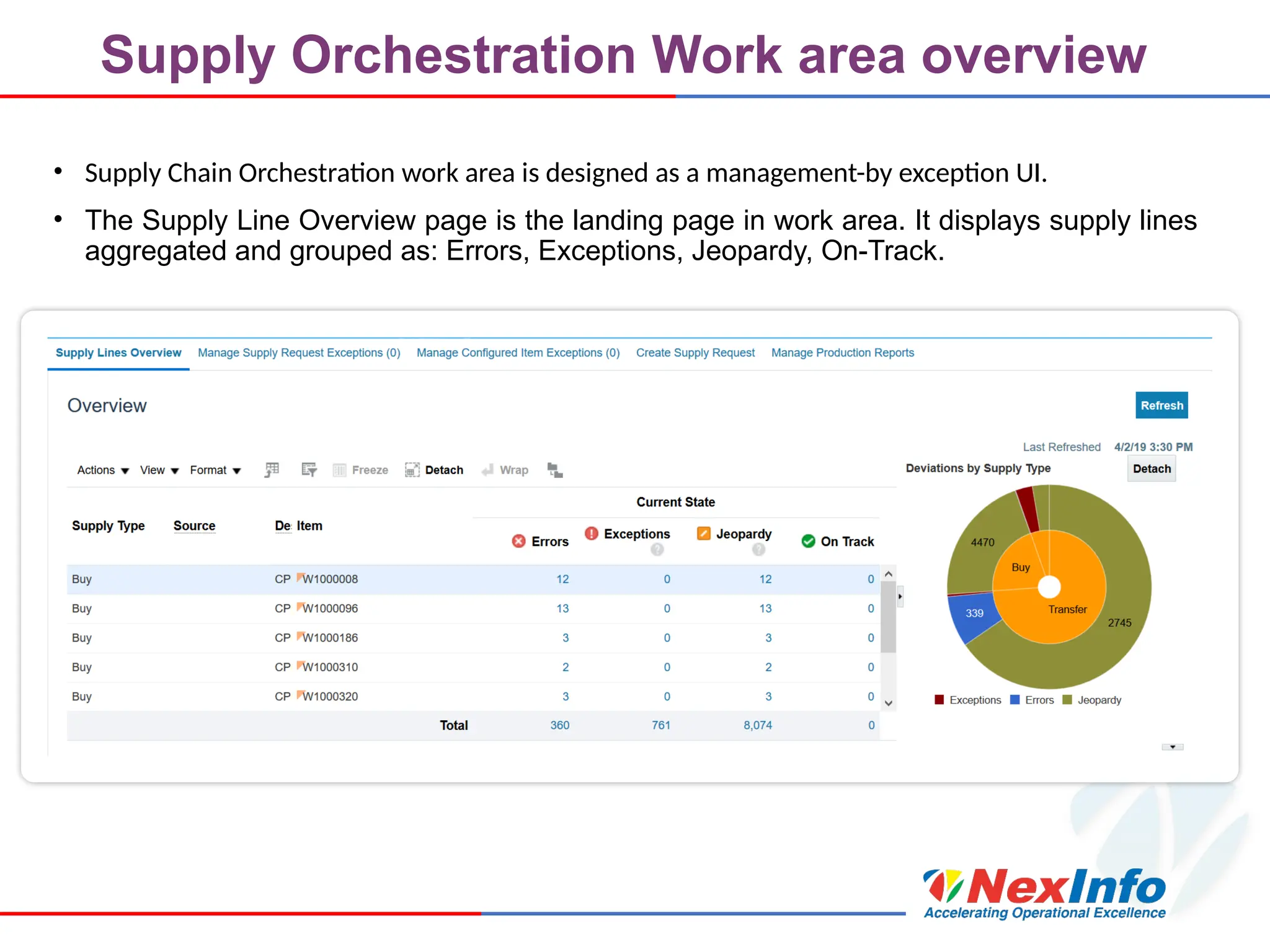
• Supply Chain Orchestration work area is designed as a management-by exception UI.
• The Supply Line Overview page is the landing page in work area. It displays supply lines
aggregated and grouped as: Errors, Exceptions, Jeopardy, On-Track.
Supply Orchestration Work area overview contd.,
• Supply lines are aggregated and grouped by the following
parameters:
• Supply Type: Make, Buy, Transfer, or Available to Promise (ATP)
–ATP refers to inventory reserved for supply. It may be on-hand
inventory or the inventory expected by the date of supply.
• Source: Sources of supply. Values are:
–Buy: Source is a supplier.
–Transfer: Source is a warehouse that ships the supply to the
destination warehouse.
–Make and ATP: Destination and source warehouses are the same.
• Destination: Warehouse to which supply is delivered to fill a
customer order
• Item: Item number for which a supply is created
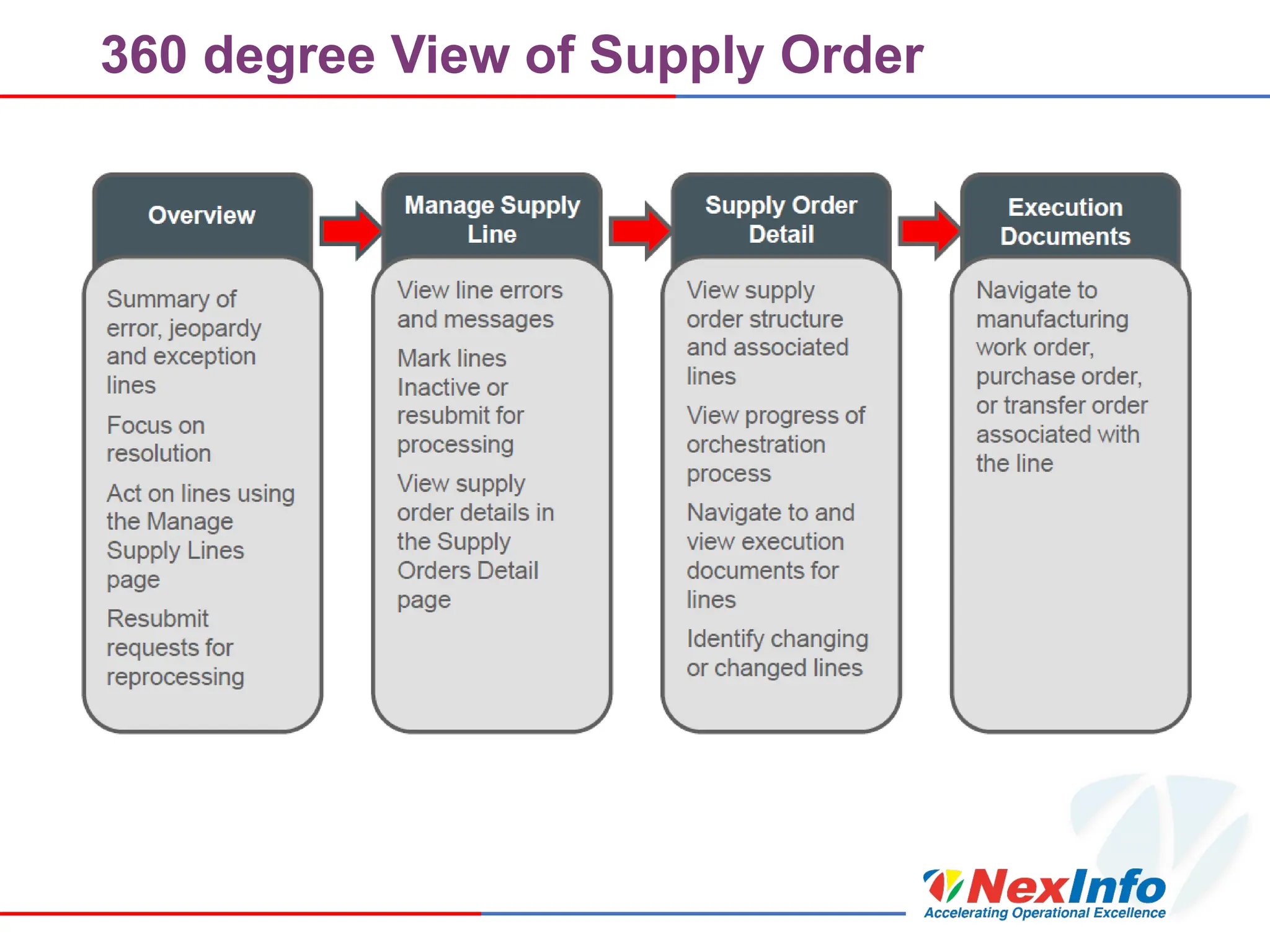
360 degree View of Supply Order
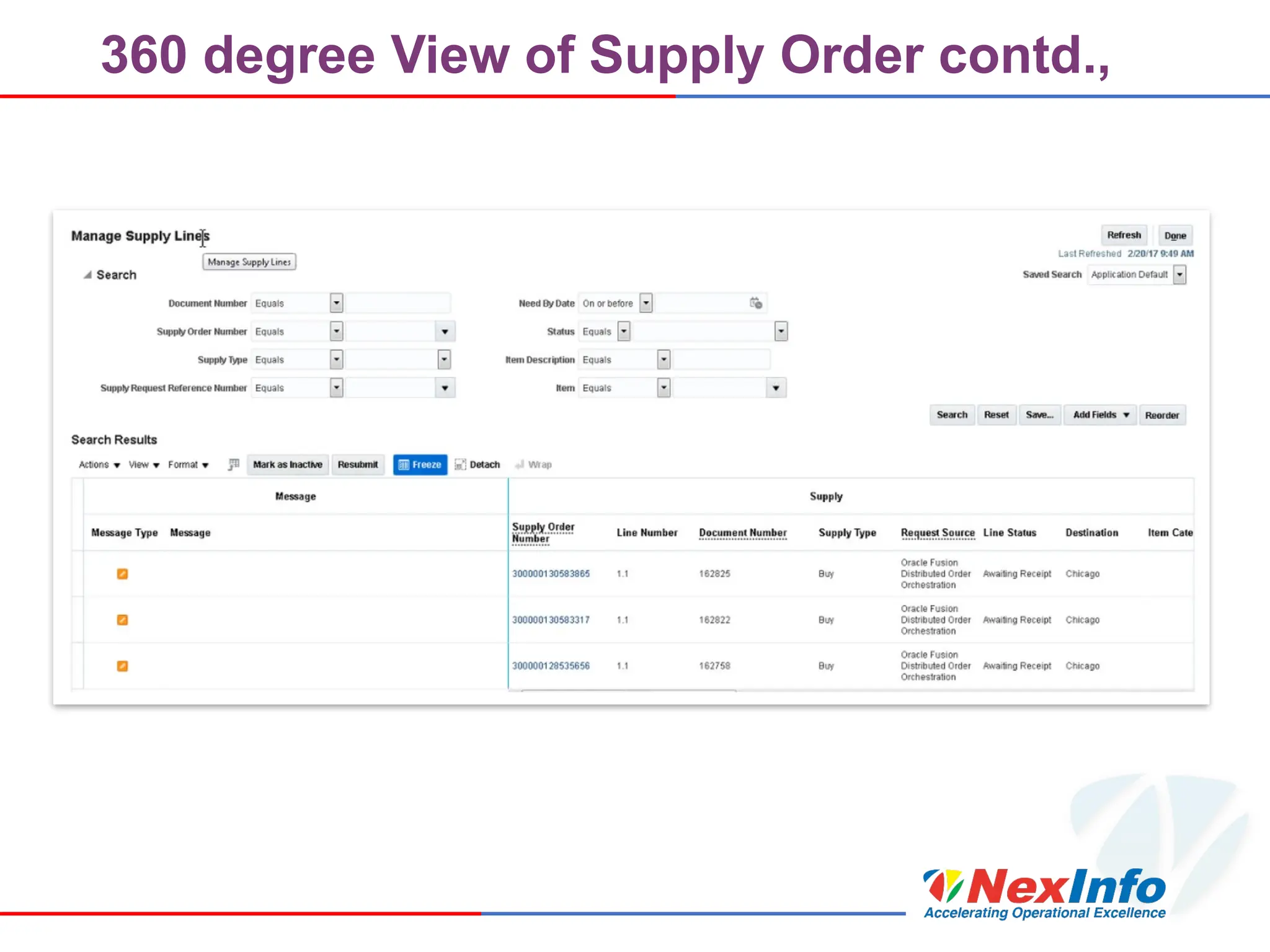
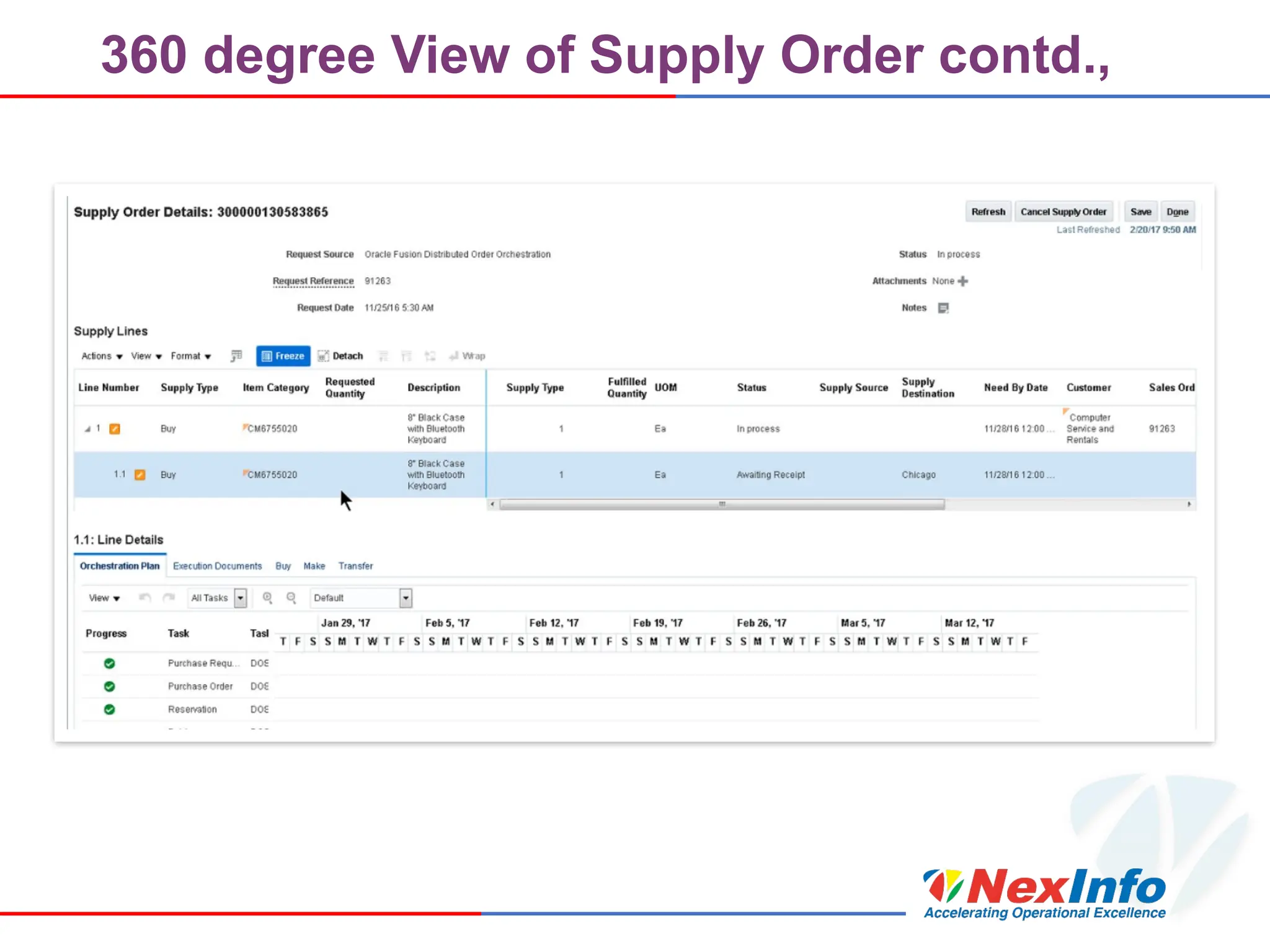
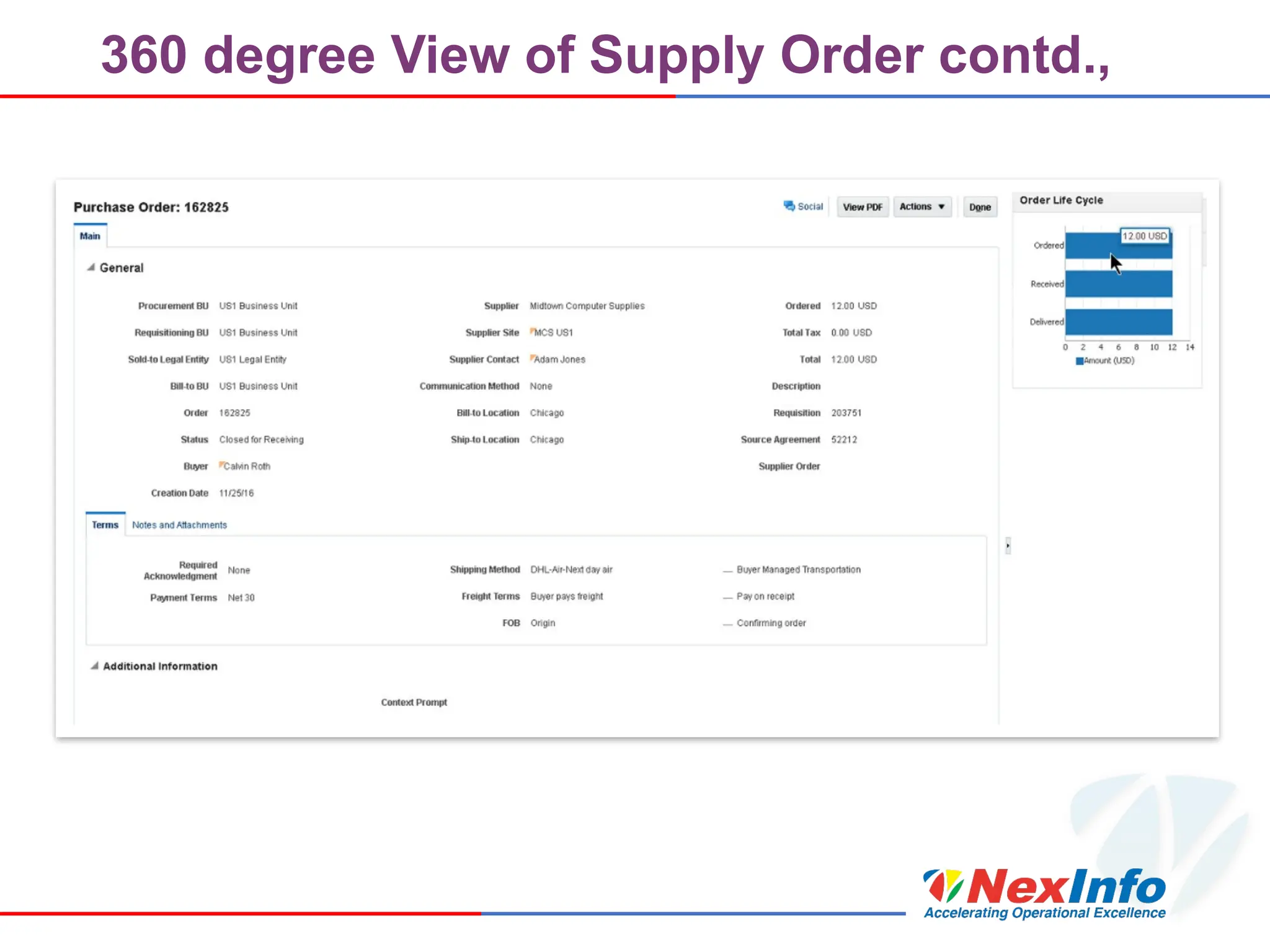
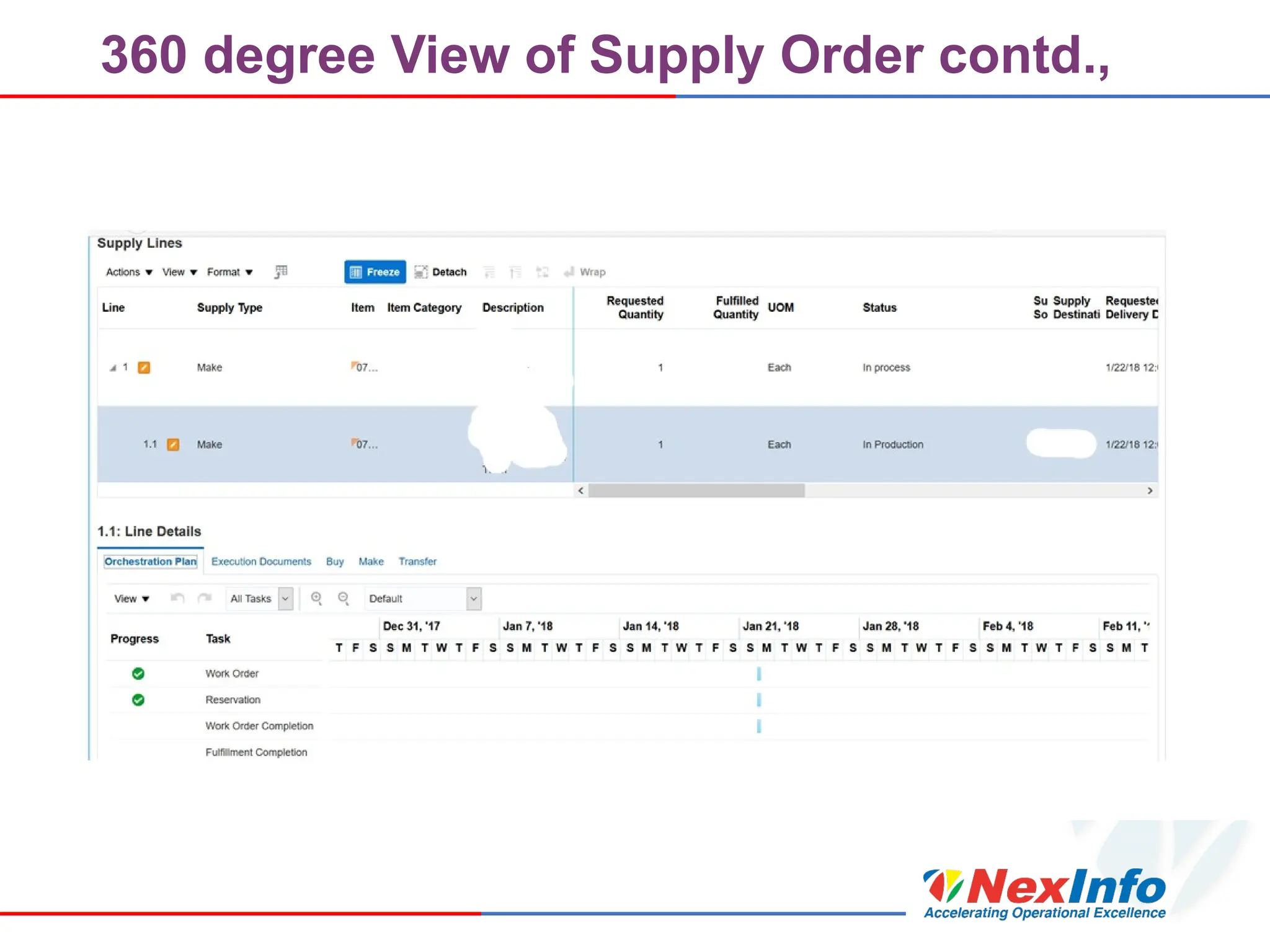
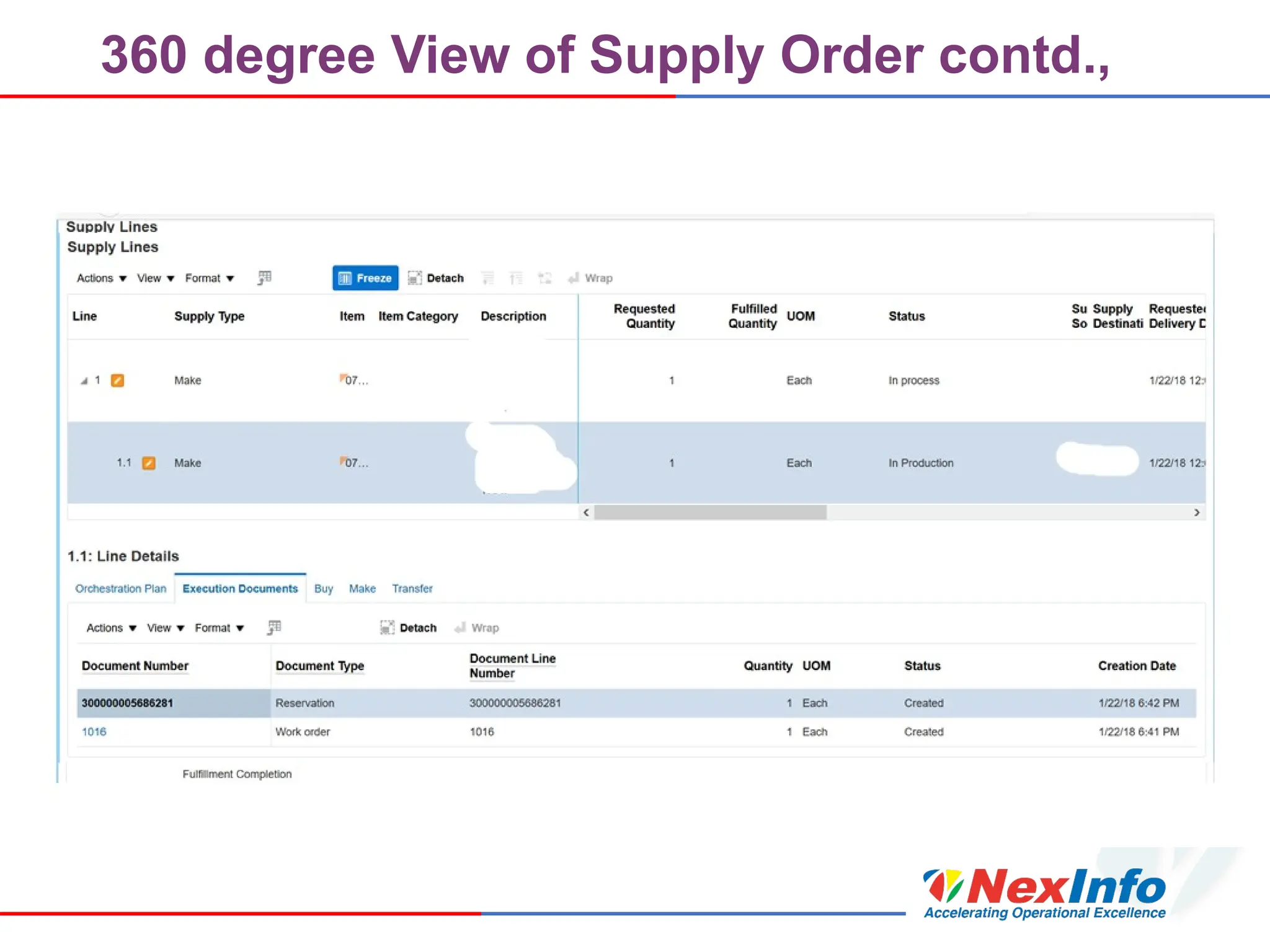
360 degree View of Supply Order contd.,
Summary
Fulfillment complexities
Advance Fulfillment Process
Advance Fulfillment Techniques
Supply Chain Orchestration overview
Automated Change Management
Advance fulfillment process flows in Cloud
Tracking Supply Lines in Supply Orchestration
38
Thank you
Q&A
39
Contact Us
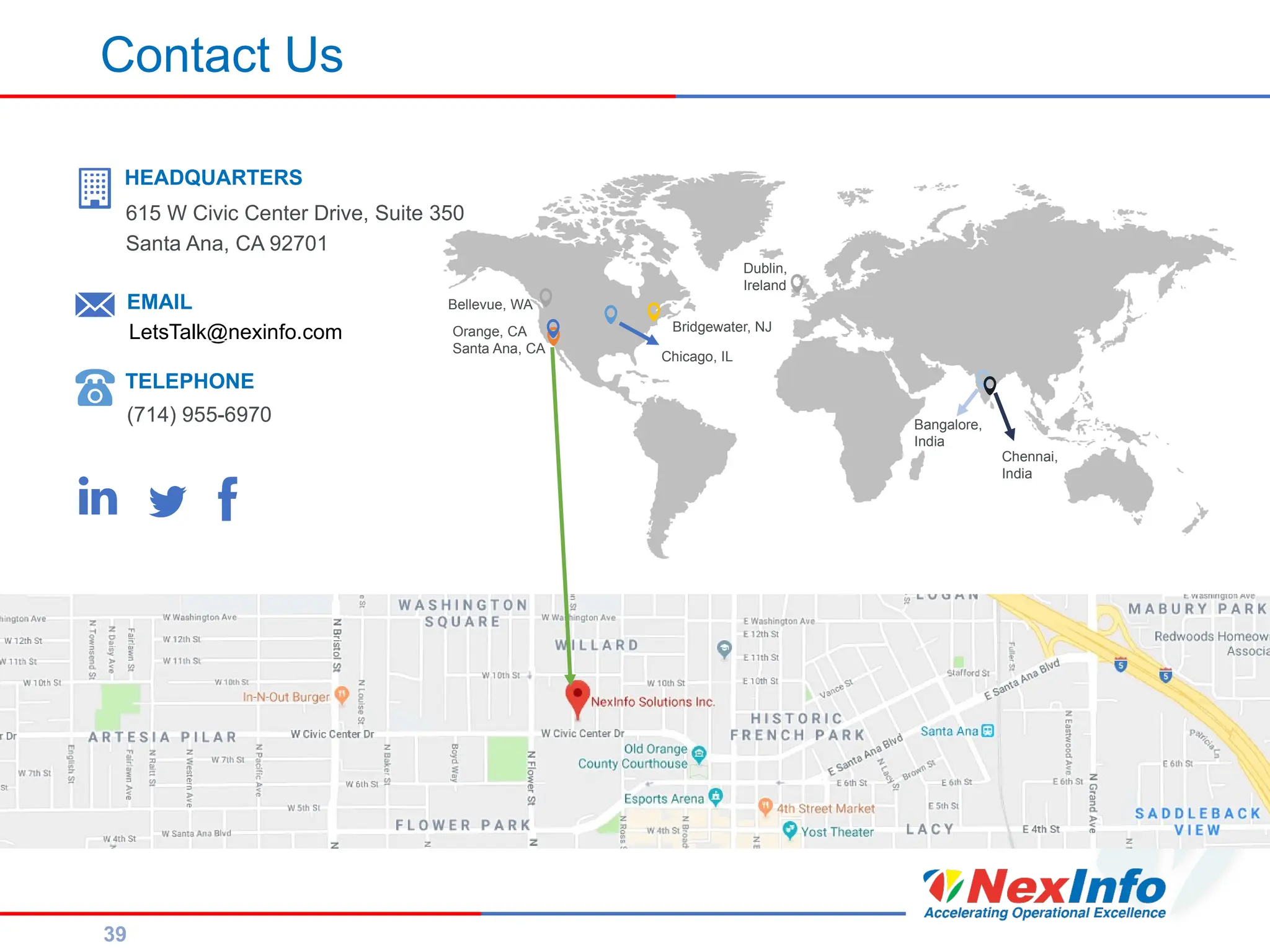
HEADQUARTERS
615 W Civic Center Drive, Suite 350
Santa Ana, CA 92701
EMAIL
LetsTalk@nexinfo.com
TELEPHONE
(714) 955-6970
Bellevue, WA
Orange, CA
Santa Ana, CA
Bridgewater, NJ
Chicago, IL
Dublin,
Ireland
Chennai,
India
Bangalore,
India

Advanced Fulfillment and Supply Orchestration – SCM Cloud

  • 1.
    Advanced Fulfillment and SupplyOrchestration – SCM Cloud Presenter: Mahesh Naalla @NexInfoSolution 06/20/2019
  • 2.
    2 Who Is NexInfo? SUMMARY •Consulting company focused on helping clients achieve Operational Excellence via an optimal blend of Business Process & Software consulting services • Deep domain expertise, including: Integrated Business Planning (IBP/S&OP), Enterprise Resource Planning (ERP), Product Lifecycle Management (PLM), Customer Relationship Management (CRM), Enterprise Planning Management (EPM), Human Capital Management (HCM), Predictive Data Analytics, Security, & Business Transformations • Founded in 1999 and managed by computer industry & business process professionals • Clients include emerging companies and Fortune 1000 corporations • Recognized in the industry, including features in Gartner Reports, The Silicon Review (50 Smartest Companies of the Year 2016 and 10 Fastest Growing Oracle Solution Providers 2017), and CIO Review (100 Most Promising Oracle Solution Providers 2015) PARTNERS CORPORATE INFO • HQ in Orange County, CA with offices in Redmond, WA, Chicago, IL, Bridgewater, NJ, Dublin, Ireland, Chennai & Bangalore, India • Operations across the United States, Europe (Ireland, UK, Switzerland, Belgium) & India
  • 3.
    Presenter Information Name: MaheshNaalla Experience: 10+ Years of Industry and IT Experience • 10+ years of experience as Oracle supply chain and procurement consultant • Fusion Certified Implementation Specialist • Multiple Oracle Fusion Implementations experience • Business Process mapping and design experience across industries
  • 4.
    Agenda  Fulfillment complexities Advance Fulfillment Process  Advance Fulfillment Techniques  Supply Chain Orchestration overview  Automated Change Management  Advance fulfillment process flows in Cloud  Tracking Supply Lines in Supply Orchestration
  • 5.
  • 6.
    6 Use Case –Client’s Scope/Challenges Scope Resolve issues with fulfillment for custom orders and outside processing activities for a well known manufacturing company. Key Challenges/Requirements • Custom Orders with special label requirements and quality checks • Ability to provide delivery date to customer as soon as order is received • Manual process for tracking outside processing operations • Difficulty handling supply or demand changes and issues with reservation • Reporting needs and end to end automated process Recommendation Streamline Order to Fulfillment process and implement Fusion Advanced fulfillment techniques.
  • 7.
    Fulfillment Complexities  ReduceCost Reduce Delivery time Deliver on time Channel expansion coupled with the need to optimize cost and delivery time across the global supply chain has increased fulfillment complexity.
  • 8.
  • 9.
    Advanced Fulfillment Techniques Thefollowing advance fulfillment processes can be handled in fusion • Back to Back Supply creation and fulfillment • Drop ship • Internal material transfer • Consigned inventory • Contract manufacturing • Outside Processing
  • 10.
    Supply Chain Orchestrationoverview Supply Chain Orchestration provides the ability to:  Receive supply requests from several sources operating in the Oracle Cloud.  Launch and manage complex business processes.  Perform automated change management to match supply to demand.  Provide a 360 degree view of the supply-creation process.
  • 11.
    Supply Lines overview The Supply Lines Overview page is the landing page or dashboard that gives a comprehensive view of the supply lines being processed and their current status.  Supply requests are captured as supply lines and supply tracking lines. What's a Supply Line? • Supply lines capture key information that identifies the supply request, such as supply source, supply request type, item details, quantity details, and supply status. What's a Supply Tracking Line? • Supply tracking lines capture key attributes and, in addition, also capture the attributes used in the supply request execution.
  • 12.
  • 13.
  • 14.
  • 15.
  • 16.
    Automated Change Management Prevent excess inventory build up by matching supply to demand  Reduce cost for handling exceptions by automating change management  Reduce errors associated with manual changes
  • 17.
    Automated Change Managementcontd., Supported supply-side changes include:  Increase or decrease in supply quantity  Supply order cancellation, that is the supplied quantity reduced to zero  Changes in dates on which supply will become available  Split in supply, that is the total quantity will become available in more than one delivery Supported demand-side changes include:  Cancellation of demand  Increase or decrease in demand quantity  Change in need-by dates
  • 18.
    Back to BackOverview
  • 19.
    Back to BackOverview contd.,
  • 20.
    Internal Material TransferOverview  An internal material transfer is an automated or manual transfer request of materials within or between organizations.  Transfer orders transfer inventory for inter organization, intra organization, and intercompany flows.  Transfer orders represent demand and supply in a single document.  You can transfer material to an inventory destination or an expense destination.
  • 21.
  • 22.
    Contract Manufacturing Overview Contractmanufacturing is a business process in which an organization, known as the original equipment manufacturer (OEM), outsources manufacturing to another organization, known as the Contract Manufacturer, to manufacture a specific part or a full product.  Fully integrated contract manufacturing process  Make-to-stock or make to order  Complete visibility into your partner’s operations  Plan and supply components to Contract manufacturer  Ship directly from Contract manufacturer
  • 23.
  • 24.
    Outside Processing Overview Outsideprocessing is a business process where one or more operations of a work order are outsourced to a supplier who Provides specialized manufacturing services.  To lower manufacturing costs due to production costs  To leverage state of the art manufacturing technology  To increase capacity to overcome production bottlenecks  To focus on core competencies
  • 25.
  • 26.
    Tracking Supply Ordersin Supply Chain Orchestration
  • 27.
    Supply Orchestration Workarea overview • Supply Chain Orchestration work area is designed as a management-by exception UI. • The Supply Line Overview page is the landing page in work area. It displays supply lines aggregated and grouped as: Errors, Exceptions, Jeopardy, On-Track.
  • 28.
    Supply Orchestration Workarea overview contd., • Supply lines are aggregated and grouped by the following parameters: • Supply Type: Make, Buy, Transfer, or Available to Promise (ATP) –ATP refers to inventory reserved for supply. It may be on-hand inventory or the inventory expected by the date of supply. • Source: Sources of supply. Values are: –Buy: Source is a supplier. –Transfer: Source is a warehouse that ships the supply to the destination warehouse. –Make and ATP: Destination and source warehouses are the same. • Destination: Warehouse to which supply is delivered to fill a customer order • Item: Item number for which a supply is created
  • 29.
    360 degree Viewof Supply Order
  • 30.
    360 degree Viewof Supply Order contd.,
  • 31.
    360 degree Viewof Supply Order contd.,
  • 32.
    360 degree Viewof Supply Order contd.,
  • 33.
    360 degree Viewof Supply Order contd.,
  • 34.
    360 degree Viewof Supply Order contd.,
  • 35.
    360 degree Viewof Supply Order contd.,
  • 36.
    360 degree Viewof Supply Order contd.,
  • 37.
    Summary Fulfillment complexities Advance FulfillmentProcess Advance Fulfillment Techniques Supply Chain Orchestration overview Automated Change Management Advance fulfillment process flows in Cloud Tracking Supply Lines in Supply Orchestration
  • 38.
  • 39.
    39 Contact Us HEADQUARTERS 615 WCivic Center Drive, Suite 350 Santa Ana, CA 92701 EMAIL LetsTalk@nexinfo.com TELEPHONE (714) 955-6970 Bellevue, WA Orange, CA Santa Ana, CA Bridgewater, NJ Chicago, IL Dublin, Ireland Chennai, India Bangalore, India

Editor's Notes

  • #2 We are company with a blend of Business Process & Software Consulting We follow the Level 1-2-3 methodology to arrive at a Future business process and get key stakeholder sign offs We are an Oracle Platinum Partner We implement Oracle Cloud (ALL Clouds – ERP (Financials), SCM, Sales, Service, Planning Central, WMS, HCM etc.) We are in the midst of 5 Cloud implementations – one going live next month – full footprint Expertise in on-premise software – EBS, VCP, JDE, Peoplesoft We are a 200 + people company with a Global Delivery Model – we deliver in the US, Europe and South America We have experience running 100 + TURNKEY TRANSFORMATION PROJECTS in the last 18 + years We have a lot of industry expertise – Pharmaceuticals, LifeSciences, High Technology, Discrete and Process manufacturing to name a few. We have been around since 1999, that’s 18 years. We have focused on supply chain and the technologies that goes around supply chain. Product life cycle management and the technologies that go enabling product life cycle management. And finally we have done a lot of compliance and IT government type of projects. We have been recognized by a few organizations including Silicon Review, CIO, Gartner-they were following us endlessly because we specialized in supply chain area. From a SW perspective, We deliver solutions in different software, Oracle EBS, VCP, JDE, PLM + Agile, Enovia, TeamCenter + SAP – ECC, BW and APO + Microsoft Sharepoint, Active Directory etc. We have a worldwide presence with operations and localized resources across US, in Ireland & United Kingdom (Europe), & India (Asia) We have a very large footprint in what we delivery – Forecasting, Demand Management, Manufacturing, Supply Planning, Collaboration, Product Lifecycle Management, etc. We typically run about 15 – 20 projects concurrently We are an organization with a dedicated sales team, a solution development team and a delivery team – that provides structure again.
  • #7  In today’s competitive world where we have cut throat competition in terms of meeting customer req, in terms of reducing cost, reducing delivery time. You may want to expand your channel meaning even if you don’t store the inv you may want to give flexibility to customer to order items and internal it is fulfilled by one of these techniques. This is the racial behind all these new approaches. Channel expansion coupled with the need to optimize cost and delivery time across the global supply chain has increased fulfillment complexity.
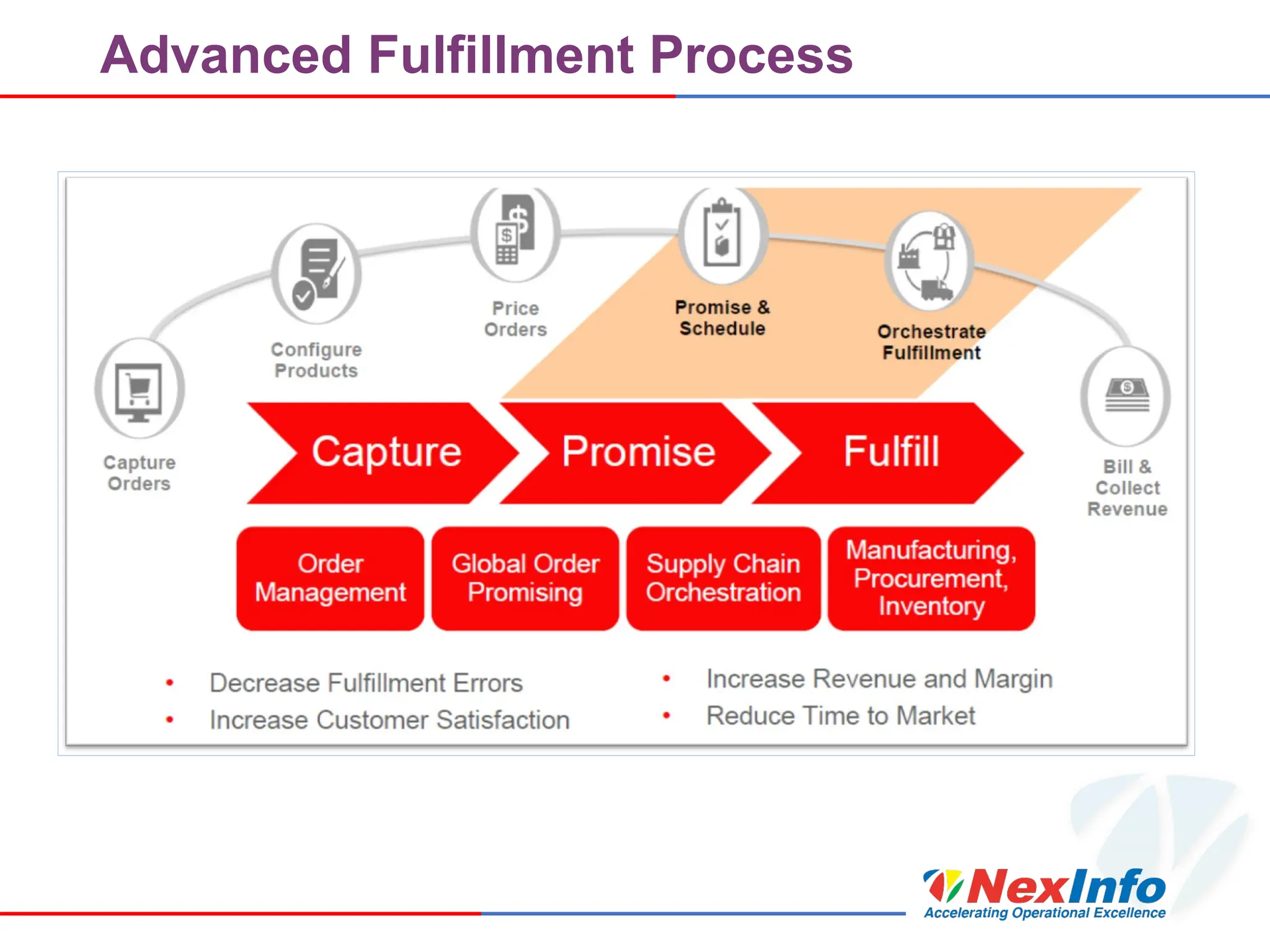
  • #8  1st step is order creation, then price the order and submit. After the order is submitted it calls in GOP to promise the order date to customer. GOP looks at sourcing rules, ATP rules, etc., evaluates all the constraints and provides the best possible data and source. Once the order is promised and scheduled this information will be passed onto supply orchestration and it picks up supply creation activity. And it will provide full cycle view for order entry person with supply creation process. •Decrease Fulfillment Errors – everything is automated after order is entered into the system. Order orchestration rules kicks after order is booked, supply orchestration rules kicks in and creates supply, etc.,. •Increase Customer Satisfaction – Because of GOP it gives proper ship to date or deliver date •Increase Revenue and Margin – You have flexibility to do trade off to see if you can do internal mfg or do contract mfg •Reduce Time to Market -
  • #9 Internal material transfer requests can be within an organization (intra-org) or between two organizations (inter-org). Supply Chain Orchestration manages both intra-org and inter-org internal material transfers. Reservation refers to allocation of material against the specific demand of an Order Management order fulfillment line. Reservation is required to support back-to-back business flows for Inventory tasks that involve creating and managing material reservations.
  • #10 Oracle Fusion Supply Chain Orchestration provides the backbone infrastructure that delivers end-to-end supply execution and management across the Oracle Supply Chain Management Cloud. Supporting various business processes and flows, Supply Chain Orchestration receives supply requests from multiple Oracle SCM Cloud products. • Create rules for business process management. • Enable central control and decentralized execution. • Scale process monitoring and exception management.
  • #11 The Supply Lines Overview page is the landing page or dashboard that gives a comprehensive view of the supply lines being processed and their current status. Deviations by Supply Type The Deviations by Supply Type sunburst chart in the Supply Lines Overview page contains segments that represent the number of supply tracking lines in deviation. By default, the chart represents the deviations for all supply tracking lines displayed in the Overview table.
  • #13 Execution Rules: Rules determine whether a transfer is executed using Transfer Order or Purchase Order. –The default option is to create a Transfer Order for a requested transfer. Enrichment Rules: Rules determine whether a transfer order is: –Passed to the Inventory Management Cloud. This is the default option. –Routed through the Cloud Order Management system —An Order Management user gets visibility into internal orders. —An Order Management user can prioritize between internal and external orders.
  • #17 Automated change management is used to manage: • Changes in supply quantity by supply providers such as manufacturing plants and suppliers. • Changes in supply completion date by supply providers. • Changes in demand quantity of a sales order. • Changes in need-by date of a sales order. • Cancellation of a sales order, purchase order, transfer order, or work order. • Splitting of a sales order, purchase order, or transfer order.
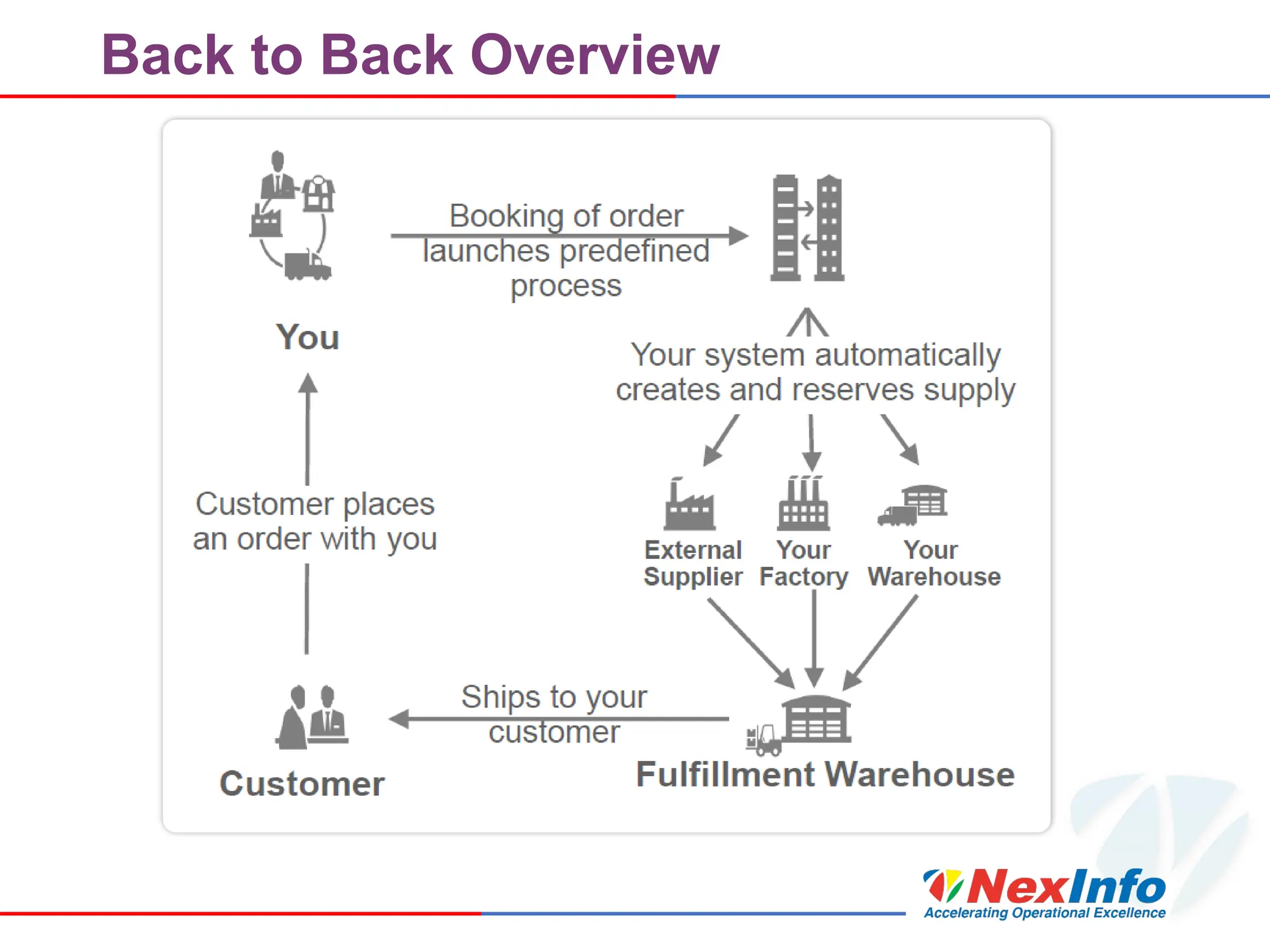
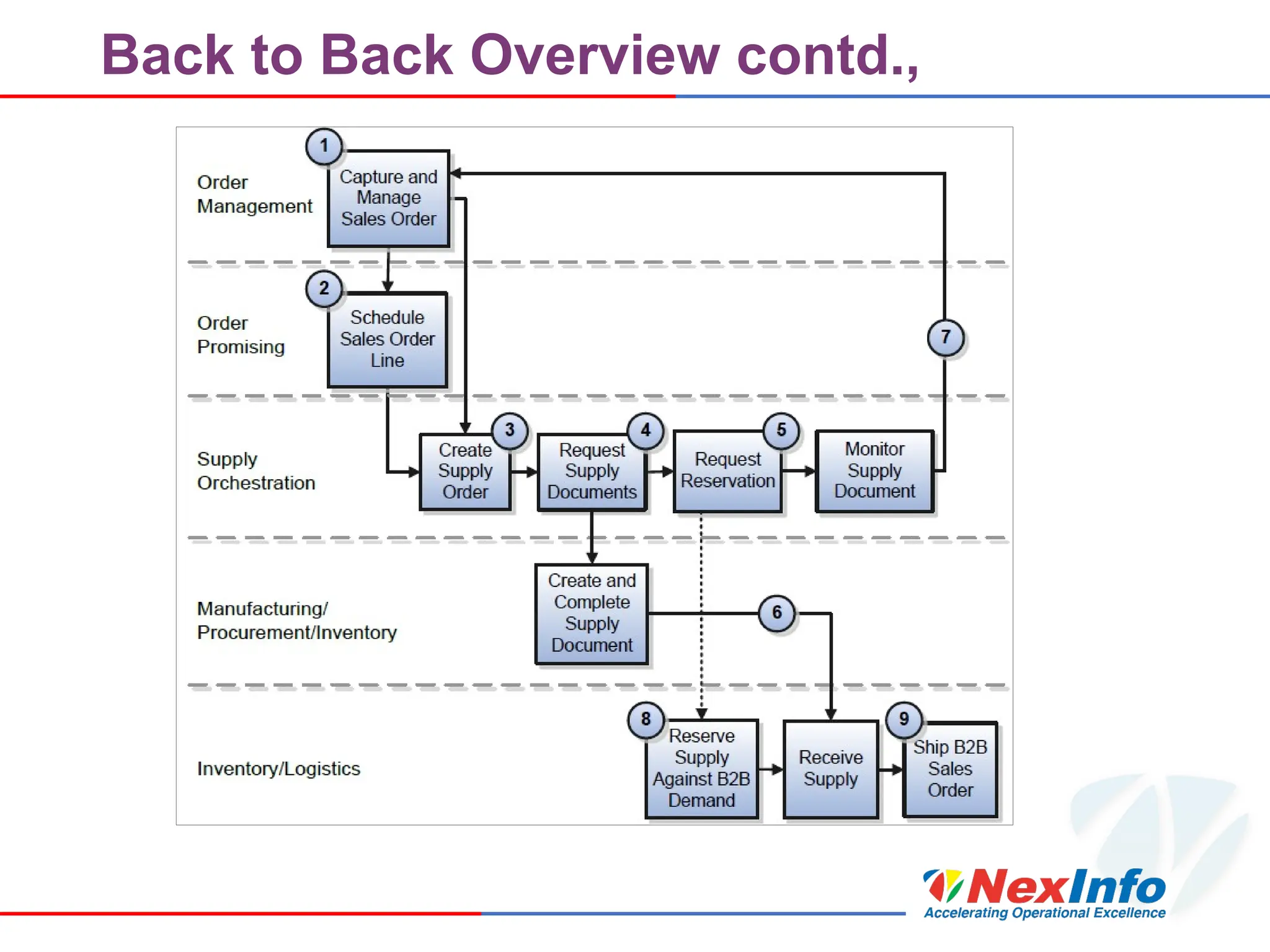
  • #18 The back-to-back fulfillment process is one in which specific sales order demand triggers supply creation, and a hard link is established between the sales order and the supply. Don’t store anything in inv, receive item and ship to customer. This is basically used for high cost items or slow-moving items or items that cannot be stored. Reservation is key in B2B process. You create supply for a back-to-back order using one or more of the following back-to-back flows: • Buy: Procurement from an external supplier. • Make: Production in an internal manufacturing facility (includes in-house manufacturing and contract manufacturing). • Transfer: Transfer from another warehouse. • On hand: Reservation of on-hand supply in the fulfillment organization.
  • #19 In the SCM Cloud, this process is fully automated – allowing you to focus your time and energy on your companies core competencies. •Automated selection of source of supply, internal or external •Reservation of supply until fulfillment •Automated, rule-based response to supply changes Global Order Promising performs two key functions: 1) promises orders for back-back items by choosing the best possible sources across the supply chain, while considering sourcing rules, available-to-promise (ATP) rules, and other constraints. 2) Second, Global Order Promising releases supply recommendations (or the supply picture) to Oracle Fusion Supply Chain Orchestration. 7. Supply Chain Orchestration tracks the status of the supply document and sends updates to order management.
  • #20 Oracle SCM Cloud provides end-to-end support for the transfer of goods internally. •Unified flow for Intra organization, Inter organization, and Intercompany transfers •Transfer Order serves as a single document for demand and supply sides •Integrated fulfillment and receiving •Balance internal and External demands It could be triggered by B2B process or inv min max or planning. When planning suggests internal order it does not worry about if it is a move between orgs within same legal entity or across legal entities. It is the responsibility of supply orchestration to trigger PO or internal order based on Orchestration rules defined.
  • #21 Oracle Fusion Supply Chain Financial Orchestration calculates the transfer price and integrates with tax for tax calculation. For requisition lines, Self Service Procurement calls Supply Chain Financial Orchestration directly when creating transfer orders to get the price to use for approvals and budgetary control purposes. Oracle Fusion Cost management orchestrates the costing and accounting of internal material transfers automatically. Manage Execution Document Creation Rules Use the supply execution document creation rules to determine if an internal material transfer should be executed using a transfer order or a purchase order for an organization. During the supply creation process, if based on the supply execution document creation rules, it is determined that the supply document should be a purchase order, the following updates are made: • Supply type on the internal material transfer request is updated to Buy. • Supplier and supplier site associated to the source organization is used to create supply documents. Manage Supply Order Enrichment Rules Use the supply order defaulting and enrichment rules to route shipments of items on an internal material transfer request through Oracle Fusion Order Management. This allows the order manager to view transfer orders, as well as regular customer sales orders, on the Order Workbench, and prioritize shipments from the Order Workbench when needed.
  • #22 Contract manufacturing is set into motion either when a customer places an order for manufacturing a product with the original equipment manufacturer (OEM) for back-to-back flow, or from Planning for plan-to-produce flow. The OEM in turn outsources the customer order to the contract manufacturer. The contract manufacturer manufactures the product and reports progress. Once the product is manufactured, the contract manufacturer stocks the finished goods and ships them on request. This completes the life cycle of contract manufacturing. •Fully integrated contract manufacturing process •Make-to-stock or make to order •Complete visibility into your partner’s operations •Plan and supply components to Contract manufacturer •Ship directly from Contract manufacturer
  • #23 A contract manufacturer can send the production progress in three ways: Operation and material transaction public web services exposed by the OEM Preformatted spreadsheet given by the OEM E-mail or Phone
  • #24 Outside processing is often adopted as a strategic alternative to in-house manufacturing for the following reasons: • To lower manufacturing costs due to production costs • To leverage state of the art manufacturing technology • To increase capacity to overcome production bottlenecks • To focus on core competencies
  • #25 1. Create and release a work order with supplier operations in Oracle Fusion Manufacturing Service. Work orders are scheduled using the unconstrained logic in Oracle Fusion Planning Central Service and Oracle Fusion Supply Planning Service. 2. When the work order is released, a request is sent to Oracle Fusion Orchestration Service to create a Purchase Requisition. Oracle Fusion Orchestration Service in turn creates a Supply Order and triggers the creation of a Purchase Requisition in Self-Service Procurement. 3. An Outside Processing Purchase Order is created in Oracle Fusion Purchasing Service using the details maintained in the Outside Processing Blanket Agreement. 4. Execute the work order by reporting quantities as completed at the operation prior to the supplier operation. A request is then sent to Oracle Fusion Orchestration Service to create a Shipment Line. Oracle Fusion Orchestration Service in turn creates a Supply Order Line and triggers the creation of a Shipment Line in Oracle Fusion Shipping. 5. A Shipment is manually created for the Shipment Line in Oracle Fusion Shipping which is then Confirmed and Closed. Based on the options set for the Ship Confirm Rule, the processes to Print Packing Slip and Bill of Lading are initiated automatically. 6. The next step is to create an Advance Shipment Notice (ASN) in the Supplier Portal for the outside processing service item. Goods are received in Oracle Fusion Receiving using the ASN and delivered to Oracle Fusion Manufacturing Service. For a supplier operation that is not serialization enabled, this results in automatic completion of quantities at the supplier operation. 7. Supplier operations are then managed and tracked in Oracle Fusion Manufacturing Service. 8. The receipt, delivery and operation transactions result in receipt and cost accounting in Oracle Fusion Cost Management.