Introduction to Composite Materials
(Laminated Composite Materials)
Mechanical Engineering
Instructor: Autar Kaw
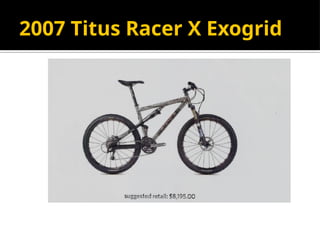
2007 Titus Racer X Exogrid
The Full Page Ad for
2007 Titus Racer X Exogrid
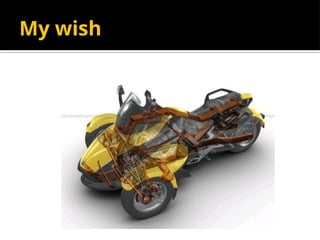
My wish
What are you going to
learn?
 What are composite materials?
 How are they manufactured?
 What advantages and drawbacks do
composites have over metals?
 Develop mathematical models to understand
the mechanical response of composites to
mechanical and hygrothermal loads?
 Use the above mathematical models to
optimally design structures made of
composites.
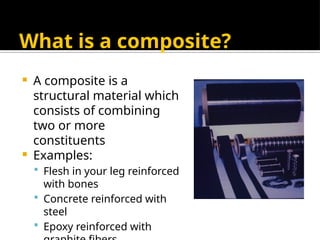
What is a composite?
 A composite is a
structural material which
consists of combining
two or more
constituents
 Examples:
 Flesh in your leg reinforced
with bones
 Concrete reinforced with
steel
 Epoxy reinforced with
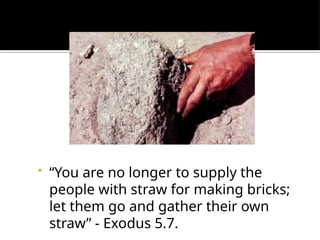
• “You are no longer to supply the
people with straw for making bricks;
let them go and gather their own
straw” - Exodus 5.7.
Shift in Paradigm About
Materials
“More important than any
one new application is
the new ‘materials’
concept itself ”
Peter F. Drucker
The Age of Discontinuity, 1969
What is this paradigm shift
in materials?
 From substance to structures
 From artisan to science
 From workshop to mathematical
modeling
 From what nature provides to what man
can accomplish
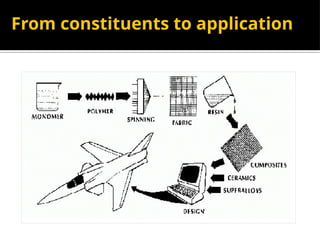
From constituents to application
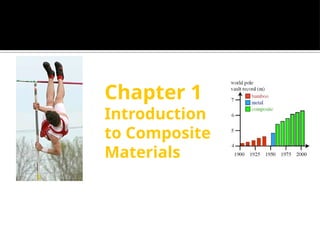
Chapter 1
Introduction
to Composite
Materials
Short Videos on Composite
Materials
 Some videos of composite materials
 NASA uses composite materials in shuttl
e
 Composites improve efficiency
 Cloth composites
 What is a composite?
 What are the advantages and drawbacks of
composites over monolithic materials?
 What factors influence mechanical
properties of a composite
Chapter 1: Objectives
 How do we classify composites?
 What are the common types of fibers and
matrices?
 How are composite materials manufactured?
 What are the mechanical properties of
composite materials?
Chapter Objectives
(continued)
Chapter Objectives
(continued)
 Give applications of composite materials.
 How are composites recycled?
 What terminology is used for studying
mechanics of composites?
What is an advanced composite?
 Advanced composites are composite
materials which were traditionally used
in aerospace industries
Examples include graphite/epoxy,
Kevlar/epoxy and Boron/aluminum
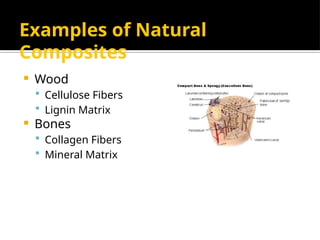
Examples of Natural
Composites
 Wood
 Cellulose Fibers
 Lignin Matrix
 Bones
 Collagen Fibers
 Mineral Matrix
Why composites over metals?
 High Strength and High
Stiffness
 Tailored Design
 Fatigue Life
 Dimensional Stability
 Corrosion Resistance
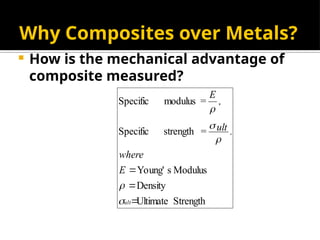
Why Composites over Metals?
 How is the mechanical advantage of
composite measured?
Strength
Ultimate
Density
Modulus
s
Young'
strength
Specific
modulus
Specific



ult
E
where
.
ult
=
,
E
=





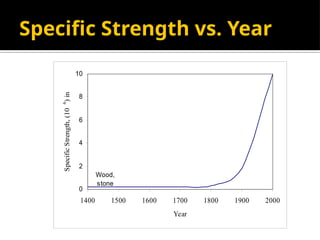
Specific Strength vs. Year
0
2
4
6
8
10
1400 1500 1600 1700 1800 1900 2000
Year
Specific
Strength,
(10
6
)
in
Wood,
stone
Bronze Cast Iron Steel
Aluminum
Composites
Aramid Fibers,
Carbon Fibers
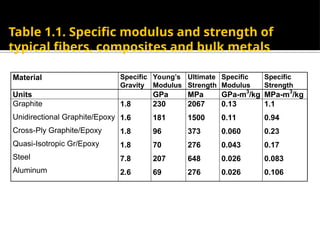
Table 1.1. Specific modulus and strength of
typical fibers, composites and bulk metals
Material Specific
Gravity
Young’s
Modulus
Ultimate
Strength
Specific
Modulus
Specific
Strength
Units GPa MPa GPa-m3
/kg MPa-m3
/kg
Graphite
Unidirectional Graphite/Epoxy
Cross-Ply Graphite/Epoxy
Quasi-Isotropic Gr/Epoxy
Steel
Aluminum
1.8
1.6
1.8
1.8
7.8
2.6
230
181
96
70
207
69
2067
1500
373
276
648
276
0.13
0.11
0.060
0.043
0.026
0.026
1.1
0.94
0.23
0.17
0.083
0.106
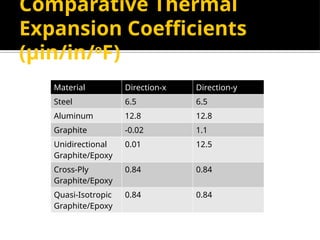
Comparative Thermal
Expansion Coefficients
(μin/in/o
F)
Material Direction-x Direction-y
Steel 6.5 6.5
Aluminum 12.8 12.8
Graphite -0.02 1.1
Unidirectional
Graphite/Epoxy
0.01 12.5
Cross-Ply
Graphite/Epoxy
0.84 0.84
Quasi-Isotropic
Graphite/Epoxy
0.84 0.84
Specific Strength vs Specific Modulus
0
500
1000
1500
2000
2500
3000
3500
4000
4500
5000
0 100 200 300 400 500 600
Specific Modulus [Msi-in
3
/lb]
Specific
Strength
[Ksi-in
3
/lb]
Steel
Aluminum
Quasi-isotropic
Graphite/Epoxy
Cross-Ply
Graphite/Epoxy
Unidirectional
Graphite/Epoxy
Graphite Fiber
Other Mechanical Parameters
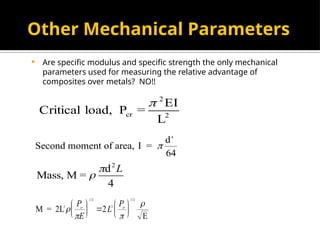
 Are specific modulus and specific strength the only mechanical
parameters used for measuring the relative advantage of
composites over metals? NO!!
2
2
cr
L
EI
=
P
load,
Critical

Second moment of area, I =
d
64
4

4
d
=
M
Mass,
2
L


M = 2L
E
2

 

P
E
L
P
cr cr





  





1 2
2
1 2
2
/ /
Tailored Design
 Engineered to meet specific demands
as choices of making the material are
many more as compared to metals.
 Examples of choices
 fiber volume fraction
 layer orientation
 type of layer
 layer stacking sequence
Fatigue Life
 Fatigue life is higher than metals such
as aluminum.
 Important consideration in applications
such as
 aircrafts
 bridges
 structures exposed to wind
Dimensional Stability
 Temperature changes can result
 in overheating of components (example
engines)
 thermal fatigue due to cyclic temperature
changes (space structures)
 render structures inoperable (space
antennas)
Corrosion Resistance
 Polymers and ceramics matrix are
corrosion resistant
 Examples include
 underground storage tanks
 doors
 window frames
 structural members of offshore drilling
platforms
What is most limiting factor
in the use of composites in
structures?
Lack of engineers with the
knowledge and experience to
design with these materials!!!!
Cost Considerations
 Composites may be more expensive per
pound than conventional materials.
Then why do we use composite
materials?
Factors in Cost Estimate
 For Composite Materials
 Fewer pounds are required
 Fabrication cost may be lower
 Transportation costs are generally
lower
 Less maintenance than
conventional materials is required
Fiber Factors
 What fiber factors contribute to the
mechanical performance of a
composite?
▪Length
▪Orientation
▪Shape
▪Material
Fiber Factor - Length
 Long Fibers
 Easy to orient
 Easy to process
 Higher impact resistance
 Dimensional stability
 Short Fibers
 Low Cost
 Fast cycle time
Fiber Factor - Orientation
 One direction orientation
 High stiffness and strength in that direction
 Low stiffness and strength in other
directions
 Multi-direction orientation
 Less stiffness but more direction
independent
Fiber Factor - Shape
 Most common shape is circular
 Hexagon and square shapes give high
packing factors
Fiber Factor - Material
 Graphite and aramids have high
strength and stiffness
 Glass has low stiffness but cost less
Matrix Factors
 What are the matrix factors which
contribute to the mechanical
performance of composites?
 Binds fibers together
 Protects fibers from environment
 Shielding from damage due to handling
 Distributing the load to fibers.
Factors Other Than
Fiber and Matrix
 Fiber-matrix interface
 Chemical bonding
 Mechanical bonding
Fiber Types
 Glass Fiber (first synthetic fiber)
 Boron (first advanced fiber)
 Carbon
 Silicon Carbide
Types of Matrices
 Polymers
 Metals
 Ceramics
Polymer Matrix
 Thermosets
 polyester
 epoxy
 polymide
 Thermoplastics
 polypropylene
 polyvinyl chloride
 nylon
Metal Matrix
 Aluminum
 Titanium
 Copper
Ceramic Matrix
 Carbon
 Silicon Carbide
 Calcium AluminoSilicate
 Lithium AluminoSilicate
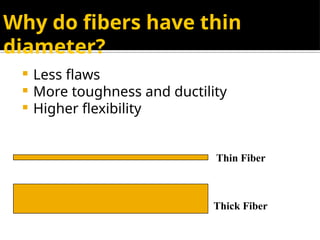
Why do fibers have thin
diameter?
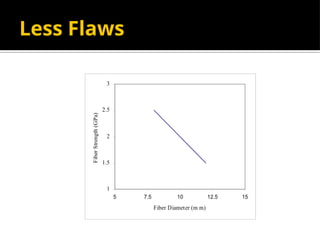
 Less flaws
 More toughness and ductility
 Higher flexibility
Thin Fiber
Thick Fiber
Less Flaws
1
1.5
2
2.5
3
5 7.5 10 12.5 15
Fiber Diameter (m m)
Fiber
Strength
(GPa)
More Toughness and Ductility
 Fiber-matrix interface area is inversely
proportional to the diameter of the
fibers
 Higher surface area of fiber-matrix
interface results in higher ductility and
toughness, and better transfer of loads.
More Flexibility
 Flexibility is proportional to inverse of
▪ Young’s modulus
▪ Fourth power of diameter
 Thinner fibers hence have a higher
flexibility and are easy to handle in
manufacturing.
END
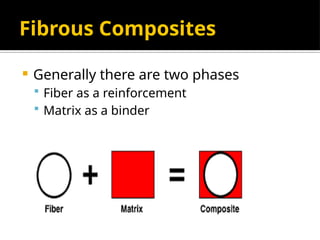
Fibrous Composites
 Generally there are two phases
 Fiber as a reinforcement
 Matrix as a binder
Historical Perspective
 4000 B.C. Fibrous composites were used
in Egypt in making laminated writing
materials
 1300 BC: Reference to Book of Exodus
 1700 AD: French Scientist, Reumer
talked about potential of glass fibers
Historical Perspectives
(continued)
 1939: Glass fiber manufactured
commercially for high temperature
electrical applications
 1950s: Boron and carbon fibers were
produced to make ropes.
 1960s: Matrix added to make polymeric
matrix composites
Historical Perspectives (continued)
 1970s: Cold war forces development of
metal matrix composites for military
aircrafts and missile guidance systems
 1990s: High temperature ceramic matrix
composites are being aggressively
researched for use in next generation
aircraft engines and power plant turbines
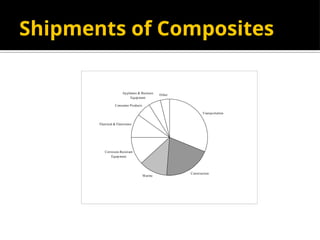
Shipments of Composites
Transportation
Construction
M arine
Corrosion-Resistant
Equipment
Electrical & Electronics
Consumer Products
Appliance & Business
Equipment
Other
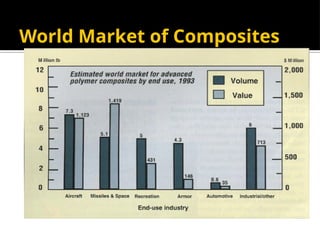
World Market of Composites
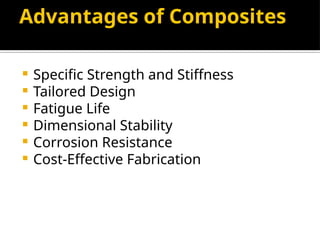
Advantages of Composites
 Specific Strength and Stiffness
 Tailored Design
 Fatigue Life
 Dimensional Stability
 Corrosion Resistance
 Cost-Effective Fabrication
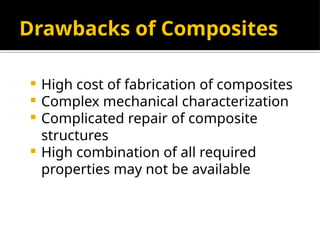
Drawbacks of Composites
 High cost of fabrication of composites
 Complex mechanical characterization
 Complicated repair of composite
structures
 High combination of all required
properties may not be available
END
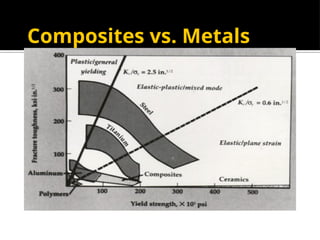
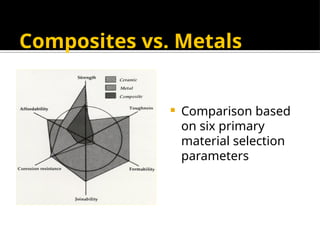
Composites vs. Metals
 Comparison based
on six primary
material selection
parameters
Design Parameters
 Torque Resistance.
 Should carry load without failure
 Not rotate close to natural frequency.
 Need high natural frequency otherwise
whirling may take place
 Buckling Resistance.
 May buckle before failing

composite materials introduction materail

  • 1.
    Introduction to CompositeMaterials (Laminated Composite Materials) Mechanical Engineering Instructor: Autar Kaw
  • 2.
  • 3.
    The Full PageAd for 2007 Titus Racer X Exogrid
  • 4.
  • 5.
    What are yougoing to learn?  What are composite materials?  How are they manufactured?  What advantages and drawbacks do composites have over metals?  Develop mathematical models to understand the mechanical response of composites to mechanical and hygrothermal loads?  Use the above mathematical models to optimally design structures made of composites.
  • 6.
    What is acomposite?  A composite is a structural material which consists of combining two or more constituents  Examples:  Flesh in your leg reinforced with bones  Concrete reinforced with steel  Epoxy reinforced with
  • 7.
    • “You areno longer to supply the people with straw for making bricks; let them go and gather their own straw” - Exodus 5.7.
  • 8.
    Shift in ParadigmAbout Materials “More important than any one new application is the new ‘materials’ concept itself ” Peter F. Drucker The Age of Discontinuity, 1969
  • 9.
    What is thisparadigm shift in materials?  From substance to structures  From artisan to science  From workshop to mathematical modeling  From what nature provides to what man can accomplish
  • 10.
  • 11.
  • 12.
    Short Videos onComposite Materials  Some videos of composite materials  NASA uses composite materials in shuttl e  Composites improve efficiency  Cloth composites
  • 13.
     What isa composite?  What are the advantages and drawbacks of composites over monolithic materials?  What factors influence mechanical properties of a composite Chapter 1: Objectives
  • 14.
     How dowe classify composites?  What are the common types of fibers and matrices?  How are composite materials manufactured?  What are the mechanical properties of composite materials? Chapter Objectives (continued)
  • 15.
    Chapter Objectives (continued)  Giveapplications of composite materials.  How are composites recycled?  What terminology is used for studying mechanics of composites?
  • 16.
    What is anadvanced composite?  Advanced composites are composite materials which were traditionally used in aerospace industries Examples include graphite/epoxy, Kevlar/epoxy and Boron/aluminum
  • 17.
    Examples of Natural Composites Wood  Cellulose Fibers  Lignin Matrix  Bones  Collagen Fibers  Mineral Matrix
  • 18.
    Why composites overmetals?  High Strength and High Stiffness  Tailored Design  Fatigue Life  Dimensional Stability  Corrosion Resistance
  • 19.
    Why Composites overMetals?  How is the mechanical advantage of composite measured? Strength Ultimate Density Modulus s Young' strength Specific modulus Specific    ult E where . ult = , E =     
  • 20.
    Specific Strength vs.Year 0 2 4 6 8 10 1400 1500 1600 1700 1800 1900 2000 Year Specific Strength, (10 6 ) in Wood, stone Bronze Cast Iron Steel Aluminum Composites Aramid Fibers, Carbon Fibers
  • 21.
    Table 1.1. Specificmodulus and strength of typical fibers, composites and bulk metals Material Specific Gravity Young’s Modulus Ultimate Strength Specific Modulus Specific Strength Units GPa MPa GPa-m3 /kg MPa-m3 /kg Graphite Unidirectional Graphite/Epoxy Cross-Ply Graphite/Epoxy Quasi-Isotropic Gr/Epoxy Steel Aluminum 1.8 1.6 1.8 1.8 7.8 2.6 230 181 96 70 207 69 2067 1500 373 276 648 276 0.13 0.11 0.060 0.043 0.026 0.026 1.1 0.94 0.23 0.17 0.083 0.106
  • 22.
    Comparative Thermal Expansion Coefficients (μin/in/o F) MaterialDirection-x Direction-y Steel 6.5 6.5 Aluminum 12.8 12.8 Graphite -0.02 1.1 Unidirectional Graphite/Epoxy 0.01 12.5 Cross-Ply Graphite/Epoxy 0.84 0.84 Quasi-Isotropic Graphite/Epoxy 0.84 0.84
  • 23.
    Specific Strength vsSpecific Modulus 0 500 1000 1500 2000 2500 3000 3500 4000 4500 5000 0 100 200 300 400 500 600 Specific Modulus [Msi-in 3 /lb] Specific Strength [Ksi-in 3 /lb] Steel Aluminum Quasi-isotropic Graphite/Epoxy Cross-Ply Graphite/Epoxy Unidirectional Graphite/Epoxy Graphite Fiber
  • 24.
    Other Mechanical Parameters Are specific modulus and specific strength the only mechanical parameters used for measuring the relative advantage of composites over metals? NO!! 2 2 cr L EI = P load, Critical  Second moment of area, I = d 64 4  4 d = M Mass, 2 L   M = 2L E 2     P E L P cr cr              1 2 2 1 2 2 / /
  • 25.
    Tailored Design  Engineeredto meet specific demands as choices of making the material are many more as compared to metals.  Examples of choices  fiber volume fraction  layer orientation  type of layer  layer stacking sequence
  • 26.
    Fatigue Life  Fatiguelife is higher than metals such as aluminum.  Important consideration in applications such as  aircrafts  bridges  structures exposed to wind
  • 27.
    Dimensional Stability  Temperaturechanges can result  in overheating of components (example engines)  thermal fatigue due to cyclic temperature changes (space structures)  render structures inoperable (space antennas)
  • 28.
    Corrosion Resistance  Polymersand ceramics matrix are corrosion resistant  Examples include  underground storage tanks  doors  window frames  structural members of offshore drilling platforms
  • 29.
    What is mostlimiting factor in the use of composites in structures? Lack of engineers with the knowledge and experience to design with these materials!!!!
  • 30.
    Cost Considerations  Compositesmay be more expensive per pound than conventional materials. Then why do we use composite materials?
  • 31.
    Factors in CostEstimate  For Composite Materials  Fewer pounds are required  Fabrication cost may be lower  Transportation costs are generally lower  Less maintenance than conventional materials is required
  • 32.
    Fiber Factors  Whatfiber factors contribute to the mechanical performance of a composite? ▪Length ▪Orientation ▪Shape ▪Material
  • 33.
    Fiber Factor -Length  Long Fibers  Easy to orient  Easy to process  Higher impact resistance  Dimensional stability  Short Fibers  Low Cost  Fast cycle time
  • 34.
    Fiber Factor -Orientation  One direction orientation  High stiffness and strength in that direction  Low stiffness and strength in other directions  Multi-direction orientation  Less stiffness but more direction independent
  • 35.
    Fiber Factor -Shape  Most common shape is circular  Hexagon and square shapes give high packing factors
  • 36.
    Fiber Factor -Material  Graphite and aramids have high strength and stiffness  Glass has low stiffness but cost less
  • 37.
    Matrix Factors  Whatare the matrix factors which contribute to the mechanical performance of composites?  Binds fibers together  Protects fibers from environment  Shielding from damage due to handling  Distributing the load to fibers.
  • 38.
    Factors Other Than Fiberand Matrix  Fiber-matrix interface  Chemical bonding  Mechanical bonding
  • 39.
    Fiber Types  GlassFiber (first synthetic fiber)  Boron (first advanced fiber)  Carbon  Silicon Carbide
  • 40.
    Types of Matrices Polymers  Metals  Ceramics
  • 41.
    Polymer Matrix  Thermosets polyester  epoxy  polymide  Thermoplastics  polypropylene  polyvinyl chloride  nylon
  • 42.
    Metal Matrix  Aluminum Titanium  Copper
  • 43.
    Ceramic Matrix  Carbon Silicon Carbide  Calcium AluminoSilicate  Lithium AluminoSilicate
  • 44.
    Why do fibershave thin diameter?  Less flaws  More toughness and ductility  Higher flexibility Thin Fiber Thick Fiber
  • 45.
    Less Flaws 1 1.5 2 2.5 3 5 7.510 12.5 15 Fiber Diameter (m m) Fiber Strength (GPa)
  • 46.
    More Toughness andDuctility  Fiber-matrix interface area is inversely proportional to the diameter of the fibers  Higher surface area of fiber-matrix interface results in higher ductility and toughness, and better transfer of loads.
  • 47.
    More Flexibility  Flexibilityis proportional to inverse of ▪ Young’s modulus ▪ Fourth power of diameter  Thinner fibers hence have a higher flexibility and are easy to handle in manufacturing.
  • 48.
  • 49.
    Fibrous Composites  Generallythere are two phases  Fiber as a reinforcement  Matrix as a binder
  • 50.
    Historical Perspective  4000B.C. Fibrous composites were used in Egypt in making laminated writing materials  1300 BC: Reference to Book of Exodus  1700 AD: French Scientist, Reumer talked about potential of glass fibers
  • 51.
    Historical Perspectives (continued)  1939:Glass fiber manufactured commercially for high temperature electrical applications  1950s: Boron and carbon fibers were produced to make ropes.  1960s: Matrix added to make polymeric matrix composites
  • 52.
    Historical Perspectives (continued) 1970s: Cold war forces development of metal matrix composites for military aircrafts and missile guidance systems  1990s: High temperature ceramic matrix composites are being aggressively researched for use in next generation aircraft engines and power plant turbines
  • 53.
    Shipments of Composites Transportation Construction Marine Corrosion-Resistant Equipment Electrical & Electronics Consumer Products Appliance & Business Equipment Other
  • 54.
    World Market ofComposites
  • 55.
    Advantages of Composites Specific Strength and Stiffness  Tailored Design  Fatigue Life  Dimensional Stability  Corrosion Resistance  Cost-Effective Fabrication
  • 56.
    Drawbacks of Composites High cost of fabrication of composites  Complex mechanical characterization  Complicated repair of composite structures  High combination of all required properties may not be available
  • 57.
  • 58.
  • 59.
    Composites vs. Metals Comparison based on six primary material selection parameters
  • 60.
    Design Parameters  TorqueResistance.  Should carry load without failure  Not rotate close to natural frequency.  Need high natural frequency otherwise whirling may take place  Buckling Resistance.  May buckle before failing