WHITE
HYDROGEN
Whitepaper
Dr. Flavio Ortigao, CTO
flavio.ortigao@recupera.si
HYDROGEN IS
THE NUMBER
ONE
THE COLORS OF
HYDROGEN
Hydrogen (H2) is the lightest and most abundant element in the
universe, the number one on the Periodic Table of the Elements. It
is the fuel of the stars, like the Sun. On the Earth hydrogen is not
freely available in any significant amount, but bond to other
elements and must be extract from compounds like water, metal
hydrates or hydrocarbons.
H2 has the highest energy density, 3 times more than fossil oil.
Hydrogen is a carrier of chemical energy. Differently from oil, when
converted to work, it does not emit carbon dioxide (CO2). When
burned in fuel cell, hydrogen emits only water. Although H2 use
does not emit CO2, its production can be very CO2 emissive. H2 is a
colorless gas that burns with an invisible flame, but consulting
2
group McKinsey1 has given different colors to hydrogen according to
their production mode:
Brown: The H2 produced by mineral coal gasification;
Grey: The H2 produced by natural gas steam reform (SMR);
Blue: The H2, produced by the above-mentioned methods with
carbon capture and storage (CCS);
Green: The H2 produced by water electrolysis, utilizing wind and
solar energy;
To these, we at Recupera want to add:
White: the H2 produced by gasification of renewable sources, like
biomass or plastics at end-of-life, to syngas, a gas essentially
composed of H2 and carbon monoxide (CO), by simple gas
separation.
WHITE HYDROGEN IS CIRCULAR ECONOMY
By converting plastics, which are mostly derived from fossil oil, and
composed mainly of hydrogen and carbon, to syngas without
emission, we produce H2 saving the same amount of fossil fuel and
avoiding CO2 emissions. White hydrogen is a viable way to
transform the problem of non-recyclable plastics into a green
solution.
Hydrogen will play a decisive role in the transition to a decarbonized
economy, as already decided by many countries.
1 Mckinsey 2018 Hydrogen rapport
3
Fig. 1
HOW RECUPERA PRODUCES WHITE HYDROGEN
At Recupera we produce H2 by gasification with our proprietary Low
Temperature Conversion (LTC) technology utilizing exclusively non-
recyclable plastics and biomass from sustainable forest
management as feedstock.
Our many years of experience in pyrolysis and gasification projects
have brought the know-how on the best feedstocks and the proper
pre-treatment and processing. The success of any gasification
process is intrinsically associated with this proper choice of
materials and pre-processing.
Our gasifiers were engineered to deliver the highest quality of
syngas, a mixture of H2 and CO at the relation 2:1. The gas is
separated using conventional Pressure Swing Absorption (PSA)
technology. By this method, without CO2 emission a purity of
99,99% can be achieved. CO is a valuable feedstock for the
chemical industry for FT-synthesis and methanol production. It can
also be used as heating gas.
2McKinsey & Company
There are seven roles for hydrogen in the energy transition
Act as a buffer to
increase system
resilience
Distribute energy
across sectors and
regions
Enable large-scale
renewables integration
and power generation
2
3
Decarbonize
transportation
Help decarbonize
building heating and
power
Decarbonize industry
energy use
Serve as feedstock, using
captured carbon
SOURCE: Hydrogen Council
4
7
5
6
1
Enable the renewable energy system Decarbonize end uses
4
RECUPERA LTC Gasifier
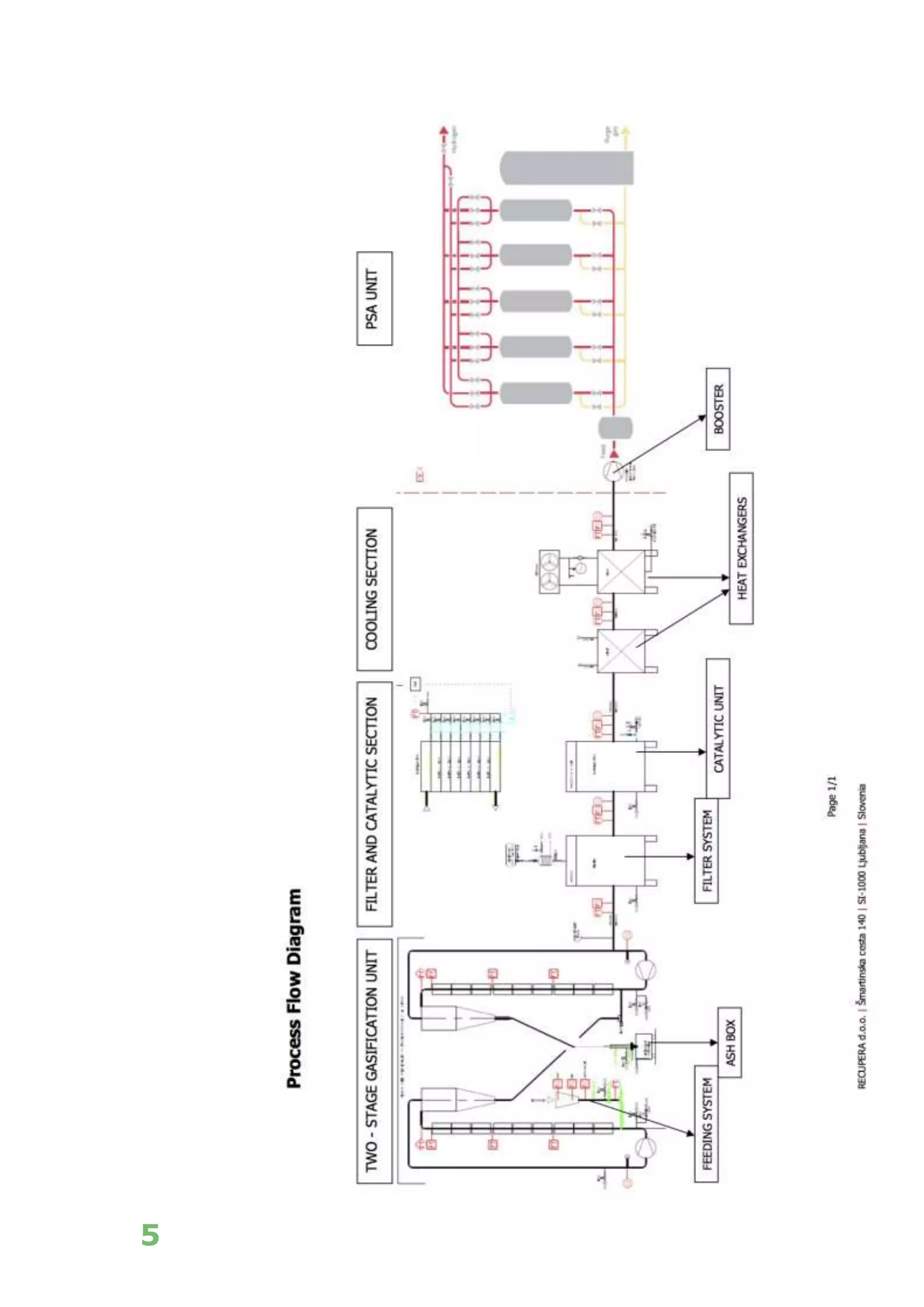
1. Gasification
The LTC plants utilize progressive thermo-catalytic material
gasification in a con, material is gasified by infra-red
induction heat at 450°C and integrated gas purification, all
within a hermetically closed system. The result is a clean
process with very high yield. The plants fluidized bed
reactors allow for continuous flow while inductive heat
transfer decomposes organic structures into their constituent
elements in a multi-stage process. The following reactions
occur within a completely closed plant system:
Steam Gasification:
C + H2O  CO + H2 H = +131 Kj/mol
Boudouard:
C + CO2  2CO H = + 172 Kj/mol
Hydrogasification
C + 2H2  CH4 H = -74 KJ/mol
Watershift
CO + H2O  CO2 + H2 H= -41Kj/mol
Gas reforming to Hydrogen
The syngas exiting the gasifier is cooled to about 350°C then
undergoes the water gas shift (WGS) reaction in a high temperature
shift (HTS) converter.
In the “classical process”, the gas is further cooled to about 220°C
and undergoes WGS in a low temperature shift (LTS) converter .
Finally, to remove trace amounts of CO and CO2 a methanation
reactor is used (CO + 3H2  CH4 + H2O). The product hydrogen has
a purity of 97-99%.
Currently, after the shift conversion step, hydrogen is purified using
a pressure swing adsorption (PSA) unit or membrane separation to
obtain purity greater than 99.99%.
5
6
Hydrogen is ready for sale
Recupera Bio-refinery
5McKinsey & Company
Hydrogen: Ready for scale!
SOURCE: Hydrogen Council
Trans-
portation
Power
generation
Industry
energy
Building heating
and power
Industry
feedstock
Today 2020 25 30 35 40 2045
1 Mass market acceptability defined as sales >1% within segment in priority markets 2 Market share refers to the amount of production that uses hydrogen and captured carbon to replace feedstock
3 DRI with green H2, iron reduction in blast furnaces and other low-carbon steel making processes using H2 4 Market share refers to the amount of feedstock that is produced from low-carbon sources
Start of
commercialization
Mass market
acceptability1
In renewables-constrained countries
In other countries
Forklifts
Mid-sized and large cars
City buses
Vans
Coaches
Trucks
Small cars
Minibuses
Trams and railways
Passenger ships
Synfuel for freight
ships and airplanes
4
1
5
6
7
Medium-/low industry heat
Blended hydgrogen heating
Production of methanol, olefins and BTX using H2 and captured carbon2
High-grade industry heat
Pure hydrogen heating
Refining
Ammonia, methanol
Decarbonization of feedstock4
Steel3
4McKinsey & Company
Hydrogen benefits energy systems, environment and business
SOURCE: Hydrogen Council, IEA ETP Hydrogen and Fuel Cells CBS, National Energy Outlook 2016”
13%
of total energy demand
in 2050
7.5 Gt
annual CO2 abate-
ment in 2050
USD
4,000 bn
annual sales in 2050
(hydrogen and
applications)
7
Analogous to the petroleum refinery, a biorefinery is a refinery
where different carbonaceous educts are converted to different
added value products, by undergoing specific chemical or
biotechnological conversions. The great differential of the
biorefinery is that it essential part of the Circular Economy, whereas
process residues rather than virgin fossil feedstocks are converted
into new value-added intermediary compounds or products for the
circular green chemical process. The biorefinery avoids that the
same amount of fossil feedstock is extracted from the earth,
contributing so for the decarbonization.
As for feedstocks, carbon (C), hydrogen (H) and oxygen (O) are the
three chemical elements of the conversion. Fossil derived
feedstocks, like plastics, are most CH materials, biomass are CHO.
Coal, graphite or anthracite have the highest carbon and hence
energy content. They define the thermodynamic quality of the
feedstock. Feedstocks can be energy crops or residues.
Sustainability focus, is on the treatment of residues, not competing
with food.
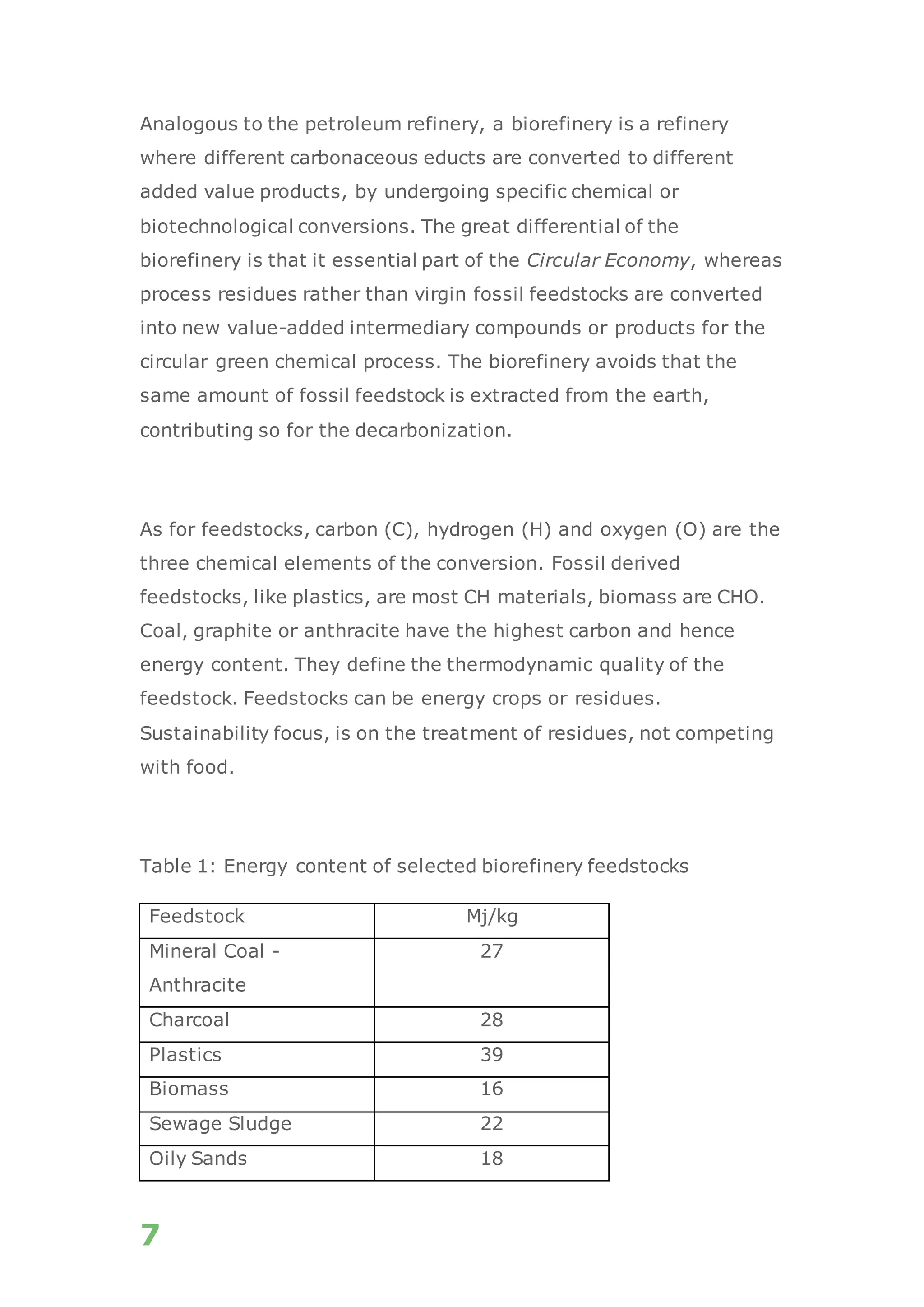
Table 1: Energy content of selected biorefinery feedstocks
Feedstock Mj/kg
Mineral Coal -
Anthracite
27
Charcoal 28
Plastics 39
Biomass 16
Sewage Sludge 22
Oily Sands 18
8
MSW 10
The core biorefinery processes, can be divided in biotechnological,
thermal or chemical, according to the scheme in fig. 1.
Incineration, pyrolysis and gasification are related processes, the
difference between them is that incineration is oxidation with excess
oxidizing agent, usually oxygen or air, leading to complete
conversion of C to CO2, whereas heat is produced. Pyrolysis is the
thermal treatment in complete absence of external oxidizer, anoxic,
leads to the formation of three products char, pyrolysis oil and a
strong gas. Gasification is a controlled oxidation, done with oxygen
or air, and leads to the formation of syngas, a gas essentially
containing H2 and CO. The products of pyrolysis and gasification
have higher energy qualities (exergy) than incineration. The choice
between thermal treatment is limited by the energy content of the
feedstock and the product that is sought. Fig. 2, shows the options
Core Biorefinery
Processes
Biotechnology
Anaerobic
Fermentatio
Aerobic
Fermentation
Enzymativc
Conversions
Thermal-
Treatment
Incineration
Heat
Pyrolysis
Char
Oil
Gas
Gasification
Syngas
Chemical
Treatment
Hydrolisis
9
that are available. As energy is conserved, the total energy content
of the output products will be determined by the total energy input.
The biorefinery primary products, can be further refined to different
end products as summarized in Table 2, bellow.
Feedstock Mode Downstream Product Refining, secondary
Woodchip Gasification filter Syngas CHP, FT-fuels, AvK,
hydrogen
Sawmill Gasification filter Syngas CHP, FT-fuels, AvK,
hydrogen
Coconut Carbonization Activation Activated
Carbon
Single pass, continuous
Nuts Carbonization Activated
Carbon
Single pass, continuous
activation
Rice husks Gasification Syngas Heat & Silica
Straw Gasification Filter Syngas CHP
10
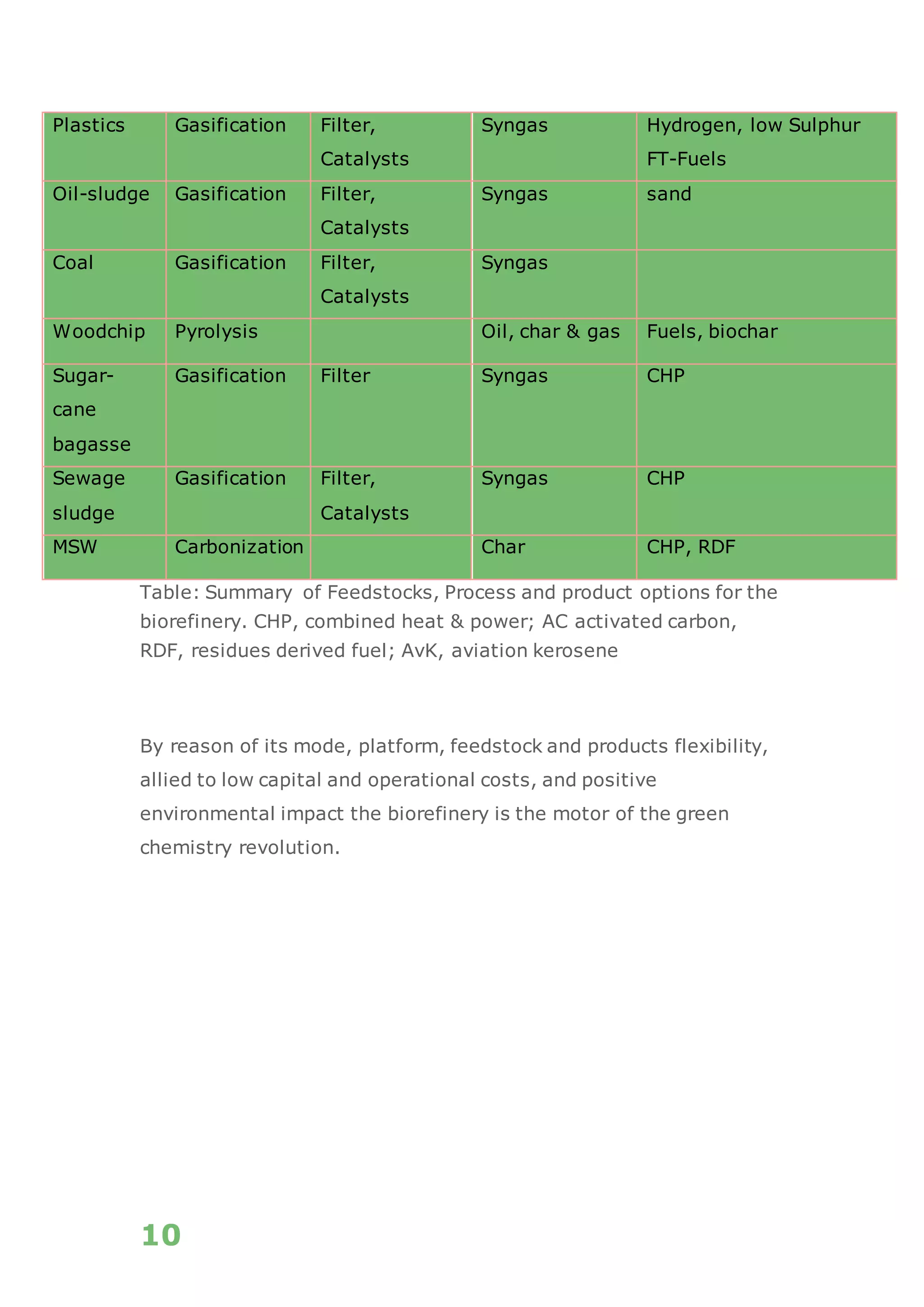
Table: Summary of Feedstocks, Process and product options for the
biorefinery. CHP, combined heat & power; AC activated carbon,
RDF, residues derived fuel; AvK, aviation kerosene
By reason of its mode, platform, feedstock and products flexibility,
allied to low capital and operational costs, and positive
environmental impact the biorefinery is the motor of the green
chemistry revolution.
Plastics Gasification Filter,
Catalysts
Syngas Hydrogen, low Sulphur
FT-Fuels
Oil-sludge Gasification Filter,
Catalysts
Syngas sand
Coal Gasification Filter,
Catalysts
Syngas
Woodchip Pyrolysis Oil, char & gas Fuels, biochar
Sugar-
cane
bagasse
Gasification Filter Syngas CHP
Sewage
sludge
Gasification Filter,
Catalysts
Syngas CHP
MSW Carbonization Char CHP, RDF
11
Core platform: Low Temperature Conversion
Gasification
1t/h
4mm shredded feedstocks
2500m3/h
Syngas
H2
+
CO
2:1
Gasification
The LTC plants utilize progressive thermo-catalytic material gasification. The material is gasified by
infra-red induction heat bellow 450°C and integrated gas purification, all within a hermetically
closed system. The result is a clean process with very high yield. The plants fluidized bed reactors
allow for continuous flow while inductive heat transfer decomposes organic structures into their
constituent elements in a multi-stage process.

White hydrogen

  • 1.
    WHITE HYDROGEN Whitepaper Dr. Flavio Ortigao,CTO flavio.ortigao@recupera.si
  • 2.
    HYDROGEN IS THE NUMBER ONE THECOLORS OF HYDROGEN Hydrogen (H2) is the lightest and most abundant element in the universe, the number one on the Periodic Table of the Elements. It is the fuel of the stars, like the Sun. On the Earth hydrogen is not freely available in any significant amount, but bond to other elements and must be extract from compounds like water, metal hydrates or hydrocarbons. H2 has the highest energy density, 3 times more than fossil oil. Hydrogen is a carrier of chemical energy. Differently from oil, when converted to work, it does not emit carbon dioxide (CO2). When burned in fuel cell, hydrogen emits only water. Although H2 use does not emit CO2, its production can be very CO2 emissive. H2 is a colorless gas that burns with an invisible flame, but consulting
  • 3.
    2 group McKinsey1 hasgiven different colors to hydrogen according to their production mode: Brown: The H2 produced by mineral coal gasification; Grey: The H2 produced by natural gas steam reform (SMR); Blue: The H2, produced by the above-mentioned methods with carbon capture and storage (CCS); Green: The H2 produced by water electrolysis, utilizing wind and solar energy; To these, we at Recupera want to add: White: the H2 produced by gasification of renewable sources, like biomass or plastics at end-of-life, to syngas, a gas essentially composed of H2 and carbon monoxide (CO), by simple gas separation. WHITE HYDROGEN IS CIRCULAR ECONOMY By converting plastics, which are mostly derived from fossil oil, and composed mainly of hydrogen and carbon, to syngas without emission, we produce H2 saving the same amount of fossil fuel and avoiding CO2 emissions. White hydrogen is a viable way to transform the problem of non-recyclable plastics into a green solution. Hydrogen will play a decisive role in the transition to a decarbonized economy, as already decided by many countries. 1 Mckinsey 2018 Hydrogen rapport
  • 4.
    3 Fig. 1 HOW RECUPERAPRODUCES WHITE HYDROGEN At Recupera we produce H2 by gasification with our proprietary Low Temperature Conversion (LTC) technology utilizing exclusively non- recyclable plastics and biomass from sustainable forest management as feedstock. Our many years of experience in pyrolysis and gasification projects have brought the know-how on the best feedstocks and the proper pre-treatment and processing. The success of any gasification process is intrinsically associated with this proper choice of materials and pre-processing. Our gasifiers were engineered to deliver the highest quality of syngas, a mixture of H2 and CO at the relation 2:1. The gas is separated using conventional Pressure Swing Absorption (PSA) technology. By this method, without CO2 emission a purity of 99,99% can be achieved. CO is a valuable feedstock for the chemical industry for FT-synthesis and methanol production. It can also be used as heating gas. 2McKinsey & Company There are seven roles for hydrogen in the energy transition Act as a buffer to increase system resilience Distribute energy across sectors and regions Enable large-scale renewables integration and power generation 2 3 Decarbonize transportation Help decarbonize building heating and power Decarbonize industry energy use Serve as feedstock, using captured carbon SOURCE: Hydrogen Council 4 7 5 6 1 Enable the renewable energy system Decarbonize end uses
  • 5.
    4 RECUPERA LTC Gasifier 1.Gasification The LTC plants utilize progressive thermo-catalytic material gasification in a con, material is gasified by infra-red induction heat at 450°C and integrated gas purification, all within a hermetically closed system. The result is a clean process with very high yield. The plants fluidized bed reactors allow for continuous flow while inductive heat transfer decomposes organic structures into their constituent elements in a multi-stage process. The following reactions occur within a completely closed plant system: Steam Gasification: C + H2O  CO + H2 H = +131 Kj/mol Boudouard: C + CO2  2CO H = + 172 Kj/mol Hydrogasification C + 2H2  CH4 H = -74 KJ/mol Watershift CO + H2O  CO2 + H2 H= -41Kj/mol Gas reforming to Hydrogen The syngas exiting the gasifier is cooled to about 350°C then undergoes the water gas shift (WGS) reaction in a high temperature shift (HTS) converter. In the “classical process”, the gas is further cooled to about 220°C and undergoes WGS in a low temperature shift (LTS) converter . Finally, to remove trace amounts of CO and CO2 a methanation reactor is used (CO + 3H2  CH4 + H2O). The product hydrogen has a purity of 97-99%. Currently, after the shift conversion step, hydrogen is purified using a pressure swing adsorption (PSA) unit or membrane separation to obtain purity greater than 99.99%.
  • 6.
  • 7.
    6 Hydrogen is readyfor sale Recupera Bio-refinery 5McKinsey & Company Hydrogen: Ready for scale! SOURCE: Hydrogen Council Trans- portation Power generation Industry energy Building heating and power Industry feedstock Today 2020 25 30 35 40 2045 1 Mass market acceptability defined as sales >1% within segment in priority markets 2 Market share refers to the amount of production that uses hydrogen and captured carbon to replace feedstock 3 DRI with green H2, iron reduction in blast furnaces and other low-carbon steel making processes using H2 4 Market share refers to the amount of feedstock that is produced from low-carbon sources Start of commercialization Mass market acceptability1 In renewables-constrained countries In other countries Forklifts Mid-sized and large cars City buses Vans Coaches Trucks Small cars Minibuses Trams and railways Passenger ships Synfuel for freight ships and airplanes 4 1 5 6 7 Medium-/low industry heat Blended hydgrogen heating Production of methanol, olefins and BTX using H2 and captured carbon2 High-grade industry heat Pure hydrogen heating Refining Ammonia, methanol Decarbonization of feedstock4 Steel3 4McKinsey & Company Hydrogen benefits energy systems, environment and business SOURCE: Hydrogen Council, IEA ETP Hydrogen and Fuel Cells CBS, National Energy Outlook 2016” 13% of total energy demand in 2050 7.5 Gt annual CO2 abate- ment in 2050 USD 4,000 bn annual sales in 2050 (hydrogen and applications)
  • 8.
    7 Analogous to thepetroleum refinery, a biorefinery is a refinery where different carbonaceous educts are converted to different added value products, by undergoing specific chemical or biotechnological conversions. The great differential of the biorefinery is that it essential part of the Circular Economy, whereas process residues rather than virgin fossil feedstocks are converted into new value-added intermediary compounds or products for the circular green chemical process. The biorefinery avoids that the same amount of fossil feedstock is extracted from the earth, contributing so for the decarbonization. As for feedstocks, carbon (C), hydrogen (H) and oxygen (O) are the three chemical elements of the conversion. Fossil derived feedstocks, like plastics, are most CH materials, biomass are CHO. Coal, graphite or anthracite have the highest carbon and hence energy content. They define the thermodynamic quality of the feedstock. Feedstocks can be energy crops or residues. Sustainability focus, is on the treatment of residues, not competing with food. Table 1: Energy content of selected biorefinery feedstocks Feedstock Mj/kg Mineral Coal - Anthracite 27 Charcoal 28 Plastics 39 Biomass 16 Sewage Sludge 22 Oily Sands 18
  • 9.
    8 MSW 10 The corebiorefinery processes, can be divided in biotechnological, thermal or chemical, according to the scheme in fig. 1. Incineration, pyrolysis and gasification are related processes, the difference between them is that incineration is oxidation with excess oxidizing agent, usually oxygen or air, leading to complete conversion of C to CO2, whereas heat is produced. Pyrolysis is the thermal treatment in complete absence of external oxidizer, anoxic, leads to the formation of three products char, pyrolysis oil and a strong gas. Gasification is a controlled oxidation, done with oxygen or air, and leads to the formation of syngas, a gas essentially containing H2 and CO. The products of pyrolysis and gasification have higher energy qualities (exergy) than incineration. The choice between thermal treatment is limited by the energy content of the feedstock and the product that is sought. Fig. 2, shows the options Core Biorefinery Processes Biotechnology Anaerobic Fermentatio Aerobic Fermentation Enzymativc Conversions Thermal- Treatment Incineration Heat Pyrolysis Char Oil Gas Gasification Syngas Chemical Treatment Hydrolisis
  • 10.
    9 that are available.As energy is conserved, the total energy content of the output products will be determined by the total energy input. The biorefinery primary products, can be further refined to different end products as summarized in Table 2, bellow. Feedstock Mode Downstream Product Refining, secondary Woodchip Gasification filter Syngas CHP, FT-fuels, AvK, hydrogen Sawmill Gasification filter Syngas CHP, FT-fuels, AvK, hydrogen Coconut Carbonization Activation Activated Carbon Single pass, continuous Nuts Carbonization Activated Carbon Single pass, continuous activation Rice husks Gasification Syngas Heat & Silica Straw Gasification Filter Syngas CHP
  • 11.
    10 Table: Summary ofFeedstocks, Process and product options for the biorefinery. CHP, combined heat & power; AC activated carbon, RDF, residues derived fuel; AvK, aviation kerosene By reason of its mode, platform, feedstock and products flexibility, allied to low capital and operational costs, and positive environmental impact the biorefinery is the motor of the green chemistry revolution. Plastics Gasification Filter, Catalysts Syngas Hydrogen, low Sulphur FT-Fuels Oil-sludge Gasification Filter, Catalysts Syngas sand Coal Gasification Filter, Catalysts Syngas Woodchip Pyrolysis Oil, char & gas Fuels, biochar Sugar- cane bagasse Gasification Filter Syngas CHP Sewage sludge Gasification Filter, Catalysts Syngas CHP MSW Carbonization Char CHP, RDF
  • 12.
    11 Core platform: LowTemperature Conversion Gasification 1t/h 4mm shredded feedstocks 2500m3/h Syngas H2 + CO 2:1 Gasification The LTC plants utilize progressive thermo-catalytic material gasification. The material is gasified by infra-red induction heat bellow 450°C and integrated gas purification, all within a hermetically closed system. The result is a clean process with very high yield. The plants fluidized bed reactors allow for continuous flow while inductive heat transfer decomposes organic structures into their constituent elements in a multi-stage process.