
We Transform Waste Into Value
Dr. Flávio Ortigão
Recovering Waste Plastics
from Oceans
INTRODUCTION
Company: Recupera - The White Hydrogen Company
Location: Commercial Demonstration plant in Celje, Slovenia.
Operational plants near the collection site on shore or on board
Objective: Commercial demonstration of thermal, distributed, compact,
ev. mobile, on-and off-shore, low temperature conversion (LTC) of
plastic residues to syngas and further processing to electric, thermal
energy and valuable chemicals, and industrial gases, specially
hydrogen
Operational Focus: Plastics to H2.
Goal: Construction of a demonstration plant, closed, compact,
1t/h, 8000h/year
EXECUTIVE SUMMARY
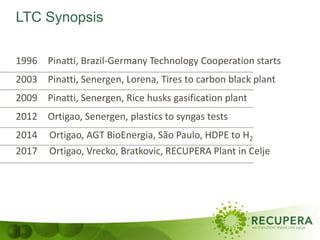
1996 Pinatti, Brazil-Germany Technology Cooperation starts
2003 Pinatti, Senergen, Lorena, Tires to carbon black plant
2009 Pinatti, Senergen, Rice husks gasification plant
2012 Ortigao, Senergen, plastics to syngas tests
2014 Ortigao, AGT BioEnergia, São Paulo, HDPE to H2
2017 Ortigao, Vrecko, Bratkovic, RECUPERA Plant in Celje
LTC Synopsis
Solution to plastic problem
Knowhow
Off-take market
Timing
High impact
High tech and high efficient solutions
Management experience
Strategic value for sea and land plastic pollution
PARTNERS ADVANTAGE
VALUE PROPOSITION
Compact, closed and mobile
Economic feasible. Low temp. -> low operational cost
Evironmentally corrected end disposition of residues
Residues valorization
Constant and non-volatile production
High efficiency
Positive environmental impact  low emissions,
pollutant destruction
ANALYSIS
SOLUTION to PROBLEMS
ANALYSIS
Plastic pollution is a planetary threat, affecting nearly every marine and freshwater
ecosystem globally. In response, multilevel mitigation strategies are being adopted but with
a lack of quantitative assessment of how such strategies reduce plastic emissions. We
assessed the impact of three broad management strategies, plastic waste reduction, waste
management, and environmental recovery, at different levels of effort to estimate plastic
emissions to 2030 for 173 countries. We estimate that 19 to 23 million metric tons, or
11%, of plastic waste generated globally in 2016 entered aquatic ecosystems. Considering
the ambitious commitments currently set by governments, annual emissions may reach up
to 53 million metric tons per year by 2030. To reduce emissions to a level well below this
prediction, extraordinary efforts to transform the global plastics economy are needed.
Science Vol 369, 6510, 16 September 2020.
SOLUTION to PROBLEMS
5 trillion pieces of plastics currently litter the oceans
Dispersed in the 5 oceans
According to Science magazine Feb 2015, 8 million
metric tonnes per year of plastics are dumped into
the oceans
Macro, micro and nano plastics (perfect sized for
direct gasification)
ANALYSIS
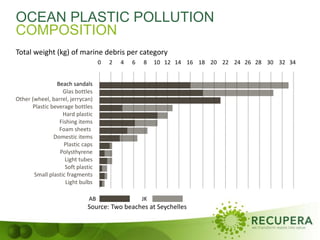
OCEAN PLASTIC POLLUTION
COMPOSITION
Beach sandals
Glas bottles
Other (wheel, barrel, jerrycan)
Plastic beverage bottles
Hard plastic
Fishing items
Foam sheets
Domestic items
Plastic caps
Polysthyrene
Light tubes
Soft plastic
Small plastic fragments
Light bulbs
Total weight (kg) of marine debris per category
0 2 4 6 8 10 12 14 16 18 20 22 24 26 28 30 32 34
AB JK
Source: Two beaches at Seychelles
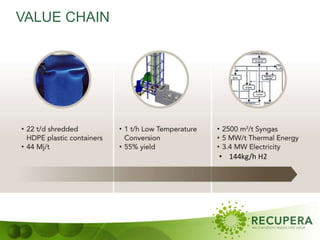
VALUE CHAIN
• 144kg/h H2
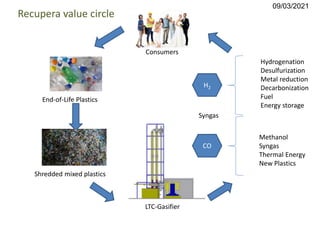
09/03/2021
Recupera value circle
Consumers
End-of-Life Plastics
Shredded mixed plastics
LTC-Gasifier
H2
CO
Hydrogenation
Desulfurization
Metal reduction
Decarbonization
Fuel
Energy storage
Methanol
Syngas
Thermal Energy
New Plastics
Syngas
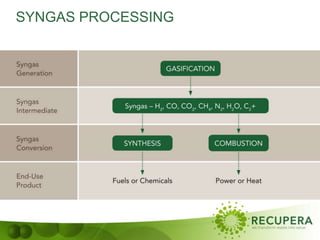
SYNGAS PROCESSING
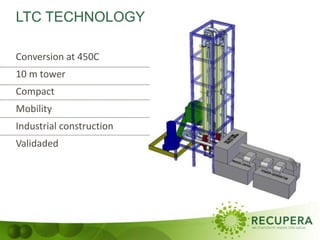
LTC TECHNOLOGY
Conversion at 450C
10 m tower
Compact
Mobility
Industrial construction
Validaded
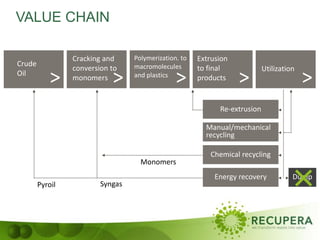
VALUE CHAIN
Crude
Oil
Receiving & Stocking
Final Destination
Certified
> >
>
LTC
>
Syngas
>
> > > >
Cracking and
conversion to
monomers
Polymerization. to
macromolecules
and plastics
Extrusion
to final
products
Utilization
Re-extrusion
Manual/mechanical
recycling
Chemical recycling
Energy recovery Dump
Monomers
Syngas
Pyroil
THANK YOU!

Recupera ocean clean

  • 2.
    We Transform WasteInto Value Dr. Flávio Ortigão Recovering Waste Plastics from Oceans
  • 3.
    INTRODUCTION Company: Recupera -The White Hydrogen Company Location: Commercial Demonstration plant in Celje, Slovenia. Operational plants near the collection site on shore or on board Objective: Commercial demonstration of thermal, distributed, compact, ev. mobile, on-and off-shore, low temperature conversion (LTC) of plastic residues to syngas and further processing to electric, thermal energy and valuable chemicals, and industrial gases, specially hydrogen Operational Focus: Plastics to H2. Goal: Construction of a demonstration plant, closed, compact, 1t/h, 8000h/year EXECUTIVE SUMMARY
  • 4.
    1996 Pinatti, Brazil-GermanyTechnology Cooperation starts 2003 Pinatti, Senergen, Lorena, Tires to carbon black plant 2009 Pinatti, Senergen, Rice husks gasification plant 2012 Ortigao, Senergen, plastics to syngas tests 2014 Ortigao, AGT BioEnergia, São Paulo, HDPE to H2 2017 Ortigao, Vrecko, Bratkovic, RECUPERA Plant in Celje LTC Synopsis
  • 5.
    Solution to plasticproblem Knowhow Off-take market Timing High impact High tech and high efficient solutions Management experience Strategic value for sea and land plastic pollution PARTNERS ADVANTAGE
  • 6.
    VALUE PROPOSITION Compact, closedand mobile Economic feasible. Low temp. -> low operational cost Evironmentally corrected end disposition of residues Residues valorization Constant and non-volatile production High efficiency Positive environmental impact  low emissions, pollutant destruction ANALYSIS
  • 7.
    SOLUTION to PROBLEMS ANALYSIS Plasticpollution is a planetary threat, affecting nearly every marine and freshwater ecosystem globally. In response, multilevel mitigation strategies are being adopted but with a lack of quantitative assessment of how such strategies reduce plastic emissions. We assessed the impact of three broad management strategies, plastic waste reduction, waste management, and environmental recovery, at different levels of effort to estimate plastic emissions to 2030 for 173 countries. We estimate that 19 to 23 million metric tons, or 11%, of plastic waste generated globally in 2016 entered aquatic ecosystems. Considering the ambitious commitments currently set by governments, annual emissions may reach up to 53 million metric tons per year by 2030. To reduce emissions to a level well below this prediction, extraordinary efforts to transform the global plastics economy are needed. Science Vol 369, 6510, 16 September 2020.
  • 8.
    SOLUTION to PROBLEMS 5trillion pieces of plastics currently litter the oceans Dispersed in the 5 oceans According to Science magazine Feb 2015, 8 million metric tonnes per year of plastics are dumped into the oceans Macro, micro and nano plastics (perfect sized for direct gasification) ANALYSIS
  • 9.
    OCEAN PLASTIC POLLUTION COMPOSITION Beachsandals Glas bottles Other (wheel, barrel, jerrycan) Plastic beverage bottles Hard plastic Fishing items Foam sheets Domestic items Plastic caps Polysthyrene Light tubes Soft plastic Small plastic fragments Light bulbs Total weight (kg) of marine debris per category 0 2 4 6 8 10 12 14 16 18 20 22 24 26 28 30 32 34 AB JK Source: Two beaches at Seychelles
  • 10.
  • 11.
    09/03/2021 Recupera value circle Consumers End-of-LifePlastics Shredded mixed plastics LTC-Gasifier H2 CO Hydrogenation Desulfurization Metal reduction Decarbonization Fuel Energy storage Methanol Syngas Thermal Energy New Plastics Syngas
  • 12.
  • 13.
    LTC TECHNOLOGY Conversion at450C 10 m tower Compact Mobility Industrial construction Validaded
  • 14.
    VALUE CHAIN Crude Oil Receiving &Stocking Final Destination Certified > > > LTC > Syngas > > > > > Cracking and conversion to monomers Polymerization. to macromolecules and plastics Extrusion to final products Utilization Re-extrusion Manual/mechanical recycling Chemical recycling Energy recovery Dump Monomers Syngas Pyroil
  • 16.

Editor's Notes