
Advanced Analytics for
Asset Management with IBM
2
ABOUT PERFICIENT
Perficient is a leading information technology and
management consulting firm serving clients
throughout North America.
We help clients implement digital experience, business optimization,
and industry solutions that cultivate and captivate customers, drive
efficiency and productivity, integrate business processes, improve
productivity, reduce costs, and create a more agile enterprise.
3
PERFICIENT PROFILE
Founded in 1997
Public, NASDAQ: PRFT
2014 revenue $456.7 million
Major market locations:
Allentown, Atlanta, Ann Arbor, Boston, Charlotte, Chicago, Cincinnati,
Columbus, Dallas, Denver, Detroit, Fairfax, Houston, Indianapolis,
Lafayette, Milwaukee, Minneapolis, New York City, Northern
California, Oxford (UK), Southern California, St. Louis, Toronto
Global delivery centers in China and India
>2,600 colleagues
Dedicated solution practices
~90% repeat business rate
Alliance partnerships with major technology vendors
Multiple vendor/industry technology and growth awards
4
ABOUT THE SPEAKERS
Greg Crist, IBM
Technical Sales Specialist, Predictive Maintenance & Quality Solutions
Greg has over eight years of experience working with customers to utilize predictive analytics to solve
business problems and gain early warning of impending events. For the past three years he has focused
on applying predictive analytics to various business segments within the industrial space.
Kevin Clark, Perficient
Practice Director, IBM Asset Management
Kevin leads Perficient’s asset management practice and brings over a decade of experience in industry
leadership roles in engineering and manufacturing. Prior to joining Perficient, Kevin was the Global Maximo
& Maintenance Excellence Leader at Johnson & Johnson. Kevin is also on the board and/or leader of
multiple asset management user groups and communities.
Dave Reiber, Perficient
Business Solutions Architect
Dave recently joined Perficient from General Motors, where he led predictive maintenance and global
training for Maximo. Dave is a co-leader, member and frequent speaker various maintenance and Maximo
user groups and conferences. He holds CMRP and CPMM certifications.
5
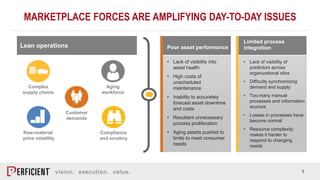
MARKETPLACE FORCES ARE AMPLIFYING DAY-TO-DAY ISSUES
Poor asset performance
• Lack of visibility into
asset health
• High costs of
unscheduled
maintenance
• Inability to accurately
forecast asset downtime
and costs
• Resultant unnecessary
process proliferation
• Aging assets pushed to
limits to meet consumer
needs
Limited process
integration
• Lack of visibility of
predictors across
organizational silos
• Difficulty synchronizing
demand and supply
• Too many manual
processes and information
sources
• Losses in processes have
become normal
• Resource complexity
makes it harder to
respond to changing
needs
Raw-material
price volatility
Compliance
and scrutiny
Aging
workforce
Complex
supply chains
Customer
demands
Lean operations
6
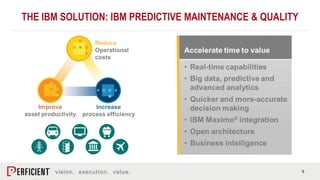
THE IBM SOLUTION: IBM PREDICTIVE MAINTENANCE & QUALITY
7
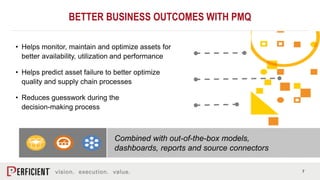
• Helps monitor, maintain and optimize assets for
better availability, utilization and performance
• Helps predict asset failure to better optimize
quality and supply chain processes
• Reduces guesswork during the
decision-making process
Combined with out-of-the-box models,
dashboards, reports and source connectors
BETTER BUSINESS OUTCOMES WITH PMQ
8
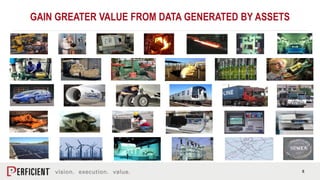
GAIN GREATER VALUE FROM DATA GENERATED BY ASSETS
9
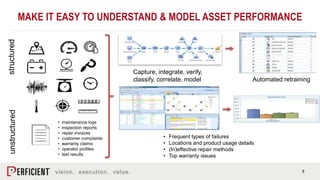
MAKE IT EASY TO UNDERSTAND & MODEL ASSET PERFORMANCE
unstructuredstructured
• maintenance logs
• inspection reports
• repair invoices
• customer complaints
• warranty claims
• operator profiles
• test results
• Frequent types of failures
• Locations and product usage details
• (In)effective repair methods
• Top warranty issues
Capture, integrate, verify,
classify, correlate, model Automated retraining
10
EXCERPT FROM UPTIME MAGAZINE ARTICLE – WHY PMQ?
Why PMQ? In my words:
Is this the right time to bring Big Data analytics to the asset
management world? YES
 Many tools enhance the maintenance process
 Few existing tools provide the total picture
 Large quantities of data exist from a lot of sources, but it’s tough
to get the best results
What’s the real goal of a maintenance team?
“On a flight path of continuous improvement, always striving to achieve
precision maintenance”
11
WHAT IS PRECISION MAINTENANCE?
Making more precise
calls around predictive
failure probability
 You found an anomaly – How
long before it fails?
 Do I need another tool to
validate what I found?
 Do I need to call in outside help?
 Can we get by until the
weekend? End of month? Etc.
Live health scores of my
most critical assets
 Trending data from many sources
 Patterning data from many
sources
 Aggregating multiple data
sources, in any format
 System getting smarter every day
Automated actions direct
from the PMQ system
 Auto generated work orders
 Auto generated communication
templates
 Auto-generated texts, voice
messages, etc.
“Maintenance teams are a vital part of the manufacturing process as long as we focus on
throughput and quality. We must continuously deliver uptime and equipment reliability.”
12
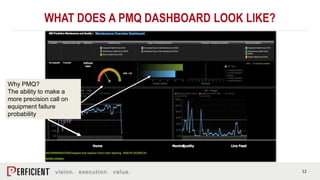
WHAT DOES A PMQ DASHBOARD LOOK LIKE?
Why PMQ?
The ability to make a
more precision call on
equipment failure
probability
13
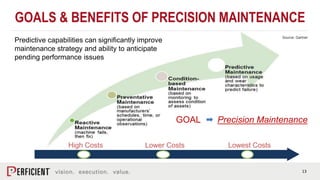
GOALS & BENEFITS OF PRECISION MAINTENANCE
Source: Gartner
GOAL Precision Maintenance
High Costs Lower Costs Lowest Costs
Predictive capabilities can significantly improve
maintenance strategy and ability to anticipate
pending performance issues
14
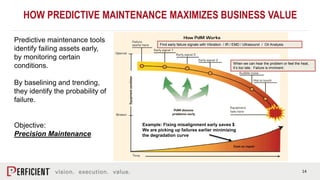
Predictive maintenance tools
identify failing assets early,
by monitoring certain
conditions.
By baselining and trending,
they identify the probability of
failure.
Objective:
Precision Maintenance
Find early failure signals with Vibration / IR / EMD / Ultrasound / Oil Analysis
When we can hear the problem or feel the heat,
it’s too late. Failure is imminent.
Example: Fixing misalignment early saves $
We are picking up failures earlier minimizing
the degradation curve
HOW PREDICTIVE MAINTENANCE MAXIMIZES BUSINESS VALUE
15
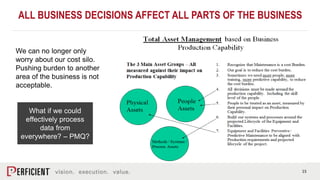
We can no longer only
worry about our cost silo.
Pushing burden to another
area of the business is not
acceptable.
What if we could
effectively process
data from
everywhere? – PMQ?
ALL BUSINESS DECISIONS AFFECT ALL PARTS OF THE BUSINESS
16
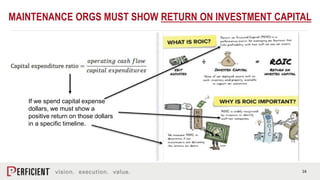
MAINTENANCE ORGS MUST SHOW RETURN ON INVESTMENT CAPITAL
If we spend capital expense
dollars, we must show a
positive return on those dollars
in a specific timeline.
17
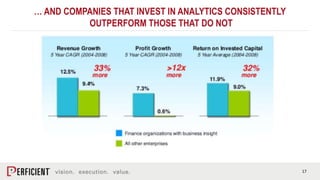
… AND COMPANIES THAT INVEST IN ANALYTICS CONSISTENTLY
OUTPERFORM THOSE THAT DO NOT
18
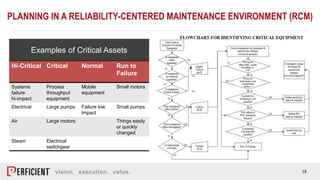
Hi-Critical Critical Normal Run to
Failure
Systems
failure
hi-impact
Process
throughput
equipment
Mobile
equipment
Small motors
Electrical Large pumps Failure low
impact
Small pumps
Air Large motors Things easily
or quickly
changed
Steam Electrical
switchgear
Examples of Critical Assets
PLANNING IN A RELIABILITY-CENTERED MAINTENANCE ENVIRONMENT (RCM)
19
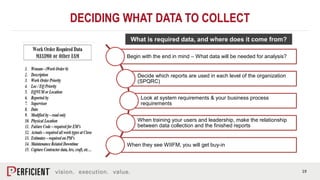
DECIDING WHAT DATA TO COLLECT
Begin with the end in mind – What data will be needed for analysis?
Decide which reports are used in each level of the organization
(SPQRC)
Look at system requirements & your business process
requirements
When training your users and leadership, make the relationship
between data collection and the finished reports
When they see WIIFM, you will get buy-in
MAXIMO or Other EAM
What is required data, and where does it come from?
20
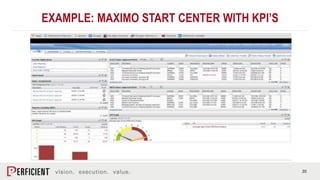
EXAMPLE: MAXIMO START CENTER WITH KPI’S
21
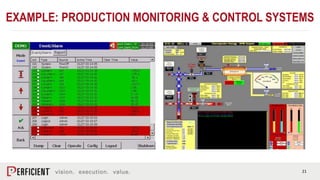
EXAMPLE: PRODUCTION MONITORING & CONTROL SYSTEMS
22
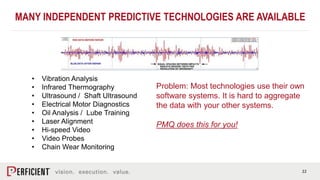
Problem: Most technologies use their own
software systems. It is hard to aggregate
the data with your other systems.
PMQ does this for you!
• Vibration Analysis
• Infrared Thermography
• Ultrasound / Shaft Ultrasound
• Electrical Motor Diagnostics
• Oil Analysis / Lube Training
• Laser Alignment
• Hi-speed Video
• Video Probes
• Chain Wear Monitoring
MANY INDEPENDENT PREDICTIVE TECHNOLOGIES ARE AVAILABLE
23
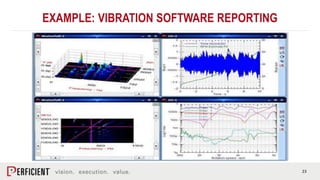
EXAMPLE: VIBRATION SOFTWARE REPORTING
24
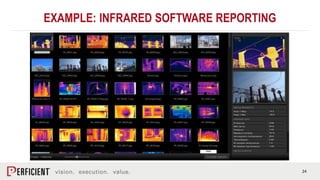
EXAMPLE: INFRARED SOFTWARE REPORTING
25
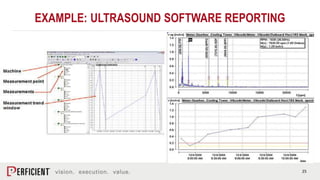
EXAMPLE: ULTRASOUND SOFTWARE REPORTING
26
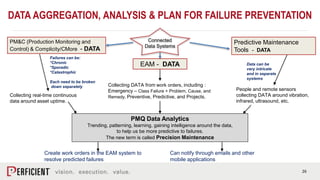
PM&C (Production Monitoring and
Control) & Complicity/CMore - DATA
EAM - DATA
Predictive Maintenance
Tools - DATA
Collecting real-time continuous
data around asset uptime.
People and remote sensors
collecting DATA around vibration,
infrared, ultrasound, etc.
Collecting DATA from work orders, including :
Emergency – Class Failure + Problem, Cause, and
Remedy, Preventive, Predictive, and Projects.
PMQ Data Analytics
Trending, patterning, learning, gaining intelligence around the data,
to help us be more predictive to failures.
The new term is called Precision Maintenance
Create work orders in the EAM system to
resolve predicted failures
Can notify through emails and other
mobile applications
Failures can be:
*Chronic
*Sporadic
*Catastrophic
Each need to be broken
down separately
Data can be
very intricate
and in separate
systems
onnected
Data Sets
Connected
Data Systems
DATA AGGREGATION, ANALYSIS & PLAN FOR FAILURE PREVENTATION
27
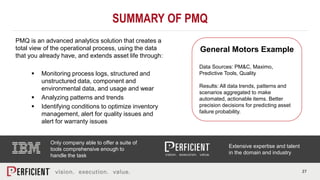
SUMMARY OF PMQ
PMQ is an advanced analytics solution that creates a
total view of the operational process, using the data
that you already have, and extends asset life through:
 Monitoring process logs, structured and
unstructured data, component and
environmental data, and usage and wear
 Analyzing patterns and trends
 Identifying conditions to optimize inventory
management, alert for quality issues and
alert for warranty issues
Only company able to offer a suite of
tools comprehensive enough to
handle the task
Extensive expertise and talent
in the domain and industry
General Motors Example
Data Sources: PM&C, Maximo,
Predictive Tools, Quality
Results: All data trends, patterns and
scenarios aggregated to make
automated, actionable items. Better
precision decisions for predicting asset
failure probability.
28
PMQ IN THE REGULATED INDUSTRIES: LIFE SCIENCES
“Product recall and defect reporting data demonstrate unacceptably high occurrences of problems
attributed to inherent defects in product and process design; these data further indicate failures in
the implementation of manufacturing process scale-up as well as routine production.”
“There have been alarming shortages of critical drugs over the past few years. Many of these
shortages were caused by the use of outdated equipment, reliance on aging facilities operating at
maximum production capacity, and lack of effective quality management systems.”
FDA Pharmaceutical Quality Oversight: One Quality Voice
29
PMQ SUPPORT FOR FDA COMPLIANCE
Predictive Maintenance & Quality
 Food & Drug Administration
 Office of Pharmaceutical Quality (2015)
 Quality Systems Regulations
 Quality by Design
 Process Analytical Tools
 Current Good Manufacturing Practices
PMQ supports the FDA and the OPQ under QSR and through QbD
utilizing PAT while complying to cGMP
30
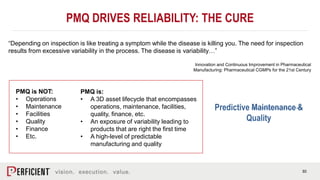
PMQ DRIVES RELIABILITY: THE CURE
“Depending on inspection is like treating a symptom while the disease is killing you. The need for inspection
results from excessive variability in the process. The disease is variability…”
Innovation and Continuous Improvement in Pharmaceutical
Manufacturing: Pharmaceutical CGMPs for the 21st Century
PMQ is NOT:
• Operations
• Maintenance
• Facilities
• Quality
• Finance
• Etc.
PMQ is:
• A 3D asset lifecycle that encompasses
operations, maintenance, facilities,
quality, finance, etc.
• An exposure of variability leading to
products that are right the first time
• A high-level of predictable
manufacturing and quality
Predictive Maintenance &
Quality
31
PMQ IN THE REGULATED INDUSTRIES: LIFE SCIENCES
Janet Woodcock, Director, FDA CDER (Center for Drug Evaluation and Research):
“…to shift [the FDA’s] focus to performance and away from compliance.”
• By its own admission, the heavy focus on compliance by the FDA and industry
has caused quality to suffer
• Performance (quality, throughput) drives compliance
• Quality metrics (analytics) and innovative technology/processes (predictability) are the future
PMQ is tipping the scales by exposing, eliminating or mitigating the risk
of failure and creating a culture of “knowns”
32
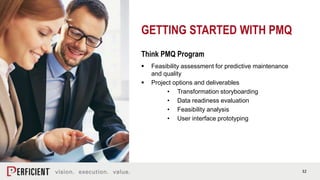
GETTING STARTED WITH PMQ
Think PMQ Program
 Feasibility assessment for predictive maintenance
and quality
 Project options and deliverables
• Transformation storyboarding
• Data readiness evaluation
• Feasibility analysis
• User interface prototyping
33
FOLLOW US ONLINE
• Perficient.com/SocialMedia
• Facebook.com/Perficient
• Twitter.com/Perficient_IBM
• Blogs.perficient.com/IBM
Next up:
Leverage Customer Data to Deliver a
Personalized Digital Experience
Thursday, August 20 | 1:00 PM CT
bit.ly/datadigital

Advanced Analytics for Asset Management with IBM

  • 1.
    Advanced Analytics for AssetManagement with IBM
  • 2.
    2 ABOUT PERFICIENT Perficient isa leading information technology and management consulting firm serving clients throughout North America. We help clients implement digital experience, business optimization, and industry solutions that cultivate and captivate customers, drive efficiency and productivity, integrate business processes, improve productivity, reduce costs, and create a more agile enterprise.
  • 3.
    3 PERFICIENT PROFILE Founded in1997 Public, NASDAQ: PRFT 2014 revenue $456.7 million Major market locations: Allentown, Atlanta, Ann Arbor, Boston, Charlotte, Chicago, Cincinnati, Columbus, Dallas, Denver, Detroit, Fairfax, Houston, Indianapolis, Lafayette, Milwaukee, Minneapolis, New York City, Northern California, Oxford (UK), Southern California, St. Louis, Toronto Global delivery centers in China and India >2,600 colleagues Dedicated solution practices ~90% repeat business rate Alliance partnerships with major technology vendors Multiple vendor/industry technology and growth awards
  • 4.
    4 ABOUT THE SPEAKERS GregCrist, IBM Technical Sales Specialist, Predictive Maintenance & Quality Solutions Greg has over eight years of experience working with customers to utilize predictive analytics to solve business problems and gain early warning of impending events. For the past three years he has focused on applying predictive analytics to various business segments within the industrial space. Kevin Clark, Perficient Practice Director, IBM Asset Management Kevin leads Perficient’s asset management practice and brings over a decade of experience in industry leadership roles in engineering and manufacturing. Prior to joining Perficient, Kevin was the Global Maximo & Maintenance Excellence Leader at Johnson & Johnson. Kevin is also on the board and/or leader of multiple asset management user groups and communities. Dave Reiber, Perficient Business Solutions Architect Dave recently joined Perficient from General Motors, where he led predictive maintenance and global training for Maximo. Dave is a co-leader, member and frequent speaker various maintenance and Maximo user groups and conferences. He holds CMRP and CPMM certifications.
  • 5.
    5 MARKETPLACE FORCES AREAMPLIFYING DAY-TO-DAY ISSUES Poor asset performance • Lack of visibility into asset health • High costs of unscheduled maintenance • Inability to accurately forecast asset downtime and costs • Resultant unnecessary process proliferation • Aging assets pushed to limits to meet consumer needs Limited process integration • Lack of visibility of predictors across organizational silos • Difficulty synchronizing demand and supply • Too many manual processes and information sources • Losses in processes have become normal • Resource complexity makes it harder to respond to changing needs Raw-material price volatility Compliance and scrutiny Aging workforce Complex supply chains Customer demands Lean operations
  • 6.
    6 THE IBM SOLUTION:IBM PREDICTIVE MAINTENANCE & QUALITY
  • 7.
    7 • Helps monitor,maintain and optimize assets for better availability, utilization and performance • Helps predict asset failure to better optimize quality and supply chain processes • Reduces guesswork during the decision-making process Combined with out-of-the-box models, dashboards, reports and source connectors BETTER BUSINESS OUTCOMES WITH PMQ
  • 8.
    8 GAIN GREATER VALUEFROM DATA GENERATED BY ASSETS
  • 9.
    9 MAKE IT EASYTO UNDERSTAND & MODEL ASSET PERFORMANCE unstructuredstructured • maintenance logs • inspection reports • repair invoices • customer complaints • warranty claims • operator profiles • test results • Frequent types of failures • Locations and product usage details • (In)effective repair methods • Top warranty issues Capture, integrate, verify, classify, correlate, model Automated retraining
  • 10.
    10 EXCERPT FROM UPTIMEMAGAZINE ARTICLE – WHY PMQ? Why PMQ? In my words: Is this the right time to bring Big Data analytics to the asset management world? YES  Many tools enhance the maintenance process  Few existing tools provide the total picture  Large quantities of data exist from a lot of sources, but it’s tough to get the best results What’s the real goal of a maintenance team? “On a flight path of continuous improvement, always striving to achieve precision maintenance”
  • 11.
    11 WHAT IS PRECISIONMAINTENANCE? Making more precise calls around predictive failure probability  You found an anomaly – How long before it fails?  Do I need another tool to validate what I found?  Do I need to call in outside help?  Can we get by until the weekend? End of month? Etc. Live health scores of my most critical assets  Trending data from many sources  Patterning data from many sources  Aggregating multiple data sources, in any format  System getting smarter every day Automated actions direct from the PMQ system  Auto generated work orders  Auto generated communication templates  Auto-generated texts, voice messages, etc. “Maintenance teams are a vital part of the manufacturing process as long as we focus on throughput and quality. We must continuously deliver uptime and equipment reliability.”
  • 12.
    12 WHAT DOES APMQ DASHBOARD LOOK LIKE? Why PMQ? The ability to make a more precision call on equipment failure probability
  • 13.
    13 GOALS & BENEFITSOF PRECISION MAINTENANCE Source: Gartner GOAL Precision Maintenance High Costs Lower Costs Lowest Costs Predictive capabilities can significantly improve maintenance strategy and ability to anticipate pending performance issues
  • 14.
    14 Predictive maintenance tools identifyfailing assets early, by monitoring certain conditions. By baselining and trending, they identify the probability of failure. Objective: Precision Maintenance Find early failure signals with Vibration / IR / EMD / Ultrasound / Oil Analysis When we can hear the problem or feel the heat, it’s too late. Failure is imminent. Example: Fixing misalignment early saves $ We are picking up failures earlier minimizing the degradation curve HOW PREDICTIVE MAINTENANCE MAXIMIZES BUSINESS VALUE
  • 15.
    15 We can nolonger only worry about our cost silo. Pushing burden to another area of the business is not acceptable. What if we could effectively process data from everywhere? – PMQ? ALL BUSINESS DECISIONS AFFECT ALL PARTS OF THE BUSINESS
  • 16.
    16 MAINTENANCE ORGS MUSTSHOW RETURN ON INVESTMENT CAPITAL If we spend capital expense dollars, we must show a positive return on those dollars in a specific timeline.
  • 17.
    17 … AND COMPANIESTHAT INVEST IN ANALYTICS CONSISTENTLY OUTPERFORM THOSE THAT DO NOT
  • 18.
    18 Hi-Critical Critical NormalRun to Failure Systems failure hi-impact Process throughput equipment Mobile equipment Small motors Electrical Large pumps Failure low impact Small pumps Air Large motors Things easily or quickly changed Steam Electrical switchgear Examples of Critical Assets PLANNING IN A RELIABILITY-CENTERED MAINTENANCE ENVIRONMENT (RCM)
  • 19.
    19 DECIDING WHAT DATATO COLLECT Begin with the end in mind – What data will be needed for analysis? Decide which reports are used in each level of the organization (SPQRC) Look at system requirements & your business process requirements When training your users and leadership, make the relationship between data collection and the finished reports When they see WIIFM, you will get buy-in MAXIMO or Other EAM What is required data, and where does it come from?
  • 20.
    20 EXAMPLE: MAXIMO STARTCENTER WITH KPI’S
  • 21.
  • 22.
    22 Problem: Most technologiesuse their own software systems. It is hard to aggregate the data with your other systems. PMQ does this for you! • Vibration Analysis • Infrared Thermography • Ultrasound / Shaft Ultrasound • Electrical Motor Diagnostics • Oil Analysis / Lube Training • Laser Alignment • Hi-speed Video • Video Probes • Chain Wear Monitoring MANY INDEPENDENT PREDICTIVE TECHNOLOGIES ARE AVAILABLE
  • 23.
  • 24.
  • 25.
  • 26.
    26 PM&C (Production Monitoringand Control) & Complicity/CMore - DATA EAM - DATA Predictive Maintenance Tools - DATA Collecting real-time continuous data around asset uptime. People and remote sensors collecting DATA around vibration, infrared, ultrasound, etc. Collecting DATA from work orders, including : Emergency – Class Failure + Problem, Cause, and Remedy, Preventive, Predictive, and Projects. PMQ Data Analytics Trending, patterning, learning, gaining intelligence around the data, to help us be more predictive to failures. The new term is called Precision Maintenance Create work orders in the EAM system to resolve predicted failures Can notify through emails and other mobile applications Failures can be: *Chronic *Sporadic *Catastrophic Each need to be broken down separately Data can be very intricate and in separate systems onnected Data Sets Connected Data Systems DATA AGGREGATION, ANALYSIS & PLAN FOR FAILURE PREVENTATION
  • 27.
    27 SUMMARY OF PMQ PMQis an advanced analytics solution that creates a total view of the operational process, using the data that you already have, and extends asset life through:  Monitoring process logs, structured and unstructured data, component and environmental data, and usage and wear  Analyzing patterns and trends  Identifying conditions to optimize inventory management, alert for quality issues and alert for warranty issues Only company able to offer a suite of tools comprehensive enough to handle the task Extensive expertise and talent in the domain and industry General Motors Example Data Sources: PM&C, Maximo, Predictive Tools, Quality Results: All data trends, patterns and scenarios aggregated to make automated, actionable items. Better precision decisions for predicting asset failure probability.
  • 28.
    28 PMQ IN THEREGULATED INDUSTRIES: LIFE SCIENCES “Product recall and defect reporting data demonstrate unacceptably high occurrences of problems attributed to inherent defects in product and process design; these data further indicate failures in the implementation of manufacturing process scale-up as well as routine production.” “There have been alarming shortages of critical drugs over the past few years. Many of these shortages were caused by the use of outdated equipment, reliance on aging facilities operating at maximum production capacity, and lack of effective quality management systems.” FDA Pharmaceutical Quality Oversight: One Quality Voice
  • 29.
    29 PMQ SUPPORT FORFDA COMPLIANCE Predictive Maintenance & Quality  Food & Drug Administration  Office of Pharmaceutical Quality (2015)  Quality Systems Regulations  Quality by Design  Process Analytical Tools  Current Good Manufacturing Practices PMQ supports the FDA and the OPQ under QSR and through QbD utilizing PAT while complying to cGMP
  • 30.
    30 PMQ DRIVES RELIABILITY:THE CURE “Depending on inspection is like treating a symptom while the disease is killing you. The need for inspection results from excessive variability in the process. The disease is variability…” Innovation and Continuous Improvement in Pharmaceutical Manufacturing: Pharmaceutical CGMPs for the 21st Century PMQ is NOT: • Operations • Maintenance • Facilities • Quality • Finance • Etc. PMQ is: • A 3D asset lifecycle that encompasses operations, maintenance, facilities, quality, finance, etc. • An exposure of variability leading to products that are right the first time • A high-level of predictable manufacturing and quality Predictive Maintenance & Quality
  • 31.
    31 PMQ IN THEREGULATED INDUSTRIES: LIFE SCIENCES Janet Woodcock, Director, FDA CDER (Center for Drug Evaluation and Research): “…to shift [the FDA’s] focus to performance and away from compliance.” • By its own admission, the heavy focus on compliance by the FDA and industry has caused quality to suffer • Performance (quality, throughput) drives compliance • Quality metrics (analytics) and innovative technology/processes (predictability) are the future PMQ is tipping the scales by exposing, eliminating or mitigating the risk of failure and creating a culture of “knowns”
  • 32.
    32 GETTING STARTED WITHPMQ Think PMQ Program  Feasibility assessment for predictive maintenance and quality  Project options and deliverables • Transformation storyboarding • Data readiness evaluation • Feasibility analysis • User interface prototyping
  • 33.
    33 FOLLOW US ONLINE •Perficient.com/SocialMedia • Facebook.com/Perficient • Twitter.com/Perficient_IBM • Blogs.perficient.com/IBM Next up: Leverage Customer Data to Deliver a Personalized Digital Experience Thursday, August 20 | 1:00 PM CT bit.ly/datadigital