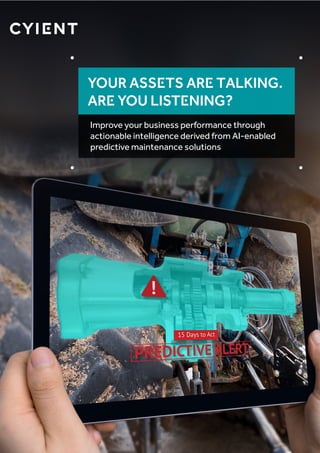
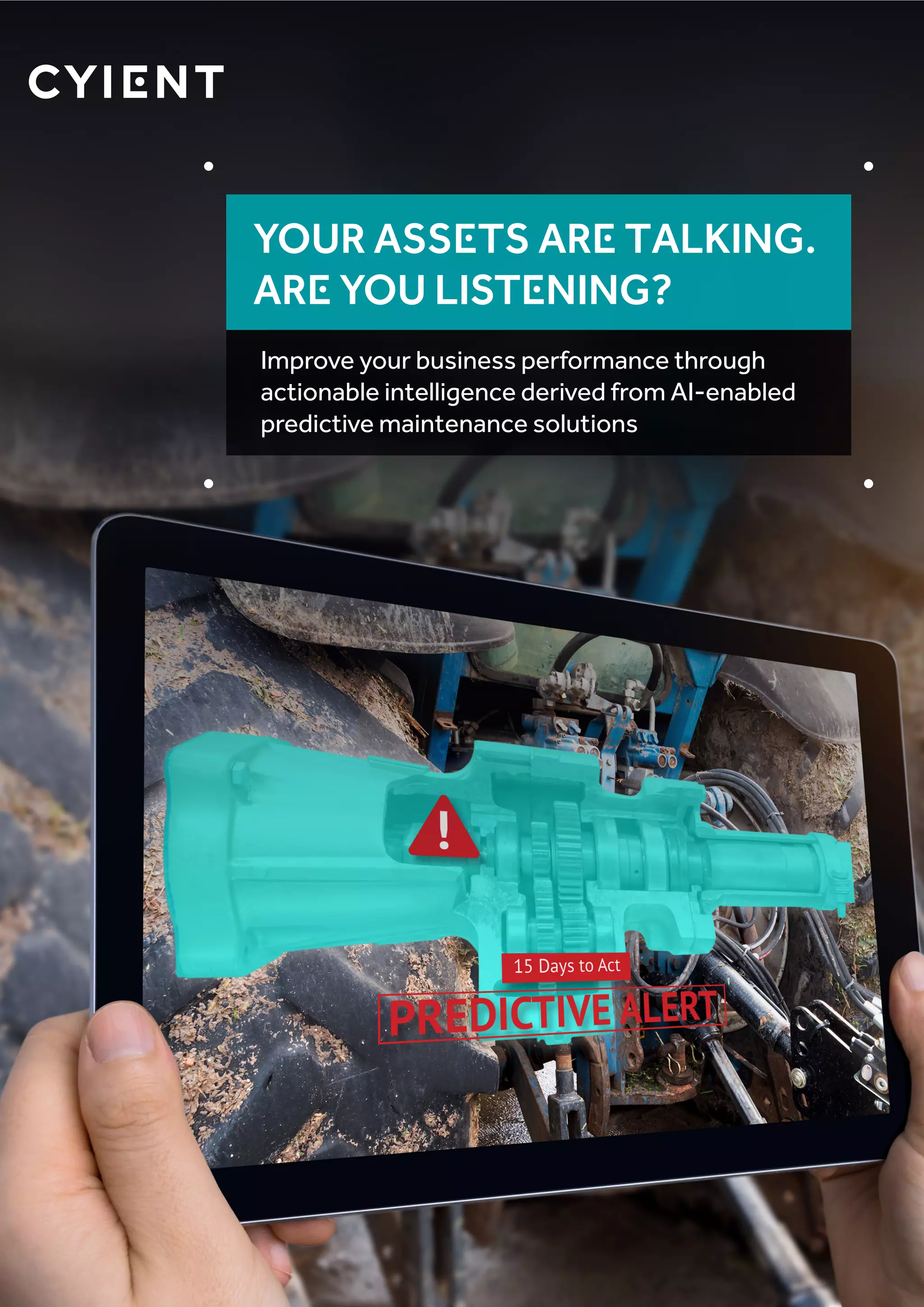
Your assets are talking.
Are you listening?
Improve your business performance through
actionable intelligence derived from AI-enabled
predictive maintenance solutions
2
Industrial | Whitepaper
CONTENTS
Abstract 01
Insights that Drive Asset Performance 01
So what’s challenging the pursuit of data-driven intelligence? 02
Effective predictive maintenance solution: Here’s what it takes 02
Leverage existing technology on the backend 01
Apply models and algorithms to data to derive meaningful insights 04
Provide a flexible front-end on top to seamlessly integrate with the
existing tools
04
Benefits of Predictive Maintenance 05
The Cyient Edge 06
The Cyient Thought Board 07
Conclusion 08
About Cyient 09
01
Industrial | Whitepaper
The field of maintenance is as old as the first
industrial revolution itself, which introduced
the concept of mechanized manufacturing.
As machines improved efficiency and brought
scale to the production process, manufacturers
soon realized the high cost of breakdowns and
related operational issues. And thus began the
science of maintenance and deriving maximum
value from an asset.
Over the years, our reliance on machines
and automation has consistently increased,
and while it has reaped benefits, it also has
a downside. According to a recent study,
industrial manufacturers incur a loss of around
$50 billion every year due to unplanned
downtime—about 42% of which is caused
due to equipment failure. The study also
suggested that poor maintenance of assets
reduced productivity by up to 20%. While these
numbers are staggering, companies today
have access to new, advanced technologies
such as artificial intelligence (AI) and IoT, which
allow machines to communicate with humans
and provide insights essential for proactive
maintenance planning.
Like the conversations we have in our daily
lives, it is vital to listen to what our assets are
saying and respond to what we hear. Given the
complexity of methodologies, the increasing
importance of machine learning, and the
sheer scale of data sets, many organizations
understandably outsource the responsibility
to interpret data for insights to experts.
However, the strength of machine learning and
similar technologies lies in making informed
decisions from the data, adjusting as new data
is captured, and embedding actions into work
processes in real-time.
Active “listening” enables companies to move
away from a reactive approach to maintenance
toward proactive and predictive maintenance
activities. Developing a predictive maintenance
strategy can be a daunting task that not only
requires robust tools to enable, but also tools
that connect with and allow employees to
listen to what these devices are saying. Real
success will come from breaking down the wall
of silence between employees and the assets
they are managing. Unfortunately, many asset
management solutions follow a pattern of
gathering and reporting without considering
how to support the change from reactive to
predictive maintenance, leaving unrealized
potential savings or efficiencies from their data
on the table.
Abstract
The artificial intelligence (AI) revolution is here and is set to transform how companies
organize, operate, develop talent, create value, and service their customers.
We are well past the groundswell, and while the momentum build-up is evident, only
a few organizations have gone ahead to leverage the potential in data and reap the
rewards. Companies are increasingly connecting assets, equipment, and devices, and
gathering all that information en masse into distributed databases. Unfortunately, and
all too often, the data is captured but not used to drive decisions. Much like a one-
sided conversation, businesses record what is being said by the equipment, but are
challenged to “listen” to what it is “saying” and taking action in useful and intelligent
ways. This white paper discusses challenges faced by organizations in gaining real
insights from their assets and the best practices to overcome them.
Insights that Drive Asset Performance
02
Industrial | Whitepaper
This white paper covers the typical challenges
asset-intensive industries experience when
developing and implementing predictive
maintenance programs. It also focuses on
ways to overcome these challenges by driving
profit and growth from new technologies and
leveraging the opportunities offered by big data
and advanced digital operating models.
So what’s challenging the pursuit of
data-driven intelligence?
The pressures of faster time-to-market:
Today’s competitive business environment
requires companies to bring their products to
market faster and more cost-effectively than
ever before. Reduced downtime, improved
operational efficiency, optimized maintenance
costs, effective forecasting, and improved
production efficiency are the continuous asks
of the industry. To achieve these, companies
should move away from a responsive
maintenance strategy and move toward an
informed, proactive maintenance strategy.
The end goal of a proactive maintenance
strategy can be difficult to attain without the
right solution.
A continually evolving technology landscape:
The digitization of equipment and technologies
such as the IoT are dramatically changing
business models for equipment manufacturers
and operators. Businesses must keep up with
the rapid pace of technology change, business
innovation, and security concerns while
delivering on expectations.
Interpreting and making sense of big data:
Advanced analytics and machine learning are
becoming embedded in organizations today.
Big data capture what is said, and advanced
analytics processes it into meaningful bites.
However, once processed, data still needs to
be turned into something useful. The real goal
is improved business performance through
actionable intelligence—not pristine data
Many asset management
solutions gather and
report data without
considering how it
supports predictive
maintenance. Advanced
analytics is an essential
means to bridge this gap.
sets, interesting patterns, or killer algorithms.
This quest for data intelligence is what every
company is pursuing.
Distilling insights from information:
Advanced data analytics is an essential means
to an end. It’s a discriminating tool to identify
and recommend a value-driving answer.
However, that answer varies depending on
the company, industry, or geography. It is
difficult to find a generic solution when every
data set is unique. Building a customized
solution requires diverse and niche skills from
product designers, data scientists, technology
architects, and developers. No matter what
the starting point is, a strategy to get insights
unleashed by analytics should be at the core
of an organization’s approach to continuously
define and improve.
Democratizing technology within the
organization: Technology by itself is an enabler
and a tool for effective decision-making. To
realize the true potential it offers, the focus
should be on leveraging big data and analytics
to provide employees with tools to work
efficiently rather than making them experts
in statistics. Within asset management,
these employees are technicians, repair
and maintenance workers, and factory line
operators and supervisors. Access to the right
tools and advanced analytics translates into
better-informed and timely decision-making
for those who regularly interact with the
equipment assets.
03
Industrial | Whitepaper
Effective predictive maintenance solution: Here’s what it takes
Many companies realize that the pace with which they want to add advanced technology to support
operations is not in sync with the capacity or capability of their underlying IT infrastructure.
Additionally, connecting a diverse set of IoT endpoints and assets can mean a sophisticated
translation of connectivity options and communication protocols that either isn’t supported or
don’t integrate smoothly with existing infrastructure. To overcome these challenges, companies
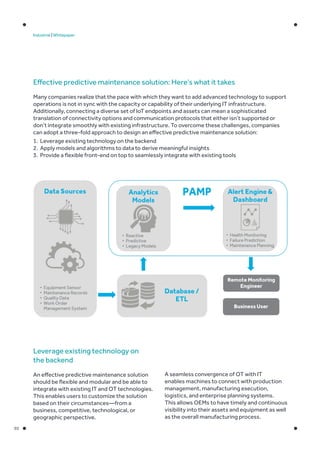
can adopt a three-fold approach to design an effective predictive maintenance solution:
1. Leverage existing technology on the backend
2. Apply models and algorithms to data to derive meaningful insights
3. Provide a flexible front-end on top to seamlessly integrate with existing tools
Leverage existing technology on
the backend
An effective predictive maintenance solution
should be flexible and modular and be able to
integrate with existing IT and OT technologies.
This enables users to customize the solution
based on their circumstances—from a
business, competitive, technological, or
geographic perspective.
A seamless convergence of OT with IT
enables machines to connect with production
management, manufacturing execution,
logistics, and enterprise planning systems.
This allows OEMs to have timely and continuous
visibility into their assets and equipment as well
as the overall manufacturing process.
04
Industrial | Whitepaper
Apply models and algorithms to data
to derive meaningful insights
A robust predictive maintenance solution
empowers users to perform deep-dive analysis,
scenario planning, and search for anomalies
and non-intuitive correlations. Using machine
intelligence to identify patterns and move to
a predictive analytics model over time, such a
solution enables preventative maintenance at
the right time to prevent problems before
they occur.
By applying advanced analytics to the data their
systems generate, companies can identify and
predict performance bottlenecks and make
informed decisions about how to improve
asset operations, manage their workforce,
optimize supply chain risks, and enhance the
product design process. From a business
perspective, this allows manufacturers to
service their customers better, resulting in
increased customer satisfaction and revenue
while reducing claims and warranty costs. It also
helps minimize downtime, maintenance-related
costs, and energy consumption while increasing
the lifetime of their machinery.
Provide a flexible front-end on top to
seamlessly integrate with the existing
tools
The value such a solution brings is fully realized
only if it is used by and is accessible to internal
stakeholders across the board. These users
are often cut across functions and are not
necessarily from an IT background. Given this, it
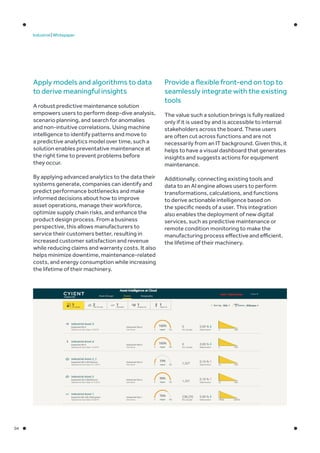
helps to have a visual dashboard that generates
insights and suggests actions for equipment
maintenance.
Additionally, connecting existing tools and
data to an AI engine allows users to perform
transformations, calculations, and functions
to derive actionable intelligence based on
the specific needs of a user. This integration
also enables the deployment of new digital
services, such as predictive maintenance or
remote condition monitoring to make the
manufacturing process effective and efficient.
the lifetime of their machinery.
05
Industrial | Whitepaper
Benefits of Predictive Maintenance
To leverage the power of data combined with
analytics, companies can be successful when
there is a solution in place that can help easily
access and find the appropriate information.
The focus should be on designing metrics that
are powerfully predictive and informative, but
also transformative for the organization. An
AI-enabled predictive maintenance solution can
help drive a continuous improvement process
from an analytics perspective, and the insight
generated. In addition to this, it also helps in the
following aspects:
•	 Improve quality: An enterprise view of quality
performance data and early identification
of potential issues and root causes helps
maximize production yield, manage the cost
of quality, and increase customer satisfaction.
•	 Reduce unplanned downtime: Predictive
models monitor the system in near-real-
time to identify patterns that indicate a
performance issue or predict a failure before
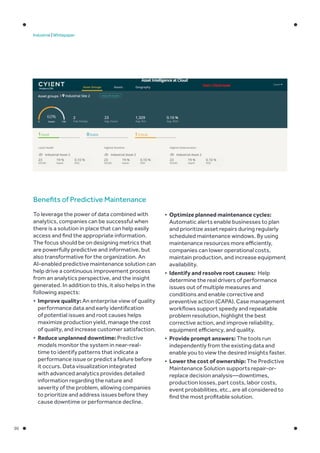
it occurs. Data visualization integrated
with advanced analytics provides detailed
information regarding the nature and
severity of the problem, allowing companies
to prioritize and address issues before they
cause downtime or performance decline.
•	 Optimize planned maintenance cycles:
Automatic alerts enable businesses to plan
and prioritize asset repairs during regularly
scheduled maintenance windows. By using
maintenance resources more efficiently,
companies can lower operational costs,
maintain production, and increase equipment
availability.
•	 Identify and resolve root causes: Help
determine the real drivers of performance
issues out of multiple measures and
conditions and enable corrective and
preventive action (CAPA). Case management
workflows support speedy and repeatable
problem resolution, highlight the best
corrective action, and improve reliability,
equipment efficiency, and quality.
•	 Provide prompt answers: The tools run
independently from the existing data and
enable you to view the desired insights faster.
•	 Lower the cost of ownership: The Predictive
Maintenance Solution supports repair-or-
replace decision analysis—downtimes,
production losses, part costs, labor costs,
event probabilities, etc., are all considered to
find the most profitable solution.
06
Industrial | Whitepaper
The Cyient Edge
Leveraging millions of hours of experience in
designing industrial equipment, products, and
end-to-end systems, Cyient has developed
an accelerated value realization model for
connected products based on their existing
design and market expectations.
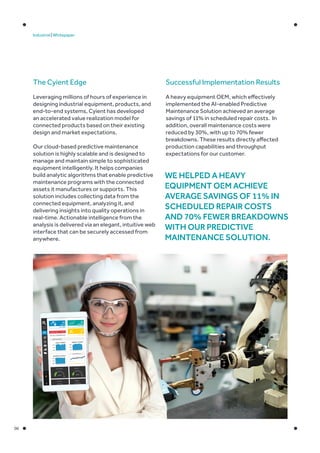
Our cloud-based predictive maintenance
solution is highly scalable and is designed to
manage and maintain simple to sophisticated
equipment intelligently. It helps companies
build analytic algorithms that enable predictive
maintenance programs with the connected
assets it manufactures or supports. This
solution includes collecting data from the
connected equipment, analyzing it, and
delivering insights into quality operations in
real-time. Actionable intelligence from the
analysis is delivered via an elegant, intuitive web
interface that can be securely accessed from
anywhere.
Successful Implementation Results
A heavy equipment OEM, which effectively
implemented the AI-enabled Predictive
Maintenance Solution achieved an average
savings of 11% in scheduled repair costs. In
addition, overall maintenance costs were
reduced by 30%, with up to 70% fewer
breakdowns. These results directly affected
production capabilities and throughput
expectations for our customer.
We helped a heavy
equipment OEM achieve
average savings of 11% in
scheduled repair costs
and 70% fewer breakdowns
with our predictive
maintenance solution.
07
Industrial | Whitepaper
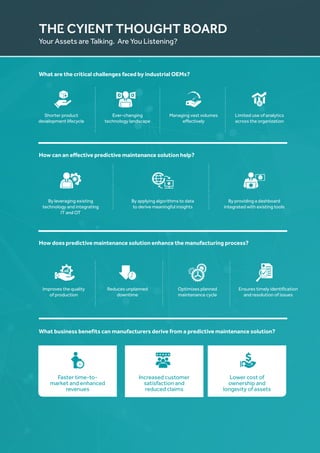
The Cyient Thought Board
What are the critical challenges faced by industrial OEMs?
Your Assets are Talking. Are You Listening?
What business benefits can manufacturers derive from a predictive maintenance solution?
How does predictive maintenance solution enhance the manufacturing process?
How can an effective predictive maintenance solution help?
Shorter product
development lifecycle
Improves the quality
of production
Ever-changing
technology landscape
Reduces unplanned
downtime
By leveraging existing
technology and integrating
IT and OT
By applying algorithms to data
to derive meaningful insights
By providing a dashboard
integrated with existing tools
Limited use of analytics
across the organization
Ensures timely identification
and resolution of issues
Managing vast volumes
effectively
Optimizes planned
maintenance cycle
Faster time-to-
market and enhanced
revenues
Increased customer
satisfaction and
reduced claims
Lower cost of
ownership and
longevity of assets
08
Industrial | Whitepaper
Conclusion
The digital transformation of business is here, and it is putting an increasing pressure on industrial
companies to deliver intelligent equipment for their customers. To get an edge in this hyper-
competitive landscape, it is imperative for companies to look beyond capturing or storing data.
The key to success lies in the ability of a manufacturer to capture and analyze asset data to draw
real-time insights to monitor and improve asset performance that leads to operational efficiency.
Companies that listen to their equipment and focus on analytics tied with improved business
processes can expect a faster return on their investment than those that use analytics without an
effective solution to deliver insights.
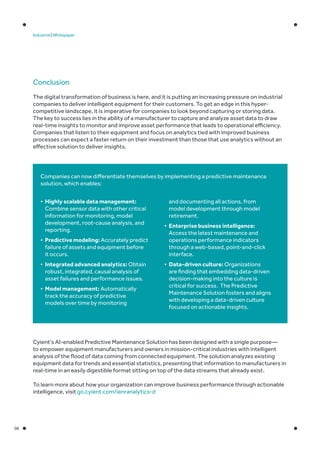
Companies can now differentiate themselves by implementing a predictive maintenance
solution, which enables:
•	 Highly scalable data management:
Combine sensor data with other critical
information for monitoring, model
development, root-cause analysis, and
reporting.
•	 Predictive modeling: Accurately predict
failure of assets and equipment before
it occurs.
•	 Integrated advanced analytics: Obtain
robust, integrated, causal analysis of
asset failures and performance issues.
•	 Model management: Automatically
track the accuracy of predictive
models over time by monitoring
and documenting all actions, from
model development through model
retirement.
•	 Enterprise business intelligence:
Access the latest maintenance and
operations performance indicators
through a web-based, point-and-click
interface.
•	 Data-driven culture: Organizations
are finding that embedding data-driven
decision-making into the culture is
critical for success. The Predictive
Maintenance Solution fosters and aligns
with developing a data-driven culture
focused on actionable insights.
Cyient’s AI-enabled Predictive Maintenance Solution has been designed with a single purpose—
to empower equipment manufacturers and owners in mission-critical industries with intelligent
analysis of the flood of data coming from connected equipment. The solution analyzes existing
equipment data for trends and essential statistics, presenting that information to manufacturers in
real-time in an easily digestible format sitting on top of the data streams that already exist.
To learn more about how your organization can improve business performance through actionable
intelligence, visit go.cyient.com/ienranalytics-d
09
Industrial | Whitepaper
Contact UsAbout Cyient
North America Headquarters
Cyient, Inc.
99 East River Drive
5th Floor
East Hartford, CT 06108
USA
T: +1 860 528 5430
F: +1 860 528 5873
Europe, Middle East, and Africa Headquarters
Cyient Europe Limited
Apex, Forbury Road,
Reading
RG1 1AX
UK
T: +44 118 3043720
Asia Pacific Headquarters
Cyient Limited
Level 1, 350 Collins Street
Melbourne, Victoria, 3000
Australia
T: +61 3 8605 4815
F: +61 3 8601 1180
Global Headquarters
Cyient Limited
Plot No. 11
Software Units Layout
Infocity, Madhapur
Hyderabad - 500081
India
T: +91 40 6764 1000
F: +91 40 2311 0352
Cyient (Estd: 1991, NSE: CYIENT) is a global
engineering and technology solutions
company. As a Design, Build, and Maintain
partner, for leading organizations worldwide,
we take solution ownership across the value
chain to help clients focus on their core,
innovate, and stay ahead of the curve. We
leverage digital technologies, advanced
analytics capabilities, and our domain
knowledge and technical expertise, to solve
complex business problems.
With over 15,000 employees in 20 countries,
we partner with clients to operate as part of
their extended team in ways that best suit
their organization’s culture and requirements.
Our industry focus includes aerospace and
defense, healthcare, telecommunications, rail
transportation, semiconductor, geospatial,
industrial, and energy.
For more information, please visit
www.cyient.com
© 2019 Cyient. Cyient believes the information in this publication is accurate as of its publication date; such information is subject to change
without notice. Cyient acknowledges the proprietary rights of the trademarks and product names of other companies mentioned in this document.
IND_WP_PAM_OV_1019

Predictive Maintenance Solution -1019

  • 1.
    Your assets aretalking. Are you listening? Improve your business performance through actionable intelligence derived from AI-enabled predictive maintenance solutions
  • 2.
    2 Industrial | Whitepaper CONTENTS Abstract01 Insights that Drive Asset Performance 01 So what’s challenging the pursuit of data-driven intelligence? 02 Effective predictive maintenance solution: Here’s what it takes 02 Leverage existing technology on the backend 01 Apply models and algorithms to data to derive meaningful insights 04 Provide a flexible front-end on top to seamlessly integrate with the existing tools 04 Benefits of Predictive Maintenance 05 The Cyient Edge 06 The Cyient Thought Board 07 Conclusion 08 About Cyient 09
  • 3.
    01 Industrial | Whitepaper Thefield of maintenance is as old as the first industrial revolution itself, which introduced the concept of mechanized manufacturing. As machines improved efficiency and brought scale to the production process, manufacturers soon realized the high cost of breakdowns and related operational issues. And thus began the science of maintenance and deriving maximum value from an asset. Over the years, our reliance on machines and automation has consistently increased, and while it has reaped benefits, it also has a downside. According to a recent study, industrial manufacturers incur a loss of around $50 billion every year due to unplanned downtime—about 42% of which is caused due to equipment failure. The study also suggested that poor maintenance of assets reduced productivity by up to 20%. While these numbers are staggering, companies today have access to new, advanced technologies such as artificial intelligence (AI) and IoT, which allow machines to communicate with humans and provide insights essential for proactive maintenance planning. Like the conversations we have in our daily lives, it is vital to listen to what our assets are saying and respond to what we hear. Given the complexity of methodologies, the increasing importance of machine learning, and the sheer scale of data sets, many organizations understandably outsource the responsibility to interpret data for insights to experts. However, the strength of machine learning and similar technologies lies in making informed decisions from the data, adjusting as new data is captured, and embedding actions into work processes in real-time. Active “listening” enables companies to move away from a reactive approach to maintenance toward proactive and predictive maintenance activities. Developing a predictive maintenance strategy can be a daunting task that not only requires robust tools to enable, but also tools that connect with and allow employees to listen to what these devices are saying. Real success will come from breaking down the wall of silence between employees and the assets they are managing. Unfortunately, many asset management solutions follow a pattern of gathering and reporting without considering how to support the change from reactive to predictive maintenance, leaving unrealized potential savings or efficiencies from their data on the table. Abstract The artificial intelligence (AI) revolution is here and is set to transform how companies organize, operate, develop talent, create value, and service their customers. We are well past the groundswell, and while the momentum build-up is evident, only a few organizations have gone ahead to leverage the potential in data and reap the rewards. Companies are increasingly connecting assets, equipment, and devices, and gathering all that information en masse into distributed databases. Unfortunately, and all too often, the data is captured but not used to drive decisions. Much like a one- sided conversation, businesses record what is being said by the equipment, but are challenged to “listen” to what it is “saying” and taking action in useful and intelligent ways. This white paper discusses challenges faced by organizations in gaining real insights from their assets and the best practices to overcome them. Insights that Drive Asset Performance
  • 4.
    02 Industrial | Whitepaper Thiswhite paper covers the typical challenges asset-intensive industries experience when developing and implementing predictive maintenance programs. It also focuses on ways to overcome these challenges by driving profit and growth from new technologies and leveraging the opportunities offered by big data and advanced digital operating models. So what’s challenging the pursuit of data-driven intelligence? The pressures of faster time-to-market: Today’s competitive business environment requires companies to bring their products to market faster and more cost-effectively than ever before. Reduced downtime, improved operational efficiency, optimized maintenance costs, effective forecasting, and improved production efficiency are the continuous asks of the industry. To achieve these, companies should move away from a responsive maintenance strategy and move toward an informed, proactive maintenance strategy. The end goal of a proactive maintenance strategy can be difficult to attain without the right solution. A continually evolving technology landscape: The digitization of equipment and technologies such as the IoT are dramatically changing business models for equipment manufacturers and operators. Businesses must keep up with the rapid pace of technology change, business innovation, and security concerns while delivering on expectations. Interpreting and making sense of big data: Advanced analytics and machine learning are becoming embedded in organizations today. Big data capture what is said, and advanced analytics processes it into meaningful bites. However, once processed, data still needs to be turned into something useful. The real goal is improved business performance through actionable intelligence—not pristine data Many asset management solutions gather and report data without considering how it supports predictive maintenance. Advanced analytics is an essential means to bridge this gap. sets, interesting patterns, or killer algorithms. This quest for data intelligence is what every company is pursuing. Distilling insights from information: Advanced data analytics is an essential means to an end. It’s a discriminating tool to identify and recommend a value-driving answer. However, that answer varies depending on the company, industry, or geography. It is difficult to find a generic solution when every data set is unique. Building a customized solution requires diverse and niche skills from product designers, data scientists, technology architects, and developers. No matter what the starting point is, a strategy to get insights unleashed by analytics should be at the core of an organization’s approach to continuously define and improve. Democratizing technology within the organization: Technology by itself is an enabler and a tool for effective decision-making. To realize the true potential it offers, the focus should be on leveraging big data and analytics to provide employees with tools to work efficiently rather than making them experts in statistics. Within asset management, these employees are technicians, repair and maintenance workers, and factory line operators and supervisors. Access to the right tools and advanced analytics translates into better-informed and timely decision-making for those who regularly interact with the equipment assets.
  • 5.
    03 Industrial | Whitepaper Effectivepredictive maintenance solution: Here’s what it takes Many companies realize that the pace with which they want to add advanced technology to support operations is not in sync with the capacity or capability of their underlying IT infrastructure. Additionally, connecting a diverse set of IoT endpoints and assets can mean a sophisticated translation of connectivity options and communication protocols that either isn’t supported or don’t integrate smoothly with existing infrastructure. To overcome these challenges, companies can adopt a three-fold approach to design an effective predictive maintenance solution: 1. Leverage existing technology on the backend 2. Apply models and algorithms to data to derive meaningful insights 3. Provide a flexible front-end on top to seamlessly integrate with existing tools Leverage existing technology on the backend An effective predictive maintenance solution should be flexible and modular and be able to integrate with existing IT and OT technologies. This enables users to customize the solution based on their circumstances—from a business, competitive, technological, or geographic perspective. A seamless convergence of OT with IT enables machines to connect with production management, manufacturing execution, logistics, and enterprise planning systems. This allows OEMs to have timely and continuous visibility into their assets and equipment as well as the overall manufacturing process.
  • 6.
    04 Industrial | Whitepaper Applymodels and algorithms to data to derive meaningful insights A robust predictive maintenance solution empowers users to perform deep-dive analysis, scenario planning, and search for anomalies and non-intuitive correlations. Using machine intelligence to identify patterns and move to a predictive analytics model over time, such a solution enables preventative maintenance at the right time to prevent problems before they occur. By applying advanced analytics to the data their systems generate, companies can identify and predict performance bottlenecks and make informed decisions about how to improve asset operations, manage their workforce, optimize supply chain risks, and enhance the product design process. From a business perspective, this allows manufacturers to service their customers better, resulting in increased customer satisfaction and revenue while reducing claims and warranty costs. It also helps minimize downtime, maintenance-related costs, and energy consumption while increasing the lifetime of their machinery. Provide a flexible front-end on top to seamlessly integrate with the existing tools The value such a solution brings is fully realized only if it is used by and is accessible to internal stakeholders across the board. These users are often cut across functions and are not necessarily from an IT background. Given this, it helps to have a visual dashboard that generates insights and suggests actions for equipment maintenance. Additionally, connecting existing tools and data to an AI engine allows users to perform transformations, calculations, and functions to derive actionable intelligence based on the specific needs of a user. This integration also enables the deployment of new digital services, such as predictive maintenance or remote condition monitoring to make the manufacturing process effective and efficient. the lifetime of their machinery.
  • 7.
    05 Industrial | Whitepaper Benefitsof Predictive Maintenance To leverage the power of data combined with analytics, companies can be successful when there is a solution in place that can help easily access and find the appropriate information. The focus should be on designing metrics that are powerfully predictive and informative, but also transformative for the organization. An AI-enabled predictive maintenance solution can help drive a continuous improvement process from an analytics perspective, and the insight generated. In addition to this, it also helps in the following aspects: • Improve quality: An enterprise view of quality performance data and early identification of potential issues and root causes helps maximize production yield, manage the cost of quality, and increase customer satisfaction. • Reduce unplanned downtime: Predictive models monitor the system in near-real- time to identify patterns that indicate a performance issue or predict a failure before it occurs. Data visualization integrated with advanced analytics provides detailed information regarding the nature and severity of the problem, allowing companies to prioritize and address issues before they cause downtime or performance decline. • Optimize planned maintenance cycles: Automatic alerts enable businesses to plan and prioritize asset repairs during regularly scheduled maintenance windows. By using maintenance resources more efficiently, companies can lower operational costs, maintain production, and increase equipment availability. • Identify and resolve root causes: Help determine the real drivers of performance issues out of multiple measures and conditions and enable corrective and preventive action (CAPA). Case management workflows support speedy and repeatable problem resolution, highlight the best corrective action, and improve reliability, equipment efficiency, and quality. • Provide prompt answers: The tools run independently from the existing data and enable you to view the desired insights faster. • Lower the cost of ownership: The Predictive Maintenance Solution supports repair-or- replace decision analysis—downtimes, production losses, part costs, labor costs, event probabilities, etc., are all considered to find the most profitable solution.
  • 8.
    06 Industrial | Whitepaper TheCyient Edge Leveraging millions of hours of experience in designing industrial equipment, products, and end-to-end systems, Cyient has developed an accelerated value realization model for connected products based on their existing design and market expectations. Our cloud-based predictive maintenance solution is highly scalable and is designed to manage and maintain simple to sophisticated equipment intelligently. It helps companies build analytic algorithms that enable predictive maintenance programs with the connected assets it manufactures or supports. This solution includes collecting data from the connected equipment, analyzing it, and delivering insights into quality operations in real-time. Actionable intelligence from the analysis is delivered via an elegant, intuitive web interface that can be securely accessed from anywhere. Successful Implementation Results A heavy equipment OEM, which effectively implemented the AI-enabled Predictive Maintenance Solution achieved an average savings of 11% in scheduled repair costs. In addition, overall maintenance costs were reduced by 30%, with up to 70% fewer breakdowns. These results directly affected production capabilities and throughput expectations for our customer. We helped a heavy equipment OEM achieve average savings of 11% in scheduled repair costs and 70% fewer breakdowns with our predictive maintenance solution.
  • 9.
    07 Industrial | Whitepaper TheCyient Thought Board What are the critical challenges faced by industrial OEMs? Your Assets are Talking. Are You Listening? What business benefits can manufacturers derive from a predictive maintenance solution? How does predictive maintenance solution enhance the manufacturing process? How can an effective predictive maintenance solution help? Shorter product development lifecycle Improves the quality of production Ever-changing technology landscape Reduces unplanned downtime By leveraging existing technology and integrating IT and OT By applying algorithms to data to derive meaningful insights By providing a dashboard integrated with existing tools Limited use of analytics across the organization Ensures timely identification and resolution of issues Managing vast volumes effectively Optimizes planned maintenance cycle Faster time-to- market and enhanced revenues Increased customer satisfaction and reduced claims Lower cost of ownership and longevity of assets
  • 10.
    08 Industrial | Whitepaper Conclusion Thedigital transformation of business is here, and it is putting an increasing pressure on industrial companies to deliver intelligent equipment for their customers. To get an edge in this hyper- competitive landscape, it is imperative for companies to look beyond capturing or storing data. The key to success lies in the ability of a manufacturer to capture and analyze asset data to draw real-time insights to monitor and improve asset performance that leads to operational efficiency. Companies that listen to their equipment and focus on analytics tied with improved business processes can expect a faster return on their investment than those that use analytics without an effective solution to deliver insights. Companies can now differentiate themselves by implementing a predictive maintenance solution, which enables: • Highly scalable data management: Combine sensor data with other critical information for monitoring, model development, root-cause analysis, and reporting. • Predictive modeling: Accurately predict failure of assets and equipment before it occurs. • Integrated advanced analytics: Obtain robust, integrated, causal analysis of asset failures and performance issues. • Model management: Automatically track the accuracy of predictive models over time by monitoring and documenting all actions, from model development through model retirement. • Enterprise business intelligence: Access the latest maintenance and operations performance indicators through a web-based, point-and-click interface. • Data-driven culture: Organizations are finding that embedding data-driven decision-making into the culture is critical for success. The Predictive Maintenance Solution fosters and aligns with developing a data-driven culture focused on actionable insights. Cyient’s AI-enabled Predictive Maintenance Solution has been designed with a single purpose— to empower equipment manufacturers and owners in mission-critical industries with intelligent analysis of the flood of data coming from connected equipment. The solution analyzes existing equipment data for trends and essential statistics, presenting that information to manufacturers in real-time in an easily digestible format sitting on top of the data streams that already exist. To learn more about how your organization can improve business performance through actionable intelligence, visit go.cyient.com/ienranalytics-d
  • 11.
    09 Industrial | Whitepaper ContactUsAbout Cyient North America Headquarters Cyient, Inc. 99 East River Drive 5th Floor East Hartford, CT 06108 USA T: +1 860 528 5430 F: +1 860 528 5873 Europe, Middle East, and Africa Headquarters Cyient Europe Limited Apex, Forbury Road, Reading RG1 1AX UK T: +44 118 3043720 Asia Pacific Headquarters Cyient Limited Level 1, 350 Collins Street Melbourne, Victoria, 3000 Australia T: +61 3 8605 4815 F: +61 3 8601 1180 Global Headquarters Cyient Limited Plot No. 11 Software Units Layout Infocity, Madhapur Hyderabad - 500081 India T: +91 40 6764 1000 F: +91 40 2311 0352 Cyient (Estd: 1991, NSE: CYIENT) is a global engineering and technology solutions company. As a Design, Build, and Maintain partner, for leading organizations worldwide, we take solution ownership across the value chain to help clients focus on their core, innovate, and stay ahead of the curve. We leverage digital technologies, advanced analytics capabilities, and our domain knowledge and technical expertise, to solve complex business problems. With over 15,000 employees in 20 countries, we partner with clients to operate as part of their extended team in ways that best suit their organization’s culture and requirements. Our industry focus includes aerospace and defense, healthcare, telecommunications, rail transportation, semiconductor, geospatial, industrial, and energy. For more information, please visit www.cyient.com © 2019 Cyient. Cyient believes the information in this publication is accurate as of its publication date; such information is subject to change without notice. Cyient acknowledges the proprietary rights of the trademarks and product names of other companies mentioned in this document. IND_WP_PAM_OV_1019