


Advanced Algorithms #1
Union/Find on Disjoint-Set Data Structures
www.youtube.com/watch?v=vDotBqwa0AE
Andrea Angella
Who I am?
• Co-Founder of DotNetToscana
• Software Engineer in Red Gate Software (UK)
• Microsoft C# Specialist
• Passion for algorithms
Mail: angella.andrea@gmail.com
Blog: andrea-angella.blogspot.co.uk
Agenda
• Introduction to the series
• Practical Problem: Image Coloring
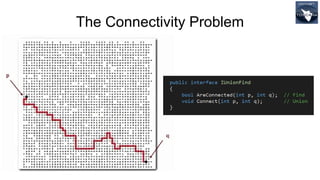
• The Connectivity Problem
• 5 different implementations
• Image Coloring solution
Why learning algorithms?
• To solve problems
• To solve complex problems
• To solve problems on big data sets
• To become a better developer
• To find a job in top software companies
• To challenge yourself and the community
• Lifelong investment
It is fun!
Why this series?
• Practical (real problems and solutions)
• Pragmatic (no mathematical proofs)
• Algorithms are written from scratch in C#
Credits
• Robert Sedgewick and Kevin Wayne
• Algorithms 4 Edition
http://algs4.cs.princeton.edu/code/
• Coursera:
https://www.coursera.org/course/algs4partI
https://www.coursera.org/course/algs4partII
Problem: Image Coloring
Example
The Connectivity Problem
Example
0 1 2
3 4
N = 5
Connect (0, 1)
Connect (1, 3)
Connect (2, 4)
AreConnected (0, 3) = TRUE
AreConnected (1, 2) = FALSE
CODE
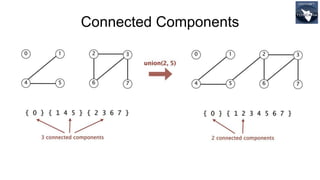
Connected Components
1) Quick Find
0
0
1
1
2
2
2
3
1
4
1
5
2
6
2
7
id[] 0
0
1
1
1
2
1
3
1
4
1
5
1
6
1
7
id[]
• Assign to each node a number (the id of the connected component)
• Find: check if p and q have the same id
• Union: change all entries whose id equals id[p] to id[q]
CODE
2) Quick Union
Assign to each node a parent (organize nodes in a forest of trees).
Find
check if p and q have the same root
Union
set the parent of p’s root to the q’s root
0
0
1
1
9
2
4
3
9
4
6
5
6
6
7
7
parent[] 8
8
9
9
0
0
1
1
9
2
4
3
9
4
6
5
6
6
7
7
parent[] 8
8
6
9
CODE
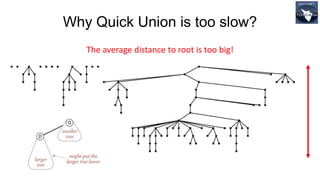
Why Quick Union is too slow?
The average distance to root is too big!
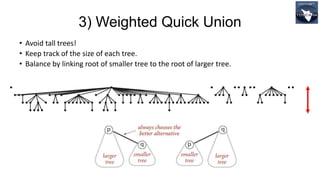
3) Weighted Quick Union
• Avoid tall trees!
• Keep track of the size of each tree.
• Balance by linking root of smaller tree to the root of larger tree.
CODE
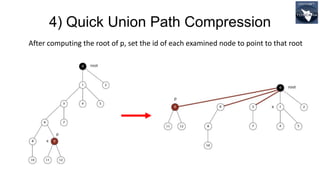
4) Quick Union Path Compression
After computing the root of p, set the id of each examined node to point to that root
CODE
5) Weighted Quick Union Path
Compression
Weighted Quick
Union
Quick Union
Path Compression+
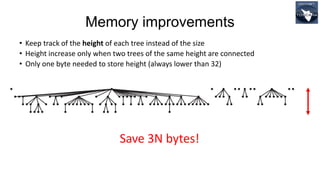
Memory improvements
• Keep track of the height of each tree instead of the size
• Height increase only when two trees of the same height are connected
• Only one byte needed to store height (always lower than 32)
Save 3N bytes!
CODE
Image Coloring Solution
CODE
Performance Analysis
Algorithm Find Union
Quick Find N N2
Quick Union N2 N2
Weighted Quick Union N Log N N Log N
Quick Union Path Compression N Log N N Log N
Weighted Quick Union Path Compression N Log* N N Log* N
Linear Union/Find? N N
N Log* N
1 0
2 1
4 2
16 3
65536 4
265536 5
[Fredman-Saks] No linear-time algorithm exists. (1989)
In practice Weighted QU Path Compression is linear!
Don’t miss the next webcasts
• Graph Search (DFS/BFS)
• Suffix Array and Suffix Trees
• Kd-Trees
• Minimax
• Convex Hull
• Max Flow
• Radix Sort
• Combinatorial
• Dynamic Programming
• …
Thank you
https://github.com/angellaa/AdvancedAlgorithms

Advanced Algorithms #1 - Union/Find on Disjoint-set Data Structures.

  • 1.
    Advanced Algorithms #1 Union/Findon Disjoint-Set Data Structures www.youtube.com/watch?v=vDotBqwa0AE Andrea Angella
  • 2.
    Who I am? •Co-Founder of DotNetToscana • Software Engineer in Red Gate Software (UK) • Microsoft C# Specialist • Passion for algorithms Mail: angella.andrea@gmail.com Blog: andrea-angella.blogspot.co.uk
  • 3.
    Agenda • Introduction tothe series • Practical Problem: Image Coloring • The Connectivity Problem • 5 different implementations • Image Coloring solution
  • 4.
    Why learning algorithms? •To solve problems • To solve complex problems • To solve problems on big data sets • To become a better developer • To find a job in top software companies • To challenge yourself and the community • Lifelong investment It is fun!
  • 5.
    Why this series? •Practical (real problems and solutions) • Pragmatic (no mathematical proofs) • Algorithms are written from scratch in C#
  • 7.
    Credits • Robert Sedgewickand Kevin Wayne • Algorithms 4 Edition http://algs4.cs.princeton.edu/code/ • Coursera: https://www.coursera.org/course/algs4partI https://www.coursera.org/course/algs4partII
  • 8.
  • 9.
  • 10.
  • 11.
    Example 0 1 2 34 N = 5 Connect (0, 1) Connect (1, 3) Connect (2, 4) AreConnected (0, 3) = TRUE AreConnected (1, 2) = FALSE
  • 12.
  • 13.
  • 14.
    1) Quick Find 0 0 1 1 2 2 2 3 1 4 1 5 2 6 2 7 id[]0 0 1 1 1 2 1 3 1 4 1 5 1 6 1 7 id[] • Assign to each node a number (the id of the connected component) • Find: check if p and q have the same id • Union: change all entries whose id equals id[p] to id[q]
  • 15.
  • 16.
    2) Quick Union Assignto each node a parent (organize nodes in a forest of trees). Find check if p and q have the same root Union set the parent of p’s root to the q’s root 0 0 1 1 9 2 4 3 9 4 6 5 6 6 7 7 parent[] 8 8 9 9 0 0 1 1 9 2 4 3 9 4 6 5 6 6 7 7 parent[] 8 8 6 9
  • 17.
  • 18.
    Why Quick Unionis too slow? The average distance to root is too big!
  • 19.
    3) Weighted QuickUnion • Avoid tall trees! • Keep track of the size of each tree. • Balance by linking root of smaller tree to the root of larger tree.
  • 20.
  • 21.
    4) Quick UnionPath Compression After computing the root of p, set the id of each examined node to point to that root
  • 22.
  • 23.
    5) Weighted QuickUnion Path Compression Weighted Quick Union Quick Union Path Compression+
  • 24.
    Memory improvements • Keeptrack of the height of each tree instead of the size • Height increase only when two trees of the same height are connected • Only one byte needed to store height (always lower than 32) Save 3N bytes!
  • 25.
  • 26.
  • 27.
  • 28.
    Performance Analysis Algorithm FindUnion Quick Find N N2 Quick Union N2 N2 Weighted Quick Union N Log N N Log N Quick Union Path Compression N Log N N Log N Weighted Quick Union Path Compression N Log* N N Log* N Linear Union/Find? N N N Log* N 1 0 2 1 4 2 16 3 65536 4 265536 5 [Fredman-Saks] No linear-time algorithm exists. (1989) In practice Weighted QU Path Compression is linear!
  • 29.
    Don’t miss thenext webcasts • Graph Search (DFS/BFS) • Suffix Array and Suffix Trees • Kd-Trees • Minimax • Convex Hull • Max Flow • Radix Sort • Combinatorial • Dynamic Programming • …
  • 30.