By Hema Sri M(M.Pharm,RPh-DHA)
Asst.Professor,
Pharmacy Practice Dept.
AM REDDY COLLEGE OF PHARMACY.
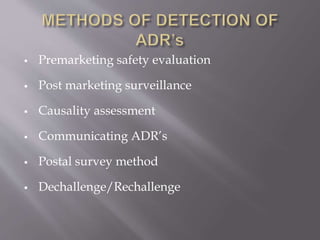
 Premarketing safety evaluation
 Post marketing surveillance
 Causality assessment
 Communicating ADR’s
 Postal survey method
 Dechallenge/Rechallenge
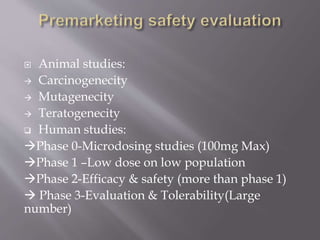
 Animal studies:
 Carcinogenecity
 Mutagenecity
 Teratogenecity
 Human studies:
Phase 0-Microdosing studies (100mg Max)
Phase 1 –Low dose on low population
Phase 2-Efficacy & safety (more than phase 1)
 Phase 3-Evaluation & Tolerability(Large
number)
 Spontaneous report  ADR by health care
 Clinical studies
 Cohort studies –patient exposed to particular
dose & compared to unexposed.
 Case control studies- Person affected ADR’s(
recognised & compared)
 Published case reports-- studies
 ADR’s to suspected medicines
 In case of ADR suspected  assessment starts
collection of relevant data:
1. Time of action
2. Duration of action
3. Treatment of reaction
4. Outcome & report
 Knowledge about medicines
 Training to healthcare professionals
 Conducting constant education programme
 Counseling the patients
 Standardized surveys Questionnaries are
sent by post
 1-2 years after drug has been launched
 Collect information about ADR’s
 This refers to the stopping of the drug, usually
after an adverse event(AE)
 Dechallenge may be complete or partial.
 i.e drug is fully stopped or decreased in dose
 And AE may fully disappears or only partially
decreased
 Result of the dechallenge can be confusing
 Rechallenge refers to the restarting of the same
drug after having stopped it usually for an AE
 Most important in medical treatment
• Receipt, Data entering, Assessment, Documentation
 Spontaneous reporting of suspected ADR’s possible at
regional & country level web system PV
 Reporting authorities: Healthcare professionals,
Nurses, pharmacist, marketing authority holders
 Reporting data: All serious reactions & interactions
such as poisoning, drug-drug, drug-food interactions
 Sections to validate individual case safety report such
as patient identification, reporter identification,
suspected ADR’s, suspected medicines
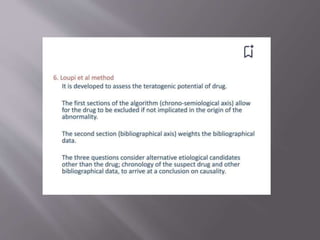
 Definition: It is the assessment of relationship
between a drug treatment & the occurrence of
an adverse event.
 It is an essential part of ADR report and
important task conducted by ‘National
Pharmacovigilance Programme’.
 Methods:
1.Expert judgements or global introspection
2.Algorithms
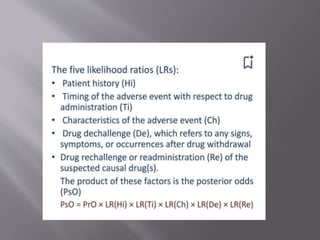
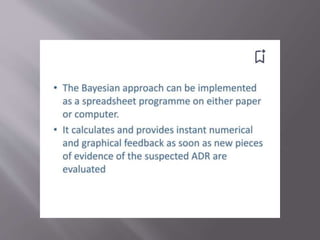
3.Probabilistic methods (Bayesian approaches)
 These are inividual assessments based on previous
knowledge & experience in the field using no
standardized tool to arrive at conclusions regarding
causality.
 Swedish method of Wilholam
1.The temporal sequence--how time sequence of event
related to the drug administration
2.Previous information on the drug
3.Dose relationship
4.Response pattern to drug
5.Rechallenge
6.Alternative etiological conditions
7.Concomitant drugs
 WHO –UMC Causality assessment criteria:
1.Time relationship between drug use & AE
2.Absence of other competing causes
3.Response of drug withdrawal & dose
reduction(Dechallenge)
4.Response of drug re administration(Rechallenge)
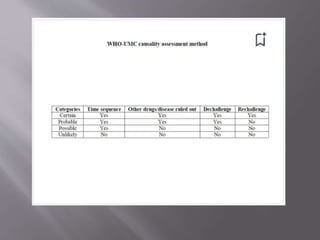
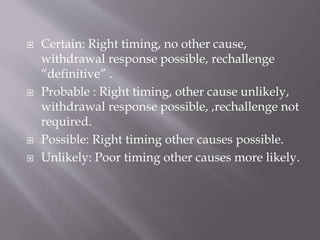
 Certain: Right timing, no other cause,
withdrawal response possible, rechallenge
“definitive” .
 Probable : Right timing, other cause unlikely,
withdrawal response possible, ,rechallenge not
required.
 Possible: Right timing other causes possible.
 Unlikely: Poor timing other causes more likely.
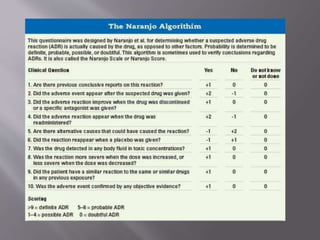
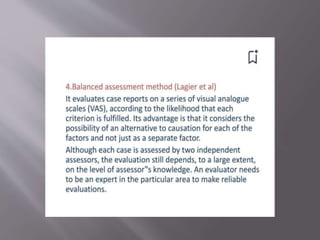
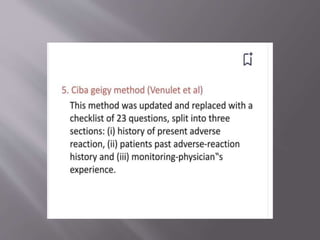
 These are sets of specific questions with
associated scores for calculating the likelihood
of a cause-effect relationship
 Problem specific flow charts step by step
instructions how to arrive at an answer
 Questionnaire probability of causation(when
ADR is suspected)
 No single algorithm accepted as the gold
standard because of the shortcomings &
disagreements that exist between them.
ADR’s DETECTION,REPORTING & METHODS IN CASUALITY ASSESSMENT.pptx

ADR’s DETECTION,REPORTING & METHODS IN CASUALITY ASSESSMENT.pptx

  • 1.
    By Hema SriM(M.Pharm,RPh-DHA) Asst.Professor, Pharmacy Practice Dept. AM REDDY COLLEGE OF PHARMACY.
  • 2.
     Premarketing safetyevaluation  Post marketing surveillance  Causality assessment  Communicating ADR’s  Postal survey method  Dechallenge/Rechallenge
  • 3.
     Animal studies: Carcinogenecity  Mutagenecity  Teratogenecity  Human studies: Phase 0-Microdosing studies (100mg Max) Phase 1 –Low dose on low population Phase 2-Efficacy & safety (more than phase 1)  Phase 3-Evaluation & Tolerability(Large number)
  • 4.
     Spontaneous report ADR by health care  Clinical studies  Cohort studies –patient exposed to particular dose & compared to unexposed.  Case control studies- Person affected ADR’s( recognised & compared)  Published case reports-- studies
  • 5.
     ADR’s tosuspected medicines  In case of ADR suspected  assessment starts collection of relevant data: 1. Time of action 2. Duration of action 3. Treatment of reaction 4. Outcome & report
  • 6.
     Knowledge aboutmedicines  Training to healthcare professionals  Conducting constant education programme  Counseling the patients
  • 7.
     Standardized surveysQuestionnaries are sent by post  1-2 years after drug has been launched  Collect information about ADR’s
  • 8.
     This refersto the stopping of the drug, usually after an adverse event(AE)  Dechallenge may be complete or partial.  i.e drug is fully stopped or decreased in dose  And AE may fully disappears or only partially decreased  Result of the dechallenge can be confusing  Rechallenge refers to the restarting of the same drug after having stopped it usually for an AE
  • 9.
     Most importantin medical treatment • Receipt, Data entering, Assessment, Documentation  Spontaneous reporting of suspected ADR’s possible at regional & country level web system PV  Reporting authorities: Healthcare professionals, Nurses, pharmacist, marketing authority holders  Reporting data: All serious reactions & interactions such as poisoning, drug-drug, drug-food interactions  Sections to validate individual case safety report such as patient identification, reporter identification, suspected ADR’s, suspected medicines
  • 10.
     Definition: Itis the assessment of relationship between a drug treatment & the occurrence of an adverse event.  It is an essential part of ADR report and important task conducted by ‘National Pharmacovigilance Programme’.  Methods: 1.Expert judgements or global introspection 2.Algorithms 3.Probabilistic methods (Bayesian approaches)
  • 11.
     These areinividual assessments based on previous knowledge & experience in the field using no standardized tool to arrive at conclusions regarding causality.  Swedish method of Wilholam 1.The temporal sequence--how time sequence of event related to the drug administration 2.Previous information on the drug 3.Dose relationship 4.Response pattern to drug 5.Rechallenge 6.Alternative etiological conditions 7.Concomitant drugs
  • 12.
     WHO –UMCCausality assessment criteria: 1.Time relationship between drug use & AE 2.Absence of other competing causes 3.Response of drug withdrawal & dose reduction(Dechallenge) 4.Response of drug re administration(Rechallenge)
  • 14.
     Certain: Righttiming, no other cause, withdrawal response possible, rechallenge “definitive” .  Probable : Right timing, other cause unlikely, withdrawal response possible, ,rechallenge not required.  Possible: Right timing other causes possible.  Unlikely: Poor timing other causes more likely.
  • 15.
     These aresets of specific questions with associated scores for calculating the likelihood of a cause-effect relationship  Problem specific flow charts step by step instructions how to arrive at an answer  Questionnaire probability of causation(when ADR is suspected)  No single algorithm accepted as the gold standard because of the shortcomings & disagreements that exist between them.