Chapter 1:
Introduction to Electronic Commerce
Electronic Commerce,
Seventh Annual
Edition
Electronic Commerce, Seventh Annual Edition 2
Objectives
In this chapter, you will learn about:
• What electronic commerce is and how it is
experiencing a second wave of growth with a new
focus on profitability
• Why companies now concentrate on revenue models
and the analysis of business processes instead of
business models when they undertake electronic
commerce initiatives
Electronic Commerce, Seventh Annual Edition 3
Objectives (continued)
• How economic forces have created a
business environment that is fostering the
second wave of electronic commerce
• How businesses use value chains and SWOT
analysis to identify electronic commerce
opportunities
• The international nature of electronic
commerce and the challenges that arise in
engaging in electronic commerce on a global
scale
Electronic Commerce, Seventh Annual Edition 4
Electronic Commerce: The Second
Wave
• Electronic commerce (e-commerce)
– Businesses trading with other businesses and
internal processes
• Electronic business (e-business)
– Term used interchangeably with e-commerce
– The transformation of key business processes
through the use of Internet technologies
Electronic Commerce, Seventh Annual Edition 5
Categories of Electronic
Commerce
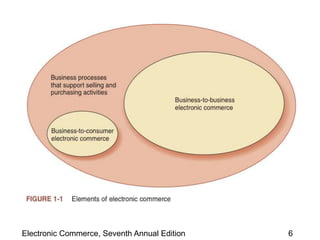
• Five general e-commerce categories:
– Business-to-consumer
– Business-to-business
– Business processes
– Consumer-to-consumer
– Business-to-government
• Supply management or procurement
– Departments are devoted to negotiating purchase
transactions with suppliers
Electronic Commerce, Seventh Annual Edition 6
Electronic Commerce, Seventh Annual Edition 7
Categories of Electronic Commerce
(continued)
• Transaction
– An exchange of value
• Business processes
– The group of logical, related, and sequential
activities and transactions in which businesses
engage
• Telecommuting or telework
– Employees log in to company computers through
the Internet instead of traveling to the office
Electronic Commerce, Seventh Annual Edition 8
Electronic Commerce, Seventh Annual Edition 9
Electronic Commerce, Seventh Annual Edition 10
The Development and Growth of
Electronic Commerce
• Electronic funds transfers (EFTs)
– Also called wire transfers
– Electronic transmissions of account exchange
information over private communications networks
• Electronic data interchange (EDI)
– Transmitting computer-readable data in a standard
format to another business
Electronic Commerce, Seventh Annual Edition 11
The Development and Growth of
Electronic Commerce (continued)
• Trading partners
– Businesses that engage in EDI with each other
• Value-added network (VAN)
– Independent firm that offers connection and
transaction-forwarding services to buyers and
sellers engaged in EDI
Electronic Commerce, Seventh Annual Edition 12
Electronic Commerce, Seventh Annual Edition 13
The Second Wave of Electronic
Commerce
• Defining characteristics of the first wave:
– Dominant influence of U.S. businesses
– Extensive use of the English language
– Many new companies started with outside investor
money
– Unstructured use of e-mail
– Over-reliance on advertising as a revenue source
Electronic Commerce, Seventh Annual Edition 14
The Second Wave of Electronic
Commerce (continued)
• Second wave:
– Global enterprises in many countries are
participating in electronic commerce
– Established companies fund electronic commerce
initiatives with their own capital
– Customized e-mail strategies are now integral to
customer contact
Electronic Commerce, Seventh Annual Edition 15
Business Models, Revenue Models,
and Business Processes
• Business model
– A set of processes that combine to yield a profit
• Revenue model
– A specific collection of business processes used
to:
• Identify customers
• Market to those customers
• Generate sales to those customers
Electronic Commerce, Seventh Annual Edition 16
Role of Merchandising
• Merchandising
– Combination of store design, layout, and product
display knowledge
Electronic Commerce, Seventh Annual Edition 17
Product/Process Suitability to
Electronic Commerce
• Commodity item
– Hard to distinguish from the same products or
services provided by other sellers
– Features have become standardized and well
known
Electronic Commerce, Seventh Annual Edition 18
Product/Process Suitability to
Electronic Commerce (continued)
• Shipping profile
– Collection of attributes that affect how easily a
product can be packaged and delivered
• High value-to-weight ratio
– Can make overall shipping cost a small fraction of
the selling price
Electronic Commerce, Seventh Annual Edition 19
Advantages of Electronic
Commerce
• Electronic commerce can increase sales and
decrease costs
• If advertising is done well on the Web, it can
get a firm’s promotional message out to
potential customers in every country
• Using e-commerce sales support and order-
taking processes, a business can:
– Reduce costs of handling sales inquiries
– Provide price quotes
Electronic Commerce, Seventh Annual Edition 20
Advantages of Electronic
Commerce (continued)
• It increases purchasing opportunities for
buyers
• Negotiating price and delivery terms is easier
• The following cost less to issue and arrive
securely and quickly:
– Electronic payments of tax refunds
– Public retirement
– Welfare support
Electronic Commerce, Seventh Annual Edition 21
Disadvantages of Electronic
Commerce
• Perishable grocery products are much harder
to sell online
• It is difficult to:
– Calculate return on investment
– Integrate existing databases and transaction-
processing software into software that enables e-
commerce
• Cultural and legal obstacles also exist
Electronic Commerce, Seventh Annual Edition 22
Economic Forces and Electronic
Commerce
• Economics
– Study of how people allocate scarce resources
• Two conditions of a market
– Potential sellers of a good come into contact with
potential buyers
– A medium of exchange is available
Electronic Commerce, Seventh Annual Edition 23
Transaction Costs
• Transaction costs are the total costs that a
buyer and seller incur
• Significant components of transaction costs:
– Cost of information search and acquisition
– Investment of the seller in equipment or in the
hiring of skilled employees to supply products or
services to the buyer
Electronic Commerce, Seventh Annual Edition 24
Using Electronic Commerce to
Reduce Transaction Costs
• Businesses and individuals can use
electronic commerce to reduce transaction
costs by:
– Improving the flow of information
– Increasing coordination of actions
Electronic Commerce, Seventh Annual Edition 25
Network Economic Structures
• Network economic structures
– Neither a market nor a hierarchy
– Companies coordinate their strategies, resources,
and skill sets by forming long-term, stable
relationships with other companies and individuals
based on shared purposes
• Strategic alliances (strategic partnerships)
– Relationships created within the network
economic structure
Electronic Commerce, Seventh Annual Edition 26
Network Economic Structures
(continued)
• Virtual companies
– Strategic alliances that occur between or among
companies operating on the Internet
• Strategic partners
– Entities that come together as a team for a specific
project or activity
Electronic Commerce, Seventh Annual Edition 27
Network Effects
• Law of diminishing returns
– Most activities yield less value as the amount of
consumption increases
• Network effect
– As more people or organizations participate in a
network, the value of the network to each
participant increases
Electronic Commerce, Seventh Annual Edition 28
Identifying Electronic Commerce
Opportunities
• Firm
– Multiple business units owned by a common set of
shareholders
• Industry
– Multiple firms that sell similar products to similar
customers
Electronic Commerce, Seventh Annual Edition 29
Strategic Business Unit Value
Chains
• Value chain
– A way of organizing the activities that each
strategic business unit undertakes
• Primary activities include:
– Designing, producing, promoting, marketing,
delivering, and supporting the products or services
it sells
• Supporting activities include:
– Human resource management and purchasing
Electronic Commerce, Seventh Annual Edition 30
Electronic Commerce, Seventh Annual Edition 31
Industry Value Chains
• Value system
– Larger stream of activities into which a particular
business unit’s value chain is embedded
– Also referred to as industry value chain
Electronic Commerce, Seventh Annual Edition 32
Electronic Commerce, Seventh Annual Edition 33
SWOT Analysis: Evaluating
Business Unit Opportunities
• In SWOT analysis:
– An analyst first looks into the business unit to
identify its strengths and weaknesses
– The analyst then reviews the operating
environment and identifies opportunities and
threats
Electronic Commerce, Seventh Annual Edition 34
Electronic Commerce, Seventh Annual Edition 35
Electronic Commerce, Seventh Annual Edition 36
International Nature of Electronic
Commerce
• Companies with established reputations:
– Often create trust by ensuring that customers
know who they are
– Can rely on their established brand names to
create trust on the Web
• Customers’ inherent lack of trust in
“strangers” on the Web is logical and to be
expected
Electronic Commerce, Seventh Annual Edition 37
Language Issues
• To do business effectively in other cultures a
business must adapt to those cultures
• Researchers have found that customers are
more likely to buy products and services from
Web sites in their own language
• Localization
– Translation that considers multiple elements of the
local environment
Electronic Commerce, Seventh Annual Edition 38
Culture Issues
• An important element of business trust is
anticipating how the other party to a
transaction will act in specific circumstances
• Culture:
– Combination of language and customs
– Varies across national boundaries
– Varies across regions within nations
Electronic Commerce, Seventh Annual Edition 39
Infrastructure Issues
• Internet infrastructure includes:
– Computers and software connected to the Internet
– Communications networks over which message
packets travel
• Organization for Economic Cooperation and
Development’s (OECD) Statements on
Information and Communications Policy deal
with telecommunications infrastructure
development issues
Electronic Commerce, Seventh Annual Edition 40
Infrastructure Issues (continued)
• Flat-rate access system
– Consumer or business pays one monthly fee for
unlimited telephone line usage
– Contributed to rapid rise of U.S. electronic
commerce
• Targets for technological solutions include
paperwork and processes that accompany
international transactions
Electronic Commerce, Seventh Annual Edition 41
Electronic Commerce, Seventh Annual Edition 42
Summary
• Commerce
– Negotiated exchange of goods or services
• Electronic commerce
– Application of new technologies to conduct
business more effectively
• First wave of electronic commerce
– Ended in 2000
• Second wave of electronic commerce
– New approaches to integrating Internet
technologies into business processes
Electronic Commerce, Seventh Annual Edition 43
Summary (continued)
• Using electronic commerce, businesses have:
– Created new products and services
– Improved promotion, marketing, and delivery of
existing offerings
• The global nature of electronic commerce
leads to many opportunities and few
challenges
• To conduct electronic commerce across
international borders, you must understand
the trust, cultural, language, and legal issues

Introduction to E-Commerce - Chapter 1.ppt

  • 1.
    Chapter 1: Introduction toElectronic Commerce Electronic Commerce, Seventh Annual Edition
  • 2.
    Electronic Commerce, SeventhAnnual Edition 2 Objectives In this chapter, you will learn about: • What electronic commerce is and how it is experiencing a second wave of growth with a new focus on profitability • Why companies now concentrate on revenue models and the analysis of business processes instead of business models when they undertake electronic commerce initiatives
  • 3.
    Electronic Commerce, SeventhAnnual Edition 3 Objectives (continued) • How economic forces have created a business environment that is fostering the second wave of electronic commerce • How businesses use value chains and SWOT analysis to identify electronic commerce opportunities • The international nature of electronic commerce and the challenges that arise in engaging in electronic commerce on a global scale
  • 4.
    Electronic Commerce, SeventhAnnual Edition 4 Electronic Commerce: The Second Wave • Electronic commerce (e-commerce) – Businesses trading with other businesses and internal processes • Electronic business (e-business) – Term used interchangeably with e-commerce – The transformation of key business processes through the use of Internet technologies
  • 5.
    Electronic Commerce, SeventhAnnual Edition 5 Categories of Electronic Commerce • Five general e-commerce categories: – Business-to-consumer – Business-to-business – Business processes – Consumer-to-consumer – Business-to-government • Supply management or procurement – Departments are devoted to negotiating purchase transactions with suppliers
  • 6.
  • 7.
    Electronic Commerce, SeventhAnnual Edition 7 Categories of Electronic Commerce (continued) • Transaction – An exchange of value • Business processes – The group of logical, related, and sequential activities and transactions in which businesses engage • Telecommuting or telework – Employees log in to company computers through the Internet instead of traveling to the office
  • 8.
  • 9.
  • 10.
    Electronic Commerce, SeventhAnnual Edition 10 The Development and Growth of Electronic Commerce • Electronic funds transfers (EFTs) – Also called wire transfers – Electronic transmissions of account exchange information over private communications networks • Electronic data interchange (EDI) – Transmitting computer-readable data in a standard format to another business
  • 11.
    Electronic Commerce, SeventhAnnual Edition 11 The Development and Growth of Electronic Commerce (continued) • Trading partners – Businesses that engage in EDI with each other • Value-added network (VAN) – Independent firm that offers connection and transaction-forwarding services to buyers and sellers engaged in EDI
  • 12.
  • 13.
    Electronic Commerce, SeventhAnnual Edition 13 The Second Wave of Electronic Commerce • Defining characteristics of the first wave: – Dominant influence of U.S. businesses – Extensive use of the English language – Many new companies started with outside investor money – Unstructured use of e-mail – Over-reliance on advertising as a revenue source
  • 14.
    Electronic Commerce, SeventhAnnual Edition 14 The Second Wave of Electronic Commerce (continued) • Second wave: – Global enterprises in many countries are participating in electronic commerce – Established companies fund electronic commerce initiatives with their own capital – Customized e-mail strategies are now integral to customer contact
  • 15.
    Electronic Commerce, SeventhAnnual Edition 15 Business Models, Revenue Models, and Business Processes • Business model – A set of processes that combine to yield a profit • Revenue model – A specific collection of business processes used to: • Identify customers • Market to those customers • Generate sales to those customers
  • 16.
    Electronic Commerce, SeventhAnnual Edition 16 Role of Merchandising • Merchandising – Combination of store design, layout, and product display knowledge
  • 17.
    Electronic Commerce, SeventhAnnual Edition 17 Product/Process Suitability to Electronic Commerce • Commodity item – Hard to distinguish from the same products or services provided by other sellers – Features have become standardized and well known
  • 18.
    Electronic Commerce, SeventhAnnual Edition 18 Product/Process Suitability to Electronic Commerce (continued) • Shipping profile – Collection of attributes that affect how easily a product can be packaged and delivered • High value-to-weight ratio – Can make overall shipping cost a small fraction of the selling price
  • 19.
    Electronic Commerce, SeventhAnnual Edition 19 Advantages of Electronic Commerce • Electronic commerce can increase sales and decrease costs • If advertising is done well on the Web, it can get a firm’s promotional message out to potential customers in every country • Using e-commerce sales support and order- taking processes, a business can: – Reduce costs of handling sales inquiries – Provide price quotes
  • 20.
    Electronic Commerce, SeventhAnnual Edition 20 Advantages of Electronic Commerce (continued) • It increases purchasing opportunities for buyers • Negotiating price and delivery terms is easier • The following cost less to issue and arrive securely and quickly: – Electronic payments of tax refunds – Public retirement – Welfare support
  • 21.
    Electronic Commerce, SeventhAnnual Edition 21 Disadvantages of Electronic Commerce • Perishable grocery products are much harder to sell online • It is difficult to: – Calculate return on investment – Integrate existing databases and transaction- processing software into software that enables e- commerce • Cultural and legal obstacles also exist
  • 22.
    Electronic Commerce, SeventhAnnual Edition 22 Economic Forces and Electronic Commerce • Economics – Study of how people allocate scarce resources • Two conditions of a market – Potential sellers of a good come into contact with potential buyers – A medium of exchange is available
  • 23.
    Electronic Commerce, SeventhAnnual Edition 23 Transaction Costs • Transaction costs are the total costs that a buyer and seller incur • Significant components of transaction costs: – Cost of information search and acquisition – Investment of the seller in equipment or in the hiring of skilled employees to supply products or services to the buyer
  • 24.
    Electronic Commerce, SeventhAnnual Edition 24 Using Electronic Commerce to Reduce Transaction Costs • Businesses and individuals can use electronic commerce to reduce transaction costs by: – Improving the flow of information – Increasing coordination of actions
  • 25.
    Electronic Commerce, SeventhAnnual Edition 25 Network Economic Structures • Network economic structures – Neither a market nor a hierarchy – Companies coordinate their strategies, resources, and skill sets by forming long-term, stable relationships with other companies and individuals based on shared purposes • Strategic alliances (strategic partnerships) – Relationships created within the network economic structure
  • 26.
    Electronic Commerce, SeventhAnnual Edition 26 Network Economic Structures (continued) • Virtual companies – Strategic alliances that occur between or among companies operating on the Internet • Strategic partners – Entities that come together as a team for a specific project or activity
  • 27.
    Electronic Commerce, SeventhAnnual Edition 27 Network Effects • Law of diminishing returns – Most activities yield less value as the amount of consumption increases • Network effect – As more people or organizations participate in a network, the value of the network to each participant increases
  • 28.
    Electronic Commerce, SeventhAnnual Edition 28 Identifying Electronic Commerce Opportunities • Firm – Multiple business units owned by a common set of shareholders • Industry – Multiple firms that sell similar products to similar customers
  • 29.
    Electronic Commerce, SeventhAnnual Edition 29 Strategic Business Unit Value Chains • Value chain – A way of organizing the activities that each strategic business unit undertakes • Primary activities include: – Designing, producing, promoting, marketing, delivering, and supporting the products or services it sells • Supporting activities include: – Human resource management and purchasing
  • 30.
  • 31.
    Electronic Commerce, SeventhAnnual Edition 31 Industry Value Chains • Value system – Larger stream of activities into which a particular business unit’s value chain is embedded – Also referred to as industry value chain
  • 32.
  • 33.
    Electronic Commerce, SeventhAnnual Edition 33 SWOT Analysis: Evaluating Business Unit Opportunities • In SWOT analysis: – An analyst first looks into the business unit to identify its strengths and weaknesses – The analyst then reviews the operating environment and identifies opportunities and threats
  • 34.
  • 35.
  • 36.
    Electronic Commerce, SeventhAnnual Edition 36 International Nature of Electronic Commerce • Companies with established reputations: – Often create trust by ensuring that customers know who they are – Can rely on their established brand names to create trust on the Web • Customers’ inherent lack of trust in “strangers” on the Web is logical and to be expected
  • 37.
    Electronic Commerce, SeventhAnnual Edition 37 Language Issues • To do business effectively in other cultures a business must adapt to those cultures • Researchers have found that customers are more likely to buy products and services from Web sites in their own language • Localization – Translation that considers multiple elements of the local environment
  • 38.
    Electronic Commerce, SeventhAnnual Edition 38 Culture Issues • An important element of business trust is anticipating how the other party to a transaction will act in specific circumstances • Culture: – Combination of language and customs – Varies across national boundaries – Varies across regions within nations
  • 39.
    Electronic Commerce, SeventhAnnual Edition 39 Infrastructure Issues • Internet infrastructure includes: – Computers and software connected to the Internet – Communications networks over which message packets travel • Organization for Economic Cooperation and Development’s (OECD) Statements on Information and Communications Policy deal with telecommunications infrastructure development issues
  • 40.
    Electronic Commerce, SeventhAnnual Edition 40 Infrastructure Issues (continued) • Flat-rate access system – Consumer or business pays one monthly fee for unlimited telephone line usage – Contributed to rapid rise of U.S. electronic commerce • Targets for technological solutions include paperwork and processes that accompany international transactions
  • 41.
  • 42.
    Electronic Commerce, SeventhAnnual Edition 42 Summary • Commerce – Negotiated exchange of goods or services • Electronic commerce – Application of new technologies to conduct business more effectively • First wave of electronic commerce – Ended in 2000 • Second wave of electronic commerce – New approaches to integrating Internet technologies into business processes
  • 43.
    Electronic Commerce, SeventhAnnual Edition 43 Summary (continued) • Using electronic commerce, businesses have: – Created new products and services – Improved promotion, marketing, and delivery of existing offerings • The global nature of electronic commerce leads to many opportunities and few challenges • To conduct electronic commerce across international borders, you must understand the trust, cultural, language, and legal issues