Overview of Concussion Epidemiology 13 th  Annual Sports Medicine for the Young Athlete James J. Kinderknecht, M.D. Hospital for Special Surgery
HSS educational activities are carried out in a manner that serves the educational component of our Mission.  As faculty we are committed to providing transparency in any/all external relationships prior to giving an academic presentation. James J. Kinderknecht, M.D. Disclosure:  I DO NOT  have a financial relationship with any commercial interest.
Concussion Definition Traumatically induced alteration in brain function manifested by Alteration in awareness  Dinged, dazed, stunned, woozy, foggy, amnesic, LOC, etc Signs of symptoms of post-concussive syndrome Headache, vertigo, light-headedness, balance disturbance, cognitive dysfunction, memory disturbance, hearing loss, tinnitus, vision disturbance, personality changes, drowsiness, lethargy, fatigue, inability to perform daily activities
Concussion Epidemiology Difficulty until recently detecting the true epidemiology The true number of “mild” TBI’s are altered by every individual presenting to health care providers that have been injured The ability of the health care providers to accurately diagnose Asymptomatic vs asymptomatic Clearly there are numerous concussions that go undiagnosed
Concussion Epidemiology Several levels of participation Children/Adolescents/Young adults participating in non-organized activities Children/Adolescents/Young adults participating in organized activities Adults participating in non-organized activities Adults participating in organized activities Professionals participating in activities
Concussion Epidemiology in Children/Adolescents Estimated 44 million children and adolescents participate in organized sports in the US Estimated 170 million adults participate in physical activities including sports Estimated 1.7 million TBI’s in the US annually CDC estimates 1.6 to 3.8 million concussions occur annually in sports and recreational activities and has deemed it a public health issue
Reported Concussion Rates High School Sports-Related Injury Surveillance System NCAA Sports-Related Injury Surveillance System Number of reported concussions increased 7% from 1988/1989 to the 2003/2004 seasons
Concussion Injury Rate per 1000 Athletic Exposures 1988/1989 to 2003/2004 NCAA seasons Athletic exposure defined as one athlete participating in one game or practice
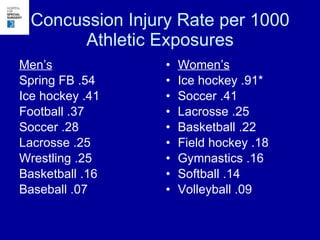
Concussion Injury Rate per 1000 Athletic Exposures Men’s Spring FB .54 Ice hockey .41 Football .37 Soccer .28 Lacrosse .25 Wrestling .25 Basketball .16 Baseball .07 Women’s Ice hockey .91* Soccer .41 Lacrosse .25 Basketball .22 Field hockey .18 Gymnastics .16 Softball .14 Volleyball .09
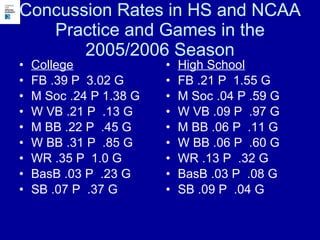
Concussion Rates in HS and NCAA Practice and Games in the 2005/2006 Season College FB .39 P  3.02 G M Soc .24 P 1.38 G W VB .21 P  .13 G M BB .22 P  .45 G W BB .31 P  .85 G WR .35 P  1.0 G BasB .03 P  .23 G SB .07 P  .37 G High School FB .21 P  1.55 G M Soc .04 P .59 G W VB .09 P  .97 G M BB .06 P  .11 G W BB .06 P  .60 G WR .13 P  .32 G BasB .03 P  .08 G SB .09 P  .04 G
Incidence in High School Sports Lincoln et al. AJSM Jan 2011 Prospective 11 Year Study 1997/1998 to 2007/2008 Six boy’s sports/Six girl’s sports 25 high schools (all with athletic trainers and EMR) 10,926,892 athletic exposures 2651 concussions (incidence rate of 0.24) Various methods of diagnosis
AJSM Lincoln et al. Boys sports were 53% of AE and 75% concussions Football (rate .6) was more than half the concussions with boy’s lacrosse  being the next most common (rate .3) FB was 11x that of baseball (lowest rate .06) Girl’s soccer (rate .35) with lacrosse (rate .2) G soccer was 6x that of cheerleading (rate .06)
AJSM Lincoln et al. Overall concussion rate increased from .12 AE’s in 1998 to 0.49 in 2008 and a ave. yearly increase of 15.5% (increased in all sports) Big jump in 2005 (more trainers) Boys BB less than girls BB  .10 to.16 Boys soccer less than girls soccer .17 to .35 Similar data to other published studies Gessel et al J Athl Train 2007 Rechel et al J Athl Train 2008
Concussion Epidemiology Several factors that may be contributing to a false “rate increase” More trained “evaluators” Physicians, athletic trainers, coaches, parents, other athletes Media coverage CDC programs (Heads Up) New state laws Rule changes Increased education from sports-bodies (NCAA, NATA, etc)
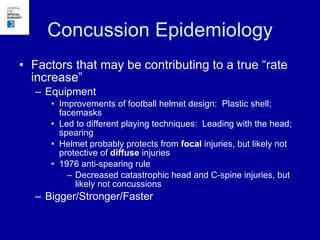
Concussion Epidemiology Factors that may be contributing to a true “rate increase” Equipment Improvements of football helmet design:  Plastic shell; facemasks Led to different playing techniques:  Leading with the head; spearing Helmet probably protects from  focal  injuries, but likely not protective of  diffuse  injuries 1976 anti-spearing rule Decreased catastrophic head and C-spine injuries, but likely not concussions Bigger/Stronger/Faster
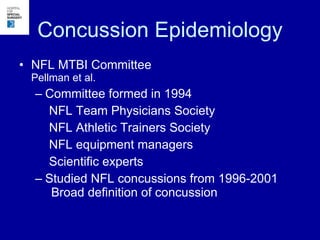
Concussion Epidemiology NFL MTBI Committee Pellman et al. Committee formed in 1994 NFL Team Physicians Society NFL Athletic Trainers Society NFL equipment managers Scientific experts Studied NFL concussions from 1996-2001 Broad definition of concussion
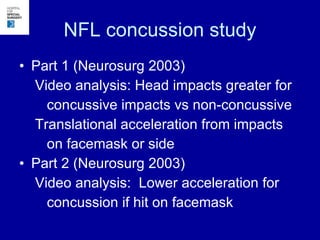
NFL concussion study Part 1 (Neurosurg 2003) Video analysis: Head impacts greater for concussive impacts vs non-concussive Translational acceleration from impacts  on facemask or side Part 2 (Neurosurg 2003) Video analysis:  Lower acceleration for  concussion if hit on facemask
NFL concussion study Part 3 (Neurosurg 2004) Epidemiology 787 concussions = .41 per game  most in QB’s, WR’s, DB’s   67.7% helmet-helmet 20.9% another body part 11.4% ground  9.3% LOC Half returned within 1 day; 92% within  one week
Age Considerations in Concussion Catastrophic injuries (death or permanent neurologic injury) Most in football 133 catastrophic injuries since 1982/1983 in FB 120 HS athletes 11 college athletes 2 “sandlot” 0 professionals
Second Impact Syndrome First described in 1973 (Schneider) Malignant cerebral edema exists in case reports after head trauma, but is it really  second impact  ?  Numerous case reports, essentially all under 22 y/o Rare, but devasting, occurrence Unclear whether it has occurred in an asymptomatic person
Possible Genetic Factore Apolipoprotein E e4 (APOE) Jordan el al (JAMA 1997) 30 boxers with chronic brain injury scores High exposure  scored 2.6  APOE (+) 3.9 Low exposure  scored 0.3  APOE (+) 1.8 Teasdale et al (Lancet 1997) 89 head injuries Unfavorable outcome 57% APOE (+) 27% APOE (+)
Apolipoprotein E Tierney et al (Clin J Sports Med 2010) Carriers of all 3 APOE rare alleles (0.7% of the population) were 10x more likely to report a concussion All studies have been retrospective designs Cross sectional and case-control Too early to determine anything
Conclusions/Summary What do we know? Concussions occur with fair frequency Concussions are under reported/under recognized Definite neurocognitive and pathologic  effects
Conclusions/Summary What  don’t  we know? True pathology: neuronal cell death vs temporary dysfunction Existence and risk of “second impact syndrome” Cumulative effects: concussive vs sub- concussive effects Prognostic parameters Genetic factors Best evaluation tools
HSS educational activities are carried out in a manner that serves the educational component of our Mission.  As faculty we are committed to providing transparency in any/all external relationships prior to giving an academic presentation. Baxter B. Allen, M.D. Weill Cornell Medical College Disclosure:  I DO NOT  have a financial relationship with any commercial interest.
Baxter B. Allen, MD Research Associate in Child Neurology Weill Cornell Medical College
Blow or jolt to the head or a penetrating head injury that disrupts the function of the brain. Not all blows or jolts to the head result in a TBI. Severity …. may range from "mild," i.e., a brief change in mental status or consciousness to "severe," i.e., an extended period of unconsciousness or amnesia after the injury.  TBI can result in short or long-term problems with independent function. Traumatic brain injury (TBI) CDC 7/06
Mod Mild Severe Sports concussion ? “ Minimal” Glasgow Coma Scale Consensus Statement on Concussion in Sport.  3 rd  International Conference on Concussion in Sport held in Zurich, Nov 2008
Loss of consciousness < 30 minutes or amnesia <24 hours or altered mental status at time of injury Glasgow Coma Scale (GCS) score 13-15, measured ≥30 mins after injury lower GCS = moderate to severe ACADEMIC EMERGENCY MEDICINE 2006 Current Pharmaceutical Design, 2001, 7, 1475  Concussion
Deformation of elastic brain within rigid skull Sudden acceleration or deceleration Focal contusions, hematomas, diffuse injury Neuronal axonal processes Not necessarily transection early Derangement of cytoskeletal elements Microtubules, neurofilaments Interrupt transport Delayed, progressive proteolysis Primary v secondary injury ACADEMIC EMERGENCY MEDICINE 2006 Current Pharmaceutical Design, 2001, 7, 1475
COUP - CONTRECOUP  INJURY
Biomechanical investigations dating back to the beginning of the 20th century suggest that  concussion results from a rotational motion  of the cerebral hemispheres in the anterior–posterior plane, around the fulcrum of the fixed-in-place upper brain stem.  N Engl J Med 2007;356:166-72. Mechanism of Concussion Viano et al
Littre (1705): negative autopsy findings in a fatal head injury Koch (1874): concussion due to the shaking of nervous structure not to any structural defect. Claimed repeated small blows paralyzed the respiratory, vasomotor and pupillary centres Kramer: due to momentary compression of the brain, which  compression, exerted by the cerebrospinal fluid, collapsed the cerebral vessels Maasland: sudden ↑ICP Stops respiration and heart beat  Required high pressures (5 kg.) on the bare dura of dog Witkowski (1877) not vascular changes.  Frogs continued to move after removal of heart, stunned by blow to head, then began moving again. Experimental concussion - Occurrence of  immediate traumatic paralysis of reflex function, with no visible CNS lesions.  Subconcussive blows depress but not abolish reflex function Denny-Brown D. Experimental cerebral concussion. Brain 1941; 64:93
Physical signs  (eg. loss of consciousness, amnesia)  Symptoms   somatic (eg. headache) cognitive (eg. feeling like in a fog) emotional symptoms (eg. lability) Behavioural changes  (eg. irritablity) Cognitive impairment  (eg. slowed reaction times)  Sleep disturbance  (eg. drowsiness) Consensus Statement on Concussion in Sport.  3 rd  International Conference on Concussion in Sport held in Zurich, Nov 2008
Glutamate release and Ionic Flux Alterations to Glucose Metabolism and Mitochondrial Function Alterations to Cerebral Blood Flow Axonal Injury Alterations in Brain Activation Acute Response to Repeat Concussion Cumulative Injury and Chronic Sequelae Barkhoudrain G et al. The Molecular Pathophysiology of Concussive Brain Injury. Clin Sports Med 30 (2011): 33-48.
Membrane deformation leads to potassium efflux and release of excitatory amino acids, especially glutamate Glutamate binds NMDA and AMPA ionic channels Calcium influx and further depolarization Depolarization leads to neuron suppression resembling spreading depression ATP-dependent Na+/K+ pumps work to restore ionic balance High levels of glucose metabolism due to high energy needs (lasts from .5 – 4 hours in rat TBI experiments) Lactate production is increased, leading to local acidosis, increased membrane permeability, and cerebral edema Barkhoudrain G et al. The Molecular Pathophysiology of Concussive Brain Injury. Clin Sports Med 30 (2011): 33-48.
TAKAHASHI H. Changes in extracellular potassium concentration in cortex and brain stem during the acute phase of experimental closed head injury.  J Neurosurg 55:708-717, 1981
Initial hyperglycolysis followed by prolonged period of hypo metabolism (up to 5 days in rat study) NMDA channel activation leads to influx of Ca++ Ca++ accumulates in mitochondria Leads to glucose oxidative dysfunction Barkhoudrain G et al. The Molecular Pathophysiology of Concussive Brain Injury. Clin Sports Med 30 (2011): 33-48.
Triphasic alteration in severe TBI, but not well studied in mild TBI Initial cerebral hypoperfusion (day 0) Cerebral hyperemia (days 1-3) Cerebral vasospasm (days 4-15) Evidence of acute impairment of regulation of venous tone in concussion Barkhoudrain G et al. The Molecular Pathophysiology of Concussive Brain Injury. Clin Sports Med 30 (2011): 33-48. Dicheskul ML & Kulikov VP. Arterial and venous brain reactivity in the acute period of cerebral concussion. Neurosci Behav Physiol. 2011 Jan;41(1):64-7.
Mechanical stretching of axonal cell membranes leads same effects as above with additional consequences Neurofilament compaction acutely due to phosphorylation or proteolysis of sidearms Destabilization of microtubules due to calcium influx Interferes with axonal transport, causing axonal blebbing and even disconnection Like reversible injury in mild TBI, which progresses through cortical and subcortical structures over 4-6 weeks Correlated with impaired cognition in rat model DTI imaging confirms similar process in humans Barkhoudrain G et al. The Molecular Pathophysiology of Concussive Brain Injury. Clin Sports Med 30 (2011): 33-48.
Diffuse Axonal Injury (DAI) – The severe end of the spectrum
J. Ng 1 , M. Wahl 1 , E. Tong 1 , H. Lee 2 , S. Veeraraghavan 1 , D. Xu1, S. Zhao 1 , J. Kornak 1 , M. Meeker 2 , J. Ghajar 3 , G. T. Manley 2 , and P. Mukherjee 1 1 Radiology and Biomedical Imaging, University of California, San Francisco, San Francisco, CA, United States,  2 Neurological Surgery, University of California, San Francisco, San Francisco, CA, United States,  3 Neurological Surgery, Weill Cornell and  Brain Trauma Foundation, New York, NY, United States
Yang FG, Ghajar J, Manley JT, Mukherjee P. (In preparation)
 
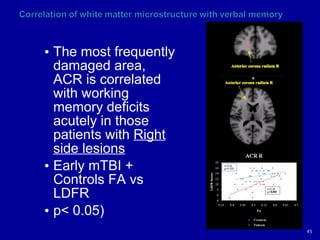
The most frequently damaged area, ACR is correlated with working memory deficits acutely in those patients with  Right side lesions Early mTBI + Controls FA vs LDFR  p< 0.05)
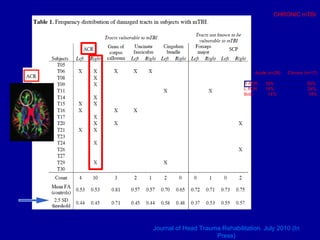
CHRONIC mTBI        Acute (n=28)    Chronic (n=17) R ACR    18%                  59% L ACR     14%                  24% Both        14%                  18% Journal of Head Trauma Rehabilitation. July 2010 (In Press)
Smits M.  Microstructural brain injury in post-concussion syndrome after minor head injury.  Neuroradiol 2010; 10 MD mean diffusitivity FA fractional anisotropy SLF superior longitudinal fasciculus IFO inferior frontal fasciculus ILF inferior longitudinal fasciculus Severity of post-concussive symptoms significantly correlates with ↓white matter integrity (↑in diffusivity ➙↓anisotropic diffusion.)
NMDA receptor downregulation Occurs 2-4 days after initial injury Returns to normal after day 7 Correlates with decreases in LTP induction during this period LTP does not always fully recover immediately (up to 8 weeks post-injury) Human fMRI shows abnormal activation of neural circuits, correlates with prolonged recovery Barkhoudrain G et al. The Molecular Pathophysiology of Concussive Brain Injury. Clin Sports Med 30 (2011): 33-48.
“ Second Impact Syndrome” Catastrophic cerebral edema after an apparent concussion Can result in coma and severe neurological deficit/mortality Likely due to underlying physiological changes in brain function due to first impact Window of vulnerability appears to follow window of impairment Barkhoudrain G et al. The Molecular Pathophysiology of Concussive Brain Injury. Clin Sports Med 30 (2011): 33-48.
Multiple concussions associated with cumulative effects on function and cognition Early onset of memory disturbances Possible early dementia Boxers with chronic traumatic encephalopathy Severe impairment accompanied by ApoE-4 alleles ApoE-4 transgenic mice have more diffuse plaques after experimental TBI than control mice (not examined after repeat injury) Barkhoudrain G et al. The Molecular Pathophysiology of Concussive Brain Injury. Clin Sports Med 30 (2011): 33-48.
Diffusion anisotropy maps and diffusion tensor imaging-based white matter trac- tography of a representative boxer (A and B ; 27 years old) and a control (C and D ; 29 years old). Intensity is proportional to anisotropy and color shows the direction. The boxer has decreased anisotropy in CC and anterior and posterior limb of IC compared with the healthy control subjects. Fiber tracking showed overall fewer trackable white matter fibers in this boxer ’s brain (B ) compared with that of a control subject (D ). The difference in fibers through the corpus callosum is particularly striking. Am J Neuroradiol 27:2000 – 04 Oct 2006
Bijur PE. Cognitive Outcomes of Multiple Mild Head Injuries in Children.  J Dev Behav Pediatr 1996. 17:143.
Alzheimer ’s disease, mild cognitive impairment Synergistic interaction of environmental and genetic factors in dementia.  Data do not suggest the 2 factors influence clinical presentation or course Functional Neurology 2006; 21(4): 223-228 APOE4 and TBI
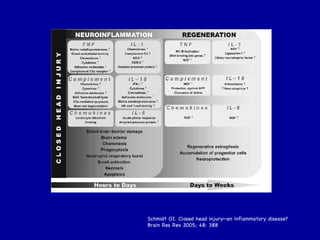
Schmidt OI. Closed head injury—an inflammatory disease?  Brain Res Rev 2005; 48: 388
HSS educational activities are carried out in a manner that serves the educational component of our Mission.  As faculty we are committed to providing transparency in any/all external relationships prior to giving an academic presentation. Kenneth Perrine, Ph.D. Weill-Cornell College of Medicine Disclosure:  I DO NOT  have a financial relationship with any commercial interest.
Neurocognitive Testing for All? Kenneth Perrine, Ph.D. Department of Neurological Surgery Weill-Cornell Medical College Consultant:  NY Jets, NY Islanders
What is a neuropsychologist? Ph.D. or Psy.D. in clinical psychology or neuropsychology Coursework in neuroanatomy, neurophysiology, neuropathology, clinical neurology Internship in neuropsychology Fellowship (1-2y) in neuropsychology Focus is on assessment of higher cortical functions Very little involvement in mental heath/psychiatric issues Beware “back-door” neuropsychologists Primarily a psychologist Knowledge acquisition through weekend workshops No board certification (a “certificate” is not the same)
Neuropsychological Testing Types: Paper-and-Pencil/Question-Answer Computerized Areas assessed Intelligence  “ Executive Functions” Mediated by frontal lobe Planning, organizing, sequencing, reasoning, problem solving Attention, concentration Memory Language Spatial Ability Motor:  Fine motor speed Psychological (personality) functioning
Types of Traditional Batteries Typical Battery Assesses all areas described above From 3 – 5 hours of face-face testing Expensive ($1,000 – 3,000) Tiring Does not target referral question Targeted Battery Tailored to presenting problem Shorter, cheaper
 
Stroop Test RED GREEN BLUE GREEN RED BLUE RED GREEN RED
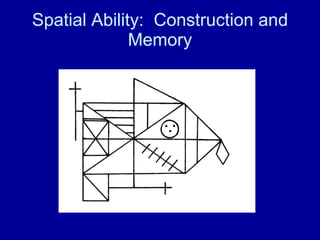
Spatial Ability:  Construction and Memory
Spatial Ability:  Visual Synthesis
 
Memory:  List Learning Bowl Fork Dawn Rum Passion Pan Judgment Pistol Grant Sword Bee Spatula Plane Bourbon Country Vodka Choice Pot Seed Bomb Wool Rifle Meal Wine
Post-Concussion  Neuropsychological Testing Areas affected most by concussion Attention, concentration Memory Visuo-motor ability Cognitive speed Motor speed
Computerized Batteries Can be: Online Free-standing on 1 or more computers Common batteries ImPACT ANAM MicroCog CNS Vital Signs
Computerized Batteries Reliability is very poor Confusion over instructions Wrong buttons Accidentally moving screen to screen No way to monitor effort “Sandbagging” at baseline Computer glitches– screen savers, backups
ImPACT Battery 6 subtests and a symptom checklist Combined to form composites: Verbal Memory Visual Memory Visual Motor Reaction Time  Impulse Control Norms and Reliable Change Indexes
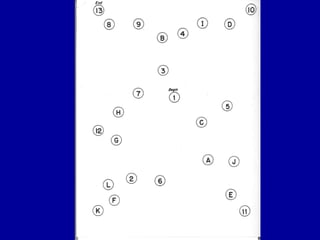
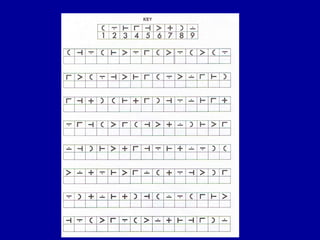
My Battery:  <30’ Pittsburgh Post-Concussion Scale Verbal learning:  12 words, 3 trials, recall, recognition Non-verbal learning:  6 geometric shapes, 3 trials, free recall Visuo-motor:  Trail Making Test Visuo-motor learning:  Digit Symbol Attention/concentration:  Digit Span Fine motor speed:  Grooved Pegboard Test Frontal executive/cognitive speed:  Stroop Test Review of ImPACT computerized battery
Protocols NHL Baseline:  All athletes do computerized (ImPACT) testing by neuropsychologist Post-Concussion ImPACT performed by neuropsychologist Paper-and-pencil performed by neuropsychologist NFL Similar, but ImPACT performed by trainer and complete paper/pencil baseline testing by neuropsychologist BOTH Athlete is cleared to resume heavier exercise and practice ONLY after symptom-free and normal neurocognitive testing (both p-p & ImPACT) Gradual introduction of more intense exercise, practice without contact, practice with contact
Neurocognitive Testing for  Concussions from School Sports Injuries Face-Face vs. Computerized Baseline Practical only for computerized batteries Sandbagging dilemma Timing While symptomatic After symptom-free Utility Detect abnormalities not self-reported Degree:  Compare to baseline or to normative group
Utilizing a Neuropsychologist Pro: Can monitor effort, reliability Look in their eyes Non-sports related issues– family, financial Flexibility to target specific symptom complexes Sensitivity/specificity of neurocognitive tests Con: Cost Availability
Utility of Neurocognitive Testing USUALLY  neurocognitive testing is normal once athlete is symptom-free Argument for not using neurocognitive testing Those who remain NOT symptom-free pose the problem– why?  Cerebral functioning?  Psychosocial isues?  Back on the horse?
Factors Affecting School Athletes Denial of symptoms in hopes of return to play  Motivation:  excused from school, attention Woody Allen Syndrome Other psychosocial factors Computerized battery cannot address all of these issues
When to Refer for  Neurocognitive Testing PCS symptoms are not remitting  History of multiple prior concussions Positive findings on neuroimaging, neurologic examination Suspicion of non-sports related factors
MOTTO WHEN IN DOUBT, HOLD THEM OUT

Adolescent Concussion Update

  • 1.
    Overview of ConcussionEpidemiology 13 th Annual Sports Medicine for the Young Athlete James J. Kinderknecht, M.D. Hospital for Special Surgery
  • 2.
    HSS educational activitiesare carried out in a manner that serves the educational component of our Mission. As faculty we are committed to providing transparency in any/all external relationships prior to giving an academic presentation. James J. Kinderknecht, M.D. Disclosure: I DO NOT have a financial relationship with any commercial interest.
  • 3.
    Concussion Definition Traumaticallyinduced alteration in brain function manifested by Alteration in awareness Dinged, dazed, stunned, woozy, foggy, amnesic, LOC, etc Signs of symptoms of post-concussive syndrome Headache, vertigo, light-headedness, balance disturbance, cognitive dysfunction, memory disturbance, hearing loss, tinnitus, vision disturbance, personality changes, drowsiness, lethargy, fatigue, inability to perform daily activities
  • 4.
    Concussion Epidemiology Difficultyuntil recently detecting the true epidemiology The true number of “mild” TBI’s are altered by every individual presenting to health care providers that have been injured The ability of the health care providers to accurately diagnose Asymptomatic vs asymptomatic Clearly there are numerous concussions that go undiagnosed
  • 5.
    Concussion Epidemiology Severallevels of participation Children/Adolescents/Young adults participating in non-organized activities Children/Adolescents/Young adults participating in organized activities Adults participating in non-organized activities Adults participating in organized activities Professionals participating in activities
  • 6.
    Concussion Epidemiology inChildren/Adolescents Estimated 44 million children and adolescents participate in organized sports in the US Estimated 170 million adults participate in physical activities including sports Estimated 1.7 million TBI’s in the US annually CDC estimates 1.6 to 3.8 million concussions occur annually in sports and recreational activities and has deemed it a public health issue
  • 7.
    Reported Concussion RatesHigh School Sports-Related Injury Surveillance System NCAA Sports-Related Injury Surveillance System Number of reported concussions increased 7% from 1988/1989 to the 2003/2004 seasons
  • 8.
    Concussion Injury Rateper 1000 Athletic Exposures 1988/1989 to 2003/2004 NCAA seasons Athletic exposure defined as one athlete participating in one game or practice
  • 9.
    Concussion Injury Rateper 1000 Athletic Exposures Men’s Spring FB .54 Ice hockey .41 Football .37 Soccer .28 Lacrosse .25 Wrestling .25 Basketball .16 Baseball .07 Women’s Ice hockey .91* Soccer .41 Lacrosse .25 Basketball .22 Field hockey .18 Gymnastics .16 Softball .14 Volleyball .09
  • 10.
    Concussion Rates inHS and NCAA Practice and Games in the 2005/2006 Season College FB .39 P 3.02 G M Soc .24 P 1.38 G W VB .21 P .13 G M BB .22 P .45 G W BB .31 P .85 G WR .35 P 1.0 G BasB .03 P .23 G SB .07 P .37 G High School FB .21 P 1.55 G M Soc .04 P .59 G W VB .09 P .97 G M BB .06 P .11 G W BB .06 P .60 G WR .13 P .32 G BasB .03 P .08 G SB .09 P .04 G
  • 11.
    Incidence in HighSchool Sports Lincoln et al. AJSM Jan 2011 Prospective 11 Year Study 1997/1998 to 2007/2008 Six boy’s sports/Six girl’s sports 25 high schools (all with athletic trainers and EMR) 10,926,892 athletic exposures 2651 concussions (incidence rate of 0.24) Various methods of diagnosis
  • 12.
    AJSM Lincoln etal. Boys sports were 53% of AE and 75% concussions Football (rate .6) was more than half the concussions with boy’s lacrosse being the next most common (rate .3) FB was 11x that of baseball (lowest rate .06) Girl’s soccer (rate .35) with lacrosse (rate .2) G soccer was 6x that of cheerleading (rate .06)
  • 13.
    AJSM Lincoln etal. Overall concussion rate increased from .12 AE’s in 1998 to 0.49 in 2008 and a ave. yearly increase of 15.5% (increased in all sports) Big jump in 2005 (more trainers) Boys BB less than girls BB .10 to.16 Boys soccer less than girls soccer .17 to .35 Similar data to other published studies Gessel et al J Athl Train 2007 Rechel et al J Athl Train 2008
  • 14.
    Concussion Epidemiology Severalfactors that may be contributing to a false “rate increase” More trained “evaluators” Physicians, athletic trainers, coaches, parents, other athletes Media coverage CDC programs (Heads Up) New state laws Rule changes Increased education from sports-bodies (NCAA, NATA, etc)
  • 15.
    Concussion Epidemiology Factorsthat may be contributing to a true “rate increase” Equipment Improvements of football helmet design: Plastic shell; facemasks Led to different playing techniques: Leading with the head; spearing Helmet probably protects from focal injuries, but likely not protective of diffuse injuries 1976 anti-spearing rule Decreased catastrophic head and C-spine injuries, but likely not concussions Bigger/Stronger/Faster
  • 16.
    Concussion Epidemiology NFLMTBI Committee Pellman et al. Committee formed in 1994 NFL Team Physicians Society NFL Athletic Trainers Society NFL equipment managers Scientific experts Studied NFL concussions from 1996-2001 Broad definition of concussion
  • 17.
    NFL concussion studyPart 1 (Neurosurg 2003) Video analysis: Head impacts greater for concussive impacts vs non-concussive Translational acceleration from impacts on facemask or side Part 2 (Neurosurg 2003) Video analysis: Lower acceleration for concussion if hit on facemask
  • 18.
    NFL concussion studyPart 3 (Neurosurg 2004) Epidemiology 787 concussions = .41 per game most in QB’s, WR’s, DB’s 67.7% helmet-helmet 20.9% another body part 11.4% ground 9.3% LOC Half returned within 1 day; 92% within one week
  • 19.
    Age Considerations inConcussion Catastrophic injuries (death or permanent neurologic injury) Most in football 133 catastrophic injuries since 1982/1983 in FB 120 HS athletes 11 college athletes 2 “sandlot” 0 professionals
  • 20.
    Second Impact SyndromeFirst described in 1973 (Schneider) Malignant cerebral edema exists in case reports after head trauma, but is it really second impact ? Numerous case reports, essentially all under 22 y/o Rare, but devasting, occurrence Unclear whether it has occurred in an asymptomatic person
  • 21.
    Possible Genetic FactoreApolipoprotein E e4 (APOE) Jordan el al (JAMA 1997) 30 boxers with chronic brain injury scores High exposure scored 2.6 APOE (+) 3.9 Low exposure scored 0.3 APOE (+) 1.8 Teasdale et al (Lancet 1997) 89 head injuries Unfavorable outcome 57% APOE (+) 27% APOE (+)
  • 22.
    Apolipoprotein E Tierneyet al (Clin J Sports Med 2010) Carriers of all 3 APOE rare alleles (0.7% of the population) were 10x more likely to report a concussion All studies have been retrospective designs Cross sectional and case-control Too early to determine anything
  • 23.
    Conclusions/Summary What dowe know? Concussions occur with fair frequency Concussions are under reported/under recognized Definite neurocognitive and pathologic effects
  • 24.
    Conclusions/Summary What don’t we know? True pathology: neuronal cell death vs temporary dysfunction Existence and risk of “second impact syndrome” Cumulative effects: concussive vs sub- concussive effects Prognostic parameters Genetic factors Best evaluation tools
  • 25.
    HSS educational activitiesare carried out in a manner that serves the educational component of our Mission. As faculty we are committed to providing transparency in any/all external relationships prior to giving an academic presentation. Baxter B. Allen, M.D. Weill Cornell Medical College Disclosure: I DO NOT have a financial relationship with any commercial interest.
  • 26.
    Baxter B. Allen,MD Research Associate in Child Neurology Weill Cornell Medical College
  • 27.
    Blow or joltto the head or a penetrating head injury that disrupts the function of the brain. Not all blows or jolts to the head result in a TBI. Severity …. may range from &quot;mild,&quot; i.e., a brief change in mental status or consciousness to &quot;severe,&quot; i.e., an extended period of unconsciousness or amnesia after the injury. TBI can result in short or long-term problems with independent function. Traumatic brain injury (TBI) CDC 7/06
  • 28.
    Mod Mild SevereSports concussion ? “ Minimal” Glasgow Coma Scale Consensus Statement on Concussion in Sport. 3 rd International Conference on Concussion in Sport held in Zurich, Nov 2008
  • 29.
    Loss of consciousness< 30 minutes or amnesia <24 hours or altered mental status at time of injury Glasgow Coma Scale (GCS) score 13-15, measured ≥30 mins after injury lower GCS = moderate to severe ACADEMIC EMERGENCY MEDICINE 2006 Current Pharmaceutical Design, 2001, 7, 1475 Concussion
  • 30.
    Deformation of elasticbrain within rigid skull Sudden acceleration or deceleration Focal contusions, hematomas, diffuse injury Neuronal axonal processes Not necessarily transection early Derangement of cytoskeletal elements Microtubules, neurofilaments Interrupt transport Delayed, progressive proteolysis Primary v secondary injury ACADEMIC EMERGENCY MEDICINE 2006 Current Pharmaceutical Design, 2001, 7, 1475
  • 31.
  • 32.
    Biomechanical investigations datingback to the beginning of the 20th century suggest that concussion results from a rotational motion of the cerebral hemispheres in the anterior–posterior plane, around the fulcrum of the fixed-in-place upper brain stem. N Engl J Med 2007;356:166-72. Mechanism of Concussion Viano et al
  • 33.
    Littre (1705): negativeautopsy findings in a fatal head injury Koch (1874): concussion due to the shaking of nervous structure not to any structural defect. Claimed repeated small blows paralyzed the respiratory, vasomotor and pupillary centres Kramer: due to momentary compression of the brain, which compression, exerted by the cerebrospinal fluid, collapsed the cerebral vessels Maasland: sudden ↑ICP Stops respiration and heart beat Required high pressures (5 kg.) on the bare dura of dog Witkowski (1877) not vascular changes. Frogs continued to move after removal of heart, stunned by blow to head, then began moving again. Experimental concussion - Occurrence of immediate traumatic paralysis of reflex function, with no visible CNS lesions. Subconcussive blows depress but not abolish reflex function Denny-Brown D. Experimental cerebral concussion. Brain 1941; 64:93
  • 34.
    Physical signs (eg. loss of consciousness, amnesia) Symptoms somatic (eg. headache) cognitive (eg. feeling like in a fog) emotional symptoms (eg. lability) Behavioural changes (eg. irritablity) Cognitive impairment (eg. slowed reaction times) Sleep disturbance (eg. drowsiness) Consensus Statement on Concussion in Sport. 3 rd International Conference on Concussion in Sport held in Zurich, Nov 2008
  • 35.
    Glutamate release andIonic Flux Alterations to Glucose Metabolism and Mitochondrial Function Alterations to Cerebral Blood Flow Axonal Injury Alterations in Brain Activation Acute Response to Repeat Concussion Cumulative Injury and Chronic Sequelae Barkhoudrain G et al. The Molecular Pathophysiology of Concussive Brain Injury. Clin Sports Med 30 (2011): 33-48.
  • 36.
    Membrane deformation leadsto potassium efflux and release of excitatory amino acids, especially glutamate Glutamate binds NMDA and AMPA ionic channels Calcium influx and further depolarization Depolarization leads to neuron suppression resembling spreading depression ATP-dependent Na+/K+ pumps work to restore ionic balance High levels of glucose metabolism due to high energy needs (lasts from .5 – 4 hours in rat TBI experiments) Lactate production is increased, leading to local acidosis, increased membrane permeability, and cerebral edema Barkhoudrain G et al. The Molecular Pathophysiology of Concussive Brain Injury. Clin Sports Med 30 (2011): 33-48.
  • 37.
    TAKAHASHI H. Changesin extracellular potassium concentration in cortex and brain stem during the acute phase of experimental closed head injury. J Neurosurg 55:708-717, 1981
  • 38.
    Initial hyperglycolysis followedby prolonged period of hypo metabolism (up to 5 days in rat study) NMDA channel activation leads to influx of Ca++ Ca++ accumulates in mitochondria Leads to glucose oxidative dysfunction Barkhoudrain G et al. The Molecular Pathophysiology of Concussive Brain Injury. Clin Sports Med 30 (2011): 33-48.
  • 39.
    Triphasic alteration insevere TBI, but not well studied in mild TBI Initial cerebral hypoperfusion (day 0) Cerebral hyperemia (days 1-3) Cerebral vasospasm (days 4-15) Evidence of acute impairment of regulation of venous tone in concussion Barkhoudrain G et al. The Molecular Pathophysiology of Concussive Brain Injury. Clin Sports Med 30 (2011): 33-48. Dicheskul ML & Kulikov VP. Arterial and venous brain reactivity in the acute period of cerebral concussion. Neurosci Behav Physiol. 2011 Jan;41(1):64-7.
  • 40.
    Mechanical stretching ofaxonal cell membranes leads same effects as above with additional consequences Neurofilament compaction acutely due to phosphorylation or proteolysis of sidearms Destabilization of microtubules due to calcium influx Interferes with axonal transport, causing axonal blebbing and even disconnection Like reversible injury in mild TBI, which progresses through cortical and subcortical structures over 4-6 weeks Correlated with impaired cognition in rat model DTI imaging confirms similar process in humans Barkhoudrain G et al. The Molecular Pathophysiology of Concussive Brain Injury. Clin Sports Med 30 (2011): 33-48.
  • 41.
    Diffuse Axonal Injury(DAI) – The severe end of the spectrum
  • 42.
    J. Ng 1, M. Wahl 1 , E. Tong 1 , H. Lee 2 , S. Veeraraghavan 1 , D. Xu1, S. Zhao 1 , J. Kornak 1 , M. Meeker 2 , J. Ghajar 3 , G. T. Manley 2 , and P. Mukherjee 1 1 Radiology and Biomedical Imaging, University of California, San Francisco, San Francisco, CA, United States, 2 Neurological Surgery, University of California, San Francisco, San Francisco, CA, United States, 3 Neurological Surgery, Weill Cornell and Brain Trauma Foundation, New York, NY, United States
  • 43.
    Yang FG, GhajarJ, Manley JT, Mukherjee P. (In preparation)
  • 44.
  • 45.
    The most frequentlydamaged area, ACR is correlated with working memory deficits acutely in those patients with Right side lesions Early mTBI + Controls FA vs LDFR p< 0.05)
  • 46.
    CHRONIC mTBI      Acute (n=28)    Chronic (n=17) R ACR    18%                  59% L ACR     14%                  24% Both        14%                 18% Journal of Head Trauma Rehabilitation. July 2010 (In Press)
  • 47.
    Smits M. Microstructural brain injury in post-concussion syndrome after minor head injury. Neuroradiol 2010; 10 MD mean diffusitivity FA fractional anisotropy SLF superior longitudinal fasciculus IFO inferior frontal fasciculus ILF inferior longitudinal fasciculus Severity of post-concussive symptoms significantly correlates with ↓white matter integrity (↑in diffusivity ➙↓anisotropic diffusion.)
  • 48.
    NMDA receptor downregulationOccurs 2-4 days after initial injury Returns to normal after day 7 Correlates with decreases in LTP induction during this period LTP does not always fully recover immediately (up to 8 weeks post-injury) Human fMRI shows abnormal activation of neural circuits, correlates with prolonged recovery Barkhoudrain G et al. The Molecular Pathophysiology of Concussive Brain Injury. Clin Sports Med 30 (2011): 33-48.
  • 49.
    “ Second ImpactSyndrome” Catastrophic cerebral edema after an apparent concussion Can result in coma and severe neurological deficit/mortality Likely due to underlying physiological changes in brain function due to first impact Window of vulnerability appears to follow window of impairment Barkhoudrain G et al. The Molecular Pathophysiology of Concussive Brain Injury. Clin Sports Med 30 (2011): 33-48.
  • 50.
    Multiple concussions associatedwith cumulative effects on function and cognition Early onset of memory disturbances Possible early dementia Boxers with chronic traumatic encephalopathy Severe impairment accompanied by ApoE-4 alleles ApoE-4 transgenic mice have more diffuse plaques after experimental TBI than control mice (not examined after repeat injury) Barkhoudrain G et al. The Molecular Pathophysiology of Concussive Brain Injury. Clin Sports Med 30 (2011): 33-48.
  • 51.
    Diffusion anisotropy mapsand diffusion tensor imaging-based white matter trac- tography of a representative boxer (A and B ; 27 years old) and a control (C and D ; 29 years old). Intensity is proportional to anisotropy and color shows the direction. The boxer has decreased anisotropy in CC and anterior and posterior limb of IC compared with the healthy control subjects. Fiber tracking showed overall fewer trackable white matter fibers in this boxer ’s brain (B ) compared with that of a control subject (D ). The difference in fibers through the corpus callosum is particularly striking. Am J Neuroradiol 27:2000 – 04 Oct 2006
  • 52.
    Bijur PE. CognitiveOutcomes of Multiple Mild Head Injuries in Children. J Dev Behav Pediatr 1996. 17:143.
  • 53.
    Alzheimer ’s disease,mild cognitive impairment Synergistic interaction of environmental and genetic factors in dementia. Data do not suggest the 2 factors influence clinical presentation or course Functional Neurology 2006; 21(4): 223-228 APOE4 and TBI
  • 54.
    Schmidt OI. Closedhead injury—an inflammatory disease? Brain Res Rev 2005; 48: 388
  • 55.
    HSS educational activitiesare carried out in a manner that serves the educational component of our Mission. As faculty we are committed to providing transparency in any/all external relationships prior to giving an academic presentation. Kenneth Perrine, Ph.D. Weill-Cornell College of Medicine Disclosure: I DO NOT have a financial relationship with any commercial interest.
  • 56.
    Neurocognitive Testing forAll? Kenneth Perrine, Ph.D. Department of Neurological Surgery Weill-Cornell Medical College Consultant: NY Jets, NY Islanders
  • 57.
    What is aneuropsychologist? Ph.D. or Psy.D. in clinical psychology or neuropsychology Coursework in neuroanatomy, neurophysiology, neuropathology, clinical neurology Internship in neuropsychology Fellowship (1-2y) in neuropsychology Focus is on assessment of higher cortical functions Very little involvement in mental heath/psychiatric issues Beware “back-door” neuropsychologists Primarily a psychologist Knowledge acquisition through weekend workshops No board certification (a “certificate” is not the same)
  • 58.
    Neuropsychological Testing Types:Paper-and-Pencil/Question-Answer Computerized Areas assessed Intelligence “ Executive Functions” Mediated by frontal lobe Planning, organizing, sequencing, reasoning, problem solving Attention, concentration Memory Language Spatial Ability Motor: Fine motor speed Psychological (personality) functioning
  • 59.
    Types of TraditionalBatteries Typical Battery Assesses all areas described above From 3 – 5 hours of face-face testing Expensive ($1,000 – 3,000) Tiring Does not target referral question Targeted Battery Tailored to presenting problem Shorter, cheaper
  • 60.
  • 61.
    Stroop Test REDGREEN BLUE GREEN RED BLUE RED GREEN RED
  • 62.
    Spatial Ability: Construction and Memory
  • 63.
    Spatial Ability: Visual Synthesis
  • 64.
  • 65.
    Memory: ListLearning Bowl Fork Dawn Rum Passion Pan Judgment Pistol Grant Sword Bee Spatula Plane Bourbon Country Vodka Choice Pot Seed Bomb Wool Rifle Meal Wine
  • 66.
    Post-Concussion NeuropsychologicalTesting Areas affected most by concussion Attention, concentration Memory Visuo-motor ability Cognitive speed Motor speed
  • 67.
    Computerized Batteries Canbe: Online Free-standing on 1 or more computers Common batteries ImPACT ANAM MicroCog CNS Vital Signs
  • 68.
    Computerized Batteries Reliabilityis very poor Confusion over instructions Wrong buttons Accidentally moving screen to screen No way to monitor effort “Sandbagging” at baseline Computer glitches– screen savers, backups
  • 69.
    ImPACT Battery 6subtests and a symptom checklist Combined to form composites: Verbal Memory Visual Memory Visual Motor Reaction Time Impulse Control Norms and Reliable Change Indexes
  • 70.
    My Battery: <30’ Pittsburgh Post-Concussion Scale Verbal learning: 12 words, 3 trials, recall, recognition Non-verbal learning: 6 geometric shapes, 3 trials, free recall Visuo-motor: Trail Making Test Visuo-motor learning: Digit Symbol Attention/concentration: Digit Span Fine motor speed: Grooved Pegboard Test Frontal executive/cognitive speed: Stroop Test Review of ImPACT computerized battery
  • 71.
    Protocols NHL Baseline: All athletes do computerized (ImPACT) testing by neuropsychologist Post-Concussion ImPACT performed by neuropsychologist Paper-and-pencil performed by neuropsychologist NFL Similar, but ImPACT performed by trainer and complete paper/pencil baseline testing by neuropsychologist BOTH Athlete is cleared to resume heavier exercise and practice ONLY after symptom-free and normal neurocognitive testing (both p-p & ImPACT) Gradual introduction of more intense exercise, practice without contact, practice with contact
  • 72.
    Neurocognitive Testing for Concussions from School Sports Injuries Face-Face vs. Computerized Baseline Practical only for computerized batteries Sandbagging dilemma Timing While symptomatic After symptom-free Utility Detect abnormalities not self-reported Degree: Compare to baseline or to normative group
  • 73.
    Utilizing a NeuropsychologistPro: Can monitor effort, reliability Look in their eyes Non-sports related issues– family, financial Flexibility to target specific symptom complexes Sensitivity/specificity of neurocognitive tests Con: Cost Availability
  • 74.
    Utility of NeurocognitiveTesting USUALLY neurocognitive testing is normal once athlete is symptom-free Argument for not using neurocognitive testing Those who remain NOT symptom-free pose the problem– why? Cerebral functioning? Psychosocial isues? Back on the horse?
  • 75.
    Factors Affecting SchoolAthletes Denial of symptoms in hopes of return to play Motivation: excused from school, attention Woody Allen Syndrome Other psychosocial factors Computerized battery cannot address all of these issues
  • 76.
    When to Referfor Neurocognitive Testing PCS symptoms are not remitting History of multiple prior concussions Positive findings on neuroimaging, neurologic examination Suspicion of non-sports related factors
  • 77.
    MOTTO WHEN INDOUBT, HOLD THEM OUT