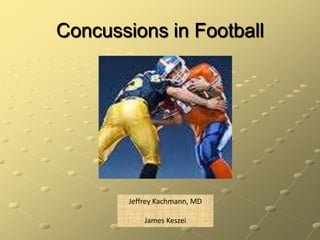
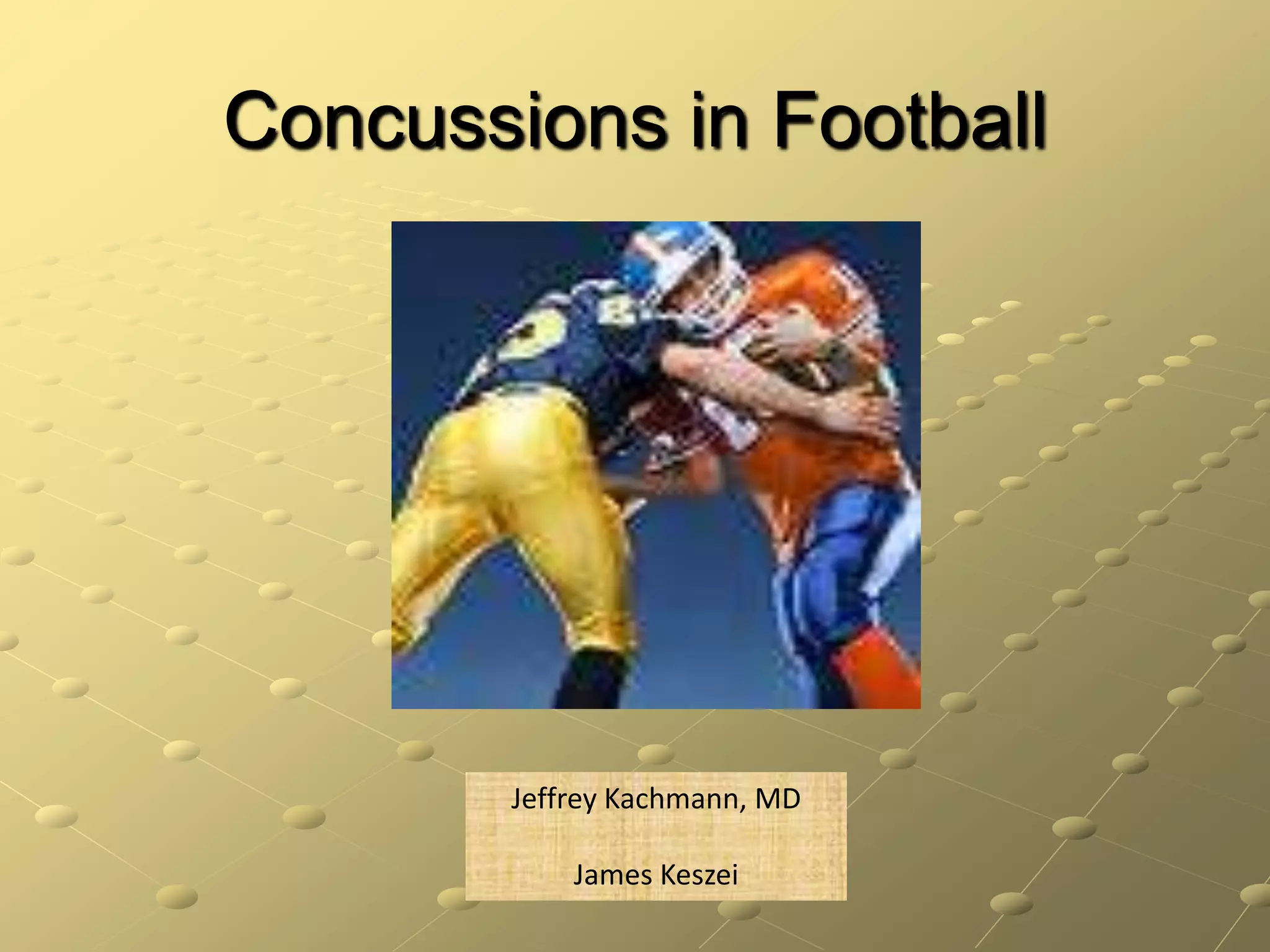
Concussions in FootballJeffrey Kachmann, MD		    James Keszei
Topics CoveredWhat is a Concussion;Symptoms/Signs of a Concussion;Research on Long Term Effects of Concussions;Second Impact Syndrome (video);How to Deal with Concussions, When in Doubt, Sit it Out (video);Athlete Responsibilities.  Return To Play GuidelinesDiscussion/Questions/Comments         		         (VIDEO)
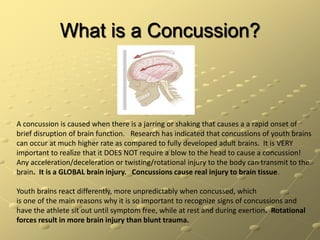
What is a Concussion?A concussion is caused when there is a jarring or shaking that causes a a rapid onset of  brief disruption of brain function.   Research has indicated that concussions of youth brains can occur at much higher rate as compared to fully developed adult brains.  It is VERY important to realize that it DOES NOT require a blow to the head to cause a concussion! Any acceleration/deceleration or twisting/rotational injury to the body can transmit to the brain.  It is a GLOBAL brain injury.   Concussions cause real injury to brain tissue.Youth brains react differently, more unpredictably when concussed, whichis one of the main reasons why it is so important to recognize signs of concussions and have the athlete sit out until symptom free, while at rest and during exertion.  Rotational forces result in more brain injury than blunt trauma.
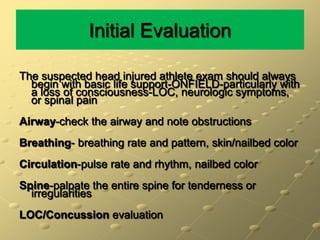
Initial EvaluationThe suspected head injured athlete exam should always begin with basic life support-ONFIELD-particularly with a loss of consciousness-LOC, neurologic symptoms, or spinal painAirway-check the airway and note obstructionsBreathing- breathing rate and pattern, skin/nailbedcolorCirculation-pulse rate and rhythm, nailbedcolorSpine-palpate the entire spine for tenderness or irregularitiesLOC/Concussion evaluation
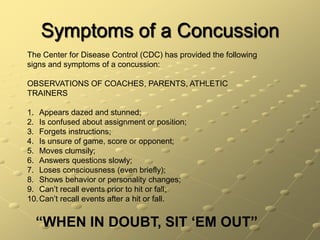
Symptoms of a ConcussionThe Center for Disease Control (CDC) has provided the following signs and symptoms of a concussion:OBSERVATIONS OF COACHES, PARENTS, ATHLETIC TRAINERSAppears dazed and stunned;Is confused about assignment or position;Forgets instructions;Is unsure of game, score or opponent;Moves clumsily;Answers questions slowly;Loses consciousness (even briefly);Shows behavior or personality changes;Can’t recall events prior to hit or fall;Can’t recall events after a hit or fall.“WHEN IN DOUBT, SIT ‘EM OUT”
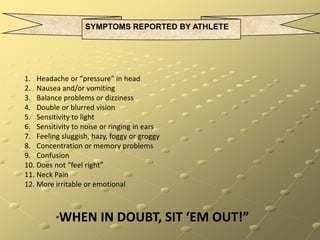
SYMPTOMS REPORTED BY ATHLETEHeadache or “pressure” in headNausea and/or vomitingBalance problems or dizzinessDouble or blurred visionSensitivity to lightSensitivity to noise or ringing in earsFeeling sluggish, hazy, foggy or groggyConcentration or memory problemsConfusionDoes not “feel right”Neck PainMore irritable or emotional                 “WHEN IN DOUBT, SIT ‘EM OUT!”
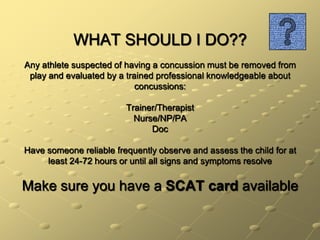
WHAT SHOULD I DO??Any athlete suspected of having a concussion must be removed from play and evaluated by a trained professional knowledgeable about concussions:Trainer/TherapistNurse/NP/PADocHave someone reliable frequently observe and assess the child for at least 24-72 hours or until all signs and symptoms resolveMake sure you have a SCAT card available
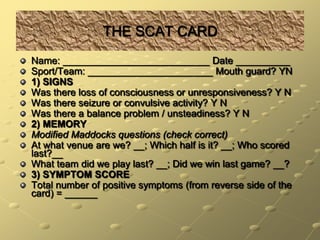
THE SCAT CARDName: ___________________________ Date __________Sport/Team: _______________________ Mouth guard? YN1) SIGNSWas there loss of consciousness or unresponsiveness? Y NWas there seizure or convulsive activity? Y NWas there a balance problem / unsteadiness? Y N2) MEMORYModified Maddocks questions (check correct)At what venue are we? __; Which half is it? __; Who scored last?__What team did we play last? __; Did we win last game? __?3) SYMPTOM SCORETotal number of positive symptoms (from reverse side of the card) = ______
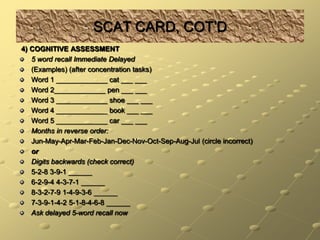
SCAT CARD, COT’D 4) COGNITIVE ASSESSMENT5 word recall Immediate Delayed(Examples) (after concentration tasks)Word 1 _____________ cat ___ ___Word 2_____________ pen ___ ___Word 3 _____________ shoe ___ ___Word 4 _____________ book ___ ___Word 5 _____________ car ___ ___Months in reverse order:Jun-May-Apr-Mar-Feb-Jan-Dec-Nov-Oct-Sep-Aug-Jul (circle incorrect)orDigits backwards (check correct)5-2-8 3-9-1 ______6-2-9-4 4-3-7-1 ______8-3-2-7-9 1-4-9-3-6 ______7-3-9-1-4-2 5-1-8-4-6-8 ______Ask delayed 5-word recall now
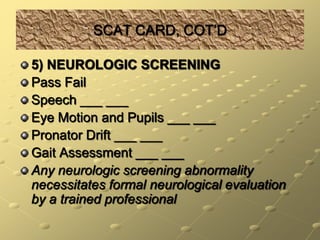
SCAT CARD, COT’D5) NEUROLOGIC SCREENINGPass FailSpeech ___ ___Eye Motion and Pupils ___ ___Pronator Drift ___ ___Gait Assessment ___ ___Any neurologic screening abnormality necessitates formal neurological evaluation by a trained professional
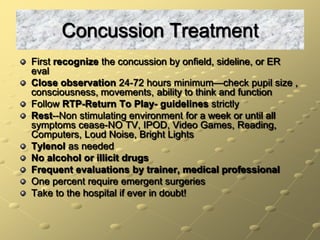
Concussion TreatmentFirst recognize the concussion by onfield, sideline, or ER evalClose observation 24-72 hours minimum—check pupil size , consciousness, movements, ability to think and functionFollow RTP-Return To Play- guidelines strictlyRest--Non stimulating environment for a week or until all symptoms cease-NO TV, IPOD, Video Games, Reading, Computers, Loud Noise, Bright LightsTylenol as neededNo alcohol or illicit drugsFrequent evaluations by trainer, medical professionalOne percent require emergent surgeriesTake to the hospital if ever in doubt!
Send your player to the Hospital if:Headaches worsenToo drowsy to wake upCan’t Recognize people or places or very confusedRepetitive vomiting—more than once!SeizuresExtremity or facial numbness, tingling, pain or weaknessSlurred speechUnsteady walkDilated Pupils or unequal gazeIrregular, slow, or very fast pulse or breathingAny obvious injuriesLOC  (loss of consciousness) more than 5 minutes
Head Injuries can cause structural injury in and around the brainNEVER forget that a seemingly simple hit resulting in a concussion can cause a: skull fractureepi or subdural hematoma (blood clot on the outside or inside   of the lining around the brain) post traumatic subarachnoid hemorrhage (salt n pepper bleeding on the brain surface)intracerebral hemorrhage (bleeding inside the brain-petecchial or larger clot) brain contusion (bruise) axonal shearing injury (nerve fiber or coating injury)Brainstem injuryMalignant out of control brain swelling resulting in death or disabilitySpinal injury					       (VIDEO)
SECOND IMPACT SYNDROME    One of the worst scenarios involving concussions occurs when a youth athlete is concussed during an event, returns to play, and receives a second concussion on top of the existing concussion.  In this scenario, and athlete can suffer a traumatic brain injury that can debilitate the youth athlete for the rest of their life, or even result in their death.  Particularly in children, a concussion can result in loss of autoregulation of brain blood flow with a rush of blood into the brain blood vessels causing very rapid brain swelling and herniation through the skull and instant death or severe debilty.  I have personally witnessed this and it is very scary!   WHEN IN DOUBT, SIT ‘EM OUT!
Brain Vulnerability After a ConcussionThe brain is VERY vulnerable to further injury after a concussion for minutes to daysLarge numbers of neurons (nerve cells) can die as a result of even small changes in intracranial (inside the head) pressure, blood flow, and anoxia (lack of oxygen—always remember the ABC’s of resuscitation!!!) after a concussionREMEMBER, CONCUSSIONS ARE VERY GROSSLY UNDERDIAGNOSED—UP TO 88% ARE UNRECOGNIZED!!!
REPEATS  Athletes involved in a concussion are far more vulnerable to further concussions(VIDEO)
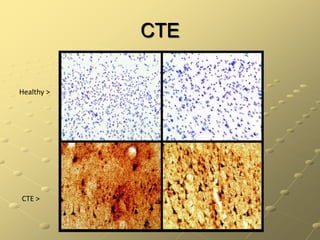
Research on Long Term Effects of ConcussionsNew research regarding the long term effects of repeated concussions  can cause some athletes to suffer the progressive  neurodegenerative brain disease Chronic Traumatic Encephalopathy (CTE), which eventually leads to dementia.  An estimated 10% to 20% of all athletes participating in contact sports suffer a concussion each season.  Most athletes recover completely and can return to play following an appropriate period of recovery.  Realize that cumulative concussions injure the brain permanently and cause long term effects now and later in life.
CTEHealthy >CTE >
Long Term effects from ConcussionsMemory lossCognitive disorders (problems thinking through things)DementiaDepressionAnxietyPTSD-Post Traumatic Stress DisorderSubstance abusePoor Physical PerformanceLack of energy or enthusiasmIrritabiltyHeadachesDizzinessInsomniaTremors/Parkinsonism—Muhammad Ali
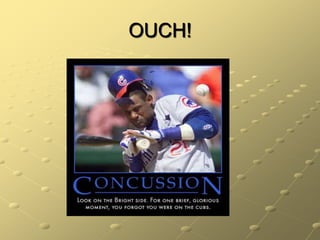
OUCH!
How to Deal With a Suspected ConcussionThe most important thing to remember when dealing with an athlete with a suspected concussion is to air on the side of caution.  It is not worth the potentiallong term health problems, or traumatic brain injury, to rush an athlete back intoa game or practice situation, prior to being symptom free at rest and during exertion.  	*****WHEN IN DOUBT, SIT THEM OUT*****Review your league’s concussion policy to ensure the safety of the players is thenumber one priority.  Return to play policy.  Many leagues, to include Youth, Middle School, and HighSchool programs do NOT have a return to play policy, which could result in catastrophic injury coupled with legal action.
Athlete ResponsibilitiesAs Coaches you must let athletes know they will not be looked down uponor treated unfairly if they report a concussion.  Athletes must feel confidentthey can report symptoms of a concussion without Coaches punishing them for not “Toughing it Out”.  Most Athletes are very competitive, however, they are responsible for reporting symptoms and need to understand the potentiallong term negative effects of not reporting concussions.
www.sportslegacy.orgMinimum Recommended GuidelinesAs a natural evolution of the 10 Point Plan, in September 2010, SLI announced the release of 7 Steps for Brain Safety: Minimum Recommended Guidelines for Youth Sports, a list of practical, simple, and free solutions to minimize brain trauma.On the following pages, you will find a link to recommended programs, as well as links to supplemental programs. Programs should adopt at least the recommended program.If you received a paper version of the 7 Steps, visit www.sportslegacy.org to locate the links.SLI’s 7 Steps for Brain Safety1. Preseason Education for Coaches2. Preseason Education for Athletes3. Preseason Education for Parents4. Coaches Use CDC’s Heads Up Clipboard Sticker5. Adopt CDC’s Concussion Action Plan for Removaland Return-to-Play6. Prevention through Neck Strengthening7. Prevention through Overall Brain Trauma Reduction
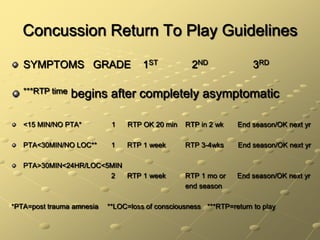
Concussion Return To Play GuidelinesSYMPTOMS   GRADE    1ST    	       2ND3RD***RTP time begins after completely asymptomatic<15 MIN/NO PTA*               1      RTP OK 20 min    RTP in 2 wk      End season/OK next yrPTA<30MIN/NO LOC**1      RTP 1 week	       RTP 3-4wks       End season/OK next yrPTA>30MIN<24HR/LOC<5MIN  				  2      RTP 1 week	       RTP 1 mo or 	 End season/OK next yr					       end season*PTA=post trauma amnesia	**LOC=loss of consciousness	  ***RTP=return to play
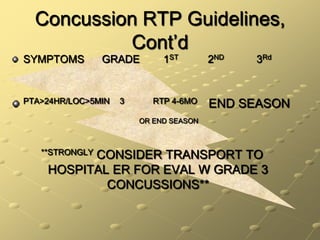
Concussion RTP Guidelines, Cont’dSYMPTOMS   GRADE        1ST          2ND3RdPTA>24HR/LOC>5MIN3	      RTP 4-6MO   END SEASONOR END SEASON**STRONGLY CONSIDER TRANSPORT TO HOSPITAL ER FOR EVAL W GRADE 3 CONCUSSIONS**
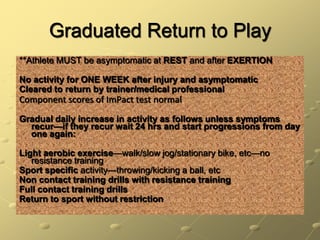
Graduated Return to Play**Athlete MUST be asymptomatic at REST and after EXERTIONNo activity for ONE WEEK after injury and asymptomaticCleared to return by trainer/medical professionalComponent scores of ImPact test normalGradual daily increase in activity as follows unless symptoms recur—if they recur wait 24 hrs and start progressions from day one again:Light aerobic exercise—walk/slow jog/stationary bike, etc—no resistance trainingSport specific activity—throwing/kicking a ball, etcNon contact training drills with resistance trainingFull contact training drillsReturn to sport without restriction
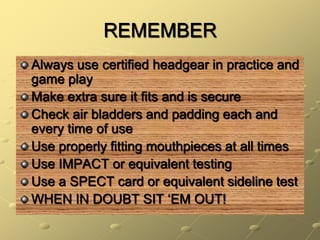
REMEMBERAlways use certified headgear in practice and game playMake extra sure it fits and is secureCheck air bladders and padding each and every time of useUse properly fitting mouthpieces at all timesUse IMPACT or equivalent testingUse a SPECT card or equivalent sideline testWHEN IN DOUBT SIT ‘EM OUT!
DiscussionQuestionsComments

Concussions In Football

  • 1.
    Concussions in FootballJeffreyKachmann, MD James Keszei
  • 2.
    Topics CoveredWhat isa Concussion;Symptoms/Signs of a Concussion;Research on Long Term Effects of Concussions;Second Impact Syndrome (video);How to Deal with Concussions, When in Doubt, Sit it Out (video);Athlete Responsibilities. Return To Play GuidelinesDiscussion/Questions/Comments (VIDEO)
  • 3.
    What is aConcussion?A concussion is caused when there is a jarring or shaking that causes a a rapid onset of brief disruption of brain function. Research has indicated that concussions of youth brains can occur at much higher rate as compared to fully developed adult brains. It is VERY important to realize that it DOES NOT require a blow to the head to cause a concussion! Any acceleration/deceleration or twisting/rotational injury to the body can transmit to the brain. It is a GLOBAL brain injury. Concussions cause real injury to brain tissue.Youth brains react differently, more unpredictably when concussed, whichis one of the main reasons why it is so important to recognize signs of concussions and have the athlete sit out until symptom free, while at rest and during exertion. Rotational forces result in more brain injury than blunt trauma.
  • 4.
    Initial EvaluationThe suspectedhead injured athlete exam should always begin with basic life support-ONFIELD-particularly with a loss of consciousness-LOC, neurologic symptoms, or spinal painAirway-check the airway and note obstructionsBreathing- breathing rate and pattern, skin/nailbedcolorCirculation-pulse rate and rhythm, nailbedcolorSpine-palpate the entire spine for tenderness or irregularitiesLOC/Concussion evaluation
  • 5.
    Symptoms of aConcussionThe Center for Disease Control (CDC) has provided the following signs and symptoms of a concussion:OBSERVATIONS OF COACHES, PARENTS, ATHLETIC TRAINERSAppears dazed and stunned;Is confused about assignment or position;Forgets instructions;Is unsure of game, score or opponent;Moves clumsily;Answers questions slowly;Loses consciousness (even briefly);Shows behavior or personality changes;Can’t recall events prior to hit or fall;Can’t recall events after a hit or fall.“WHEN IN DOUBT, SIT ‘EM OUT”
  • 6.
    SYMPTOMS REPORTED BYATHLETEHeadache or “pressure” in headNausea and/or vomitingBalance problems or dizzinessDouble or blurred visionSensitivity to lightSensitivity to noise or ringing in earsFeeling sluggish, hazy, foggy or groggyConcentration or memory problemsConfusionDoes not “feel right”Neck PainMore irritable or emotional “WHEN IN DOUBT, SIT ‘EM OUT!”
  • 7.
    WHAT SHOULD IDO??Any athlete suspected of having a concussion must be removed from play and evaluated by a trained professional knowledgeable about concussions:Trainer/TherapistNurse/NP/PADocHave someone reliable frequently observe and assess the child for at least 24-72 hours or until all signs and symptoms resolveMake sure you have a SCAT card available
  • 8.
    THE SCAT CARDName:___________________________ Date __________Sport/Team: _______________________ Mouth guard? YN1) SIGNSWas there loss of consciousness or unresponsiveness? Y NWas there seizure or convulsive activity? Y NWas there a balance problem / unsteadiness? Y N2) MEMORYModified Maddocks questions (check correct)At what venue are we? __; Which half is it? __; Who scored last?__What team did we play last? __; Did we win last game? __?3) SYMPTOM SCORETotal number of positive symptoms (from reverse side of the card) = ______
  • 9.
    SCAT CARD, COT’D4) COGNITIVE ASSESSMENT5 word recall Immediate Delayed(Examples) (after concentration tasks)Word 1 _____________ cat ___ ___Word 2_____________ pen ___ ___Word 3 _____________ shoe ___ ___Word 4 _____________ book ___ ___Word 5 _____________ car ___ ___Months in reverse order:Jun-May-Apr-Mar-Feb-Jan-Dec-Nov-Oct-Sep-Aug-Jul (circle incorrect)orDigits backwards (check correct)5-2-8 3-9-1 ______6-2-9-4 4-3-7-1 ______8-3-2-7-9 1-4-9-3-6 ______7-3-9-1-4-2 5-1-8-4-6-8 ______Ask delayed 5-word recall now
  • 10.
    SCAT CARD, COT’D5)NEUROLOGIC SCREENINGPass FailSpeech ___ ___Eye Motion and Pupils ___ ___Pronator Drift ___ ___Gait Assessment ___ ___Any neurologic screening abnormality necessitates formal neurological evaluation by a trained professional
  • 11.
    Concussion TreatmentFirst recognizethe concussion by onfield, sideline, or ER evalClose observation 24-72 hours minimum—check pupil size , consciousness, movements, ability to think and functionFollow RTP-Return To Play- guidelines strictlyRest--Non stimulating environment for a week or until all symptoms cease-NO TV, IPOD, Video Games, Reading, Computers, Loud Noise, Bright LightsTylenol as neededNo alcohol or illicit drugsFrequent evaluations by trainer, medical professionalOne percent require emergent surgeriesTake to the hospital if ever in doubt!
  • 12.
    Send your playerto the Hospital if:Headaches worsenToo drowsy to wake upCan’t Recognize people or places or very confusedRepetitive vomiting—more than once!SeizuresExtremity or facial numbness, tingling, pain or weaknessSlurred speechUnsteady walkDilated Pupils or unequal gazeIrregular, slow, or very fast pulse or breathingAny obvious injuriesLOC (loss of consciousness) more than 5 minutes
  • 13.
    Head Injuries cancause structural injury in and around the brainNEVER forget that a seemingly simple hit resulting in a concussion can cause a: skull fractureepi or subdural hematoma (blood clot on the outside or inside of the lining around the brain) post traumatic subarachnoid hemorrhage (salt n pepper bleeding on the brain surface)intracerebral hemorrhage (bleeding inside the brain-petecchial or larger clot) brain contusion (bruise) axonal shearing injury (nerve fiber or coating injury)Brainstem injuryMalignant out of control brain swelling resulting in death or disabilitySpinal injury (VIDEO)
  • 14.
    SECOND IMPACT SYNDROME One of the worst scenarios involving concussions occurs when a youth athlete is concussed during an event, returns to play, and receives a second concussion on top of the existing concussion. In this scenario, and athlete can suffer a traumatic brain injury that can debilitate the youth athlete for the rest of their life, or even result in their death. Particularly in children, a concussion can result in loss of autoregulation of brain blood flow with a rush of blood into the brain blood vessels causing very rapid brain swelling and herniation through the skull and instant death or severe debilty. I have personally witnessed this and it is very scary! WHEN IN DOUBT, SIT ‘EM OUT!
  • 15.
    Brain Vulnerability Aftera ConcussionThe brain is VERY vulnerable to further injury after a concussion for minutes to daysLarge numbers of neurons (nerve cells) can die as a result of even small changes in intracranial (inside the head) pressure, blood flow, and anoxia (lack of oxygen—always remember the ABC’s of resuscitation!!!) after a concussionREMEMBER, CONCUSSIONS ARE VERY GROSSLY UNDERDIAGNOSED—UP TO 88% ARE UNRECOGNIZED!!!
  • 16.
    REPEATS Athletesinvolved in a concussion are far more vulnerable to further concussions(VIDEO)
  • 17.
    Research on LongTerm Effects of ConcussionsNew research regarding the long term effects of repeated concussions can cause some athletes to suffer the progressive neurodegenerative brain disease Chronic Traumatic Encephalopathy (CTE), which eventually leads to dementia. An estimated 10% to 20% of all athletes participating in contact sports suffer a concussion each season. Most athletes recover completely and can return to play following an appropriate period of recovery. Realize that cumulative concussions injure the brain permanently and cause long term effects now and later in life.
  • 18.
  • 19.
    Long Term effectsfrom ConcussionsMemory lossCognitive disorders (problems thinking through things)DementiaDepressionAnxietyPTSD-Post Traumatic Stress DisorderSubstance abusePoor Physical PerformanceLack of energy or enthusiasmIrritabiltyHeadachesDizzinessInsomniaTremors/Parkinsonism—Muhammad Ali
  • 20.
  • 21.
    How to DealWith a Suspected ConcussionThe most important thing to remember when dealing with an athlete with a suspected concussion is to air on the side of caution. It is not worth the potentiallong term health problems, or traumatic brain injury, to rush an athlete back intoa game or practice situation, prior to being symptom free at rest and during exertion. *****WHEN IN DOUBT, SIT THEM OUT*****Review your league’s concussion policy to ensure the safety of the players is thenumber one priority. Return to play policy. Many leagues, to include Youth, Middle School, and HighSchool programs do NOT have a return to play policy, which could result in catastrophic injury coupled with legal action.
  • 22.
    Athlete ResponsibilitiesAs Coachesyou must let athletes know they will not be looked down uponor treated unfairly if they report a concussion. Athletes must feel confidentthey can report symptoms of a concussion without Coaches punishing them for not “Toughing it Out”. Most Athletes are very competitive, however, they are responsible for reporting symptoms and need to understand the potentiallong term negative effects of not reporting concussions.
  • 23.
    www.sportslegacy.orgMinimum Recommended GuidelinesAsa natural evolution of the 10 Point Plan, in September 2010, SLI announced the release of 7 Steps for Brain Safety: Minimum Recommended Guidelines for Youth Sports, a list of practical, simple, and free solutions to minimize brain trauma.On the following pages, you will find a link to recommended programs, as well as links to supplemental programs. Programs should adopt at least the recommended program.If you received a paper version of the 7 Steps, visit www.sportslegacy.org to locate the links.SLI’s 7 Steps for Brain Safety1. Preseason Education for Coaches2. Preseason Education for Athletes3. Preseason Education for Parents4. Coaches Use CDC’s Heads Up Clipboard Sticker5. Adopt CDC’s Concussion Action Plan for Removaland Return-to-Play6. Prevention through Neck Strengthening7. Prevention through Overall Brain Trauma Reduction
  • 24.
    Concussion Return ToPlay GuidelinesSYMPTOMS GRADE 1ST 2ND3RD***RTP time begins after completely asymptomatic<15 MIN/NO PTA* 1 RTP OK 20 min RTP in 2 wk End season/OK next yrPTA<30MIN/NO LOC**1 RTP 1 week RTP 3-4wks End season/OK next yrPTA>30MIN<24HR/LOC<5MIN 2 RTP 1 week RTP 1 mo or End season/OK next yr end season*PTA=post trauma amnesia **LOC=loss of consciousness ***RTP=return to play
  • 25.
    Concussion RTP Guidelines,Cont’dSYMPTOMS GRADE 1ST 2ND3RdPTA>24HR/LOC>5MIN3 RTP 4-6MO END SEASONOR END SEASON**STRONGLY CONSIDER TRANSPORT TO HOSPITAL ER FOR EVAL W GRADE 3 CONCUSSIONS**
  • 26.
    Graduated Return toPlay**Athlete MUST be asymptomatic at REST and after EXERTIONNo activity for ONE WEEK after injury and asymptomaticCleared to return by trainer/medical professionalComponent scores of ImPact test normalGradual daily increase in activity as follows unless symptoms recur—if they recur wait 24 hrs and start progressions from day one again:Light aerobic exercise—walk/slow jog/stationary bike, etc—no resistance trainingSport specific activity—throwing/kicking a ball, etcNon contact training drills with resistance trainingFull contact training drillsReturn to sport without restriction
  • 27.
    REMEMBERAlways use certifiedheadgear in practice and game playMake extra sure it fits and is secureCheck air bladders and padding each and every time of useUse properly fitting mouthpieces at all timesUse IMPACT or equivalent testingUse a SPECT card or equivalent sideline testWHEN IN DOUBT SIT ‘EM OUT!
  • 28.