Sports Related Concussions:
Present and Future
Alyssa Hoot
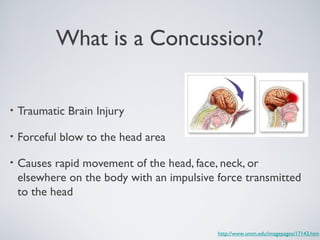
What is a Concussion?
• Traumatic Brain Injury
• Forceful blow to the head area
• Causes rapid movement of the head, face, neck, or
elsewhere on the body with an impulsive force transmitted
to the head
http://www.umm.edu/imagepages/17143.htm
Brain Function
• Disturbance of brain function
• Brain is literally bouncing within the skull
• Cell and cell membranes in the brain are stretched and torn
and are disrupted from their normal functions
• Calcium, potassium, glutamate, and other substances
abnormally move in and out of the injured cells
Brain Function
• Blood flow is restricted in the brain’s injured area
• Blood is the brains only source of fuel
• Limited supply for the injured brain cells
• High demand for blood as the brain tries to repair
Signs and Symptoms
• Headache
• Nausea/Vomiting
• Loss of consciousness
• Amnesia
• Balance Problems or Dizziness
• BlurryVision
• Sensitivity to Light and Noise
• Feeling Sluggish
• Concentration or Memory Problems
• Confusion
• Not Feeling Right or Feeling Down
Chronic Traumatic
Encephalopathy
• Progressive degenerative disease of the brain
• Found with history of repetitive brain injury
• Memory loss, depression, aggression, dementia
• Effects the brain tissue
• Build up of tau protein
Tau Protein
• Structural element of tiny tunnels called microtubles in the
axon.
• Tau malfunctions and stops working while the tunnels are
deteriorating.
• Nothing can get through because the brain function is not
functioning correctly.
• Staining the tissue with an antibody turns the tau protein
brown abnormal tau protein remains as clumps and strands.
Photo by Ann C McKee, MD, VA Boston/Boston University School of Medicine.
Copyright: Ann C McKee, MD, VA Boston/Boston University School of Medicine.
(Nowinski, 2013)
Post Concussion Syndrome
• Persists beyond the general time frame of recovery
• Symptoms may include:Attention, memory, headaches,
dizziness, sleeping problems, or irritability
• Symptoms can last for weeks to months
Baseline Testing
• Recommended to establish the athlete’s normal pre injury
performance
• Evaluates: Brain processing speed, Memory, Reaction time,
andVisual motor skills
• A benchmark to measure post injury recovery
SCAT Test
• Standardized tool of evaluating injured athletes
• Sideline evaluation assessment
• Evaluates symptoms, balance, Glasgow coma scale, cognitive
assessment, coordination examination, memory,
concentration, and delayed recall
Impact Test
• Computerized neurocognitive assessment
• Measures:Attention span,Working memory, Sustained and
selective attention time, Response variability, Non-verbal
problem solving, and Reaction time
• Guidance in return to play decision
Return to Play
Rehabilitation Stage
Functional exercise at each
stage of rehabilitation
Objective of each stage
1. No Activity
Symptom limited physical and cognitive
rest
Recovery
2. Light Aerobic Exercise
Walking, swimming or stationary
cycling keeping intensity <70% max
permitted HR
Increase HR
3. Sport-Specific Exercise
Skating drills in ice hockey, running
drills in soccer. No head impact
activities
Add Movement
4. Non-Contact Training Drills
Progression to more complex training
drills. May start progressive resistance
training.
Exercise, Coordination & cognitive load
5. Full-Contact Practice
Following medical clearance participate
in normal training activities
Restore confidence & assess functional
skills by coaching staff
6. Return to Play Normal game play
Second Impact Syndrome
• Athlete who returns to play while recovering from initial
injury and sustain another concussion
• Athlete is more susceptible because of the inherent risk of a
second injury
• This could happen days or weeks after initial injury
• Rare, but young athletes are at an increased risk
• Could cause permanent brain damage and can be fatal
Xenith x2
• Fit Seeker
• Shock Bonnet
www.xenith.com
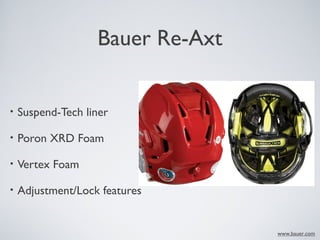
Bauer Re-Axt
• Suspend-Tech liner
• Poron XRD Foam
• Vertex Foam
• Adjustment/Lock features
www.bauer.com
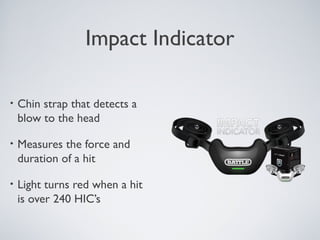
Impact Indicator
• Chin strap that detects a
blow to the head
• Measures the force and
duration of a hit
• Light turns red when a hit
is over 240 HIC’s
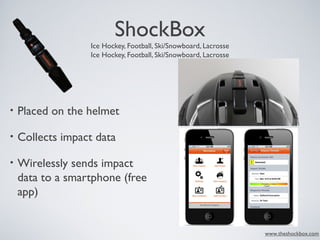
ShockBox
Ice Hockey, Football, Ski/Snowboard, Lacrosse
• Placed on the helmet
• Collects impact data
• Wirelessly sends impact
data to a smartphone (free
app)
www.theshockbox.com
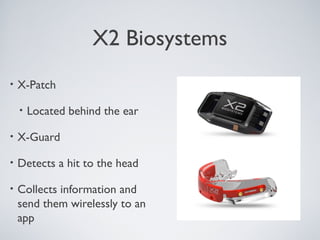
X2 Biosystems
• X-Patch
• Located behind the ear
• X-Guard
• Detects a hit to the head
• Collects information and
send them wirelessly to an
app
What can be improved
• Education:
• Coaches go through training seminars - certified
• Family physicians go through training
• Contact sports: proper hitting techniques
• Baseline Testing: Before the regular season starts
• Ages 12 and under: every year
• Ages 13 and up: every 2 years
• Testing is covered by insurance
• Offered by family physician
What can be improved
• Return to Play:
• No same day return
• Graduated return to play steps
• Medical clearance
• Equipment:
• Knowledge of helmets
• Sensor
WHEN IN DOUBT,
SIT THEM OUT!

Hoot Powerpoint

  • 1.
  • 2.
    What is aConcussion? • Traumatic Brain Injury • Forceful blow to the head area • Causes rapid movement of the head, face, neck, or elsewhere on the body with an impulsive force transmitted to the head http://www.umm.edu/imagepages/17143.htm
  • 3.
    Brain Function • Disturbanceof brain function • Brain is literally bouncing within the skull • Cell and cell membranes in the brain are stretched and torn and are disrupted from their normal functions • Calcium, potassium, glutamate, and other substances abnormally move in and out of the injured cells
  • 4.
    Brain Function • Bloodflow is restricted in the brain’s injured area • Blood is the brains only source of fuel • Limited supply for the injured brain cells • High demand for blood as the brain tries to repair
  • 5.
    Signs and Symptoms •Headache • Nausea/Vomiting • Loss of consciousness • Amnesia • Balance Problems or Dizziness • BlurryVision • Sensitivity to Light and Noise • Feeling Sluggish • Concentration or Memory Problems • Confusion • Not Feeling Right or Feeling Down
  • 6.
    Chronic Traumatic Encephalopathy • Progressivedegenerative disease of the brain • Found with history of repetitive brain injury • Memory loss, depression, aggression, dementia • Effects the brain tissue • Build up of tau protein
  • 7.
    Tau Protein • Structuralelement of tiny tunnels called microtubles in the axon. • Tau malfunctions and stops working while the tunnels are deteriorating. • Nothing can get through because the brain function is not functioning correctly. • Staining the tissue with an antibody turns the tau protein brown abnormal tau protein remains as clumps and strands.
  • 8.
    Photo by AnnC McKee, MD, VA Boston/Boston University School of Medicine. Copyright: Ann C McKee, MD, VA Boston/Boston University School of Medicine. (Nowinski, 2013)
  • 9.
    Post Concussion Syndrome •Persists beyond the general time frame of recovery • Symptoms may include:Attention, memory, headaches, dizziness, sleeping problems, or irritability • Symptoms can last for weeks to months
  • 10.
    Baseline Testing • Recommendedto establish the athlete’s normal pre injury performance • Evaluates: Brain processing speed, Memory, Reaction time, andVisual motor skills • A benchmark to measure post injury recovery
  • 11.
    SCAT Test • Standardizedtool of evaluating injured athletes • Sideline evaluation assessment • Evaluates symptoms, balance, Glasgow coma scale, cognitive assessment, coordination examination, memory, concentration, and delayed recall
  • 12.
    Impact Test • Computerizedneurocognitive assessment • Measures:Attention span,Working memory, Sustained and selective attention time, Response variability, Non-verbal problem solving, and Reaction time • Guidance in return to play decision
  • 13.
    Return to Play RehabilitationStage Functional exercise at each stage of rehabilitation Objective of each stage 1. No Activity Symptom limited physical and cognitive rest Recovery 2. Light Aerobic Exercise Walking, swimming or stationary cycling keeping intensity <70% max permitted HR Increase HR 3. Sport-Specific Exercise Skating drills in ice hockey, running drills in soccer. No head impact activities Add Movement 4. Non-Contact Training Drills Progression to more complex training drills. May start progressive resistance training. Exercise, Coordination & cognitive load 5. Full-Contact Practice Following medical clearance participate in normal training activities Restore confidence & assess functional skills by coaching staff 6. Return to Play Normal game play
  • 14.
    Second Impact Syndrome •Athlete who returns to play while recovering from initial injury and sustain another concussion • Athlete is more susceptible because of the inherent risk of a second injury • This could happen days or weeks after initial injury • Rare, but young athletes are at an increased risk • Could cause permanent brain damage and can be fatal
  • 15.
    Xenith x2 • FitSeeker • Shock Bonnet www.xenith.com
  • 16.
    Bauer Re-Axt • Suspend-Techliner • Poron XRD Foam • Vertex Foam • Adjustment/Lock features www.bauer.com
  • 17.
    Impact Indicator • Chinstrap that detects a blow to the head • Measures the force and duration of a hit • Light turns red when a hit is over 240 HIC’s
  • 18.
    ShockBox Ice Hockey, Football,Ski/Snowboard, Lacrosse Ice Hockey, Football, Ski/Snowboard, Lacrosse • Placed on the helmet • Collects impact data • Wirelessly sends impact data to a smartphone (free app) www.theshockbox.com
  • 19.
    X2 Biosystems • X-Patch •Located behind the ear • X-Guard • Detects a hit to the head • Collects information and send them wirelessly to an app
  • 20.
    What can beimproved • Education: • Coaches go through training seminars - certified • Family physicians go through training • Contact sports: proper hitting techniques • Baseline Testing: Before the regular season starts • Ages 12 and under: every year • Ages 13 and up: every 2 years • Testing is covered by insurance • Offered by family physician
  • 21.
    What can beimproved • Return to Play: • No same day return • Graduated return to play steps • Medical clearance • Equipment: • Knowledge of helmets • Sensor
  • 22.