Play It Smart:
                            What you need to know
                            about sports concussions
                            Cynthia L. Boyer, Ph.D.
                            Executive Director, Brain Injury Services
                            September 26, 2012


@2012 All rights reserved
Our Mission
To ensure that every person is given opportunities for lifelong learning
and fulfillment.
We do this by altering perceptions, and by supporting those with
intellectual and developmental challenges and acquired brain injuries in
achieving their life goals as valued and respected members of our world.

                             Our Vision
By 2014 our distinct ability to deliver high quality individualized services in
modern living, learning and working environments will exceed stakeholder
expectations and secure Bancroft as the region’s elite provider of services to
people with intellectual and developmental disabilities and brain injuries.

                        Our Core Values
Responsible Empathetic Supportive Passionate Empowered Committed Trustworthy

                               RESPECT
2
3
Why the increased focus on
sports-related concussions?
 Concussions are common in sports, and
  their frequency appears to be increasing
 Although typically mild, sports
  concussions have a high risk of recurrence
  and can have significant complications
 Knowledge of the potential for long-term
  negative outcomes
   4
What is a Concussion?
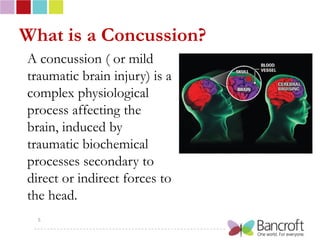
A concussion ( or mild
traumatic brain injury) is a
complex physiological
process affecting the
brain, induced by
traumatic biochemical
processes secondary to
direct or indirect forces to
the head.
  5
What is a Concussion?
Disturbance of brain
function is related to
neurometabolic
dysfunction rather than
structural brain injury and
is typically associated with
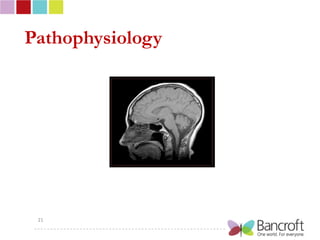
normal structural imaging
findings

  6
What is a Concussion?
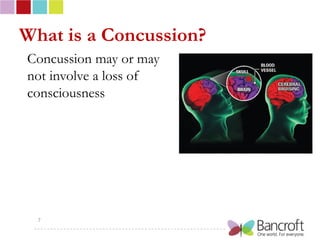
Concussion may or may
not involve a loss of
consciousness


  7
What is a Concussion?
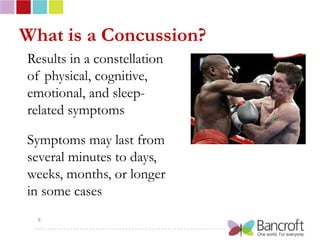
Results in a constellation
of physical, cognitive,
emotional, and sleep-
related symptoms

Symptoms may last from
several minutes to days,
weeks, months, or longer
in some cases
  8
Current Diagnosis of Concussion
       Does not require LOC
       Does not require a direct blow to the head
       Does not require amnesia
       CT/MRI likely to be normal


    9
Sports and Concussions
 In the United States there are
  over 3.8 million sports related
  concussions a year.

 It is estimated that an athlete
  playing a contact sport has a
  19% chance of suffering a
  concussion each year of play.

  10
Sports and Concussions
 34% of college football
  players have suffered at least
  one concussion.

 20% of college football
  players have suffered multiple
  concussions

Department of Neurosurgery, University of Pittsburgh

   11
Sports and Concussions
 All sports and recreation-related concussion in
  U.S. 1.6-3.8 million/year

 Concussion is COMMON in youth sports:
  8.9% of high school athletes

 Concussions appear to be increasing,
  especially among high school athletes
Meehan WP, et al. High School concussions in the 2008-2009 Academic Year: Mechanisms,
Symptoms and Management. A J Sports Med.2010;38(12):2405-2409.
   12
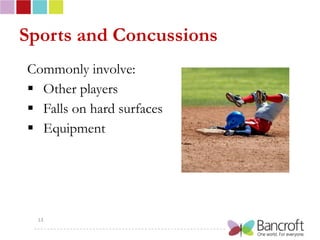
Sports and Concussions
Commonly involve:
 Other players
 Falls on hard surfaces
 Equipment


  13
“Limited Contact” Sports Also
Carry a Risk of Concussion
    Baseball              Raquetball
    Bicycling             Ice Skating
    Cheerleading          Skateboarding
    Fencing               Snowboarding
    Flag Football         Softball
    Gymnastics            Squash
    Horseback Riding      Volley ball
    14
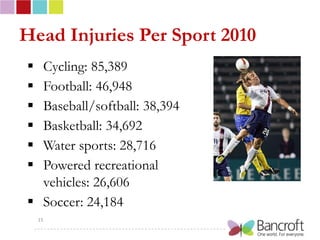
Head Injuries Per Sport 2010
 Cycling: 85,389
 Football: 46,948
 Baseball/softball: 38,394
 Basketball: 34,692
 Water sports: 28,716
 Powered recreational
  vehicles: 26,606
 Soccer: 24,184
    15
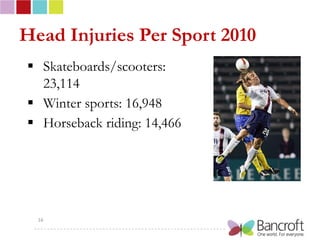
Head Injuries Per Sport 2010
 Skateboards/scooters:
  23,114
 Winter sports: 16,948
 Horseback riding: 14,466


  16
Gender Differences


  17
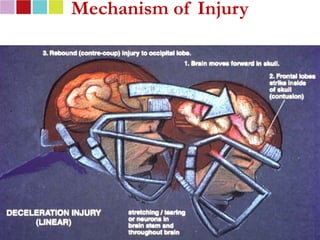
Mechanism of Injury


18
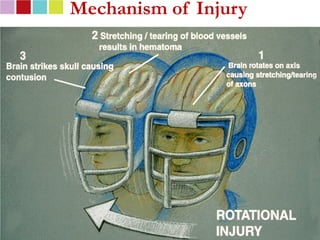
Mechanism of Injury


19
20
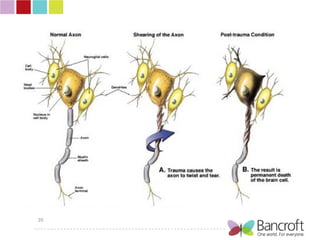
Pathophysiology


 21
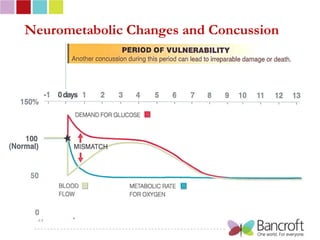
Metabolic Abnormalities
 Potassium, glutamate and glucose are
  immediately released from affected brain cells
 Calcium enters these disturbed cells
 Neurotransmitter release occurs with loss of
  autoregulation on the affected area
 Decreased cerebral blood flow


  22
Neurometabolic Changes and Concussion


 23
Injury Aftermath
 An energy crisis in the brain
 The brain is vulnerable to further damage


  24
Emergency Symptoms
    Changes in alertness and consciousness
    Seizures
    Muscle weakness on one or both sides
    Persistent confusion
    Remaining unconsciousness (coma)
    Repeated vomiting
    Unequal pupils
    Unusual eye movements
    Walking problems
    25
26
Concussion Symptoms
 Headache                Feeling slowed down
 Nausea/Vomiting         Foggy
 Balance Problems/       Difficulty with
  Dizziness                memory/concentration
 Fatigue/Drowsiness      Double vision
 Trouble sleeping        Ringing in ears
 Irritability/Sadness    Sensitivity to light/noise
 Nervousness/more
  emotional
   27
Observed Signs of Concussion
    Appears dazed, stunned
    Confused about assignment/position
    Forgets an instruction
    Moves clumsily
    Answers questions slowly
    Loses consciousness (even briefly)
    Exhibits mood/ behavior/personality changes
    Can’t recall events before hit

    28
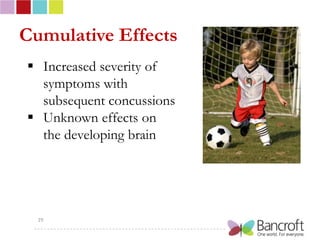
Cumulative Effects
 Increased severity of
  symptoms with
  subsequent concussions
 Unknown effects on
  the developing brain


  29
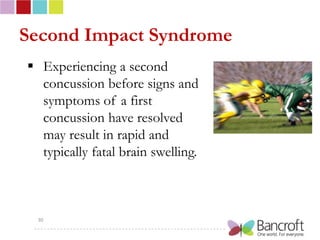
Second Impact Syndrome
 Experiencing a second
  concussion before signs and
  symptoms of a first
  concussion have resolved
  may result in rapid and
  typically fatal brain swelling.


  30
Second Impact Syndrome
 Athletes should never to
  return to sports while
  they're still experiencing
  symptoms of concussion.


 31
Post Concussion Syndrome
 20-25% of patients who suffer a
  concussion residual symptoms
 Estimated < 5% of sports related
  concussions


 32
Post Concussion Syndrome
Symptoms
    Headache
    Dizziness
    Sensitivity to light and sound
    Blurred vision
    Concentration, attention, and memory
     problems


    33
Post Concussion Syndrome
 Most people recover fully
  from post concussion
  syndrome within 3-6 months.

 However, 7-15% of people
  will experience symptoms 1
  year post injury.


 34
Long Term Effects of Concussions
  Chronic Clinical Changes seen in NFL players
       - Increased risk of cognitive impairment
       - Increased risk of depression
  Chronic Traumatic Encephalopathy (CTE)
       - Damaged Tau Protein as seen in AD
       - Diagnosed in a college football player


  35
36
Concussion Management
  ANY Signs or Symptoms: NO RETURN
   TO ANY SPORTS ACTIVITY
  Rest
  Gradual Return to Play


 37
Clinical Dilemma of Concussion
  There is no proven treatment-the injury must
   run its course
  The severity of the concussion is not fully
   known until it has resolved
  Uncertainty about when it is safe to return to
   competition


  38
Concussion Management
 REMOVE                     athlete from play
 REFER                      to medical provider
 REST                       no sports, no texting, no tv
 RETURN                     only with medical clearance

 Children’s Hospital, Boston, Sports Concussion Clinic


  39
We Don’t Know……
     How many concussions are too many?
     When the brain is really back to “normal”?
     If pharmocotherapy could help?
     Why are more injury prone?


 40
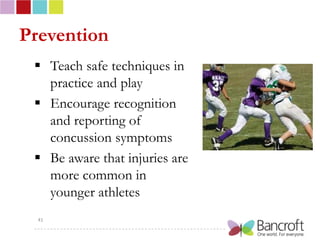
Prevention
  Teach safe techniques in
   practice and play
  Encourage recognition
   and reporting of
   concussion symptoms
  Be aware that injuries are
   more common in
   younger athletes
  41
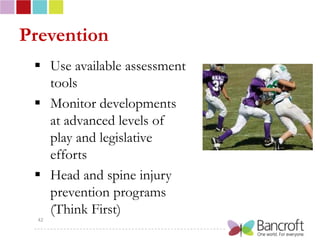
Prevention
  Use available assessment
   tools
  Monitor developments
   at advanced levels of
   play and legislative
   efforts
  Head and spine injury
   prevention programs
   (Think First)
  42
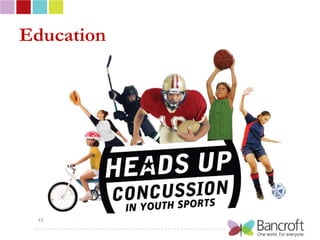
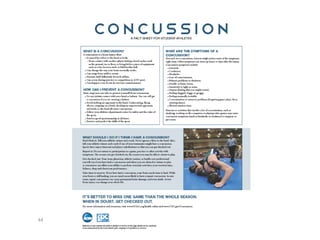
Education


 43
44
Videos About Concussions
Can Be Seen On

 https://www.nanonline.org/NAN/_Research
 _Publications/Concussions_in_Sport.aspx


  45
Resources
  Mayo Clinic http://www.mayoclinic.com
  The Center for Sports Concussion at Idaho
   State University www.knowconcussion.org
  Center for Disease Control www.cdc.gov
  Medicine Plus www.nlm.nih.gov
  Sports Concussion Center of NJ
   http://www.sportsconcussionnj.com/?1f6c31
   00
 46
Resources
 Concussion tear-off pad: a resource for
 coaches, physical education teachers, school
 nurses, community youth sports personnel, and
 emergency response professionals. It is a pad of
 50 sheets which can be torn off and sent home
 with parents or students.
 http://www.sportsconcussion.com/pdf/resource
 s/tear-off%20pad%202010.pdf
 47
Thank you!


48

Bancroft sports concussions

  • 1.
    Play It Smart: What you need to know about sports concussions Cynthia L. Boyer, Ph.D. Executive Director, Brain Injury Services September 26, 2012 @2012 All rights reserved
  • 2.
    Our Mission To ensurethat every person is given opportunities for lifelong learning and fulfillment. We do this by altering perceptions, and by supporting those with intellectual and developmental challenges and acquired brain injuries in achieving their life goals as valued and respected members of our world. Our Vision By 2014 our distinct ability to deliver high quality individualized services in modern living, learning and working environments will exceed stakeholder expectations and secure Bancroft as the region’s elite provider of services to people with intellectual and developmental disabilities and brain injuries. Our Core Values Responsible Empathetic Supportive Passionate Empowered Committed Trustworthy RESPECT 2
  • 3.
  • 4.
    Why the increasedfocus on sports-related concussions?  Concussions are common in sports, and their frequency appears to be increasing  Although typically mild, sports concussions have a high risk of recurrence and can have significant complications  Knowledge of the potential for long-term negative outcomes 4
  • 5.
    What is aConcussion? A concussion ( or mild traumatic brain injury) is a complex physiological process affecting the brain, induced by traumatic biochemical processes secondary to direct or indirect forces to the head. 5
  • 6.
    What is aConcussion? Disturbance of brain function is related to neurometabolic dysfunction rather than structural brain injury and is typically associated with normal structural imaging findings 6
  • 7.
    What is aConcussion? Concussion may or may not involve a loss of consciousness 7
  • 8.
    What is aConcussion? Results in a constellation of physical, cognitive, emotional, and sleep- related symptoms Symptoms may last from several minutes to days, weeks, months, or longer in some cases 8
  • 9.
    Current Diagnosis ofConcussion  Does not require LOC  Does not require a direct blow to the head  Does not require amnesia  CT/MRI likely to be normal 9
  • 10.
    Sports and Concussions In the United States there are over 3.8 million sports related concussions a year.  It is estimated that an athlete playing a contact sport has a 19% chance of suffering a concussion each year of play. 10
  • 11.
    Sports and Concussions 34% of college football players have suffered at least one concussion.  20% of college football players have suffered multiple concussions Department of Neurosurgery, University of Pittsburgh 11
  • 12.
    Sports and Concussions All sports and recreation-related concussion in U.S. 1.6-3.8 million/year  Concussion is COMMON in youth sports: 8.9% of high school athletes  Concussions appear to be increasing, especially among high school athletes Meehan WP, et al. High School concussions in the 2008-2009 Academic Year: Mechanisms, Symptoms and Management. A J Sports Med.2010;38(12):2405-2409. 12
  • 13.
    Sports and Concussions Commonlyinvolve:  Other players  Falls on hard surfaces  Equipment 13
  • 14.
    “Limited Contact” SportsAlso Carry a Risk of Concussion  Baseball  Raquetball  Bicycling  Ice Skating  Cheerleading  Skateboarding  Fencing  Snowboarding  Flag Football  Softball  Gymnastics  Squash  Horseback Riding  Volley ball 14
  • 15.
    Head Injuries PerSport 2010  Cycling: 85,389  Football: 46,948  Baseball/softball: 38,394  Basketball: 34,692  Water sports: 28,716  Powered recreational vehicles: 26,606  Soccer: 24,184 15
  • 16.
    Head Injuries PerSport 2010  Skateboards/scooters: 23,114  Winter sports: 16,948  Horseback riding: 14,466 16
  • 17.
  • 18.
  • 19.
  • 20.
  • 21.
  • 22.
    Metabolic Abnormalities  Potassium,glutamate and glucose are immediately released from affected brain cells  Calcium enters these disturbed cells  Neurotransmitter release occurs with loss of autoregulation on the affected area  Decreased cerebral blood flow 22
  • 23.
  • 24.
    Injury Aftermath  Anenergy crisis in the brain  The brain is vulnerable to further damage 24
  • 25.
    Emergency Symptoms  Changes in alertness and consciousness  Seizures  Muscle weakness on one or both sides  Persistent confusion  Remaining unconsciousness (coma)  Repeated vomiting  Unequal pupils  Unusual eye movements  Walking problems 25
  • 26.
  • 27.
    Concussion Symptoms  Headache  Feeling slowed down  Nausea/Vomiting  Foggy  Balance Problems/  Difficulty with Dizziness memory/concentration  Fatigue/Drowsiness  Double vision  Trouble sleeping  Ringing in ears  Irritability/Sadness  Sensitivity to light/noise  Nervousness/more emotional 27
  • 28.
    Observed Signs ofConcussion  Appears dazed, stunned  Confused about assignment/position  Forgets an instruction  Moves clumsily  Answers questions slowly  Loses consciousness (even briefly)  Exhibits mood/ behavior/personality changes  Can’t recall events before hit 28
  • 29.
    Cumulative Effects  Increasedseverity of symptoms with subsequent concussions  Unknown effects on the developing brain 29
  • 30.
    Second Impact Syndrome Experiencing a second concussion before signs and symptoms of a first concussion have resolved may result in rapid and typically fatal brain swelling. 30
  • 31.
    Second Impact Syndrome Athletes should never to return to sports while they're still experiencing symptoms of concussion. 31
  • 32.
    Post Concussion Syndrome 20-25% of patients who suffer a concussion residual symptoms  Estimated < 5% of sports related concussions 32
  • 33.
    Post Concussion Syndrome Symptoms  Headache  Dizziness  Sensitivity to light and sound  Blurred vision  Concentration, attention, and memory problems 33
  • 34.
    Post Concussion Syndrome Most people recover fully from post concussion syndrome within 3-6 months.  However, 7-15% of people will experience symptoms 1 year post injury. 34
  • 35.
    Long Term Effectsof Concussions  Chronic Clinical Changes seen in NFL players - Increased risk of cognitive impairment - Increased risk of depression  Chronic Traumatic Encephalopathy (CTE) - Damaged Tau Protein as seen in AD - Diagnosed in a college football player 35
  • 36.
  • 37.
    Concussion Management ANY Signs or Symptoms: NO RETURN TO ANY SPORTS ACTIVITY  Rest  Gradual Return to Play 37
  • 38.
    Clinical Dilemma ofConcussion  There is no proven treatment-the injury must run its course  The severity of the concussion is not fully known until it has resolved  Uncertainty about when it is safe to return to competition 38
  • 39.
    Concussion Management REMOVE athlete from play REFER to medical provider REST no sports, no texting, no tv RETURN only with medical clearance Children’s Hospital, Boston, Sports Concussion Clinic 39
  • 40.
    We Don’t Know……  How many concussions are too many?  When the brain is really back to “normal”?  If pharmocotherapy could help?  Why are more injury prone? 40
  • 41.
    Prevention  Teachsafe techniques in practice and play  Encourage recognition and reporting of concussion symptoms  Be aware that injuries are more common in younger athletes 41
  • 42.
    Prevention  Useavailable assessment tools  Monitor developments at advanced levels of play and legislative efforts  Head and spine injury prevention programs (Think First) 42
  • 43.
  • 44.
  • 45.
    Videos About Concussions CanBe Seen On https://www.nanonline.org/NAN/_Research _Publications/Concussions_in_Sport.aspx 45
  • 46.
    Resources  MayoClinic http://www.mayoclinic.com  The Center for Sports Concussion at Idaho State University www.knowconcussion.org  Center for Disease Control www.cdc.gov  Medicine Plus www.nlm.nih.gov  Sports Concussion Center of NJ http://www.sportsconcussionnj.com/?1f6c31 00 46
  • 47.
    Resources Concussion tear-offpad: a resource for coaches, physical education teachers, school nurses, community youth sports personnel, and emergency response professionals. It is a pad of 50 sheets which can be torn off and sent home with parents or students. http://www.sportsconcussion.com/pdf/resource s/tear-off%20pad%202010.pdf 47
  • 48.