Tackling Sports Concussions
          Head On
      Jeffrey Rosenberg MD
         Sports Medicine
       September 5, 2012
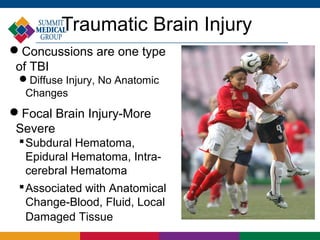
Traumatic Brain Injury
Concussions are one type
 of TBI
 Diffuse Injury, No Anatomic
  Changes
Focal Brain Injury-More
 Severe
  Subdural Hematoma,
   Epidural Hematoma, Intra-
   cerebral Hematoma
  Associated with Anatomical
   Change-Blood, Fluid, Local
   Damaged Tissue
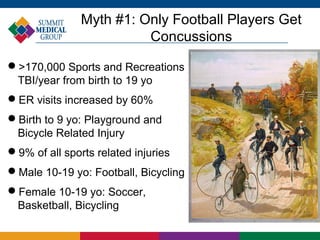
Myth #1: Only Football Players Get
                         Concussions

>170,000 Sports and Recreations
 TBI/year from birth to 19 yo
ER visits increased by 60%
Birth to 9 yo: Playground and
 Bicycle Related Injury
9% of all sports related injuries
Male 10-19 yo: Football, Bicycling
Female 10-19 yo: Soccer,
 Basketball, Bicycling
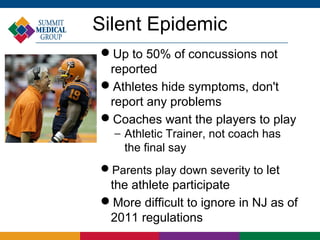
Silent Epidemic
Up to 50% of concussions not
 reported
Athletes hide symptoms, don't
 report any problems
Coaches want the players to play
  − Athletic Trainer, not coach has
    the final say
Parents play down severity to let
 the athlete participate
More difficult to ignore in NJ as of
 2011 regulations
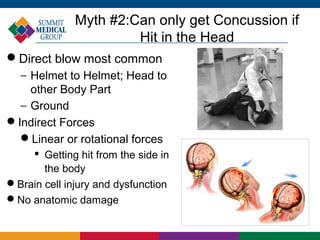
Myth #2:Can only get Concussion if
                       Hit in the Head
Direct blow most common
  − Helmet to Helmet; Head to
    other Body Part
  − Ground
Indirect Forces
  Linear or rotational forces
     Getting hit from the side in
       the body
Brain cell injury and dysfunction
No anatomic damage
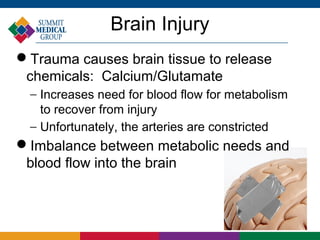
Brain Injury
Trauma causes brain tissue to release
 chemicals: Calcium/Glutamate
  − Increases need for blood flow for metabolism
    to recover from injury
  − Unfortunately, the arteries are constricted
Imbalance between metabolic needs and
 blood flow into the brain
Myth #3: Can't be a concussion if
              you aren't knocked out

Only 10% of concussions have LOC
“Got my Bell Rung”
  − If any symptoms, this is a concussion as well
Symptoms may not start immediately
 after the hit
Seizure activity at injury very scarey but
 not permanent
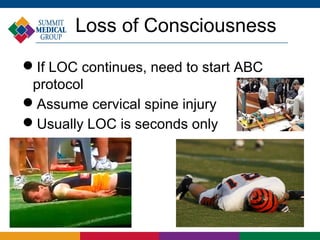
Loss of Consciousness
If LOC continues, need to start ABC
 protocol
Assume cervical spine injury
Usually LOC is seconds only
Confusion

Hallmark symptom of TBI is confusion
Eyes glassy, loss of focus
Incoherent speech
Going to wrong team's huddle
Memory Loss
  − Loss of memory prior to event-retrograde
    amnesia
  − Loss of future memory-anterograde amnesia
Myth #4: Of course he can play doc next
              week, he only has a concussion
Loss of consciousness, Amnesia, Confusion
 used to be used to 'grade concussions'
  − These 'grades' would determine return to play
No data to support the grading systems
  − 15 different systems
  − No longer used
Treat each concussion individually
  − Symptoms must completely resolve prior to
    return to activities
Ding's matter
Second Impact Syndrome
Continued symptoms sign that
 brain metabolism not yet normal
With additional injury (even mild)
 the blood vessels open wide which
 increases the pressure in the brain
  − Coma, Death
  − 10-15 die a year <19 yo
  − Younger the brain, more susceptible
This is why conservative in youth
 sports, JH, HS sports
Myth #5: 'Johnny' will be ready by
                next week
Each concussion is different, hard to
 predict
Longer recovery with repeated
 concussions
Younger patients typically need more
 time
None the less, most better with 5-7 days
Same day return to play no longer
 recommended for youth sports
  − If College athlete or Pro, maybe
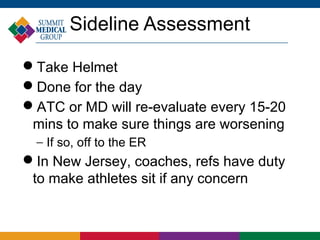
Sideline Assessment
Assess symptoms: headache, confusion,
 nausea, vision
Neurological Exam
 − Pupillary Response
 − ROM/Strength
 − Balance/Coordination
SCAT
 − Orientation
 − Memory
 − Confusion
Sideline Assessment

Take Helmet
Done for the day
ATC or MD will re-evaluate every 15-20
 mins to make sure things are worsening
  − If so, off to the ER
In New Jersey, coaches, refs have duty
 to make athletes sit if any concern
Red Flag Symptoms
•   Headaches that worsen
•   Look very drowsy, can’t be awakened
•   Can’t recognize people or places
•   Unusual behavior change
•   Seizures
•   Repeated vomiting
•   Increasing confusion
•   Increasing irritability
•   Neck pain
•   Slurred speech
•   Weakness or numbness in arms or legs
•   Loss of consciousness
Myth #6: We need to go to the ER
Generally not needed
If significant LOC, confusion, or worsening
 mental state
  − CT and MRI are always normal by definition
  − If neurological status worsens must be imaged to
    r/o bleed
No longer recommend waking up athlete every
 hour over night
  − Observe for unusual breathing patterns or
    atypical movements (jerking, tremor,
    convulsions)
Myth #7-'Captain looks fine' so he didn't
                      have a concussion
Unlike physical injury, its hard to 'see' the
 injury
  − No post game activities
Treatment of concussion
  − Rest, Rest, Rest
  − Brain Rest, Physical Rest
  − Quite, Dark
  − NSAIDs/Tylenol for headache
  − No electronics, phones, texting, computers,
    etc
Brain Rest

If minimal sx ok to go to school monday
  − Most athletes will need to miss some school
  − Schools finally understanding and are
    required to comply
Take to MD on monday or tuesday for
 eval
Complications to Recovery
          Concussion
           History
          Headache History
          Developmental
           History
          Psychiatric
           History
Post Concussion
Every patient has different set of symptoms
Physical
  − Headaches, N/V, FATIGUE, Balance, Sensitivity
Thinking
  − Mentally Foggy, Concentration, Memory, Slow
Emotional
  − Irritability, Sadness, Nervous, More Emotional
Sleep
  − Drowsiness, Sleep more or Less, Difficult
    sleeping
Post Concussion
Let the child sleep, Daytime Naps
 recommended at the beginning
Eat and stay hydrated
Limit Activities requiring thinking or
 concentrating
  − Read, TV, Computer, etc
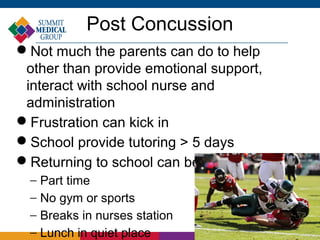
Watch the grass grow
Do not attend anything with flying objects
 or potential for repeated injury
Post Concussion
Not much the parents can do to help
 other than provide emotional support,
 interact with school nurse and
 administration
Frustration can kick in
School provide tutoring > 5 days
Returning to school can be gradual
  − Part time
  − No gym or sports
  − Breaks in nurses station
  − Lunch in quiet place
Myth #8: There are no treatment for
                  concussions
Insomnia-Melatonin
Emotional symptoms
 − Role for amitriptyline/SSRI
Physical symptoms
 − Balance can improve with vestibular therapy
Concentration
 − ADHD medications
Amantidine
Nuvigil
Return to Play
All physical sx must be gone
IMPACT scores return to
 baseline
Medical clearance
5-7 day return to play
 protocol
  − Start with minimal exertion
  − Progress daily
  − If symptoms reoccur must
    return to previous step
ImPACT Testing
Focused neuropsychiatric,
 computer based test
Memory, Coordination,
 Concentration
Preseason Testing Optimal
@2 days post injury can
 provide prognosis
When symptoms are gone to
 confirm brain function normal
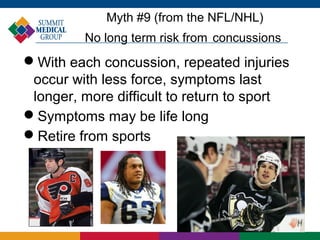
Myth #9 (from the NFL/NHL)
         No long term risk from concussions
With each concussion, repeated injuries
 occur with less force, symptoms last
 longer, more difficult to return to sport
Symptoms may be life long
Retire from sports
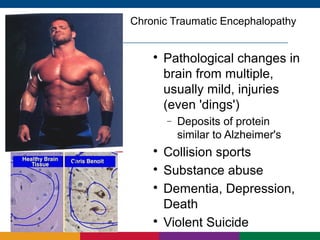
Chronic Traumatic Encephalopathy


    
        Pathological changes in
        brain from multiple,
        usually mild, injuries
        (even 'dings')
        −   Deposits of protein
            similar to Alzheimer's
    
        Collision sports
    
        Substance abuse
    
        Dementia, Depression,
        Death
    
        Violent Suicide
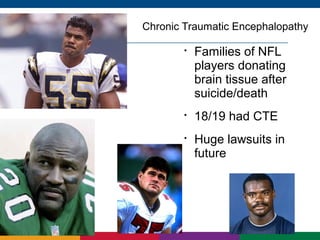
Chronic Traumatic Encephalopathy

        
            Families of NFL
            players donating
            brain tissue after
            suicide/death
        
            18/19 had CTE
        
            Huge lawsuits in
            future

Fixed tackling sports concussions head on

  • 1.
    Tackling Sports Concussions Head On Jeffrey Rosenberg MD Sports Medicine September 5, 2012
  • 2.
    Traumatic Brain Injury Concussionsare one type of TBI Diffuse Injury, No Anatomic Changes Focal Brain Injury-More Severe  Subdural Hematoma, Epidural Hematoma, Intra- cerebral Hematoma  Associated with Anatomical Change-Blood, Fluid, Local Damaged Tissue
  • 3.
    Myth #1: OnlyFootball Players Get Concussions >170,000 Sports and Recreations TBI/year from birth to 19 yo ER visits increased by 60% Birth to 9 yo: Playground and Bicycle Related Injury 9% of all sports related injuries Male 10-19 yo: Football, Bicycling Female 10-19 yo: Soccer, Basketball, Bicycling
  • 4.
    Silent Epidemic Up to50% of concussions not reported Athletes hide symptoms, don't report any problems Coaches want the players to play − Athletic Trainer, not coach has the final say Parents play down severity to let the athlete participate More difficult to ignore in NJ as of 2011 regulations
  • 5.
    Myth #2:Can onlyget Concussion if Hit in the Head Direct blow most common − Helmet to Helmet; Head to other Body Part − Ground Indirect Forces Linear or rotational forces  Getting hit from the side in the body Brain cell injury and dysfunction No anatomic damage
  • 6.
    Brain Injury Trauma causesbrain tissue to release chemicals: Calcium/Glutamate − Increases need for blood flow for metabolism to recover from injury − Unfortunately, the arteries are constricted Imbalance between metabolic needs and blood flow into the brain
  • 7.
    Myth #3: Can'tbe a concussion if you aren't knocked out Only 10% of concussions have LOC “Got my Bell Rung” − If any symptoms, this is a concussion as well Symptoms may not start immediately after the hit Seizure activity at injury very scarey but not permanent
  • 8.
    Loss of Consciousness IfLOC continues, need to start ABC protocol Assume cervical spine injury Usually LOC is seconds only
  • 9.
    Confusion Hallmark symptom ofTBI is confusion Eyes glassy, loss of focus Incoherent speech Going to wrong team's huddle Memory Loss − Loss of memory prior to event-retrograde amnesia − Loss of future memory-anterograde amnesia
  • 10.
    Myth #4: Ofcourse he can play doc next week, he only has a concussion Loss of consciousness, Amnesia, Confusion used to be used to 'grade concussions' − These 'grades' would determine return to play No data to support the grading systems − 15 different systems − No longer used Treat each concussion individually − Symptoms must completely resolve prior to return to activities Ding's matter
  • 11.
    Second Impact Syndrome Continuedsymptoms sign that brain metabolism not yet normal With additional injury (even mild) the blood vessels open wide which increases the pressure in the brain − Coma, Death − 10-15 die a year <19 yo − Younger the brain, more susceptible This is why conservative in youth sports, JH, HS sports
  • 12.
    Myth #5: 'Johnny'will be ready by next week Each concussion is different, hard to predict Longer recovery with repeated concussions Younger patients typically need more time None the less, most better with 5-7 days Same day return to play no longer recommended for youth sports − If College athlete or Pro, maybe
  • 13.
    Sideline Assessment Assess symptoms:headache, confusion, nausea, vision Neurological Exam − Pupillary Response − ROM/Strength − Balance/Coordination SCAT − Orientation − Memory − Confusion
  • 14.
    Sideline Assessment Take Helmet Donefor the day ATC or MD will re-evaluate every 15-20 mins to make sure things are worsening − If so, off to the ER In New Jersey, coaches, refs have duty to make athletes sit if any concern
  • 15.
    Red Flag Symptoms • Headaches that worsen • Look very drowsy, can’t be awakened • Can’t recognize people or places • Unusual behavior change • Seizures • Repeated vomiting • Increasing confusion • Increasing irritability • Neck pain • Slurred speech • Weakness or numbness in arms or legs • Loss of consciousness
  • 16.
    Myth #6: Weneed to go to the ER Generally not needed If significant LOC, confusion, or worsening mental state − CT and MRI are always normal by definition − If neurological status worsens must be imaged to r/o bleed No longer recommend waking up athlete every hour over night − Observe for unusual breathing patterns or atypical movements (jerking, tremor, convulsions)
  • 17.
    Myth #7-'Captain looksfine' so he didn't have a concussion Unlike physical injury, its hard to 'see' the injury − No post game activities Treatment of concussion − Rest, Rest, Rest − Brain Rest, Physical Rest − Quite, Dark − NSAIDs/Tylenol for headache − No electronics, phones, texting, computers, etc
  • 18.
    Brain Rest If minimalsx ok to go to school monday − Most athletes will need to miss some school − Schools finally understanding and are required to comply Take to MD on monday or tuesday for eval
  • 19.
    Complications to Recovery Concussion History Headache History Developmental History Psychiatric History
  • 20.
    Post Concussion Every patienthas different set of symptoms Physical − Headaches, N/V, FATIGUE, Balance, Sensitivity Thinking − Mentally Foggy, Concentration, Memory, Slow Emotional − Irritability, Sadness, Nervous, More Emotional Sleep − Drowsiness, Sleep more or Less, Difficult sleeping
  • 21.
    Post Concussion Let thechild sleep, Daytime Naps recommended at the beginning Eat and stay hydrated Limit Activities requiring thinking or concentrating − Read, TV, Computer, etc Watch the grass grow Do not attend anything with flying objects or potential for repeated injury
  • 22.
    Post Concussion Not muchthe parents can do to help other than provide emotional support, interact with school nurse and administration Frustration can kick in School provide tutoring > 5 days Returning to school can be gradual − Part time − No gym or sports − Breaks in nurses station − Lunch in quiet place
  • 23.
    Myth #8: Thereare no treatment for concussions Insomnia-Melatonin Emotional symptoms − Role for amitriptyline/SSRI Physical symptoms − Balance can improve with vestibular therapy Concentration − ADHD medications Amantidine Nuvigil
  • 24.
    Return to Play Allphysical sx must be gone IMPACT scores return to baseline Medical clearance 5-7 day return to play protocol − Start with minimal exertion − Progress daily − If symptoms reoccur must return to previous step
  • 25.
    ImPACT Testing Focused neuropsychiatric, computer based test Memory, Coordination, Concentration Preseason Testing Optimal @2 days post injury can provide prognosis When symptoms are gone to confirm brain function normal
  • 26.
    Myth #9 (fromthe NFL/NHL) No long term risk from concussions With each concussion, repeated injuries occur with less force, symptoms last longer, more difficult to return to sport Symptoms may be life long Retire from sports
  • 27.
    Chronic Traumatic Encephalopathy  Pathological changes in brain from multiple, usually mild, injuries (even 'dings') − Deposits of protein similar to Alzheimer's  Collision sports  Substance abuse  Dementia, Depression, Death  Violent Suicide
  • 28.
    Chronic Traumatic Encephalopathy  Families of NFL players donating brain tissue after suicide/death  18/19 had CTE  Huge lawsuits in future

Editor's Notes

  • #3 Each year, an estimated 1.7 million people sustain a TBI annually. 1 TBI is a contributing factor to a third (30.5%) of all injury-related deaths in the United States. 1 About 75% of TBIs that occur each year are concussions or other forms of mild TBI. 2
  • #4 Each year, U.S. emergency departments (EDs) treat an estimated 173,285 sports- and recreation-related TBIs , including concussions, among children and adolescents, from birth to 19 years. 1 During the last decade, ED visits for sports- and recreation-related TBIs, including concussions, among children and adolescents increased by 60%. 1 Overall, the activities associated with the greatest number of TBI-related ED visits included bicycling, football, playground activities, basketball, and soccer. 1 TBI represents almost 9% of all injuries reported in the 9 sports Numbers and rates are highest in football (55,007; 0.47 per 1000 athlete exposures) and girl’s soccer (29,167; 0.36 per 1000 athlete exposures 71.0% of all sports- and recreation-related TBI emergency department visits were among males. 70.5% of sports- and recreation-related TBI emergency department visits were among persons aged 10-19 years. For males aged 10-19 years, sports- and recreation-related TBIs occurred most often while playing football or bicycling. Females aged 10-19 years sustained sports- and recreation-related TBIs most often while playing soccer or basketball or while bicycling.
  • #5 Players hide or deny sx so they can play-its all they want to do.
  • #9 ,Assume c spine injury so must be placed on board for transport with head/shoulder pads stabilized
  • #11 Dings matter because multiple dings implicated in CTE. Players at the college and pro level whom never had LOC/major concussion have patholigcal changes of CTE
  • #12 If another brain injury occurs (seemingly minor), the blood vessels open wide which increases the pressure in the brain
  • #13 Factors which can delay improvement: Prior mental health issues, ADD, number of prior concussions, LD Same day return to play no longer recommended for youth sports If College athlete or Pro, maybe if medical examined and cleared depending on multiple factor which include complete recovery of sympotms, normal side line assesement (including cognitive and neuro, balance testing, and after stressed physically)
  • #20 Prior concussions/lenth of prior symptoms H.o Migranes seems to be associated with delayed improvement, don&apos;t know why LD, ADD complicate brains recovery H/o of depression, anxiety, school phobia, may worsen what were mild symptoms prior to the injury-prediagnosis state
  • #27 Eric Lindross Jacob Bell Sidney Crosby