Volume – II
YEAR 2015
WRITTEN BY:
SYED AQEEL RAZA
The ledger accounts show the position of each account and the balances
of accounts at the end of specified period and to known the correctness
of accounts require making equal debit and credit balances.
Another device or to trial balances, we need trial balance having column
title of Accounts, account number, debit and credit where we put balance
debit in debit columnand credit incredit column as accounts sequence as
assets, liabilities, proprietorship, income and expenses.
There will be following steps of accounts summary or trial balance;
Trial Balance – unadjusted
Trial balance – adjusted
Post closing Trial balance
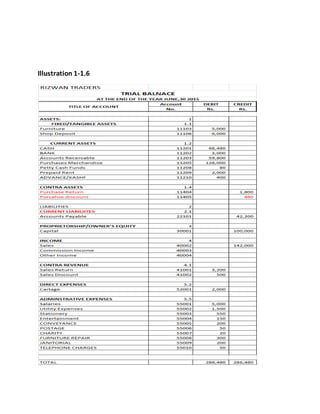
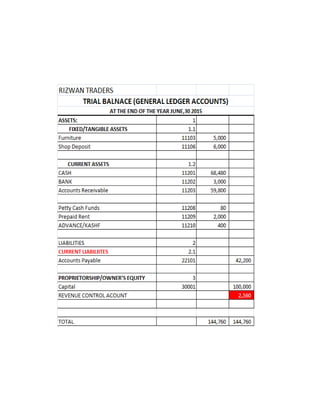
TRIAL BALNACE - UNADJUSTED
Trial balance unadjusted means a trial balance which was created before
adjustment in accounts for seeing the equality of balances in debit and
credit. If the sum of debit and the sum of credit have no difference, the
posting is considered correct otherwise the difference is ascertained by
checking accounts.
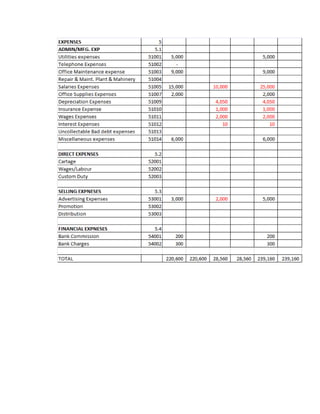
Illustration 1-1.6
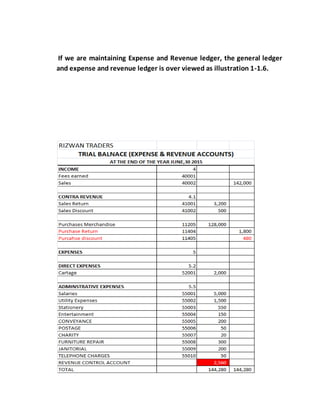
If we are maintaining Expense and Revenue ledger, the general ledger
and expense and revenue ledger is over viewed as illustration 1-1.6.
TRIAL BALNACE ADJUSTED
After journalizing and posting in respectiveaccounts of all adjusting entries,
an adjusted trial balance is prepared. The adjustment or settlement of an
account is made at the end of the period like accrued expense, bad debts or
uncollectible, unused supplies or merchandise, accrued income, unearned
revenue etc. The same contents as trial balance are used herein but with
the replacement of balance amount in account.
The adjustment, reversal and correction of errors are made before making
adjusted trial balance.
An adjusting entry is the entry that updates the balance of an account at
the end of the period; financial period or month like below;
Accrued expenses or accrual of expenses
Accruedexpensesmeans recording of expenses in accounts of the period
to be settled in next month or financial period like salaries, wages, rent,
interest on loan, advertising expenses, telephone charges, electricity
charges, insurance expenses etc. which are debited and payable of each
account or accrued expense account credited.
The expense, which has been made or to be made but not recorded in
accounts are recorded by adjusting entries like adjusting entries of (A);
a) Salaries Rs.10, 000/= for the last month not yet paid.
b) Wages Rs.2, 000/= for the last 5 days are remained unpaid.
Salaries Expenses 10,000/=
Salaries Payable 10,000/=
Wages Expenses 5, 000/=
Wages payable 5, 000/=
(B) Interest on notes payable Rs.10 for 15 days is accrued as;
Suppose that a firm signed on 6% interest bearing promissory note of
Rs.4, 000/= for 60 days on June 16 and June 30 is ending accounting
period, the calculation will be;
Computation on 60 days @ 6% note of Rs. 4, 000/=
Signed Date June 16
Ending Accounting Date June 30
Maturity Date August 15
6% of Rs.4, 000 makes 120 one month Rs.240 for 12 months
Rs.240 divided by 12 months Rs.20 for 30 days
Rs.20 is divided by 30 days Rs.0.666667 for 1 day
Interest from June 16 to June 30 Rs.0.666667 x 15 days = Rs.10/=
Interest from July 1 to June 30 Rs.0.666667 x 45 days = Rs.30/=
Total 60 days interest Rs.0.666667 x60 days = Rs.40/=
Journal Entry;
Dr. Interest Expenses
Cr. Interest payable on notes payable
The accrual of expenses will increase both liabilities and expenses.
Accrued revenue or accrual of revenue
The revenue, which has been earned but not received or recorded in
accounting period, will be recorded in accounts by adjusting entries such
as; services renderedbut not received, rent for the last three months not
received, commission due but not received.
The adjusting entries will be service revenue receivable debitandservices
revenue credit, accrued rent revenue receivable debit and rent revenue
credit and commission revenue receivable debit and commission credit.
Examples:
- Services rendered but not billed.
- Commission receivable.
- Interest receivable on note receivable
Adjustments;
Services revenue receivable
Service revenue
Commission revenue receivable
Commission Income
Accrued Interest receivable
Interest Income
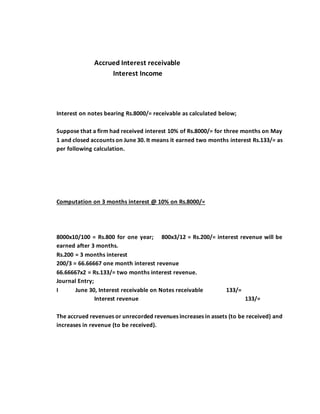
Interest on notes bearing Rs.8000/= receivable as calculated below;
Suppose that a firm had received interest 10% of Rs.8000/= for three months on May
1 and closed accounts on June 30. It means it earned two months interest Rs.133/= as
per following calculation.
Computation on 3 months interest @ 10% on Rs.8000/=
8000x10/100 = Rs.800 for one year; 800x3/12 = Rs.200/= interest revenue will be
earned after 3 months.
Rs.200 = 3 months interest
200/3 = 66.66667 one month interest revenue
66.66667x2 = Rs.133/= two months interest revenue.
Journal Entry;
I June 30, Interest receivable on Notes receivable 133/=
Interest revenue 133/=
The accrued revenues or unrecorded revenues increases in assets (to be received) and
increases in revenue (to be received).
Prepaid Expenses
Which expenses paidinadvance e.g. insurance, rent, advertising etc. may
be adjusted at the end of the period against a portion of the period
expired or consumed by making adjusting entries as; Insurance Expense
debit and prepaid insurance credit, rent expense debit and prepaid rent
credit, advertising expense debit and prepaid advertising credit.
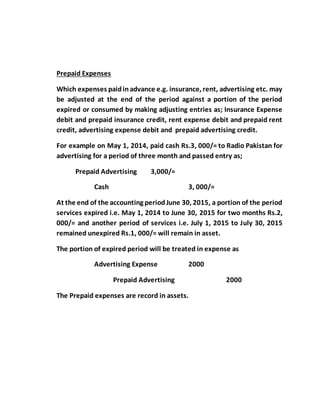
For example on May 1, 2014, paid cash Rs.3, 000/= to Radio Pakistan for
advertising for a period of three month and passed entry as;
Prepaid Advertising 3,000/=
Cash 3, 000/=
At the end of the accounting periodJune 30, 2015, a portion of the period
services expired i.e. May 1, 2014 to June 30, 2015 for two months Rs.2,
000/= and another period of services i.e. July 1, 2015 to July 30, 2015
remained unexpired Rs.1, 000/= will remain in asset.
The portion of expired period will be treated in expense as
Advertising Expense 2000
Prepaid Advertising 2000
The Prepaid expenses are record in assets.
Unearned Revenue
Such revenues are received in advance against merchandise to be
supplied or services to be rendered. At the end of the accounting period,
the earnedrevenue is recorded, and the balance is treated as liability and
referred to as a deferred revenue account.
For example;
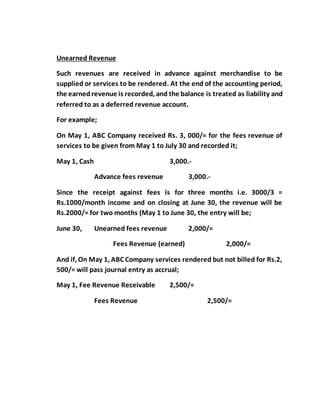
On May 1, ABC Company received Rs. 3, 000/= for the fees revenue of
services to be given from May 1 to July 30 and recorded it;
May 1, Cash 3,000.-
Advance fees revenue 3,000.-
Since the receipt against fees is for three months i.e. 3000/3 =
Rs.1000/month income and on closing at June 30, the revenue will be
Rs.2000/= for two months (May 1 to June 30, the entry will be;
June 30, Unearned fees revenue 2,000/=
Fees Revenue (earned) 2,000/=
And if, On May 1, ABC Company services rendered but not billed for Rs.2,
500/= will pass journal entry as accrual;
May 1, Fee Revenue Receivable 2,500/=
Fees Revenue 2,500/=
Depreciation
The allocation of the cost of fixed assets to the period the services are
receivable may call depreciation neither the physical deterioration nor
decrease in market value. The expired cost of tangible asset is also
referred to depreciation.
There are many methods for calculationof depreciationontangible assets
especially straight line method, declining balance method and sum of the
year digit method on time basis and depreciation on tangible asset used
basis.
A newaccount named “accumulated depreciation”is generated as contra
asset of particular asset account.
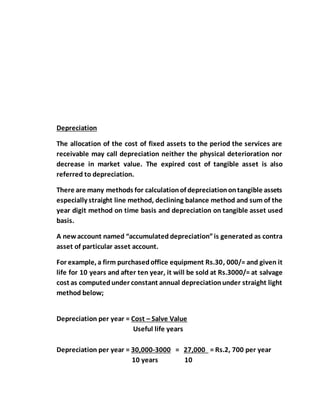
For example, a firm purchasedoffice equipment Rs.30, 000/= and given it
life for 10 years and after ten year, it will be sold at Rs.3000/= at salvage
cost as computedunder constant annual depreciationunder straight light
method below;
Depreciation per year = Cost – Salve Value
Useful life years
Depreciation per year = 30,000-3000 = 27,000 = Rs.2, 700 per year
10 years 10
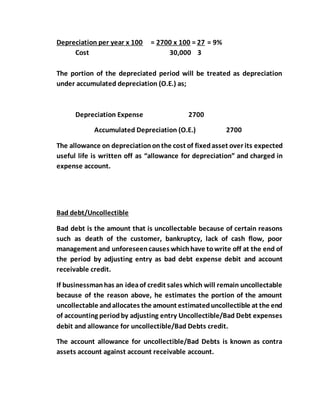
Depreciation per year x 100 = 2700 x 100 = 27 = 9%
Cost 30,000 3
The portion of the depreciated period will be treated as depreciation
under accumulated depreciation (O.E.) as;
Depreciation Expense 2700
Accumulated Depreciation (O.E.) 2700
The allowance on depreciationonthe cost of fixedasset over its expected
useful life is written off as “allowance for depreciation” and charged in
expense account.
Bad debt/Uncollectible
Bad debt is the amount that is uncollectable because of certain reasons
such as death of the customer, bankruptcy, lack of cash flow, poor
management and unforeseencauses whichhave towrite off at the end of
the period by adjusting entry as bad debt expense debit and account
receivable credit.
If businessmanhas an ideaof credit sales which will remain uncollectable
because of the reason above, he estimates the portion of the amount
uncollectable andallocates the amount estimateduncollectible at the end
of accounting periodby adjusting entry Uncollectible/Bad Debt expenses
debit and allowance for uncollectible/Bad Debts credit.
The account allowance for uncollectible/Bad Debts is known as contra
assets account against account receivable account.
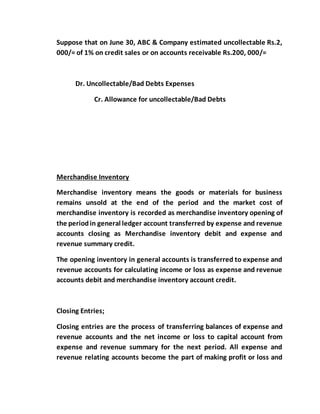
Suppose that on June 30, ABC & Company estimated uncollectable Rs.2,
000/= of 1% on credit sales or on accounts receivable Rs.200, 000/=
Dr. Uncollectable/Bad Debts Expenses
Cr. Allowance for uncollectable/Bad Debts
Merchandise Inventory
Merchandise inventory means the goods or materials for business
remains unsold at the end of the period and the market cost of
merchandise inventory is recorded as merchandise inventory opening of
the periodin general ledger account transferred by expense and revenue
accounts closing as Merchandise inventory debit and expense and
revenue summary credit.
The opening inventory in general accounts is transferred to expense and
revenue accounts for calculating income or loss as expense and revenue
accounts debit and merchandise inventory account credit.
Closing Entries;
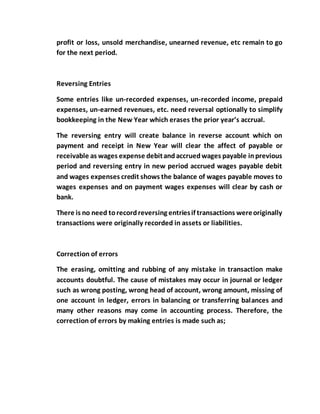
Closing entries are the process of transferring balances of expense and
revenue accounts and the net income or loss to capital account from
expense and revenue summary for the next period. All expense and
revenue relating accounts become the part of making profit or loss and
profit or loss, unsold merchandise, unearned revenue, etc remain to go
for the next period.
Reversing Entries
Some entries like un-recorded expenses, un-recorded income, prepaid
expenses, un-earned revenues, etc. need reversal optionally to simplify
bookkeeping in the New Year which erases the prior year’s accrual.
The reversing entry will create balance in reverse account which on
payment and receipt in New Year will clear the affect of payable or
receivable as wages expense debitandaccruedwages payable inprevious
period and reversing entry in new period accrued wages payable debit
and wages expenses credit shows the balance of wages payable moves to
wages expenses and on payment wages expenses will clear by cash or
bank.
There is no need torecordreversing entriesif transactions wereoriginally
transactions were originally recorded in assets or liabilities.
Correction of errors
The erasing, omitting and rubbing of any mistake in transaction make
accounts doubtful. The cause of mistakes may occur in journal or ledger
such as wrong posting, wrong head of account, wrong amount, missing of
one account in ledger, errors in balancing or transferring balances and
many other reasons may come in accounting process. Therefore, the
correction of errors by making entries is made such as;
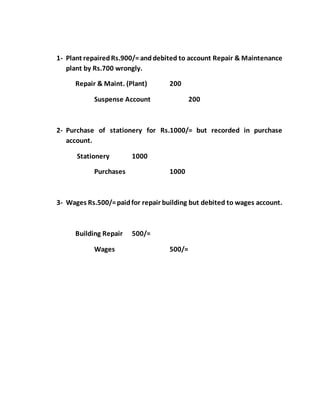
1- Plant repairedRs.900/= anddebited to account Repair & Maintenance
plant by Rs.700 wrongly.
Repair & Maint. (Plant) 200
Suspense Account 200
2- Purchase of stationery for Rs.1000/= but recorded in purchase
account.
Stationery 1000
Purchases 1000
3- Wages Rs.500/=paidfor repair building but debited to wages account.
Building Repair 500/=
Wages 500/=
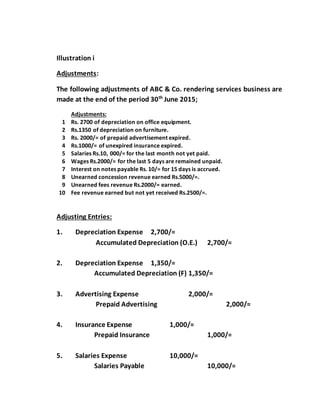
Illustration i
Adjustments:
The following adjustments of ABC & Co. rendering services business are
made at the end of the period 30th
June 2015;
Adjustments:
1 Rs. 2700 of depreciation on office equipment.
2 Rs.1350 of depreciation on furniture.
3 Rs. 2000/= of prepaid advertisement expired.
4 Rs.1000/= of unexpired insurance expired.
5 Salaries Rs.10, 000/= for the last month not yet paid.
6 Wages Rs.2000/= for the last 5 days are remained unpaid.
7 Interest on notes payable Rs. 10/= for 15 days is accrued.
8 Unearned concession revenue earned Rs.5000/=.
9 Unearned fees revenue Rs.2000/= earned.
10 Fee revenue earned but not yet received Rs.2500/=.
Adjusting Entries:
1. Depreciation Expense 2,700/=
Accumulated Depreciation (O.E.) 2,700/=
2. Depreciation Expense 1,350/=
Accumulated Depreciation (F) 1,350/=
3. Advertising Expense 2,000/=
Prepaid Advertising 2,000/=
4. Insurance Expense 1,000/=
Prepaid Insurance 1,000/=
5. Salaries Expense 10,000/=
Salaries Payable 10,000/=
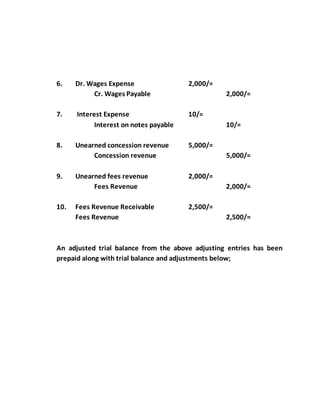
6. Dr. Wages Expense 2,000/=
Cr. Wages Payable 2,000/=
7. Interest Expense 10/=
Interest on notes payable 10/=
8. Unearned concession revenue 5,000/=
Concession revenue 5,000/=
9. Unearned fees revenue 2,000/=
Fees Revenue 2,000/=
10. Fees Revenue Receivable 2,500/=
Fees Revenue 2,500/=
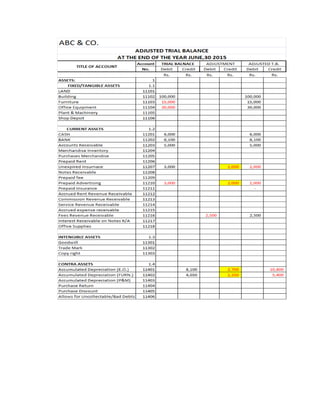
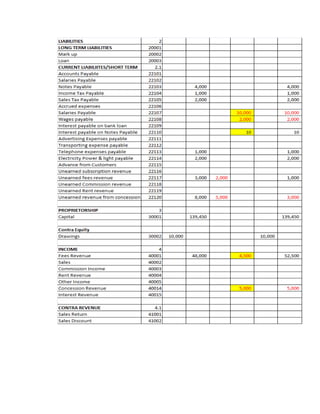
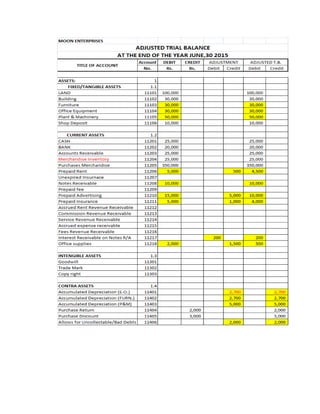
An adjusted trial balance from the above adjusting entries has been
prepaid along with trial balance and adjustments below;
Illustration ii
Adjustments:
Rs.2700/= depreciation on Office Furniture.
Rs.900/= depreciation on Office Equipment.
Rs.2000/= prepaid rent expired.
Rs.133/= interest on notes receivable.
Rs.2000/= prepaid advertising expired.
Rs.3000/= unearned subscription revenue earned.
Rs.1000/= rent for the last month not yet received.
Rs.4000/= commission receivable.
Rs.5000/= services rendered but not yet received.
Adjusting Entries
Depreciation Expense 2700/=
Accumulated Depreciation (O.F.) 2700/=
Depreciation Expense 900/=
Accumulated Depreciation (O.E.) 900/=
Rent Expense 2000/=
Prepaid Rent 2000/=
Interest Receivable on notes receivable 133/=
Interest Income 133/=
Advertising Expense 2000/=
Prepaid Advertising 2000/=
Unearned subscription revenue 3000/=
Subscription revenue 3000/=
Accrued Rent Revenue receivable 1000/=
Rent Revenue 1000/=
Commission revenue receivable 4000/=
Commission Income 4000/=
Services revenue receivable 5000/=
Service revenue 5000/=
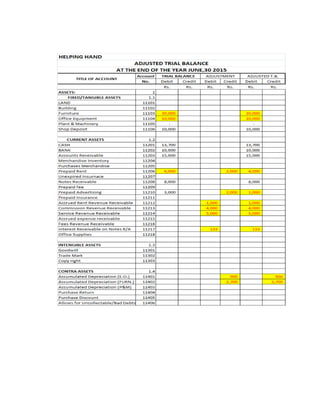
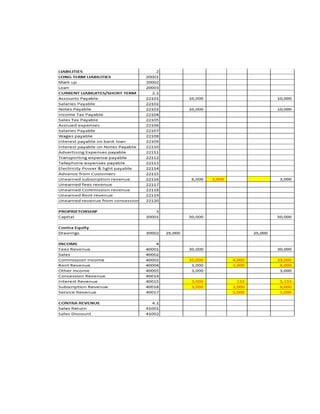
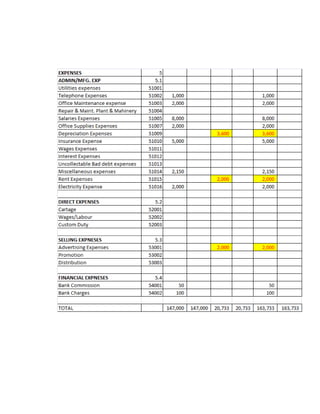
The above adjustments and entries related to the account of M/s.
Helping- Hands are made at the end of the period at 30th
June 2015 and
on the basis of adjustments the following adjusted trial balance has been
made showing complete picture of trial balance, adjustment and adjusted
trial balance;
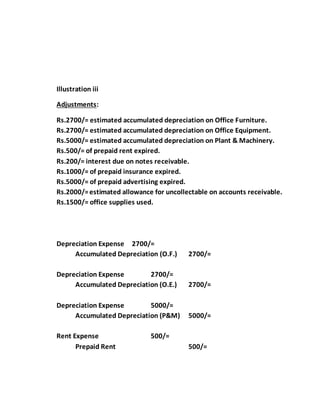
Illustration iii
Adjustments:
Rs.2700/= estimated accumulated depreciation on Office Furniture.
Rs.2700/= estimated accumulated depreciation on Office Equipment.
Rs.5000/= estimated accumulated depreciation on Plant & Machinery.
Rs.500/= of prepaid rent expired.
Rs.200/= interest due on notes receivable.
Rs.1000/= of prepaid insurance expired.
Rs.5000/= of prepaid advertising expired.
Rs.2000/=estimated allowance for uncollectable on accounts receivable.
Rs.1500/= office supplies used.
Depreciation Expense 2700/=
Accumulated Depreciation (O.F.) 2700/=
Depreciation Expense 2700/=
Accumulated Depreciation (O.E.) 2700/=
Depreciation Expense 5000/=
Accumulated Depreciation (P&M) 5000/=
Rent Expense 500/=
Prepaid Rent 500/=
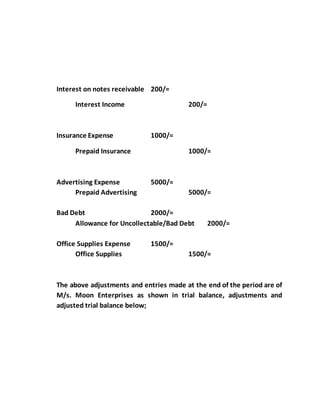
Interest on notes receivable 200/=
Interest Income 200/=
Insurance Expense 1000/=
Prepaid Insurance 1000/=
Advertising Expense 5000/=
Prepaid Advertising 5000/=
Bad Debt 2000/=
Allowance for Uncollectable/Bad Debt 2000/=
Office Supplies Expense 1500/=
Office Supplies 1500/=
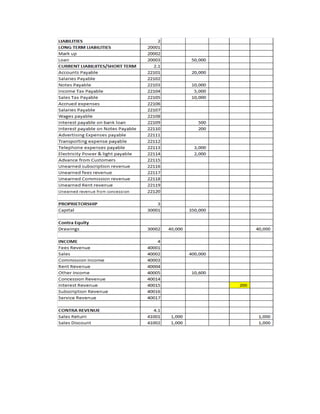
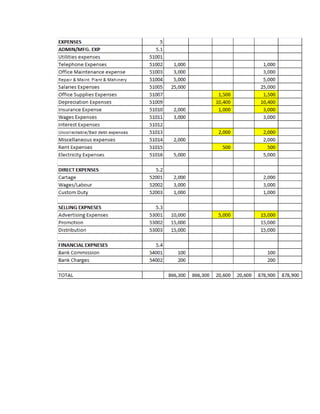
The above adjustments and entries made at the end of the period are of
M/s. Moon Enterprises as shown in trial balance, adjustments and
adjusted trial balance below;
The ledger shows activity in accounts individually and the summary of
accounts consists on ending balance may call trial balance by rectified by
adjusting entries andcorrectionof errors whichensuresthe equality of all
debits and credits.
After moving balance of temporary accounts relating to income and
expenses to Expense and Revenue summary, the rest of accounts are
transferred under post closing trial balance to next accounting cycle.
WRITER

Trial balances

  • 1.
    Volume – II YEAR2015 WRITTEN BY: SYED AQEEL RAZA
  • 3.
    The ledger accountsshow the position of each account and the balances of accounts at the end of specified period and to known the correctness of accounts require making equal debit and credit balances. Another device or to trial balances, we need trial balance having column title of Accounts, account number, debit and credit where we put balance debit in debit columnand credit incredit column as accounts sequence as assets, liabilities, proprietorship, income and expenses. There will be following steps of accounts summary or trial balance; Trial Balance – unadjusted Trial balance – adjusted Post closing Trial balance TRIAL BALNACE - UNADJUSTED Trial balance unadjusted means a trial balance which was created before adjustment in accounts for seeing the equality of balances in debit and credit. If the sum of debit and the sum of credit have no difference, the posting is considered correct otherwise the difference is ascertained by checking accounts.
  • 4.
  • 5.
    If we aremaintaining Expense and Revenue ledger, the general ledger and expense and revenue ledger is over viewed as illustration 1-1.6.
  • 7.
    TRIAL BALNACE ADJUSTED Afterjournalizing and posting in respectiveaccounts of all adjusting entries, an adjusted trial balance is prepared. The adjustment or settlement of an account is made at the end of the period like accrued expense, bad debts or uncollectible, unused supplies or merchandise, accrued income, unearned revenue etc. The same contents as trial balance are used herein but with the replacement of balance amount in account. The adjustment, reversal and correction of errors are made before making adjusted trial balance. An adjusting entry is the entry that updates the balance of an account at the end of the period; financial period or month like below; Accrued expenses or accrual of expenses Accruedexpensesmeans recording of expenses in accounts of the period to be settled in next month or financial period like salaries, wages, rent, interest on loan, advertising expenses, telephone charges, electricity charges, insurance expenses etc. which are debited and payable of each account or accrued expense account credited. The expense, which has been made or to be made but not recorded in accounts are recorded by adjusting entries like adjusting entries of (A); a) Salaries Rs.10, 000/= for the last month not yet paid. b) Wages Rs.2, 000/= for the last 5 days are remained unpaid. Salaries Expenses 10,000/= Salaries Payable 10,000/=
  • 8.
    Wages Expenses 5,000/= Wages payable 5, 000/= (B) Interest on notes payable Rs.10 for 15 days is accrued as; Suppose that a firm signed on 6% interest bearing promissory note of Rs.4, 000/= for 60 days on June 16 and June 30 is ending accounting period, the calculation will be; Computation on 60 days @ 6% note of Rs. 4, 000/= Signed Date June 16 Ending Accounting Date June 30 Maturity Date August 15 6% of Rs.4, 000 makes 120 one month Rs.240 for 12 months Rs.240 divided by 12 months Rs.20 for 30 days Rs.20 is divided by 30 days Rs.0.666667 for 1 day Interest from June 16 to June 30 Rs.0.666667 x 15 days = Rs.10/= Interest from July 1 to June 30 Rs.0.666667 x 45 days = Rs.30/= Total 60 days interest Rs.0.666667 x60 days = Rs.40/= Journal Entry; Dr. Interest Expenses Cr. Interest payable on notes payable The accrual of expenses will increase both liabilities and expenses.
  • 9.
    Accrued revenue oraccrual of revenue The revenue, which has been earned but not received or recorded in accounting period, will be recorded in accounts by adjusting entries such as; services renderedbut not received, rent for the last three months not received, commission due but not received. The adjusting entries will be service revenue receivable debitandservices revenue credit, accrued rent revenue receivable debit and rent revenue credit and commission revenue receivable debit and commission credit. Examples: - Services rendered but not billed. - Commission receivable. - Interest receivable on note receivable Adjustments; Services revenue receivable Service revenue Commission revenue receivable Commission Income
  • 10.
    Accrued Interest receivable InterestIncome Interest on notes bearing Rs.8000/= receivable as calculated below; Suppose that a firm had received interest 10% of Rs.8000/= for three months on May 1 and closed accounts on June 30. It means it earned two months interest Rs.133/= as per following calculation. Computation on 3 months interest @ 10% on Rs.8000/= 8000x10/100 = Rs.800 for one year; 800x3/12 = Rs.200/= interest revenue will be earned after 3 months. Rs.200 = 3 months interest 200/3 = 66.66667 one month interest revenue 66.66667x2 = Rs.133/= two months interest revenue. Journal Entry; I June 30, Interest receivable on Notes receivable 133/= Interest revenue 133/= The accrued revenues or unrecorded revenues increases in assets (to be received) and increases in revenue (to be received).
  • 11.
    Prepaid Expenses Which expensespaidinadvance e.g. insurance, rent, advertising etc. may be adjusted at the end of the period against a portion of the period expired or consumed by making adjusting entries as; Insurance Expense debit and prepaid insurance credit, rent expense debit and prepaid rent credit, advertising expense debit and prepaid advertising credit. For example on May 1, 2014, paid cash Rs.3, 000/= to Radio Pakistan for advertising for a period of three month and passed entry as; Prepaid Advertising 3,000/= Cash 3, 000/= At the end of the accounting periodJune 30, 2015, a portion of the period services expired i.e. May 1, 2014 to June 30, 2015 for two months Rs.2, 000/= and another period of services i.e. July 1, 2015 to July 30, 2015 remained unexpired Rs.1, 000/= will remain in asset. The portion of expired period will be treated in expense as Advertising Expense 2000 Prepaid Advertising 2000 The Prepaid expenses are record in assets.
  • 12.
    Unearned Revenue Such revenuesare received in advance against merchandise to be supplied or services to be rendered. At the end of the accounting period, the earnedrevenue is recorded, and the balance is treated as liability and referred to as a deferred revenue account. For example; On May 1, ABC Company received Rs. 3, 000/= for the fees revenue of services to be given from May 1 to July 30 and recorded it; May 1, Cash 3,000.- Advance fees revenue 3,000.- Since the receipt against fees is for three months i.e. 3000/3 = Rs.1000/month income and on closing at June 30, the revenue will be Rs.2000/= for two months (May 1 to June 30, the entry will be; June 30, Unearned fees revenue 2,000/= Fees Revenue (earned) 2,000/= And if, On May 1, ABC Company services rendered but not billed for Rs.2, 500/= will pass journal entry as accrual; May 1, Fee Revenue Receivable 2,500/= Fees Revenue 2,500/=
  • 13.
    Depreciation The allocation ofthe cost of fixed assets to the period the services are receivable may call depreciation neither the physical deterioration nor decrease in market value. The expired cost of tangible asset is also referred to depreciation. There are many methods for calculationof depreciationontangible assets especially straight line method, declining balance method and sum of the year digit method on time basis and depreciation on tangible asset used basis. A newaccount named “accumulated depreciation”is generated as contra asset of particular asset account. For example, a firm purchasedoffice equipment Rs.30, 000/= and given it life for 10 years and after ten year, it will be sold at Rs.3000/= at salvage cost as computedunder constant annual depreciationunder straight light method below; Depreciation per year = Cost – Salve Value Useful life years Depreciation per year = 30,000-3000 = 27,000 = Rs.2, 700 per year 10 years 10
  • 14.
    Depreciation per yearx 100 = 2700 x 100 = 27 = 9% Cost 30,000 3 The portion of the depreciated period will be treated as depreciation under accumulated depreciation (O.E.) as; Depreciation Expense 2700 Accumulated Depreciation (O.E.) 2700 The allowance on depreciationonthe cost of fixedasset over its expected useful life is written off as “allowance for depreciation” and charged in expense account. Bad debt/Uncollectible Bad debt is the amount that is uncollectable because of certain reasons such as death of the customer, bankruptcy, lack of cash flow, poor management and unforeseencauses whichhave towrite off at the end of the period by adjusting entry as bad debt expense debit and account receivable credit. If businessmanhas an ideaof credit sales which will remain uncollectable because of the reason above, he estimates the portion of the amount uncollectable andallocates the amount estimateduncollectible at the end of accounting periodby adjusting entry Uncollectible/Bad Debt expenses debit and allowance for uncollectible/Bad Debts credit. The account allowance for uncollectible/Bad Debts is known as contra assets account against account receivable account.
  • 15.
    Suppose that onJune 30, ABC & Company estimated uncollectable Rs.2, 000/= of 1% on credit sales or on accounts receivable Rs.200, 000/= Dr. Uncollectable/Bad Debts Expenses Cr. Allowance for uncollectable/Bad Debts Merchandise Inventory Merchandise inventory means the goods or materials for business remains unsold at the end of the period and the market cost of merchandise inventory is recorded as merchandise inventory opening of the periodin general ledger account transferred by expense and revenue accounts closing as Merchandise inventory debit and expense and revenue summary credit. The opening inventory in general accounts is transferred to expense and revenue accounts for calculating income or loss as expense and revenue accounts debit and merchandise inventory account credit. Closing Entries; Closing entries are the process of transferring balances of expense and revenue accounts and the net income or loss to capital account from expense and revenue summary for the next period. All expense and revenue relating accounts become the part of making profit or loss and
  • 16.
    profit or loss,unsold merchandise, unearned revenue, etc remain to go for the next period. Reversing Entries Some entries like un-recorded expenses, un-recorded income, prepaid expenses, un-earned revenues, etc. need reversal optionally to simplify bookkeeping in the New Year which erases the prior year’s accrual. The reversing entry will create balance in reverse account which on payment and receipt in New Year will clear the affect of payable or receivable as wages expense debitandaccruedwages payable inprevious period and reversing entry in new period accrued wages payable debit and wages expenses credit shows the balance of wages payable moves to wages expenses and on payment wages expenses will clear by cash or bank. There is no need torecordreversing entriesif transactions wereoriginally transactions were originally recorded in assets or liabilities. Correction of errors The erasing, omitting and rubbing of any mistake in transaction make accounts doubtful. The cause of mistakes may occur in journal or ledger such as wrong posting, wrong head of account, wrong amount, missing of one account in ledger, errors in balancing or transferring balances and many other reasons may come in accounting process. Therefore, the correction of errors by making entries is made such as;
  • 17.
    1- Plant repairedRs.900/=anddebited to account Repair & Maintenance plant by Rs.700 wrongly. Repair & Maint. (Plant) 200 Suspense Account 200 2- Purchase of stationery for Rs.1000/= but recorded in purchase account. Stationery 1000 Purchases 1000 3- Wages Rs.500/=paidfor repair building but debited to wages account. Building Repair 500/= Wages 500/=
  • 18.
    Illustration i Adjustments: The followingadjustments of ABC & Co. rendering services business are made at the end of the period 30th June 2015; Adjustments: 1 Rs. 2700 of depreciation on office equipment. 2 Rs.1350 of depreciation on furniture. 3 Rs. 2000/= of prepaid advertisement expired. 4 Rs.1000/= of unexpired insurance expired. 5 Salaries Rs.10, 000/= for the last month not yet paid. 6 Wages Rs.2000/= for the last 5 days are remained unpaid. 7 Interest on notes payable Rs. 10/= for 15 days is accrued. 8 Unearned concession revenue earned Rs.5000/=. 9 Unearned fees revenue Rs.2000/= earned. 10 Fee revenue earned but not yet received Rs.2500/=. Adjusting Entries: 1. Depreciation Expense 2,700/= Accumulated Depreciation (O.E.) 2,700/= 2. Depreciation Expense 1,350/= Accumulated Depreciation (F) 1,350/= 3. Advertising Expense 2,000/= Prepaid Advertising 2,000/= 4. Insurance Expense 1,000/= Prepaid Insurance 1,000/= 5. Salaries Expense 10,000/= Salaries Payable 10,000/=
  • 19.
    6. Dr. WagesExpense 2,000/= Cr. Wages Payable 2,000/= 7. Interest Expense 10/= Interest on notes payable 10/= 8. Unearned concession revenue 5,000/= Concession revenue 5,000/= 9. Unearned fees revenue 2,000/= Fees Revenue 2,000/= 10. Fees Revenue Receivable 2,500/= Fees Revenue 2,500/= An adjusted trial balance from the above adjusting entries has been prepaid along with trial balance and adjustments below;
  • 23.
    Illustration ii Adjustments: Rs.2700/= depreciationon Office Furniture. Rs.900/= depreciation on Office Equipment. Rs.2000/= prepaid rent expired. Rs.133/= interest on notes receivable. Rs.2000/= prepaid advertising expired. Rs.3000/= unearned subscription revenue earned. Rs.1000/= rent for the last month not yet received. Rs.4000/= commission receivable. Rs.5000/= services rendered but not yet received. Adjusting Entries Depreciation Expense 2700/= Accumulated Depreciation (O.F.) 2700/= Depreciation Expense 900/= Accumulated Depreciation (O.E.) 900/= Rent Expense 2000/= Prepaid Rent 2000/=
  • 24.
    Interest Receivable onnotes receivable 133/= Interest Income 133/= Advertising Expense 2000/= Prepaid Advertising 2000/= Unearned subscription revenue 3000/= Subscription revenue 3000/= Accrued Rent Revenue receivable 1000/= Rent Revenue 1000/= Commission revenue receivable 4000/= Commission Income 4000/= Services revenue receivable 5000/= Service revenue 5000/= The above adjustments and entries related to the account of M/s. Helping- Hands are made at the end of the period at 30th June 2015 and on the basis of adjustments the following adjusted trial balance has been made showing complete picture of trial balance, adjustment and adjusted trial balance;
  • 28.
    Illustration iii Adjustments: Rs.2700/= estimatedaccumulated depreciation on Office Furniture. Rs.2700/= estimated accumulated depreciation on Office Equipment. Rs.5000/= estimated accumulated depreciation on Plant & Machinery. Rs.500/= of prepaid rent expired. Rs.200/= interest due on notes receivable. Rs.1000/= of prepaid insurance expired. Rs.5000/= of prepaid advertising expired. Rs.2000/=estimated allowance for uncollectable on accounts receivable. Rs.1500/= office supplies used. Depreciation Expense 2700/= Accumulated Depreciation (O.F.) 2700/= Depreciation Expense 2700/= Accumulated Depreciation (O.E.) 2700/= Depreciation Expense 5000/= Accumulated Depreciation (P&M) 5000/= Rent Expense 500/= Prepaid Rent 500/=
  • 29.
    Interest on notesreceivable 200/= Interest Income 200/= Insurance Expense 1000/= Prepaid Insurance 1000/= Advertising Expense 5000/= Prepaid Advertising 5000/= Bad Debt 2000/= Allowance for Uncollectable/Bad Debt 2000/= Office Supplies Expense 1500/= Office Supplies 1500/= The above adjustments and entries made at the end of the period are of M/s. Moon Enterprises as shown in trial balance, adjustments and adjusted trial balance below;
  • 33.
    The ledger showsactivity in accounts individually and the summary of accounts consists on ending balance may call trial balance by rectified by adjusting entries andcorrectionof errors whichensuresthe equality of all debits and credits. After moving balance of temporary accounts relating to income and expenses to Expense and Revenue summary, the rest of accounts are transferred under post closing trial balance to next accounting cycle. WRITER