INTRODUCTION
ASSALAMMUALAIKUM AND GOOD MORNING TO TEACHER AND MEMBERS
OF THE FLOOR. WE WOULD LIKE TO THANK YOU TO TEACHER SYED FOR
GIVING US THIS GOLDEN OPPORTUNITY TO PRESENT SOME INFORMATION
ON ADJECTIVES.
TEAM MEMBERS
1.
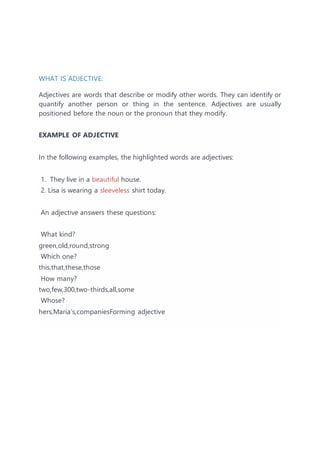
WHAT IS ADJECTIVE:
Adjectives are words that describe or modify other words. They can identify or
quantify another person or thing in the sentence. Adjectives are usually
positioned before the noun or the pronoun that they modify.
EXAMPLE OF ADJECTIVE
In the following examples, the highlighted words are adjectives:
1. They live in a beautiful house.
2. Lisa is wearing a sleeveless shirt today.
An adjective answers these questions:
What kind?
green,old,round,strong
Which one?
this,that,these,those
How many?
two,few,300,two-thirds,all,some
Whose?
hers,Maria’s,companiesForming adjective
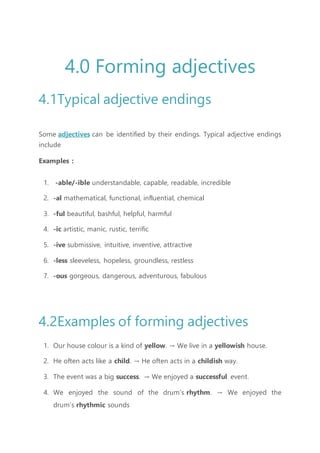
4.0 Forming adjectives
4.1Typical adjective endings
Some adjectives can be identified by their endings. Typical adjective endings
include
Examples :
1. -able/-ible understandable, capable, readable, incredible
2. -al mathematical, functional, influential, chemical
3. -ful beautiful, bashful, helpful, harmful
4. -ic artistic, manic, rustic, terrific
5. -ive submissive, intuitive, inventive, attractive
6. -less sleeveless, hopeless, groundless, restless
7. -ous gorgeous, dangerous, adventurous, fabulous
4.2Examples of forming adjectives
1. Our house colour is a kind of yellow. → We live in a yellowish house.
2. He often acts like a child. → He often acts in a childish way.
3. The event was a big success. → We enjoyed a successful event.
4. We enjoyed the sound of the drum’s rhythm. → We enjoyed the
drum’s rhythmic sounds
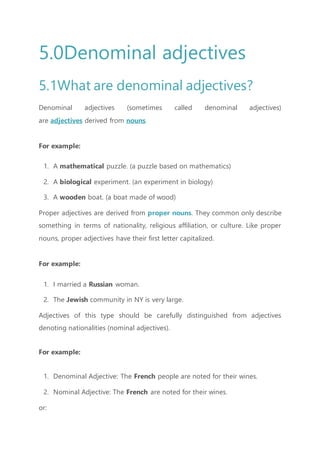
5.0Denominal adjectives
5.1What are denominal adjectives?
Denominal adjectives (sometimes called denominal adjectives)
are adjectives derived from nouns.
For example:
1. A mathematical puzzle. (a puzzle based on mathematics)
2. A biological experiment. (an experiment in biology)
3. A wooden boat. (a boat made of wood)
Proper adjectives are derived from proper nouns. They common only describe
something in terms of nationality, religious affiliation, or culture. Like proper
nouns, proper adjectives have their first letter capitalized.
For example:
1. I married a Russian woman.
2. The Jewish community in NY is very large.
Adjectives of this type should be carefully distinguished from adjectives
denoting nationalities (nominal adjectives).
For example:
1. Denominal Adjective: The French people are noted for their wines.
2. Nominal Adjective: The French are noted for their wines.
or:
1. Denominal Adjective: The poor people are more vulnerable.
2. Nominal Adjective: The poor are getting poorer.
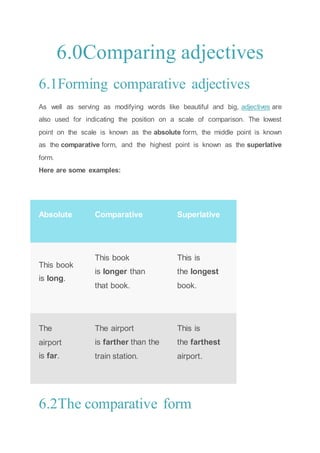
6.0Comparing adjectives
6.1Forming comparative adjectives
As well as serving as modifying words like beautiful and big, adjectives are
also used for indicating the position on a scale of comparison. The lowest
point on the scale is known as the absolute form, the middle point is known
as the comparative form, and the highest point is known as the superlative
form.
Here are some examples:
Absolute Comparative Superlative
This book
is long.
This book
is longer than
that book.
This is
the longest
book.
The
airport
is far.
The airport
is farther than the
train station.
This is
the farthest
airport.
6.2The comparative form
When two objects or persons are being compared, the comparative form of
the adjective is used. The comparative adjective can be formed in two ways:
1. Adding –er to the absolute form of the adjective.
2. Adding the word more before the adjective.
For example:
1. My essay is longer than yours.
2. She is more beautiful than her sister.
6.3Superlative
The superlative is used to say what thing or person has the most of a
particular quality within a group or of its kind. The superlative can be formed in
two ways:
1. Adding –est to the absolute form of the adjective.
2. Adding the word most before the adjective.
For example:
1. This is the most beautiful dress I have ever seen.
2. The biggest table in the room.
7.0Compound adjectives
7.1What are compound adjectives?
A compound adjective is formed when two or more adjectives are joined
together to modify the same noun. These terms should be hyphenated to
avoid confusion or ambiguity.
For example:
1. Diana submitted a 6-page document.
2. She adopted a two-year-old cat
7.2Compound adjectives – Exceptions
Note that combining an adverb and an adjective does not create a compound
adjective. No hyphen is required because it is already clear that the adverb
modifies the adjective rather than the subsequent noun.
For example:
1. It was a terribly hot day.
2. It is an amazingly good idea.
In addition, you should not place a hyphen in a compound adjective if the
adjectives are capitalized, such as when they are part of a title.
7.3Examples of compound adjectives
1. This is a four-foot table.
2. Danielle is a part-time worker.
8.0Order of adjectives
8.1How to order adjectives in English
In many languages, adjectives denoting attributes usually occur in a specific
order. Generally, the adjective order in English is:
1. Quantity or number
2. Quality or opinion
3. Size
4. Age
5. Shape
6. Colour
7. Proper adjective (often nationality, other place of origin, or material)
8. Purpose or qualifier
For example:
1. I love that really big old green antique car that always parked at the end
of the street.
2. My sister adopted a beautiful big white bulldog.
When there are two or more adjectives that are from the same group, the
word and is placed between the two adjectives:
1. The house is green and red.
2. The library has old and new books.
When there are three or more adjectives from the same adjective group, place
a comma between each of the coordinate adjectives:
1. We live in the big green, white and red house at the end of the street.
2. My friend lost a red, black and white watch.
ENGLISH PRESENTATION

ENGLISH PRESENTATION

  • 1.
    INTRODUCTION ASSALAMMUALAIKUM AND GOODMORNING TO TEACHER AND MEMBERS OF THE FLOOR. WE WOULD LIKE TO THANK YOU TO TEACHER SYED FOR GIVING US THIS GOLDEN OPPORTUNITY TO PRESENT SOME INFORMATION ON ADJECTIVES. TEAM MEMBERS 1.
  • 2.
    WHAT IS ADJECTIVE: Adjectivesare words that describe or modify other words. They can identify or quantify another person or thing in the sentence. Adjectives are usually positioned before the noun or the pronoun that they modify. EXAMPLE OF ADJECTIVE In the following examples, the highlighted words are adjectives: 1. They live in a beautiful house. 2. Lisa is wearing a sleeveless shirt today. An adjective answers these questions: What kind? green,old,round,strong Which one? this,that,these,those How many? two,few,300,two-thirds,all,some Whose? hers,Maria’s,companiesForming adjective
  • 3.
    4.0 Forming adjectives 4.1Typicaladjective endings Some adjectives can be identified by their endings. Typical adjective endings include Examples : 1. -able/-ible understandable, capable, readable, incredible 2. -al mathematical, functional, influential, chemical 3. -ful beautiful, bashful, helpful, harmful 4. -ic artistic, manic, rustic, terrific 5. -ive submissive, intuitive, inventive, attractive 6. -less sleeveless, hopeless, groundless, restless 7. -ous gorgeous, dangerous, adventurous, fabulous 4.2Examples of forming adjectives 1. Our house colour is a kind of yellow. → We live in a yellowish house. 2. He often acts like a child. → He often acts in a childish way. 3. The event was a big success. → We enjoyed a successful event. 4. We enjoyed the sound of the drum’s rhythm. → We enjoyed the drum’s rhythmic sounds
  • 4.
    5.0Denominal adjectives 5.1What aredenominal adjectives? Denominal adjectives (sometimes called denominal adjectives) are adjectives derived from nouns. For example: 1. A mathematical puzzle. (a puzzle based on mathematics) 2. A biological experiment. (an experiment in biology) 3. A wooden boat. (a boat made of wood) Proper adjectives are derived from proper nouns. They common only describe something in terms of nationality, religious affiliation, or culture. Like proper nouns, proper adjectives have their first letter capitalized. For example: 1. I married a Russian woman. 2. The Jewish community in NY is very large. Adjectives of this type should be carefully distinguished from adjectives denoting nationalities (nominal adjectives). For example: 1. Denominal Adjective: The French people are noted for their wines. 2. Nominal Adjective: The French are noted for their wines. or:
  • 5.
    1. Denominal Adjective:The poor people are more vulnerable. 2. Nominal Adjective: The poor are getting poorer.
  • 6.
    6.0Comparing adjectives 6.1Forming comparativeadjectives As well as serving as modifying words like beautiful and big, adjectives are also used for indicating the position on a scale of comparison. The lowest point on the scale is known as the absolute form, the middle point is known as the comparative form, and the highest point is known as the superlative form. Here are some examples: Absolute Comparative Superlative This book is long. This book is longer than that book. This is the longest book. The airport is far. The airport is farther than the train station. This is the farthest airport. 6.2The comparative form
  • 7.
    When two objectsor persons are being compared, the comparative form of the adjective is used. The comparative adjective can be formed in two ways: 1. Adding –er to the absolute form of the adjective. 2. Adding the word more before the adjective. For example: 1. My essay is longer than yours. 2. She is more beautiful than her sister. 6.3Superlative The superlative is used to say what thing or person has the most of a particular quality within a group or of its kind. The superlative can be formed in two ways: 1. Adding –est to the absolute form of the adjective. 2. Adding the word most before the adjective. For example: 1. This is the most beautiful dress I have ever seen. 2. The biggest table in the room.
  • 8.
    7.0Compound adjectives 7.1What arecompound adjectives? A compound adjective is formed when two or more adjectives are joined together to modify the same noun. These terms should be hyphenated to avoid confusion or ambiguity. For example: 1. Diana submitted a 6-page document. 2. She adopted a two-year-old cat 7.2Compound adjectives – Exceptions Note that combining an adverb and an adjective does not create a compound adjective. No hyphen is required because it is already clear that the adverb modifies the adjective rather than the subsequent noun. For example: 1. It was a terribly hot day. 2. It is an amazingly good idea. In addition, you should not place a hyphen in a compound adjective if the adjectives are capitalized, such as when they are part of a title. 7.3Examples of compound adjectives 1. This is a four-foot table. 2. Danielle is a part-time worker.
  • 9.
    8.0Order of adjectives 8.1Howto order adjectives in English In many languages, adjectives denoting attributes usually occur in a specific order. Generally, the adjective order in English is: 1. Quantity or number 2. Quality or opinion 3. Size 4. Age 5. Shape 6. Colour 7. Proper adjective (often nationality, other place of origin, or material) 8. Purpose or qualifier For example: 1. I love that really big old green antique car that always parked at the end of the street. 2. My sister adopted a beautiful big white bulldog. When there are two or more adjectives that are from the same group, the word and is placed between the two adjectives: 1. The house is green and red. 2. The library has old and new books. When there are three or more adjectives from the same adjective group, place a comma between each of the coordinate adjectives: 1. We live in the big green, white and red house at the end of the street. 2. My friend lost a red, black and white watch.