Adjectives
• Adjectives are the words
that describe nouns and
pronouns
Adjective describe nouns and
pronouns by giving some
information about an objects;
its size, shape, age, color, origin,
or materials.
Numeral Adjectives
– An adjective of number is an adjective that shows the exact number of persons
or things denoted by Noun or Pronoun.
– An adjective of number can also demonstrate a nouns position or place in a
certain order.
– An adjective of number is also knows as a numeral adjective
– Adjectives of number are used with countable nouns.
There are several types of adjectives of number. They are definite numeral
adjectives, indefinite numeral adjectives, and distributive numeral adjectives.
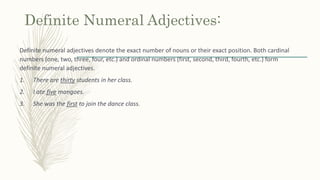
Definite Numeral Adjectives:
Definite numeral adjectives denote the exact number of nouns or their exact position. Both cardinal
numbers (one, two, three, four, etc.) and ordinal numbers (first, second, third, fourth, etc.) form
definite numeral adjectives.
1. There are thirty students in her class.
2. I ate five mangoes.
3. She was the first to join the dance class.
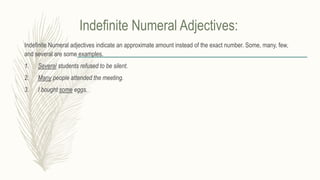
Indefinite Numeral Adjectives:
Indefinite Numeral adjectives indicate an approximate amount instead of the exact number. Some, many, few,
and several are some examples.
1. Several students refused to be silent.
2. Many people attended the meeting.
3. I bought some eggs.
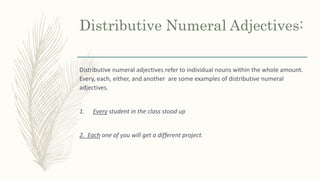
Distributive Numeral Adjectives:
Distributive numeral adjectives refer to individual nouns within the whole amount.
Every, each, either, and another are some examples of distributive numeral
adjectives.
1. Every student in the class stood up
2. Each one of you will get a different project.
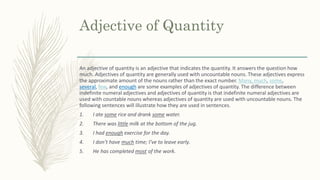
Adjective of Quantity
An adjective of quantity is an adjective that indicates the quantity. It answers the question how
much. Adjectives of quantity are generally used with uncountable nouns. These adjectives express
the approximate amount of the nouns rather than the exact number. Many, much, some,
several, few, and enough are some examples of adjectives of quantity. The difference between
indefinite numeral adjectives and adjectives of quantity is that indefinite numeral adjectives are
used with countable nouns whereas adjectives of quantity are used with uncountable nouns. The

following sentences will illustrate how they are used in sentences.
1. I ate some rice and drank some water.
2. There was little milk at the bottom of the jug.
3. I had enough exercise for the day.
4. I don’t have much time; I’ve to leave early.
5. He has completed most of the work.
Difference Between Adjective of Number
and Quantity
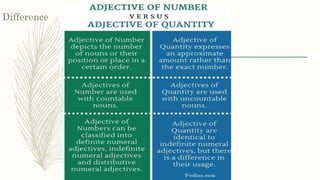
 Adjective of Number depicts the number of nouns or their position or place in a
certain order.
 is used with countable nouns.
 Adjective of Quantity expresses an approximate amount rather than the exact
number.
 is used with uncountable nouns.
Classification
 Adjective of Numbers can be classified into definite numeral adjectives,
indefinite numeral adjectives, and distributive numeral adjectives.
 Adjective of Quantity are identical to indefinite numeral adjectives, but there is
a difference in their usage.
Difference
English Grammar
Presentation
–By
–Kamran Khan

Adjectives

  • 1.
    Adjectives • Adjectives arethe words that describe nouns and pronouns Adjective describe nouns and pronouns by giving some information about an objects; its size, shape, age, color, origin, or materials.
  • 2.
    Numeral Adjectives – Anadjective of number is an adjective that shows the exact number of persons or things denoted by Noun or Pronoun. – An adjective of number can also demonstrate a nouns position or place in a certain order. – An adjective of number is also knows as a numeral adjective – Adjectives of number are used with countable nouns. There are several types of adjectives of number. They are definite numeral adjectives, indefinite numeral adjectives, and distributive numeral adjectives.
  • 3.
    Definite Numeral Adjectives: Definitenumeral adjectives denote the exact number of nouns or their exact position. Both cardinal numbers (one, two, three, four, etc.) and ordinal numbers (first, second, third, fourth, etc.) form definite numeral adjectives. 1. There are thirty students in her class. 2. I ate five mangoes. 3. She was the first to join the dance class.
  • 4.
    Indefinite Numeral Adjectives: IndefiniteNumeral adjectives indicate an approximate amount instead of the exact number. Some, many, few, and several are some examples. 1. Several students refused to be silent. 2. Many people attended the meeting. 3. I bought some eggs.
  • 5.
    Distributive Numeral Adjectives: Distributivenumeral adjectives refer to individual nouns within the whole amount. Every, each, either, and another are some examples of distributive numeral adjectives. 1. Every student in the class stood up 2. Each one of you will get a different project.
  • 6.
    Adjective of Quantity Anadjective of quantity is an adjective that indicates the quantity. It answers the question how much. Adjectives of quantity are generally used with uncountable nouns. These adjectives express the approximate amount of the nouns rather than the exact number. Many, much, some, several, few, and enough are some examples of adjectives of quantity. The difference between indefinite numeral adjectives and adjectives of quantity is that indefinite numeral adjectives are used with countable nouns whereas adjectives of quantity are used with uncountable nouns. The following sentences will illustrate how they are used in sentences. 1. I ate some rice and drank some water. 2. There was little milk at the bottom of the jug. 3. I had enough exercise for the day. 4. I don’t have much time; I’ve to leave early. 5. He has completed most of the work.
  • 7.
    Difference Between Adjectiveof Number and Quantity  Adjective of Number depicts the number of nouns or their position or place in a certain order.  is used with countable nouns.  Adjective of Quantity expresses an approximate amount rather than the exact number.  is used with uncountable nouns.
  • 8.
    Classification  Adjective ofNumbers can be classified into definite numeral adjectives, indefinite numeral adjectives, and distributive numeral adjectives.  Adjective of Quantity are identical to indefinite numeral adjectives, but there is a difference in their usage.
  • 9.
  • 10.