Aderenta siAderenta si
controlul riscului cardiovascularcontrolul riscului cardiovascular
Alexandru Andritoiu
Sp. Militar Craiova
Subiecte
• Riscul CV
• Aderenta
• Nonaderenta
• Complianta
• Persistenta
Riscul CVRiscul CV
• Total (global)
-absolut
-relativ
• Formule de calcul probabilistic intr-o
populatie tinta
Riscul global-CADRiscul global-CAD
• Riscul global este un calcul al riscului absolut
de a avea un eveniment coronarian (deces,
IMA) intr-un interval de timp specificat (10
ani).
• Cunoasterea RCV permite medicului sa
prescrie terapii tintite in copul reducerii
riscului (antihipertensive, statine, aspirina).
Permite aflarea raspunsului la intrebarilePermite aflarea raspunsului la intrebarile
• Cine va beneficia de interventiile terapeutice?
• Cand trebuie inceput tratamentul farmacologic
si non-faramacologic?
• La cine, aceste interventii sunt cost-eficiente?.
• Calculul risului CV poate ajuta in luarea celei
mai bune decizii de management.
Calcululul Riscului Global
Calculul riscului CV global este recomandat in toate
ghidurile nationale ca punct de plecare in decizia
terapeutica
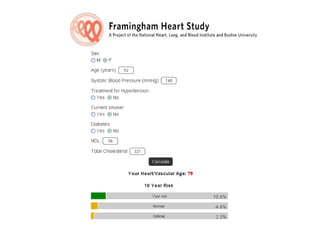
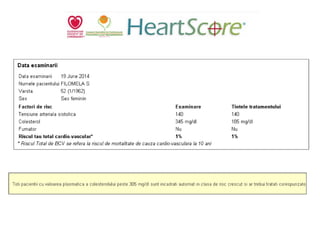
• Framingham CardioVascular Risk Score
(Framingham Heart Study)-USA
• Prospective Cardiovascular Munster Heart Study
(PROCAM)
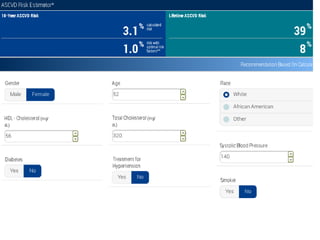
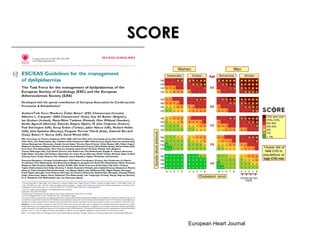
• Systematic Coronary Risk Evaluation system (SCORE)
• United Kingdom Prospective Diabetes Study
(UKPDS) for diabetics,
• Reynolds Risk Score
• NHANES (include the obesity as a risk factor)
2,062 views-125 downloads
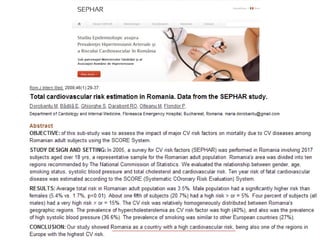
SCORESCORE
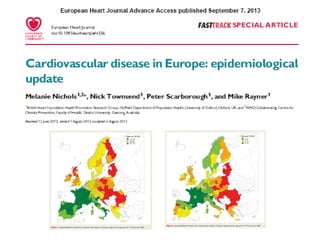
European Heart Journal
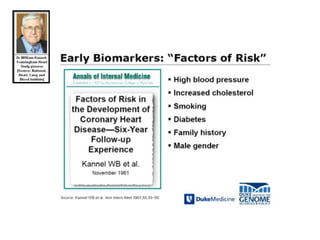
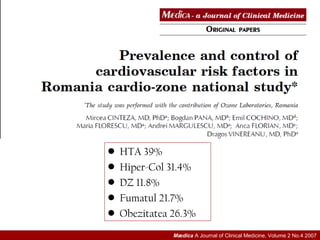
Mædica A Journal of Clinical Medicine, Volume 2 No.4 2007
• HTA 39%
• Hiper-Col 31.4%
• DZ 11.8%
• Fumatul 21.7%
• Obezitatea 26.3%
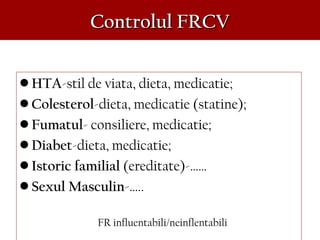
Controlul FRCVControlul FRCV
• HTA-stil de viata, dieta, medicatie;
• Colesterol-dieta, medicatie (statine);
• Fumatul- consiliere, medicatie;
• Diabet-dieta, medicatie;
• Istoric familial (ereditate)-……
• Sexul Masculin-…..
FR influentabili/neinflentabili
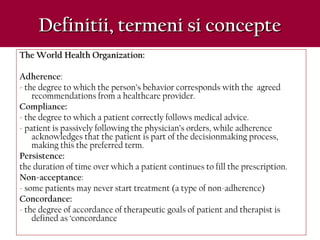
Definitii, termeni si concepteDefinitii, termeni si concepte
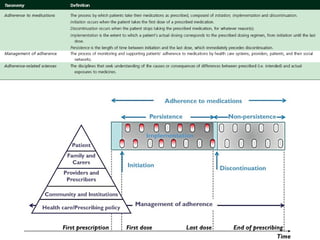
The World Health Organization:The World Health Organization:
Adherence:
- the degree to which the person’s behavior corresponds with the agreed
recommendations from a healthcare provider.
Compliance:
- the degree to which a patient correctly follows medical advice.
- patient is passively following the physician’s orders, while adherence
acknowledges that the patient is part of the decisionmaking process,
making this the preferred term.
Persistence:
the duration of time over which a patient continues to fill the prescription.
Non-acceptance:
- some patients may never start treatment (a type of non-adherence)
Concordance:
- the degree of accordance of therapeutic goals of patient and therapist is
defined as ‘concordance
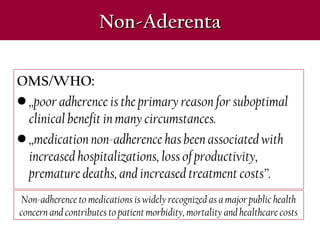
Non-AderentaNon-Aderenta
OMS/WHO:
• ,,poor adherence is the primary reason for suboptimal
clinical benefit in many circumstances.
• ,,medication non-adherence has been associated with
increased hospitalizations, loss of productivity,
premature deaths, and increased treatment costs”.
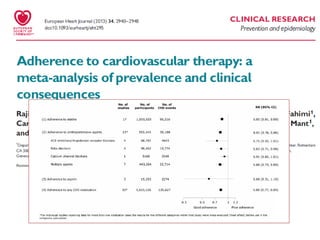
Non-adherence to medications is widely recognized as a major public health
concern and contributes to patient morbidity, mortality and healthcare costs
Ce este aderenta pe termen lungCe este aderenta pe termen lung
(long-time adherence)?(long-time adherence)?
• 12 luni dupa externare
• 24 luni
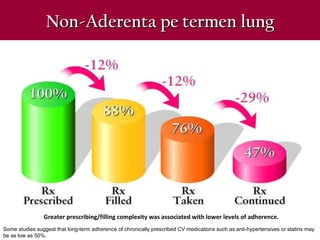
Non-Non-AderenAderenta pe termen lungta pe termen lung
Greater prescribing/filling complexity was associated with lower levels of adherence.
Some studies suggest that long-term adherence of chronically prescribed CV medications such as anti-hypertensives or statins may
be as low as 50%.
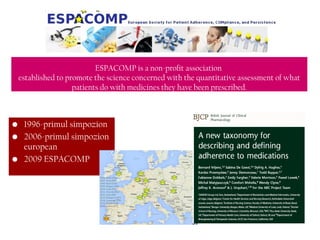
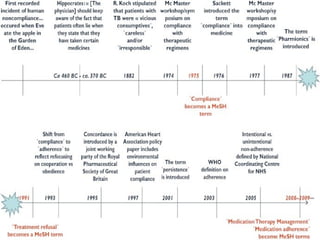
• 1996-primul simpozion
• 2006-primul simpozion
european
• 2009 ESPACOMP
ESPACOMP is a non-profit association
established to promote the science concerned with the quantitative assessment of what
patients do with medicines they have been prescribed.
Cum masuram aderenta?
• Nu este o metoda gold-standard
• Criterii directe:
- conc. medicamentului sau metabolitilor sai in
prodise biologice (sange/urina)
• Criterii indirecte:
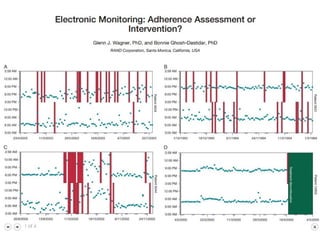
- chestionare, met. electronice, contabilizare Rp,
masurarea unor markeri biologivie (LDL-Col),
etc.
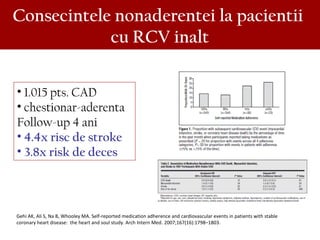
Consecintele nonaderentei la pacientii
cu RCV inalt
Gehi AK, Ali S, Na B, Whooley MA. Self-reported medication adherence and cardiovascular events in patients with stable
coronary heart disease: the heart and soul study. Arch Intern Med. 2007;167(16):1798–1803.
• 1.015 pts. CAD
• chestionar-aderenta
Follow-up 4 ani
• 4.4x risc de stroke
• 3.8x risk de deces
Cauze de Non-AderentaCauze de Non-Aderenta
• Legate de medic
• Legate de pacient
• Legate de sistem
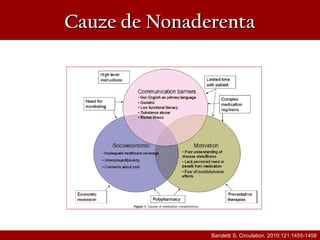
Cauze de NonaderentaCauze de Nonaderenta
Baroletti S, Circulation. 2010;121:1455-1458
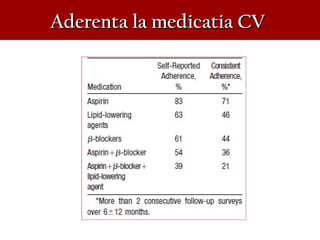
Aderenta la medicatia CVAderenta la medicatia CV
• In SUA numai 50% dintre pts. continua
tratamentul cu statine la 6 luni, si doar 30-
40% la 1 an!
• Beneficiile tratamentului cu statine este pus
sub semnul intrebarii in populatia generala.
• Riscurile intreruperii tratamentului cu statine
sunt devastatatoare, in ciuda beneficiilor certe
demonstrate in trial-urile clinice.
Aderenta la statine
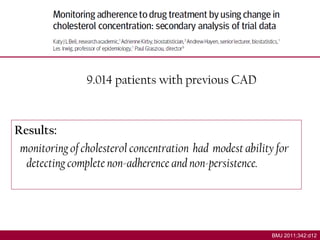
9.014 patients with previous CAD
Results:
monitoring of cholesterol concentration had modest ability for
detecting complete non-adherence and non-persistence.
BMJ 2011;342:d12
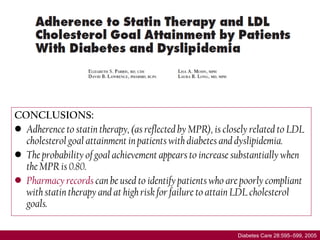
Diabetes Care 28:595–599, 2005
CONCLUSIONS:
• Adherence to statin therapy, (as reflected by MPR), is closely related to LDL
cholesterol goal attainment in patients with diabetes and dyslipidemia.
• The probability of goal achievement appears to increase substantially when
the MPR is 0.80.
• Pharmacy records can be used to identify patients who are poorly compliant
with statin therapy and at high risk for failure to attain LDL cholesterol
goals.
Motivele intreruperii tratamentuluiMotivele intreruperii tratamentului
cu statine-o dilema actuala?cu statine-o dilema actuala?
• Efectele adverse (diabet?, rabdomioliza)
• Costuri (original vs generic)
• Lipsa de incredere in produs
• Campania anti-statine in mediul on-line
• Comunicare, educatie, follow-up
• Unii pts intrerup o perioada, dupa care reiau
tratamentul!
Riscurile terapiei cu statine suntRiscurile terapiei cu statine sunt
determinate genetic!determinate genetic!
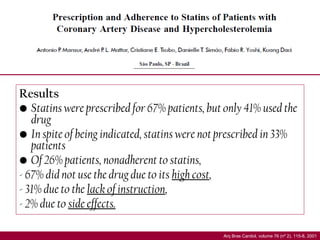
Results
• Statins were prescribed for 67% patients, but only 41% used the
drug
• In spite of being indicated, statins were not prescribed in 33%
patients
• Of 26% patients, nonadherent to statins,
- 67% did not use the drug due to its high cost,
- 31% due to the lack of instruction,
- 2% due to side effects.
Arq Bras Cardiol, volume 76 (nº 2), 115-8, 2001
Adherence With Statin Therapy in Elderly
Patients With and Without Acute Coronary
Syndromes 
Cynthia A. Jackevicius, Muhammad Mamdani, Jack V. Tu
JAMA. 2002;288(4):462-467.
Conclusions: 
Elderly patients with and without recent ACS have low rates of adherence
to statins.
This suggests that many patients initiating statin therapy may receive no
or limited benefit from statins because of premature discontinuation.
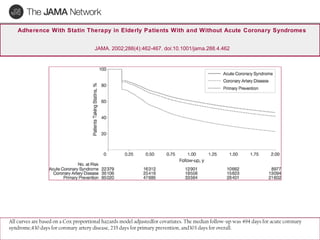
Adherence With Statin Therapy in Elderly Patients With and Without Acute Coronary Syndromes
JAMA. 2002;288(4):462-467. doi:10.1001/jama.288.4.462
All curves are based on a Cox proportional hazards model adjustedfor covariates. The median follow-up was 494 days for acute coronary
syndrome,430 days for coronary artery disease, 235 days for primary prevention, and303 days for overall.
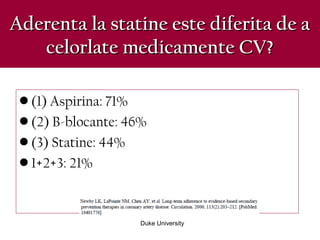
Aderenta la statine este diferita de aAderenta la statine este diferita de a
celorlate medicamente CV?celorlate medicamente CV?
• (1) Aspirina: 71%
• (2) B-blocante: 46%
• (3) Statine: 44%
• 1+2+3: 21%
Duke University
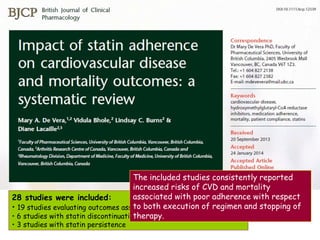
28 studies were included:
• 19 studies evaluating outcomes associated with statin adherence
• 6 studies with statin discontinuation
• 3 studies with statin persistence
The included studies consistently reported
increased risks of CVD and mortality
associated with poor adherence with respect
to both execution of regimen and stopping of
therapy.
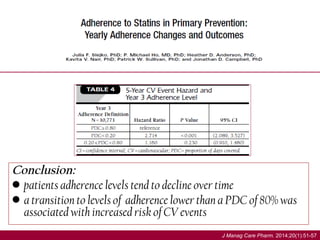
J Manag Care Pharm. 2014;20(1):51-57
Conclusion:
• patients adherence levels tend to decline over time
• a transition to levels of adherence lower than a PDC of 80% was
associated with increased risk of CV events
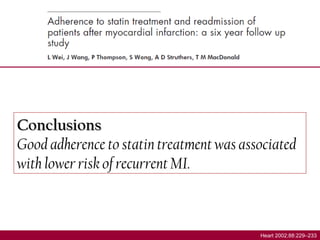
Heart 2002;88:229–233
ConclusionsConclusions
Good adherence to statin treatment was associated
with lower risk of recurrent MI.
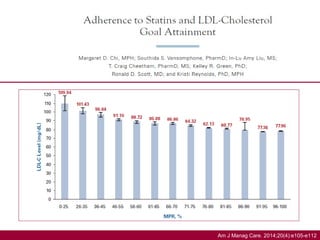
Am J Manag Care. 2014;20(4):e105-e112
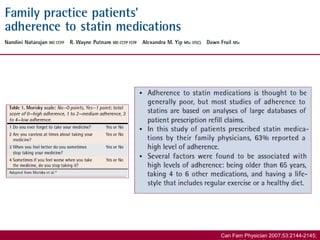
Can Fam Physician 2007;53:2144-2145;
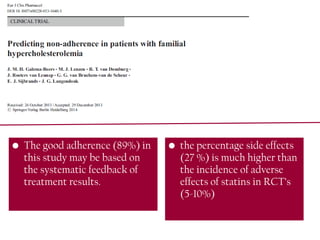
• The good adherence (89%) in
this study may be based on
the systematic feedback of
treatment results.
• the percentage side effects
(27 %) is much higher than
the incidence of adverse
effects of statins in RCT’s
(5-10%)
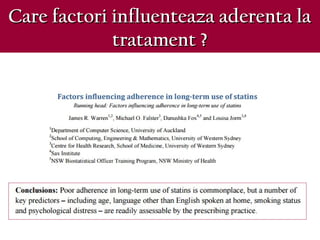
Care factori influenteaza aderenta laCare factori influenteaza aderenta la
tratament ?tratament ?
• Statin therapy for patients with cardiovascular
conditions (first-year measure)
• Statin therapy for patients with diabetes (first-year
measure).
The Healthcare Effectiveness Data andThe Healthcare Effectiveness Data and
Information Set (HEDIS)Information Set (HEDIS)
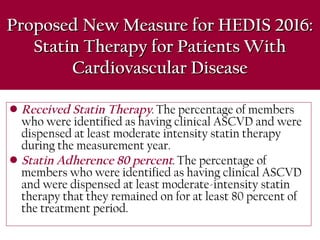
Proposed New Measure for HEDIS 2016:Proposed New Measure for HEDIS 2016:
Statin Therapy for Patients WithStatin Therapy for Patients With
Cardiovascular DiseaseCardiovascular Disease
• Received Statin Therapy. The percentage of members
who were identified as having clinical ASCVD and were
dispensed at least moderate intensity statin therapy
during the measurement year.
• Statin Adherence 80 percent. The percentage of
members who were identified as having clinical ASCVD
and were dispensed at least moderate-intensity statin
therapy that they remained on for at least 80 percent of
the treatment period.
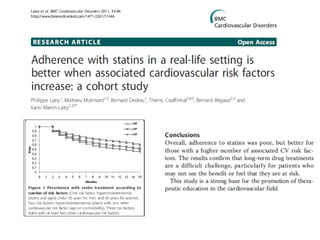
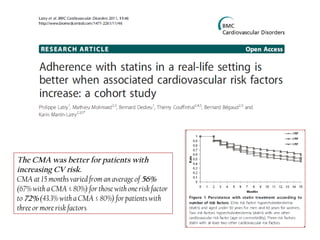
The CMA was better for patients with
increasing CV risk.
CMA at 15 months varied from an average of 56%
(67% with a CMA ≤ 80%) for those with one risk factor
to 72% (43.3% with a CMA ≤ 80%) for patients with
three or more risk factors
Aderenta in tratamentul HTAAderenta in tratamentul HTA
• Controlul TA optim-un deziderat neatins in
populatie
• Nonaderenta-cauza de falsa HTA rezistenta
Medicatia antihipertensiva
• Aderenta buna-Ca bloc, IECA
• Aderenta scazuta-Beta bloc, diuretic
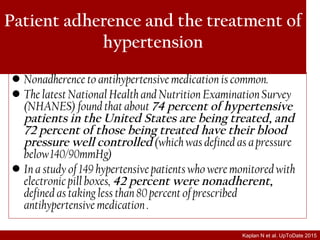
Patient adherence and the treatment of
hypertension
• Nonadherence to antihypertensive medication is common.
• The latest National Health and Nutrition Examination Survey
(NHANES) found that about 74 percent of hypertensive
patients in the United States are being treated, and
72 percent of those being treated have their blood
pressure well controlled (which was defined as a pressure
below 140/90mmHg)
• In a study of 149 hypertensive patients who were monitored with
electronic pill boxes, 42 percent were nonadherent,
defined as taking less than 80 percent of prescribed
antihypertensive medication .
Kaplan N et al. UpToDate 2015
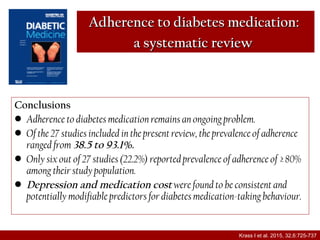
Adherence to diabetes medication:Adherence to diabetes medication:
a systematic reviewa systematic review
Conclusions
• Adherence to diabetes medication remains an ongoing problem.
• Of the 27 studies included in the present review, the prevalence of adherence
ranged from 38.5 to 93.1%.
• Only six out of 27 studies (22.2%) reported prevalence of adherence of ≥ 80%
among their study population.
• Depression and medication cost were found to be consistent and
potentially modifiable predictors for diabetes medication-taking behaviour.
Krass I et al. 2015, 32,6:725-737
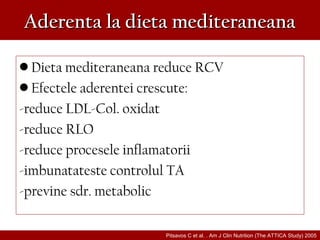
Aderenta la dieta mediteraneanaAderenta la dieta mediteraneana
• Dieta mediteraneana reduce RCV
• Efectele aderentei crescute:
-reduce LDL-Col. oxidat
-reduce RLO
-reduce procesele inflamatorii
-imbunatateste controlul TA
-previne sdr. metabolic
Pitsavos C et al. . Am J Clin Nutrition (The ATTICA Study) 2005
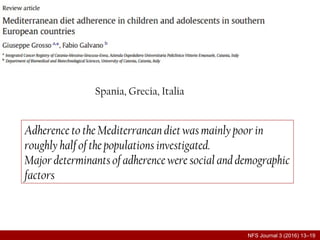
Spania, Grecia, Italia
Adherence to the Mediterranean diet was mainly poor in
roughly half of the populations investigated.
Major determinants of adherence were social and demographic
factors
NFS Journal 3 (2016) 13–19
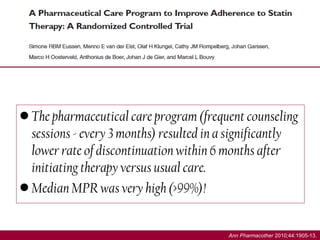
Ann Pharmacother 2010;44:1905-13.
• The pharmaceutical care program (frequent counseling
sessions - every 3 months) resulted in a significantly
lower rate of discontinuation within 6 months after
initiating therapy versus usual care.
• Median MPR was very high (>99%)!
ConcluzieConcluzie

Aderenta si riscul cardiovascul

  • 1.
    Aderenta siAderenta si controlulriscului cardiovascularcontrolul riscului cardiovascular Alexandru Andritoiu Sp. Militar Craiova
  • 2.
    Subiecte • Riscul CV •Aderenta • Nonaderenta • Complianta • Persistenta
  • 4.
    Riscul CVRiscul CV •Total (global) -absolut -relativ • Formule de calcul probabilistic intr-o populatie tinta
  • 5.
    Riscul global-CADRiscul global-CAD •Riscul global este un calcul al riscului absolut de a avea un eveniment coronarian (deces, IMA) intr-un interval de timp specificat (10 ani). • Cunoasterea RCV permite medicului sa prescrie terapii tintite in copul reducerii riscului (antihipertensive, statine, aspirina).
  • 6.
    Permite aflarea raspunsuluila intrebarilePermite aflarea raspunsului la intrebarile • Cine va beneficia de interventiile terapeutice? • Cand trebuie inceput tratamentul farmacologic si non-faramacologic? • La cine, aceste interventii sunt cost-eficiente?. • Calculul risului CV poate ajuta in luarea celei mai bune decizii de management.
  • 7.
    Calcululul Riscului Global Calcululriscului CV global este recomandat in toate ghidurile nationale ca punct de plecare in decizia terapeutica • Framingham CardioVascular Risk Score (Framingham Heart Study)-USA • Prospective Cardiovascular Munster Heart Study (PROCAM) • Systematic Coronary Risk Evaluation system (SCORE) • United Kingdom Prospective Diabetes Study (UKPDS) for diabetics, • Reynolds Risk Score • NHANES (include the obesity as a risk factor)
  • 9.
  • 12.
  • 15.
    Mædica A Journalof Clinical Medicine, Volume 2 No.4 2007 • HTA 39% • Hiper-Col 31.4% • DZ 11.8% • Fumatul 21.7% • Obezitatea 26.3%
  • 17.
    Controlul FRCVControlul FRCV •HTA-stil de viata, dieta, medicatie; • Colesterol-dieta, medicatie (statine); • Fumatul- consiliere, medicatie; • Diabet-dieta, medicatie; • Istoric familial (ereditate)-…… • Sexul Masculin-….. FR influentabili/neinflentabili
  • 18.
    Definitii, termeni siconcepteDefinitii, termeni si concepte The World Health Organization:The World Health Organization: Adherence: - the degree to which the person’s behavior corresponds with the agreed recommendations from a healthcare provider. Compliance: - the degree to which a patient correctly follows medical advice. - patient is passively following the physician’s orders, while adherence acknowledges that the patient is part of the decisionmaking process, making this the preferred term. Persistence: the duration of time over which a patient continues to fill the prescription. Non-acceptance: - some patients may never start treatment (a type of non-adherence) Concordance: - the degree of accordance of therapeutic goals of patient and therapist is defined as ‘concordance
  • 19.
    Non-AderentaNon-Aderenta OMS/WHO: • ,,poor adherenceis the primary reason for suboptimal clinical benefit in many circumstances. • ,,medication non-adherence has been associated with increased hospitalizations, loss of productivity, premature deaths, and increased treatment costs”. Non-adherence to medications is widely recognized as a major public health concern and contributes to patient morbidity, mortality and healthcare costs
  • 20.
    Ce este aderentape termen lungCe este aderenta pe termen lung (long-time adherence)?(long-time adherence)? • 12 luni dupa externare • 24 luni
  • 21.
    Non-Non-AderenAderenta pe termenlungta pe termen lung Greater prescribing/filling complexity was associated with lower levels of adherence. Some studies suggest that long-term adherence of chronically prescribed CV medications such as anti-hypertensives or statins may be as low as 50%.
  • 22.
    • 1996-primul simpozion •2006-primul simpozion european • 2009 ESPACOMP ESPACOMP is a non-profit association established to promote the science concerned with the quantitative assessment of what patients do with medicines they have been prescribed.
  • 25.
    Cum masuram aderenta? •Nu este o metoda gold-standard • Criterii directe: - conc. medicamentului sau metabolitilor sai in prodise biologice (sange/urina) • Criterii indirecte: - chestionare, met. electronice, contabilizare Rp, masurarea unor markeri biologivie (LDL-Col), etc.
  • 28.
    Consecintele nonaderentei lapacientii cu RCV inalt Gehi AK, Ali S, Na B, Whooley MA. Self-reported medication adherence and cardiovascular events in patients with stable coronary heart disease: the heart and soul study. Arch Intern Med. 2007;167(16):1798–1803. • 1.015 pts. CAD • chestionar-aderenta Follow-up 4 ani • 4.4x risc de stroke • 3.8x risk de deces
  • 29.
    Cauze de Non-AderentaCauzede Non-Aderenta • Legate de medic • Legate de pacient • Legate de sistem
  • 30.
    Cauze de NonaderentaCauzede Nonaderenta Baroletti S, Circulation. 2010;121:1455-1458
  • 31.
    Aderenta la medicatiaCVAderenta la medicatia CV
  • 32.
    • In SUAnumai 50% dintre pts. continua tratamentul cu statine la 6 luni, si doar 30- 40% la 1 an! • Beneficiile tratamentului cu statine este pus sub semnul intrebarii in populatia generala. • Riscurile intreruperii tratamentului cu statine sunt devastatatoare, in ciuda beneficiilor certe demonstrate in trial-urile clinice. Aderenta la statine
  • 33.
    9.014 patients withprevious CAD Results: monitoring of cholesterol concentration had modest ability for detecting complete non-adherence and non-persistence. BMJ 2011;342:d12
  • 34.
    Diabetes Care 28:595–599,2005 CONCLUSIONS: • Adherence to statin therapy, (as reflected by MPR), is closely related to LDL cholesterol goal attainment in patients with diabetes and dyslipidemia. • The probability of goal achievement appears to increase substantially when the MPR is 0.80. • Pharmacy records can be used to identify patients who are poorly compliant with statin therapy and at high risk for failure to attain LDL cholesterol goals.
  • 35.
    Motivele intreruperii tratamentuluiMotiveleintreruperii tratamentului cu statine-o dilema actuala?cu statine-o dilema actuala? • Efectele adverse (diabet?, rabdomioliza) • Costuri (original vs generic) • Lipsa de incredere in produs • Campania anti-statine in mediul on-line • Comunicare, educatie, follow-up • Unii pts intrerup o perioada, dupa care reiau tratamentul!
  • 36.
    Riscurile terapiei custatine suntRiscurile terapiei cu statine sunt determinate genetic!determinate genetic!
  • 37.
    Results • Statins wereprescribed for 67% patients, but only 41% used the drug • In spite of being indicated, statins were not prescribed in 33% patients • Of 26% patients, nonadherent to statins, - 67% did not use the drug due to its high cost, - 31% due to the lack of instruction, - 2% due to side effects. Arq Bras Cardiol, volume 76 (nº 2), 115-8, 2001
  • 38.
    Adherence With StatinTherapy in Elderly Patients With and Without Acute Coronary Syndromes  Cynthia A. Jackevicius, Muhammad Mamdani, Jack V. Tu JAMA. 2002;288(4):462-467. Conclusions:  Elderly patients with and without recent ACS have low rates of adherence to statins. This suggests that many patients initiating statin therapy may receive no or limited benefit from statins because of premature discontinuation.
  • 39.
    Adherence With StatinTherapy in Elderly Patients With and Without Acute Coronary Syndromes JAMA. 2002;288(4):462-467. doi:10.1001/jama.288.4.462 All curves are based on a Cox proportional hazards model adjustedfor covariates. The median follow-up was 494 days for acute coronary syndrome,430 days for coronary artery disease, 235 days for primary prevention, and303 days for overall.
  • 41.
    Aderenta la statineeste diferita de aAderenta la statine este diferita de a celorlate medicamente CV?celorlate medicamente CV? • (1) Aspirina: 71% • (2) B-blocante: 46% • (3) Statine: 44% • 1+2+3: 21% Duke University
  • 42.
    28 studies wereincluded: • 19 studies evaluating outcomes associated with statin adherence • 6 studies with statin discontinuation • 3 studies with statin persistence The included studies consistently reported increased risks of CVD and mortality associated with poor adherence with respect to both execution of regimen and stopping of therapy.
  • 43.
    J Manag CarePharm. 2014;20(1):51-57 Conclusion: • patients adherence levels tend to decline over time • a transition to levels of adherence lower than a PDC of 80% was associated with increased risk of CV events
  • 44.
    Heart 2002;88:229–233 ConclusionsConclusions Good adherenceto statin treatment was associated with lower risk of recurrent MI.
  • 45.
    Am J ManagCare. 2014;20(4):e105-e112
  • 46.
    Can Fam Physician2007;53:2144-2145;
  • 47.
    • The goodadherence (89%) in this study may be based on the systematic feedback of treatment results. • the percentage side effects (27 %) is much higher than the incidence of adverse effects of statins in RCT’s (5-10%)
  • 48.
    Care factori influenteazaaderenta laCare factori influenteaza aderenta la tratament ?tratament ?
  • 49.
    • Statin therapyfor patients with cardiovascular conditions (first-year measure) • Statin therapy for patients with diabetes (first-year measure). The Healthcare Effectiveness Data andThe Healthcare Effectiveness Data and Information Set (HEDIS)Information Set (HEDIS)
  • 50.
    Proposed New Measurefor HEDIS 2016:Proposed New Measure for HEDIS 2016: Statin Therapy for Patients WithStatin Therapy for Patients With Cardiovascular DiseaseCardiovascular Disease • Received Statin Therapy. The percentage of members who were identified as having clinical ASCVD and were dispensed at least moderate intensity statin therapy during the measurement year. • Statin Adherence 80 percent. The percentage of members who were identified as having clinical ASCVD and were dispensed at least moderate-intensity statin therapy that they remained on for at least 80 percent of the treatment period.
  • 52.
    The CMA wasbetter for patients with increasing CV risk. CMA at 15 months varied from an average of 56% (67% with a CMA ≤ 80%) for those with one risk factor to 72% (43.3% with a CMA ≤ 80%) for patients with three or more risk factors
  • 53.
    Aderenta in tratamentulHTAAderenta in tratamentul HTA • Controlul TA optim-un deziderat neatins in populatie • Nonaderenta-cauza de falsa HTA rezistenta Medicatia antihipertensiva • Aderenta buna-Ca bloc, IECA • Aderenta scazuta-Beta bloc, diuretic
  • 54.
    Patient adherence andthe treatment of hypertension • Nonadherence to antihypertensive medication is common. • The latest National Health and Nutrition Examination Survey (NHANES) found that about 74 percent of hypertensive patients in the United States are being treated, and 72 percent of those being treated have their blood pressure well controlled (which was defined as a pressure below 140/90mmHg) • In a study of 149 hypertensive patients who were monitored with electronic pill boxes, 42 percent were nonadherent, defined as taking less than 80 percent of prescribed antihypertensive medication . Kaplan N et al. UpToDate 2015
  • 56.
    Adherence to diabetesmedication:Adherence to diabetes medication: a systematic reviewa systematic review Conclusions • Adherence to diabetes medication remains an ongoing problem. • Of the 27 studies included in the present review, the prevalence of adherence ranged from 38.5 to 93.1%. • Only six out of 27 studies (22.2%) reported prevalence of adherence of ≥ 80% among their study population. • Depression and medication cost were found to be consistent and potentially modifiable predictors for diabetes medication-taking behaviour. Krass I et al. 2015, 32,6:725-737
  • 57.
    Aderenta la dietamediteraneanaAderenta la dieta mediteraneana • Dieta mediteraneana reduce RCV • Efectele aderentei crescute: -reduce LDL-Col. oxidat -reduce RLO -reduce procesele inflamatorii -imbunatateste controlul TA -previne sdr. metabolic Pitsavos C et al. . Am J Clin Nutrition (The ATTICA Study) 2005
  • 58.
    Spania, Grecia, Italia Adherenceto the Mediterranean diet was mainly poor in roughly half of the populations investigated. Major determinants of adherence were social and demographic factors NFS Journal 3 (2016) 13–19
  • 60.
    Ann Pharmacother 2010;44:1905-13. •The pharmaceutical care program (frequent counseling sessions - every 3 months) resulted in a significantly lower rate of discontinuation within 6 months after initiating therapy versus usual care. • Median MPR was very high (>99%)!
  • 61.

Editor's Notes

  • #22 Some studies suggest that long-term adherence of chronically prescribed CV medications such as anti-hypertensives or statins may be as low as 50%. All we know about the value of these chronic medications in reducing untoward outcomes are usually based on rigorous RCT that involve frequent visits, free medications, and pill counts to verify adherence. The actual benefit of CV medications when they are taken only intermittently or for a short period of time and then stopped is not known for sure, but is thought to be worse based on observational studies in routine practice.
  • #29 As would be hypothesized, not taking one’s chronic medications has important clinical consequences. In this observational study in a high-risk cohort of patients with established but stable coronary artery disease, a single question was asked to examine the extent to which they were taking their medications as prescribed (adherence). Patients were followed for an average follow-up period of four years. Those taking their medications as prescribed only 75% of the time, or less, had a more than four times the increased risk of stroke and almost a four-fold increased risk of death.