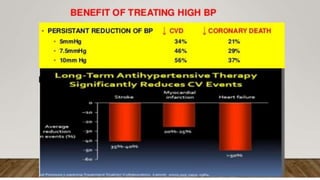
Hypertension
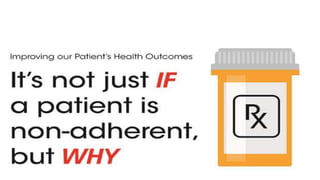
“Non-Adherence to medication”
Dr. Ameel Toma
Cardiologist
College of Medicine
University of Duhok 17/3/2021
Hypertension:
• By 2010, the worldwide prevalence of hypertension was
estimated at 31.1%, affecting 1.39 billion people.
• Rapidly rising prevalence in low and middle–income countries.
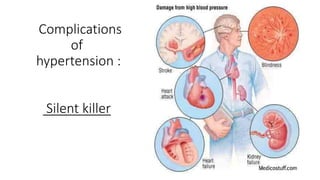
Complications
of
hypertension :
Silent killer
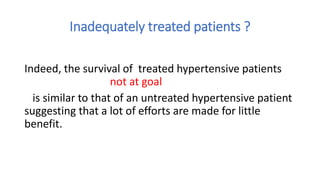
Inadequately treated patients ?
Indeed, the survival of treated hypertensive patients
not at goal
is similar to that of an untreated hypertensive patient
suggesting that a lot of efforts are made for little
benefit.
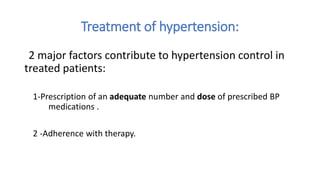
Treatment of hypertension:
2 major factors contribute to hypertension control in
treated patients:
1-Prescription of an adequate number and dose of prescribed BP
medications .
2 -Adherence with therapy.
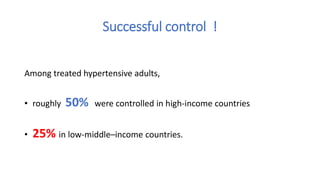
Successful control !
Among treated hypertensive adults,
• roughly 50% were controlled in high-income countries
• 25% in low-middle–income countries.
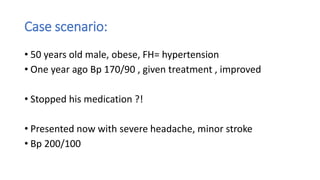
Case scenario:
• 50 years old male, obese, FH= hypertension
• One year ago Bp 170/90 , given treatment , improved
• Stopped his medication ?!
• Presented now with severe headache, minor stroke
• Bp 200/100
Not taking medication ?
ADHERENCE
‘The extent to which a person's behavior
[in] taking medication following a diet, and
executing lifestyle changes, corresponds
with agreed recommendations from a
health care provider’
- World Health Organization -2003
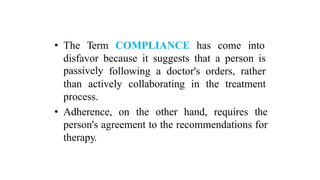
• The Term COMPLIANCE has come into
disfavor
passively
because it suggests that a person is
following a doctor's orders, rather
than actively collaborating in the treatment
process.
• Adherence, on the other hand, requires the
person's agreement to the recommendations for
therapy.
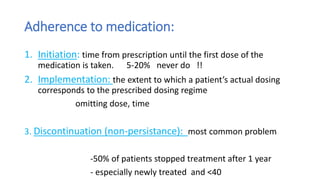
Adherence to medication:
1. Initiation: time from prescription until the first dose of the
medication is taken. 5-20% never do !!
2. Implementation: the extent to which a patient’s actual dosing
corresponds to the prescribed dosing regime
omitting dose, time
3. Discontinuation (non-persistance): most common problem
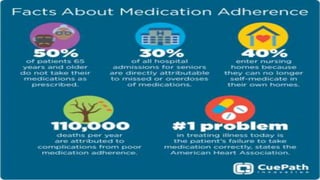
-50% of patients stopped treatment after 1 year
- especially newly treated and <40
Is this a major problem?
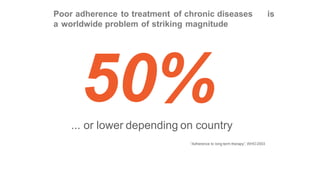
Poor adherence to treatment of chronic diseases is
a worldwide problem of striking magnitude
50%
... or lower depending on country
“Adherence to long term therapy”, WHO2003
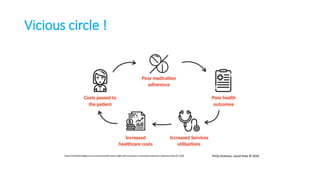
Vicious circle !
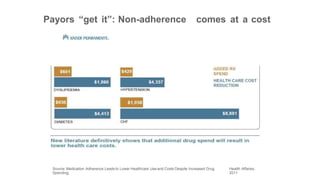
Payors “get it”: Non-adherence comes at a cost
Source: Medication Adherence Leads to Lower Healthcare Use and Costs Despite Increased Drug
Spending,
Health Affaires,
2011
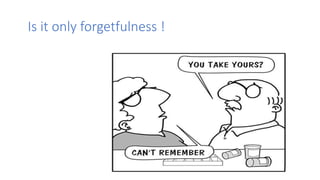
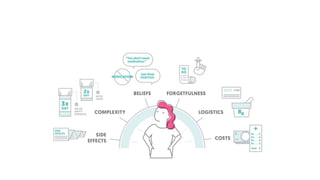
Is it only forgetfulness !
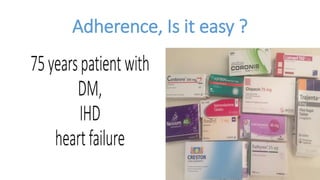
Adherence, Is it easy ?
Perceptions of hypertension treatment(study)
• It is difficult to accept that hypertension is a chronic condition and see it as
a physiological reaction to stress
• It is a temporary illness.
• Denial : deny the HT, deny need for treatment
“If there is high blood pressure, I do not want to know... thinking of that
makes me anxious... I am healthy because I feel healthy”
• Self-adjustment: modify their doctor instructions, can treat their self,
can stop treatment,
• Side effect:
“The doctor found that I have blood pressure.
The pill caused heartburn so I stopped taking it.”
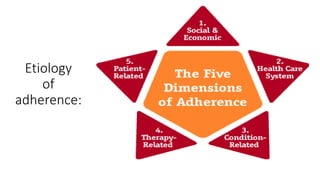
Etiology
of
adherence:
1. SOCIAL AND ECONOMIC DIMENSION
1-Cultural and lay beliefs about illness and treatment
2-Cost (health insurance !)
3-Low health literacy (TV, newspaper)
4-Lack of family or social support
5-Unstable living conditions;
6-Certain work schedule.
7-Limited language proficiency
2. HEALTH CARE SYSTEM :
1-Doctor-patient relationship
2-Doctor communication skills
3- Long wait times .
4- Volume dependent care and not patient centered care.
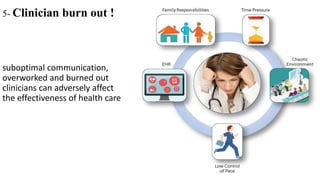
5- Clinician burn out !
suboptimal communication,
overworked and burned out
clinicians can adversely affect
the effectiveness of health care
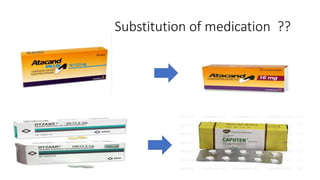
Substitution of medication ??
3. CONDITION-RELATED DIMENSION
1.
2.
3.
Chronic conditions
Lack of symptoms
Severity of symptoms
4. THERAPY-RELATED DIMENSION
1. Complex protocol
2. Time to benefit
3. Treatment changes
4. Treatment failure
5. Treatment duration
6. Side effects
5. PATIENT-RELATED FACTORS:
the most important factor
1. Denial of the diagnosis.
2. Do not perceive the impact of asymptomatic disease on their
health.
3. Lack of Knowledge about hypertension and its complications.
4. Use of alternate medicine.
5. Suboptimal treatment and development of side effects.
6. Future discounting
Future discounting:
Individuals who discount the future at higher rates appear less likely
to engage in preventive health behaviors including taking medications
for chronic conditions.
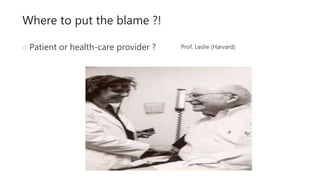
Where to put the blame ?!
Patient or health-care provider ? Prof. Leslie (Harvard)
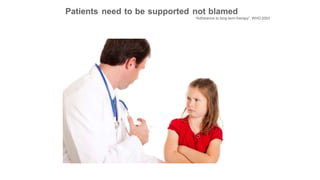
Patients need to be supported not blamed
“Adherence to long term therapy”, WHO2003
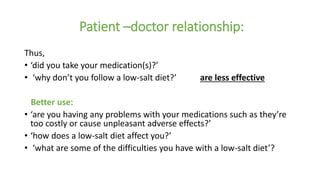
Patient –doctor relationship:
Thus,
• ‘did you take your medication(s)?’
• ‘why don’t you follow a low-salt diet?’ are less effective
Better use:
• ‘are you having any problems with your medications such as they’re
too costly or cause unpleasant adverse effects?’
• ‘how does a low-salt diet affect you?’
• ‘what are some of the difficulties you have with a low-salt diet’?
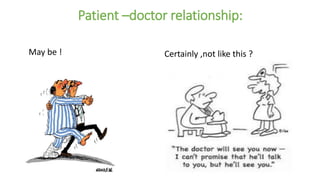
Patient –doctor relationship:
May be ! Certainly ,not like this ?
Patient –doctor relationship
Trust is the critical currency in most human interactions and this
applies especially to healthcare.
The patient must have confidence that their clinician is competent and
has their best interests specially in management decisions.
Possible solution:
• Patient education ( disease, complications)
• Improving Doctor –patient relationship(patient centered therapy)
• Improving communication skills
• Drug dosage: simple as possible, single pill combination
avoid initial high doses(assoc. with SE).
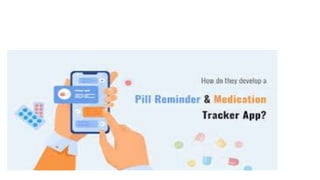
• Using mobile app. Reminder
• Using pill box
In our community:
• Doctor-patient-family relationship (rely on it)
• Pharmacist ?
• Health system and authorities?
Take home message:
• Hypertension is a global problem with major complication.
• Poor adherence to medication is a major contributor for poor control
of hypertension.
• Silent disease– poor adherence--- silent killer.
• Try to identify the cause for poor adherence.
• The key solutions are related to educating patients, family and
improving doctor-patient relationship.
• Treat the patient ,not only the disease.
Thank
you

Hypertension, Non adherence to therapy

  • 1.
    Hypertension “Non-Adherence to medication” Dr.Ameel Toma Cardiologist College of Medicine University of Duhok 17/3/2021
  • 2.
    Hypertension: • By 2010,the worldwide prevalence of hypertension was estimated at 31.1%, affecting 1.39 billion people. • Rapidly rising prevalence in low and middle–income countries.
  • 3.
  • 6.
    Inadequately treated patients? Indeed, the survival of treated hypertensive patients not at goal is similar to that of an untreated hypertensive patient suggesting that a lot of efforts are made for little benefit.
  • 7.
    Treatment of hypertension: 2major factors contribute to hypertension control in treated patients: 1-Prescription of an adequate number and dose of prescribed BP medications . 2 -Adherence with therapy.
  • 8.
    Successful control ! Amongtreated hypertensive adults, • roughly 50% were controlled in high-income countries • 25% in low-middle–income countries.
  • 9.
    Case scenario: • 50years old male, obese, FH= hypertension • One year ago Bp 170/90 , given treatment , improved • Stopped his medication ?! • Presented now with severe headache, minor stroke • Bp 200/100
  • 10.
  • 11.
    ADHERENCE ‘The extent towhich a person's behavior [in] taking medication following a diet, and executing lifestyle changes, corresponds with agreed recommendations from a health care provider’ - World Health Organization -2003
  • 12.
    • The TermCOMPLIANCE has come into disfavor passively because it suggests that a person is following a doctor's orders, rather than actively collaborating in the treatment process. • Adherence, on the other hand, requires the person's agreement to the recommendations for therapy.
  • 13.
    Adherence to medication: 1.Initiation: time from prescription until the first dose of the medication is taken. 5-20% never do !! 2. Implementation: the extent to which a patient’s actual dosing corresponds to the prescribed dosing regime omitting dose, time 3. Discontinuation (non-persistance): most common problem -50% of patients stopped treatment after 1 year - especially newly treated and <40
  • 14.
    Is this amajor problem?
  • 15.
    Poor adherence totreatment of chronic diseases is a worldwide problem of striking magnitude 50% ... or lower depending on country “Adherence to long term therapy”, WHO2003
  • 17.
  • 18.
    Payors “get it”:Non-adherence comes at a cost Source: Medication Adherence Leads to Lower Healthcare Use and Costs Despite Increased Drug Spending, Health Affaires, 2011
  • 20.
    Is it onlyforgetfulness !
  • 21.
  • 22.
    Perceptions of hypertensiontreatment(study) • It is difficult to accept that hypertension is a chronic condition and see it as a physiological reaction to stress • It is a temporary illness. • Denial : deny the HT, deny need for treatment “If there is high blood pressure, I do not want to know... thinking of that makes me anxious... I am healthy because I feel healthy”
  • 23.
    • Self-adjustment: modifytheir doctor instructions, can treat their self, can stop treatment, • Side effect: “The doctor found that I have blood pressure. The pill caused heartburn so I stopped taking it.”
  • 25.
  • 26.
    1. SOCIAL ANDECONOMIC DIMENSION 1-Cultural and lay beliefs about illness and treatment 2-Cost (health insurance !) 3-Low health literacy (TV, newspaper) 4-Lack of family or social support 5-Unstable living conditions; 6-Certain work schedule. 7-Limited language proficiency
  • 27.
    2. HEALTH CARESYSTEM : 1-Doctor-patient relationship 2-Doctor communication skills 3- Long wait times . 4- Volume dependent care and not patient centered care.
  • 28.
    5- Clinician burnout ! suboptimal communication, overworked and burned out clinicians can adversely affect the effectiveness of health care
  • 29.
  • 30.
    3. CONDITION-RELATED DIMENSION 1. 2. 3. Chronicconditions Lack of symptoms Severity of symptoms
  • 31.
    4. THERAPY-RELATED DIMENSION 1.Complex protocol 2. Time to benefit 3. Treatment changes 4. Treatment failure 5. Treatment duration 6. Side effects
  • 32.
    5. PATIENT-RELATED FACTORS: themost important factor 1. Denial of the diagnosis. 2. Do not perceive the impact of asymptomatic disease on their health. 3. Lack of Knowledge about hypertension and its complications. 4. Use of alternate medicine. 5. Suboptimal treatment and development of side effects. 6. Future discounting
  • 33.
    Future discounting: Individuals whodiscount the future at higher rates appear less likely to engage in preventive health behaviors including taking medications for chronic conditions.
  • 34.
    Where to putthe blame ?! Patient or health-care provider ? Prof. Leslie (Harvard)
  • 35.
    Patients need tobe supported not blamed “Adherence to long term therapy”, WHO2003
  • 36.
    Patient –doctor relationship: Thus, •‘did you take your medication(s)?’ • ‘why don’t you follow a low-salt diet?’ are less effective Better use: • ‘are you having any problems with your medications such as they’re too costly or cause unpleasant adverse effects?’ • ‘how does a low-salt diet affect you?’ • ‘what are some of the difficulties you have with a low-salt diet’?
  • 37.
    Patient –doctor relationship: Maybe ! Certainly ,not like this ?
  • 38.
    Patient –doctor relationship Trustis the critical currency in most human interactions and this applies especially to healthcare. The patient must have confidence that their clinician is competent and has their best interests specially in management decisions.
  • 40.
    Possible solution: • Patienteducation ( disease, complications) • Improving Doctor –patient relationship(patient centered therapy) • Improving communication skills • Drug dosage: simple as possible, single pill combination avoid initial high doses(assoc. with SE). • Using mobile app. Reminder • Using pill box
  • 43.
    In our community: •Doctor-patient-family relationship (rely on it) • Pharmacist ? • Health system and authorities?
  • 44.
    Take home message: •Hypertension is a global problem with major complication. • Poor adherence to medication is a major contributor for poor control of hypertension. • Silent disease– poor adherence--- silent killer. • Try to identify the cause for poor adherence. • The key solutions are related to educating patients, family and improving doctor-patient relationship. • Treat the patient ,not only the disease.
  • 45.