Click to edit Master title style
Cardiac Dysfunction in Older
Adults Living with Cancer:
Special Considerations
Camilla Wong, MD FRCPC MHSc
Canadian Cardiac Oncology Network Meeting 2019
Click to edit Master title styleDisclosures
• I have no relationships with commercial interests.
• I have received grant funding from the Ministry of Health and Long Term
Care of Ontario for research related to geriatric screening in oncology.
Click to edit Master title style
1 2 3
Objectives
To apply a framework for
multimorbidity to older adults
with cardiac dysfunction
living with cancer.
To review the
cardiovascular
physiology of aging.
To discuss special
considerations in cardio-
oncology in older adults.
Can J Cardiol. 2016; 32(9): 1056–1064.
The percentage of Canadians over age 75 is increasing.
Cancer incidence rises with age.
Statistics Canada
Statistics Canada
Heart disease incidence also rises with age.
J Clin Oncol. 2003;21(8):1618-23.
Older adults are underrepresented in oncology trials.
Older patients accounted for 22% of trial enrollees, compared with 58% of the Canadian population with cancer.
Older Canadians are living with major chronic diseases.
Canadian Community Health Survey, 2014
Chronic diseases: cancer,
cardiovascular disease, chronic
respiratory disease, diabetes.
Public Health Reviews. 2010;32:451-74.
COMORBIDITY MULTIMORBIDITY
Public Health Reviews 2011;32(2):451-474.
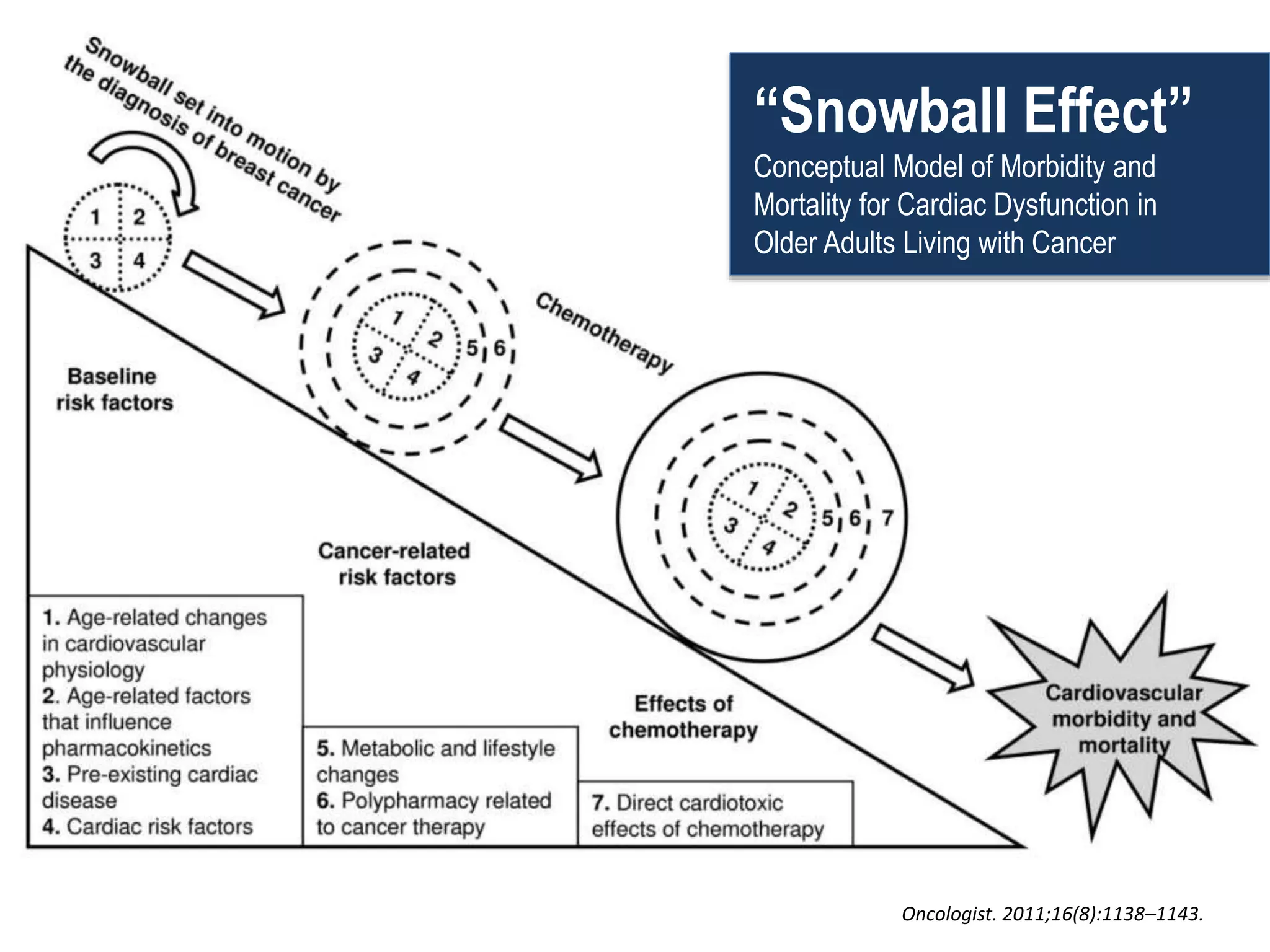
Oncologist. 2011;16(8):1138–1143.
“Snowball Effect”
Conceptual Model of Morbidity and
Mortality for Cardiac Dysfunction in
Older Adults Living with Cancer
disease
dominance
psychosocial
complexity
pharmacokinetics
geriatric syndromes
and frailty
common risk factors
obesity, smoking,
sedentary
older age
breast cancer cardiovascular disease
trastuzumab
anthracycline
q3month
cardiac
monitoring
type 1
cardiomyopathy
type 2
cardiomyopathy
cardiac toxicity
LV dysfunction
caregiver for spouse
with dementia
mild cognitive
impairment
delayed/missed
monitoring
heart failure
functional
decline
falls
delirium
albumin
eGFR
symptomatic
aortic stenosis beta-blocker
ACE inhibitor
statin
The Big Picture
polypharmacy
polypharmacy
Concordant Conditions
S i m i l a r p a t h o p h y s i o l o g i c p r o f i l e a n d d i s e a s e m a n a g e m e n t p l a n s .
Discordant Conditions
N o t d i r e c t l y r e l a t e d i n e i t h e r p a t h o g e n e s i s o r m a n a g e m e n t .
Dominant Condition
Identify and treat clinically dominant
conditions that eclipse other less important
conditions, which may be better left alone.
The heart and vessels undergo major changes with age,
even without superimposed diseases.
Intensive Care Med 2018;44: 93-4..
Lancet. 2013;381(9868):752-62.
A comprehensive geriatric assessment (CGA) is a
multidimensional, interdisciplinary diagnostic
process to determine the medical, psychological,
and functional capabilities of a frail elderly person in
order to develop a coordinated and integrated plan
for treatment and long-term follow-up.
J Clin Oncol. 2018;36(22):2326-2347.
“In patients age 65 and older receiving chemotherapy, geriatric assessment
should be used to identify vulnerabilities or geriatric impairments that are
not routinely captured in oncology assessments (Evidence quality: high;
Strength of recommendation: strong).” –ASCO Guideline
F R A M E W O R K F O R M U L T I M O R B I D I T Y
J Am Geriatr Soc. 2012;60(10):E1-25.
F R A M E W O R K F O R M U L T I M O R B I D I T Y
J Am Geriatr Soc. 2012;60(10):E1-25.
WHAT
MATTERS
TO YOU?
Moving from
“What is the
matter?”
JAMA. 2014;311(20):2110-2120.
F R A M E W O R K F O R M U L T I M O R B I D I T Y
J Am Geriatr Soc. 2012;60(10):E1-25.
anthracyclines
fluorouracil
bortezomib
cyclophosphamide
docetaxel
paclitaxel
cisplatin
trastuzumab
bevacizumab
lapatinib
imatinib
dasatinib
nilotinib
sunitinib
erlotinib
sorafenib
thalidomide
lenalidomide
Many known cardiotoxicities
ibrutinib
J Clin Oncol. 2014;32(24):2654-61.
anthracyclines
fluorouracil
bortezomib
cyclophosphamide
docetaxel
paclitaxel
cisplatin
trastuzumab
bevacizumab
lapatinib
imatinib
dasatinib
nilotinib
sunitinib
erlotinib
sorafenib
thalidomide
lenalidomide
Many known cardiotoxicities but only a few with data on
age-related cardiotoxicity.
ibrutinib
J Clin Oncol. 2014;32(24):2654-61.
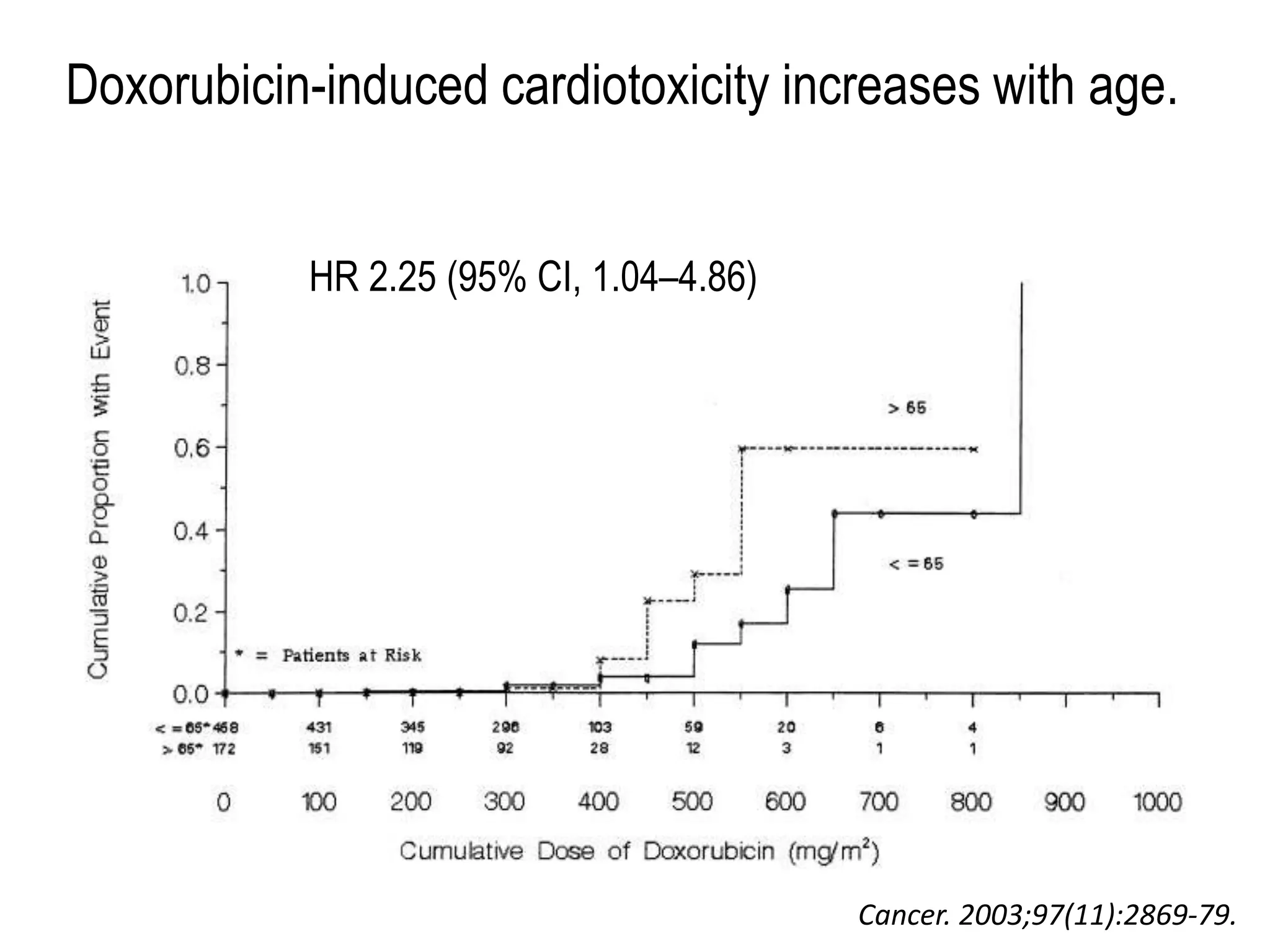
Doxorubicin-induced cardiotoxicity increases with age.
Cancer. 2003;97(11):2869-79.
HR 2.25 (95% CI, 1.04–4.86)
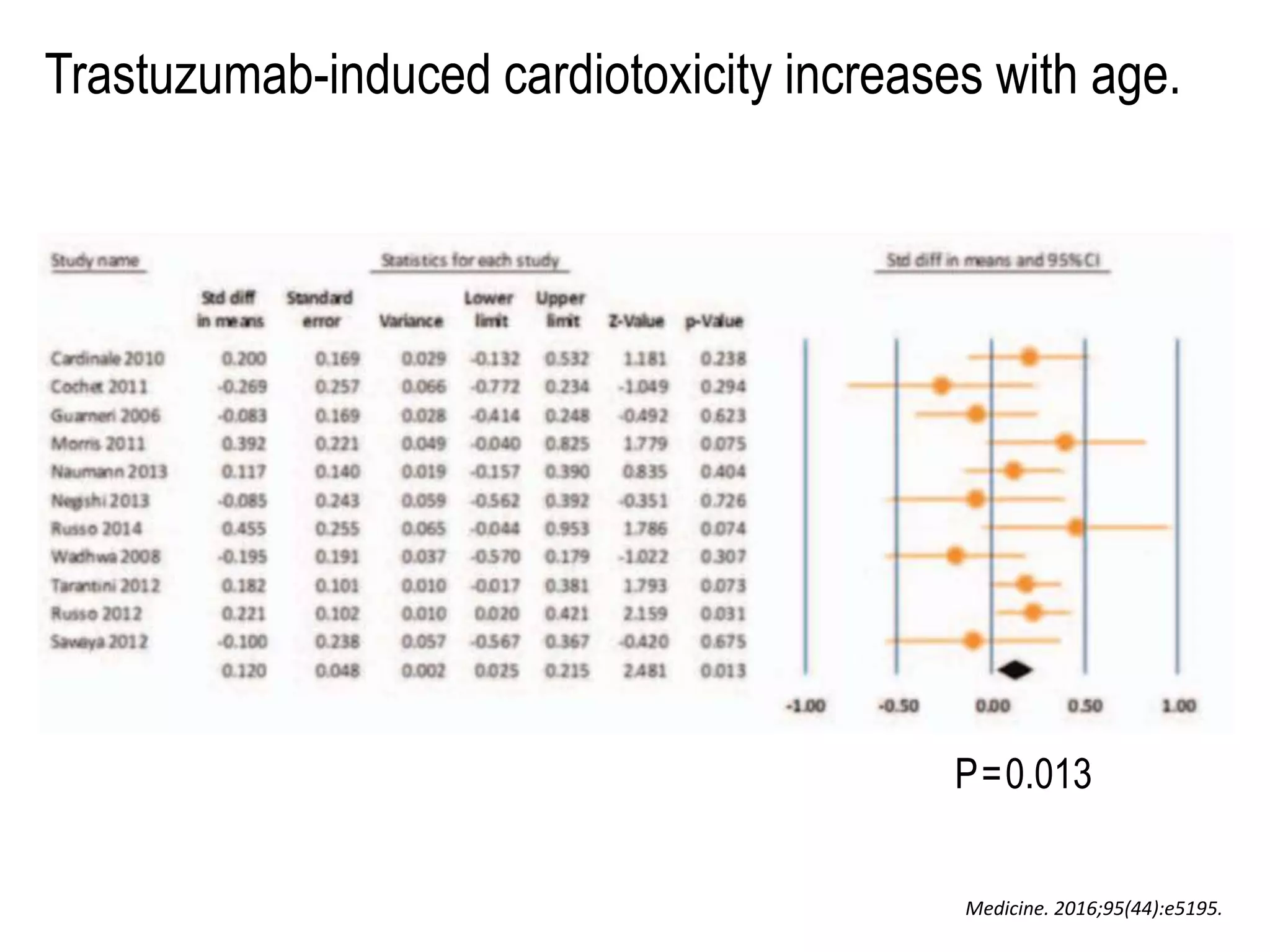
Trastuzumab-induced cardiotoxicity increases with age.
Medicine. 2016;95(44):e5195.
P=0.013
Leuk Lymphoma. 2017;58(7):1630-1639.
Older adults are at higher risk for developing atrial
fibrillation with ibrutinib (p < .0001).
Age Adjusted Hazard Ratio (95% CI)
65-74 2.4 (1.6-3.6)
75+ 3.6 (2.3-5.6)
Adjusted HR 2.17
(95% CI, 1.17-4.01)
In metastatic cancer, the incidence of arterial
thromboembolic events with bevacizumab is associated
with older age. J Natl Cancer Inst. 2007;99(16):1232-9.
In older adults with stage I-III colorectal cancer, there is
significant interaction between hypertension and
chemotherapy for CVD (P=.001), and between diabetes
and chemotherapy for CHF. (P=.001)
J Clin Oncol. 2018;36(6):609-616.
CHF: diabetes x chemotherapy CVD: hypertension x chemotherapy
F R A M E W O R K F O R M U L T I M O R B I D I T Y
J Am Geriatr Soc. 2012;60(10):E1-25.
T I M E T O B E N E F I T ( T T B )
T h e t i m e u n t i l a s t a t i s t i c a l l y s i g n i f i c a n t b e n e f i t i s o b s e r v e d i n
t r i a l s o f p e o p l e t a k i n g a t h e ra p y c o m p a re d t o a c o n t ro l g ro u p
n o t t a k i n g t h e t h e ra p y.
JAMA. 2012;307(2):182-192
PREDICTING TOXICITY
Cancer and Aging Research Group (CARG) Chemo-Toxicity Calculator
Chemotherapy Risk Assessment Scale for High-Age Patients (CRASH) score
J Clin Oncol. 2011;29(25):3457–3465.
Classic oncology tools like the Karnofsky performance
status poorly predict chemotoxicity in older adults.
Karnofsky performance status
%chemotoxicity
CARG Chemo-Tox Calculator
mycarg.org
J Clin Oncol. 2011; 29(25): 3457–3465.
geriatric
variables
J Clin Oncol. 2011; 29(25): 3457–3465.
CARG Chemo-Tox Calculator
Geriatric variables increase the predictive precision
F R A M E W O R K F O R M U L T I M O R B I D I T Y
J Am Geriatr Soc. 2012;60(10):E1-25.
Polypharmacy
• Altered hemodynamics.
• Drug-drug interactions.
• Adverse drug events.
• Withdrawal.
• Cost.
• Adherence.
SIOG guideline recommends cardiac monitoring every
2-3 cycles of anthracyline.
Ann Oncol. 2011;22(2):257-67.
The care plan should ensure minimal treatment burden to achieve the
patient’s health outcome goals.
F R A M E W O R K F O R M U L T I M O R B I D I T Y
J Am Geriatr Soc. 2012;60(10):E1-25.
OPTIMIZATION
Strategies to minimize cardiac complications of cancer treatment in
older adults
lifestyle
changes
personalize
surveillance
address
polypharmacy
risk
stratification
cardioprotective
therapy
other formulations,
schedules, doses
O n e - s t o p s h o p .
CROSS SPECIALTY COLLABORATION
increase functional capacity in anticipation of an upcoming stress
P R E H A B I L I TAT I O N
Tri-modal optimization program.
Am J Phys Med Rehabil. 2013;92(8):715-27.
J Geriatr Oncol. 2012 ; 3(2): 90–97.
• Proportion of older patients in clinical
trials should reflect the population.
• Trials should report frailty and patient-
oriented outcomes.
• Trials should include older patients with
both cancer and cardiovascular disease.
Click to edit Master title style
Thank You.
Email: camilla.wong@utoronto.ca
Twitter: @camilla_wong

Geriatric Cardio-Oncology

Editor's Notes

  • #3 Older adults, in general, for this presentation will mean 65+
  • #4 Older adults, in general, for this presentation will mean 65+
  • #5 This is important, because incidence of cancer rises with increasing age, but so does the prevalence of cardiovascular disease.
  • #8 When it comes to geriatric oncology, available evidence continues to demonstrate age‐related disparities in screening, diagnosis, treatment, and outcomes Older patients accounted for 22% of trial enrollees, compared with 58% of the Canadian population with cancer. J Clin Oncol. 2003;21(8):1618-23. Enrollment of older patients in cancer treatment trials in Canada: why is age a barrier?
  • #9 (cancer, cardiovascular disease, chronic respiratory disease, diabetes).
  • #10 Comorbidity is defined as the co-occurrence of diseases that can alter the treatment or clinical course of the index disease. Comorbidity does not necesarily imply fraility, although frailty is more frequent in patients with high comorbidity, and therefore its cause should always be assessed. Disability is an impairment that limits a person's ability to carry out daily activities. Frailty can be understood as a predisability state (physical frailty) or as an accumulation of deficits that define a vulnerable status (multidimensional frailty). Conceptual Diagram of Comorbidity: Index Disease, With One or More Comorbid Condition or Diseases Affecting Its Course and Treatment. Comorbidity has often been studied and treated in clinical practice from the perspective of an index disease, and one or more comorbid diseases may typically be considered. These diseases may affect the course and treatment of the index disease to varying degrees (varied weight of connecting bars). This framework may create disjointed treatment plans for each of the diseases and become cumbersome in patients with several co-existing diseases. Conceptual Diagram of Multimorbidity within an Individual Person’s Circumstances and Preferences. The perspective of multimorbidity may be useful for treating patients with multiple conditions. Conditions include traditional diseases, but also may reflect conditions such as disability, falls, hearing impairment, and sarcopenia that fall outside the traditional disease model. These conditions may overlap to varying degrees. The intersecting conditions exist within a context of biological health and reserves, as well as the psychological circumstances of a person (i.e., positive affect). The multimorbid conditions also unfold for given people within their social, educational, cultural, economic and environmental circumstances, and these will affect management of the multimorbid conditions. The person with multimorbidity also has individual values and priorities for their life and healthcare, which need to be elicited and factored into treatment plans. Comorbidity: index disease as centre of interest, different importance of conditions, only interaction with index disease assumed Multimorbidity: no index disease, all conditions equal, chronic conditions, interaction between conditions
  • #11 Baseline age-related factors is ‘set in motion’ by the cancer diagnosis and is further exacerbated by cancer treatments which cause direct injury to tissues and organs. Polypharmacy and use of potentially inappropriate medications are prevalent in older adults and can exacerbate the toxicity associated with cancer treatments.
  • #12  The presence of comorbidities can lead to polypharmacy and potential drug interactions within chemotherapy. For many older patients with competing causes of death the goal of treatment needs to extend beyond survival to include gains in quality of life (QoL), symptom control, and preservation of function.
  • #13 Most CPGs address single diseases in accordance with modern medicine’s focus on disease and pathophysiology. When we practice in the silos of our subspecialty, the management of concordant conditions is not problematic.
  • #14 But more often than not, the patient has discordant conditions whereby practicing in silos, may be problematic.
  • #15 In the sea of multimorbidity, is there a dominant disease whereby the suggested management strategy may be to identify and treat clinically dominant conditions that eclipse other less important conditions, which may be better left alone? The tricky part for frail individuals is that treatment of 1 condition can exacerbate other conditions that do not lead to net health improvements (eg, improved glucose control leads to hypoglycemia, resulting in falls). The suggested management strategy is to identify and treat clinically dominant conditions that eclipse other less important conditions, which may be better left alone
  • #16 Cardiovascular changes with ageing are due to a complex process of senescence, apoptosis, and vascular inflammation. Pacemaker and conducting pathways degenerate (cells are lost, fat accumulates in the sinoatrial node), slowing heart rate response to stress and increasing the risk of arrhythmias. Valve stiffening and calcification increase afterload and valve incompetence. Myocyte hypertrophy reduce plasticity and ability to respond to stress. Altered cardiac shape, such as septal hypertrophy, reduces efficiency. Vascular changes increase thickness, fibrosis, contribute to diastolic dysfunction. Increased pulse wave velocity increases systolic pressure and afterload. All this to say that age-associated changes results in a diminished ability to tolerate the physiological stressors of chemotherapy.
  • #17 Frailty is broadly considered as decreased physiologic reserve across multiple organ systems leading to an impaired ability to withstand physiologic stress. Frailty makes it difficult for individuals to respond to the acute stress of trauma.
  • #18 So integrate in geriatric medicine. One of the cornerstones of modern geriatric care is the Comprehensive Geriatric Assessment (CGA). A CGA is a multidimensional interdisciplinary diagnostic process focused on determining a frail older person’s medical, psychological and functional capabilities in order to develop a coordinated and integrated plan for treatment and long-term follow-up. The optimal approach assess to assess vulnerability in older adults prior to administering cancer therapies is the Comprehensive Geriatric Assessment (CGA) which encompasses the main geriatric domains and can be used to help predict complications and side effects of treatment, in addition to estimating survival. The strength of the evidence in support of geriatric assessment led the American Society of Clinical Oncology to recommend that all older adults with cancer undergo geriatric assessment prior to chemotherapy to identify vulnerabilities not routinely identified in oncology practice
  • #21 While overtreatment is a concern, older adults may also be undertreated due to potentially “ageist” attitudes (with belief that chronological age is a contraindication to treatments despite proven benefits), although evidence in a variety of cardiovascular disorders suggests that treatment in older adults is becoming more aggressive.
  • #23 PREFERENCES Seeing the forest for the trees. Moving from “What is the matter?” to “What Matters to You?”
  • #24 Understand the trade-offs a patient is willing to undertake for a particular outcome. For instance, while there may be improved survival with ICD in severe LV dysfunction, it is important to stress that ICD therapy can be easily deactivated when shock therapy become dyssynchronous with the patient’s goals of care.
  • #25 All patients should have careful clinical evaluation and assessment of CV risk factors, such as CAD, diabetes, hypertension and managed according to ACC/AHA guidelines. Baseline EF measurement, troponins, biomarkers. Many cancer treatments are associated with cardiovascular toxicity, but it is difficult to determine the magnitude of that risk for an older individual patient with currently available data.
  • #26 Bevacizumab ibrutinib
  • #27 Bevacizumab ibrutinib
  • #28 HR 2.25 (95% CI, 1.04–4.86)
  • #29 P = 0.013
  • #30 Older age (p < .0001), male sex (p = .01), valvular heart disease (p = .001), and hypertension (p = .04) were associated with risk of incident AF on multivariate analysis
  • #31 Data were pooled from five randomized controlled trials that included a total of 1745 patients with metastatic colorectal, breast, or non – small-cell lung carcinoma. In a multivariable Cox proportional hazards analysis the incidence of arterial thromboembolic event was associated with age of 65 years or older 2.17 (1.17 to 4.01) .01 Bevacizumab = VEGF inhibitor New-Onset Cardiovascular Morbidity in Older Adults With Stage I to III Colorectal Cancer. J Clin Oncol. 2018 Feb 20;36(6):609-616.
  • #32 In older adults with stage I-III colorectal cancer Propensity score matching study. The interaction between hypertension and chemotherapy was significant (P , .001) for CVD, and that between diabetes and chemotherapy was significant (P, .001) for CHF
  • #33 All patients should have careful clinical evaluation and assessment of CV risk factors, such as CAD, diabetes, hypertension and managed according to ACC/AHA guidelines. Baseline EF measurement, troponins, biomarkers.
  • #34 Similarly, time horizon to harm. Timeline for developing late toxicities may not be within individual’s life expectancy.
  • #38 Cardiac imaging, troponins, biomarkers. Need to move beyond cardiac risk stratification. PROGNOSIS There are two validated chemotherapy toxicity prediction scores in the elderly Two large studies with > 500 participants, using an internal model validation approach. Included cancer characteristics, biological data, and GA variables.
  • #40 A predictive model for grade 3 to 5 toxicity that consisted of 5 geriatric assessment variables, lab tests, patient, tumour and treatment characteristics
  • #41 N = 500 A predictive model for grade 3 to 5 toxicity that consisted of 5 geriatric assessment variables, lab tests, patient, tumour and treatment characteristics. Mild (grade 1), moderate (grade 2), severe (grade 3), or life-threatening (grade 4), with specific parameters according to the organ system involved. Death (grade 5) is used to denote fatality.
  • #42 Frailty matters. Although over treatment is a concern, older adults may also be undertreated because of potentially ‘ageist’ attitudes.
  • #43 Monitoring recommendations
  • #44 If there is limited life expectancy and knowing what matters to the patient, are there opportunities to reduce polypharmacy and adverse drug side effects to align with patient preferences, improve compliance and reduce cost? Drug-drug interactions: tyrosine kinase inhibitors and medications metabolized by the cytochrome p450 system (diltiazem, verapamil)
  • #45 SIOG recommends cardiac monitoring every 2-3 cycles of anthracyline. Management that ensures minimal treatment burden to achieve patient’s health outcome goals. The care plan should ensure minimal treatment burden to achieve the patient’s health outcome goals.
  • #46 Liposomal formulations, continuous vs bolus infusions, use of dexrazoxane, dose adjustments, personalize surveillance. Betablockers, ACE inhibitors, reduce lipid levels, stop smoking Physical exercise to reduce cardiotoxicity Multidisciplinary approach.
  • #48 And interdisciplinary
  • #49 More recent research shows that opportunities exist to use other unimodal or multimodal prehabilitation interventions to decrease morbidity, improve physical and psychological health outcomes, increase the number of potential treatment options, decrease hospital readmissions, and reduce both direct and indirect healthcare costs attributed to cancer. Future research may demonstrate increased compliance with acute cancer treatment protocols and, therefore, improved survival outcomes. New studies suggest that a multimodal approach that incorporates both physical and psychological prehabilitation interventions may be more effective than a unimodal approach that addresses just one or the other.
  • #50 Aerobic training improves myocardial contractility, diastolic relaxation and fillings, increases stroke volume and attenuates pathological left ventricular modeling Improve lung function in lung cancer, Improve continence in prostate cancer., Older patients who reported using exercise during and following treatment reported less severe symptoms during and following treatment. J Geriatr Oncol. 2012 Apr 1; 3(2): 90–97.
  • #51 Proportion of older patients in clinical trials to reflect the population Report frailty and functional outcomes Include older patients with cancer and cardiovascular disease