business case
lessons learned
HRIS AND SAAS/CLOUD
FREDRIK REXHAMMAR
HTTPS:// W W W . LI N KE DI N.C OM/ PR OF I LE/ P U B LI C -P R OFI L E - S E T TI N G S? T R K=P R OF - ED I T-E DI T -
PUBLIC _P ROF I LE
Business
drivers from
HR and IT
perspective
2014-08-20 2
BUSINESS CASE
Business needs Relevance
Life cycle management of old legacy
HR systems including local payroll and
local HR systems
Common situation in many companies. BPO is a viable option but not
self-evident.
ERP system without consolidated
functionality for talent management
Common variant of this which includes that an ERP system which is
in place but lacks consolidated functionality for talent management
Need for unified and global HR
processes which are mutually
reinforcing.
Common situation in companies where stand alone solutions have
been implemented.
Need for all HR processes to interact and feed each other and use
core data.
For example - compensation management uses core people data and
feeds into performance which in turn is the foundation for talent and
succession.
Consolidate IT systems in HR i.e. lower
IT costs and more efficient IT
management
3
BUSINESS AND IT MANAGEMENT NEEDS
-TOGETHER ACT AS DRIVERS TOWARDS CONSOLIDATED SAAS SOLUTIONS
Core HR system
•Master register for employees
•Basic data /Manager team structure
•Basic HR processes
Payroll including time, travel & expenses
•Local vendors due to law requirements
•Local due to integration with payroll
Recruitment
•Recruitment portal
•CV database
Performance
Management
•Goals
•Performance review
Learning
•Training admin
•Self service catalogue
•e-learning portal
•Certifications
•Learning history
One or more
standalone talent
modules
Core HR
People information
(master) and basic
people processes
Country based
(laws and
regulations
EXAMPLE HRIS ECOSYSTEM
- ONE OR MORE NON CONSOLIDATED ISLANDS
One or more stand
alone talent modules
Local country based payroll
Talent/Succession
• Talent review
• Succession
planning
…Global ERP system
Compensation
• Salary revision
• Job grading
One or more local HR
systems …. OR …
EXAMPLE CONSOLIDATED SAAS ARCHITECTURE
EXAMPLE VENDOR X WITH BOTH GLOBAL HR AND TALENT INTEGRATED WITH LOCAL PAYROLL
Compensation management
Global Core HR
Consolidated view of all
employees and organization
•Provides access to all talent
modules for all managers
and employees
Performance
and Goals
Succession
Talent review
Learning Recruitment
Local payroll for different countries
Access
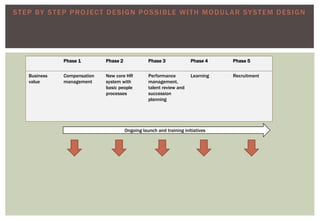
Phase 1 Phase 2 Phase 3 Phase 4 Phase 5
Business
value
Compensation
management
New core HR
system with
basic people
processes
Performance
management,
talent review and
succession
planning
Learning Recruitment
STEP BY STEP PROJECT DESIGN POSSIBLE WITH MODULAR SYSTEM DESIGN
Ongoing launch and training initiatives
SAAS SOLUTIONS IN HR
-REQUIREMENTS AND POSSIBILITIES
7
 Can be part of CIO strategy where HR is a possible area for SaaS IT
delivery
 HR is not core business in terms of IT solutions
 Compare with on premise costs
 Mature and proven SaaS solutions are available today
 Internal IT has problems with building and maintaining competence for
small specialized areas such as HR
 Less strain on internal IT resources with SaaS
 Competence shift necessary in IT when we go for new internal platforms in lifecycle
management
 HR preparedness to adapt to best practice processes and rely on
standard application configuration
 Business case should focus on business value as well as lower TCO for
HRIS
20/01/2015 8
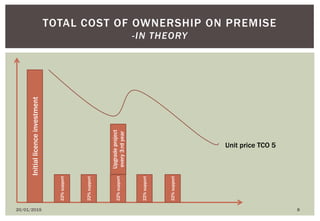
TOTAL COST OF OWNERSHIP ON PREMISE
-IN THEORYInitiallicenceinvestment
22%support
22%support
22%support
22%support
22%support
Upgradeproject
every3:rdyear
Unit price TCO 5
20/01/2015 9
TOTAL COST OF OWNERSHIP ON PREMISE
– IN PRACTICEInitiallicenceinvestment
22%support
22%support
22%support
22%support
22%support
Lack of internal IT resources
specialized in HRIS requires
consultant support to use the
vendors support correctly
Consultant
support
Consultant
support
Consultant
support
Consultant
support
Consultant
support
There are often more major releases
but the business cannot always
manage projects for all versions.
Frustration for the business to lag in
functionality creates an upgrade
pressure. In this case 2 major upgrades
over a 5 year period.
2majorupgrades
over5years
2majorupgrades
over5years
Unit price TCO 5
Internal
SLA
Internal
SLA
Internal
SLA
Internal
SLA
Internal
SLA
20/01/2015 10
SAAS DELIVERY REWARDS CONSOLIDATION
- THE MARGIN COST OF ADDING A MODULE IS LOWSaaSfeeforcore/first
modulewhichincludes
infrastructure
(highpriceapprox70%)
Add-on
module1
(5-15%)
Add-on
module2
(5-15%)
Margin cost for adding a new
module is low. Alternative cost
for Add-on module 2 is a new
SaaS service provider
relationship and possibly
integration.
AlternativeSaaS
solutionforAdd-on
module2(70%)
Integration
cost
Functional area Consolidated SaaS solution Standalone solutions
Consolidated solution X yearly SaaS fee N/A
HR Core Included in consolidated solution X yearly SLA
Payroll 0,5 X yearly SLA 0,5 X yearly SLA
Compensation management Included in consolidated solution 0,5 X yearly SLA
Performance Included in consolidated solution Manual process or 0,5 X for
extra licenses in standalone
solution.
Talent review and succession Included in consolidated solution Manual process or 0,5 X for
extra licenses in standalone
solution.
Learning Included in consolidated solution Manual process or 0,5 X for
extra licenses in standalone
solution.
Potential yearly IT costs for HR 1,5 X 2 – 3,5 X
20/01/2015 11
BUSINESS CASE TCO POTENTIAL
Effect Quantifiable Values
Controlled workflow for managers and HR
The manual excel based process is replaced with a controlled workflow with
monitoring and audit trail capabilities.
X
less hours spent
Quality
Lower risk
Efficient administration X less FTE Effectiveness
Improved reporting X less FTE Effectiveness
Quality
Common process which avoid risk of extra costs due to process inefficiency
for example: salary increases due to local, non-aligned manual processes with
lack of decision support..
X
Potential
less cost increase
Effectiveness
Quality
20/01/2015 12
OTHER BUSINESS CASE EFFECTS
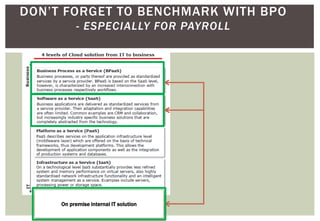
DON’T FORGET TO BENCHMARK WITH BPO
- ESPECIALLY FOR PAYROLL
On premise internal IT solution
Setting up
SaaS based IT
management
2014-08-20 14
LESSONS LEARNED
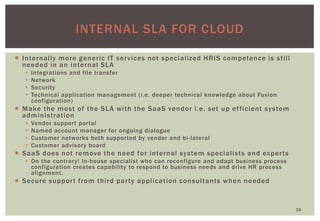
INTERNAL SLA FOR CLOUD
15
 Internally more generic IT services not specialized HRIS competence is still
needed in an internal SLA
 Integrations and file transfer
 Network
 Security
 Technical application management (i.e. deeper technical knowledge about Fusion
configuration)
 Make the most of the SLA with the SaaS vendor i.e. set up efficient system
administration
 Vendor support portal
 Named account manager for ongoing dialogue
 Customer networks both supported by vendor and bi-lateral
 Customer advisory board
 SaaS does not remove the need for internal system specialists and experts
 On the contrary! In-house specialist who can reconfigure and adapt business process
configuration creates capability to respond to business needs and drive HR process
alignment.
 Secure support from third party application consultants when needed
THE SELECTION AND EVALUATION PARADOX
16
Current
solution
Proposed
solution
Theoretical
ideal
We spend to much comparing this
• Data privacy
• Disaster recovery
• Service availability
• Integrations
• etc.
Legal requirements
...when we should consider this
Security
 Architectural review
 Penetration tests
 Rights to perform
penetration tests
 Regular third party
test reports
 ”Large vendor
advantage”
 Process audit
reports
 Rights to inspect
premises
17
Data privacy
 No data outside EU
including disaster
recovery
 Named data centre
 List of sub-contractor
entities
 Bound by same
conditions as Vendor
 Use EU model clauses
for data management
outside EU
 Vendor should comply
to all local legislation
as a contract clause
 Adherence agreements
between company and
other legal entities
CLOUD – SECURITY – DATA PRIVACY
Data
processing
agreement
External part
Company
Other legal unit
Adherence
agreement
Data
processing
agreement
Sub-contractor
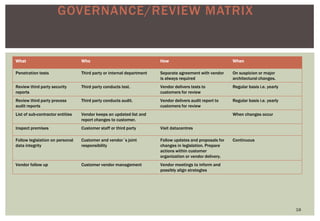
GOVERNANCE/REVIEW MATRIX
18
What Who How When
Penetration tests Third party or internal department Separate agreement with vendor
is always required
On suspicion or major
architectural changes.
Review third party security
reports
Third party conducts test. Vendor delivers tests to
customers for review
Regular basis i.e. yearly
Review third party process
audit reports
Third party conducts audit. Vendor delivers audit report to
customers for review
Regular basis i.e. yearly
List of sub-contractor entities Vendor keeps an updated list and
report changes to customer.
When changes occur
Inspect premises Customer staff or third party Visit datacentres
Follow legislation on personal
data integrity
Customer and vendor´s joint
responsibility
Follow updates and proposals for
changes in legislation. Prepare
actions within customer
organization or vendor delivery.
Continuous
Vendor follow up Customer vendor management Vendor meetings to inform and
possibly align strategies
 Quick implementation
possibilities in system
requires flexible
implementation
partners…with
 ….step-by-step approach
with agile thinking and
successive deliveries
 “Large vendor
advantage” i.e. they can
deliver on extensive
security and data
processing
requirements.
 Competence build up in
business necessary to
keep up with new
features and versions
19
 Plenty of initial bugs in
new systems
 Secure
configuration/admin
services directly via
support without large
implementation project.
 Have vendors align with
partners so customers
can have solution SLA:s
and knowledge about
co-existence and
integrations.
 Make sure best practice
processes are in place
– not just a bunch of
functionality
 You select a vendor not
only a solution…trust on
that vendors ambition
and capability to be in
the frontline.
 Internal support
 Top management
support
 IT strategy support
 Cooperation with risk,
legal and compliance
etc.
 Lack of understanding
and resistance in some
parts of IT can exist
even with management
support
THINGS TO CONSIDER
 Fredrik Rexhammar
 https://www.linkedin.com/profile/public-profile-settings?trk=prof-
edit-edit-public_profile
1/20/2015 20
WANT TO KNOW MORE?

HRIS and cloud

  • 1.
    business case lessons learned HRISAND SAAS/CLOUD FREDRIK REXHAMMAR HTTPS:// W W W . LI N KE DI N.C OM/ PR OF I LE/ P U B LI C -P R OFI L E - S E T TI N G S? T R K=P R OF - ED I T-E DI T - PUBLIC _P ROF I LE
  • 2.
    Business drivers from HR andIT perspective 2014-08-20 2 BUSINESS CASE
  • 3.
    Business needs Relevance Lifecycle management of old legacy HR systems including local payroll and local HR systems Common situation in many companies. BPO is a viable option but not self-evident. ERP system without consolidated functionality for talent management Common variant of this which includes that an ERP system which is in place but lacks consolidated functionality for talent management Need for unified and global HR processes which are mutually reinforcing. Common situation in companies where stand alone solutions have been implemented. Need for all HR processes to interact and feed each other and use core data. For example - compensation management uses core people data and feeds into performance which in turn is the foundation for talent and succession. Consolidate IT systems in HR i.e. lower IT costs and more efficient IT management 3 BUSINESS AND IT MANAGEMENT NEEDS -TOGETHER ACT AS DRIVERS TOWARDS CONSOLIDATED SAAS SOLUTIONS
  • 4.
    Core HR system •Masterregister for employees •Basic data /Manager team structure •Basic HR processes Payroll including time, travel & expenses •Local vendors due to law requirements •Local due to integration with payroll Recruitment •Recruitment portal •CV database Performance Management •Goals •Performance review Learning •Training admin •Self service catalogue •e-learning portal •Certifications •Learning history One or more standalone talent modules Core HR People information (master) and basic people processes Country based (laws and regulations EXAMPLE HRIS ECOSYSTEM - ONE OR MORE NON CONSOLIDATED ISLANDS One or more stand alone talent modules Local country based payroll Talent/Succession • Talent review • Succession planning …Global ERP system Compensation • Salary revision • Job grading One or more local HR systems …. OR …
  • 5.
    EXAMPLE CONSOLIDATED SAASARCHITECTURE EXAMPLE VENDOR X WITH BOTH GLOBAL HR AND TALENT INTEGRATED WITH LOCAL PAYROLL Compensation management Global Core HR Consolidated view of all employees and organization •Provides access to all talent modules for all managers and employees Performance and Goals Succession Talent review Learning Recruitment Local payroll for different countries Access
  • 6.
    Phase 1 Phase2 Phase 3 Phase 4 Phase 5 Business value Compensation management New core HR system with basic people processes Performance management, talent review and succession planning Learning Recruitment STEP BY STEP PROJECT DESIGN POSSIBLE WITH MODULAR SYSTEM DESIGN Ongoing launch and training initiatives
  • 7.
    SAAS SOLUTIONS INHR -REQUIREMENTS AND POSSIBILITIES 7  Can be part of CIO strategy where HR is a possible area for SaaS IT delivery  HR is not core business in terms of IT solutions  Compare with on premise costs  Mature and proven SaaS solutions are available today  Internal IT has problems with building and maintaining competence for small specialized areas such as HR  Less strain on internal IT resources with SaaS  Competence shift necessary in IT when we go for new internal platforms in lifecycle management  HR preparedness to adapt to best practice processes and rely on standard application configuration  Business case should focus on business value as well as lower TCO for HRIS
  • 8.
    20/01/2015 8 TOTAL COSTOF OWNERSHIP ON PREMISE -IN THEORYInitiallicenceinvestment 22%support 22%support 22%support 22%support 22%support Upgradeproject every3:rdyear Unit price TCO 5
  • 9.
    20/01/2015 9 TOTAL COSTOF OWNERSHIP ON PREMISE – IN PRACTICEInitiallicenceinvestment 22%support 22%support 22%support 22%support 22%support Lack of internal IT resources specialized in HRIS requires consultant support to use the vendors support correctly Consultant support Consultant support Consultant support Consultant support Consultant support There are often more major releases but the business cannot always manage projects for all versions. Frustration for the business to lag in functionality creates an upgrade pressure. In this case 2 major upgrades over a 5 year period. 2majorupgrades over5years 2majorupgrades over5years Unit price TCO 5 Internal SLA Internal SLA Internal SLA Internal SLA Internal SLA
  • 10.
    20/01/2015 10 SAAS DELIVERYREWARDS CONSOLIDATION - THE MARGIN COST OF ADDING A MODULE IS LOWSaaSfeeforcore/first modulewhichincludes infrastructure (highpriceapprox70%) Add-on module1 (5-15%) Add-on module2 (5-15%) Margin cost for adding a new module is low. Alternative cost for Add-on module 2 is a new SaaS service provider relationship and possibly integration. AlternativeSaaS solutionforAdd-on module2(70%) Integration cost
  • 11.
    Functional area ConsolidatedSaaS solution Standalone solutions Consolidated solution X yearly SaaS fee N/A HR Core Included in consolidated solution X yearly SLA Payroll 0,5 X yearly SLA 0,5 X yearly SLA Compensation management Included in consolidated solution 0,5 X yearly SLA Performance Included in consolidated solution Manual process or 0,5 X for extra licenses in standalone solution. Talent review and succession Included in consolidated solution Manual process or 0,5 X for extra licenses in standalone solution. Learning Included in consolidated solution Manual process or 0,5 X for extra licenses in standalone solution. Potential yearly IT costs for HR 1,5 X 2 – 3,5 X 20/01/2015 11 BUSINESS CASE TCO POTENTIAL
  • 12.
    Effect Quantifiable Values Controlledworkflow for managers and HR The manual excel based process is replaced with a controlled workflow with monitoring and audit trail capabilities. X less hours spent Quality Lower risk Efficient administration X less FTE Effectiveness Improved reporting X less FTE Effectiveness Quality Common process which avoid risk of extra costs due to process inefficiency for example: salary increases due to local, non-aligned manual processes with lack of decision support.. X Potential less cost increase Effectiveness Quality 20/01/2015 12 OTHER BUSINESS CASE EFFECTS
  • 13.
    DON’T FORGET TOBENCHMARK WITH BPO - ESPECIALLY FOR PAYROLL On premise internal IT solution
  • 14.
    Setting up SaaS basedIT management 2014-08-20 14 LESSONS LEARNED
  • 15.
    INTERNAL SLA FORCLOUD 15  Internally more generic IT services not specialized HRIS competence is still needed in an internal SLA  Integrations and file transfer  Network  Security  Technical application management (i.e. deeper technical knowledge about Fusion configuration)  Make the most of the SLA with the SaaS vendor i.e. set up efficient system administration  Vendor support portal  Named account manager for ongoing dialogue  Customer networks both supported by vendor and bi-lateral  Customer advisory board  SaaS does not remove the need for internal system specialists and experts  On the contrary! In-house specialist who can reconfigure and adapt business process configuration creates capability to respond to business needs and drive HR process alignment.  Secure support from third party application consultants when needed
  • 16.
    THE SELECTION ANDEVALUATION PARADOX 16 Current solution Proposed solution Theoretical ideal We spend to much comparing this • Data privacy • Disaster recovery • Service availability • Integrations • etc. Legal requirements ...when we should consider this
  • 17.
    Security  Architectural review Penetration tests  Rights to perform penetration tests  Regular third party test reports  ”Large vendor advantage”  Process audit reports  Rights to inspect premises 17 Data privacy  No data outside EU including disaster recovery  Named data centre  List of sub-contractor entities  Bound by same conditions as Vendor  Use EU model clauses for data management outside EU  Vendor should comply to all local legislation as a contract clause  Adherence agreements between company and other legal entities CLOUD – SECURITY – DATA PRIVACY Data processing agreement External part Company Other legal unit Adherence agreement Data processing agreement Sub-contractor
  • 18.
    GOVERNANCE/REVIEW MATRIX 18 What WhoHow When Penetration tests Third party or internal department Separate agreement with vendor is always required On suspicion or major architectural changes. Review third party security reports Third party conducts test. Vendor delivers tests to customers for review Regular basis i.e. yearly Review third party process audit reports Third party conducts audit. Vendor delivers audit report to customers for review Regular basis i.e. yearly List of sub-contractor entities Vendor keeps an updated list and report changes to customer. When changes occur Inspect premises Customer staff or third party Visit datacentres Follow legislation on personal data integrity Customer and vendor´s joint responsibility Follow updates and proposals for changes in legislation. Prepare actions within customer organization or vendor delivery. Continuous Vendor follow up Customer vendor management Vendor meetings to inform and possibly align strategies
  • 19.
     Quick implementation possibilitiesin system requires flexible implementation partners…with  ….step-by-step approach with agile thinking and successive deliveries  “Large vendor advantage” i.e. they can deliver on extensive security and data processing requirements.  Competence build up in business necessary to keep up with new features and versions 19  Plenty of initial bugs in new systems  Secure configuration/admin services directly via support without large implementation project.  Have vendors align with partners so customers can have solution SLA:s and knowledge about co-existence and integrations.  Make sure best practice processes are in place – not just a bunch of functionality  You select a vendor not only a solution…trust on that vendors ambition and capability to be in the frontline.  Internal support  Top management support  IT strategy support  Cooperation with risk, legal and compliance etc.  Lack of understanding and resistance in some parts of IT can exist even with management support THINGS TO CONSIDER
  • 20.
     Fredrik Rexhammar https://www.linkedin.com/profile/public-profile-settings?trk=prof- edit-edit-public_profile 1/20/2015 20 WANT TO KNOW MORE?

Editor's Notes

  • #6 Each step can be implemented stand-alone i.e. there is no implicit commitment to move to next step The timetable for moving to next step must be owned by customer and based on business priorities The business cases for each step must “stand on their own”