1
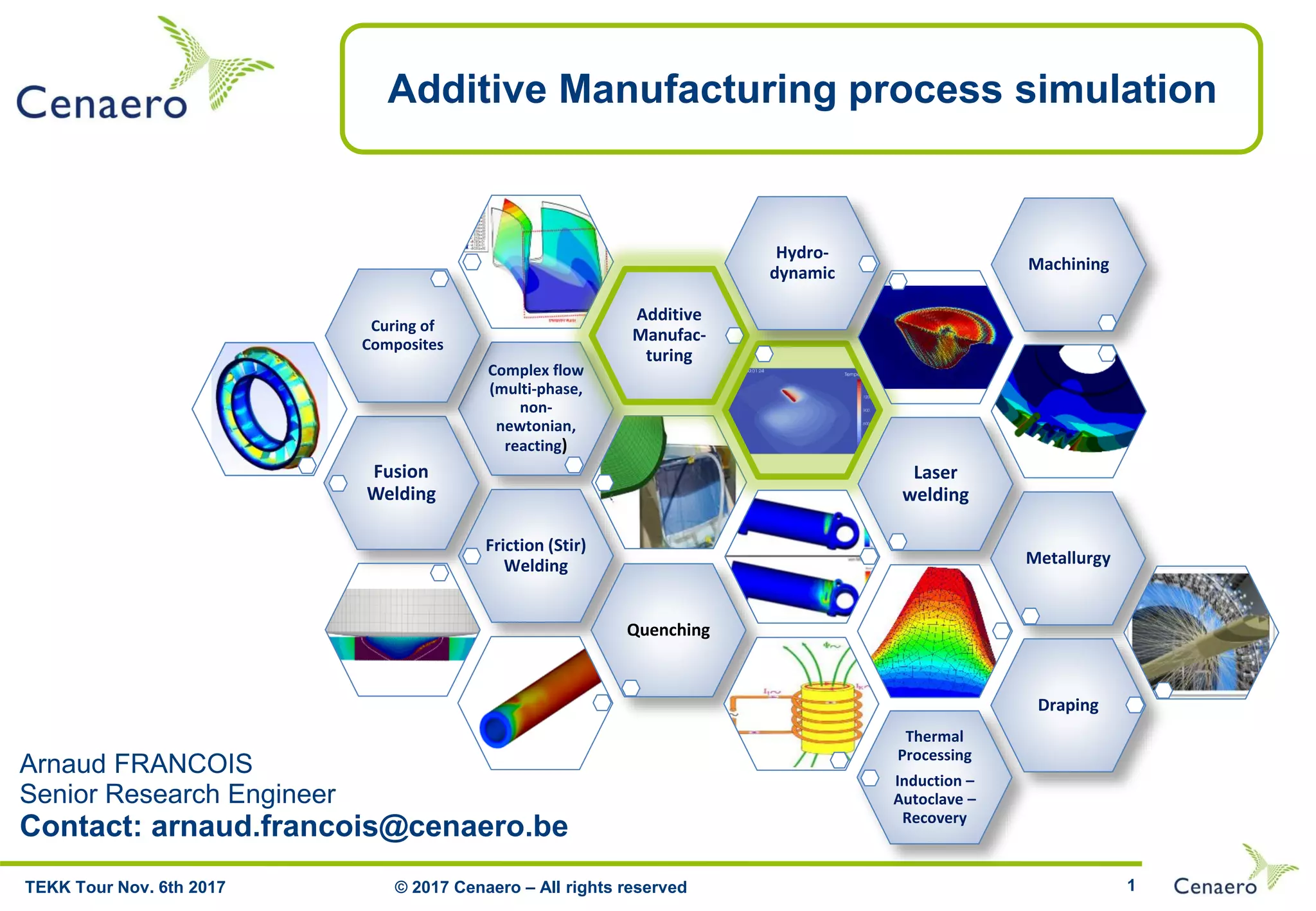
Additive Manufacturing process simulation
Fusion
Welding
Complex flow
(multi-phase,
non-
newtonian,
reacting)
Curing of
Composites
Additive
Manufac-
turing
Hydro-
dynamic
Laser
welding
Friction (Stir)
Welding Metallurgy
Machining
Quenching
Thermal
Processing
Induction –
Autoclave –
Recovery
Draping
Arnaud FRANCOIS
Senior Research Engineer
Contact: arnaud.francois@cenaero.be
© 2017 Cenaero – All rights reservedTEKK Tour Nov. 6th 2017
PROD-F-015-02
2
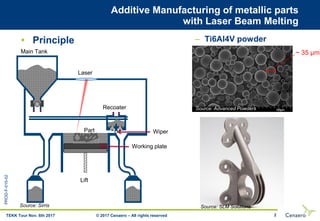
Additive Manufacturing of metallic parts
with Laser Beam Melting
• Principle
© 2017 Cenaero – All rights reservedTEKK Tour Nov. 6th 2017
Main Tank
Laser
Recoater
Lift
Part
Working plate
Wiper
Source: Sirris
Source: Advanced Powders
~ 35 µm
– Ti6Al4V powder
Source: SLM Solutions
PROD-F-015-02
3
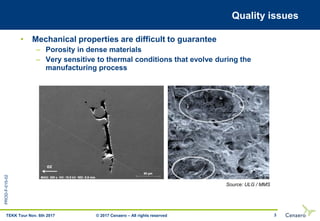
Quality issues
• Mechanical properties are difficult to guarantee
– Porosity in dense materials
– Very sensitive to thermal conditions that evolve during the
manufacturing process
© 2017 Cenaero – All rights reservedTEKK Tour Nov. 6th 2017
Source: ULG / MMS
PROD-F-015-02
4
Origin of defects
• LBM process window and porosity distribution [Gong et al. 2013] :
© 2017 Cenaero – All rights reservedTEKK Tour Nov. 6th 2017
Full
dense
Lack of
fusion
Excess of
fusion
Over-
heating
Zone II
Spherical shape
Zone III
Irregular shape
PROD-F-015-02
5
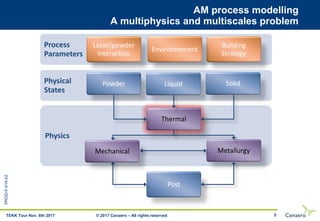
AM process modelling
A multiphysics and multiscales problem
© 2017 Cenaero – All rights reservedTEKK Tour Nov. 6th 2017
Process
Parameters
Laser/powder
interaction
Building
Strategy
Physical
States
Powder
Post
Physics
Thermal
Metallurgy
Environnement
Liquid Solid
Mechanical
PROD-F-015-02
6
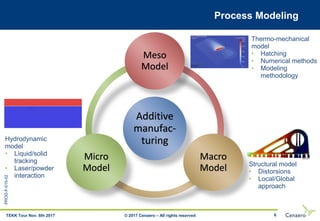
Process Modeling
© 2017 Cenaero – All rights reservedTEKK Tour Nov. 6th 2017
Additive
manufac-
turing
Meso
Model
Macro
Model
Micro
Model
Thermo-mechanical
model
• Hatching
• Numerical methods
• Modeling
methodology
Hydrodynamic
model
• Liquid/solid
tracking
• Laser/powder
interaction
Structural model
• Distorsions
• Local/Global
approach
PROD-F-015-02
7
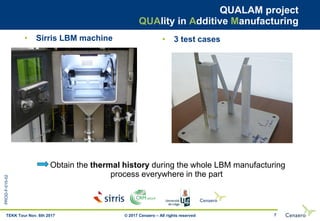
QUALAM project
QUAlity in Additive Manufacturing
© 2017 Cenaero – All rights reservedTEKK Tour Nov. 6th 2017
• Sirris LBM machine • 3 test cases
Obtain the thermal history during the whole LBM manufacturing
process everywhere in the part
PROD-F-015-02
8
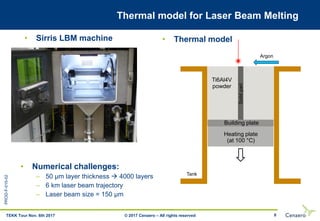
Thermal model for Laser Beam Melting
© 2017 Cenaero – All rights reservedTEKK Tour Nov. 6th 2017
Argon
Building plate
Heating plate
(at 100 °C)
Ti6Al4V
powder
Solidpart
Tank
• Numerical challenges:
– 50 µm layer thickness  4000 layers
– 6 km laser beam trajectory
– Laser beam size = 150 µm
• Sirris LBM machine • Thermal model
PROD-F-015-02
9
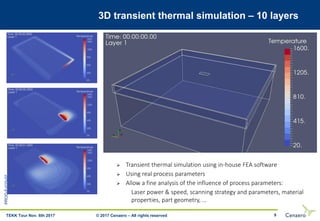
3D transient thermal simulation – 10 layers
© 2017 Cenaero – All rights reservedTEKK Tour Nov. 6th 2017
 Transient thermal simulation using in-house FEA software
 Using real process parameters
 Allow a fine analysis of the influence of process parameters:
Laser power & speed, scanning strategy and parameters, material
properties, part geometry, …
PROD-F-015-02
10
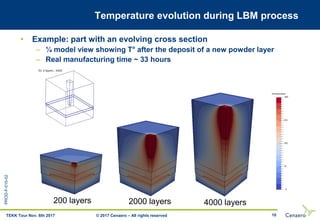
Temperature evolution during LBM process
• Example: part with an evolving cross section
– ¼ model view showing T° after the deposit of a new powder layer
– Real manufacturing time ~ 33 hours
© 2017 Cenaero – All rights reservedTEKK Tour Nov. 6th 2017
200 layers 2000 layers 4000 layers
PROD-F-015-02
11
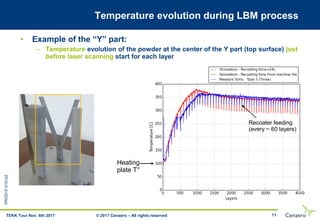
Temperature evolution during LBM process
• Example of the “Y” part:
– Temperature evolution of the powder at the center of the Y part (top surface) just
before laser scanning start for each layer
© 2017 Cenaero – All rights reservedTEKK Tour Nov. 6th 2017
Heating
plate T°
Recoater feeding
(every ~ 60 layers)
PROD-F-015-02
12
Closing remarks
 Development of a transient thermal model for LBM process (in-
house FE solver)
• Study the impact of process and laser hatching parameters
• Reduce the number of trial and errors (cost and time)
 Experimental measurements for :
• Material properties (ULG/MMS)
• Model validation and heat loss calibration from experimental
temperature measurements (Sirris & CRM)
 Perspectives - Work in progress:
• Extension to thermo-mechanical models
• Towards an integrated, multi-disciplinary process / product
conception
© 2017 Cenaero – All rights reservedTEKK Tour Nov. 6th 2017

Additive Manufacturing process simulation

  • 1.
    1 Additive Manufacturing processsimulation Fusion Welding Complex flow (multi-phase, non- newtonian, reacting) Curing of Composites Additive Manufac- turing Hydro- dynamic Laser welding Friction (Stir) Welding Metallurgy Machining Quenching Thermal Processing Induction – Autoclave – Recovery Draping Arnaud FRANCOIS Senior Research Engineer Contact: arnaud.francois@cenaero.be © 2017 Cenaero – All rights reservedTEKK Tour Nov. 6th 2017
  • 2.
    PROD-F-015-02 2 Additive Manufacturing ofmetallic parts with Laser Beam Melting • Principle © 2017 Cenaero – All rights reservedTEKK Tour Nov. 6th 2017 Main Tank Laser Recoater Lift Part Working plate Wiper Source: Sirris Source: Advanced Powders ~ 35 µm – Ti6Al4V powder Source: SLM Solutions
  • 3.
    PROD-F-015-02 3 Quality issues • Mechanicalproperties are difficult to guarantee – Porosity in dense materials – Very sensitive to thermal conditions that evolve during the manufacturing process © 2017 Cenaero – All rights reservedTEKK Tour Nov. 6th 2017 Source: ULG / MMS
  • 4.
    PROD-F-015-02 4 Origin of defects •LBM process window and porosity distribution [Gong et al. 2013] : © 2017 Cenaero – All rights reservedTEKK Tour Nov. 6th 2017 Full dense Lack of fusion Excess of fusion Over- heating Zone II Spherical shape Zone III Irregular shape
  • 5.
    PROD-F-015-02 5 AM process modelling Amultiphysics and multiscales problem © 2017 Cenaero – All rights reservedTEKK Tour Nov. 6th 2017 Process Parameters Laser/powder interaction Building Strategy Physical States Powder Post Physics Thermal Metallurgy Environnement Liquid Solid Mechanical
  • 6.
    PROD-F-015-02 6 Process Modeling © 2017Cenaero – All rights reservedTEKK Tour Nov. 6th 2017 Additive manufac- turing Meso Model Macro Model Micro Model Thermo-mechanical model • Hatching • Numerical methods • Modeling methodology Hydrodynamic model • Liquid/solid tracking • Laser/powder interaction Structural model • Distorsions • Local/Global approach
  • 7.
    PROD-F-015-02 7 QUALAM project QUAlity inAdditive Manufacturing © 2017 Cenaero – All rights reservedTEKK Tour Nov. 6th 2017 • Sirris LBM machine • 3 test cases Obtain the thermal history during the whole LBM manufacturing process everywhere in the part
  • 8.
    PROD-F-015-02 8 Thermal model forLaser Beam Melting © 2017 Cenaero – All rights reservedTEKK Tour Nov. 6th 2017 Argon Building plate Heating plate (at 100 °C) Ti6Al4V powder Solidpart Tank • Numerical challenges: – 50 µm layer thickness  4000 layers – 6 km laser beam trajectory – Laser beam size = 150 µm • Sirris LBM machine • Thermal model
  • 9.
    PROD-F-015-02 9 3D transient thermalsimulation – 10 layers © 2017 Cenaero – All rights reservedTEKK Tour Nov. 6th 2017  Transient thermal simulation using in-house FEA software  Using real process parameters  Allow a fine analysis of the influence of process parameters: Laser power & speed, scanning strategy and parameters, material properties, part geometry, …
  • 10.
    PROD-F-015-02 10 Temperature evolution duringLBM process • Example: part with an evolving cross section – ¼ model view showing T° after the deposit of a new powder layer – Real manufacturing time ~ 33 hours © 2017 Cenaero – All rights reservedTEKK Tour Nov. 6th 2017 200 layers 2000 layers 4000 layers
  • 11.
    PROD-F-015-02 11 Temperature evolution duringLBM process • Example of the “Y” part: – Temperature evolution of the powder at the center of the Y part (top surface) just before laser scanning start for each layer © 2017 Cenaero – All rights reservedTEKK Tour Nov. 6th 2017 Heating plate T° Recoater feeding (every ~ 60 layers)
  • 12.
    PROD-F-015-02 12 Closing remarks  Developmentof a transient thermal model for LBM process (in- house FE solver) • Study the impact of process and laser hatching parameters • Reduce the number of trial and errors (cost and time)  Experimental measurements for : • Material properties (ULG/MMS) • Model validation and heat loss calibration from experimental temperature measurements (Sirris & CRM)  Perspectives - Work in progress: • Extension to thermo-mechanical models • Towards an integrated, multi-disciplinary process / product conception © 2017 Cenaero – All rights reservedTEKK Tour Nov. 6th 2017