Understanding the current Australian and global stakeholder climate and its implications Presentation by Noel Turnbull  Director Growth Solutions Group and  Adjunct Professor RMIT University
The presentation What is the current social and political climate? How does it interact with perceptions of PR/PA practitioners? Stakeholder relations and reputation A model for managing stakeholders The importance of trust and authenticity
… a personal note  The Millennium Edge predicted: - The 21 st  C will be the Asian century -  Millenarians might try to bring about the apocalypse if it doesn’t come Two responses: - 1997 Asian financial crisis -  August 30 2001
The PR/PA mindset Much PR/PA practice presupposes: - Crisis - Uncertainty - Confusion - Gloom and doom * Within the context of conventional wisdom
Current confusions New Age spiritualism versus “aspirational” class goals Downshifting vs longer hours and demands Globalism vs localism Markets vs communities Market triumphalism vs corporate distrust
The top seven strategies for reconnecting with Australians Eye on Australia 2004
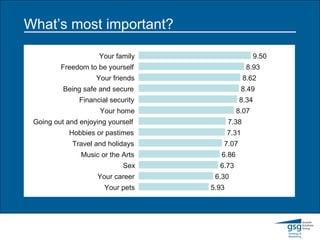
Some social context 70% of Australians would like to be working at a slower pace 71% say there is too many pressures in the work environment 79% of people with children under 18 wish they had more time to look after their health and well-being 78% would like to live in a close-knit community 69% says it’s important to have some kind of spiritual belief 67% wish life contained more experiences that fed their souls 51% say technology is making their life more stressful, even 44% of people aged 18 to 24 agree with this 89% believe there is too much emphasis on making money 92% say family is the most important part of their life 88% want to get to know the neighbours 86% think it’s important to be involved in the local community Source: Above and next two slides Grey Worldwide Eye on Australia T
What’s most important? 9.50 8.93 8.62 8.49 8.34 8.07 7.38 7.31 7.07 6.86 6.73 6.30 5.93 Your family Freedom to be yourself Your friends Being safe and secure Financial security Your home Going out and enjoying yourself Hobbies or pastimes Travel and holidays Music or the Arts Sex Your career Your pets
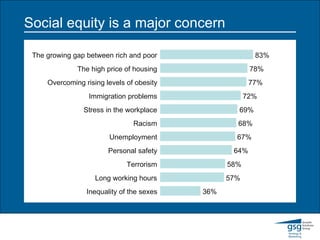
Social equity is a major concern 83% 78% 77% 72% 69% 68% 67% 64% 58% 57% 36% The growing gap between rich and poor The high price of housing Overcoming rising levels of obesity Immigration problems Stress in the workplace Racism Unemployment Personal safety Terrorism Long working hours Inequality of the sexes
Monitoring Cultural Change SCAN Australia TM
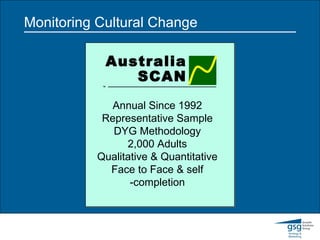
Monitoring Cultural Change Annual Since 1992 Representative Sample DYG Methodology 2,000 Adults Qualitative & Quantitative Face to Face & self -completion SCAN Australia TM
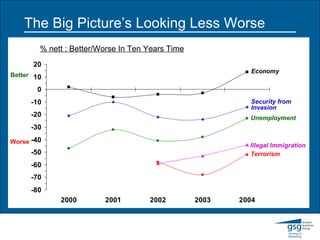
The Big Picture’s Looking Less Worse Better % nett : Better/Worse In Ten Years Time Worse Illegal Immigration Terrorism Security from Invasion Economy Unemployment
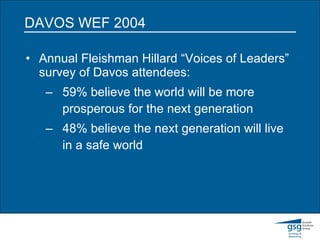
DAVOS WEF 2004 Annual Fleishman Hillard “Voices of Leaders” survey of Davos attendees: 59% believe the world will be more prosperous for the next generation 48% believe the next generation will live in a safe world
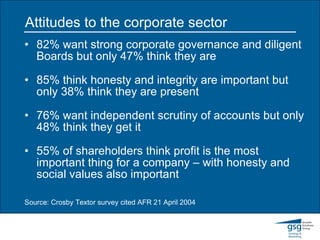
Attitudes to the corporate sector 82% want strong corporate governance and diligent Boards but only 47% think they are 85% think honesty and integrity are important but only 38% think they are present 76% want independent scrutiny of accounts but only 48% think they get it 55% of shareholders think profit is the most important thing for a company – with honesty and social values also important Source: Crosby Textor survey cited AFR 21 April 2004
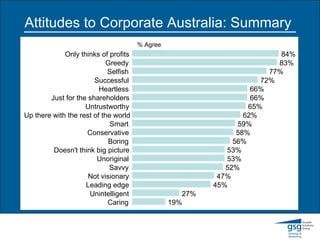
Attitudes to Corporate Australia: Summary 84% 83% 77% 72% 66% 66% 65% 62% 59% 58% 56% 53% 53% 52% 47% 45% 27% 19% Only thinks of profits Greedy Selfish Successful Heartless Just for the shareholders Untrustworthy Up there with the rest of the world Smart Conservative Boring Doesn't think big picture Unoriginal Savvy Not visionary Leading edge Unintelligent Caring % Agree
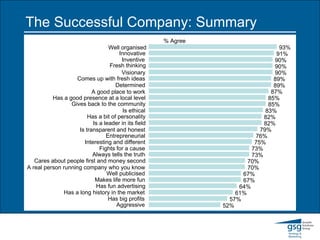
The Successful Company: Summary  93% 91% 90% 90% 90% 89% 89% 87% 85% 85% 83% 82% 82% 79% 76% 75% 73% 73% 70% 70% 67% 67% 64% 61% 57% 52% Well organised Innovative Inventive Fresh thinking Visionary Comes up with fresh ideas Determined A good place to work Has a good presence at a local level Gives back to the community Is ethical Has a bit of personality Is a leader in its field Is transparent and honest Entrepreneurial Interesting and different Fights for a cause Always tells the truth Cares about people first and money second A real person running company who you know  Well publicised Makes life more fun Has fun advertising Has a long history in the market Has big profits Aggressive % Agree
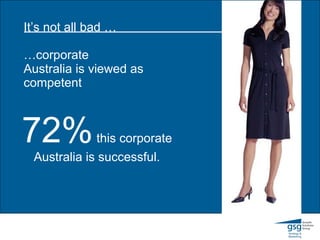
It’s not all bad … …corporate  Australia is viewed as  competent 72%  this corporate Australia is successful.
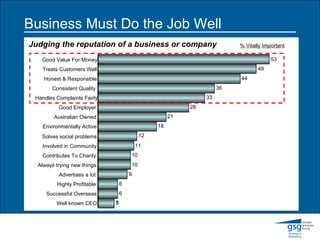
5 6 6 9 10 10 11 12 18 21 28 33 36 44 49 53 Well known CEO Successful Overseas Highly Profitable Advertises a lot Always trying new things Contributes To Charity Involved in Community Solves social problems Environmentally Active Australian Owned Good Employer Handles Complaints Fairly Consistent Quality Honest & Responsible Treats Customers Well Good Value For Money Business Must Do the Job Well % Vitally Important Judging the reputation of a business or company
What is an ethical company? Looks after its employees first and foremost (82%) Is honest and transparent in its dealings (81%) Puts people before profits(79%) Cares for local communities (78%) Is environmentally friendly (74%) Gives to charity (59%) Source: Grey Worldwide Eye on Australia 2004
Some conclusions about the climate Spiritual, non-material yearning exists People are stressed and over-worked Companies are greedy and not as ethical as should be … and yet… People believe the world is getting better (or less worse) Companies performance / reputation judged pragmatically
How should we respond? The conventional answer is clear cut: Manage your reputation and focus on Corporate Social Responsibility … ..but is this enough?
Some reservations Does CSR change attitudes or is it a given? Is it the most important benchmark for reputation? Who defines CSR? Do we agree on what it is?
The CSR bandwagon CSR is clearly important: Federal Government offering $2000 prize to school children for an essay on CSR  Reputation indices proliferation FTSE and Dow Jones socially responsible companies indices
But will they take yes for an answer? Christian Aid: “calling on politicians to take responsibility for the ethical operation of companies rather than surrendering it to business peddling fine words and lofty sentiments” Shell, BAT, Coca-Cola  “pay lip service to CSR while making things worse for the community in which they work” CSR is the new “great sham” Source: The Economist 24 January 2004
So, what is to be done? Recognise there are too many contradictory indicators to be certain about too much Recognise there are too many stakeholders with too many agendas Recognise that you can’t respond to all stakeholders and all issues Focus on what can be done
Key Priorities Build trust to build reputation Behaviours which demonstrate values, ethics , responsibility and performance * Base trust and reputation on relationships
Where do you start? Developing relationships depends on defining the stakeholders with which you need to have them
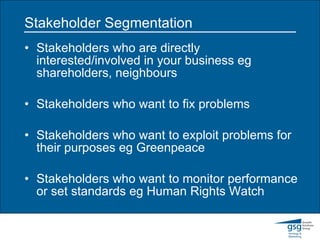
Stakeholder Segmentation Stakeholders who are directly interested/involved in your business eg shareholders, neighbours Stakeholders who want to fix problems Stakeholders who want to exploit problems for their purposes eg Greenpeace Stakeholders who want to monitor performance or set standards eg Human Rights Watch
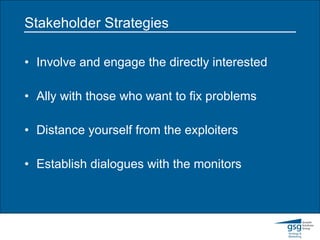
Stakeholder Strategies Involve and engage the directly interested Ally with those who want to fix problems Distance yourself from the exploiters Establish dialogues with the monitors
Reputation and Relationships There is no one strategy but there are ways you can approach the issue and ways that you can measure both reputation and relationships …… and that’s NOT by using reputation management indices
Corporate Brand & Reputation Building Blocks  There are a set of conceptual building blocks for Corporate Reputation that incorporate the logic that a ‘good reputation’ is an asset that provides access to the sort of resources and support that is critical to an organisations success Reputation  is an  asset  of  value . [It’s synonymous with  Corporate   Brand ] Reputation largely exists in the  heads  of  strategic stakeholders  - and is primarily shaped by their  experiences  and  interaction  with the company. The benefits of a  (good) reputation  come from  superior outcomes  in gaining  access  to  resources  or  support  from  strategic stakeholders . A reputation is enhanced by the organisation delivering on its  value proposition  to  specific stakeholder groups   (provided the value proposition is relevant and ‘valuable’). A reputation can be managed  proactively  or  reactively , but is sometimes affected by events beyond the control of management.
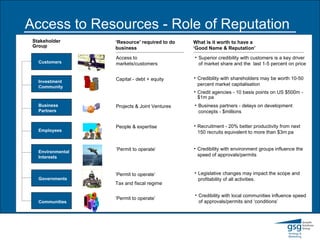
Access to Resources - Role of Reputation  Stakeholder Group Customers Investment Community Business Partners Employees ‘ Resource’ required to do business What is it worth to have a ‘Good Name & Reputation’ Environmental Interests Governments Communities Access to markets/customers Capital - debt + equity  People & expertise Projects & Joint Ventures ‘ Permit to operate’ ‘ Permit to operate’ Tax and fiscal regime Superior credibility with customers is a key driver of market share and the  last 1-5 percent on price Credibility with shareholders may be worth 10-50 percent market capitalisation Credit agencies - 10 basis points on US $500m - $1m pa   Business partners - delays on development concepts - $millions Recruitment - 20% better productivity from next 150 recruits equivalent to more than $3m pa Credibility with environment groups influence the speed of approvals/permits ‘ Permit to operate’ Legislative changes may impact the scope and profitability of all activities. Credibility with local communities influence speed of approvals/permits and ‘conditions’
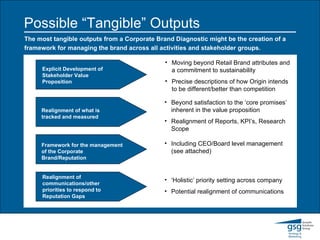
Possible “Tangible” Outputs  The most tangible outputs from a Corporate Brand Diagnostic might be the creation of a framework for managing the brand across all activities and stakeholder groups. Explicit Development of Stakeholder Value Proposition Realignment of what is tracked and measured Framework for the management of the Corporate Brand/Reputation Realignment of communications/other priorities to respond to Reputation Gaps Moving beyond Retail Brand attributes and a commitment to sustainability Precise descriptions of how Origin intends to be different/better than competition Beyond satisfaction to the ‘core promises’ inherent in the value proposition Realignment of Reports, KPI’s, Research Scope Including CEO/Board level management (see attached) ‘ Holistic’ priority setting across company Potential realignment of communications
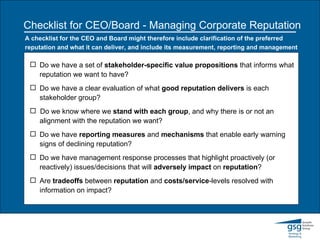
Checklist for CEO/Board - Managing Corporate Reputation  A checklist for the CEO and Board might therefore include clarification of the preferred reputation and what it can deliver, and include its measurement, reporting and management Do we have a set of  stakeholder-specific value propositions  that informs what  reputation we want to have? Do we have a clear evaluation of what  good reputation delivers  is each  stakeholder group? Do we know where we  stand with each group , and why there is or not an  alignment with the reputation we want? Do we have  reporting measures  and  mechanisms  that enable early warning  signs of declining reputation? Do we have management response processes that highlight proactively (or  reactively) issues/decisions that will  adversely impact  on  reputation ? Are  tradeoffs  between  reputation  and  costs/service -levels resolved with  information on impact?
The CareCom approach Seeks to identify how relationships with stakeholders influence their behaviours Identifies key relationship factors as well as factors which enhance and build Develops a reputation profile rather than an index Measures commitment and advocacy
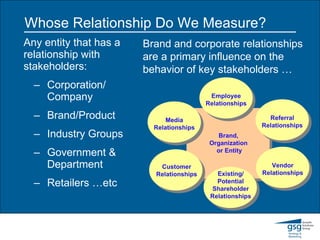
Whose Relationship Do We Measure? Any entity that has a relationship with stakeholders: Corporation/ Company Brand/Product Industry Groups Government &  Department Retailers …etc Brand and corporate relationships are a primary influence on the behavior of key stakeholders … Brand,  Organization  or Entity Customer Relationships Referral Relationships Vendor Relationships Existing/ Potential Shareholder Relationships Media Relationships Employee Relationships
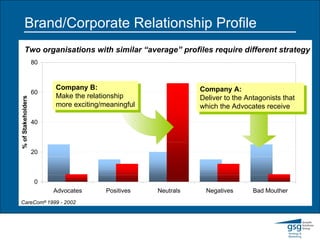
Brand/Corporate Relationship Profile Two organisations with similar “average” profiles require different strategy CareCom ©  1999 - 2002 Company B: Make the relationship  more exciting/meaningful Company A: Deliver to the Antagonists that which the Advocates receive
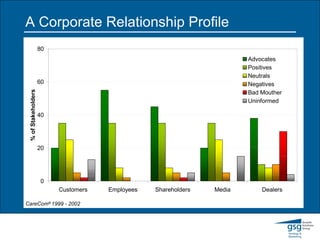
A Corporate Relationship Profile CareCom ©  1999 - 2002
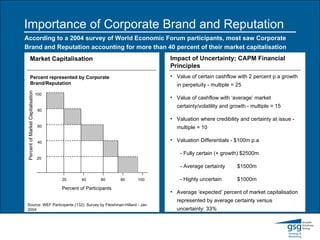
Importance of Corporate Brand and Reputation  According to a 2004 survey of World Economic Forum participants, most saw Corporate Brand and Reputation accounting for more than 40 percent of their market capitalisation Market Capitalisation Impact of Uncertainty; CAPM Financial Principles Percent represented by Corporate Brand/Reputation 20 40 60 80 100 20 40 60 80 100 Percent of Participants Percent of Market Capitalisation Source: WEF Participants (132). Survey by Fleishman-Hillard - Jan 2004 Value of certain cashflow with 2 percent p.a growth  in perpetuity - multiple = 25 Value of cashflow with ‘average’ market  certainty/volatility and growth - multiple = 15 Valuation where credibility and certainty at issue -  multiple = 10 Valuation Differentials - $100m p.a - Fully certain (+ growth) $2500m - Average certainty  $1500m - Highly uncertain $1000m Average ‘expected’ percent of market capitalisation  represented by average certainty versus  uncertainty: 33%
Some concluding thoughts The role of the CEO: “ If a chief executive has an inner strength and a constant set of values everyone can rely on; if his (sic) personality inspires because of a combination of modesty and extraordinary competence; and, if he is frequently in the trenches with his troops – if these are the kinds of qualities which emerge as opposed to the lust for self-aggrandisement, then charisma is sure a prerequisite for steering a big organisation” Jeffrey Sonnefeld, Yale
The focus for the company “ Medicine is for the people. It’s not for the profits. The profits follow”.   Ray Gilmartin, Merck
The role for the PA/PR practitioner “ CEOs need to surround themselves not just with the usual sycophants but with me and women who are willing to challenge every decision” Jeffrey Garten  Yale School of Management Dean – The Politics of Fortune: a new agenda for business leaders
A value set for all? The Nolan principles: Selflessness  Integrity  Objectivity  Accountability  Openness Honesty and  Leadership * You build trust by aspiring to authenticity and practising  transparency

The stakeholder climate

  • 1.
    Understanding the currentAustralian and global stakeholder climate and its implications Presentation by Noel Turnbull Director Growth Solutions Group and Adjunct Professor RMIT University
  • 2.
    The presentation Whatis the current social and political climate? How does it interact with perceptions of PR/PA practitioners? Stakeholder relations and reputation A model for managing stakeholders The importance of trust and authenticity
  • 3.
    … a personalnote The Millennium Edge predicted: - The 21 st C will be the Asian century - Millenarians might try to bring about the apocalypse if it doesn’t come Two responses: - 1997 Asian financial crisis - August 30 2001
  • 4.
    The PR/PA mindsetMuch PR/PA practice presupposes: - Crisis - Uncertainty - Confusion - Gloom and doom * Within the context of conventional wisdom
  • 5.
    Current confusions NewAge spiritualism versus “aspirational” class goals Downshifting vs longer hours and demands Globalism vs localism Markets vs communities Market triumphalism vs corporate distrust
  • 6.
    The top sevenstrategies for reconnecting with Australians Eye on Australia 2004
  • 7.
    Some social context70% of Australians would like to be working at a slower pace 71% say there is too many pressures in the work environment 79% of people with children under 18 wish they had more time to look after their health and well-being 78% would like to live in a close-knit community 69% says it’s important to have some kind of spiritual belief 67% wish life contained more experiences that fed their souls 51% say technology is making their life more stressful, even 44% of people aged 18 to 24 agree with this 89% believe there is too much emphasis on making money 92% say family is the most important part of their life 88% want to get to know the neighbours 86% think it’s important to be involved in the local community Source: Above and next two slides Grey Worldwide Eye on Australia T
  • 8.
    What’s most important?9.50 8.93 8.62 8.49 8.34 8.07 7.38 7.31 7.07 6.86 6.73 6.30 5.93 Your family Freedom to be yourself Your friends Being safe and secure Financial security Your home Going out and enjoying yourself Hobbies or pastimes Travel and holidays Music or the Arts Sex Your career Your pets
  • 9.
    Social equity isa major concern 83% 78% 77% 72% 69% 68% 67% 64% 58% 57% 36% The growing gap between rich and poor The high price of housing Overcoming rising levels of obesity Immigration problems Stress in the workplace Racism Unemployment Personal safety Terrorism Long working hours Inequality of the sexes
  • 10.
    Monitoring Cultural ChangeSCAN Australia TM
  • 11.
    Monitoring Cultural ChangeAnnual Since 1992 Representative Sample DYG Methodology 2,000 Adults Qualitative & Quantitative Face to Face & self -completion SCAN Australia TM
  • 12.
    The Big Picture’sLooking Less Worse Better % nett : Better/Worse In Ten Years Time Worse Illegal Immigration Terrorism Security from Invasion Economy Unemployment
  • 13.
    DAVOS WEF 2004Annual Fleishman Hillard “Voices of Leaders” survey of Davos attendees: 59% believe the world will be more prosperous for the next generation 48% believe the next generation will live in a safe world
  • 14.
    Attitudes to thecorporate sector 82% want strong corporate governance and diligent Boards but only 47% think they are 85% think honesty and integrity are important but only 38% think they are present 76% want independent scrutiny of accounts but only 48% think they get it 55% of shareholders think profit is the most important thing for a company – with honesty and social values also important Source: Crosby Textor survey cited AFR 21 April 2004
  • 15.
    Attitudes to CorporateAustralia: Summary 84% 83% 77% 72% 66% 66% 65% 62% 59% 58% 56% 53% 53% 52% 47% 45% 27% 19% Only thinks of profits Greedy Selfish Successful Heartless Just for the shareholders Untrustworthy Up there with the rest of the world Smart Conservative Boring Doesn't think big picture Unoriginal Savvy Not visionary Leading edge Unintelligent Caring % Agree
  • 16.
    The Successful Company:Summary 93% 91% 90% 90% 90% 89% 89% 87% 85% 85% 83% 82% 82% 79% 76% 75% 73% 73% 70% 70% 67% 67% 64% 61% 57% 52% Well organised Innovative Inventive Fresh thinking Visionary Comes up with fresh ideas Determined A good place to work Has a good presence at a local level Gives back to the community Is ethical Has a bit of personality Is a leader in its field Is transparent and honest Entrepreneurial Interesting and different Fights for a cause Always tells the truth Cares about people first and money second A real person running company who you know Well publicised Makes life more fun Has fun advertising Has a long history in the market Has big profits Aggressive % Agree
  • 17.
    It’s not allbad … …corporate Australia is viewed as competent 72% this corporate Australia is successful.
  • 18.
    5 6 69 10 10 11 12 18 21 28 33 36 44 49 53 Well known CEO Successful Overseas Highly Profitable Advertises a lot Always trying new things Contributes To Charity Involved in Community Solves social problems Environmentally Active Australian Owned Good Employer Handles Complaints Fairly Consistent Quality Honest & Responsible Treats Customers Well Good Value For Money Business Must Do the Job Well % Vitally Important Judging the reputation of a business or company
  • 19.
    What is anethical company? Looks after its employees first and foremost (82%) Is honest and transparent in its dealings (81%) Puts people before profits(79%) Cares for local communities (78%) Is environmentally friendly (74%) Gives to charity (59%) Source: Grey Worldwide Eye on Australia 2004
  • 20.
    Some conclusions aboutthe climate Spiritual, non-material yearning exists People are stressed and over-worked Companies are greedy and not as ethical as should be … and yet… People believe the world is getting better (or less worse) Companies performance / reputation judged pragmatically
  • 21.
    How should werespond? The conventional answer is clear cut: Manage your reputation and focus on Corporate Social Responsibility … ..but is this enough?
  • 22.
    Some reservations DoesCSR change attitudes or is it a given? Is it the most important benchmark for reputation? Who defines CSR? Do we agree on what it is?
  • 23.
    The CSR bandwagonCSR is clearly important: Federal Government offering $2000 prize to school children for an essay on CSR Reputation indices proliferation FTSE and Dow Jones socially responsible companies indices
  • 24.
    But will theytake yes for an answer? Christian Aid: “calling on politicians to take responsibility for the ethical operation of companies rather than surrendering it to business peddling fine words and lofty sentiments” Shell, BAT, Coca-Cola “pay lip service to CSR while making things worse for the community in which they work” CSR is the new “great sham” Source: The Economist 24 January 2004
  • 25.
    So, what isto be done? Recognise there are too many contradictory indicators to be certain about too much Recognise there are too many stakeholders with too many agendas Recognise that you can’t respond to all stakeholders and all issues Focus on what can be done
  • 26.
    Key Priorities Buildtrust to build reputation Behaviours which demonstrate values, ethics , responsibility and performance * Base trust and reputation on relationships
  • 27.
    Where do youstart? Developing relationships depends on defining the stakeholders with which you need to have them
  • 28.
    Stakeholder Segmentation Stakeholderswho are directly interested/involved in your business eg shareholders, neighbours Stakeholders who want to fix problems Stakeholders who want to exploit problems for their purposes eg Greenpeace Stakeholders who want to monitor performance or set standards eg Human Rights Watch
  • 29.
    Stakeholder Strategies Involveand engage the directly interested Ally with those who want to fix problems Distance yourself from the exploiters Establish dialogues with the monitors
  • 30.
    Reputation and RelationshipsThere is no one strategy but there are ways you can approach the issue and ways that you can measure both reputation and relationships …… and that’s NOT by using reputation management indices
  • 31.
    Corporate Brand &Reputation Building Blocks There are a set of conceptual building blocks for Corporate Reputation that incorporate the logic that a ‘good reputation’ is an asset that provides access to the sort of resources and support that is critical to an organisations success Reputation is an asset of value . [It’s synonymous with Corporate Brand ] Reputation largely exists in the heads of strategic stakeholders - and is primarily shaped by their experiences and interaction with the company. The benefits of a (good) reputation come from superior outcomes in gaining access to resources or support from strategic stakeholders . A reputation is enhanced by the organisation delivering on its value proposition to specific stakeholder groups (provided the value proposition is relevant and ‘valuable’). A reputation can be managed proactively or reactively , but is sometimes affected by events beyond the control of management.
  • 32.
    Access to Resources- Role of Reputation Stakeholder Group Customers Investment Community Business Partners Employees ‘ Resource’ required to do business What is it worth to have a ‘Good Name & Reputation’ Environmental Interests Governments Communities Access to markets/customers Capital - debt + equity People & expertise Projects & Joint Ventures ‘ Permit to operate’ ‘ Permit to operate’ Tax and fiscal regime Superior credibility with customers is a key driver of market share and the last 1-5 percent on price Credibility with shareholders may be worth 10-50 percent market capitalisation Credit agencies - 10 basis points on US $500m - $1m pa Business partners - delays on development concepts - $millions Recruitment - 20% better productivity from next 150 recruits equivalent to more than $3m pa Credibility with environment groups influence the speed of approvals/permits ‘ Permit to operate’ Legislative changes may impact the scope and profitability of all activities. Credibility with local communities influence speed of approvals/permits and ‘conditions’
  • 33.
    Possible “Tangible” Outputs The most tangible outputs from a Corporate Brand Diagnostic might be the creation of a framework for managing the brand across all activities and stakeholder groups. Explicit Development of Stakeholder Value Proposition Realignment of what is tracked and measured Framework for the management of the Corporate Brand/Reputation Realignment of communications/other priorities to respond to Reputation Gaps Moving beyond Retail Brand attributes and a commitment to sustainability Precise descriptions of how Origin intends to be different/better than competition Beyond satisfaction to the ‘core promises’ inherent in the value proposition Realignment of Reports, KPI’s, Research Scope Including CEO/Board level management (see attached) ‘ Holistic’ priority setting across company Potential realignment of communications
  • 34.
    Checklist for CEO/Board- Managing Corporate Reputation A checklist for the CEO and Board might therefore include clarification of the preferred reputation and what it can deliver, and include its measurement, reporting and management Do we have a set of stakeholder-specific value propositions that informs what reputation we want to have? Do we have a clear evaluation of what good reputation delivers is each stakeholder group? Do we know where we stand with each group , and why there is or not an alignment with the reputation we want? Do we have reporting measures and mechanisms that enable early warning signs of declining reputation? Do we have management response processes that highlight proactively (or reactively) issues/decisions that will adversely impact on reputation ? Are tradeoffs between reputation and costs/service -levels resolved with information on impact?
  • 35.
    The CareCom approachSeeks to identify how relationships with stakeholders influence their behaviours Identifies key relationship factors as well as factors which enhance and build Develops a reputation profile rather than an index Measures commitment and advocacy
  • 36.
    Whose Relationship DoWe Measure? Any entity that has a relationship with stakeholders: Corporation/ Company Brand/Product Industry Groups Government & Department Retailers …etc Brand and corporate relationships are a primary influence on the behavior of key stakeholders … Brand, Organization or Entity Customer Relationships Referral Relationships Vendor Relationships Existing/ Potential Shareholder Relationships Media Relationships Employee Relationships
  • 37.
    Brand/Corporate Relationship ProfileTwo organisations with similar “average” profiles require different strategy CareCom © 1999 - 2002 Company B: Make the relationship more exciting/meaningful Company A: Deliver to the Antagonists that which the Advocates receive
  • 38.
    A Corporate RelationshipProfile CareCom © 1999 - 2002
  • 39.
    Importance of CorporateBrand and Reputation According to a 2004 survey of World Economic Forum participants, most saw Corporate Brand and Reputation accounting for more than 40 percent of their market capitalisation Market Capitalisation Impact of Uncertainty; CAPM Financial Principles Percent represented by Corporate Brand/Reputation 20 40 60 80 100 20 40 60 80 100 Percent of Participants Percent of Market Capitalisation Source: WEF Participants (132). Survey by Fleishman-Hillard - Jan 2004 Value of certain cashflow with 2 percent p.a growth in perpetuity - multiple = 25 Value of cashflow with ‘average’ market certainty/volatility and growth - multiple = 15 Valuation where credibility and certainty at issue - multiple = 10 Valuation Differentials - $100m p.a - Fully certain (+ growth) $2500m - Average certainty $1500m - Highly uncertain $1000m Average ‘expected’ percent of market capitalisation represented by average certainty versus uncertainty: 33%
  • 40.
    Some concluding thoughtsThe role of the CEO: “ If a chief executive has an inner strength and a constant set of values everyone can rely on; if his (sic) personality inspires because of a combination of modesty and extraordinary competence; and, if he is frequently in the trenches with his troops – if these are the kinds of qualities which emerge as opposed to the lust for self-aggrandisement, then charisma is sure a prerequisite for steering a big organisation” Jeffrey Sonnefeld, Yale
  • 41.
    The focus forthe company “ Medicine is for the people. It’s not for the profits. The profits follow”. Ray Gilmartin, Merck
  • 42.
    The role forthe PA/PR practitioner “ CEOs need to surround themselves not just with the usual sycophants but with me and women who are willing to challenge every decision” Jeffrey Garten Yale School of Management Dean – The Politics of Fortune: a new agenda for business leaders
  • 43.
    A value setfor all? The Nolan principles: Selflessness Integrity Objectivity Accountability Openness Honesty and Leadership * You build trust by aspiring to authenticity and practising transparency