Monitoring and evaluation of research communications- what’s it all about? Anna Downie, Information Department, IDS
Objectives for the session To think about the purpose of evaluating communication strategies To develop some measurable indicators To identify data collection methods and monitoring processes
 
Why evaluate your communication strategy?
What is “monitoring”?  … routine, ongoing, collection of information on a program’s outputs, outcomes and indicators to measure, improve and report on the performance.
What is “evaluation”? … the systematic acquisition and assessment of information to provide useful feedback about a program, policy, technology or activity.
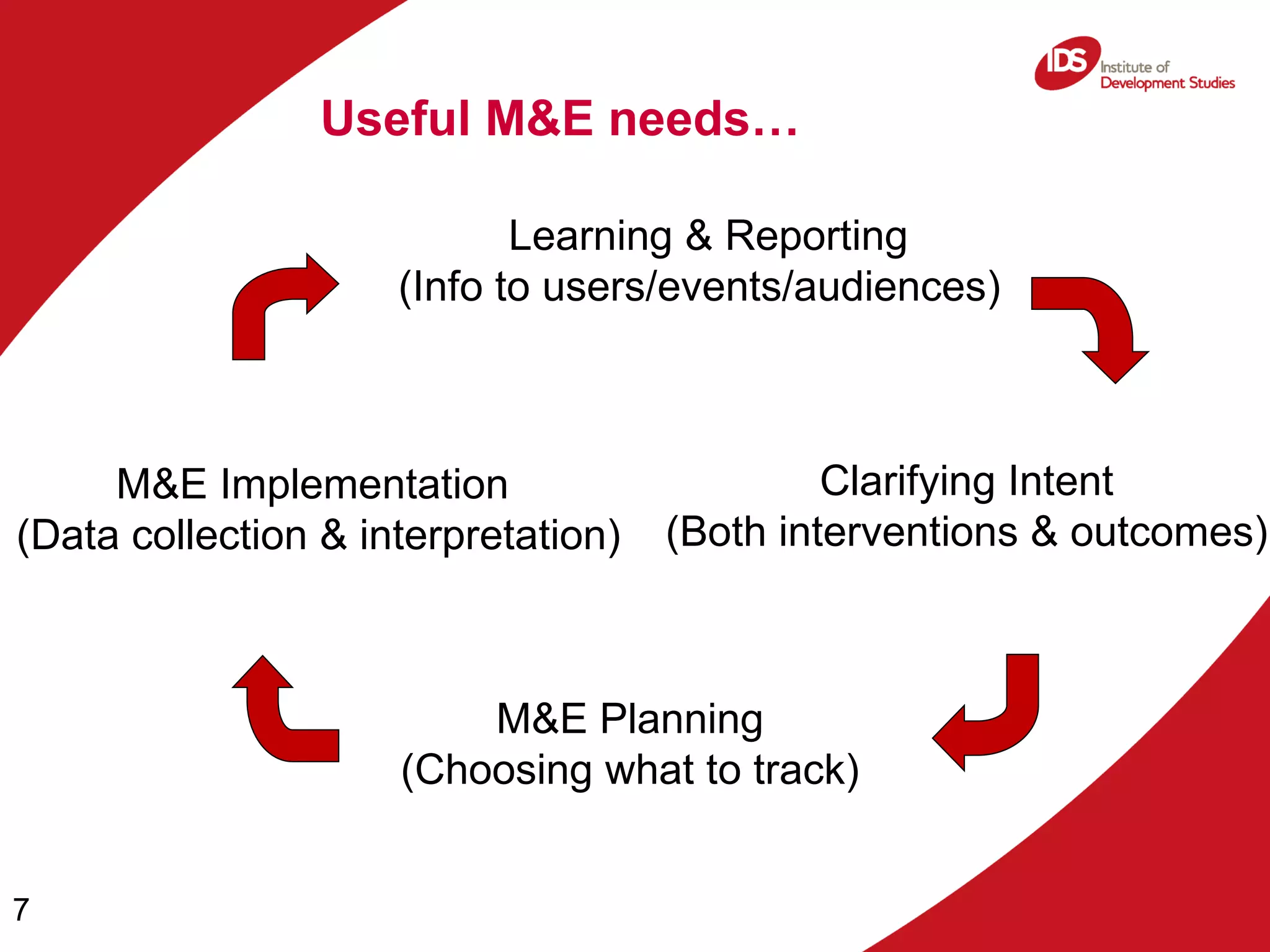
Learning & Reporting (Info to users/events/audiences) Clarifying Intent (Both interventions & outcomes) M&E Planning (Choosing what to track) M&E Implementation (Data collection & interpretation) Useful M&E needs…
Boundary partners those individuals, groups, and organisations with whom the program:  interacts directly to effect change anticipates opportunities for influence engages in mutual learning
Outcome mapping: Nested spheres Adapted from: Steff Deprez VVOB-CEGO, Nov 2006 sphere of  ‘control’ sphere of influence sphere of interest Research project Partners Beneficiaries
Outcomes and indicators Who has seen the wind? Neither I nor you. But when the leaves hang trembling, The wind is passing through.  Who has seen the wind?  Neither you nor I.  But when the trees bow down their heads,  The wind is passing by. By Christina Rossetti (1830-1894)
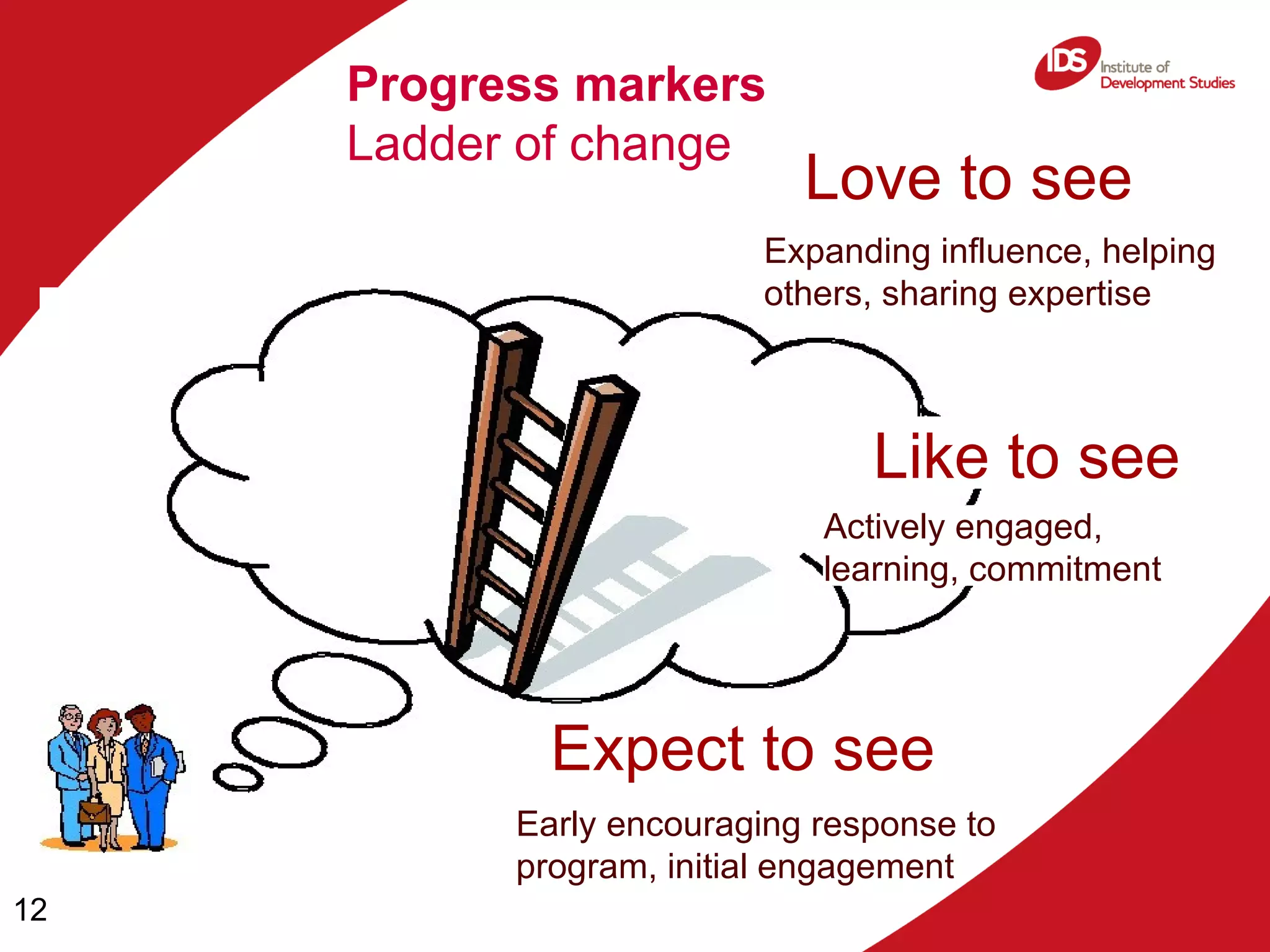
A graduated set of statements describing a progression of changed  behaviours  in the boundary partner Describe changes in actions, activities and relationships leading to the ideal outcome Articulate the complexity of the change process Progress markers
Progress markers Ladder of change Expanding influence, helping others, sharing expertise Actively engaged, learning, commitment  Early encouraging response to program, initial engagement Love to see Like to see Expect to see
Some indicators (suggested by Hilary) References to work of partners in policy and finance statements Statements and position papers Commitments in national plans and finance strategies Changes in position or attitudes Resources commitments of finance or health ministers Expenditure on contraception Changes in SRH spending Changes in services delivery
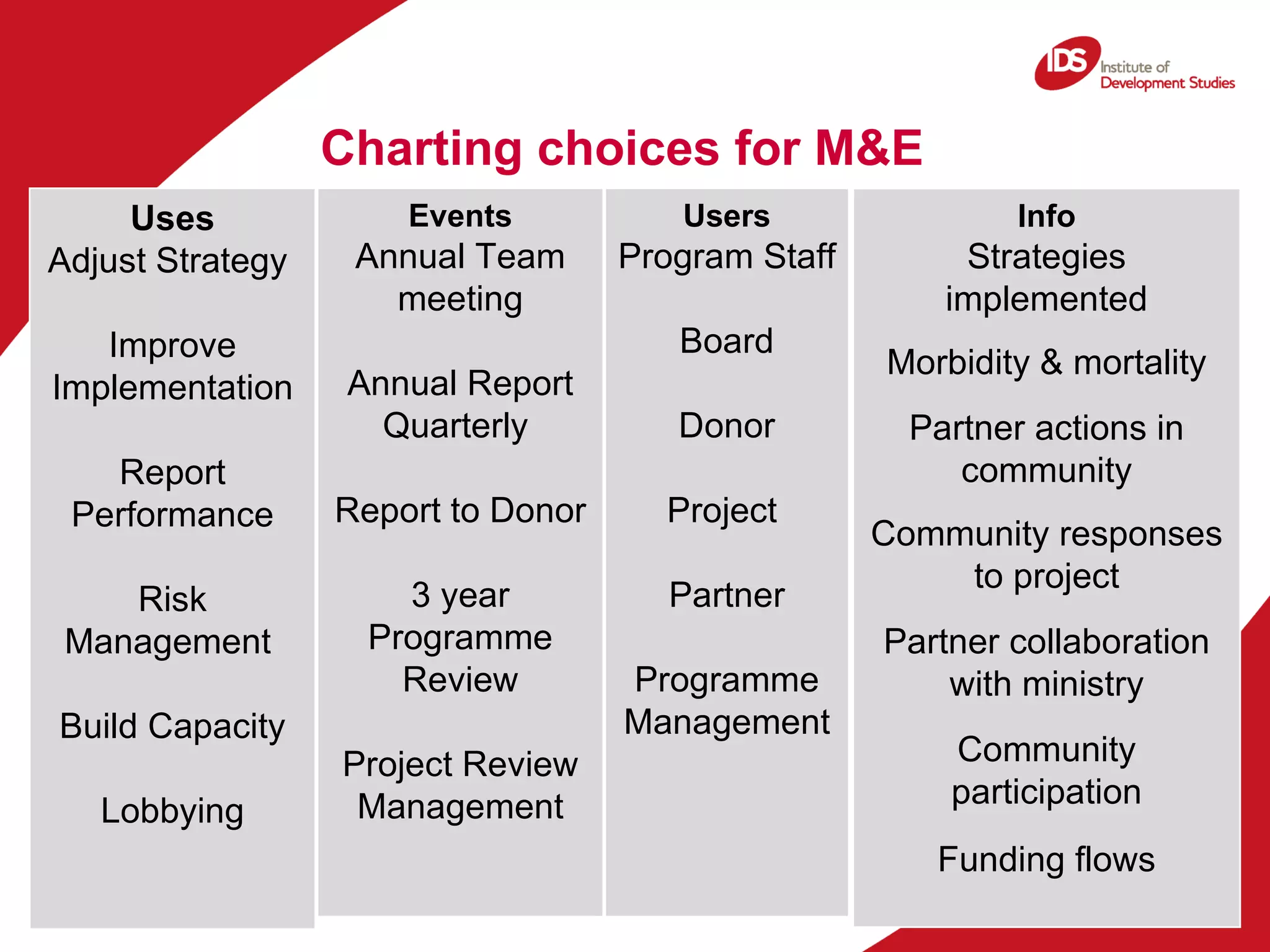
Charting choices for M&E Uses Adjust Strategy  Improve Implementation Report Performance Risk Management  Build Capacity Lobbying Events Annual Team meeting Annual Report Quarterly  Report to Donor 3 year  Programme  Review Project Review Management Users Program Staff  Board Donor Project  Partner Programme  Management Info Strategies implemented Morbidity & mortality Partner actions in community Community responses to project Partner collaboration with ministry Community participation Funding flows
… facilitate mid-course corrections and improvements articulate the complexity of change stimulate the program to consider how it can contribute to the most profound transformation possible suggest the logic model of change are NOT a checklist of accomplishments! Taken together,  progress markers
Who, what, when and how of evaluation What data will you need to collect? Who will collect it? When will you collect it? How often will you collect it?
Finally Expecting the unexpected Think about baselines Don’t just seek the positive  Most significant change Learn from your learning Share your learning Peer review
For more information on  Outcome Mapping : www.outcomemapping.ca   www.idrc.ca/evaluation For more information on the  Most Significant Change :  www.mande.co.uk/MSC Further reading

Monitoring and evaluation of research communications- what’s it all about?

  • 1.
    Monitoring and evaluationof research communications- what’s it all about? Anna Downie, Information Department, IDS
  • 2.
    Objectives for thesession To think about the purpose of evaluating communication strategies To develop some measurable indicators To identify data collection methods and monitoring processes
  • 3.
  • 4.
    Why evaluate yourcommunication strategy?
  • 5.
    What is “monitoring”? … routine, ongoing, collection of information on a program’s outputs, outcomes and indicators to measure, improve and report on the performance.
  • 6.
    What is “evaluation”?… the systematic acquisition and assessment of information to provide useful feedback about a program, policy, technology or activity.
  • 7.
    Learning & Reporting(Info to users/events/audiences) Clarifying Intent (Both interventions & outcomes) M&E Planning (Choosing what to track) M&E Implementation (Data collection & interpretation) Useful M&E needs…
  • 8.
    Boundary partners thoseindividuals, groups, and organisations with whom the program: interacts directly to effect change anticipates opportunities for influence engages in mutual learning
  • 9.
    Outcome mapping: Nestedspheres Adapted from: Steff Deprez VVOB-CEGO, Nov 2006 sphere of ‘control’ sphere of influence sphere of interest Research project Partners Beneficiaries
  • 10.
    Outcomes and indicatorsWho has seen the wind? Neither I nor you. But when the leaves hang trembling, The wind is passing through. Who has seen the wind? Neither you nor I. But when the trees bow down their heads, The wind is passing by. By Christina Rossetti (1830-1894)
  • 11.
    A graduated setof statements describing a progression of changed behaviours in the boundary partner Describe changes in actions, activities and relationships leading to the ideal outcome Articulate the complexity of the change process Progress markers
  • 12.
    Progress markers Ladderof change Expanding influence, helping others, sharing expertise Actively engaged, learning, commitment Early encouraging response to program, initial engagement Love to see Like to see Expect to see
  • 13.
    Some indicators (suggestedby Hilary) References to work of partners in policy and finance statements Statements and position papers Commitments in national plans and finance strategies Changes in position or attitudes Resources commitments of finance or health ministers Expenditure on contraception Changes in SRH spending Changes in services delivery
  • 14.
    Charting choices forM&E Uses Adjust Strategy Improve Implementation Report Performance Risk Management Build Capacity Lobbying Events Annual Team meeting Annual Report Quarterly Report to Donor 3 year Programme Review Project Review Management Users Program Staff Board Donor Project Partner Programme Management Info Strategies implemented Morbidity & mortality Partner actions in community Community responses to project Partner collaboration with ministry Community participation Funding flows
  • 15.
    … facilitate mid-coursecorrections and improvements articulate the complexity of change stimulate the program to consider how it can contribute to the most profound transformation possible suggest the logic model of change are NOT a checklist of accomplishments! Taken together, progress markers
  • 16.
    Who, what, whenand how of evaluation What data will you need to collect? Who will collect it? When will you collect it? How often will you collect it?
  • 17.
    Finally Expecting theunexpected Think about baselines Don’t just seek the positive Most significant change Learn from your learning Share your learning Peer review
  • 18.
    For more informationon Outcome Mapping : www.outcomemapping.ca www.idrc.ca/evaluation For more information on the Most Significant Change : www.mande.co.uk/MSC Further reading