Addictions and the Brain
Acknowledgements La Hacienda Treatment Center American Society of Addiction Medicine National Institute of Drug Abuse
Definition A primary, progressive biochemical, psychosocial, genetically transmitted chronic disease of relapse who’s hallmarks are denial, loss of control and unmanageability.
DSM IV Criteria for dependency:  At least 3 of the 7 below Withdrawal Tolerance The substance is taken in larger amounts or over a longer period than was intended. There is a persistent desire or unsuccessful efforts to cut down or control substance use. A great deal of time is spent in activities necessary to obtain the substance, use the substance, or recover from its effects. Important social, occupational, or recreational activities are given up or reduced because of the substance use. The substance use is continued despite knowledge of having a persistent or recurrent physical or psychological problem that is likely to have been caused or exacerbated by the substance.
Dispute between behavior and disease
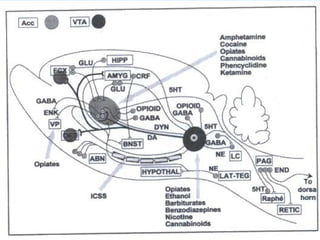
Present understanding of the Hypothalamus location of the disease hypothesis.


Dispute regarding behavior versus disease


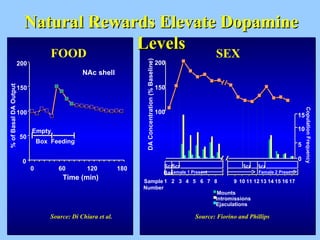
Natural Rewards Elevate Dopamine Levels 0 50 100 150 200 0 60 120 180 Time (min) % of Basal DA Output NAc shell Empty Box Feeding Source: Di Chiara et al. FOOD 100 150 200 DA Concentration (% Baseline) Mounts Intromissions Ejaculations 15 0 5 10 Copulation Frequency Sample Number 1 2 3 4 5 6 7 8 9 10 11 12 13 14 15 16 17 Scr Scr Bas Female 1 Present Scr Female 2 Present Scr Source: Fiorino and Phillips SEX
0 100 200 300 400 500 600 700 800 900 1000 1100 0 1 2 3 4 5 hr Time After Amphetamine % of Basal Release DA DOPAC HVA Accumbens AMPHETAMINE 0 100 200 300 400 0 1 2 3 4 5 hr Time After Cocaine % of Basal Release DA DOPAC HVA Accumbens COCAINE 0 100 150 200 250 0 1 2 3 4 5hr Time After Morphine % of Basal Release Accumbens 0.5 1.0 2.5 10 Dose (mg/kg) MORPHINE 0 100 150 200 250 0 1 2 3 hr Time After Nicotine % of Basal Release Accumbens Caudate NICOTINE Source: Di Chiara and Imperato Effects of Drugs on Dopamine Levels
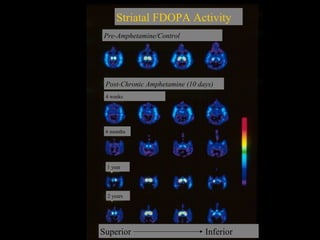
Post-Chronic Amphetamine (10 days) Pre-Amphetamine/Control Striatal FDOPA Activity 4 weeks 6 months 1 year 2 years Superior   Inferior
 
 
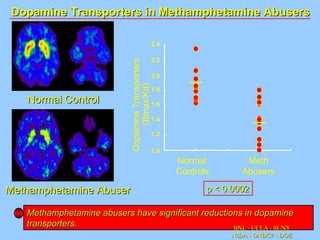
Dopamine Transporters in Methamphetamine Abusers Methamphetamine abusers have significant reductions in dopamine transporters. Normal Control Methamphetamine Abuser p < 0.0002 Dopamine Transporters (Bmax/Kd) 1.0 1.2 1.4 1.6 1.8 2.0 2.2 2.4 BNL - UCLA - SUNY NIDA - ONDCP - DOE Normal Controls Meth Abusers
Dopamine Transporters in Methamphetamine Abusers   BNL/UCLA/SUNY NIDA, ONDCP, DOE   Motor Task Loss of dopamine transporters  in the meth abusers may result  in slowing of motor reactions. Memory Task Loss of dopamine transporters  in the meth abusers may result  in memory impairment. Time Gait (seconds) Delayed Recall (words remembered) Dopamine Transporter Bmax/Kd  7 8 9 10 11 12 13 1.0 1.2 1.4 1.6 1.8 2.0 4 6 8 10 12 14 16 1.0 1.2 1.4 1.6 1.8 2.0
Cocaine Food DA D2 Receptor Availability Meth Alcohol Dopamine D2 Receptors in Addiction Experimental groups Control groups


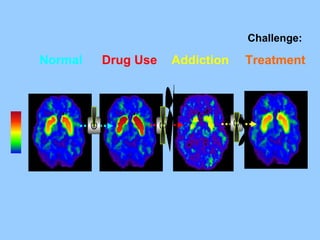
Drug Use Addiction Treatment Normal Challenge:
 
 
Three Major Relapse Pathways Cross Addicting Drugs People/Place/Things B.H.A.L.T.
Cross Addicting Drugs Chemical of choice Related drugs Tobacco Life long relapse pathway
People/Place/Things History of discovery Three month limit for relapse
B.H.A.L.T. Boredom Hunger Anger/emotions Loneliness Tiredness
Relapse Prevention Medications Antabuse Campral ReVia Vivitrol Off label
Antabuse Mechanism of action Dosing Side Effects Efficacy
Campral Mechanism of action Dosing Side Effects Efficacy
ReVia Mechanism of action Dosing Side Effects Efficacy
Vivitrol Mechanism of action Dosing Side Effects Efficacy
Off label
Cabergoline  Disulfiram (Antabuse)  Reserpine Selegiline Cocaine Methamphetamine Bupropion Lofexidine Opiates Phase 3 Clinical Trials On A Number of Promising Drugs
 
Dual Diagnosis Prevalence Testing Treatment
 
Spiritual Component of Recovery
Dr. Daniel Boone La Hacienda Treatment Center 800-749-6160 [email_address]

Addictions and the Brain

  • 1.
  • 2.
    Acknowledgements La HaciendaTreatment Center American Society of Addiction Medicine National Institute of Drug Abuse
  • 3.
    Definition A primary,progressive biochemical, psychosocial, genetically transmitted chronic disease of relapse who’s hallmarks are denial, loss of control and unmanageability.
  • 4.
    DSM IV Criteriafor dependency: At least 3 of the 7 below Withdrawal Tolerance The substance is taken in larger amounts or over a longer period than was intended. There is a persistent desire or unsuccessful efforts to cut down or control substance use. A great deal of time is spent in activities necessary to obtain the substance, use the substance, or recover from its effects. Important social, occupational, or recreational activities are given up or reduced because of the substance use. The substance use is continued despite knowledge of having a persistent or recurrent physical or psychological problem that is likely to have been caused or exacerbated by the substance.
  • 5.
  • 6.
    Present understanding ofthe Hypothalamus location of the disease hypothesis.
  • 7.
  • 8.
  • 9.
  • 10.
  • 11.
  • 12.
  • 13.
  • 14.
  • 15.
  • 16.
  • 17.
    Natural Rewards ElevateDopamine Levels 0 50 100 150 200 0 60 120 180 Time (min) % of Basal DA Output NAc shell Empty Box Feeding Source: Di Chiara et al. FOOD 100 150 200 DA Concentration (% Baseline) Mounts Intromissions Ejaculations 15 0 5 10 Copulation Frequency Sample Number 1 2 3 4 5 6 7 8 9 10 11 12 13 14 15 16 17 Scr Scr Bas Female 1 Present Scr Female 2 Present Scr Source: Fiorino and Phillips SEX
  • 18.
    0 100 200300 400 500 600 700 800 900 1000 1100 0 1 2 3 4 5 hr Time After Amphetamine % of Basal Release DA DOPAC HVA Accumbens AMPHETAMINE 0 100 200 300 400 0 1 2 3 4 5 hr Time After Cocaine % of Basal Release DA DOPAC HVA Accumbens COCAINE 0 100 150 200 250 0 1 2 3 4 5hr Time After Morphine % of Basal Release Accumbens 0.5 1.0 2.5 10 Dose (mg/kg) MORPHINE 0 100 150 200 250 0 1 2 3 hr Time After Nicotine % of Basal Release Accumbens Caudate NICOTINE Source: Di Chiara and Imperato Effects of Drugs on Dopamine Levels
  • 19.
    Post-Chronic Amphetamine (10days) Pre-Amphetamine/Control Striatal FDOPA Activity 4 weeks 6 months 1 year 2 years Superior Inferior
  • 20.
  • 21.
  • 22.
    Dopamine Transporters inMethamphetamine Abusers Methamphetamine abusers have significant reductions in dopamine transporters. Normal Control Methamphetamine Abuser p < 0.0002 Dopamine Transporters (Bmax/Kd) 1.0 1.2 1.4 1.6 1.8 2.0 2.2 2.4 BNL - UCLA - SUNY NIDA - ONDCP - DOE Normal Controls Meth Abusers
  • 23.
    Dopamine Transporters inMethamphetamine Abusers BNL/UCLA/SUNY NIDA, ONDCP, DOE Motor Task Loss of dopamine transporters in the meth abusers may result in slowing of motor reactions. Memory Task Loss of dopamine transporters in the meth abusers may result in memory impairment. Time Gait (seconds) Delayed Recall (words remembered) Dopamine Transporter Bmax/Kd 7 8 9 10 11 12 13 1.0 1.2 1.4 1.6 1.8 2.0 4 6 8 10 12 14 16 1.0 1.2 1.4 1.6 1.8 2.0
  • 24.
    Cocaine Food DAD2 Receptor Availability Meth Alcohol Dopamine D2 Receptors in Addiction Experimental groups Control groups
  • 25.
  • 26.
  • 27.
  • 28.
  • 29.
  • 30.
  • 31.
  • 32.
  • 33.
    Drug Use AddictionTreatment Normal Challenge:
  • 34.
  • 35.
  • 36.
    Three Major RelapsePathways Cross Addicting Drugs People/Place/Things B.H.A.L.T.
  • 37.
    Cross Addicting DrugsChemical of choice Related drugs Tobacco Life long relapse pathway
  • 38.
    People/Place/Things History ofdiscovery Three month limit for relapse
  • 39.
    B.H.A.L.T. Boredom HungerAnger/emotions Loneliness Tiredness
  • 40.
    Relapse Prevention MedicationsAntabuse Campral ReVia Vivitrol Off label
  • 41.
    Antabuse Mechanism ofaction Dosing Side Effects Efficacy
  • 42.
    Campral Mechanism ofaction Dosing Side Effects Efficacy
  • 43.
    ReVia Mechanism ofaction Dosing Side Effects Efficacy
  • 44.
    Vivitrol Mechanism ofaction Dosing Side Effects Efficacy
  • 45.
  • 46.
    Cabergoline Disulfiram(Antabuse) Reserpine Selegiline Cocaine Methamphetamine Bupropion Lofexidine Opiates Phase 3 Clinical Trials On A Number of Promising Drugs
  • 47.
  • 48.
    Dual Diagnosis PrevalenceTesting Treatment
  • 49.
  • 50.
  • 51.
    Dr. Daniel BooneLa Hacienda Treatment Center 800-749-6160 [email_address]

Editor's Notes

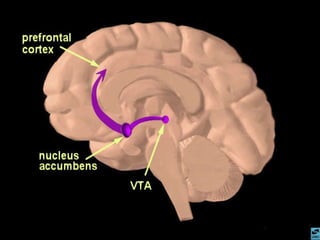
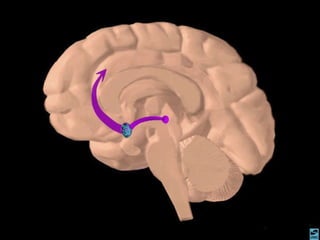
  • #15 Slide 9: The reward pathway Tell students that this is a view of the brain cut down the middle. An important part of the reward system is shown and the major structures are highlighted: the ventral tegmental area (VTA), the nucleus accumbens (nuc. acc.) and the prefrontal cortex. Also, the pathway connecting these structures is highlighted. The information travels from the VTA to the nucleus accumbens and then up to the prefrontal cortex. Reiterate that this pathway is activated by a rewarding stimulus. [Note to scientists - this is not the only pathway activated by reward, other structures are involved too, but only this part of the pathway is shown for simplicity.]
  • #17 Slide 11: Localization of cocaine &amp;quot;binding sites&amp;quot; When a person smokes or snorts cocaine, it travels quickly to the brain. Although it reaches all areas of the brain, it concentrates in some specific areas. These are highlighted with the turquoise sprinkles; the VTA, the nucleus accumbens and the caudate nucleus (lighter turquoise since the caudate is inside the hemisphere). Point out that cocaine concentrates especially in the reward areas that you have just discussed. Cocaine accumulation in other areas such as the caudate nucleus can explain other effects such as increased stereotypic behaviors (pacing, nail-biting, scratching, etc..)
  • #21 Slide 12: Dopamine binding to receptors and uptake pumps in the nucleus accumbens Explain that cocaine concentrates in areas of the brain that are rich in dopamine synapses. Review dopamine transmission in the nucleus accumbens. Point to dopamine in the synapse and to dopamine bound to dopamine receptors and to uptake pumps on the terminal.
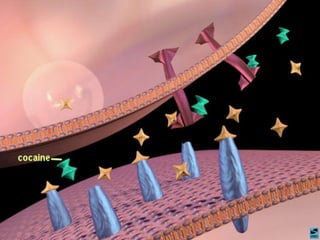
  • #22 Slide 13: Cocaine binding to uptake pumps; inhibition of dopamine uptake Now, show what happens when cocaine is present in the synapse. Cocaine (turquoise) binds to the uptake pumps and prevents them from removing dopamine from the synapse. This results in more dopamine in the synapse, and more dopamine receptors are activated.
  • #26 Slide 16: Positron emission tomography (PET) scan of a person on cocaine Cocaine has other actions in the brain in addition to activating reward. Scientists have the ability to see how cocaine actually affects brain function in people. The PET scan allows one to see how the brain uses glucose; glucose provides energy to each neuron so it can perform work. The scans show where the cocaine interferes with the brain&apos;s use of glucose - or its metabolic activity. The left scan is taken from a normal, awake person. The red color shows the highest level of glucose utilization (yellow represents less utilization and blue shows the least). The right scan is taken from a cocaine abuser on cocaine. It shows that the brain cannot use glucose nearly as effectively - show the loss of red compared to the left scan. There are many areas of the brain that have reduced metabolic activity. The continued reduction in the neurons&apos; ability to use glucose (energy) results in disruption of many brain functions.
  • #27 Slide 15: Summary; cocaine binding in nucleus accumbens and activation of reward pathway Show the &amp;quot;big picture&amp;quot;. As a result of cocaine&apos;s actions in the nucleus accumbens (point to the sprinkles of cocaine in the nuc. acc.), there are increased impulses leaving the nucleus accumbens to activate the reward system. Indicate that with continued use of cocaine, the body relies on this drug to maintain rewarding feelings. The person is no longer able to feel the positive reinforcement or pleasurable feelings of natural rewards (food, water, sex).
  • #30 Slide 17: Localization of opiate binding sites When a person injects heroin or morphine, it too, travels quickly to the brain. Point to the areas where opiates concentrate. The VTA, nucleus accumbens, caudate nucleus and thalamus are highlighted. The opiates bind to opiate receptors that are concentrated in areas within the reward system. Indicate that the action of opiates in the thalamus contributes to their ability to produce analgesia.
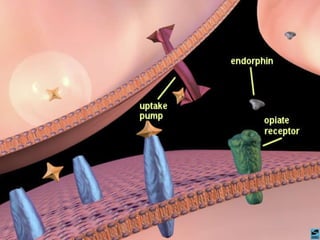
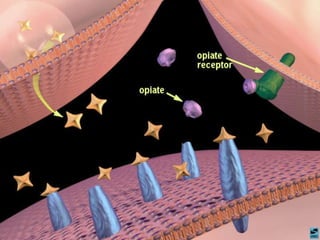
  • #31 Slide 18: Opiates binding to opiate receptors in the nucleus accumbens: increased dopamine release Show how opiates activiate the reward system using the nucleus accumbens as an example. Explain that the action is a little more complicated than cocaine&apos;s because more than two neurons are involved. Point out that 3 neurons participate in opiate action; the dopamine terminal, another terminal (on the right) containing a different neurotransmitter (probably GABA for those that would like to know), and the post-synaptic cell containing dopamine receptors. Show that opiates bind to opiate receptors (green) on the neighboring terminal and this sends a signal to the dopamine terminal to release more dopamine. [In case an inquisitive student asks how - one theory is that opiate receptor activation decreases GABA release, which normally inhibits dopamine release - so dopamine release is increased.]
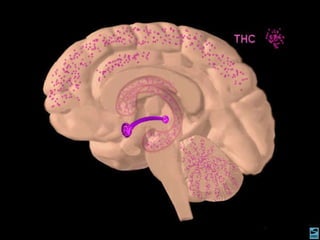
  • #32 Slide 21: Localization of THC binding sites When a person smokes marijuana, the active ingredient, cannabinoids or THC, travels quickly to the brain. Point to the areas where THC (magenta) concentrates. The VTA, nucleus accumbens, caudate nucleus, hippocampus, and cerebellum are highlighted. THC binds to THC receptors that are concentrated in areas within the reward system as well as these other areas. Indicate that the action of THC in the hippocampus explains its ability to interfere with memory and actions in the cerebellum are responsible for its ability to cause incoordination and loss of balance.
  • #33 Slide 22: THC binding to THC receptors in the nucleus accumbens: increased dopamine release [Note to scientists - the interaction of THC with the reward system is not fully understood at this point. The following discussion is based on recent data, but additional theories may emerge as we obtain more data.] State that scientists know the least about THC. Over the last few years, there has been intense study to discover where and how THC works. One theory is that it acts in a similar way to opiates. Again use the nucleus accumbens as an example. The same 3 neurons are probably involved; the dopamine terminal, another terminal (on the right) containing a different neurotransmitter (probably GABA), and the post-synaptic cell containing dopamine receptors. Ask the students if they can tell you how THC might work. THC binds to THC receptors (magenta) on the neighboring terminal and this sends a signal to the dopamine terminal to release more dopamine. [Again, it is probably a presynaptic receptor on GABA interneurons that controls dopamine release.]
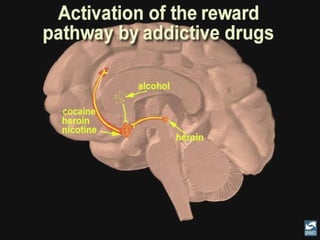
  • #35 Slide 25: Overall summary; these drugs of abuse all activate the reward system via increasing dopamine neurotransmission In this last slide, the binding of all 3 drugs is shown in one of the reward areas, the nucleus accumbens. Summarize that each drug increases the activity of the reward pathway by increasing dopamine transmission. This happens even though the drugs act by different mechanisms. Because of the way our brains are designed, and because these drugs activate a particular brain pathway for reward, they have the ability to be abused. Start a discussion; ask the students if they can think of any other drugs that are abused that probably activate the reward system in the same way. Answer: alcohol, nicotine, and amphetamine are good examples.