DRUG ADDICTION
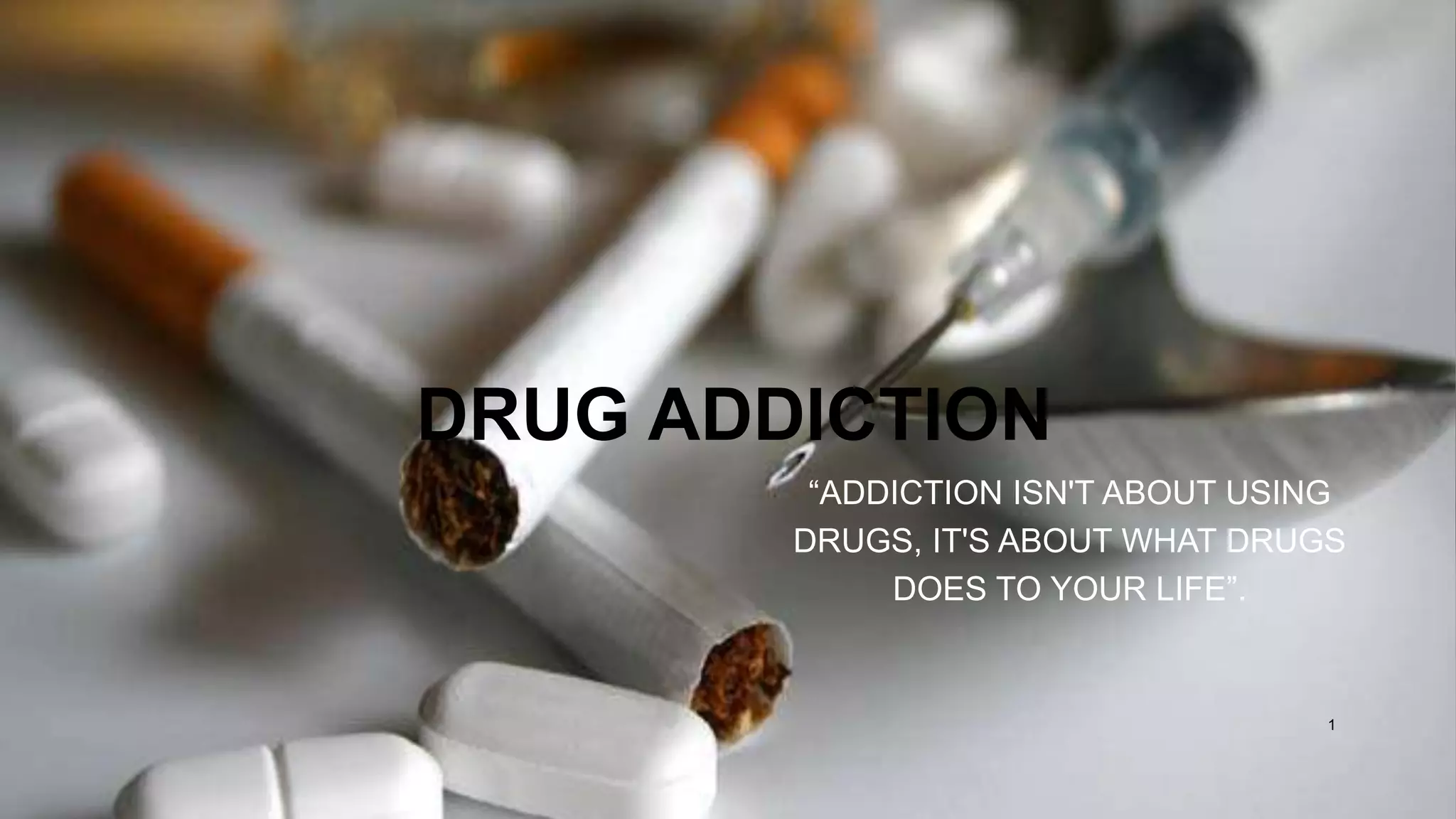
“ADDICTION ISN'T ABOUT USING
DRUGS, IT'S ABOUT WHAT DRUGS
DOES TO YOUR LIFE”.
1
INTRODUCTION TO DRUGS
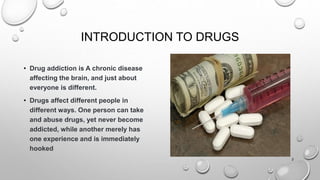
• Drug addiction is A chronic disease
affecting the brain, and just about
everyone is different.
• Drugs affect different people in
different ways. One person can take
and abuse drugs, yet never become
addicted, while another merely has
one experience and is immediately
hooked
2
INTRODUCTION TO DRUGS
• INTRODUCTION OF DRUG ADDICTION EXPLAINS AND IS CHARACTERIZED BY A
PERSON HAVING TO USE THE DRUG(S) REPEATEDLY, REGARDLESS OF THE
DAMAGE IT DOES TO;
- THEIR HEALTH
- THEIR FAMILY
- THEIR CAREER
- THEIR RELATIONSHIPS WITH
FRIENDS AND THE COMMUNITY
3
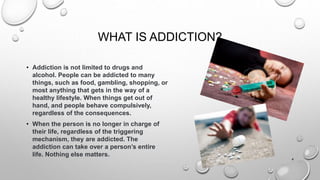
WHAT IS ADDICTION?
• Addiction is not limited to drugs and
alcohol. People can be addicted to many
things, such as food, gambling, shopping, or
most anything that gets in the way of a
healthy lifestyle. When things get out of
hand, and people behave compulsively,
regardless of the consequences.
• When the person is no longer in charge of
their life, regardless of the triggering
mechanism, they are addicted. The
addiction can take over a person’s entire
life. Nothing else matters.
4
WHAT CAUSES DRUG ADDICTION?
• There are several factors and causes to consider with addiction. First there is a
genetic component, that is, what is passed on to you through your family.
• If your blood relatives had a predisposition to become addicted, chances are you
have that same tendency.
• Personality contributes to drug addiction.
• Peer pressure is huge, both for teenagers and adults alike.
5
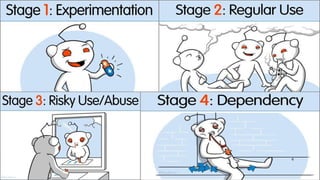
STAGES OF ADDICTION
6
STAGE 1
• CURIOSITY IS THE MOTIVATOR
• LEARNING TO TRUST/MISTRUST THE DRUG USED
• “HIGH” IS STILL A NEW FEELING
7
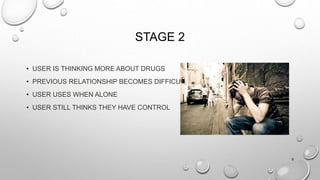
STAGE 2
• USER IS THINKING MORE ABOUT DRUGS
• PREVIOUS RELATIONSHIP BECOMES DIFFICULT
• USER USES WHEN ALONE
• USER STILL THINKS THEY HAVE CONTROL
8
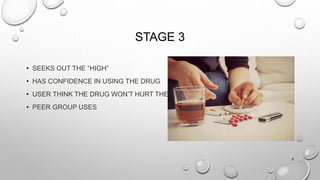
STAGE 3
• SEEKS OUT THE “HIGH”
• HAS CONFIDENCE IN USING THE DRUG
• USER THINK THE DRUG WON’T HURT THEM
• PEER GROUP USES
9
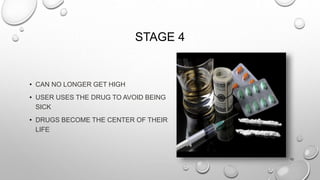
STAGE 4
• CAN NO LONGER GET HIGH
• USER USES THE DRUG TO AVOID BEING
SICK
• DRUGS BECOME THE CENTER OF THEIR
LIFE
10
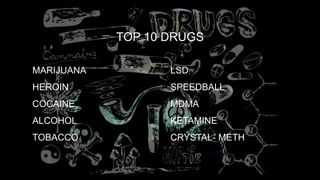
TOP 10 DRUGS
• MARIJUANA
• HEROIN
• COCAINE
• ALCOHOL
• TOBACCO
• LSD
• SPEEDBALL
• MDMA
• KETAMINE
• CRYSTAL- METH
11
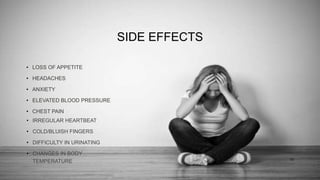
SIDE EFFECTS
• LOSS OF APPETITE
• HEADACHES
• ANXIETY
• ELEVATED BLOOD PRESSURE
• CHEST PAIN
• IRREGULAR HEARTBEAT
• COLD/BLUISH FINGERS
• DIFFICULTY IN URINATING
• CHANGES IN BODY
TEMPERATURE 12
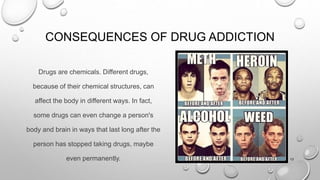
CONSEQUENCES OF DRUG ADDICTION
Drugs are chemicals. Different drugs,
because of their chemical structures, can
affect the body in different ways. In fact,
some drugs can even change a person's
body and brain in ways that last long after the
person has stopped taking drugs, maybe
even permanently. 13
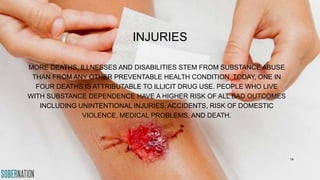
INJURIES
MORE DEATHS, ILLNESSES AND DISABILITIES STEM FROM SUBSTANCE ABUSE
THAN FROM ANY OTHER PREVENTABLE HEALTH CONDITION. TODAY, ONE IN
FOUR DEATHS IS ATTRIBUTABLE TO ILLICIT DRUG USE. PEOPLE WHO LIVE
WITH SUBSTANCE DEPENDENCE HAVE A HIGHER RISK OF ALL BAD OUTCOMES
INCLUDING UNINTENTIONAL INJURIES, ACCIDENTS, RISK OF DOMESTIC
VIOLENCE, MEDICAL PROBLEMS, AND DEATH.
14
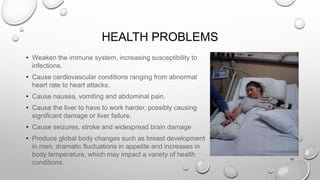
HEALTH PROBLEMS
• Weaken the immune system, increasing susceptibility to
infections.
• Cause cardiovascular conditions ranging from abnormal
heart rate to heart attacks.
• Cause nausea, vomiting and abdominal pain.
• Cause the liver to have to work harder, possibly causing
significant damage or liver failure.
• Cause seizures, stroke and widespread brain damage
• Produce global body changes such as breast development
in men, dramatic fluctuations in appetite and increases in
body temperature, which may impact a variety of health
conditions.
15
EFFECT ON THE BRAIN
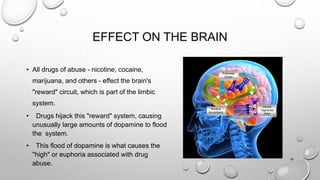
• All drugs of abuse - nicotine, cocaine,
marijuana, and others - effect the brain's
"reward" circuit, which is part of the limbic
system.
• Drugs hijack this "reward" system, causing
unusually large amounts of dopamine to flood
the system.
• This flood of dopamine is what causes the
"high" or euphoria associated with drug
abuse.
16
BEHAVIORAL PROBLEMS
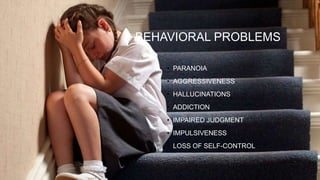
• PARANOIA
• AGGRESSIVENESS
• HALLUCINATIONS
• ADDICTION
• IMPAIRED JUDGMENT
• IMPULSIVENESS
• LOSS OF SELF-CONTROL
17
BIRTH DEFECTS
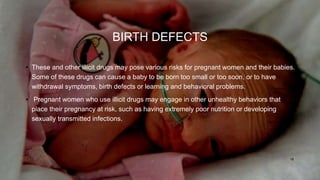
• These and other illicit drugs may pose various risks for pregnant women and their babies.
Some of these drugs can cause a baby to be born too small or too soon, or to have
withdrawal symptoms, birth defects or learning and behavioral problems.
• Pregnant women who use illicit drugs may engage in other unhealthy behaviors that
place their pregnancy at risk, such as having extremely poor nutrition or developing
sexually transmitted infections.
18
PAKISTAN DEALING WITH DRUG ADDICTION
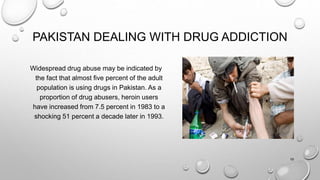
Widespread drug abuse may be indicated by
the fact that almost five percent of the adult
population is using drugs in Pakistan. As a
proportion of drug abusers, heroin users
have increased from 7.5 percent in 1983 to a
shocking 51 percent a decade later in 1993.
19
20
UNITED NATION FIGHTING DRUG ABUSE
Pakistan is not alone in fighting this disease.
With the
globalization of the drug abuse problem in
the last two decades, the situation has gone
from bad to worse, so much so that the
united nations commission on narcotic drugs
no longer discusses individual situations. It
has argued that the solution does not lie in
the hands of individual countries. It has to be
worked out through mutual efforts by south
Asian countries.
21
OVERCOMING DRUG ADDICTION
Decide to make a change:
• The way you deal with stress
• Who you allow in your life
• What you do in your free time
• How you think about yourself
22
OVERCOMING DRUG ADDICTION
• Lean on close friends and family
• Build a sober social network
• Consider moving into a sober living home
• Make meetings a priority
• Make break with old drug buddies
• Avoid bars and clubs
• Use caution with prescription drugs
23
COPING WITH DRUG CRAVINGS
• Get involved in some distracting activities
• Talk it through
• Urge surf
• Challenge and change your thoughts
24
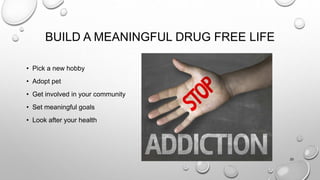
BUILD A MEANINGFUL DRUG FREE LIFE
• Pick a new hobby
• Adopt pet
• Get involved in your community
• Set meaningful goals
• Look after your health
25
26
27

Drug Addiction

  • 1.
    DRUG ADDICTION “ADDICTION ISN'TABOUT USING DRUGS, IT'S ABOUT WHAT DRUGS DOES TO YOUR LIFE”. 1
  • 2.
    INTRODUCTION TO DRUGS •Drug addiction is A chronic disease affecting the brain, and just about everyone is different. • Drugs affect different people in different ways. One person can take and abuse drugs, yet never become addicted, while another merely has one experience and is immediately hooked 2
  • 3.
    INTRODUCTION TO DRUGS •INTRODUCTION OF DRUG ADDICTION EXPLAINS AND IS CHARACTERIZED BY A PERSON HAVING TO USE THE DRUG(S) REPEATEDLY, REGARDLESS OF THE DAMAGE IT DOES TO; - THEIR HEALTH - THEIR FAMILY - THEIR CAREER - THEIR RELATIONSHIPS WITH FRIENDS AND THE COMMUNITY 3
  • 4.
    WHAT IS ADDICTION? •Addiction is not limited to drugs and alcohol. People can be addicted to many things, such as food, gambling, shopping, or most anything that gets in the way of a healthy lifestyle. When things get out of hand, and people behave compulsively, regardless of the consequences. • When the person is no longer in charge of their life, regardless of the triggering mechanism, they are addicted. The addiction can take over a person’s entire life. Nothing else matters. 4
  • 5.
    WHAT CAUSES DRUGADDICTION? • There are several factors and causes to consider with addiction. First there is a genetic component, that is, what is passed on to you through your family. • If your blood relatives had a predisposition to become addicted, chances are you have that same tendency. • Personality contributes to drug addiction. • Peer pressure is huge, both for teenagers and adults alike. 5
  • 6.
  • 7.
    STAGE 1 • CURIOSITYIS THE MOTIVATOR • LEARNING TO TRUST/MISTRUST THE DRUG USED • “HIGH” IS STILL A NEW FEELING 7
  • 8.
    STAGE 2 • USERIS THINKING MORE ABOUT DRUGS • PREVIOUS RELATIONSHIP BECOMES DIFFICULT • USER USES WHEN ALONE • USER STILL THINKS THEY HAVE CONTROL 8
  • 9.
    STAGE 3 • SEEKSOUT THE “HIGH” • HAS CONFIDENCE IN USING THE DRUG • USER THINK THE DRUG WON’T HURT THEM • PEER GROUP USES 9
  • 10.
    STAGE 4 • CANNO LONGER GET HIGH • USER USES THE DRUG TO AVOID BEING SICK • DRUGS BECOME THE CENTER OF THEIR LIFE 10
  • 11.
    TOP 10 DRUGS •MARIJUANA • HEROIN • COCAINE • ALCOHOL • TOBACCO • LSD • SPEEDBALL • MDMA • KETAMINE • CRYSTAL- METH 11
  • 12.
    SIDE EFFECTS • LOSSOF APPETITE • HEADACHES • ANXIETY • ELEVATED BLOOD PRESSURE • CHEST PAIN • IRREGULAR HEARTBEAT • COLD/BLUISH FINGERS • DIFFICULTY IN URINATING • CHANGES IN BODY TEMPERATURE 12
  • 13.
    CONSEQUENCES OF DRUGADDICTION Drugs are chemicals. Different drugs, because of their chemical structures, can affect the body in different ways. In fact, some drugs can even change a person's body and brain in ways that last long after the person has stopped taking drugs, maybe even permanently. 13
  • 14.
    INJURIES MORE DEATHS, ILLNESSESAND DISABILITIES STEM FROM SUBSTANCE ABUSE THAN FROM ANY OTHER PREVENTABLE HEALTH CONDITION. TODAY, ONE IN FOUR DEATHS IS ATTRIBUTABLE TO ILLICIT DRUG USE. PEOPLE WHO LIVE WITH SUBSTANCE DEPENDENCE HAVE A HIGHER RISK OF ALL BAD OUTCOMES INCLUDING UNINTENTIONAL INJURIES, ACCIDENTS, RISK OF DOMESTIC VIOLENCE, MEDICAL PROBLEMS, AND DEATH. 14
  • 15.
    HEALTH PROBLEMS • Weakenthe immune system, increasing susceptibility to infections. • Cause cardiovascular conditions ranging from abnormal heart rate to heart attacks. • Cause nausea, vomiting and abdominal pain. • Cause the liver to have to work harder, possibly causing significant damage or liver failure. • Cause seizures, stroke and widespread brain damage • Produce global body changes such as breast development in men, dramatic fluctuations in appetite and increases in body temperature, which may impact a variety of health conditions. 15
  • 16.
    EFFECT ON THEBRAIN • All drugs of abuse - nicotine, cocaine, marijuana, and others - effect the brain's "reward" circuit, which is part of the limbic system. • Drugs hijack this "reward" system, causing unusually large amounts of dopamine to flood the system. • This flood of dopamine is what causes the "high" or euphoria associated with drug abuse. 16
  • 17.
    BEHAVIORAL PROBLEMS • PARANOIA •AGGRESSIVENESS • HALLUCINATIONS • ADDICTION • IMPAIRED JUDGMENT • IMPULSIVENESS • LOSS OF SELF-CONTROL 17
  • 18.
    BIRTH DEFECTS • Theseand other illicit drugs may pose various risks for pregnant women and their babies. Some of these drugs can cause a baby to be born too small or too soon, or to have withdrawal symptoms, birth defects or learning and behavioral problems. • Pregnant women who use illicit drugs may engage in other unhealthy behaviors that place their pregnancy at risk, such as having extremely poor nutrition or developing sexually transmitted infections. 18
  • 19.
    PAKISTAN DEALING WITHDRUG ADDICTION Widespread drug abuse may be indicated by the fact that almost five percent of the adult population is using drugs in Pakistan. As a proportion of drug abusers, heroin users have increased from 7.5 percent in 1983 to a shocking 51 percent a decade later in 1993. 19
  • 20.
  • 21.
    UNITED NATION FIGHTINGDRUG ABUSE Pakistan is not alone in fighting this disease. With the globalization of the drug abuse problem in the last two decades, the situation has gone from bad to worse, so much so that the united nations commission on narcotic drugs no longer discusses individual situations. It has argued that the solution does not lie in the hands of individual countries. It has to be worked out through mutual efforts by south Asian countries. 21
  • 22.
    OVERCOMING DRUG ADDICTION Decideto make a change: • The way you deal with stress • Who you allow in your life • What you do in your free time • How you think about yourself 22
  • 23.
    OVERCOMING DRUG ADDICTION •Lean on close friends and family • Build a sober social network • Consider moving into a sober living home • Make meetings a priority • Make break with old drug buddies • Avoid bars and clubs • Use caution with prescription drugs 23
  • 24.
    COPING WITH DRUGCRAVINGS • Get involved in some distracting activities • Talk it through • Urge surf • Challenge and change your thoughts 24
  • 25.
    BUILD A MEANINGFULDRUG FREE LIFE • Pick a new hobby • Adopt pet • Get involved in your community • Set meaningful goals • Look after your health 25
  • 26.
  • 27.