EC 313: Adaptive Signal Processing                 Mayank Awasthi(10531005)
MATLAB Assignment – 1                              M.Tech , Communication Systems
                                                   IIT Roorkee

Chapter -5, Ques-20
function []= ques20()
%Given
a=.99;
uu=.05;

%Initializing v,u matrices to zero
v=zeros(100,101);
u=zeros(100,101);
%White noise generation with mean =0, variance= 0.02
for i= 1:100
v(i,:)= sqrt(0.02)*randn(1,101);
end

%Generating AR process with variance variance=1 considering 100 independent
%realizations
for i=1:100
   u(i,:)=filter(1 ,[1 a] ,v(i,:));
end

for n=1:100
w(1)=0;
for i=1:100
  f(n,i)=u(n,i)-w(i)*u(n,i+1);
  w(i+1)=w(i)+0.05*u(n,i+1)*f(n,i);
end
end

for i=1:100
for j=1:100
f(i,j)=f(i,j)^2;
end
end

%Ensemble averaging over 100 independent realization of the squared value
%of its output.
for n=1:100
 J(n)=mean(f(:,n));
end
 %Plotting Learning Curve
    plot(J)
end


     Mayank Awasthi(10531005), M.Tech , Communication Systems, IIT Roorkee
Output:


          Ensemble averaging over 100 independent realization of the squared value
                               of its output vs time 1≤n≤100


   Mayank Awasthi(10531005), M.Tech , Communication Systems, IIT Roorkee
Chapter -5, Ques-21
function []= ques21()
%Given
a1= 0.1;
a2= -0.8;
uu=0.05;
varv= 1- (a1*a1)/(1+a2)- (a2*a2) + (a1*a1*a2)/(1+a2)

v=zeros(1,102);
u=zeros(1,102);
%White noise generation with mean =0, variance= vvarv
  v= sqrt(varv)*randn(1,102);
%Generating AR process with variance variance=1
  u=filter(1 ,[1 a1,a2] ,v);

%Applying the LMS algorithm to calculate a1 and a2

w1(1)=0;
w2(1)=0;
for i=1:100
  f(i)=u(i)-w1(i)*u(i+1)-w2(i)*u(i+2);
  w1(i+1)=w1(i)+0.05*u(i+1)*f(i);
  w2(i+1)=w2(i)+0.05*u(i+2)*f(i);
end
a1_lms= -w1(100)
a2_lms= -w2(100)


%calculating eigen values
eig1= 1- a1/(1+a2);
eig2= 1+ a1/(1+a2);
%maximum step size
uumax= 2/eig2;
%calculating correlation matx and cross correlation matrix
R=[1, -a1/(1+a2); -a1/(1+a2), 1];
r1= -a1/(1+a2);
r2= (a1*a1)/(1+a2)- a2;
p= [r1;r2];
%Calculating optimum weights and minimum mean square error
wo= inv(R)*p;
Jmin= 1-transpose(p)*wo;


%Estimating expected value of weights and variance using small step size theory with
w(0)=0 so we have
 v1(1)= -1/sqrt(2)*(a1+a2);
 v2(1)= -1/sqrt(2)*(a1-a2);
 for n=1:100
    val=1;

    Mayank Awasthi(10531005), M.Tech , Communication Systems, IIT Roorkee
for j=1:n
       val= (1-uu*eig1)*val;
    end
       meanv1(n)=v1(1)*val;
       meansqv1(n)= uu*Jmin/(2-uu*eig1)+ val*val*(v1(1)*v1(1)- uu*Jmin/(2-
uu*eig1));
  end

  for n=1:100
     val=1;
     for j=1:n
        val= (1-uu*eig2)*val;
     end
        meanv2(n)=v2(1)*val;
        meansqv2(n)= uu*Jmin/(2-uu*eig2)+ val*val*(v2(1)*v2(1)- uu*Jmin/(2-
uu*eig2));
  end

  for n=1:100
  w1(n)= -a1-(meanv1(n)+meanv2(n))/sqrt(2);
  w2(n)= -a2-(meanv1(n)-meanv2(n))/sqrt(2);
  theoritical_J(n)= Jmin + eig1*meansqv1(n)*meansqv1(n) +
eig2*meansqv2(100)*meansqv2(n);
  end

 expectedvalue_weights=[w1(100);w2(100)];
 a1_ss= -w1(100)
 a2_ss= -w2(100)

  %Generating AR process with variance variance=1 considering 100 independent
%realizations
v=zeros(100,102);
u=zeros(100,102);
%White noise generation with mean =0, variance= 0.02
for i= 1:100
v(i,:)= sqrt(0.02)*randn(1,102);
u(i,:)=filter(1 ,[1 a1,a2] ,v(i,:));
end

for n=1:100
w1(1)=0;
w2(1)=0;
for i=1:100
  f(n,i)=u(n,i)-w1(i)*u(n,i+1)-w2(i)*u(n,i+2);
  w1(i+1)=w1(i)+0.05*u(n,i+1)*f(n,i);
  w2(i+1)=w2(i)+0.05*u(n,i+2)*f(n,i);
end
end


    Mayank Awasthi(10531005), M.Tech , Communication Systems, IIT Roorkee
for i=1:100
for j=1:100
f(i,j)=f(i,j)^2;
end
end
%Ensemble averaging over 100 independent realization of the squared value
%of its output.
for n=1:100
 J(n)=mean(f(:,n));
end
 %Plotting Learning Curve
 subplot(2,1,1);
    plot(J)

%ploting learning curve theoritically
subplot(2,1,2);
plot( theoritical_J);

end

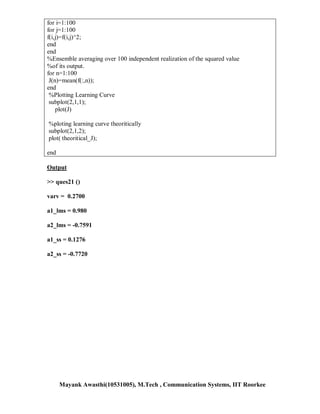
Output

>> ques21 ()

varv = 0.2700

a1_lms = 0.980

a2_lms = -0.7591

a1_ss = 0.1276

a2_ss = -0.7720


      Mayank Awasthi(10531005), M.Tech , Communication Systems, IIT Roorkee
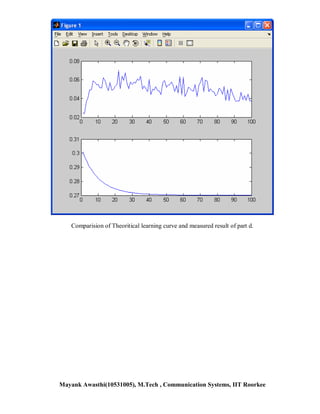
Comparision of Theoritical learning curve and measured result of part d.


Mayank Awasthi(10531005), M.Tech , Communication Systems, IIT Roorkee
Chapter-5 Ques 21- Part c

function []= ques21()
%Given
a1= 0.1;
a2= -0.8;

varv= 1- (a1*a1)/(1+a2)- (a2*a2) + (a1*a1*a2)/(1+a2);
v=zeros(1,102);
u=zeros(1,102);
%White noise generation with mean =0, variance= vvarv
   v= sqrt(varv)*randn(1,102);
%Generating AR process with variance variance=1
   u=filter(1 ,[1 a1,a2] ,v);

w1(1)=0;
w2(1)=0;
for i=1:100
  f(i)=u(i)-w1(i)*u(i+1)-w2(i)*u(i+2);
  w1(i+1)=w1(i)+0.05*u(i+1)*f(i);
  w2(i+1)=w2(i)+0.05*u(i+2)*f(i);
  e1(i)= -a1-w1(i);
  e2(i)= -a2-w2(i);
end

Fs = 32e3;

Pxx = periodogram(f);
Hpsd = dspdata.psd(Pxx,'Fs',Fs); % Create a PSD data object.
plot(Hpsd);             % Plot the PSD.

Pxx = periodogram(e1);
Hpsd = dspdata.psd(Pxx,'Fs',Fs); % Create a PSD data object.
plot(Hpsd);             % Plot the PSD.

Pxx = periodogram(e2);
Hpsd = dspdata.psd(Pxx,'Fs',Fs); % Create a PSD data object.
plot(Hpsd);             % Plot the PSD.

End


      Mayank Awasthi(10531005), M.Tech , Communication Systems, IIT Roorkee
PSD Plot of f (n)


Mayank Awasthi(10531005), M.Tech , Communication Systems, IIT Roorkee
PSD Plot of e1 (n)


Mayank Awasthi(10531005), M.Tech , Communication Systems, IIT Roorkee
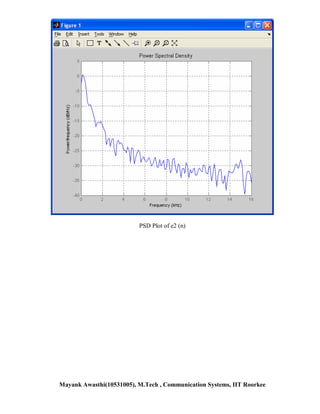
PSD Plot of e2 (n)


Mayank Awasthi(10531005), M.Tech , Communication Systems, IIT Roorkee
Chapter -5, Ques-22
function []= ques22(h1,h2,h3)

iter=500;          %no pf iterations
M=21;              %no of tap inputs
P=100;             %no of independent experiments
uu=0.001;          %learning parameter
h=[h1 h2 h3];      %channel impulse response
D1=1;              %channel impulse response is symmetric about n=1
D2=(M-1)/2;
D=D1+D2;            %total delay

for j=1:P
 %Generating Bernoulli sequence
 x=sign(rand(1,530)-0.5);
 %channel output
 u1 =conv(x,h);
 v=sqrt(0.01)*randn(1,length(u1));
 %adding AWGN noise with channel output
 u=u1+v;

%Applying LMS Algoritm
w=zeros(1,M);               %initializing weight vector
 for i=1:iter
   f(j,i) = x(D+i)- w*transpose(u(i:M-1+i));
   w= w+ uu*u(i:M-1+i)*f(j,i);
  end
end
subplot(2,2,3);
stem(w);                      %Plotting the weight vector
subplot(2,2,4);
stem(h);                      %Plotting the impuse response of channel

%Ensemble averaging over 100 independent realization of the squared value
%of its output.
for j=1:P
  f(j,:)= f(j,:).^2;
end
for n=1:iter
 J(n)=mean(f(:,n));
End

%Plotting the learning curve
subplot(2,2,1:2);
plot(J);
end


    Mayank Awasthi(10531005), M.Tech , Communication Systems, IIT Roorkee
Output:

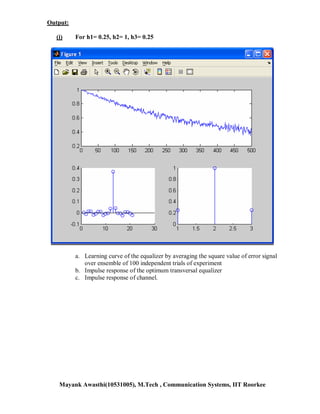
   (i)    For h1= 0.25, h2= 1, h3= 0.25


          a. Learning curve of the equalizer by averaging the square value of error signal
             over ensemble of 100 independent trials of experiment
          b. Impulse response of the optimum transversal equalizer
          c. Impulse response of channel.


    Mayank Awasthi(10531005), M.Tech , Communication Systems, IIT Roorkee
(ii)   For h1= 0.25, h2= 1, h3=- 0.25


       a. Learning curve of the equalizer by averaging the square value of error signal
          over ensemble of 100 independent trials of experiment
       b. Impulse response of the optimum transversal equalizer
       c. Impulse response of channel.


 Mayank Awasthi(10531005), M.Tech , Communication Systems, IIT Roorkee
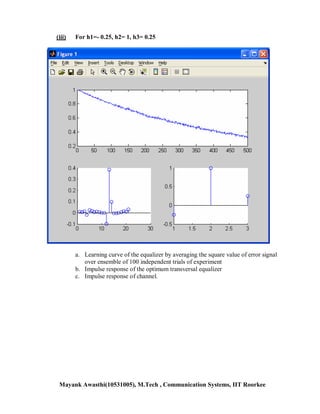
(iii)   For h1=- 0.25, h2= 1, h3= 0.25


        a. Learning curve of the equalizer by averaging the square value of error signal
           over ensemble of 100 independent trials of experiment
        b. Impulse response of the optimum transversal equalizer
        c. Impulse response of channel.


 Mayank Awasthi(10531005), M.Tech , Communication Systems, IIT Roorkee

Adaptive signal processing simon haykins

  • 1.
    EC 313: AdaptiveSignal Processing Mayank Awasthi(10531005) MATLAB Assignment – 1 M.Tech , Communication Systems IIT Roorkee Chapter -5, Ques-20 function []= ques20() %Given a=.99; uu=.05; %Initializing v,u matrices to zero v=zeros(100,101); u=zeros(100,101); %White noise generation with mean =0, variance= 0.02 for i= 1:100 v(i,:)= sqrt(0.02)*randn(1,101); end %Generating AR process with variance variance=1 considering 100 independent %realizations for i=1:100 u(i,:)=filter(1 ,[1 a] ,v(i,:)); end for n=1:100 w(1)=0; for i=1:100 f(n,i)=u(n,i)-w(i)*u(n,i+1); w(i+1)=w(i)+0.05*u(n,i+1)*f(n,i); end end for i=1:100 for j=1:100 f(i,j)=f(i,j)^2; end end %Ensemble averaging over 100 independent realization of the squared value %of its output. for n=1:100 J(n)=mean(f(:,n)); end %Plotting Learning Curve plot(J) end Mayank Awasthi(10531005), M.Tech , Communication Systems, IIT Roorkee
  • 2.
    Output: Ensemble averaging over 100 independent realization of the squared value of its output vs time 1≤n≤100 Mayank Awasthi(10531005), M.Tech , Communication Systems, IIT Roorkee
  • 3.
    Chapter -5, Ques-21 function[]= ques21() %Given a1= 0.1; a2= -0.8; uu=0.05; varv= 1- (a1*a1)/(1+a2)- (a2*a2) + (a1*a1*a2)/(1+a2) v=zeros(1,102); u=zeros(1,102); %White noise generation with mean =0, variance= vvarv v= sqrt(varv)*randn(1,102); %Generating AR process with variance variance=1 u=filter(1 ,[1 a1,a2] ,v); %Applying the LMS algorithm to calculate a1 and a2 w1(1)=0; w2(1)=0; for i=1:100 f(i)=u(i)-w1(i)*u(i+1)-w2(i)*u(i+2); w1(i+1)=w1(i)+0.05*u(i+1)*f(i); w2(i+1)=w2(i)+0.05*u(i+2)*f(i); end a1_lms= -w1(100) a2_lms= -w2(100) %calculating eigen values eig1= 1- a1/(1+a2); eig2= 1+ a1/(1+a2); %maximum step size uumax= 2/eig2; %calculating correlation matx and cross correlation matrix R=[1, -a1/(1+a2); -a1/(1+a2), 1]; r1= -a1/(1+a2); r2= (a1*a1)/(1+a2)- a2; p= [r1;r2]; %Calculating optimum weights and minimum mean square error wo= inv(R)*p; Jmin= 1-transpose(p)*wo; %Estimating expected value of weights and variance using small step size theory with w(0)=0 so we have v1(1)= -1/sqrt(2)*(a1+a2); v2(1)= -1/sqrt(2)*(a1-a2); for n=1:100 val=1; Mayank Awasthi(10531005), M.Tech , Communication Systems, IIT Roorkee
  • 4.
    for j=1:n val= (1-uu*eig1)*val; end meanv1(n)=v1(1)*val; meansqv1(n)= uu*Jmin/(2-uu*eig1)+ val*val*(v1(1)*v1(1)- uu*Jmin/(2- uu*eig1)); end for n=1:100 val=1; for j=1:n val= (1-uu*eig2)*val; end meanv2(n)=v2(1)*val; meansqv2(n)= uu*Jmin/(2-uu*eig2)+ val*val*(v2(1)*v2(1)- uu*Jmin/(2- uu*eig2)); end for n=1:100 w1(n)= -a1-(meanv1(n)+meanv2(n))/sqrt(2); w2(n)= -a2-(meanv1(n)-meanv2(n))/sqrt(2); theoritical_J(n)= Jmin + eig1*meansqv1(n)*meansqv1(n) + eig2*meansqv2(100)*meansqv2(n); end expectedvalue_weights=[w1(100);w2(100)]; a1_ss= -w1(100) a2_ss= -w2(100) %Generating AR process with variance variance=1 considering 100 independent %realizations v=zeros(100,102); u=zeros(100,102); %White noise generation with mean =0, variance= 0.02 for i= 1:100 v(i,:)= sqrt(0.02)*randn(1,102); u(i,:)=filter(1 ,[1 a1,a2] ,v(i,:)); end for n=1:100 w1(1)=0; w2(1)=0; for i=1:100 f(n,i)=u(n,i)-w1(i)*u(n,i+1)-w2(i)*u(n,i+2); w1(i+1)=w1(i)+0.05*u(n,i+1)*f(n,i); w2(i+1)=w2(i)+0.05*u(n,i+2)*f(n,i); end end Mayank Awasthi(10531005), M.Tech , Communication Systems, IIT Roorkee
  • 5.
    for i=1:100 for j=1:100 f(i,j)=f(i,j)^2; end end %Ensembleaveraging over 100 independent realization of the squared value %of its output. for n=1:100 J(n)=mean(f(:,n)); end %Plotting Learning Curve subplot(2,1,1); plot(J) %ploting learning curve theoritically subplot(2,1,2); plot( theoritical_J); end Output >> ques21 () varv = 0.2700 a1_lms = 0.980 a2_lms = -0.7591 a1_ss = 0.1276 a2_ss = -0.7720 Mayank Awasthi(10531005), M.Tech , Communication Systems, IIT Roorkee
  • 6.
    Comparision of Theoriticallearning curve and measured result of part d. Mayank Awasthi(10531005), M.Tech , Communication Systems, IIT Roorkee
  • 7.
    Chapter-5 Ques 21-Part c function []= ques21() %Given a1= 0.1; a2= -0.8; varv= 1- (a1*a1)/(1+a2)- (a2*a2) + (a1*a1*a2)/(1+a2); v=zeros(1,102); u=zeros(1,102); %White noise generation with mean =0, variance= vvarv v= sqrt(varv)*randn(1,102); %Generating AR process with variance variance=1 u=filter(1 ,[1 a1,a2] ,v); w1(1)=0; w2(1)=0; for i=1:100 f(i)=u(i)-w1(i)*u(i+1)-w2(i)*u(i+2); w1(i+1)=w1(i)+0.05*u(i+1)*f(i); w2(i+1)=w2(i)+0.05*u(i+2)*f(i); e1(i)= -a1-w1(i); e2(i)= -a2-w2(i); end Fs = 32e3; Pxx = periodogram(f); Hpsd = dspdata.psd(Pxx,'Fs',Fs); % Create a PSD data object. plot(Hpsd); % Plot the PSD. Pxx = periodogram(e1); Hpsd = dspdata.psd(Pxx,'Fs',Fs); % Create a PSD data object. plot(Hpsd); % Plot the PSD. Pxx = periodogram(e2); Hpsd = dspdata.psd(Pxx,'Fs',Fs); % Create a PSD data object. plot(Hpsd); % Plot the PSD. End Mayank Awasthi(10531005), M.Tech , Communication Systems, IIT Roorkee
  • 8.
    PSD Plot off (n) Mayank Awasthi(10531005), M.Tech , Communication Systems, IIT Roorkee
  • 9.
    PSD Plot ofe1 (n) Mayank Awasthi(10531005), M.Tech , Communication Systems, IIT Roorkee
  • 10.
    PSD Plot ofe2 (n) Mayank Awasthi(10531005), M.Tech , Communication Systems, IIT Roorkee
  • 11.
    Chapter -5, Ques-22 function[]= ques22(h1,h2,h3) iter=500; %no pf iterations M=21; %no of tap inputs P=100; %no of independent experiments uu=0.001; %learning parameter h=[h1 h2 h3]; %channel impulse response D1=1; %channel impulse response is symmetric about n=1 D2=(M-1)/2; D=D1+D2; %total delay for j=1:P %Generating Bernoulli sequence x=sign(rand(1,530)-0.5); %channel output u1 =conv(x,h); v=sqrt(0.01)*randn(1,length(u1)); %adding AWGN noise with channel output u=u1+v; %Applying LMS Algoritm w=zeros(1,M); %initializing weight vector for i=1:iter f(j,i) = x(D+i)- w*transpose(u(i:M-1+i)); w= w+ uu*u(i:M-1+i)*f(j,i); end end subplot(2,2,3); stem(w); %Plotting the weight vector subplot(2,2,4); stem(h); %Plotting the impuse response of channel %Ensemble averaging over 100 independent realization of the squared value %of its output. for j=1:P f(j,:)= f(j,:).^2; end for n=1:iter J(n)=mean(f(:,n)); End %Plotting the learning curve subplot(2,2,1:2); plot(J); end Mayank Awasthi(10531005), M.Tech , Communication Systems, IIT Roorkee
  • 12.
    Output: (i) For h1= 0.25, h2= 1, h3= 0.25 a. Learning curve of the equalizer by averaging the square value of error signal over ensemble of 100 independent trials of experiment b. Impulse response of the optimum transversal equalizer c. Impulse response of channel. Mayank Awasthi(10531005), M.Tech , Communication Systems, IIT Roorkee
  • 13.
    (ii) For h1= 0.25, h2= 1, h3=- 0.25 a. Learning curve of the equalizer by averaging the square value of error signal over ensemble of 100 independent trials of experiment b. Impulse response of the optimum transversal equalizer c. Impulse response of channel. Mayank Awasthi(10531005), M.Tech , Communication Systems, IIT Roorkee
  • 14.
    (iii) For h1=- 0.25, h2= 1, h3= 0.25 a. Learning curve of the equalizer by averaging the square value of error signal over ensemble of 100 independent trials of experiment b. Impulse response of the optimum transversal equalizer c. Impulse response of channel. Mayank Awasthi(10531005), M.Tech , Communication Systems, IIT Roorkee