
Adapting Apache UIMA to OSGi
     Tommaso Teofili | Adobe Basel R&D


© 2012 Adobe Systems Incorporated. All Rights Reserved.
Agenda

    The problem:
         not-OSGi stuff in an OSGi world
         use case
    Possible adaption approaches discussion
         an approach for our use case
    Conclusions


© 2012 Adobe Systems Incorporated. All Rights Reserved.   2
Use case: Domeo

    Annotation toolkit
    create & share ontology based annotations
    using AnnotationOntology RDF model
    supporting (semi) automated annotation
         Apache UIMA based text mining applications integrate via Apache
          Clerezza platform
         but ... Clerezza is OSGi based while UIMA is not


© 2012 Adobe Systems Incorporated. All Rights Reserved.   3
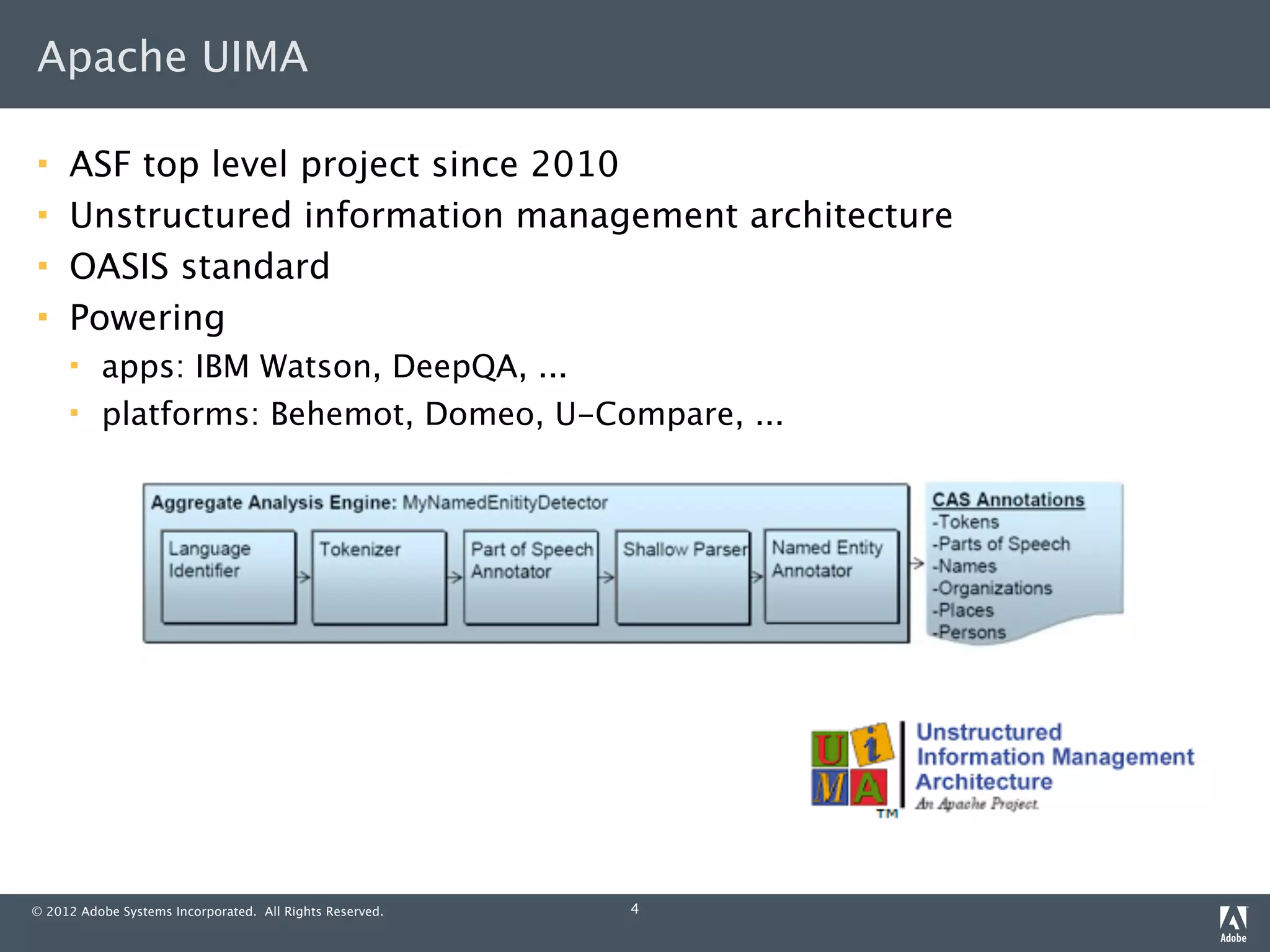
Apache UIMA

    ASF top level project since 2010
    Unstructured information management architecture
    OASIS standard
    Powering
         apps: IBM Watson, DeepQA, ...
         platforms: Behemot, Domeo, U-Compare, ...


© 2012 Adobe Systems Incorporated. All Rights Reserved.   4
Apache Clerezza

    Apache Incubator project
    Service platform for linked data
    RDF API
    JAX-RS implementation
    OSGi based
    Powering Apache Stanbol semantic content management project


© 2012 Adobe Systems Incorporated. All Rights Reserved.   5
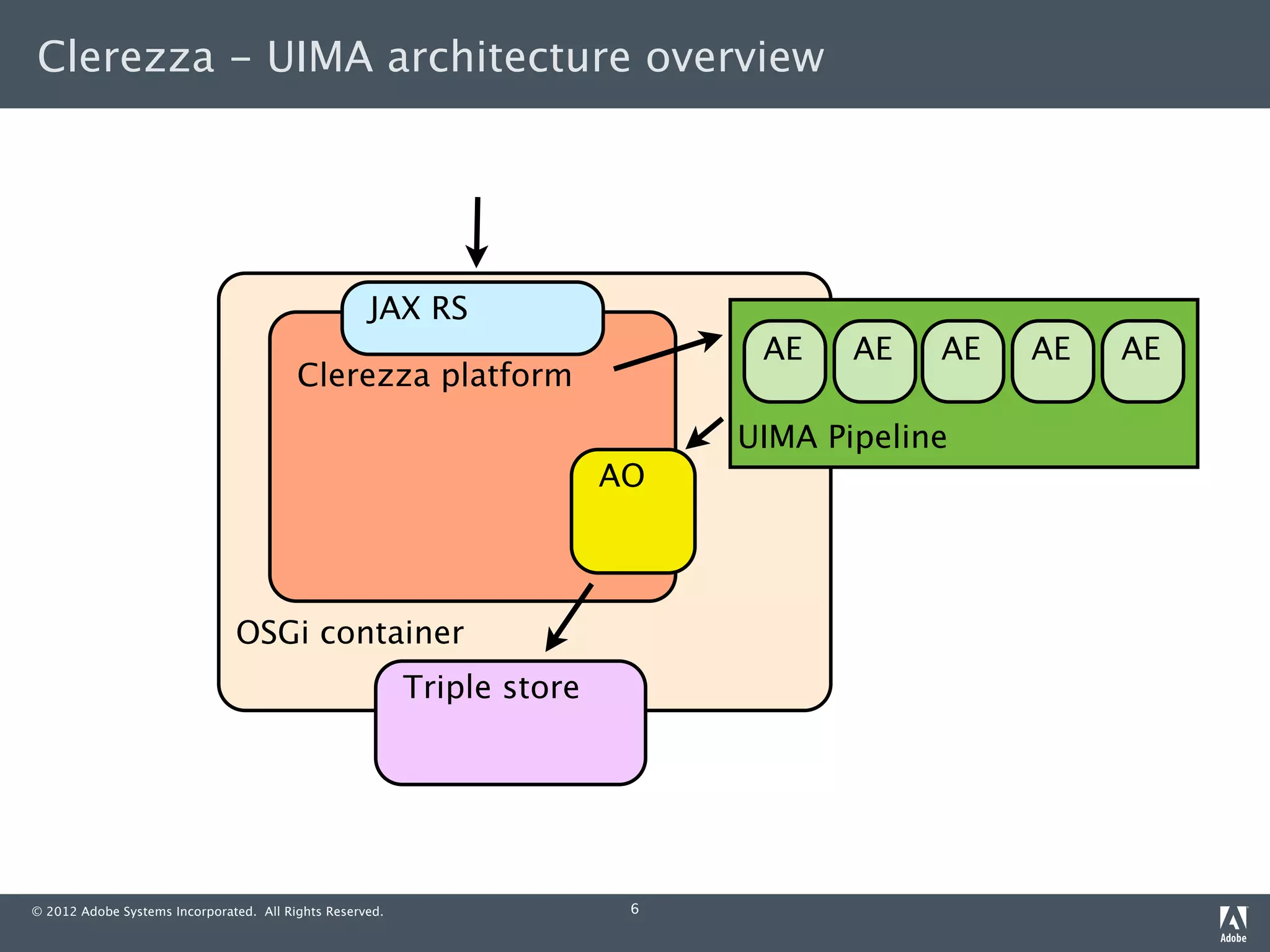
Clerezza - UIMA architecture overview


                                                    JAX RS
                                                                               AE    AE   AE   AE   AE
                                         Clerezza platform
                                                                              UIMA Pipeline
                                                                         AO


                               OSGi container
                                                          Triple store


© 2012 Adobe Systems Incorporated. All Rights Reserved.                   6
The problem

    Apache Clerezza
         is OSGi based (running on Apache Felix)
         artifacts delivered as bundles
    Apache UIMA
         is not OSGi based
         is not OSGi ready
         artifacts delivered as standard jars / PEARs
         using reflection / custom classloading
         has some OSGi artifacts for UIMA Eclipse plugins
    How to flawlessly let UIMA live and run inside Clerezza?


© 2012 Adobe Systems Incorporated. All Rights Reserved.   7
Adapting to OSGi

    Things to consider:
         backward compatibility
         development effort
         classloading
         packaging / deployments
         semantic versioning

    Business requirements are crucial to prioritize the above list


© 2012 Adobe Systems Incorporated. All Rights Reserved.   8
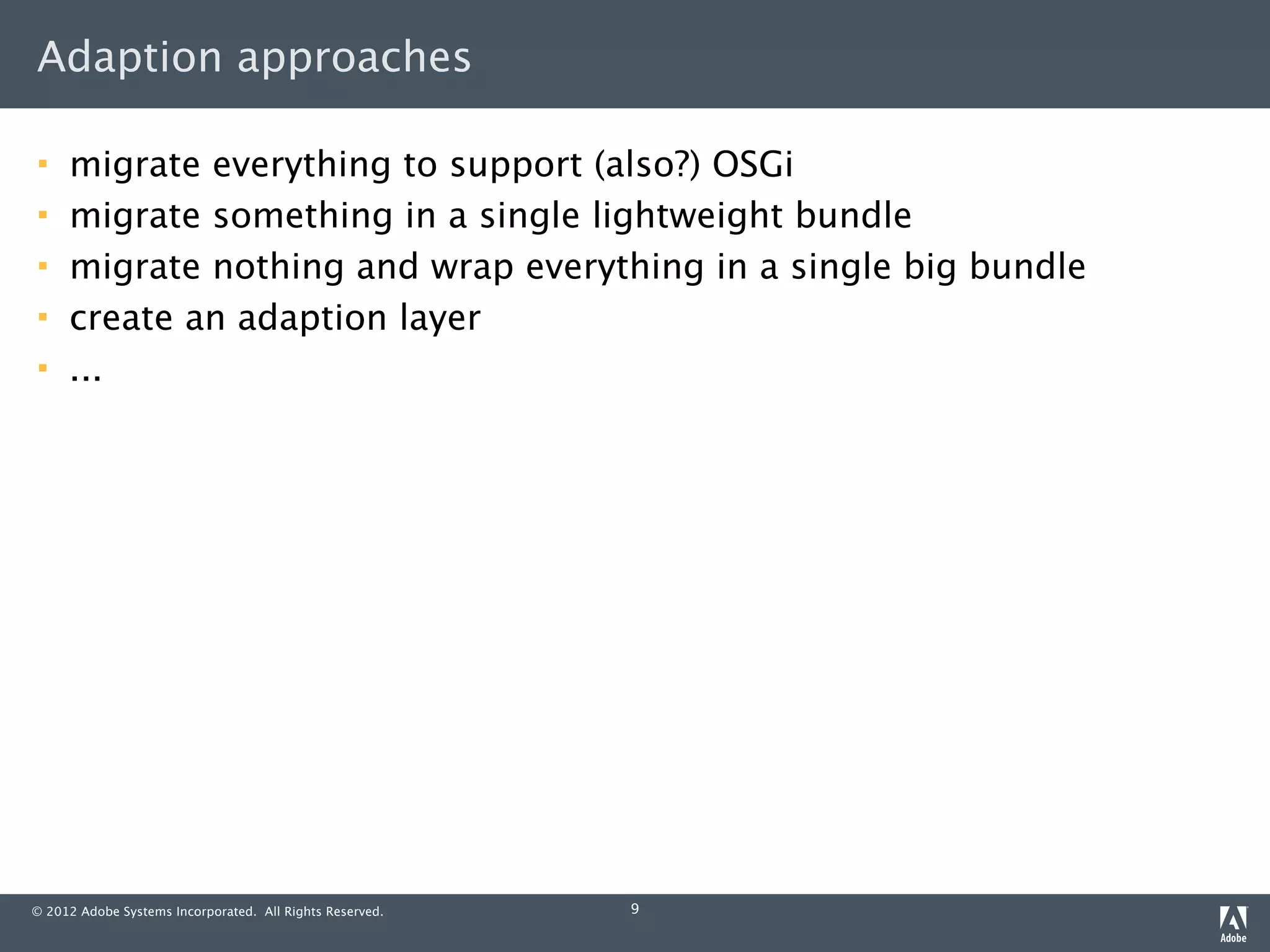
Adaption approaches

    migrate everything to support (also?) OSGi
    migrate something in a single lightweight bundle
    migrate nothing and wrap everything in a single big bundle
    create an adaption layer
    ...


© 2012 Adobe Systems Incorporated. All Rights Reserved.   9
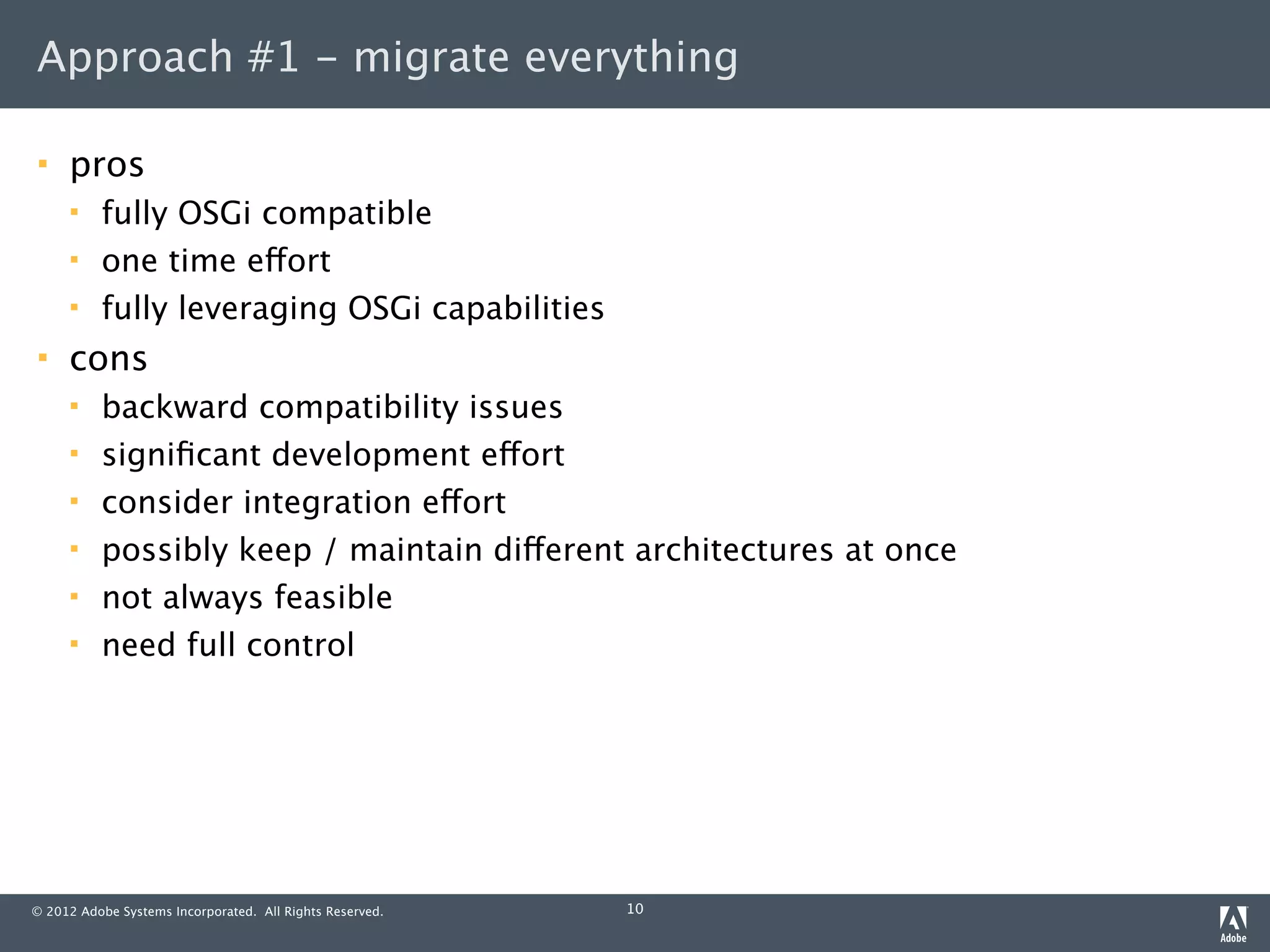
Approach #1 - migrate everything

    pros
         fully OSGi compatible
         one time effort
         fully leveraging OSGi capabilities
    cons
         backward compatibility issues
         significant development effort
         consider integration effort
         possibly keep / maintain different architectures at once
         not always feasible
         need full control


© 2012 Adobe Systems Incorporated. All Rights Reserved.   10
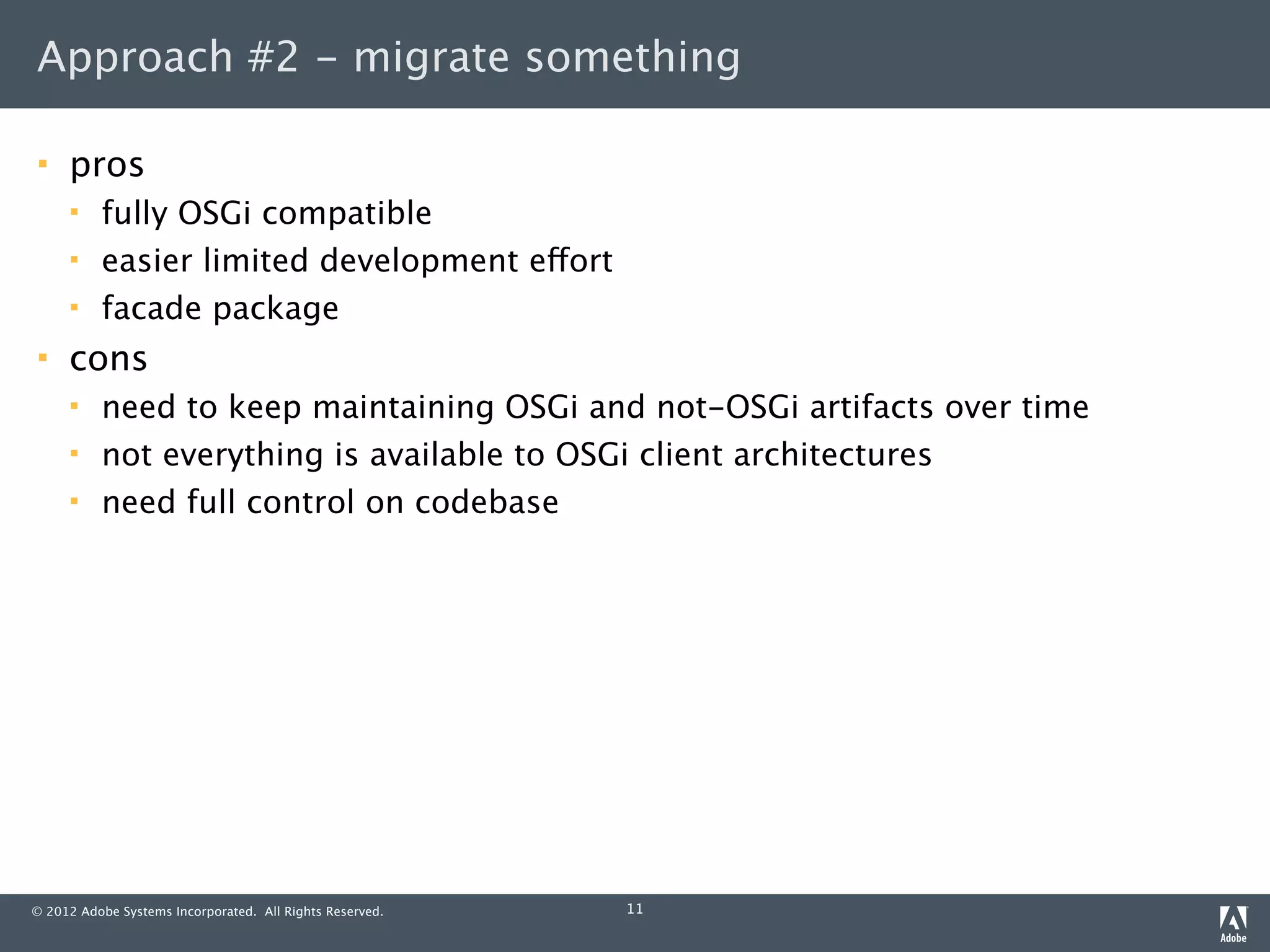
Approach #2 - migrate something

    pros
         fully OSGi compatible
         easier limited development effort
         facade package
    cons
         need to keep maintaining OSGi and not-OSGi artifacts over time
         not everything is available to OSGi client architectures
         need full control on codebase


© 2012 Adobe Systems Incorporated. All Rights Reserved.   11
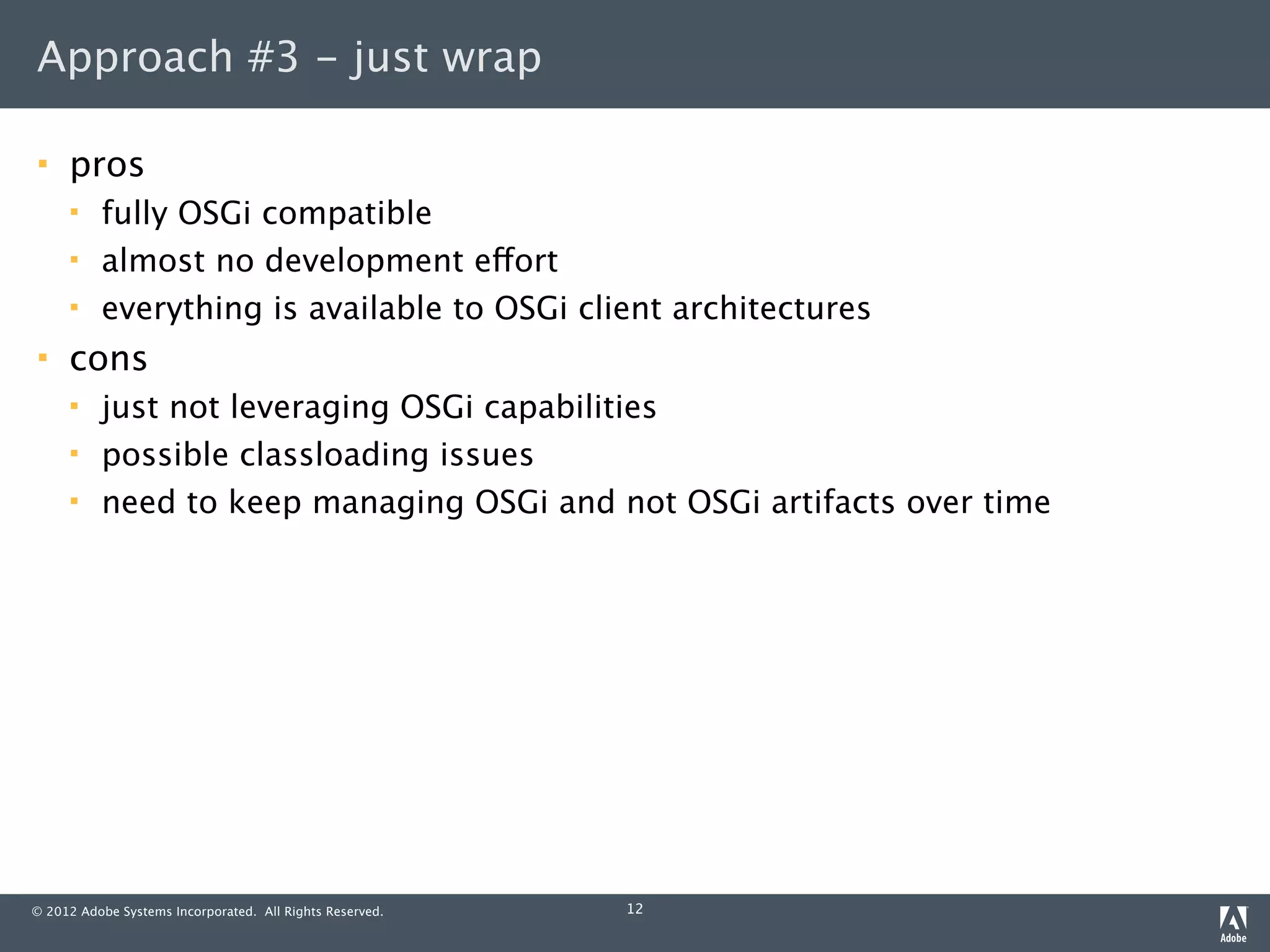
Approach #3 - just wrap

    pros
         fully OSGi compatible
         almost no development effort
         everything is available to OSGi client architectures
    cons
         just not leveraging OSGi capabilities
         possible classloading issues
         need to keep managing OSGi and not OSGi artifacts over time


© 2012 Adobe Systems Incorporated. All Rights Reserved.   12
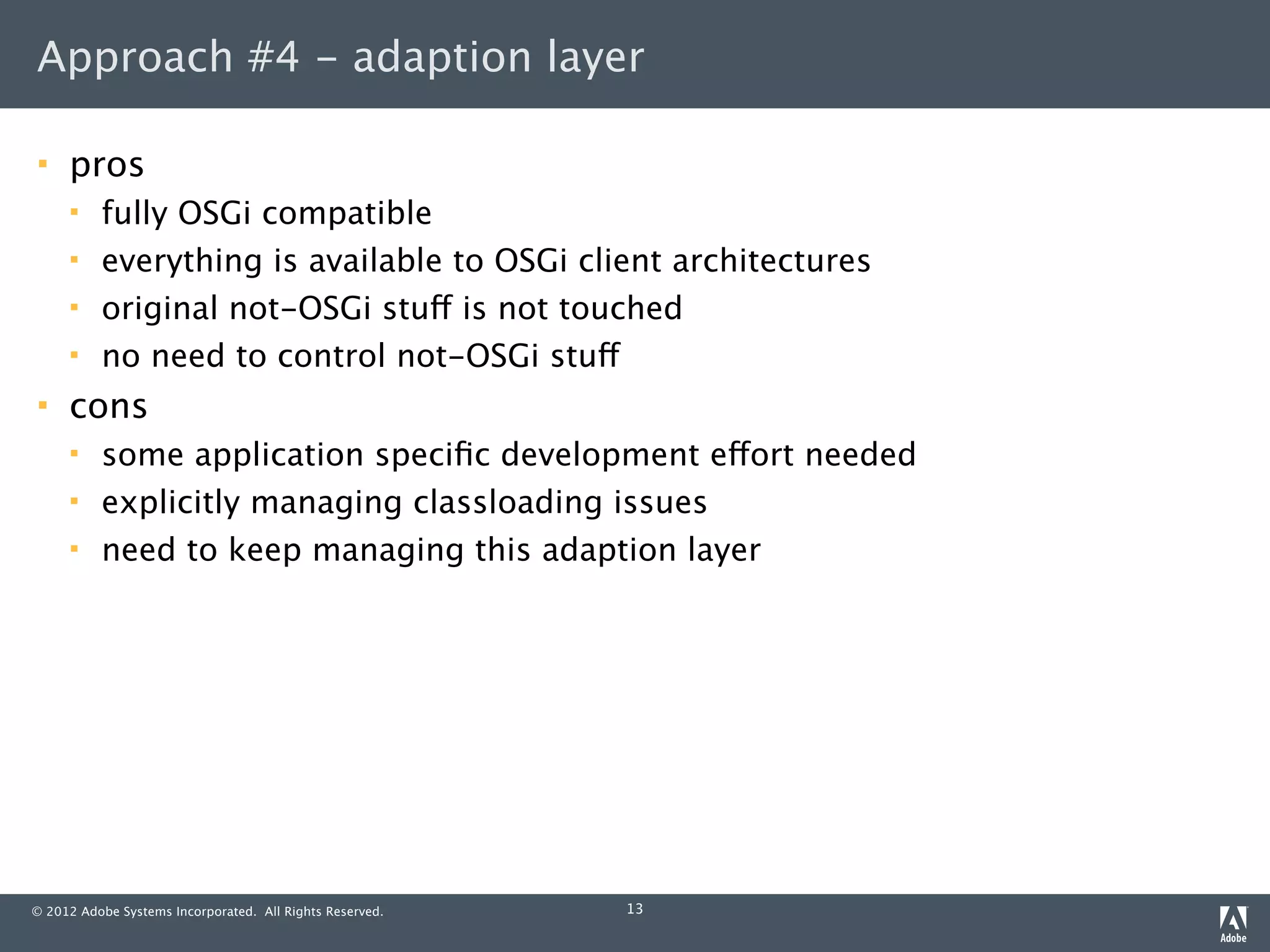
Approach #4 - adaption layer

    pros
         fully OSGi compatible
         everything is available to OSGi client architectures
         original not-OSGi stuff is not touched
         no need to control not-OSGi stuff
    cons
         some application specific development effort needed
         explicitly managing classloading issues
         need to keep managing this adaption layer


© 2012 Adobe Systems Incorporated. All Rights Reserved.   13
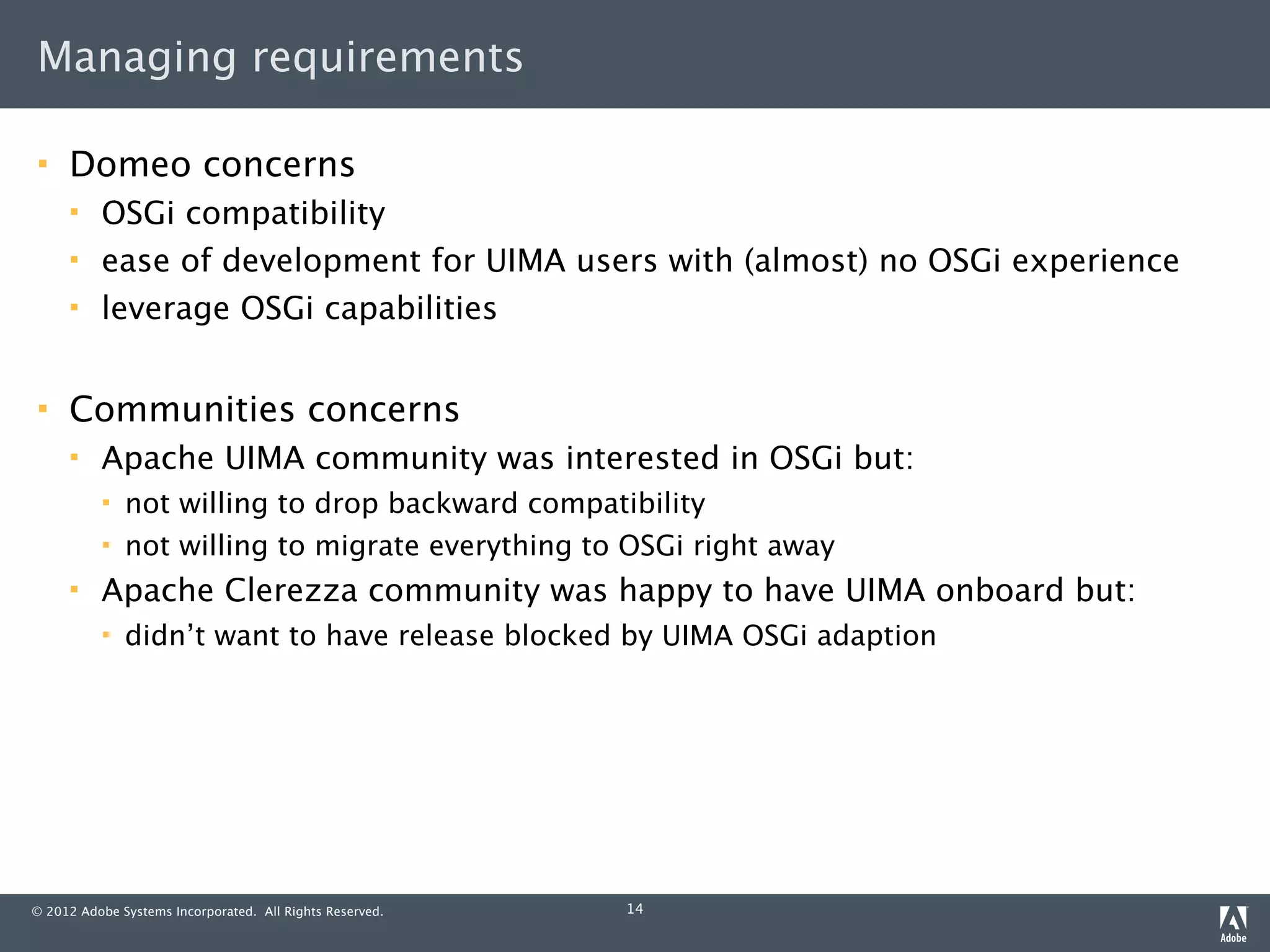
Managing requirements

    Domeo concerns
         OSGi compatibility
         ease of development for UIMA users with (almost) no OSGi experience
         leverage OSGi capabilities


    Communities concerns
         Apache UIMA community was interested in OSGi but:
             not willing to drop backward compatibility
             not willing to migrate everything to OSGi right away
         Apache Clerezza community was happy to have UIMA onboard but:
             didn’t want to have release blocked by UIMA OSGi adaption


© 2012 Adobe Systems Incorporated. All Rights Reserved.   14
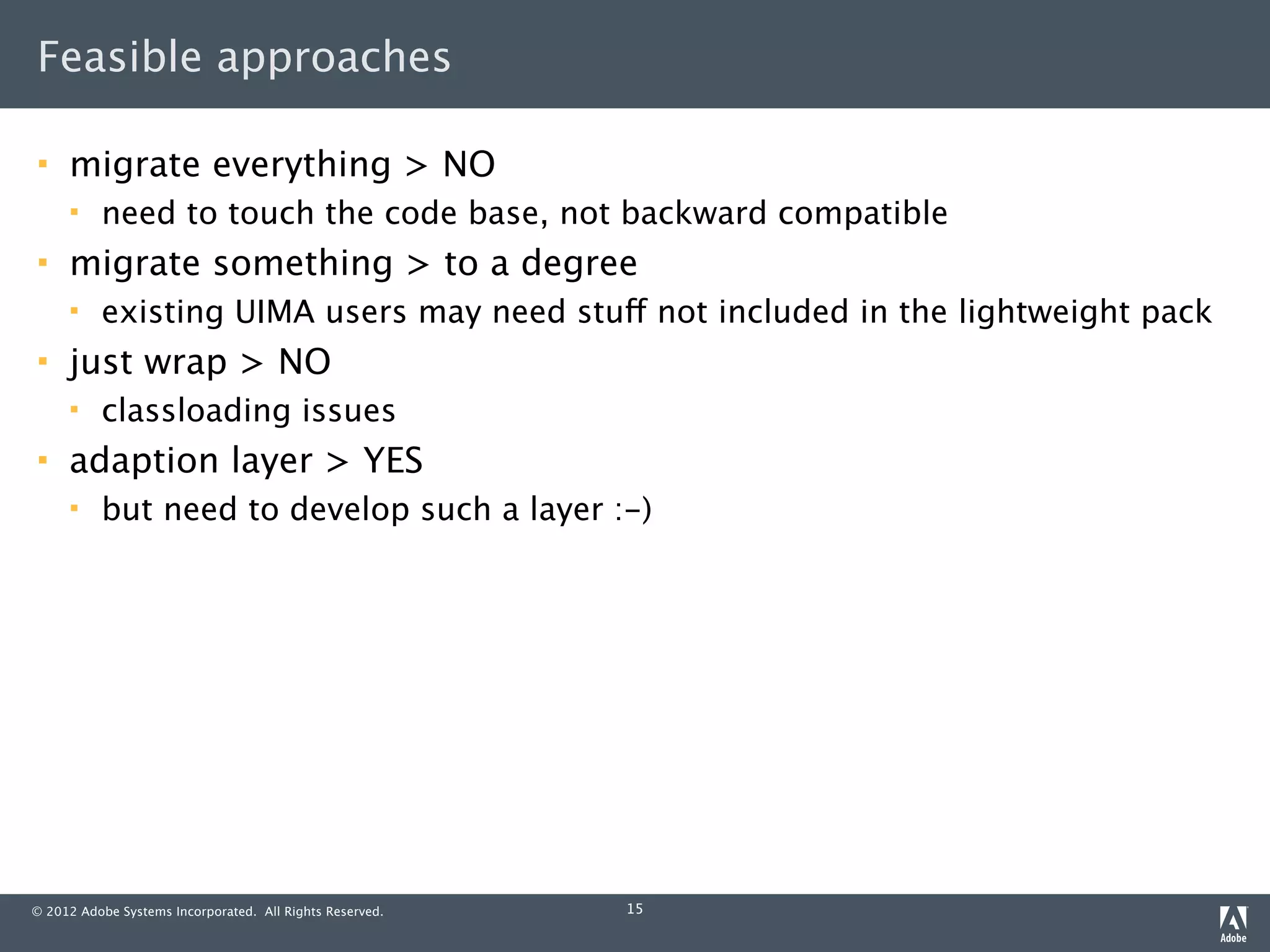
Feasible approaches

    migrate everything > NO
         need to touch the code base, not backward compatible
    migrate something > to a degree
         existing UIMA users may need stuff not included in the lightweight pack
    just wrap > NO
         classloading issues
    adaption layer > YES
         but need to develop such a layer :-)


© 2012 Adobe Systems Incorporated. All Rights Reserved.   15
UIMA OSGi adaption layer known approaches

    DME for UIMA from IBM AlphaWorks
    Clerezza - UIMA integration module
    UIMA integration for Apache Stanbol
    UIMA OSGi enablement via Maven
    ...


© 2012 Adobe Systems Incorporated. All Rights Reserved.   16
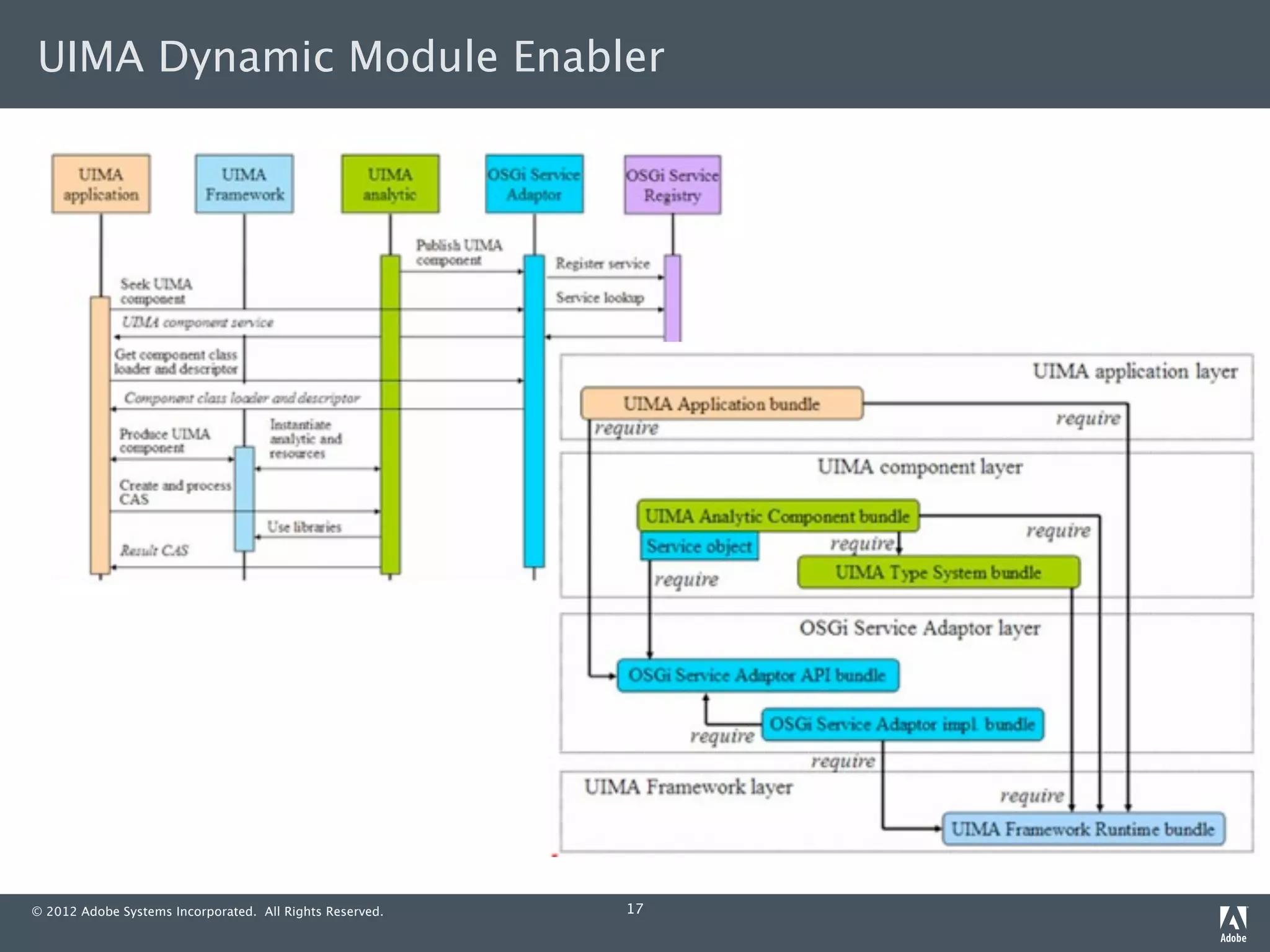
UIMA Dynamic Module Enabler


© 2012 Adobe Systems Incorporated. All Rights Reserved.   17
Clerezza - UIMA adaption layer

    simple API on top of UIMA API
         create pipeline executor, give it a UIMA descriptor, run
    still can use plain UIMA API
    each bundle using UIMA just needs a specific OSGi activator
    lightweight


© 2012 Adobe Systems Incorporated. All Rights Reserved.   18
Clerezza - UIMA : sample service

    Consider an existing text mining application using UIMA for some
     NLP task that needs to be plugged in Domeo
    it needs:
         ReST endpoint
         RDF API for dealing with ontologies
         AnnotationOntology model awareness
    it already has:
         one or more UIMA descriptors for its NLP pipeline(s)
         UIMA components (either developed internally or publicly available)

    Let’s assume our sample service has one UIMA pipeline with one
     descriptor and uses Apache OpenNLP to extract person names from
     text


© 2012 Adobe Systems Incorporated. All Rights Reserved.   19
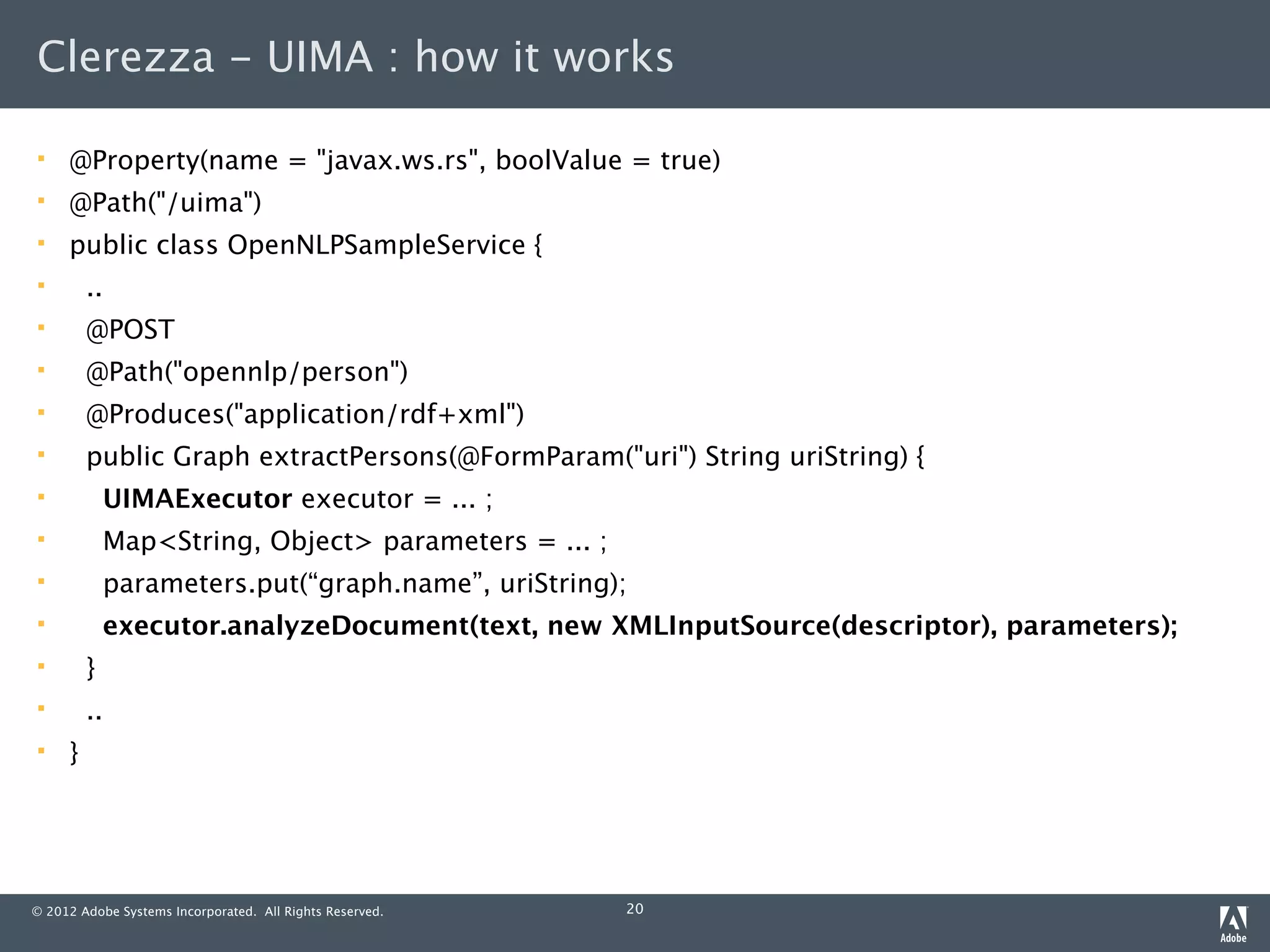
Clerezza - UIMA : how it works

    @Property(name = "javax.ws.rs", boolValue = true)
    @Path("/uima")
    public class OpenNLPSampleService {
        ..
        @POST
        @Path("opennlp/person")
        @Produces("application/rdf+xml")
        public Graph extractPersons(@FormParam("uri") String uriString) {
             UIMAExecutor executor = ... ;
             Map<String, Object> parameters = ... ;
             parameters.put(“graph.name”, uriString);
             executor.analyzeDocument(text, new XMLInputSource(descriptor), parameters);
        }
        ..
    }


© 2012 Adobe Systems Incorporated. All Rights Reserved.   20
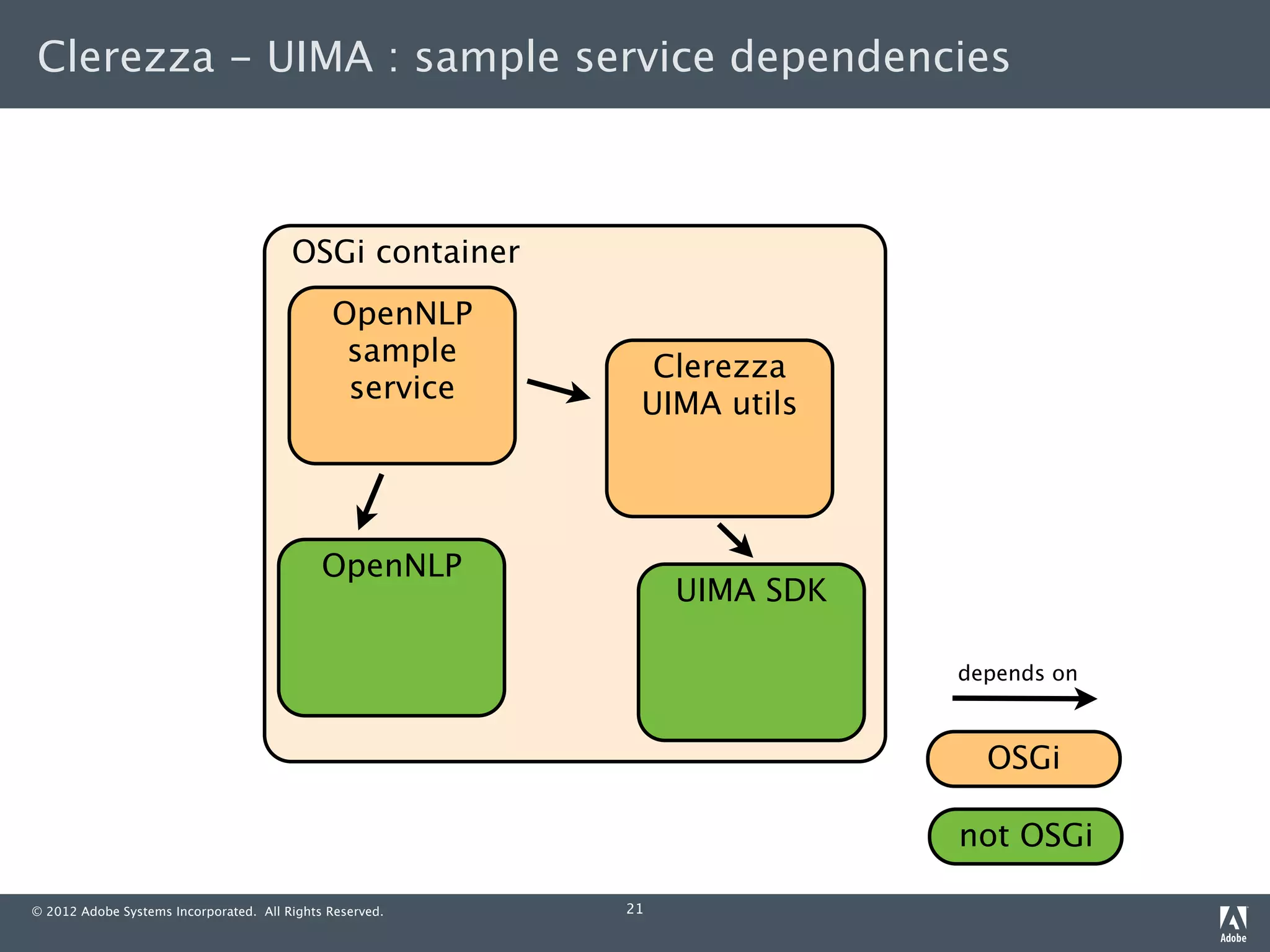
Clerezza - UIMA : sample service dependencies


                                        OSGi container
                                              OpenNLP
                                               sample       Clerezza
                                               service     UIMA utils


                                             OpenNLP
                                                               UIMA SDK

                                                                          depends on


                                                                            OSGi

                                                                          not OSGi

© 2012 Adobe Systems Incorporated. All Rights Reserved.   21
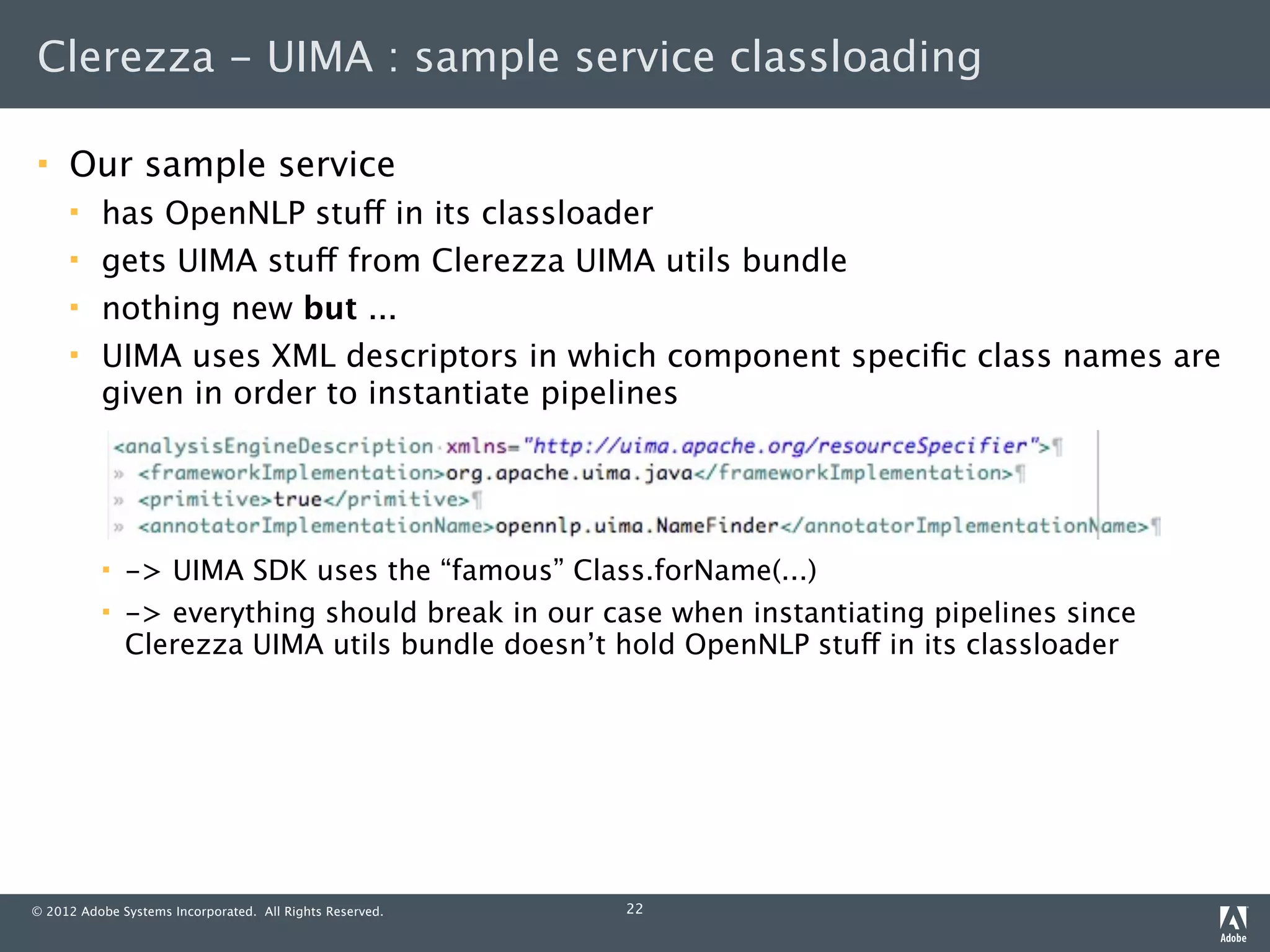
Clerezza - UIMA : sample service classloading

    Our sample service
         has OpenNLP stuff in its classloader
         gets UIMA stuff from Clerezza UIMA utils bundle
         nothing new but ...
         UIMA uses XML descriptors in which component specific class names are
          given in order to instantiate pipelines


             -> UIMA SDK uses the “famous” Class.forName(...)
             -> everything should break in our case when instantiating pipelines since
              Clerezza UIMA utils bundle doesn’t hold OpenNLP stuff in its classloader


© 2012 Adobe Systems Incorporated. All Rights Reserved.   22
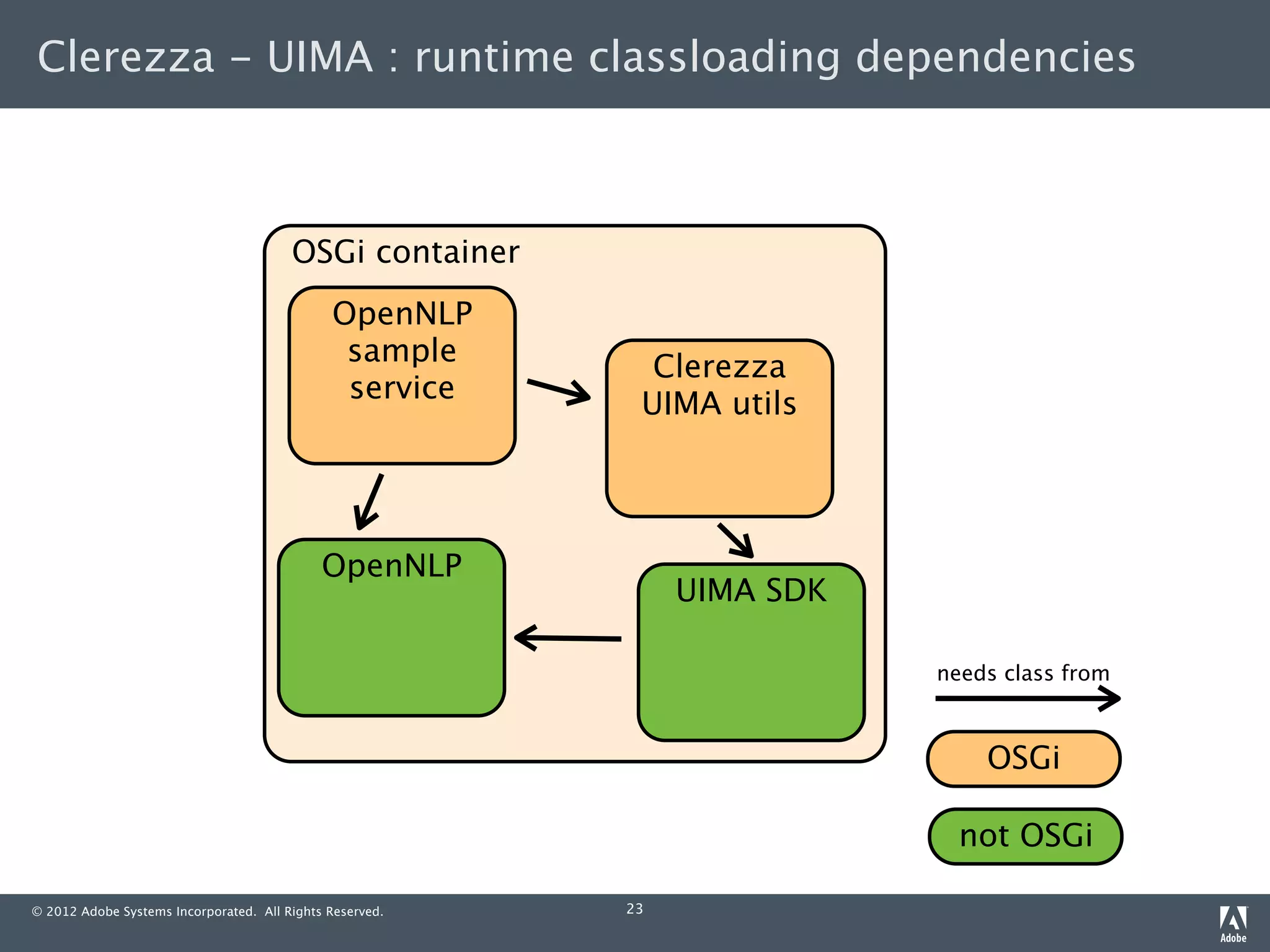
Clerezza - UIMA : runtime classloading dependencies


                                        OSGi container
                                              OpenNLP
                                               sample       Clerezza
                                               service     UIMA utils


                                             OpenNLP
                                                               UIMA SDK

                                                                          needs class from


                                                                              OSGi

                                                                            not OSGi

© 2012 Adobe Systems Incorporated. All Rights Reserved.   23
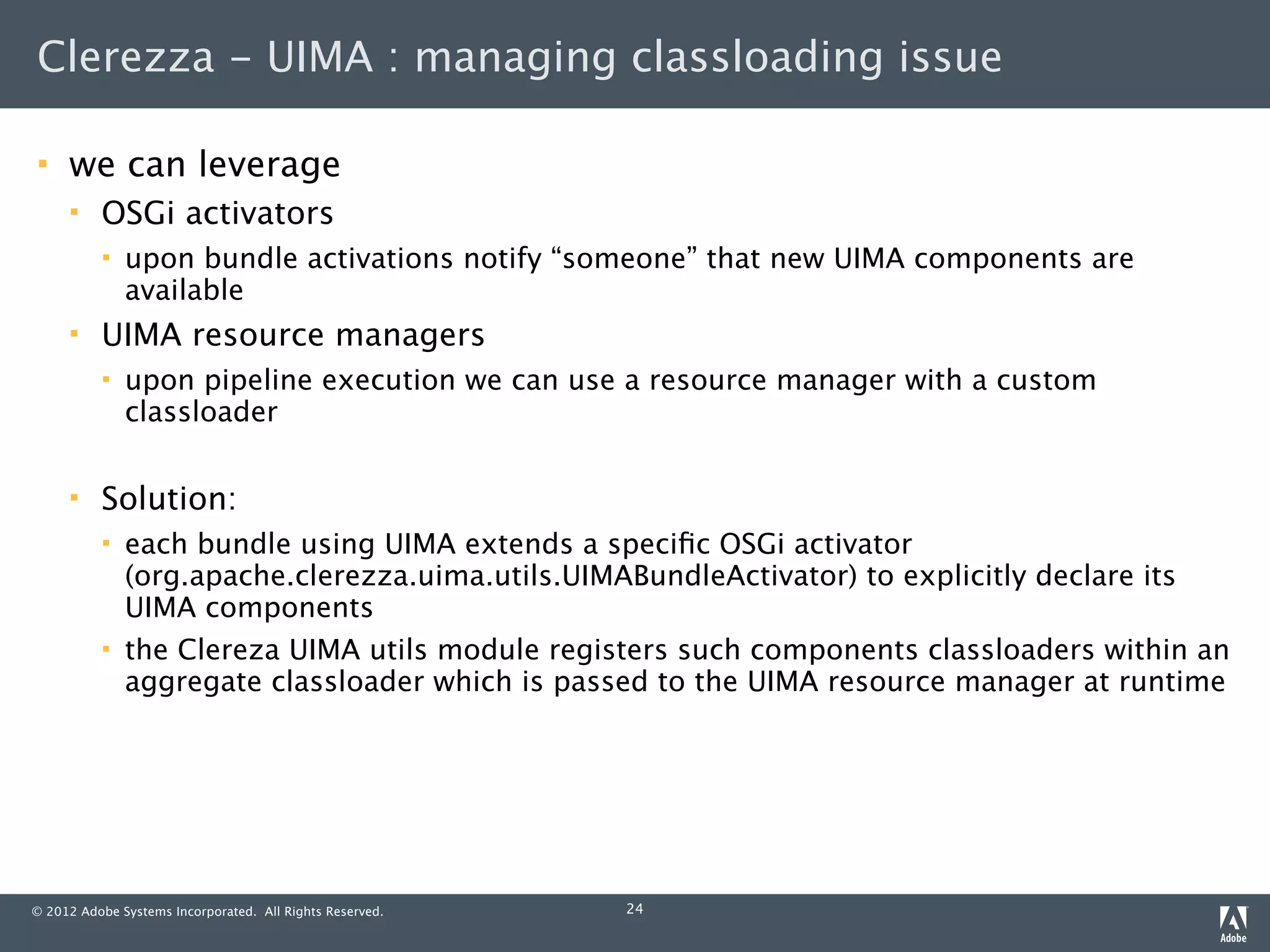
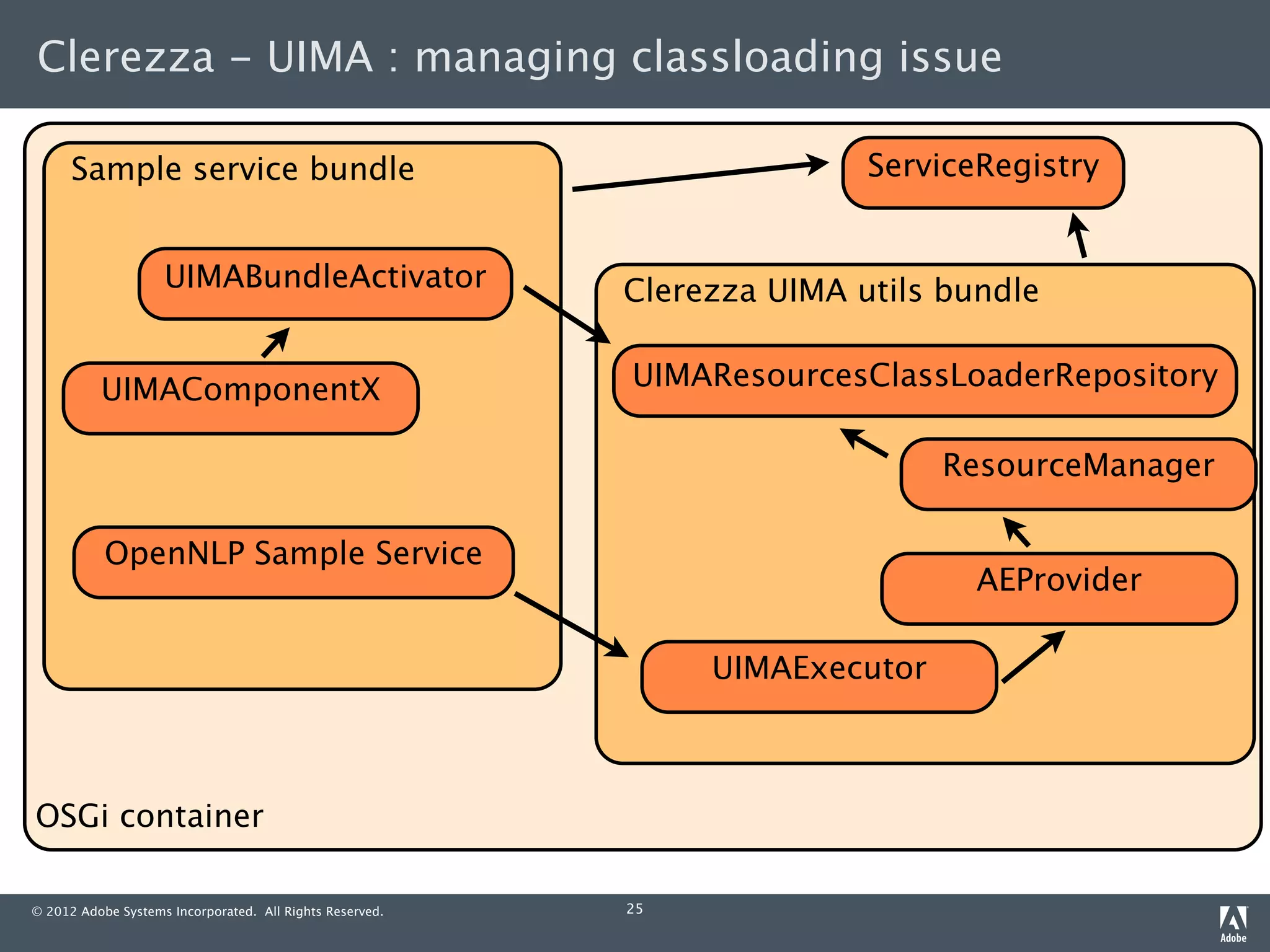
Clerezza - UIMA : managing classloading issue

    we can leverage
         OSGi activators
             upon bundle activations notify “someone” that new UIMA components are
              available
         UIMA resource managers
             upon pipeline execution we can use a resource manager with a custom
              classloader

         Solution:
             each bundle using UIMA extends a specific OSGi activator
              (org.apache.clerezza.uima.utils.UIMABundleActivator) to explicitly declare its
              UIMA components
             the Clereza UIMA utils module registers such components classloaders within an
              aggregate classloader which is passed to the UIMA resource manager at runtime


© 2012 Adobe Systems Incorporated. All Rights Reserved.   24
Clerezza - UIMA : managing classloading issue

      Sample service bundle                                              ServiceRegistry


                    UIMABundleActivator                   Clerezza UIMA utils bundle


          UIMAComponentX                                  UIMAResourcesClassLoaderRepository

                                                                              ResourceManager

           OpenNLP Sample Service
                                                                                AEProvider

                                                               UIMAExecutor


OSGi container

© 2012 Adobe Systems Incorporated. All Rights Reserved.   25
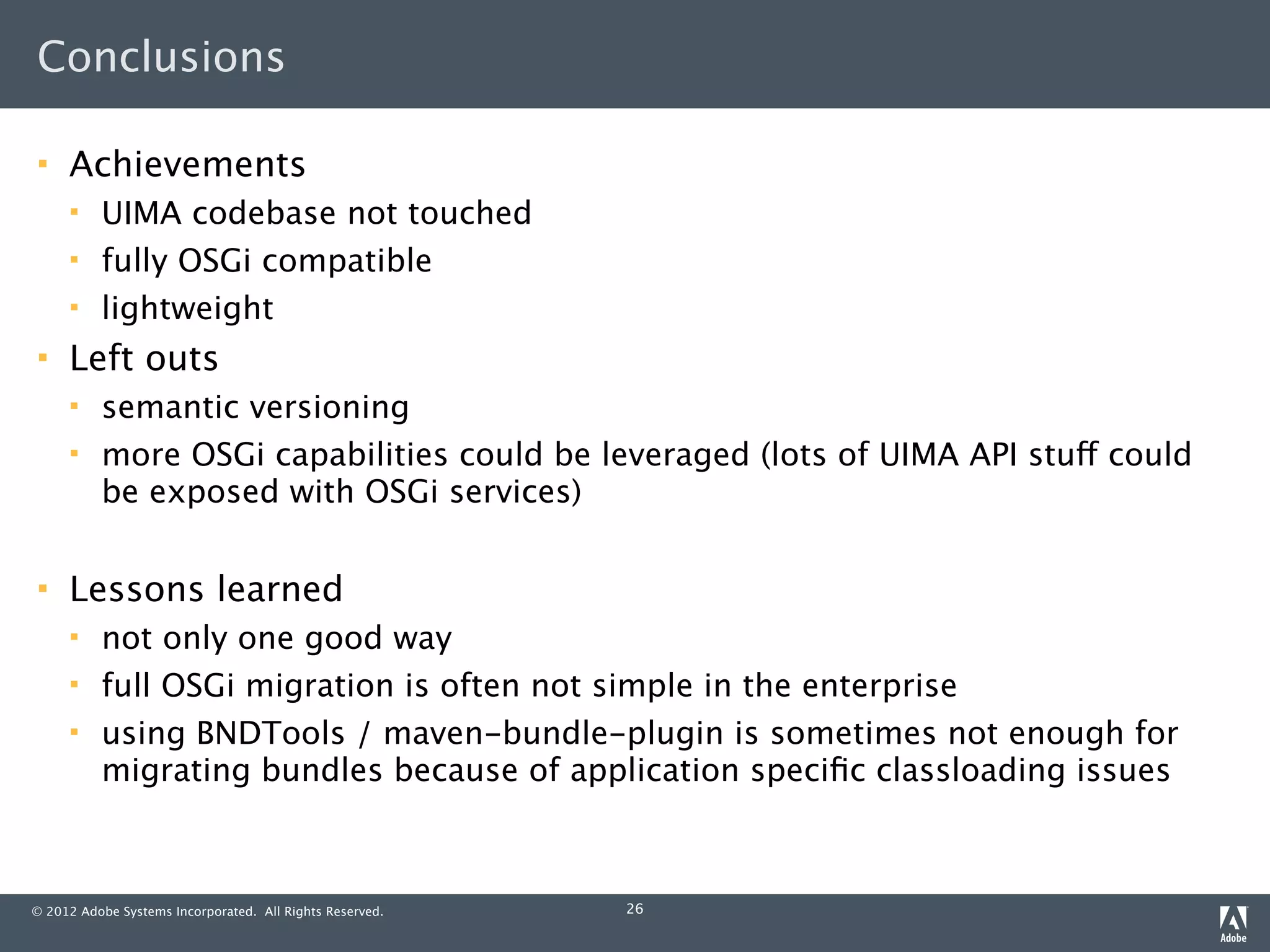
Conclusions

    Achievements
         UIMA codebase not touched
         fully OSGi compatible
         lightweight
    Left outs
         semantic versioning
         more OSGi capabilities could be leveraged (lots of UIMA API stuff could
          be exposed with OSGi services)

    Lessons learned
         not only one good way
         full OSGi migration is often not simple in the enterprise
         using BNDTools / maven-bundle-plugin is sometimes not enough for
          migrating bundles because of application specific classloading issues


© 2012 Adobe Systems Incorporated. All Rights Reserved.   26
Thanks!

    We’re hiring:
         jobs-basel@adobe.com

    Q&A


© 2012 Adobe Systems Incorporated. All Rights Reserved.   27
© 2012 Adobe Systems Incorporated. All Rights Reserved. Adobe Confidential.

Adapting Apache UIMA to OSGi

  • 1.
    Adapting Apache UIMAto OSGi Tommaso Teofili | Adobe Basel R&D © 2012 Adobe Systems Incorporated. All Rights Reserved.
  • 2.
    Agenda  The problem:  not-OSGi stuff in an OSGi world  use case  Possible adaption approaches discussion  an approach for our use case  Conclusions © 2012 Adobe Systems Incorporated. All Rights Reserved. 2
  • 3.
    Use case: Domeo  Annotation toolkit  create & share ontology based annotations  using AnnotationOntology RDF model  supporting (semi) automated annotation  Apache UIMA based text mining applications integrate via Apache Clerezza platform  but ... Clerezza is OSGi based while UIMA is not © 2012 Adobe Systems Incorporated. All Rights Reserved. 3
  • 4.
    Apache UIMA  ASF top level project since 2010  Unstructured information management architecture  OASIS standard  Powering  apps: IBM Watson, DeepQA, ...  platforms: Behemot, Domeo, U-Compare, ... © 2012 Adobe Systems Incorporated. All Rights Reserved. 4
  • 5.
    Apache Clerezza  Apache Incubator project  Service platform for linked data  RDF API  JAX-RS implementation  OSGi based  Powering Apache Stanbol semantic content management project © 2012 Adobe Systems Incorporated. All Rights Reserved. 5
  • 6.
    Clerezza - UIMAarchitecture overview JAX RS AE AE AE AE AE Clerezza platform UIMA Pipeline AO OSGi container Triple store © 2012 Adobe Systems Incorporated. All Rights Reserved. 6
  • 7.
    The problem  Apache Clerezza  is OSGi based (running on Apache Felix)  artifacts delivered as bundles  Apache UIMA  is not OSGi based  is not OSGi ready  artifacts delivered as standard jars / PEARs  using reflection / custom classloading  has some OSGi artifacts for UIMA Eclipse plugins  How to flawlessly let UIMA live and run inside Clerezza? © 2012 Adobe Systems Incorporated. All Rights Reserved. 7
  • 8.
    Adapting to OSGi  Things to consider:  backward compatibility  development effort  classloading  packaging / deployments  semantic versioning  Business requirements are crucial to prioritize the above list © 2012 Adobe Systems Incorporated. All Rights Reserved. 8
  • 9.
    Adaption approaches  migrate everything to support (also?) OSGi  migrate something in a single lightweight bundle  migrate nothing and wrap everything in a single big bundle  create an adaption layer  ... © 2012 Adobe Systems Incorporated. All Rights Reserved. 9
  • 10.
    Approach #1 -migrate everything  pros  fully OSGi compatible  one time effort  fully leveraging OSGi capabilities  cons  backward compatibility issues  significant development effort  consider integration effort  possibly keep / maintain different architectures at once  not always feasible  need full control © 2012 Adobe Systems Incorporated. All Rights Reserved. 10
  • 11.
    Approach #2 -migrate something  pros  fully OSGi compatible  easier limited development effort  facade package  cons  need to keep maintaining OSGi and not-OSGi artifacts over time  not everything is available to OSGi client architectures  need full control on codebase © 2012 Adobe Systems Incorporated. All Rights Reserved. 11
  • 12.
    Approach #3 -just wrap  pros  fully OSGi compatible  almost no development effort  everything is available to OSGi client architectures  cons  just not leveraging OSGi capabilities  possible classloading issues  need to keep managing OSGi and not OSGi artifacts over time © 2012 Adobe Systems Incorporated. All Rights Reserved. 12
  • 13.
    Approach #4 -adaption layer  pros  fully OSGi compatible  everything is available to OSGi client architectures  original not-OSGi stuff is not touched  no need to control not-OSGi stuff  cons  some application specific development effort needed  explicitly managing classloading issues  need to keep managing this adaption layer © 2012 Adobe Systems Incorporated. All Rights Reserved. 13
  • 14.
    Managing requirements  Domeo concerns  OSGi compatibility  ease of development for UIMA users with (almost) no OSGi experience  leverage OSGi capabilities  Communities concerns  Apache UIMA community was interested in OSGi but:  not willing to drop backward compatibility  not willing to migrate everything to OSGi right away  Apache Clerezza community was happy to have UIMA onboard but:  didn’t want to have release blocked by UIMA OSGi adaption © 2012 Adobe Systems Incorporated. All Rights Reserved. 14
  • 15.
    Feasible approaches  migrate everything > NO  need to touch the code base, not backward compatible  migrate something > to a degree  existing UIMA users may need stuff not included in the lightweight pack  just wrap > NO  classloading issues  adaption layer > YES  but need to develop such a layer :-) © 2012 Adobe Systems Incorporated. All Rights Reserved. 15
  • 16.
    UIMA OSGi adaptionlayer known approaches  DME for UIMA from IBM AlphaWorks  Clerezza - UIMA integration module  UIMA integration for Apache Stanbol  UIMA OSGi enablement via Maven  ... © 2012 Adobe Systems Incorporated. All Rights Reserved. 16
  • 17.
    UIMA Dynamic ModuleEnabler © 2012 Adobe Systems Incorporated. All Rights Reserved. 17
  • 18.
    Clerezza - UIMAadaption layer  simple API on top of UIMA API  create pipeline executor, give it a UIMA descriptor, run  still can use plain UIMA API  each bundle using UIMA just needs a specific OSGi activator  lightweight © 2012 Adobe Systems Incorporated. All Rights Reserved. 18
  • 19.
    Clerezza - UIMA: sample service  Consider an existing text mining application using UIMA for some NLP task that needs to be plugged in Domeo  it needs:  ReST endpoint  RDF API for dealing with ontologies  AnnotationOntology model awareness  it already has:  one or more UIMA descriptors for its NLP pipeline(s)  UIMA components (either developed internally or publicly available)  Let’s assume our sample service has one UIMA pipeline with one descriptor and uses Apache OpenNLP to extract person names from text © 2012 Adobe Systems Incorporated. All Rights Reserved. 19
  • 20.
    Clerezza - UIMA: how it works  @Property(name = "javax.ws.rs", boolValue = true)  @Path("/uima")  public class OpenNLPSampleService {  ..  @POST  @Path("opennlp/person")  @Produces("application/rdf+xml")  public Graph extractPersons(@FormParam("uri") String uriString) {  UIMAExecutor executor = ... ;  Map<String, Object> parameters = ... ;  parameters.put(“graph.name”, uriString);  executor.analyzeDocument(text, new XMLInputSource(descriptor), parameters);  }  ..  } © 2012 Adobe Systems Incorporated. All Rights Reserved. 20
  • 21.
    Clerezza - UIMA: sample service dependencies OSGi container OpenNLP sample Clerezza service UIMA utils OpenNLP UIMA SDK depends on OSGi not OSGi © 2012 Adobe Systems Incorporated. All Rights Reserved. 21
  • 22.
    Clerezza - UIMA: sample service classloading  Our sample service  has OpenNLP stuff in its classloader  gets UIMA stuff from Clerezza UIMA utils bundle  nothing new but ...  UIMA uses XML descriptors in which component specific class names are given in order to instantiate pipelines  -> UIMA SDK uses the “famous” Class.forName(...)  -> everything should break in our case when instantiating pipelines since Clerezza UIMA utils bundle doesn’t hold OpenNLP stuff in its classloader © 2012 Adobe Systems Incorporated. All Rights Reserved. 22
  • 23.
    Clerezza - UIMA: runtime classloading dependencies OSGi container OpenNLP sample Clerezza service UIMA utils OpenNLP UIMA SDK needs class from OSGi not OSGi © 2012 Adobe Systems Incorporated. All Rights Reserved. 23
  • 24.
    Clerezza - UIMA: managing classloading issue  we can leverage  OSGi activators  upon bundle activations notify “someone” that new UIMA components are available  UIMA resource managers  upon pipeline execution we can use a resource manager with a custom classloader  Solution:  each bundle using UIMA extends a specific OSGi activator (org.apache.clerezza.uima.utils.UIMABundleActivator) to explicitly declare its UIMA components  the Clereza UIMA utils module registers such components classloaders within an aggregate classloader which is passed to the UIMA resource manager at runtime © 2012 Adobe Systems Incorporated. All Rights Reserved. 24
  • 25.
    Clerezza - UIMA: managing classloading issue Sample service bundle ServiceRegistry UIMABundleActivator Clerezza UIMA utils bundle UIMAComponentX UIMAResourcesClassLoaderRepository ResourceManager OpenNLP Sample Service AEProvider UIMAExecutor OSGi container © 2012 Adobe Systems Incorporated. All Rights Reserved. 25
  • 26.
    Conclusions  Achievements  UIMA codebase not touched  fully OSGi compatible  lightweight  Left outs  semantic versioning  more OSGi capabilities could be leveraged (lots of UIMA API stuff could be exposed with OSGi services)  Lessons learned  not only one good way  full OSGi migration is often not simple in the enterprise  using BNDTools / maven-bundle-plugin is sometimes not enough for migrating bundles because of application specific classloading issues © 2012 Adobe Systems Incorporated. All Rights Reserved. 26
  • 27.
    Thanks!  We’re hiring:  jobs-basel@adobe.com  Q&A © 2012 Adobe Systems Incorporated. All Rights Reserved. 27
  • 28.
    © 2012 AdobeSystems Incorporated. All Rights Reserved. Adobe Confidential.