OSGi on the Web: Here’s How Don Brown Atlassian
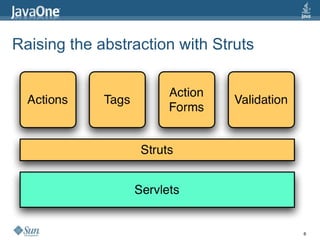
Raising the abstraction with Struts
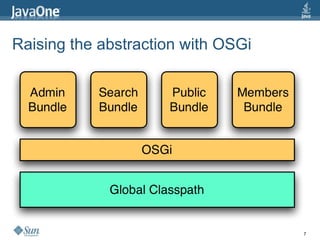
Raising the abstraction with OSGi
Why we needed OSGi
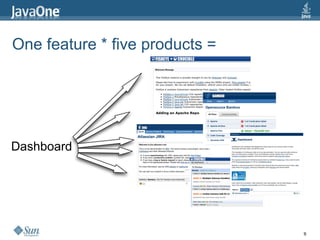
One feature * five products =  Dashboard
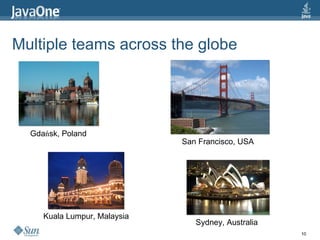
Multiple teams across the globe Gda ń sk, Poland San Francisco, USA Kuala Lumpur, Malaysia Sydney, Australia
Plugin development slow Write plugin code Build plugin Copy plugin to  WEB-INF/lib Start app Discover bug Wash, rinse, repeat
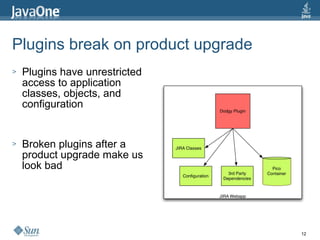
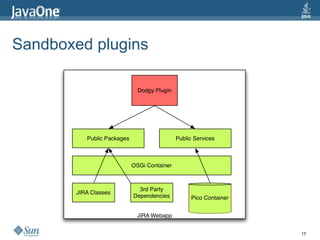
Plugins break on product upgrade Plugins have unrestricted access to application classes, objects, and configuration Broken plugins after a product upgrade make us look bad
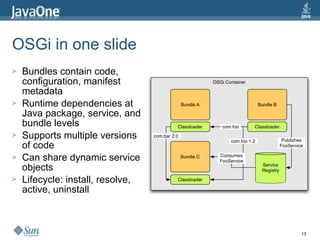
OSGi in one slide Bundles contain code, configuration, manifest metadata Runtime dependencies at Java package, service, and bundle levels Supports multiple versions of code Can share dynamic service objects Lifecycle: install, resolve, active, uninstall
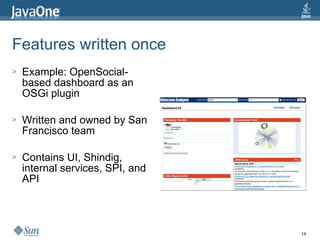
Features written once Example: OpenSocial-based dashboard as an OSGi plugin Written and owned by San Francisco team Contains UI, Shindig, internal services, SPI, and API
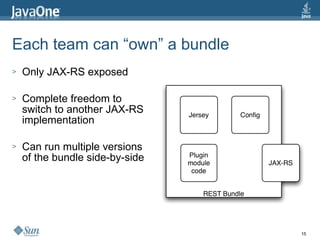
Each team can “own” a bundle Only JAX-RS exposed Complete freedom to switch to another JAX-RS implementation Can run multiple versions of the bundle side-by-side
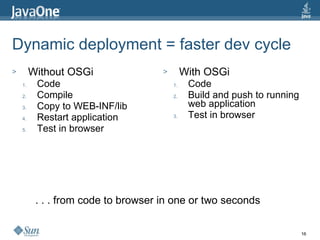
Dynamic deployment = faster dev cycle Without OSGi Code Compile Copy to WEB-INF/lib Restart application Test in browser With OSGi Code Build and push to running web application Test in browser . . . from code to browser in one or two seconds
Sandboxed plugins
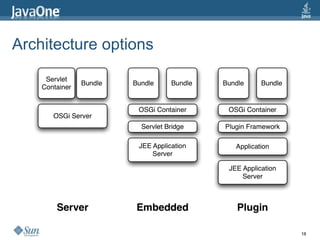
Architecture options
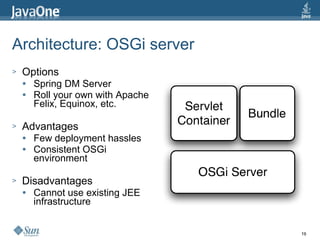
Architecture: OSGi server Options Spring DM Server Roll your own with Apache Felix, Equinox, etc. Advantages Few deployment hassles Consistent OSGi environment Disadvantages Cannot use existing JEE infrastructure
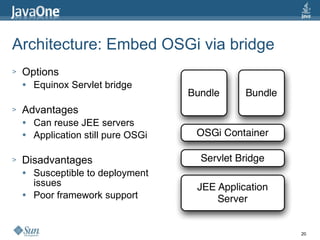
Architecture: Embed OSGi via bridge Options Equinox Servlet bridge Advantages Can reuse JEE servers Application still pure OSGi Disadvantages Susceptible to deployment issues Poor framework support
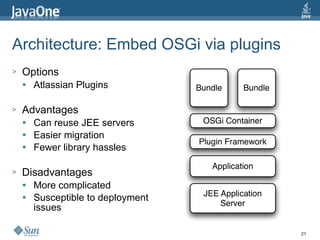
Architecture: Embed OSGi via plugins Options Atlassian Plugins Advantages Can reuse JEE servers Easier migration Fewer library hassles Disadvantages More complicated Susceptible to deployment issues
Development experience How to share and consume services? What if bundles I depend on go down? How do I configure my manifest? What tools are available?
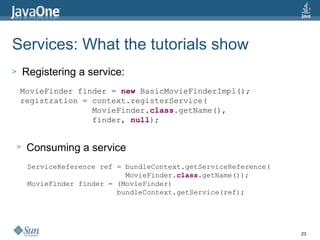
Services: What the tutorials show  Registering a service: MovieFinder finder =  new  BasicMovieFinderImpl(); registration = context.registerService( MovieFinder. class .getName(), finder,  null ); Consuming a service ServiceReference ref = bundleContext.getServiceReference( MovieFinder. class .getName()); MovieFinder finder = (MovieFinder)  bundleContext.getService(ref);
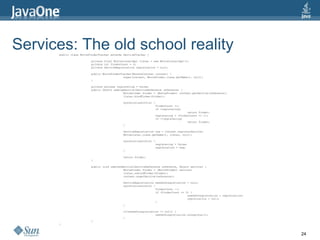
Services: The old school reality public class MovieFinderTracker extends ServiceTracker { private final MovieListerImpl lister = new MovieListerImpl(); private int finderCount = 0; private ServiceRegistration registration = null; public MovieFinderTracker(BundleContext context) { super(context, MovieFinder.class.getName(), null); } private boolean registering = false;  public Object addingService(ServiceReference reference) {  MovieFinder finder = (MovieFinder) context.getService(reference);  lister.bindFinder(finder);  synchronized(this) {  finderCount ++;  if (registering)  return finder;  registering = (finderCount == 1);  if (!registering)  return finder;  }  ServiceRegistration reg = context.registerService(  MovieLister.class.getName(), lister, null);  synchronized(this) {  registering = false;  registration = reg;  }  return finder;  }  public void removedService(ServiceReference reference, Object service) {  MovieFinder finder = (MovieFinder) service;  lister.unbindFinder(finder);  context.ungetService(reference);  ServiceRegistration needsUnregistration = null;  synchronized(this) {  finderCount --;  if (finderCount == 0) {  needsUnregistration = registration;  registration = null;  }  }  if(needsUnregistration != null) {  needsUnregistration.unregister();  }  }  }
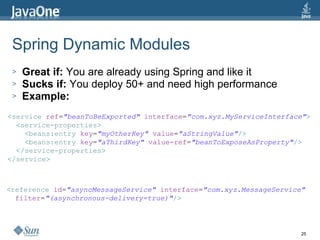
Spring Dynamic Modules Great if:  You are already using Spring and like it Sucks if:  You deploy 50+ and need high performance Example: < service   ref = &quot;beanToBeExported&quot;   interface = &quot;com.xyz.MyServiceInterface&quot; > < service-properties > < beans:entry   key = &quot;myOtherKey&quot;   value = &quot;aStringValue&quot; /> < beans:entry   key = &quot;aThirdKey&quot;   value-ref = &quot;beanToExposeAsProperty&quot; /> </ service-properties > </ service > < reference   id = &quot;asyncMessageService&quot;   interface = &quot;com.xyz.MessageService&quot; filter = &quot;(asynchronous-delivery=true)&quot; />
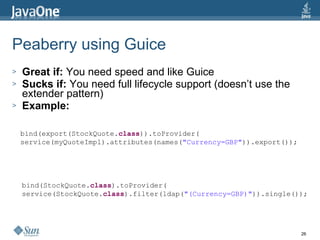
Peaberry using Guice Great if:  You need speed and like Guice Sucks if:  You need full lifecycle support (doesn’t use the extender pattern) Example: bind(export(StockQuote. class )).toProvider( service(myQuoteImpl).attributes(names( &quot;Currency=GBP&quot; )).export()); bind(StockQuote. class ).toProvider( service(StockQuote. class ).filter(ldap( &quot;(Currency=GBP)&quot; )).single());
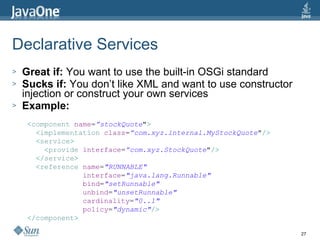
Declarative Services Great if:  You want to use the built-in OSGi standard Sucks if:  You don’t like XML and want to use constructor injection or construct your own services Example: < component   name = ”stockQuote &quot; > < implementation   class = ”com.xyz.internal.MyStockQuote &quot; /> < service > < provide   interface = ”com.xyz.StockQuote &quot; /> </ service > < reference   name = &quot;RUNNABLE&quot; interface = &quot;java.lang.Runnable&quot; bind = &quot;setRunnable&quot; unbind = &quot;unsetRunnable&quot; cardinality = &quot;0..1&quot; policy = &quot;dynamic&quot; /> </ component >
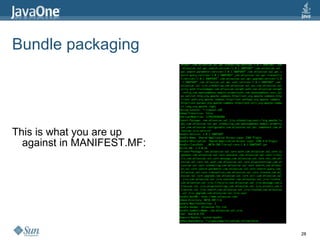
Bundle packaging This is what you are up against in MANIFEST.MF:
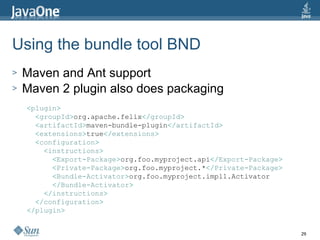
Using the bundle tool BND  Maven and Ant support Maven 2 plugin also does packaging < plugin > < groupId > org.apache.felix </ groupId > < artifactId > maven-bundle-plugin </ artifactId > < extensions > true </ extensions > < configuration > < instructions > < Export-Package > org.foo.myproject.api </ Export-Package > < Private-Package > org.foo.myproject.* </ Private-Package > < Bundle-Activator > org.foo.myproject.impl1.Activator </ Bundle-Activator > </ instructions > </ configuration > </ plugin >
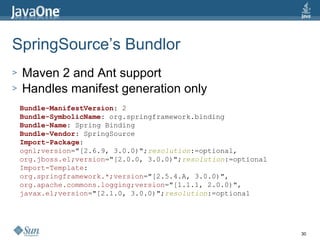
SpringSource’s Bundlor Maven 2 and Ant support Handles manifest generation only Bundle-ManifestVersion : 2 Bundle-SymbolicName : org.springframework.binding Bundle-Name : Spring Binding Bundle-Vendor : SpringSource Import-Package : ognl;version =&quot;[2.6.9, 3.0.0)&quot;; resolution :=optional, org.jboss.el;version =&quot;[2.0.0, 3.0.0)&quot;; resolution :=optional Import-Template : org.springframework.*;version =&quot;[2.5.4.A, 3.0.0)&quot;, org.apache.commons.logging;version =&quot;[1.1.1, 2.0.0)&quot;, javax.el;version =&quot;[2.1.0, 3.0.0)&quot;; resolution :=optional
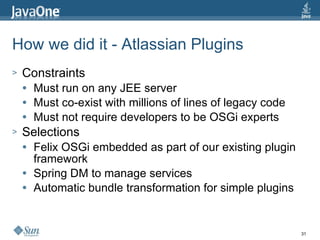
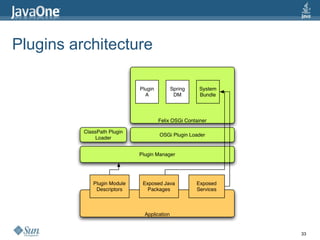
How we did it - Atlassian Plugins Constraints Must run on any JEE server Must co-exist with millions of lines of legacy code Must not require developers to be OSGi experts Selections Felix OSGi embedded as part of our existing plugin framework Spring DM to manage services Automatic bundle transformation for simple plugins
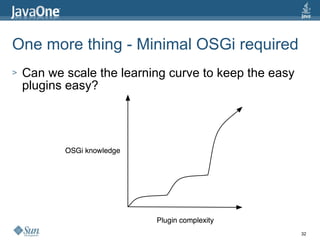
One more thing - Minimal OSGi required Can we scale the learning curve to keep the easy plugins easy?
Plugins architecture
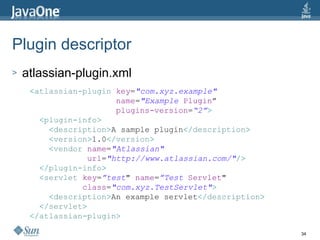
Plugin descriptor atlassian-plugin.xml < atlassian-plugin   key = &quot;com.xyz.example&quot;   name = &quot;Example   Plugin ” plugins-version = “2” > < plugin-info > < description > A sample plugin </ description > < version > 1.0 </ version > < vendor   name = &quot;Atlassian&quot;   url = &quot;http://www.atlassian.com/&quot; /> </ plugin-info > < servlet   key = ”test &quot;   name = ”Test   Servlet &quot;   class = &quot;com.xyz.TestServlet&quot; > < description > An example servlet </ description > </ servlet > </ atlassian-plugin >
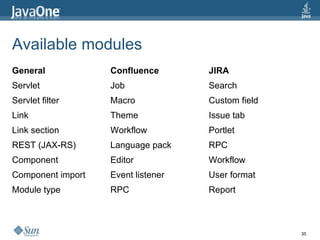
Available modules General Confluence JIRA Servlet Job Search Servlet filter Macro Custom field Link Theme Issue tab Link section Workflow Portlet REST (JAX-RS) Language pack RPC Component Editor Workflow Component import Event listener User format Module type RPC Report
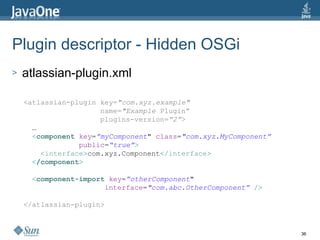
Plugin descriptor - Hidden OSGi atlassian-plugin.xml <atlassian-plugin key= &quot;com.xyz.example&quot;   name= &quot;Example  Plugin” plugins-version= “2” > … < component   key = ”myComponent &quot;   class = &quot;com.xyz.MyComponent” public = “true” > < interface > com.xyz.Component </ interface > < / component > < component-import   key = ”otherComponent &quot;   interface = &quot;com.abc.OtherComponent”   /> </atlassian-plugin>
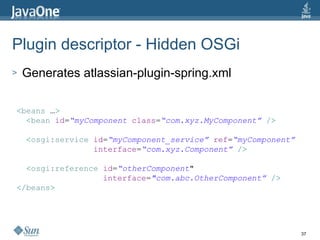
Plugin descriptor - Hidden OSGi Generates atlassian-plugin-spring.xml < beans   … > < bean   id = “myComponent   class = “com.xyz.MyComponent”   /> < osgi:service   id = “myComponent_service”   ref = “myComponent” interface = “com.xyz.Component”   /> < osgi:reference   id = “otherComponent &quot;   interface = &quot;com.abc.OtherComponent”   /> </ beans >
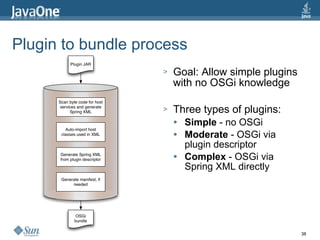
Plugin to bundle process Goal: Allow simple plugins with no OSGi knowledge Three types of plugins: Simple  - no OSGi Moderate  - OSGi via plugin descriptor Complex  - OSGi via Spring XML directly
DEMO: Using Atlassian Plugins http://atlassian.com/opensource
Lessons learned
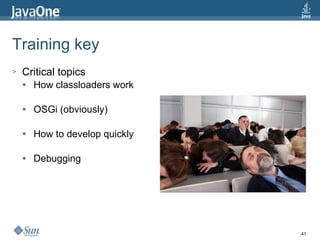
Training key Critical topics How classloaders work OSGi (obviously) How to develop quickly Debugging
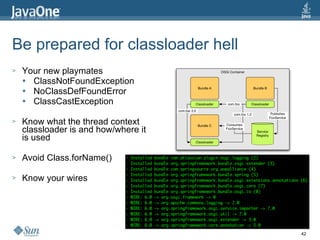
Be prepared for classloader hell Your new playmates ClassNotFoundException NoClassDefFoundError ClassCastException Know what the thread context classloader is and how/where it is used Avoid Class.forName() Know your wires
Focus on development experience early Evaluate tools like Eclipse, the Intellij IDEA plugin Osmorc, and SpringSource Tool Suite Be prepared to be under-whelmed - tool support lacking in general Look at building custom Ant/Maven/Buildr plugins to optimize build/deploy/test cycle If using Maven 2 to deploy bundles, consider the Maven CLI Plugin
Deployment environments matter WebSphere Uses OSGi but R4.0.  Ensure child-first classloading Classloader scanning for packages to expose to OSGi may not work.  Be prepared to scan WEB-INF/lib contents directly. WebLogic Uses own XML parser, so ensure weblogic.* is available via boot classpath delegation for JAXP Profiling Add com.yourkit.* and com.jprofiler.* to boot delegation
Takeaway:  Web on OSGi can rock, but beware the cliffs
Questions
Don Brown [email_address]

The Web on OSGi: Here's How

  • 1.
    OSGi on theWeb: Here’s How Don Brown Atlassian
  • 6.
  • 7.
  • 8.
  • 9.
    One feature *five products = Dashboard
  • 10.
    Multiple teams acrossthe globe Gda ń sk, Poland San Francisco, USA Kuala Lumpur, Malaysia Sydney, Australia
  • 11.
    Plugin development slowWrite plugin code Build plugin Copy plugin to WEB-INF/lib Start app Discover bug Wash, rinse, repeat
  • 12.
    Plugins break onproduct upgrade Plugins have unrestricted access to application classes, objects, and configuration Broken plugins after a product upgrade make us look bad
  • 13.
    OSGi in oneslide Bundles contain code, configuration, manifest metadata Runtime dependencies at Java package, service, and bundle levels Supports multiple versions of code Can share dynamic service objects Lifecycle: install, resolve, active, uninstall
  • 14.
    Features written onceExample: OpenSocial-based dashboard as an OSGi plugin Written and owned by San Francisco team Contains UI, Shindig, internal services, SPI, and API
  • 15.
    Each team can“own” a bundle Only JAX-RS exposed Complete freedom to switch to another JAX-RS implementation Can run multiple versions of the bundle side-by-side
  • 16.
    Dynamic deployment =faster dev cycle Without OSGi Code Compile Copy to WEB-INF/lib Restart application Test in browser With OSGi Code Build and push to running web application Test in browser . . . from code to browser in one or two seconds
  • 17.
  • 18.
  • 19.
    Architecture: OSGi serverOptions Spring DM Server Roll your own with Apache Felix, Equinox, etc. Advantages Few deployment hassles Consistent OSGi environment Disadvantages Cannot use existing JEE infrastructure
  • 20.
    Architecture: Embed OSGivia bridge Options Equinox Servlet bridge Advantages Can reuse JEE servers Application still pure OSGi Disadvantages Susceptible to deployment issues Poor framework support
  • 21.
    Architecture: Embed OSGivia plugins Options Atlassian Plugins Advantages Can reuse JEE servers Easier migration Fewer library hassles Disadvantages More complicated Susceptible to deployment issues
  • 22.
    Development experience Howto share and consume services? What if bundles I depend on go down? How do I configure my manifest? What tools are available?
  • 23.
    Services: What thetutorials show Registering a service: MovieFinder finder = new BasicMovieFinderImpl(); registration = context.registerService( MovieFinder. class .getName(), finder, null ); Consuming a service ServiceReference ref = bundleContext.getServiceReference( MovieFinder. class .getName()); MovieFinder finder = (MovieFinder) bundleContext.getService(ref);
  • 24.
    Services: The oldschool reality public class MovieFinderTracker extends ServiceTracker { private final MovieListerImpl lister = new MovieListerImpl(); private int finderCount = 0; private ServiceRegistration registration = null; public MovieFinderTracker(BundleContext context) { super(context, MovieFinder.class.getName(), null); } private boolean registering = false; public Object addingService(ServiceReference reference) { MovieFinder finder = (MovieFinder) context.getService(reference); lister.bindFinder(finder); synchronized(this) { finderCount ++; if (registering) return finder; registering = (finderCount == 1); if (!registering) return finder; } ServiceRegistration reg = context.registerService( MovieLister.class.getName(), lister, null); synchronized(this) { registering = false; registration = reg; } return finder; } public void removedService(ServiceReference reference, Object service) { MovieFinder finder = (MovieFinder) service; lister.unbindFinder(finder); context.ungetService(reference); ServiceRegistration needsUnregistration = null; synchronized(this) { finderCount --; if (finderCount == 0) { needsUnregistration = registration; registration = null; } } if(needsUnregistration != null) { needsUnregistration.unregister(); } } }
  • 25.
    Spring Dynamic ModulesGreat if: You are already using Spring and like it Sucks if: You deploy 50+ and need high performance Example: < service ref = &quot;beanToBeExported&quot; interface = &quot;com.xyz.MyServiceInterface&quot; > < service-properties > < beans:entry key = &quot;myOtherKey&quot; value = &quot;aStringValue&quot; /> < beans:entry key = &quot;aThirdKey&quot; value-ref = &quot;beanToExposeAsProperty&quot; /> </ service-properties > </ service > < reference id = &quot;asyncMessageService&quot; interface = &quot;com.xyz.MessageService&quot; filter = &quot;(asynchronous-delivery=true)&quot; />
  • 26.
    Peaberry using GuiceGreat if: You need speed and like Guice Sucks if: You need full lifecycle support (doesn’t use the extender pattern) Example: bind(export(StockQuote. class )).toProvider( service(myQuoteImpl).attributes(names( &quot;Currency=GBP&quot; )).export()); bind(StockQuote. class ).toProvider( service(StockQuote. class ).filter(ldap( &quot;(Currency=GBP)&quot; )).single());
  • 27.
    Declarative Services Greatif: You want to use the built-in OSGi standard Sucks if: You don’t like XML and want to use constructor injection or construct your own services Example: < component name = ”stockQuote &quot; > < implementation class = ”com.xyz.internal.MyStockQuote &quot; /> < service > < provide interface = ”com.xyz.StockQuote &quot; /> </ service > < reference name = &quot;RUNNABLE&quot; interface = &quot;java.lang.Runnable&quot; bind = &quot;setRunnable&quot; unbind = &quot;unsetRunnable&quot; cardinality = &quot;0..1&quot; policy = &quot;dynamic&quot; /> </ component >
  • 28.
    Bundle packaging Thisis what you are up against in MANIFEST.MF:
  • 29.
    Using the bundletool BND Maven and Ant support Maven 2 plugin also does packaging < plugin > < groupId > org.apache.felix </ groupId > < artifactId > maven-bundle-plugin </ artifactId > < extensions > true </ extensions > < configuration > < instructions > < Export-Package > org.foo.myproject.api </ Export-Package > < Private-Package > org.foo.myproject.* </ Private-Package > < Bundle-Activator > org.foo.myproject.impl1.Activator </ Bundle-Activator > </ instructions > </ configuration > </ plugin >
  • 30.
    SpringSource’s Bundlor Maven2 and Ant support Handles manifest generation only Bundle-ManifestVersion : 2 Bundle-SymbolicName : org.springframework.binding Bundle-Name : Spring Binding Bundle-Vendor : SpringSource Import-Package : ognl;version =&quot;[2.6.9, 3.0.0)&quot;; resolution :=optional, org.jboss.el;version =&quot;[2.0.0, 3.0.0)&quot;; resolution :=optional Import-Template : org.springframework.*;version =&quot;[2.5.4.A, 3.0.0)&quot;, org.apache.commons.logging;version =&quot;[1.1.1, 2.0.0)&quot;, javax.el;version =&quot;[2.1.0, 3.0.0)&quot;; resolution :=optional
  • 31.
    How we didit - Atlassian Plugins Constraints Must run on any JEE server Must co-exist with millions of lines of legacy code Must not require developers to be OSGi experts Selections Felix OSGi embedded as part of our existing plugin framework Spring DM to manage services Automatic bundle transformation for simple plugins
  • 32.
    One more thing- Minimal OSGi required Can we scale the learning curve to keep the easy plugins easy?
  • 33.
  • 34.
    Plugin descriptor atlassian-plugin.xml< atlassian-plugin key = &quot;com.xyz.example&quot; name = &quot;Example Plugin ” plugins-version = “2” > < plugin-info > < description > A sample plugin </ description > < version > 1.0 </ version > < vendor name = &quot;Atlassian&quot; url = &quot;http://www.atlassian.com/&quot; /> </ plugin-info > < servlet key = ”test &quot; name = ”Test Servlet &quot; class = &quot;com.xyz.TestServlet&quot; > < description > An example servlet </ description > </ servlet > </ atlassian-plugin >
  • 35.
    Available modules GeneralConfluence JIRA Servlet Job Search Servlet filter Macro Custom field Link Theme Issue tab Link section Workflow Portlet REST (JAX-RS) Language pack RPC Component Editor Workflow Component import Event listener User format Module type RPC Report
  • 36.
    Plugin descriptor -Hidden OSGi atlassian-plugin.xml <atlassian-plugin key= &quot;com.xyz.example&quot; name= &quot;Example Plugin” plugins-version= “2” > … < component key = ”myComponent &quot; class = &quot;com.xyz.MyComponent” public = “true” > < interface > com.xyz.Component </ interface > < / component > < component-import key = ”otherComponent &quot; interface = &quot;com.abc.OtherComponent” /> </atlassian-plugin>
  • 37.
    Plugin descriptor -Hidden OSGi Generates atlassian-plugin-spring.xml < beans … > < bean id = “myComponent class = “com.xyz.MyComponent” /> < osgi:service id = “myComponent_service” ref = “myComponent” interface = “com.xyz.Component” /> < osgi:reference id = “otherComponent &quot; interface = &quot;com.abc.OtherComponent” /> </ beans >
  • 38.
    Plugin to bundleprocess Goal: Allow simple plugins with no OSGi knowledge Three types of plugins: Simple - no OSGi Moderate - OSGi via plugin descriptor Complex - OSGi via Spring XML directly
  • 39.
    DEMO: Using AtlassianPlugins http://atlassian.com/opensource
  • 40.
  • 41.
    Training key Criticaltopics How classloaders work OSGi (obviously) How to develop quickly Debugging
  • 42.
    Be prepared forclassloader hell Your new playmates ClassNotFoundException NoClassDefFoundError ClassCastException Know what the thread context classloader is and how/where it is used Avoid Class.forName() Know your wires
  • 43.
    Focus on developmentexperience early Evaluate tools like Eclipse, the Intellij IDEA plugin Osmorc, and SpringSource Tool Suite Be prepared to be under-whelmed - tool support lacking in general Look at building custom Ant/Maven/Buildr plugins to optimize build/deploy/test cycle If using Maven 2 to deploy bundles, consider the Maven CLI Plugin
  • 44.
    Deployment environments matterWebSphere Uses OSGi but R4.0. Ensure child-first classloading Classloader scanning for packages to expose to OSGi may not work. Be prepared to scan WEB-INF/lib contents directly. WebLogic Uses own XML parser, so ensure weblogic.* is available via boot classpath delegation for JAXP Profiling Add com.yourkit.* and com.jprofiler.* to boot delegation
  • 45.
    Takeaway: Webon OSGi can rock, but beware the cliffs
  • 46.
  • 47.