Ad hoc and Wireless networks
Routing Protocols
Mrs.M.Geetha
Routing Protocols:
The routing protocol is a process to
select suitable path for the data to travel from
source to destination. The process encounters
several difficulties while selecting the route,
which depends upon, type of network, channel
characteristics and the performance metrics.
2
Routing challenges in WSNs
 The design task of routing protocols for WSN is quite challenging
because of multiple characteristics, which differentiate them, from
wireless infrastructure-less networks.
 Several types of routing challenges involved in wireless sensor
networks. Some of important challenges are mentioned
 It is almost difficult to allocate a universal identifiers scheme for a big
quantity of sensor nodes. So, wireless sensor motes are not proficient
of using classical IP-based protocols.
3
Routing challenges in WSNs
 The flow of detected data is compulsory from a number of sources to a specific
base station. But this is not occurred in typical communication networks.
 The created data traffic has significant redundancy in most of cases. Because
many sensing nodes can generate same data while sensing. So, it is essential to
exploit such redundancy by the routing protocols and utilize the available
bandwidth and energy as efficiently as possible.
 Moreover wireless motes are firmly restricted in relations of transmission energy,
bandwidth, capacity and storage and on-board energy. Due to such
dissimilarities, a number of new routing protocols have been projected in order to
cope up with these routing challenges in wireless sensor networks.
4
Design challenges in WSNs
 There are some major design challenges in wireless sensor networks due to lack of
resources such as energy, bandwidth and storage of processing. While designing new
routing protocols, the following essentials should be fulfilled by a network engineer.
Energy efficiency
 Wireless sensor networks are mostly battery powered. Energy shortage is a major
issue in these sensor networks especially in aggressive environments such as
battlefield etc. The performance of sensor nodes is adversely affected when battery is
fallen below a pre-defined battery threshold level. Energy presents a main challenge
for designers while designing sensor networks. In wireless sensor network, there are
millions of motes. Each node in this network has restricted energy resources due to
partial amount of power. So, the routing protocol should be energy efficient [1].
5
Design challenges in WSNs
Complexity
The complexity of a routing protocol may affect the performance of the entire
wireless network. The reason behind is that we have inadequate hardware
competences and we also face extreme energy limitations in wireless sensor
networks.
Scalability
As sensors are becoming cheaper day by day, hundreds or even thousands
of sensors can be installed in wireless sensor network easily. So, the routing
protocol must support scalability of network. If further nodes are to be added
in the network any time then routing protocol should not interrupt this.
6
Design challenges in WSNs
Delay
Some applications require instant reaction or response without any substantial
delay such as temperature sensor or alarm monitoring etc. So, the routing
protocol should offer minimum delay. The time needed to transmit the sensed
data is required to be as little as possible in above cited WSN applications.
Robustness
Wireless sensor networks are deployed in very crucial and loss environments
frequently. Occasionally, a sensor node might be expire or leaving the wireless
sensor network. Thus, the routing protocol should be capable to accept all sorts
of environments including severe and loss environments. The functionality of the
routing protocol should be fine also [2].
7
Design challenges in WSNs
Data transmission and transmission models
There are four modes of data transmission depending on the
applications in wireless sensor networks namely as query driven,
event driven and continuous type and hybrid type. A node begins to
transmit the data only when sink creates the query or an event occurs
in query driven model and event driven model. The data is sent out
periodically in continuous transmission mode. The performance of the
routing protocol is a function of network size and transmission media.
So, transmission media of good quality enhances the network
performance directly [3].
8
Design challenges in WSNs
Sensor location
Another major challenge that is faced by wireless sensor network
designers is to correctly locate of the sensor nodes. Most routing
protocols use some localization technique to obtain knowledge
concerning their locations. Global positioning system (GPS) receivers
are used in some scenario.
9
Classification of routing protocols
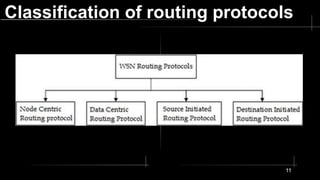
The routing protocols define how nodes will communicate with each
other and how the information will be disseminated through the network.
There are many ways to classify the routing protocols of WSN. The
basic classification of routing protocols is illustrated in Figure.
10
Classification of routing protocols
11

Ad hoc & WSN Routing protocols (Geetha) (2).pptx

  • 1.
    Ad hoc andWireless networks Routing Protocols Mrs.M.Geetha
  • 2.
    Routing Protocols: The routingprotocol is a process to select suitable path for the data to travel from source to destination. The process encounters several difficulties while selecting the route, which depends upon, type of network, channel characteristics and the performance metrics. 2
  • 3.
    Routing challenges inWSNs  The design task of routing protocols for WSN is quite challenging because of multiple characteristics, which differentiate them, from wireless infrastructure-less networks.  Several types of routing challenges involved in wireless sensor networks. Some of important challenges are mentioned  It is almost difficult to allocate a universal identifiers scheme for a big quantity of sensor nodes. So, wireless sensor motes are not proficient of using classical IP-based protocols. 3
  • 4.
    Routing challenges inWSNs  The flow of detected data is compulsory from a number of sources to a specific base station. But this is not occurred in typical communication networks.  The created data traffic has significant redundancy in most of cases. Because many sensing nodes can generate same data while sensing. So, it is essential to exploit such redundancy by the routing protocols and utilize the available bandwidth and energy as efficiently as possible.  Moreover wireless motes are firmly restricted in relations of transmission energy, bandwidth, capacity and storage and on-board energy. Due to such dissimilarities, a number of new routing protocols have been projected in order to cope up with these routing challenges in wireless sensor networks. 4
  • 5.
    Design challenges inWSNs  There are some major design challenges in wireless sensor networks due to lack of resources such as energy, bandwidth and storage of processing. While designing new routing protocols, the following essentials should be fulfilled by a network engineer. Energy efficiency  Wireless sensor networks are mostly battery powered. Energy shortage is a major issue in these sensor networks especially in aggressive environments such as battlefield etc. The performance of sensor nodes is adversely affected when battery is fallen below a pre-defined battery threshold level. Energy presents a main challenge for designers while designing sensor networks. In wireless sensor network, there are millions of motes. Each node in this network has restricted energy resources due to partial amount of power. So, the routing protocol should be energy efficient [1]. 5
  • 6.
    Design challenges inWSNs Complexity The complexity of a routing protocol may affect the performance of the entire wireless network. The reason behind is that we have inadequate hardware competences and we also face extreme energy limitations in wireless sensor networks. Scalability As sensors are becoming cheaper day by day, hundreds or even thousands of sensors can be installed in wireless sensor network easily. So, the routing protocol must support scalability of network. If further nodes are to be added in the network any time then routing protocol should not interrupt this. 6
  • 7.
    Design challenges inWSNs Delay Some applications require instant reaction or response without any substantial delay such as temperature sensor or alarm monitoring etc. So, the routing protocol should offer minimum delay. The time needed to transmit the sensed data is required to be as little as possible in above cited WSN applications. Robustness Wireless sensor networks are deployed in very crucial and loss environments frequently. Occasionally, a sensor node might be expire or leaving the wireless sensor network. Thus, the routing protocol should be capable to accept all sorts of environments including severe and loss environments. The functionality of the routing protocol should be fine also [2]. 7
  • 8.
    Design challenges inWSNs Data transmission and transmission models There are four modes of data transmission depending on the applications in wireless sensor networks namely as query driven, event driven and continuous type and hybrid type. A node begins to transmit the data only when sink creates the query or an event occurs in query driven model and event driven model. The data is sent out periodically in continuous transmission mode. The performance of the routing protocol is a function of network size and transmission media. So, transmission media of good quality enhances the network performance directly [3]. 8
  • 9.
    Design challenges inWSNs Sensor location Another major challenge that is faced by wireless sensor network designers is to correctly locate of the sensor nodes. Most routing protocols use some localization technique to obtain knowledge concerning their locations. Global positioning system (GPS) receivers are used in some scenario. 9
  • 10.
    Classification of routingprotocols The routing protocols define how nodes will communicate with each other and how the information will be disseminated through the network. There are many ways to classify the routing protocols of WSN. The basic classification of routing protocols is illustrated in Figure. 10
  • 11.