? Predictive
? Non Predictive
? Protective
What Literature says:
• Acute PVD is typically accompanied by floaters (myodesopias or
entopsias) or light flashes (photopsias)
• Significant variability in the literature regarding what the presence or
absence of these symptoms implies
• studies have variably reported that photopsia symptoms are
• 1. Predictive either of a complicated PVD, nonpredictive, or protective
• The risk of RT or RRD occurring with PVD in published reports ranges
widely from 15.0% to 27.1%
Current concept
• Acute posterior vitreous detachment (PVD) is a critical lifetime
event that may be associated with the development of a retinal
tear (RT) or rhegmatogenous retinal detachment (RRD), which
may in turn result in permanent vision loss if not identified and
treated promptly.
What is the problem with current thinking?
• Prior studies evaluating acute PVD have been
typically performed in retinal specialty practices and
likely suffer from referral bias for more significant
PVD-related events
The Question?
• What are the risk factors for retinal tear (RT) or
rhegmatogenous retinal detachment (RRD) associated with
acute, symptomatic posterior vitreous detachment (PVD) in
a comprehensive eye care setting
Main Issue
• By not referring to a retina specialist, is the comprehensive
ophthalmologist correct ?
• Especially the chances of missing “Presence of RT or RRD at initial
presentation or within 1 year thereafter”.
Reference
• Complications of Acute Posterior Vitreous Detachment.
VOLUME 129, ISSUE 1, P67-72, JANUARY 01, 2022.
• Michael I. Seider, MDCarol Conell, PhD,Ronald B. Melles, MD
Rate of RT and RRD associated with acute PVD to be lower than rates
previously reported by retina subspecialty practices.
Several patient features strongly predicted the presence of initial and late
complications of acute PVD
Complications of Acute Posterior VitreousDetachment
Michael I. Seider, MD,1,2 Carol Conell, PhD,3 Ronald B. Melles, M
Ophthalmology Volume 129, Number 1, January 2022
“How likely is a patient to have a
complicated PVD based
on features that can be determined by a
comprehensive ophthalmologist”
Role of comprehensive ophthalmologist:
• Understand
• Risk of RT/RRD at presentation and within 1 year
• Evaluation of rates and risk factors
• Relate between refraction and risk of RT/RRD
Predictive Risk factors
Population distribution of 8305 patients presenting with acute symptomatic posterior
vitreous detachment (PVD). Women made up 61.2% of the cohort and presented at a
slightly earlier age than men (63.1 vs. 64.7 years, respectively).
Risk factors: History & Symptoms
• Blurred vision
• Age < 60 years
• Prior cataract surgery
• Prior photorefractive surgery
• Symptoms < 1 week duration
• Family history of RD
• Floaters
• Flashes
Risk factors: Signs
• Vitreous pigment
• Vitreous hemorrhage
• Retinal hemorrhage
• Lattice degeneration
• Vision < 20/40
• Initial and delayed rates of acute posterior vitreous detachment (PVD) complicated by retinal tear
(RT) or retinal detachment (RD)
• ∗High-risk factors for delayed events included any vitreous hemorrhage, lattice degeneration, or
history of RT or RD in the fellow eye
Highly predictive of the presence of complicated PVD
The median interval until a late event was 22 days after initial presentation
93 of the late complications (70.0%) occurred within 6 weeks.
Sixty of the late events (45.1%) were detected at a scheduled follow-up appointment
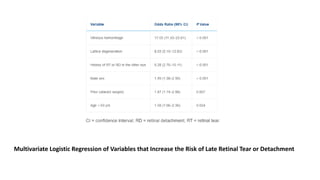
Multivariate Logistic Regression of Variables that Increase the Risk of Late Retinal Tear or Detachment
Refractive Error
• High myopia (-3.00D -6.0 D ) risk factor for complicated PV
• Independent of patient age
• Relatively linear relationship
• Between
• The age at presentation of PVD and refractive error
• Myopic patients presenting at a younger age
• Hyperopes at a later age, compared with emmetropes
Factors predictive of Late events
• More likely to occur in patients who initially presented with
• 1. Vitreous hemorrhage
• 2. Lattice degeneration
• 3. History of RT or RD in the fellow eye
• 4. Occur at a median of 22 days after presentation
• 5. Follow up closely sooner than interval of 6 weeks
Salient Points
• Incidence of RT during acute PVD in comprehensive ophthalmology is
substantially lower than that reported in series from retina subspecialty clinics
• Specific risk factors that can assist in predicting which patients are at highest
risk of complicated PVD both at triage and the time of initial examination
Predictive Factors of Late events
• Vitreous hemorrhage
• Lattice degeneration,
• History of RT or RRD in the fellow eye
• Patients with any of these key characteristics should be observed closely
Refractive error
• Close relationship among refractive error, patient age at PVD, and
risk of complicated PVD, with myopic eyes not only presenting at a
younger age but also having an independently greater risk of
associated RT or RRD

Acute PVD.pptx

  • 1.
    ? Predictive ? NonPredictive ? Protective
  • 2.
    What Literature says: •Acute PVD is typically accompanied by floaters (myodesopias or entopsias) or light flashes (photopsias) • Significant variability in the literature regarding what the presence or absence of these symptoms implies • studies have variably reported that photopsia symptoms are • 1. Predictive either of a complicated PVD, nonpredictive, or protective • The risk of RT or RRD occurring with PVD in published reports ranges widely from 15.0% to 27.1%
  • 3.
    Current concept • Acuteposterior vitreous detachment (PVD) is a critical lifetime event that may be associated with the development of a retinal tear (RT) or rhegmatogenous retinal detachment (RRD), which may in turn result in permanent vision loss if not identified and treated promptly.
  • 4.
    What is theproblem with current thinking? • Prior studies evaluating acute PVD have been typically performed in retinal specialty practices and likely suffer from referral bias for more significant PVD-related events
  • 5.
    The Question? • Whatare the risk factors for retinal tear (RT) or rhegmatogenous retinal detachment (RRD) associated with acute, symptomatic posterior vitreous detachment (PVD) in a comprehensive eye care setting
  • 6.
    Main Issue • Bynot referring to a retina specialist, is the comprehensive ophthalmologist correct ? • Especially the chances of missing “Presence of RT or RRD at initial presentation or within 1 year thereafter”.
  • 7.
    Reference • Complications ofAcute Posterior Vitreous Detachment. VOLUME 129, ISSUE 1, P67-72, JANUARY 01, 2022. • Michael I. Seider, MDCarol Conell, PhD,Ronald B. Melles, MD
  • 8.
    Rate of RTand RRD associated with acute PVD to be lower than rates previously reported by retina subspecialty practices. Several patient features strongly predicted the presence of initial and late complications of acute PVD Complications of Acute Posterior VitreousDetachment Michael I. Seider, MD,1,2 Carol Conell, PhD,3 Ronald B. Melles, M Ophthalmology Volume 129, Number 1, January 2022
  • 9.
    “How likely isa patient to have a complicated PVD based on features that can be determined by a comprehensive ophthalmologist”
  • 10.
    Role of comprehensiveophthalmologist: • Understand • Risk of RT/RRD at presentation and within 1 year • Evaluation of rates and risk factors • Relate between refraction and risk of RT/RRD
  • 11.
  • 12.
    Population distribution of8305 patients presenting with acute symptomatic posterior vitreous detachment (PVD). Women made up 61.2% of the cohort and presented at a slightly earlier age than men (63.1 vs. 64.7 years, respectively).
  • 13.
    Risk factors: History& Symptoms • Blurred vision • Age < 60 years • Prior cataract surgery • Prior photorefractive surgery • Symptoms < 1 week duration • Family history of RD • Floaters • Flashes
  • 14.
    Risk factors: Signs •Vitreous pigment • Vitreous hemorrhage • Retinal hemorrhage • Lattice degeneration • Vision < 20/40
  • 15.
    • Initial anddelayed rates of acute posterior vitreous detachment (PVD) complicated by retinal tear (RT) or retinal detachment (RD) • ∗High-risk factors for delayed events included any vitreous hemorrhage, lattice degeneration, or history of RT or RD in the fellow eye
  • 16.
    Highly predictive ofthe presence of complicated PVD
  • 17.
    The median intervaluntil a late event was 22 days after initial presentation 93 of the late complications (70.0%) occurred within 6 weeks. Sixty of the late events (45.1%) were detected at a scheduled follow-up appointment
  • 18.
    Multivariate Logistic Regressionof Variables that Increase the Risk of Late Retinal Tear or Detachment
  • 19.
    Refractive Error • Highmyopia (-3.00D -6.0 D ) risk factor for complicated PV • Independent of patient age • Relatively linear relationship • Between • The age at presentation of PVD and refractive error • Myopic patients presenting at a younger age • Hyperopes at a later age, compared with emmetropes
  • 20.
    Factors predictive ofLate events • More likely to occur in patients who initially presented with • 1. Vitreous hemorrhage • 2. Lattice degeneration • 3. History of RT or RD in the fellow eye • 4. Occur at a median of 22 days after presentation • 5. Follow up closely sooner than interval of 6 weeks
  • 21.
    Salient Points • Incidenceof RT during acute PVD in comprehensive ophthalmology is substantially lower than that reported in series from retina subspecialty clinics • Specific risk factors that can assist in predicting which patients are at highest risk of complicated PVD both at triage and the time of initial examination
  • 22.
    Predictive Factors ofLate events • Vitreous hemorrhage • Lattice degeneration, • History of RT or RRD in the fellow eye • Patients with any of these key characteristics should be observed closely
  • 23.
    Refractive error • Closerelationship among refractive error, patient age at PVD, and risk of complicated PVD, with myopic eyes not only presenting at a younger age but also having an independently greater risk of associated RT or RRD