1
Journal of APOS | Vol 3 | Issue IV | 2017
apos.co.in
Journal of APOS | Vol 3 | Issue IV | 2017
2 apos.co.in
3
Journal of APOS | Vol 3 | Issue IV | 2017
apos.co.in
Ex - Officio of APOS
President
Dr. T. Satyanarayana Reddy
Hon. General Secretary
Dr. V Sambasiva Rao
Chairman Scientific Committee
Dr. C V Gopala Raju
Chairman ARC
Dr. B.S. Naik
Proof Reading / Assistance
Mrs.P.Hemalatha, Mrs.I.Parvati Rao & Dr. C Varalakshmi
Design&Graphics
Mr. M. Siva Kumar
9966740431
Printers
GK Print House Private Limited
Rednam Gardens, Visakhapatnam
Ph : 0891-2702711, 2549422
Journal ofAPOS
Publication of Andhra Pradesh Ophthalmoic Society
Reg No. 192 of 2014
Table of Contents
EDITORIAL BOARD
Dr. Seshubabu Gosala
9848177109
Seshu.gosala@gmail.com
Dr.M.SriramaChandra
Murthy
9849123790
manchikanty@gmail.com
Dr.VirenderSachdeva
950 952 0647
vsachdeva@lvpei.org,Mobile
Dr. I.Venkata Rao
970 184 1299
ivatury_vr@yahoo.com
Dr.Ajay Sharma
944 146 9633
drajaysharma_123@yahoo.co.in
Dr.G.V.Narendra
9985455042
gvnaredra@gmail.com
1. EditorialBoard 1
2. Editorial 3
3. Reviews:
A. Idiopathic Demyelinating Optic Neuritis
Prof. K. Vengalarao
B. Vernal Keratoconjunctivitis, Part II
Dr C.V. Gopala Raju
C. Cataract: The burden and challenges
Dr. Seshubabu Gosala
D. ANewErainthetreatmentofDME
Dr G.V. Narendra
E. AdaptersinSmartphone.Howtomakeyourown.
Dr Ajay Shankar Kar
F. Retinopathyofprematurityreviewandupdate
Dr. Y. Srinivasulu Reddy and Dr. V.K. Raju
G. CaseReport
Dr. Lt Colonel K. Jyothi, Naval Hospital, Visakhapatnam
H. Inadvertent Iatrogenic Partial Detachment Of Iris Pigmented
Layer:A Rare Case Report
Dr N. Jayanthi
I. Optimizing Machine Settings For Chopping Techniques
Dr A.S.Pavan Kumar and Dr M. Srirama Chandra Murthy
J. Posterior Polar Cataract
Dr Arup Chakrabarti and Dr Meena Chakrabarti
4. LeaderArticle :
Global Opinion On Emerging Technologies.
Dr. I. Venkata Rao and Dr M. Srirama Chandra Murthy
5. GuestArticle :
Review of Stem Cell Deficiency and Surgical Options
Leela V. Raju MD and V.K. Raju MD, FRCS, USA
Part-II
NEWSANDVIEWS
1. Editorial
2. Messages : President Dr T Satyanarayana Reddy
Dr. V. Sambasiva Rao, Honry Gen. Secretary
3. AmaravatiVision 2017
Journal of APOS | Vol 3 | Issue IV | 2017
4 apos.co.in
5
Journal of APOS | Vol 3 | Issue IV | 2017
apos.co.in
Journal of APOS
Publication of Andhra Pradesh Ophthalmic Society
Editorial
I am a strong believer in systematic learning from a Guru without
whose guidance is probably difficult to attain a personality
with knowledge we all aim for. Let us all join hands respectfully
and salute those men and women who have thus moulded us.
We owe love and respect to our traditional base of mother and
father who caringly helped us take the first few steps as an
infant well before reaching the school. To those researchers
who toil day and night in developing a medical molecule that
helps save and restore useful vision, like the medical engineers
who invent and give us high tech gadgetry that helps in the
rapidly evolving Ophthalmic surgery, we say Thank You so
much.
I am often intrigued by the speed at which scientific knowledge
is evolving. Understandably the boom in Hi tech hardware /
gadgetry coupled with the Inqusitive mind is paving way for
methodologies (diagnostic and therapeutic) with gratifying
results. Thanks to the emerging technologies that have
infiltrated every aspect of modern living.
Consider bullet trains with speeds in excess of 300 KMPH
appear to be the thing of the past. The terms like hyper-speed
and hyper loop are mind boggling indeed.AUK firm is boasting
of a commercial Train between Glasgow and Edinburgh (740
KM) with a 20 minutes travel using the principle of electro-
magnetic levitation that boasts no friction and no emission.An
Auto-plane that flies like a plane whose wings can be stretched
at will indeed is a car on the road to start with.
In Ophthalmology Image guided cataract surgery and a 3D
exquisite Vitreo-retinal surgery have now become available in
managing “Dysfunctional Human Eye". Bio tissue/cell culture
in the treatment of neoplasm and trauma repair are some
stunning examples of evolving science.
Optimal utilisation of the available diagnostic and therapeutic
platforms is yielding satisfying and unparalleled results both
to the surgeon and the patient. Ethical medicine coupled with
transparency is mandatory for sustainable health delivery
system. The patient should be given ample time and interaction
in the consultation chamber. Needless to say an average patient
nowadays is better informed of his health care needs and is
constantly shopping around for good value of money spent
Every individual, hospital and institutions should consider
research and paper publication as a part of the professional
existence. Then the results would enhance the individuals
credibility and recognition follows. Targets can be achieved
by focused thinking and dedicated effort. The Editorial board
wishes the readers the very best of everything. HOPE TO SEE
YOUALLINAMARVATHI very soon
DrI.V. Rao
******
Instructions to Authors
All manuscripts must be sent by email to the editor.
Manuscripts details
Original articles: Randomized controlled trials, intervention
studies, studies of screening and diagnostic test, outcome studies,
cost effectiveness analysis, case-control series, and surveys with
high response rate come in this category. The limit of the text is
3000 words excluding about 30 references and structured abstract of
250 words.
Review articles: This include, Systemic critical assessments of
literature and data sources. The limit of the text is 4000 words
excluding 90 references and abstract. For review articles, include the
method (literature search) in abstract as well as in the introduction
section.
Community ophthalmology: The limit of the text is 3000 words
and 30 references
Ophthalmic practice/perspective: It should summarize and suggest
prevailing practice pattern in cases of multiple, diverse options.
The word count for the text should be 2500 and abstract 250 words.
Current ophthalmology: It should summarize the latest
developments in a particular field with a limit of word count for text
2500 and abstract 250 words.
Research methodology: This includes educative articles related to
the conduct of research with word count up to 3000 and references
up to 30.
Symposia: These are commissioned articles by the editorial board
Brief Communication: it is like original article with insufficient
power with some limitations in the study. The articles should be
with unstructured abstract 150 words and main text 1000 words
excluding 10 references.
Case reports: new/interesting/very rare cases can be reported. Cases
with clinical significance or implications will be given priority.
However, mere reporting of a rare case may not be considered. The
limit is 1000 words excluding references and abstract with a maximum
of 10 references.
Letter to the Editor: Should be short, decisive observation. They
should not be preliminary observations that need a later paper for
validation. The limit is 500 words and 5 references.
Announcements of conferences, meetings, courses, and other items
likely to be of interest to the readers should be submitted with the
name and address of the person from whom additional information
can be obtained.
The text of original articles should be divided into sections with
the headings: Abstract, Key-words,Introduction, Material and
Methods, Results, Discussion, References, Tables and Figure legends.
For a brief report include Abstract, Key-words Introduction, Case
report, Discussion, Reference, Tables and Legends in that order. Do
not use subheadings in these sections. The text should be in MS
Word format. Use double spacing throughout. Number pages
consecutively, beginning with the title page. The language should be
American English. Illustrations (Figures), Upload the images in
JPEG format. Figures should be numbered consecutively according
to the order in which they have been first cited in the text.
Copy Right: Journal of APOS/ APOS News & Views has no copy
rights. For any clarification, please contact the Editor.
Journal of APOS | Vol 3 | Issue IV | 2017
6 apos.co.in
IDIOPATHIC DEMYELINATING OPTIC NEURITIS (IDON)
(ACUTE RETRO BULBAR NEURITIS) & MULTIPLE SELEROSIS
Review
Objectives of this article:
To discuss the diagnosis, Evaluation and treatment of
opticneuritis.
To discuss the association of opticneuritis with multiple
sclerosis.
To discuss treatment rationale of Optic Neuritis as a first
demyelinating event (FDE).
Introduction:
Optic Neuritis (ON) is Retro bulbar Optic Nerve Injury.
It has strong association with Multiple Sclerosis (MS)
It is the First demyelinating event (FDE) in 20% MS
patients.
It affects 75% MS patients during the course of their
disease
Characteristics of IDON: [Acute Retro Bulbar Neuritis]
More prevalent in young women (3:1)
Unilateral
Acute or sub acute onset
Decreased VA
Loss of colour vision (pronounced)
Pain with eye movements in more than 90% cases
Exacerbation with heat and exercise (Uthoff’s sign)
Atypical Features of Optic Neuritis :
Older age (> 45 years)
Marked optic disc edema
Prominent vitreous inflammation,
Venous sheathing, retinitis
Bilateral involvement
Pallor at presentation
PresentingClinical Features of Optic Neuritis :
Young patient (<45 years)
Pain 92%
Photopsia (30%)
Subacute vision loss (20/20 to No PL)
Dyschromatopsia
Nerve Fiber Bundle visual field defects
Normal Fundus examination
EvaluationofPatient:
RAPD and color vision
Fundus – 2/3 cases normal, 1/3 cases show swollen OD
Normal macula and retina
OD pallor after 4 – 6 weeks
Fields – central scotoma; centrocecalscotoma
In 79% spontaneous improvement
Absence of improvement points to other diagnosis
Risk of MS should be assessed
Testing Visual Function
1. VisualAcuity
2. Visual Fields
3. RAPD
4. CV
5. Fundus
6. MRI of brain
Prof. K. Vengalarao, Bobbili Eye Hospital, Bobbili
First Demyelinating Event in multiple sclerosis is acute Retro bulbar neuritis Most common of acute
neuropathies, Age: Under the age of 45yrs It is the presenting sign of multiple sclerosis
Demyelization Plaque – myelinated nerve fibers lose myelin layer. Macrophages & Microglia phagocytose the myelin.
Astrocytes form fibrous tissue (plaque) disrupts nerve conduction within the white mater tracts in the
brain stem and spinal cord
7
Journal of APOS | Vol 3 | Issue IV | 2017
apos.co.in
Optic Neuritis : Fundus Findings normal
“The patient sees nothing,and the doctor sees nothing
Clinical Course:
Pain rarely lasts more than 7 days
Visual recovery in 4 – 6 weeks
Variable visual complaints and dysfunction after “recovery”
Future risk of MS
Optic disc edema is against the diagnosis of R.B NEURITIS
AssociationbetweenIDONandMS:
IDON patients are at high risk of developing
MS after an Isolated attack of IDON (74% in 15
yrs)
Initial MRI helps to forecast the risk of MS
TreatmentTrial(ONTT):
Compared patients treated with1g IVMP (Intra
Venous Methyl Prednisolone) versus oral
prednisone(1mg/kg/d) versus placebo
Improved speed of visual recovery among the
IVMP group has been noted
Decreased rate of CDMS (Clinically Demye
linating Multiple Sclerosis) amongthe IVMP
group after 2 years
ONTTstudy:[OPTICNEURITISTREATMENTSTUDY]
388ONTTpatientsfollowedfor12yrs,with87%
follow up achieved
Overall risk of MS at 15yrs is 50%
If MRI – Brain is normal 15yrs risk is 23%
If Brain MRI shows one T2 weighted ovoid
lesion of more than 3mm diameter it is
suggestive of 56% risk of MS in 15 years
If Brain shows 6 T2 weight white matter lesions
it is suggestive of MS risk 74%
LP may detect Oligoclonal bands in IDON
It provides additional information only when
MRI is normal
Abnormal MRI is strongest predictor of MS in
patients with ON
TreatmentprocedureofONTT:
I/VMethyolprednisolone 250 mg 6 hourly for
3days
Followed by oral Prednisolone 1mg/kg body
weight
For 11 days then tapered over 3 days
Hastens visual recovery by 2 weeks
Does not change the final outcome of visual
recovery
May help alleviate pain
Delays neurological symptoms for 2 years does
not change the risk of MS after 2 years
Oral Prednisolone should not be prescribed
alone
It doubles the risk of recurrent optic neuritis
(ONTT)
Spontaneous recovery occurs even without
treatment
Presence of Disk Edema rules out acute Retrobulbar neuritis
Journal of APOS | Vol 3 | Issue IV | 2017
8 apos.co.in
LOWRISK:
Normal MRI, male gender, prominent optic discs welling
& absence of pain
Disease Modifying Agents:
These decrease the risk of subsequent neurological
Symptoms related to MS
Should be considered in high risk patients
Interferon beta 1a (Avonex) and bete 1b (beta seron)
Approved by FDA for long term treatment of ON patients
Several other drugs are undergoing clinical trials
Some curious signs of Muiltiple sclerosis:
Uthoff’s sign: vision becomes blurred when body gets
overheated from exercise fever or hot weather. It is thought
to be a residual symptom of O.N.
Excess heat may interfere with conduction of diseased
optic nerve
Pulfrichphenomenon:
Perception of elliptical movement when observing a
pendulum swinging in one plane occurs in patients with
unilateral or asymmetric optic neuropathy. It is a stereo
illusion related to difference in conduction delay in both
eyes.
Lhermitt’s sign:
Electric shock like sensation present with M.S
It is not specific for M.S. It can also be seen in cervical
SpondilitisVit-B12
deficiency etc.
Sensation radiates from neck downwards
Duration is less than a second
Response is triggered by flexing the neck forwards
It is known also as barber’s chair phenomenon
FUTURE RISK of MS…
Clinical evidence for future CDMS?
Predictive role of MRI?
The MRI Scan is indicates FUTURE RISK.
MRI Strongest predictor for the development of CDMS
OCTinON:
OCT is very useful in the early diagnosis of multiple
selerosis
Nerve fiber layer defects are useful in the diagnosis M.S
& Optic neuritis.
Conclusions:
Optic Neuritis - a common first demyelinating event in
MS
Neuro-ophthalmic examination may predict future risk of
MS
Optic Neuritis-a model of axon loss?
MS – a neurodegenerative disorder?
Early treatment may modify the natural history of MS
MRI brain is most important investigation in
multipulselerosis
References :
1. Beck RW, Cleary PA, Anderson MM Jr, et al. A randomized, controlled
trial of corticosteroids in the treatment of acute optic neuritis. The
optic neuritis study group. N Engl J Med.1992; 326(9): 581-588
2. Optic Neuritis study group. Multiple sclerosis risk after optic neuritis:
final optic neuritis treatment trial follow-up. Arch neurol.2008; 65(6):
727-732.
3. Optic neuritis study group. Visual function 15 years after optic neuritis:
a final follow-up report from the optic neuritis treatment trial.
Ophthalmology.2008; 115(6): 1079-1082.
4. Optic Neuritis study Group. The clinical profile of optic neuritis:
experience of the optic neuritis treatment trial. Arc ophthalmol. 1991;
109(12): 1673-1678.
5. Frohman EM, Goodin DS, calabresi PA, et al. The utility of MRI in
suspected MS: report of the Therapeutics and technology assessment
subcommittee of the American academy of neurology. Neurology. 2003;
61(5): 602-611.
6. Polman CH, Reingold SC, and Banwell B, et al. Diagnostic criteria for
multiple sclerosis: 2010 revisions to the McDonald criteria. Ann Neurol.
2011; 69(2): 292-302.
7. Frohman EM, Goodin DS, Calabresi PA, et al. The utility of MRI in
suspected MS:report of the Therapeutics and technology assessment
subcommittee of the American Academy of Neurology. neurology. 2003;
61(5):602-611.
8. Polman CH, Reingold SC, BanwellB, et al. Diagnostic criteria for multiple
sclerosis:2010 revision to the Mcdonald criteria. Ann neurol. 2011;
69(2):292-302.
9
Journal of APOS | Vol 3 | Issue IV | 2017
apos.co.in
Dr. Arup Chakrabarti Dr. Meena Chakrabarti
POSTERIOR POLAR CATARACT
Review
Association of PPC: - This entity may be associated with other
ocular features like microphthalmia, microcornia, anterior polar
cataract and psychosomatic disorders28-32
. In addition it can also
be associated with ectodermal dysplasia, Rothmund disease,
scleroderma, incontinentia pigmenti, congenital dyskeratoses, and
congenital atrophy of the skin. 33
Clinical Presentation:-
PPC presents as a dense white circular opacity in the central
posterior capsule, located near the nodal point of the eye,
surrounded by concentric whorls (Bulls eye appearance)4
. (Fig
1a and 1b) The posterior polar opacity in a PPC extends anteriorly
into the posterior cortex appearing pyramidal and this feature
differentiates it from the more common posterior subcapsular
cataract, which is typically thin and occupies only the posterior
subcapsular region. Posterior polar cataracts can be either
stationary or progressive33
. The stationary type that is more
common demonstratesthe characteristic bull's eye appearance.A
small satellite lesion adjacent to the central opacity may also be
seen. Patient may be symptom free with a good visual function in
the static form of PPC. In the progressive type, whitish
opacification in the form of radiating rider opacity is present. It
has feathery and scalloped edges. It does not involve the nucleus
or extend anteriorly as far as original opacity. Visual symptoms
and glare worsen during the progression of PPC. The diagnosis
of a PPC is self evident on slit-lamp examination and retro
illumination. Oil-like droplets or particles may be seen in the
anterior vitreous.The presence of such a finding should raise the
possibility of pre-existing capsular opening.
Introduction:-
Posterior polar cataract (PPC) is an important type of
congenital cataract that is well known bycataract surgeons to
pose specific challenges during cataract surgery. The incidence
of PPC ranges from 3 to 5 in 10001-3
. The incidence of bilaterality
ranges from 40%-100%.4, 5
. The lens is usually clear at birth and
the cataractous progression takes place later in life, usually in the
third or fourth decades. PPC hasa higher predisposition to posterior
capsular rupture (PCR) during cataract surgery and hence is a
special challenge to the phaco surgeon4
.
Pathogenesis:-
The pathogenesis of PPC is unknown. It has been suggested
that PPC is caused by persistence of hyaloid artery6,7,8,
or due to
invasion of the lens by mesoblastic tissues.9,10
Electron
microscopic studies by Eshagian J have shown accumulation of
abnormal lens fibres and extracellularmaterial in the region of the
posterior polar opacity.11
The plaque of posterior polar opacity is
acellular and there is a dense adhesion of the plaque to the
underlying posterior capsule centrally12
. Electron microscopy also
demonstrates breakdown of lens fibres, presence of disorganized
lobules and membranous whorls and weakness or deficiency of
the posterior capsule. Bernheimer noted a thinning of the posterior
capsulein a report on the histopathology of a PPC in a still-born
infant.12
However Eshagian doesn't mention this in a review of
histopathology of posterior subcapsular cataract (including PPC)11
.
In approximately 20% of the cases an association with a congenital
defect in posterior capsule has been reported.4
The high incidence of PCR during surgery for patients with
PPC might be due to the tight adherence of the plaque to the
underlying otherwise normal capsule or due to the inherent
weakness or pre existing dehiscence of the posterior capsule
underlying the plaque.13
Inheritance and Genetics:-
The inheritance pattern of PPC is usually autosomal dominant
and demonstrates a heterogenetic inheritance.14, 15
This condition
can also occasionally be sporadic due to a new mutation.16
There
has also been a report of a pedigree with autosomal recessive
inheritance of PPC17
. Apositive family history has been reported
in 15% to 55% of patients4, 18,19
. PPC has been associated with
mutation on chromosome1, 10, 11
and 16.20, 21
There are 5 genes attributed to PPC that have been identified
(CTTP) and are enumerated below in Table 1
Fig 1a, 1b & 1c: Posterior polar cataract (PPC)
Fig 1a : PPC with a lesion resembling a posterior capsular
plaque in a young patient
Journal of APOS | Vol 3 | Issue IV | 2017
10 apos.co.in
Sometimes the opacity is camouflaged by nuclear sclerosis. As
normal age related opacification occurs nuclear sclerosis can mask
the presence of a PPC, unless it is carefully sought. This can lead
to unexpected surgical problems.4, 5
Mean lens thickness in PPC was found to be lower than that
found eyes with senile cataract.5
Classification:-
Because of the low incidence of PPC most of the study samples
have been small making it difficult to evolve a grading system for
PPC.
Singh et al classified PPC into 4 groups.2
, 34 Type 2 has been
reported to progress to Type 3 with the passage of time.
Schroeder graded PPC in his pediatric patientsaccording to its
effect on pupillary obstructionin the red reflex testing. 35
Symptoms:-
Both stationary and progressive forms of PPC may become
symptomatic. The lens may have evidence of a small opacity at
birth and may develop cataractous changes later in life usually by
30-50 years of age.33
Visual acuity appears to worsen once nuclear
cataract sets in. The common symptoms are increasing glare while
driving at night, difficulty in reading fine print at close range,
intolerance to light, reduced contact sensitivity and reduction in
vision.4, 5
The indications of surgery in patients with PPC include decreased
vision due to increased density of lens opacity, age related
pupillary miosis, increased glare due to forward scattering of light,
or increased functional needs and visual expectations.4, 5
There have been reports of spontaneous posterior lens dislocation
though a weakened posterior capsule in PPC.36,37
Differential Diagnosis:-
1. Posterior lenticonus: PPC and posterior lenticonus share
certain common features. Both are posterior polar abnormalities,38
which are progressive39
and are predisposed to traumatic lens
rupture.40
The differentiating features include the following.38, 39,40
PPC is predominantly inherited as an autosomal dominant
conditionwhereasposteriorlenticonustypicallyoccurssporadically.
The posterior polar opacity is usually dense and compact whereas
posterior lenticonus has a porous opacity. Posterior lenticonus is
usuallyunilateral,exhibitingafemalepreponderanceandhasacentral
posterior protuberance which is absent in PPC. 31, 39
2.PosteriorSubcapsularCataract: Itisimportanttodifferentiate
between the two conditions since the surgical implications and
management strategies are different. Posterior subcapsular cataract
is an acquired condition, more commonly seen, occurring at any
age, plate like-lacking in depth and may extend peripherally even
up to the equator in some cases. It is thinner without the
characteristic concentric rings and not adherent to the posterior
capsule. It may be associated with diabetes mellitus, steroid use
and exposure to radiation. It does n't predispose to the occurrence
of PCR. Once a preoperative diagnosis of posterior subcapsular
cataract is made the patient will be spared of the rigorous
techniques adopted for PPC surgery.
Surgical Planning:-
The Risks and Problems
The main problem in surgery for PPC is a high probability of PCR.41
Eyes with this conditionshowed a very high incidence of PCR
(36% and 26%) in early reports4, 5
. In an effort to reduce the high
incidence of PCR surgeons have developed a number of different
techniques which have evolved from a heightened understanding
of the anatomical abnormality of the posterior capsule and surgical
factors that increase the risk of intraoperative PCR. The more
recent reports in the literature cite a lower incidence of PCR varying
from 6% to 7 %.18,42
Studies have suggested that size of the polar
opacity has a bearing on the risk of intraoperative PCR. 18,43
In
Hayashi's series where only routine phacoemulsification was
performed for polar opacity < 4 mm the incidence of PCR was
reported as 7 %.18 Posterior approach was employed for larger
opacities. In the series reported by Kumar et al. PCR was noticed
in 30.43% of eyes with polar opacity > 4mm whereas only 5.71%
with posterior polar opacities of < 4 mm had PCR.43
The incidence
of PCR was higher in patients < 40 years and in eyes that underwent
extracapsularcataractincisionwhencomparedtophacoemulsification.44
Indication for Surgery
Since these eyes are prone for PCR, it may be prudent to delay the
cataract surgerytill the patient becomes visually symptomatic.
However undue delay with advancing nuclear sclerosis may render
the surgery more difficult and complication prone. Hence the
patient should be periodically monitored for progression indicated
by visual deterioration, signs of increase of the posterior polar
component, and advancing age related lens opacification. In the
presence of any of the above events surgical intervention should
be considered after appropriate counseling and an informed
consent.
Evaluation
A careful slit lamp examination should be performed to confirm
the diagnosis of PPC. One should also look for signs of congenital
dehiscence. Nuclear brunescence may camouflage an underlying
Fig 1b : PPC in a middle aged patient Fig 1c: PPC in an elderly patient
11
Journal of APOS | Vol 3 | Issue IV | 2017
apos.co.in
PPC which can be mistaken for posterior subcapsular cataract.
The findings after a meticulous evaluation will be of great value in
choosing the appropriate line of management and prognosticate
the eventual postoperative outcome.
Counseling
Counseling is extremely crucialin the management of PPC. The
patient should be informed about the unusual nature of the cataract
and the possibility of a relatively longer surgical time. He should
be counseled about possibility of intraoperative PCR, dropped
nucleus and potential need for a posterior segment intervention
as a primary or a secondary procedure. He should be apprised of
the potential postoperative complications and possibilityof
delayed visual recovery. It is also prudent to counsel about the
requirement for Nd:YAG laser capsulotomy for residual capsular
plaque.4,5,18
(Fig-3). The potential for pre-existing amblyopia in
unilateral PPC should also be taken into consideration.18
Though
these patients present early for cataract surgery multifocal IOLs
constitute a relative contraindication since these eyes are
predisposed to intraoperative PCR. After surgery majority of
patients regain 20/20 vision. Visual acuity is reported to be greater
than or equal to 20/20 in 49 out of 58 eyes (84%) 5, 18, 19
and greater
than or equal to 20/40 in 88% of a total of 111 eyes.1, 4
Surgical Management of PPC:-
Though various surgical approaches have been proposed for
managing PPC there is no surgical technique to completely
eliminate the occurrence of PCR. An appropriate technique may
be selected depending on the stage of PPC at the time of
presentation.
Intracapsular cataract extraction (ICCE). Hayashi K et al. reported
a series of 28 eyes of 20 consecutive patients withPPC who
underwent cataract surgery.18
ICCE was performed only for a single
case with a large opacity and hard nucleus.
The posterior approach. Ghosh et al. investigated this approach
in an interventional case series of 11 eyes of 8 patients with PPC
undergoing pars plana vitrectomy, lensectomy, and sulcus placed
intraocular lens (IOL).19
The rationale behind this approach is that
a controlled pars plana procedure will eliminate unpredictable
capsular rupture and its attendant posterior segment complications
encountered with an anterior approach. However this technique
was not without complications and during a mean follow-up of 13
months, 3 of 11 eyes developed posterior segment complications
including one case of retinal detachment. The posterior approach
was also used in 2 of 28 eyes undergoing cataract surgery for
PPC since the opacity was large and the lens soft.18
In view of the
presence of complications with the posterior approach it may be
unwise to consider this as a routine approach to manage PPC
since recent reports show a much lower incidence of PCR during
phacoemulsification than earlier reports. It is always desirable to
be able to maintain the capsular barrier using an anterior approach
wherever possible and employ a pars plana approach since it
limits the options for visual rehabilitation to scleral fixated, iris-
fixated or anterior chamber angle supported IOLs. However a
posterior approach to the PPC may be considered for patients
with polar plaque greater than 4 mm provided the cataract surgeon
has access to an experienced posterior segment surgeon or service.
The anterior approach phacoemulsification. The primary goal of
phacoemulsification for PPC is to maintain an intact capsulo-
zonular barrier between the anterior and posterior segments and
to implant an IOL within the capsular bag. Various modifications
of phacoemulsification techniques have been proposed to
minimizeordelaytheoccurrenceofintraoperativePCRallofwhich
provide a closed chamber environment maintaining the contours
of the globe. There are several publications in the literature
describing subtle variations of techniques. The salient and relevant
features of some of these will be discussed here.
Patients with PPC should be operated upon by experienced
surgeons.
Anesthesia: -
There is no universal anesthetic technique for PPC. However
surgeons prefer to employ an injection anesthesia since the
surgical time may be prolonged in some of these situations where
a PCR occurs and there is the need for anterior vitrectomy. Topical
anesthesia may be employed in a suitable patient. It is preferable
to perform these cases under monitored anesthetic care.
Incision:-
The surgeon may construct an incision that is his standard for
routine cases. This author creates two paracentesis incisions and
the aqueous is exchanged with a cohesive OVD. Then a definitive
valvular corneal incision is created for phacoemulsification. Today
it is the norm to perform phacoemulsification through temporal
clear corneal approach.An incision of the right dimensions (neither
too long nor too wide) is desirable.Aleaky incision will result in a
shallow anterior chamber and along incision will result in oar-
locking and intraoperative visibility issues especially while dealing
with the sub-incisional lens matter. However, in the presence of
co-existing morbidity like suprahard cataract some surgeons may
opt for the scleral tunnel incision. This may facilitate the surgery
in case the surgeon has to convert from phaco to manual non
phaco technique of nucleus removal. It is important to maintain
the eye at a physiological pressure level throughout the case.
Once the capsule is opened, an over pressurized anterior chamber,
by increasing the pressure on the nucleus may cause the weakened
posterior capsule to tear. Likewise periods of intraoperative
hypotony may cause extension of any posterior capsular tear.
Just the right amount of a cohesive OVD should be injected into
the anterior chamber to stabilize the environment.
Capsulorhexis:-
The eye should not be over pressurized with OVD before initiating
the capsulorhexis (CCC). The CCC should be "normal sized"
between 5 to 5.5mm. A larger CCC may not provide adequate
capsular support for optic capture of a sulcus- fixated PC IOL in
case the posterior capsule is significantly compromised ruling
out the possibility of placing the IOL in the capsular bag.5
, 45A
smallCCC(<4.0mm),ontheotherhandmaycomplicatethenucleus
managementbymaking the nucleus manipulations more difficult
thereby putting undue stress on the posterior capsule, A small
CCC will also make it difficult to prolapse the nucleus into the
anterior chamber if the need arises at a later stage. Some surgeons
have also attempted to modify the CCC by displacing it slightly
towards the incision or byaltering the contour by imparting a
Journal of APOS | Vol 3 | Issue IV | 2017
12 apos.co.in
smooth notch to render sub incisional nucleus management easier.
Singh et al. have recommended making an oval CCC of
approximately 8.0 mm by 4.5 mm.46
The axis of the oval CCC is the
same as the meridian of the corneal incision, irrespective of the
meridian of the pre-existing posterior capsule rupture. Their
rationale is that the long axis of the CCC allows easy and atraumatic
manipulation of the nucleus, instruments and IOL insertion within
the capsular bag. The shorter axis of the CCC leaves sufficient
anterior capsule to allow safe and secure optic capture should it
be required.
Hydroprocedures:-
Cortical cleaving hydrodissectionis a critical step in most of the
popular techniques of nuclear disassembly.47
However this should
be avoided in patients with PPC since it can lead to hydraulic
rupture of the posterior capsule.4, 5
Hydrodelineation has been
advocated by many to afford safety to the procedure by creating
a mechanical cushion of the epinucleus.1,2,5,18,48,49,50
Fine et alalso
recommends performing hydrodissection (in addition to
hydrodelineation) by injecting small quantities of BSS gently in
multiple quadrants, so that the fluid wave is not allowed to spread
across the posterior capsule.20
Hydrodelineation may be difficult
to achieve in the presence of a firm nucleus without causing undue
trauma to capsular bag and zonules. At times fluid may
inadvertently get injected subcapsularly resulting in unplanned
hydrodissection. Inside-out delineation has been proposed as an
alternative technique for hydrodelineation.51
(Fig 2a,2b) In
conventional hydrodelineation there is a possibility of the fluid
being injected inadvertently in the immediate subcapsular plane
resulting in unplanned cortical cleaving hydrodissection. In inside-
out delineation, after sculpting a central trench in the nucleus,
fluid is injected through one of the walls of the trench, the fluid
traverses inside out thereby providing the delineation. The author
prefers to avoid all hydrosteps and uses a technique of hydro-
free-dissection.(Fig 3) A blunt edged cyclodialysis spatula is
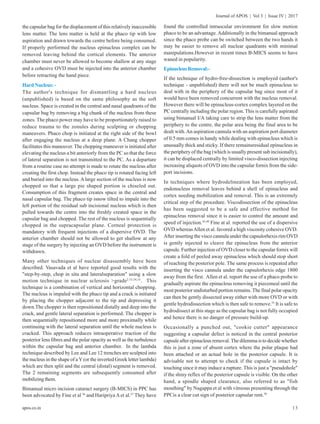
passed in the subcapsular plane almost up to the equatorial fornix
and swept in a side to side motion thereby separating the anterior
capsule from the underlying cortex. This process is performed
through both the paracentesis sites and the main incision. This
technique renders subsequent removal of lens matter much easier.
Fig 2a: Inside out hydrodelineation. Fluid is injected after placing the
hydrodissection cannula at a proper depth after sculpting an initial trench
Courtesy: Dr Abhay Vasavada. FRCS. Ahmedabad, India
Fig 2b: ‘Golden ring” created after inside-out hydrodelineation
Courtesy: Dr Abhay Vasavada. FRCS. Ahmedabad, India
Nucleus Disassembly:-
The techniques for nucleus disassembly in a PPC must take
cognizance of the fact that no effort should be made to rotate the
nucleus since cortical cleaving hydrodissection hasn't been
performed.Any such attempt may lead to zonular dialysis and/or
posterior capsular rent.5
Aggressive fluidics settings should be
avoided in order to reduce turbulence within the capsular space
and slow motion phaco as described by Osher ensures that the
cataract is removed in a gentle and controlled way.52
(26 Allen)
Many techniques for nucleus removal in PPC have been described.
The technique for nucleus dismantling depends on the degree of
nucleus sclerosis.
Soft Nucleus :
The author's preferred technique (unpublished) is to progressively
debulk the nucleus layer by layer, by sculpting adjacent grooves
centrally and in the nasal quadrants, using low phaco parameters
till a deep central bowl is created. During this process most of the
epinucleus would have been removed from the nasal quadrants
of the capsular bag. The sub incisional lens matter is visco
displaced towards the centre, by injecting OVD in a gentle and
incremental manner (limited viscodissection) into the capsular
fornix from a side port incision. Then the cyclodialysis spatula is
maneuvered from a paracentesis site to gently nudge the sub
incisional lens matter so that it just presents at the capsulorhexis
margin and becomes accessible to the phaco tip. This maneuver
is greatly facilitated by the first step when space was created in
Fig 3 Hydro-free-dissection in progress in a posterior polar cataract
13
Journal of APOS | Vol 3 | Issue IV | 2017
apos.co.in
the capsular bag for the displacement of this relatively inaccessible
lens matter. The lens matter is held at the phaco tip with low
aspiration and drawn towards the centre before being consumed.
If properly performed the nucleus epinucleus complex can be
removed leaving behind the cortical elements. The anterior
chamber must never be allowed to become shallow at any stage
and a cohesive OVD must be injected into the anterior chamber
before retracting the hand piece.
HardNucleus:-
The author's technique for dismantling a hard nucleus
(unpublished) is based on the same philosophy as the soft
nucleus. Space is created in the central and nasal quadrants of the
capsular bag by removing a big chunk of the nucleus from these
zones. The phaco power may have to be proportionately raised to
reduce trauma to the zonules during sculpting or chopping
maneuvers. Phaco chop is initiated at the right side of the bowl
after engaging the nucleus at a deep plane. A Chang chopper
facilitates this maneuver. The chopping maneuver is initiated after
elevating the nucleus a bit anteriorly from the PC so that the force
of lateral separation is not transmitted to the PC. As a departure
from a routine case no attempt is made to rotate the nucleus after
creating the first chop. Instead the phaco tip is rotated facing left
and buried into the nucleus. Alarge section of the nucleus is now
chopped so that a large pie shaped portion is chiseled out.
Consumption of this fragment creates space in the central and
nasal capsular bag. The phaco tip isnow tilted to impale into the
left portion of the residual sub incisional nucleus which is then
pulled towards the centre into the freshly created space in the
capsular bag and chopped. The rest of the nucleus is sequentially
chopped in the supracapsular plane. Corneal protection is
mandatory with frequent injections of a dispersive OVD. The
anterior chamber should not be allowed to get shallow at any
stage of the surgery by injecting an OVD before the instrument is
withdrawn.
Many other techniques of nuclear disassembly have been
described. Vasavada et al have reported good results with the
"step-by-step, chop in situ and lateralseparation" using a slow
motion technique in nuclear sclerosis >grade2.53,54,55
. This
technique is a combination of vertical and horizontal chopping.
The nucleus is impaled with the phaco tip and a crack is initiated
by placing the chopper adjacent to the tip and depressing it
down.The chopper is then repositioned distally and deep into the
crack, and gentle lateral separation is performed. The chopper is
then sequentially repositioned more and more proximally while
continuing with the lateral separation until the whole nucleus is
cracked. This approach reduces intraoperative traction of the
posterior lens fibres and the polar opacity as well as the turbulence
within the capsular bag and anterior chamber. In the lambda
technique described by Lee and Lee 12 trenches are sculpted into
the nucleus in the shape of a Y (or the inverted Greek letter lambda)
which are then split and the central (distal) segment is removed.
The 2 remaining segments are subsequently consumed after
mobilizingthem.
Bimanual micro incision cataract surgery (B-MICS) in PPC has
been advocated by Fine et al 56
and Haripriya Aet al.57
They have
found the controlled intraocular environment for slow motion
phaco to be an advantage.Additionally in the bimanual approach
since the phaco probe can be switched between the two hands it
may be easier to remove all nuclear quadrants with minimal
manipulations.However in recent times B-MICS seems to have
waned in popularity.
EpinucleusRemoval:-
If the technique of hydro-free-dissection is employed (author's
technique - unpublished) there will not be much epinucleus to
deal with in the periphery of the capsular bag since most of it
would have been removed concurrent with the nucleus removal.
However there will be epinucleus-cortex complex layered on the
PC centrally including the polar region. This is carefully aspirated
using bimanual I/A taking care to strip the lens matter from the
periphery to the centre, the polar area being the final area to be
dealt with.An aspiration cannula with an aspiration port diameter
of 0.5 mm comes in handy while dealing with epinucleus which is
unusually thick and sticky. If there remainsresidual epinucleus in
the periphery of the bag (which is usually present sub incisionally),
it can be displaced centrally by limited visco-dissection injecting
increasing aliquots of OVD into the capsular fornix from the side-
port incisions.
In techniques where hydrodelineation has been employed,
endonucleus removal leaves behind a shell of epinucleus and
cortex needing mobilization and removal. This is an extremely
critical step of the procedure. Viscodissection of the epinucleus
has been suggested to be a safe and effective method for
epinucleus removal since it is easier to control the amount and
speed of injection.45,49
Fine at al. reported the use of a dispersive
OVD whereasAllen et al. favored a high viscosity cohesive OVD.
After inserting the visco cannula under the capsulorhexis rim OVD
is gently injected to cleave the epinucleus from the anterior
capsule. Further injection of OVD closer to the capsular fornix will
create a fold of peeled away epinucleus which should stop short
of reaching the posterior pole. The same process is repeated after
inserting the visco cannula under the capsulorhexis edge 1800
away from the first. Allen et al. report the use of a phaco probe to
gradually aspirate the epinucleus removing it piecemeal until the
most posterior undisturbed portion remains. The final polar opacity
can then be gently dissected away either with more OVD or with
gentle hydrodissection which is then safe to remove.55
It is safe to
hydrodissect at this stage as the capsular bag is not fully occupied
and hence there is no danger of pressure build-up.
Occasionally a punched out, "cookie cutter" appearance
suggesting a capsular defect is noticed in the central posterior
capsule after epinucleus removal. The dilemma is to decide whether
this is just a zone of absent cortex where the polar plaque had
been attached or an actual hole in the posterior capsule. It is
advisable not to attempt to check if the capsule is intact by
touching since it may induce a rupture. This is just a "pseudohole"
if the shiny reflex of the posterior capsule is visible. On the other
hand, a spindle shaped clearance, also referred to as "fish
mouthing" by Nagappa et al with vitreous presenting through the
PPCis a clear cut sign of posterior capsular rent.58
Journal of APOS | Vol 3 | Issue IV | 2017
14 apos.co.in
CortexRemoval:-
Bimanual cortex aspiration is preferred over the coaxial technique
since it ensures stability of the anterior chamber and allows
efficient removal of the cortex even from the subincisional areas.
Cortex should be stripped towards the area of maximal weakness
instead of away from it in order to reduce stress on the weak area
that otherwise may lead to a PCR. So cortex stripping should
begin under the anterior capsule, round the equator and onto the
posterior capsule. Fine et al. recommend use of coaxial I/A while
protecting the posterior capsule with OVD during cortex removal.45
Posterior capsule polishing is hazardous in this situation and
should not be performed even at the cost of leaving behind traces
of unaspirated cortex or even a thin plaque since this can be
managed by Nd: YAG laser capsulotomy in the postoperative
period if needed. Many an intact capsule has ruptured as a
consequence of a gentle attempt to aspirate a tiny strand of cortex
from the central plaque area.59
Management of the Posterior Capsule:-
Polishing of the Posterior Capsule
There is a higher incidence of posterior capsular plaques in PPC.
Polishing or vacuuming of the opacity is avoided due to the
increased fragility of the underlying posterior capsule. 2,4,5,18,45
Surprisingly despite the plaques many patients regain good vision
postoperatively. Since posterior capsule polishing is avoided in
these situations there is a higher chance of visually significant
postoperative opacification of the posterior capsule. When
necessary neodymium-yttrium-aluminium-garnet (Nd:YAG) laser
posterior capsulotomy may be performed postoperatively.AYAG
capsulotomy rate of 18.4% was reported by Siatiri and Moghimi
with a follow-up between 2 and 20 months.48
Management of PC Dehiscence
It is prudent to treat every case of PPC as if each case is harboring
a posterior capsular dehiscence and strategize accordingly. The
same prophylactic precautions as mentioned earlier should be
followed to avoid or postpone a PCR. The surgeon should be
ever alert to this possibility and familiarity with the early diagnostic
signs of PC rent help in limiting damage. When the tear is detected
intraoperatively (Figure 4) the management is essentially the same
as with any PCR. The goal is to prevent further extension of the
capsular opening and preserve the integrity of the anterior vitreous
face. A dispersive OVD is injected on the zone of the capsular
defect to tamponade the vitreous face prior to withdrawing the
phaco or I/A handpiece from the eye.60
It is advisable to convert a
small PCR with visible margins into a posterior continuous
curvilinear capsulorhexis (PCCC) to stabilize it and prevent further
tear out. However if the vitreous face is broken a proper anterior
vitrectomy should be done after staining the prolapsed vitreous
with triamcinolone acetonide (4%). The prolapsed vitreous may
be removed by two-port limbal anterior vitrectomy or pars plana
anterior vitrectomy.After freeing the anterior chamber of vitreous
the residual cortex may be removed by the dry aspiration technique
or by bimanual I/A.
Nucleus Drop in PPC
Nucleus descent may occur if the diagnosis of PPC is missed anda
routine cortical cleaving hydrodissection is performed. In the
presence of a brunescent nucleus and liquefied vitreous it may
even sink abruptly and rapidly without apparent antecedent
vitreous loss soon after hydrodis section or as soon as nucleus
emulsification is initiated. In the presence of formed vitreous the
nucleus descent may be partial and if still occupies the pupillary
area rescue maneuvers may be under taken by the cataract surgeon
after appropriate management of the prolapsing vitreous. Under
no circumstance a sinking nucleus should be chased with the
phaco probe because this will exacerbate the vitreous loss and
enlarge the PC rupture. Injudicious attempt at phacoemulsification
of a descending nucleus will aggravate vitreous traction which in
turn may result in retinal breaks or retinal detachment.Adislocated
nucleus is best retrieved by posterior segment intervention at the
same sitting or as a 2 stage procedure. Nucleus drop may also
occur in patients where cortical cleaving hydrodissection has been
avoided if the PC rent goes unrecognized and the intraocular
manipulations (like nucleus rotation or anterior chamber depth
fluctuation) continue so that the rent enlarges. Hence the
importance of suspicion and early detection of a PC rent can't be
overemphasized. Early detection enables the surgeon to adopt an
appropriate strategy for managing the residual nucleus thereby
minimizing the potential for complications.
IOLImplantation:-
PC IOL should be implanted in-the-bag in an atraumatic manner.
Even a slight stretch or stress on the posterior capsuleduring IOL
implantation may tear the compromised posterior capsule. The
author has experienced PC tearing in a PPC case while trying to
dial the trailing haptic of a multipiece foldable IOL. A cohesive
OVD should be injected into the capsular bag without
over-inflating it to open up the bag sufficiently for safe access to
the IOL.Asingle piece hydrophobic acrylic IOLis preferred due to
its controlled release from the injector.The IOLis gently implanted
taking care that the leading haptic is placed just under the anterior
capsule without touching the posterior capsule.
Choice of IOL in patients with compromised posterior capsule
A posterior chamber IOL may be successfully placed in the bag if
adefinitivePCCChasbeenachievedinaneyewithaPCR.However
in the presence of a large PCR when PCCC is not possible the
posterior chamber IOL should be implanted in the ciliary sulcus if
Fig 4 Spindle shaped defect of the posterior capsule without vitreous
disturbance in a patient with PPC
15
Journal of APOS | Vol 3 | Issue IV | 2017
apos.co.in
there is adequate capsulo zonular support.Amulti piece PC IOLis
the ideal IOL for the ciliary sulcus and a single piece hydrophobic
acrylic PC IOL is a strict contraindication for sulcus placement.61
A posterior "optic capture" is performed by capturing the optic
through the anterior capsulorhexis if the anterior rhexis is stable
and reasonably well centered.62, 63
(Figure 5) Optic capture helps in
long term centration and stability of a sulcus fixed PC IOL. In
preparation for sulcusplacement and optic capture of the PC IOL,
OVD is injected between the anterior capsule and iris to flatten
the peripheral capsular bag opposite to the incision to guide the
leading haptic to the ciliary sulcus.Asmall amount of OVD is also
placed in the capsular bag to facilitate the subsequent optic
capture. The multipiece IOL is then injected into the eye with the
leading haptic directed to the opposite ciliary sulcus and the trailing
haptic in turn is dialed into the sulcus. Optic capture is achieved
by gently guiding the optic edge (engaging it centrally midway
between the two haptics) behind the rhexis rim by tilting and
pushing it posteriorly using a Sinskey type hook. The opposite
optic edge is also subjected to a similar maneuver so that total
optic capture is obtained. Once a perfect capture is achieved the
rhexis edge will appear oval anterior to the optic except at the
optic-haptic junctions. The residual OVD removalshould be as
complete as possibleand it is better to employ the bimanual anterior
vitrectomy system which allows piecemeal and gradual removal
of the OVD. The residual OVD in the bag stays sequestered and it
may me left there for gradual spontaneous absorption by natural
processes.A patient with a PCR should be followed-up to detect
retinal breaks cystoid macular edema etc over a period of time.
Surgery for PPC in Children:-
7%-9 % of children undergoing congenital cataract surgery have
PPC.67, 68
. In majority of these eyes, unlike in adult eyes, PPC
occurs as unilateral cataract (93%).67
Vasavada et al. reported a
case series of 400 eyes undergoing cataract surgery for congenital
cataract wherea PC defect was present in 7 % of eyes. The defect
appears to be a distinct entitycharacterized by well demarcated
thick margins, chalky white spots in a cluster or a rough circle on
the posterior capsule, and white dots in the anterior vitreous that
move with a degenerated vitreous34, 69-72
. The surgical principles
in the management of PPC in these eyes are similar to those for
adults69
. The basic difference lies in the manner of dealing with
the posterior capsule, where if intact, a posterior capsulectomy
and anterior vitrectomy are performed with a vitrector. The reader
is referred to standard textbooks on pediatric cataract surgeryfor
surgical and other details which are beyond the scope of this
chapter. Improvement of visual acuity (20/40 or better) has been
reported in 84% of children after surgery for PPC67
.
Conclusion:-
PPC can be challenging for the novice and experienced surgeon
alike. The incidence of PCR during phacoemulsification for PPC
has dropped over a period of 2 decades from 26%-30% 4, 5 to 0%
to 15 % 43,48
. This has happened due to an improved understanding
of the patho-anatomy of PPC combinedwith incorporation of
appropriatesurgical paradigm and evolving technology in the
management of this challenging situation.Aplethora of techniques
have been reported in the literature which include avoiding cortical
cleaving hydrodissection, employinghydrodelineation or hydro-
free-dissection, and innovative slow motion phacoemulsification
techniques for various grades of nucleus within a stable closed
chamber. In spite of all precautions PCR may still be encountered
whichwhenmanagedproperlywillresultinanoutcomenodifferent
from a routine case.
References
1. Lee MW, LeeYC. Phacoemulsification of posterior polar cataracts
a surgical challenge. Br, J Ophthalmol 2003; 87: 1426-7
2. Masket S. Consultation section: Cataract surgical problem. J
Cataract Refract Surg 1997; 23: 819-24.
3. Vogt G, Horvath - Puho E, Czeizel E. A population - based case
control study of isolated congenital cataract. OrvHetiz 2006;
147(23): 1077-84.
4. Osher R H, Yu BC - Y, Koch D D. Posterior polar cataracts - a
predisposition to intraoperative posterior capsular rupture. J.
Cataract Refract Surg 1990; 16: 157-162
5. Vasavada A, Singh R. Phacoemulsification in eyes with posterior
polar cataracts. J Cataract Refract Surg 1999; 16: 238-245
6. Vogt A: WeitereErgebnisse der Spaltlampenmikroskopie des
vorderenBulbusabschniltes III. Abschnitt. Angeborene und
friiherworbeneLinsenveränderungen. Albrecht von graefe Arch
Ophthalmol 1922; 107: 196-240
7. Cordes FC. Types of congenital and juvenile cataracts. In Haik, ed:
Symposium in diseases and surgery of the lens. St Louis, C V
Mosby, 1957; 43-50
8. Gifford SR: Congenital anomalies of the lens as seen with a slit
lamp. Am. J. Ophthalmol 1924; 7: 678-685
Fig 5 3- P HydrophobicAcrylic PCIOL in the sulcus with
posterior optic capture in a PPC patient (Fig 1c)
PPC with spontaneous dislocation of nucleus
Spontaneous rupture of the PC and dislocation of the lens matter
in the vitreous may result from delay in cataract surgery in an eye
with PPC36, 37
. Progressive increase in the size of the lens due to
nuclear sclerosis may exert increasing pressure on the PC, which
may give way due to its inherent anatomical weakness leading to
spontaneous dislocation.36
Such eyes are preferably managed through the posterior approach
by pars plana vitrectomy and lensectomy. The options for visual
rehabilitation for such eyes include Kelman design Multiflex
ACIOL;irissuturedPCIOLorsclerallyfixated(sutured/unsutured)
PCIOL.64, 65, 66
Journal of APOS | Vol 3 | Issue IV | 2017
16 apos.co.in
9. Nettleship. E, Ogilvie F M et al. A peculiar form of hereditary
congenital cataract. Trans Ophthalmol Soc UK 1909; 29: 296-306
10. Szily A V: The Doyne Memorial Lecture. The contribution of
pathological examination to the elucidation of the problems of
cataract. Trans Ophthalmol Soc UK 1938; 58 (II): 595-660
11. Eshagian J: Human posterior subcapsular cataract. Trans
Ophthalmol Soc UK 1982; 102: 364 - 368.
12. Bernheimer S: Zurkentis des angeborenenLinterenPolstares des
Minschen. Arch Augenheilkd 1913; 74: 8 - 12
13. Hiles D A, Chotiner B: Vitreous loss following infantile cataract
surgery. J Pediatr Ophthalmol 1977; 14: 193 - 199
14. Yamada K, Tomita H-A, Kanazawa S et al. Genetically distinct
autosomal dominant posterior polar cataract in four generation of a
Japanese family. Am J Ophthalmol 2000; 129: 159 - 165.
15. Ionides ACW Berry V, Mackay D S et al. A locus for autosomal
dominant posterior polar cataract on Chromosome I P.HumMol
Genet 1997; 6:47-51
16. Primrose D A. A slowly progressive degenerative condition
characterised by mental deficiency, wasting of limb musculature,
bone abnormalities including ossification of pinnae. J MentDefic
Res 1982; 26: 101 - 106
17. Sacb J. An investigation into the mode of hereditary of congenital
and juvenile cataracts. Br J Ophthalmol 1949; 33: 601-629.
18. Hayashi K et al. Outcome of surgery for posterior polar cataracts.J
Cataract Refract Surg 2003; 29: 45 - 49
19. Ghosh Y K, Kirkby G R. Posterior polar cataract surgery - a posterior
segment approach. Eye 2008; 22: 844-848.
20. Hejtmanick J F, Piatigorsky J. Lens proteins and their molecular
biology in Albert and Jakobiec's "Principles & Practice of
Ophthalmology" 3rd Edition, Eds Albert D M et al.
21. Addison P K, Berry V, Ionedes et al. Posterior polar cataract is the
predominant consequence of a recurrent mutation in the PITX3
gene.Br J Ophthalmol 2005; 89: 138 - 41.
22. Berry V, Francis P, Reddy MA, Collyer D et al.Alpha B crystalline
gene (CRY AB) mutation causes dominant congenital posterior
polar cataracts in humans. Am J Hum Genet 2001; 69: 1141 - 5.
23. Liu M, Ke T, Wang Z,Yang Q, Chang W, Jiang F, Tang Z, Li H, Ren
X, Wang X, Wang T et al. Identification of a CRYAB mutation with
an autosomal dominant posterior polar cataract in a Chinese family.
Invest Ophthalmol Vis Sci 2006; 47: 3461 - 6.
24. Semina E V, Ferrell R V et al. A novel homeo box gene PITX3 is
mutated in families with autosomal dominant cataract and
ASMD.Natgenet 1998; 19: 167-70.
25. Berry V, Yang Z, Addison P F et al. Recurrent 17 bp duplication in
PITX3 gene is primarily associated with posterior polar cataracts
(CPP4)J Med Genet 2004; 41: e 109.
26. Burdon K P, Mc Kay J D, Wirth M G et al. The PITX3 gene in
posterior polar congenital cataract in Australia. Mol Vis 2006; 12:
367-71.
27. Pras E, Mahler O, Kumar V et al. A new locus for autosomal
dominant posterior polar cataract in Moroccan jews map to
chromosome 14 q 22 - 23. J Med Genet 2006; 43:e 50.
28. Maumeene I H. Classification of hereditary cataracts in children by
linkage analysis. Ophthalmology 1979; 86: 1554 - 8.
29. Harman N B. New pedigree of cataract - posterior polar, anterior
polar, and microphthalmos. Trans Ophthalmol Soc UK 1909; 29:
296-306
30. Greeves R A. Two cases of Microphthalmia. Trans Ophthalmol
Soc UK. 1914; 34: 289 - 300.
31. Fran sois J, Lambrecht's J. Cataractepolaireposte'rieurecongenitaleet
volutive á hr dit dominante. Boll socbelge Ophthalmol 1950; 96:
684-694.
32. Bateman J B, Phillipart M. Ocular features of Hagberg - Santavuori
Syndrome. Am J Ophthalmol 1950;96: 684 - 694.
33. Duke-Elder S. Congenital deformities. Part 2. Normal andAbnormal
Development. System of Ophthalmology;Vol III. St Louis: C V
Mosby; 1964. pp 723-726
34. Daljit Singh, Worst J, Singh R, Singh I R. Cataract and IOL. New
Delhi, India: Jaypee Brothers Medical Publishers; 1993, pp 163 -
165.
35. Ho S F, Ahmed S et al. Spontaneous dislocation of posterior polar
cataract. J Cataract Refract Surg 2007; 33: 1471-3.
36. Shroeder HW. The management of posterior polar cataract: the
role of patching and grading. Strabismus 2005;13(4):153-156
37. Ashraf H, Khalili M R et al. Bilateral spontaneous rupture of
posterior capsule in posterior polar cataracts. Clin Experiment
Ophthalmol 2008; 36: 798-800.
38. Crouch E R Jr, Parks MM. Management of posterior lenticonus
complicated by unilateral cataract.Am J Ophthalmol 1978; 85:503-
508
39. Khalil.M, Saheb N.Posterior lenticonus. Ophthalmology 1984;91:
1429-1430
40. Skalka H W. Ultrasonic diagnosis of posterior lens rupture.
Ophthalmic Surg 1977; 8 (6): 72 - 76.
41. Hejtmanicik JF. Datilles M. Congenital and inherited cataracts. In:
Tasman W, Jaeger EA, Eds, Duane's Clin Ophthalmol, CD ROM
edition. Baltimore, MD: Lippincott Williams &Wilkins;2001:Vol
1. Chap 74.
42. Vasavada AR, Raj SM. Inside-out delineation. J Cataract Refract
Surg 2004; 30: 1167-1169.
43. Kumar S, Ram J, Sukhija J, Severia S. Phacoemulsification in
posterior polar cataract: does size of lens opacity affect surgical
outcome? Clin Experiment Ophthalmol 2010; 38: 857-861.
44. Das S, Khanna R, Mohiuddin SM, Ramamurthy B. Surgical and
visual outcomes for posterior polar cataract. Br J Ophthalmol 2008;
92: 1476-1478.
45. Fine IH, Packer M, Hoffman RS. Management of posterior polar
cataract. J Cataract Refract Surg 2003; 29: 16-19.
46. Singh K, Mittal V,Harmit K. Oval capsulorhexis in
phacoemulsification for posterior polar cataract. J Cataract Refract
Surg 2011; 37:1183-1188
47. Fine IH. Cortico-cleaving hydrodissection. J Cataract Refract Surg
1992; 18: 508-512.
17
Journal of APOS | Vol 3 | Issue IV | 2017
apos.co.in
48. Siatiri H, Moghimi S. Posterior polar cataract: minimizing risk of
posterior capsule rupture. Eye 2006; 20: 814-816.
49. Allen D, Wood C. Minimizing risk to the capsule during surgery
for posterior polar cataract. J Cataract Refract Surg 2002; 28: 742-
744.
50. AzizYA. Understanding hydrodelineation: The term and procedure.
Doc Ophthalmol 1994; 87: 123-137.
51. Vasavada AR, Raj SM. Inside-out delineation. J Cataract Refract
Surg 2004; 30: 1167-1169.
52. Osher RH. Slow motion phacoemulsification approach.(Letter) J
Cataract Refract Surg. 1993;19:667
53. VasavadaAR, Singh R. Step-by-step chop in situ and separation of
very dense cataracts. J Cataract Refract Surg 1998; 24: 156-159.
54. Osher RH, Cionni R. In: Steinert RF (2nd edn). Cataract Surgery,
Technique, Complications, Management. Saunders: Philadelphia,
2004, pp 469-486
55. Vasavada AR, Raj SM, Vasavada V, Shrivastav S. Surgical
approaches to posterior polar cataract: a review. Eye. 2012: 26:
761-770.
56. Howard Fine. Bimanual microphaco advantages in posterior polar
cataract , Eyeworld Nov 2006
57. HaripriyaA,Aravind S, Vadi K, Natchiar G. Bimanual microphaco
for posterior polar cataracts. J Cataract Refract Surg 2006; 32: 914-
917.
58. Nagappa S, Das S, Kurian M, Braganza A, Shetty R, Shetty B.
Modified technique for epinucleus removal in posterior polar
cataract. Ophthalmic Surg Lasers Imaging 2011; 42:78-80.
59. David Allen .Cataract surgery in eyes with Posterior Polar
Cataracts.In Cataract Surgery in Diseased Eyes.Ed Arup
Chakrabarti.Jaypee Brothers Medical PublishersNew Delhi, India;
2014, pp 107 - 113.
60. Gimbel HV. Posterior capsule tears using phacoemulsification:
causes, prevention and management. Eur J Implant Refract Surg
1990; 2: 63-69.
61. Chang DF, Masket S, Miller KM, Mele RB, Little, BC, Mamalis
N, Oetting TA, Packer M. Complications of sulcus placement of
single-piece acrylic intraocular lenses: Recommendations for backup
IOL implantation following posterior capsule rupture,J Cataract &
Refract Surg 2009; 35:1445-1458
62. Neuhann T, Neuhann Th. The Rhexis-Fixated Lens,' film presented
at the Symposium on Cataract IOLand Refractive Surgery, Boston,
MA, USA, 1991.
63. Gimbel HV, DeBroff BM. Posterior capsulorhexis with optic
capture: maintaining a clear visual axis after pediatric cataract
surgery. J Cataract Refract Surg 1994; 20: 658-664.
64. Wagoner MD, Cox TA,Ariyasu RG, Jacobs DS, Karp CL.American
Academy of Ophthalmology. Intraocular lens implantation in the
absence of capsular support: a report by theAmericanAcademy of
Ophthalmology. Ophthalmology 2003; 110: 840-859. Review.
65. Monteiro M, Marinho A, Borges S, Ribeiro L, Correia C. Scleral
fixation in eyes with loss of capsule or zonule support. J Cataract
Refract Surg 2007; 33: 573-576.
66. Hara T, Hara T. Ten-year results of anterior chamber fixation of the
posterior chamber intraocular lens. Arch Ophthalmol 2004; 122:
1112-1116.
67. Mistr SK, Trivedi RH, Wilson ME. Preoperative considerations
and outcomes of primary intraocular lens implantation in children
with posterior polar and posterior lentiglobus cataract. J AAPOS
2008; 12: 58-61.
68. Forster JE, Abadi RV, Muldoon M, Lloyd IC. Grading infantile
cataracts. Ophthalmic Physiol2006; 26: 372-379.
69. Vasavada AR, Praveen MR, Nath V, Dave K. Diagnosis and
management of congenital cataract with pre-existing posterior
capsule defect. J Cataract Refract Surg 2004; 30: 403-408.
70. VajpayeeRB,AngraSK,HonavarSG,TitiyalJS,SharmaYR,Sakhuja
N. Pre-existing posterior capsule breaks from perforating ocular
injuries. J Cataract Refract Surg 1994; 20:291-294.
71. VasavadaAR, Praveen MR, Dholakia SA, Trivedi RH. Preexisting
posterior capsule defect progressing to white mature cataract. J
AAPOS 2007; 11: 192-194.
72. VasavadaAR, Praveen MR, Tassignon MJ, Shah SK, Vasavada VA,
Vasavada VA et al. Posterior capsule management in congenital
cataract surgery. J Cataract Refract Surg 2011; 37: 173-193.
Journal of APOS | Vol 3 | Issue IV | 2017
18 apos.co.in
Why is the disease regressing after 2 to 10 years? Why is
the disease regressing after puberty? Why are some cases
resistant to treatment? Why is there recurrence of disease when
the therapy is discontinued? Humoral, Endocrinal and neurological
elements exist in the disease which we couldn't understand. Most
drugs used are merely palliative and do not eliminate the complex
immune response.
Preventivemeasuresandpatienteducation:
Avoidance of sun, wind and salt water are helpful but not
enough. Contact with plants and flowers should be avoided. Use
of sunglasses or any shading measures are useful. Application of
cold compresses and the use of artificial tears are effective in the
relief of symptoms by direct removal and dilution of allergen from
the ocular surface28
. Cold compresses provide symptomatic relief,
from ocular pruritus. Frequent hand, face and hair washing – before
going to bed may be helpful29
.
Pharmacologicaltherapy:
A. Vasoconstrictors and Non-specific anti-histamines
Vasoconstrictor and non-specific anti- histamine
combination eye drops like naphazoline or tetrahydrozoline and
anti- histamines like pyrilamine or pheniramine are available since
long time. These drops are safe and effective, at least temporarily.
They relieve itching and reduce redness. Burning or stinging on
installation and rebound hyperaemia are common side-effects.
B. Mast cell stabilisers
This group of drugs stabilises mast cells and prevents
degranulation. Sodium cromoglycate (qid), Lodoxamide (qid),
Nedocromil (bid) Pemirolast (qid) Cromal and Cromal Forte Eye
Drops are effective in control of symptoms and prevention of
exacerbations30, 31
.
C. OralAnti-histamines
Oral anti-histamines are a good choice when allergy
involves the eyes, nose or pharynx simultaneously. When allergic
complaints are limited to eyes, focused therapy with topical anti-
histamines is efficacious and free of untoward effects related to
oral anti-histamines.
D. SpecificAnti-histamine -H1 receptorblockers
Are topical selective H1 blockers, emedastine and
levocabastine, are better than vasoconstrictor ? Non-specific anti-
histamine combination eye drops in controlling the signs and
symptoms of VKC. The anti-inflammatory effect seen with pure
anti-histamines like levocabastine and emedastine is attributed to
Dr C V Gopala Raju, Consultant Ophthalmologist, Visakha Eye Hospital, Visakhapatnam,AP. Email: cvgraju@yahoo.com.
DrRamya Seetam Raju, Fellow,Aravind Eye Hospital, Madurai,TN, Email: ramyaseetamraju@gmail.com
Vernal keratoconjunctivitis: Are we in a better position to treat now?
Review
the blocking of histamine receptors, thus down regulating the
expression of ICAM-1 and limiting chemotaxis of inflammatory
cells32
.
E. Dual action mast cell stabilisers andAnti-histamines
New generation drugs such as olopatadine, epinastine,
ketotifen and azelastine has shown dual activity of mast-cell
stabilisation and H1 receptor antagonism. The action of these
drugs is not limited to mast-cell stabilization and H1 receptor
antagonism. They also exert anti-inflammatory effects through
several different mechanisms.
F. Non-steroidalanti-inflammatorydrugs
Topical formulations of ketorolac and diclofenac have been
shown to diminish ocular pruritus and conjunctival hyperaemia.
Prostaglandin E2 and F2 have been shown to be pruritogenic.
Ketorolac may be a good alternative to topical steroid. It reduces
itching by inhibiting the synthesis of prostaglandins and is safe
and appeared effective in the treatment of VKC33
. Stinging
sensation is the disadvantage.
G. Corticosteroids
Loteprednol is highly effective in the acute stage and
prophylactic treatment of allergic conjunctivitis. In a retrospective
study, loteprednol etabonate was shown to be safe and effective
when used for 12 months or more for the treatment of seasonal or
perennial allergic conjunctivitis34
. Fluorometholone is a mild
corticosteroid and is effective in controlling the signs and
symptoms of VKC. Supratarsal injection of dexamethasone sodium
phosphate, triamcinolone acetonide and hydrocortisone sodium
succinate are effective in the temporary suppression of
inflammation associated with VKC35, 36
.Although corticosteroids
are the most efficacious drugs, chronic usage by patients without
supervision may cause complications and steroid-resistant forms
ofVKC are not unusual and may necessitate an alternative therapy.
H. ImmuneModulators-Cyclosporine
Cyclosporine, a fungal metabolite, decreases the signs and
symptoms of VKC40
Cyclosporine 2% eye drops were effective
and safe in the treatment of severe VKC38,39
. Most of the
therapeutic effect was achieved 2 weeks after commencing the
treatment and was maintained during the next 3 months by
continuous medication39
. Cyclosporine 0.05% eye drops in oil
solution is also used to treat severe VKC and reported rapid relief
in subjective symptoms in 86% of VKC patients40
. There was a
19
Journal of APOS | Vol 3 | Issue IV | 2017
apos.co.in
significant reduction in the use of steroid eye drops in patients
with steroid-dependent allergic conjunctivitis. Clinical
improvement in VKC after cyclosporine treatment may result from
its immunomodulating effect on components of cell-mediated and
humoral immune response42
. Cyclosporine blocks Th2 lymphocyte
proliferation and IL-2 production41
. Furthermore, it inhibits
histamine release through a reduction in IL-5 production. It
accelerates apoptosis in fibroblast43
.
Cyclosporine drug delivery
Cyclosporine is a lipophilic drug. Currently available
systems using oils to deliver CsA topically are poorly tolerated
and provide a low bioavailability. CsAwater soluble preparations
(e.g. cyclodextrins), or those designed to facilitate tissue drug
penetration uses penetration enhancers. The use of colloidal
carriers (micelles, emulsions, liposomes and nanoparticles) as well
as the approach using hydrosoluble prodrugs of CsA have shown
promising results. Solid devices such as shields and particles of
collagen have been investigated to enhance retention time on the
eye surface. But none of these formulations is ideal.
Drug Interactions: The drug should be avoided in pregnancy, in
those planning pregnancy, lactation, herpes simplex keratitis,
patients with punctal plugs.
I. Immunemodulators-MitomycinC
Mitomycin-C is an inhibitor of fibroblast proliferation.
Mitomycin-C (0.01%) eye drops were shown to decrease the
mucous discharge, conjunctival hyperaemia and limbal edema in
VKC patients refractory to topical steroids and mast-cell
stabilizers44,45
.
J. Immune modulators -Tacrolimus
Tacrolimus is used by dermatologists in severe atopic
dermatitis. It can be used as a topical immunosuppressant in VKC
and KCS as ointment form. Emulsion, solution or suspension
forms are also available and the strength varies from 0.01% to
0.03%. In severe cases, as a loading dose it is used twice daily
and can be changed to once daily as maintenance dose.
After reviewing the literature of the prospective,
nonrandomized, non controlled case series, on long-term follow-
up of tacrolimus ointment for treatment of atopic
keratoconjunctivitis, there are reports of dramatic improvements
in clinical signs and symptoms, achieved 1 week after starting
topical tacrolimus treatment, and complete clinical resolution was
observed in almost all patients 6 weeks after starting treatment.
Treatment was gradually reduced, with increasing intervals
between applications. Significant patients remained asymptomatic
for up to 3 years, although recurrence occurred in some patients
who attempted to discontinue treatment. In another study of long-
term follow-up of tacrolimus ointment for treatment of atopic
keratoconjunctivitis46
, no drug related ocular complications were
encountered, and no significant changes in visual acuity or
refraction were documented. Tacrolimus ointment is a potentially
safe and effective treatment forAKC cases refractory to standard
treatment and may substitute for steroid treatments aimed at
controlling disease activity. Immunomodulatory agents can also
be used to inhibit T-cell activation and show encouraging results
among patients with severe allergic eye conditions47
.
Drug Interaction: It can interact with treatments of ultraviolet
light therapy on skin, herpes or chickenpox, precancerous skin
conditions and in immunosuppression. Avoid in lymphoma or
skin cancers, pregnancy or in those planning pregnancy, lactation
and in lymphadenopathy or infectious mononucleosis.
SummaryofmedicaltreatmentofVKC
Vernal keratoconjunctivitis and atopic keratoconjunctivitis,
involve predominantly mast cells and eosinophils, while also being
associated with a preponderance of T cells. Treatment with topical
antihistamines or mast cell stabilizers is often unsatisfactory, and
therapy depends on topical corticosteroids. Corticosteroids have
significant side-effects with long - term use; therefore, they appear
to be more appropriate for short-term pulse therapy.
Immunomodulatory agents can also be used to inhibit T-cell
activation and show encouraging results among patients with
severe allergic eye conditions. The present review is an attempt
to present a coherent picture of the recent investigations of topical
immunomodulatory agents therapy in severe allergic eye diseases,
especially cyclosporine A and tacrolimus, and their mechanisms
of action. These two Immunomodulatory agents help us in the
treatment of severe and prolonged allergic conjunctivitis in a better
way.
Surgical Treatment
Surgical excision of giant papillae is recommended if they
cause corneal lesions. Excision or cryocoagulation of large papillae
helps in the early resolution of corneal epitheliopathy or ulcer,
although papillae regrow in most patients. Debridement of ulcer
base, surgical removal of plaque or excimer laser phototherapeutic
keratectomy helps in early re-epithelialization of vernal shield ulcer
refractory to medical treatment48
.Amniotic membrane implantation
leads to complete re-epithelialization of persistent corneal epithelial
defects and vernal plaques recalcitrant to conventional medical
treatment49,50
.
Future challenges
Despite the development of newer drugs in the last decade,
the statement of Professor Lightman "At Present however, the
current situation for those with severe VKC remains a disturbing
dependence upon topical steroids, with all the attendant risks’,
emphasizing the need for more selective drugs for better and long-
lasting control of VKC", is still appropriate51
.
Journal of APOS | Vol 3 | Issue IV | 2017
20 apos.co.in
References :
28. Bielory L (2002b): Ocular allergy guidelines: a practical
treatment algorithm. Drugs 62: 1611–1634.
29. Leonardi A, Brun P, Tavolato M, Abatangel G, Plebani M &
SecchiAG (2000b): Growth factors and collagen distribution
in vernal keratoconjunctivitis. Invest Ohthalmol Vis Sci 41:
4175–4181.
30. Tabbara KF &Arafat NT (1977): Cromolyn effects on vernal
keratoconjuc- tivitis in children.Arch Ophthalmol 95: 2184–
2186.
31. Bonini S, Barney NP, Schiavone M, Centofanti M, BerrutoA,
Bonini S & Allansmith MR (1992b): Effectiveness of
Nedocromil sodium 2% eyedrops on clinical symptoms and
tear fluid cytology of patients with vernal conjunctivitis. Eye
6:648–652.
32. Bielory L, Lien KW & Bigelsen S (2005): Efficacy and
tolerability of newer antihistamines in the treatment of allergic
conjunctivitis. Drugs 65: 215–228
33. Sharma A (1997): Topical ketarolac 0.5% solution for the
treatment of vernal keratoconunctivitis. Indian J Ophthalmol
45:177–180.
34. Ilyas H, Slonim CB, Braswell GR, Favetta JR & Schulman M
(2004): Long term efficacy of Loteprednol etabonate 0.2% in
the treatment of seasonal and perennial allergic conjunctivitis.
Eye contact lens 30: 10–13.
35. Saini JS, Gupta A, Pandey SK, Gupta V & Gupta P (1999):
Efficacy of supratarsal dexamethasone versus triamcinolone
injection in recalcitrant vernal keratoconjunctivitis. Acta
Ophthalmol Scan 77: 515–518
36. Singh S, Pal V & Dhull CS (2002): Supratarsal injection of
corticosteroids in the treatment of refractory vernal
keratoconjunctivitis. Indian J Ophthalmol 50: 160–161
37. LisaneworkM(2003):Supra-tarsalinjectionofdexamethasone
in the treatment of patients with refractory vernal
keratoconjunctivitis. Ethiop Med J 41: 19–24.
38. Kilic A & Gurler B (2006): Topical 2% cyclosporine A in
preservative-free artificial tears for the treatment of vernal
keratoconjunctivitis. Can J Ophthalmol 41: 693–698.
39. Pucci N, Novembre E, CianferoniA, Lom- bardi E, Bernardini
R,CaputoR,CampaL&VierucciA(2002):Efficacyandsafety
of cyclosporine eyedrops in vernal keratoconjunctivitis.Ann
AllergyAsthma Immunol 89: 298–303.
40. BenEzraD,Pe’erJ,BrodskyM&CohenE(1986):Cyclosporine
eyedropsforthetreatmentofseverevernalkeratoconjunctivitis.
Am J Ophthalmol 101: 278– 282.
41. BenEzra D, Matamoros N & Cohen E (1988): Treatment of
severe vernal keratoconjunctivitis with cyclosporine A eye
drops. Transplant Proc 20: 644–649.
42. Abu El-Asrar AM, Tabbara KF, Geboes K, Missotten L &
Desmet V (1996):An immunohistochemical study of topical
cyclospor ine in vernal keratoconjunctivitis.Am J Ophthalmol
121:156–161.
43. LeonardiA, DeFranchis G, Fregona IA,Vio- lato D, Plebani M
& Secchi AG (2001): Effects of cyclosporin A on human
conjunctival fibroblasts.Arch Ophthalmol 119: 1512–1517.
44. Akpek EK, Hasiripi H, Christen WG & Kalayci D (2000): A
randomized trial of low-dose, topical mitomycin-C in the treat
ment of severe vernal keratoconjunctivitis. Ophthalmology
107:263–269.
45. JainAK & Sukhija J (2006): Low dose mitomycin-C in severe
vernal keratoconjunctivitis: a randomized prospective
double blind study. Indian J Ophthalmol 54: 111–116.
46. Al-AmriAM. Long-term follow-up of tacrolimus ointment for
treatment of atopic keratoconjunctivitis. Am J Ophthalmol.
2014Feb;157(2):280-6
47. Topical immunomodulators in the management of allergic eye
diseases Curr Opin Allergy Clin Immunol. 2014 Oct;14(5):
457-63.
48, Cameron JA (1995a): Shield ulcers and plaques of the cornea in
vernal keratoconjunctivitis. Ophthalmology 102: 985–993.
49. Pelegrin L, Gris O, Adan A & Plazas A (2008): Superficial
keratectomy and amniotic membrane patch in the treatment
of corneal plaque of vernal keratoconjunctivitis. Eur J
Ophthalmol18:131–133.
50. Rouher N, Pilon F, Dalens H, Fauquert JL, Kemeny JL, Rigal D
& Chiambaretta F (2004): Implantation of preserved human
amniotic membrane for the treatment of shield ulcers and
persistent corneal epithelial defects in chronic allergic kerato-
conjunctivitis. J Fr Ophtalmol 27: 1091– 1097.
51. Hingorani M & Lightman S (1995): Therapeutic options in
ocular allergic disease. Drugs 50: 208–221.
Table : Pharmacological treatment ofVernal
Keratoconjunctivitis
21
Journal of APOS | Vol 3 | Issue IV | 2017
apos.co.in
Cataract: The burden and challenges
Original Article
Cataract has caused worldwide >50% vision loss, including
33.4% blind people and 18.4% people with moderateto severe
visualimpairment.Globally,10.8millionwereblindand35.1million
people were visually impaired from cataract in 2010.Along with
the aging population and extended life expectancy, the number of
people with cataract is expected to increase continuously.
Cataract can be cured by surgery, which ranks as the most
cost-effective intervention with 4500% financial return on
investment. Cataract surgery leads to huge socioeconomic benefits
and improvement in well-being and quality of life. Cataract remains
a concern for public health, especially in low- and middle-income
countries.Atotal of $5733 million investment was estimated to be
required for eliminating blindness due to cataract between 2010
and 2020.
Of all vision-threatening disorders, cataract was the second
leading cause of disability and accounted for 3.9 million Disability
Associated Life Years (DALYs), after refraction and
accommodation disorders. Thus, cataract remains a public health
concern. The World Health Assembly endorsed disease burden,
cataract surgical rate/coverage, and human resources as the
national indicator for monitoring eye services.
The current World Health Organization (WHO) global
action plan (GAP), ''Universal eye health: a global action plan
2014-2019,'' requests countries to strengthen national initiatives
fortheeliminationofavoidablevisualimpairment.Theglobaltarget
is a reduction in the prevalence of avoidable visual impairment by
25% in 2020, compared to 2010. Globally, unoperated cataract
remains the leading cause of blindness (51% in 2010), even though
cataract surgery is one of the most cost-effective medical
procedures2, 3
. Cataract surgical rate (CSR) and coverage (CSC)
are recommended in the GAP as key indicators for delivering eye
care. The visual outcome after cataract surgery is an indicator of
the quality of cataract surgery, which is just as important as output
indicators4
. The information on output and quality of cataract
surgery is essential for monitoring the progress of surgical services,
a valuable proxy measure of eye care and burden of blindness.
RoleofGDPandHDI:
Although Gross Domestic Product (GDP) per capita is the
most commonly used indicator, it has been criticized for
overemphasizing economic factors. Human Development Index
(HDI) is a more comprehensive indicator, reflecting social and
economic domains. Comparing between countries with similar
economic size and wealth by GDP per capita, there are differences
in standard of living, education, and health, which are reflected
by HDI.
Studies have shown significant associations of HDI and
GDP per capita with quantity and quality of cataract surgery exist.
At a population level, low socioeconomic status is likely to be
correlated with care and inequality5,6
. The gross domestic product
(GDP) per capita is a single indicator of economic wealth, while
the human development index (HDI) is a composite indicator
appraising both social and economic status. Both indicators were
commonly used for the comparisons of development across
countries7
.
The countries with highest HDI had the best cataract
surgery outcomes. Proportion of good visual outcomes following
cataract surgery was higher in countries where IOL implantation
is high. CSC increases when GDP per capita grows, raising the
possibility that important factors such as increased resources for
health care, improved infrastructure and technology, efficiency of
providers, and better affordability of patients may accompany
increasing wealth. Some of the barriers to the accessibility of
cataract surgery services have been identified, such as older age,
being female, lower educational level, and geographic rurality.
Dr. Seshubabu Gosala, Consultant Ophthalmic Surgeon, Visakhapatnam
Cataract is both a boon and a bane to ophthalmologists. Technology has helped all to minimize the bane and maximize boon.
Most of the eye practitioners owe their presence in the speciality because of direct benefits of cataract, as a major contribution
to their practices. A time comes in everyone's career to ponder about returning to the society. Now is the time for everyone to
actively contribute to the cause of providing succour to the needy, considering the magnitude of the avoidable blindness due
to cataract. Technological developments and serving the poor can go hand in hand in many practices.
Journal of APOS | Vol 3 | Issue IV | 2017
22 apos.co.in
and quality of health services may be closely linked to
socioeconomic factors 2, 3,
no standard socioeconomic indicators
were specifically investigated. At present, the nature of these
associations is not well understood.
Role ofAge and Sex:
The health burden of cataract increased rapidly in people
over 50 years of age. Females had a higher health burden compared
to males at the same age. Although prevalence data and DALY
could not be compared directly, both types of information (Sex
and Age) have implications for understanding the situation of
cataract vision loss. It was estimated that the prevalence of cataract
vision loss was decreasing during the period between 1990 and
2010 in all countries, with the exception of eastern Sub-Saharan
Africa.
From 1990 to 2010, the number of people with cataract
blindness was reduced by 11.4%, and the percentage of blindness
due to cataract decreased from 38.6% to 33.4%. This may be
associated with global action such as VISION 2020, which set
cataract as a priority, and national programs. However, the
improvement in prevalence did not mean a lesser health burden of
this condition. The DALYnumber increased continuously, which
may be due to the population growth and elongation of life
expectancy. DALYwas closely associated with population number
and life expectancy. In the past 25 years, population and life
expectancy increased by approximately 30% and 16%. The life
expectancy factor contributed to 38.9% of the variation in age-
standardized DALY rate across countries.
However, the educational factor was more influential and
accounted for 55.6% of global variations in age standardized
DALY rate. Therefore, regarding the observation that the health
burden of cataract blindness increased during the past decade, it
is unlikely that it changed if one considers the changes in life
expectancy.
The outcomes and potential complications of cataract
surgery were also key components of blind prevention compared
to those in high-income countries14.There are several possible
causes of poor outcomes of cataract surgery in low-income
countries: (1) problems of biometry and availability of intraocular
lenses fitted for each patient; (2) postoperative opacification of
the capsular bag without YAG laser access; (3) poor surgical
techniques; (4) endophthalmitis related to the lack of sterile
conditions; and (5) other classic complications (retinal detachment,
cystoid macular edema). These findings reinforced sustained
demands for allocating resources to cataract services and
monitoring the quality of cataract surgery.
Cataract ranked as the most unevenly distributed eye
disorder in 2004, with higher DALYs in low- and middle-income
countries. The World Health Survey in 70 countries showed that
the prevalence of vision difficulty in low-income countries was
The Role of screening and Postoperative Monitoring:
WHO recommends that at least 80% of patients have good
visual outcomes following surgery as an indication of adequate
quality of service.To improve surgical output and quality through
HDI-sensitive strategies such as making policies in countries with
less human development, which are more likely to obtain worse
outcomes after cataract surgery, in order to improve their
compressive capacity and optimize performance of the health
system.
The World Health Assembly endorsed disease burden,
cataract surgical rate/coverage, and human resources as the
national indicator for monitoring eye services.
Studies have shown that government and NGO investment
in screening may enhance the quantity of cataract surgeries and
the monitoring of cataract surgical quality.
Socio-economic Factors:
Socioeconomic factors play a key role in the access to
high-quality health care, but also as a determinant of long-term
health outcomes following treatment8-14
. The health burden of
cataract vision loss is closely associated with socioeconomic
factors, even after adjusting for demographic and environmental
factors. When evaluated against the output and quality of cataract
surgery, socioeconomic indicators such as the HDI and GDP
present considerations for health policy and implications for target
setting in public health. Although it was previously reported that
90% of blindness was in developing countries, and that access
23
Journal of APOS | Vol 3 | Issue IV | 2017
apos.co.in
two times higher than that in high-income countries. Among the
21 Super Regions, the prevalence of cataract blindness was highest
in Oceania, followed by South and SoutheastAsia, and the lowest
in high-income countries.1
Role of Health Services:
The number of ophthalmologists per million people varied
with socioeconomic development, with higher concentration in
regions with higher HDI and per capita gross domestic product.
Globally, the preoperative visual acuity with regard to cataract
surgery was associated with increasing HDI and per capita income.
The cost was the main barrier to utilization of cataract surgery in
some developing countries. Reduction of the cost effectively
increased the cataract surgical rate by several percentage points
in many countries. More free or low-price surgeries are needed to
reduce the health burden of cataract vision loss.
RoleofEducation:
The educational factor was found to be the most prominent
HDI component. It was previously reported that increased
knowledge was associated with accepting cataract surgery,
whereas cost and transportation were not. This may be explained
by the following reasons. First, high education usually means
better knowledge of cataract. Willingness to pay for cataract
surgery has been reported to increase with knowledge of
cataract.30,31
Secondly, higher education leads to a higher possibility
of a steady occupation, as well as higher income and coverage by
medical insurance, enabling the cost of cataract surgery to be
more affordable. Even in the United States ofAmerica, annual use
of eye services was significantly associated with levels of
educational attainment after adjusting for other factors15;16
. A
randomized controlled trial demonstrated that educational
interventions can successfully increase the uptake of cataract
surgery17
.
Sex differences in the health burden of cataract vision loss
were significant for each age group. One possible explanation is
that females have a higher incidence of cataract and longer life
expectancy.Another explanation may be related to sex inequality
in relation to utilization of cataract surgery. Evidence suggests
that females are less likely to access eye health, especially in
developing countries. Though 60% of cataract blindness was in
females, males had 1.39 times odds of uptake of cataract surgery
compared to women. Being female usually was related to a higher
rate of illiteracy, especially among the elderly, and less control of
finances compared to men, which prevented opportunities for
operations18, 19, 20, 21, 22
. For children with bilateral cataract, access
to surgery for girls was also lower than for boys in low-income
countries23
. After adjusting for other factors, being female was
found to be associated with poor uncorrected visual acuity
(P<0.04)andcorrectedvisualacuity(P<0.03)postcataractsurgery.
Closing sex disparities in cataract surgical services would be
beneficial with regard to improving the health burden of cataract.
Human Development Index
Rapid assessment of avoidable blindness (RAAB).
Distributions of health burden of cataract vision loss in
2015byWHORegions.(A)DALYnumbers,(B)crudeDALYrates,
and (C) age standardized DALY rates. Dashed line represents
global average level.
Journal of APOS | Vol 3 | Issue IV | 2017
24 apos.co.in
13. Sposato LA, Saposnik G. Gross domestic product and health expenditure
associated with incidence, 30-day fatality, and age at stroke onset: a
systematic review. Stroke. 2012;43:170-177.
14. Giebel S, Labopin M, Ehninger G, et al. Association of Human
Development Index with rates and outcomes of hematopoietic stem
cell transplantation for patients with acute leukemia. Blood.
2010;116:122-128.
15. Wagner LD, Rein DB. Attributes associated with eye care use in the
United States: a meta-analysis. Ophthalmology. 2013; 120:1497-1501.
16. Zhang X, Beckles GL, Chou CF, et al. Socioeconomic disparity in use of
eye care services among US adults with age-related eye diseases: National
Health Interview Survey, 2002 and 2008. JAMA Ophthalmol.
2013;131:1198-1206.
17. Zhang X, Cotch MF, Ryskulova A, et al. Vision health disparities in the
United States by race/ethnicity, education, and economic status: findings
from two nationally representative surveys. Am J Ophthalmol.
2012;154:S53-S62.
18. Liu T, Congdon N, Yan X, et al. A randomized, controlled trial of an
intervention promoting cataract surgery acceptance in rural China:
the Guangzhou Uptake of Surgery Trial (GUSTO). Invest Ophthalmol
Vis Sci. 2012;53:5271-5278.
19. Lewallen S, Courtright P. Gender and use of cataract surgical services in
developing countries. Bull World Health Organ. 2002;80:300-303.
20. Lewallen S, Mousa A, Bassett K, Courtright P. Cataract surgical coverage
remains lower in women. Br J Ophthalmol. 2009; 93:295-298.
21. Aboobaker S, Courtright P. Barriers to cataract surgery in Africa: a
systematic review. Middle East Afr J Ophthalmol. 2016;23:145-149.
22. Finger RP. Cataracts in India: current situation, access, and barriers to
services over time. Ophthalmic Epidemiol. 2007; 14:112-118.
23. Gilbert CE, Lepvrier-Chomette N. Gender inequalities in surgery for
bilateral cataract among children in low-income countries: a systematic
review. Ophthalmology. 2016;123: 1245-1251.
References
1. World Health Organization. Universal eye health: a global action plan
2014-2019. Geneva, Switzerland: WHO; 2013. Available at:
www.who.int/blindness/actionplan/en/. Accessed January 1, 2017.
2. Bourne RR, Stevens GA, White RA, et al. Causes of vision loss worldwide,
1990-2010: a systematic analysis. Lancet Glob Health. 2013;1:e339-e349.
3. Pascolini D, Mariotti SP. Global estimates of visual impairment: 2010.
Br J Ophthalmol. 2012;96:614-618.
4. Mahmud I, Kelley T, Stowell C, et al. A proposed minimum standard set
of outcome measures for cataract surgery. JAMA Ophthalmol.
2015;133:1247-1252.
5. Gilbert CE, Shah SP, Jadoon MZ, et al. Poverty and blindness in Pakistan:
results from the Pakistan national blindness and visual impairment
survey. BMJ. 2008;336:29-32.
6. Zhang X, Beckles GL, Chou CF, et al. Socioeconomic disparity in use
of eye care services among US adults with age-related eye diseases:
National Health Interview Survey, 2002 and 2008. JAMA Ophthalmol.
2013;131:1198-1206.
7. United Nations, Development Programme. Human development report
2015. New York: PBM Graphics; 2015. Available at: http://hdr.undp.org/
en/data. Accessed January 1, 2017.
8. Wang W, Yan W, Fotis K, et al. Cataract surgical rate and socioe conomics:
a global study. Invest Ophthalmol Vis Sci. 2016;57:5872-5881.
9. Hu K, Lou L, Tian W, Pan T, Ye J, Zhang S. The outcome of breast
cancer is associated with National Human Development Index and
Health System Attainment. PLoS One. 2016; 11:e158951.
10. Roy A, Roe MT, Neely ML, et al. Impact of Human Development
Index on the profile and outcomes of patients with acute coronary
syndrome. Heart. 2015;101:279- 286.
11. Yan TL, Hu QD, Zhang Q, Li YM, Liang TB. National rates of Helicobacter
pylori recurrence are significantly and inversely correlated with human
development index. Aliment Pharmacol Ther. 2013;37:963-968.
12. Ades F, Senterre C, de Azambuja E, et al. Discrepancies in cancer incidence
and mortality and its relationship to health expenditure in the 27
European Union member states. Ann Oncol. 2013;24:2897-2902.
25
Journal of APOS | Vol 3 | Issue IV | 2017
apos.co.in
DrG.V.Narendra,MS,FRCS(Glasg), FICO(Vienna),FRF, ARAVINDARETINAVITREOUSINSTITUTE,VIJAYAWADA
A NEW ERA IN THE TREATMENT OF DME
Recent advances in diagnostic and
imaging and various therapeutic modalities
herald a new era in the management of diabetic
macular oedema (DME). Progress is being
made on several fronts: OCTA (OCT
Angiography), subthreshold laser, new anti
VEGF molecules and sustained release
corticosteroid implants.
New insights into pathogenetic mechanisms and inter
individual differences will lead to individualised treatments and
patients would benefit from these new insights and possibilities.
The ophthalmic fraternity had experienced a major
revolution in the management of DME. In fact, this is the second
DME revolution. The first one took place in the 1970s, with the
introduction of flourescein angiography (FA) and macular laser
treatment. The past decade has seen a similar diagnostic and
therapeuticrevolution,withtheintroductionofOCTandantiVEGF
treatment.
Will Octa (OctAngiography) ReplaceFAAnd OCT?
OCTAis a ongoing revolution,which is a non invasive and
dye less technique that uses the movement of red blood cells in
retinal vessels instead of dye to record the vascular network.
Unlike other imaging methods that utilise contrast agents,angio
OCT allows visualisation without the blurring or obscuring effects
of leakage,staining or pooling. This allows the clinician to see the
individual capillaries much more clearly than with FA, identifying
abnormalities with more precision than might be possible with
classical FA. Small capillary dropout is visible on angio-OCT
(OCTA) very early in the disease process, when it might be missed
on FA. With this paradigm shift in non invasive angiography, we
might foresee the eventual elimination of FA in the management
of DME.
The strength of OCTA is the early detection of of macular
vascular changes that are not visible in FA, which predicts a switch
from dye based angiograpghy to a multimodal OCT, which will
lead to a progressive replacement of FA in favour of OCTA. At
this juncture it can be stressed that, there is a need for new
pathogenic and clinical classifications of DME based on its
appearance on OCTA. InAMD, advantages of OCTAare already
obvious regarding visualising neovascular recurrences.
Pic:FA(Only MA’s seen) vs OCTA
(showing also capillary dropouts)
OCTA is poised to change the way we look at
neovascularisation and vessel loss. Because it can differentiate
between the superficial capillary plexus and the deep plexus, it will
allow us to the determine the level at which ischaemia is present
within the retinal tissue in DME. Current understanding suggests
that the deep plexus probably plays a more important role than
previously appreciated, because we could not see it with FA. At
this level, Muller cells redirect retinal water to blood vessels by way
ofaquaporinsandpotassiumchannels. Thus,ischaemicdysfunction
in this deep layer contributes to the oedema we see clinically.
(Pic:OCTA
showing
Neovascularisa-
tion)
Review
(Pic: OCTAshowing capillary drop outs,loops,microaneurysms)
Journal of APOS | Vol 3 | Issue IV | 2017
26 apos.co.in
Besides several advantages in terms of imaging, clinicians can
also expect economy in safety, time and various other costs
associated with classical FA.
CurrentStandardOfCare
According to a survey(PAT survey) conducted by
AmericanSocietyof RetinaSpecialistsin2015,90%oftheirretinal
specialists use anti VEGF therapy for initial management of vision
loss in DME involving the macular centre. But many experts have
more nuanced ideas. Most retinal specialists believe that enough
is not done yet to determine the various pathogenic mechanisms
of DME. We tend to lump all patients together into one group
and treat them with the same modality and then discover that a
significant percentage of them do not respond. After all,
approximately 30-40% of patients insufficiently respond on anti
VEGF treatment. This suggests that other modalities will continue
to play a significant role. The future of DME management lies in
the subclassification of DME phenotypes, so that patients can be
treated as individuals.
(Pic: ShowingAntiVEGF efficacy in DME)
IndividualisedTreatment
We know DME is the result of multifactorial pathogenesis.
Acute and chronic inflammatory changes occur, both of which
might contribute to the pathogenesis of DME. And while the
current pharmacotherapeutic approach is mainly based on the
administration of VEGF inhibitors, corticosteroids have been
gaining attention as alternative, particularly with the introduction
of sustained release intravitreal implants, though there is a role
for each of the therapeutic modalities, each with distinct
advantages and disadvantages.
Targeting anti VEGF is certainly effective, but it requires
multiple injections. However, since DME is more than just anti
VEGF induced leakage, other approaches, including steroids are
certainly viable options. Indeed, sustained release steroid
preparations have an important role to play in the long-term care
of patients otherwise burdened by multiple doctor visits and
juggling to maintain an active career. The problem with steroid is
their side-effect profile. Most of them cause cataracts and rise in
intraocular pressure, though the latter does not necessarily lead
to glaucoma and glaucoma filtering surgery, more so with recent
approved sustained release intravitreal steroids.
(Pic:ShowingIntravitrealDexamethasoneimplantinvitreouscavity)
The FDA approval of two sustained release intravitreal
steroid implants, Ozurdex (dexamethasone) and Illuvein
(flucinolone acetonide), has opened new doors. Besides potential
pharmacologic advanatages, this type of long acting drug may
address the issue of compliance that is often a barrier to effective
therapy in this subgroup of patients.
Still, there is an important role for laser, not necessarily the
laser in its current form, but the recent rejuvenated entry of sub
threshold / micropulse laser. This subthreshold approach is less
damaging while contributing to long-term control, though further
studies needed to confirm this.As we gain a better understanding
of the underlying mechanisms of Muller cell and Retinal pigment
epithelial cell dysfunction in diabetes, we will begin to appreciate
the role of non destructive laser treatment.
Few researchers opine that, we are in the midst of a
paradigm shift. Laser will probably become a palliative and
destructive modality of the past, and will in time be completely
replaced by anti VEGF injections atleast for DME. All this shift
will take time to occur completely in clinical practice, but it will
happen no sooner or latter. The microperimetry studies
demonstrate the damaging effect of macular laser, which can induce
microscotomas which are undetectable by traditional
measurements of visual acuity, but which nevertheless decrease
patients’ quality of vision. But even after patients are switched
from anti VEGF to laser treatment, some improvement is still
possible. The particular charm of Anti VEGF in DME consists in
its reduced need over time.
Anti –VEGF And the Promise Of Aflibercept
So, for the ophthalmologist who has determined that a
particular patient would be treated with anti - VEGF injections,
how does he or she decide which drug to use? What are the
current views on the various anti VEGF molecules for the treatment
of DME? Since the DAVINCI, VISTA,VIVID studies established
that treatment with aflibercept yields greater visual gains than
macular laser treatment, various trials have focussed on the
molecule’s value in relation to the other VEGF inhibitors already
on the market. This comparision is particularly relevant considering
the price differences between the various molecules.
27
Journal of APOS | Vol 3 | Issue IV | 2017
apos.co.in
(Pic: Showing VEGF trap mechanism ofAflibercept)
Several points stand out which are clinically very relevant.
First, a recent trial has demonstrated that aflibercept is superior to
ranibizumab or bevacizumab for eyes with DME and poorer
presenting visual acuity. Secondly, clinical investigations have
indicated that eyes with DME unresponsive to multiple injections
of either ranibizumab or bevacizumab can demonstrate both
anatomical and visual improvement upon conversion to aflibercept.
Theories for this difference are based on the pharmacodynamics
of aflibercept (VEGF trap), which binds VEGF with much greater
affinity and also binds placental growth factor.
But what about the cost of repeated anti VEGF injections,
particularly in countries in which only ranibizumab and/or
aflibercept are approved for DME, as opposed to far less expensive
bevacizumab?
While aflibercept injections are significantly more costly
than bevacizumab, potential improvements that can be anticipated
offer a justification for conversion to the newer molecule. Further,
one has to remember that DME is not AMD. The duration of
treatment regimen is not endless. Most patients need approximately
four to five injections in the first year of treatment, two to three in
second year and only one or two in the third year. By the fourth
year, most eyes are no longer receiving injections, so the
investment in superior molecules is worthwhile for this relatively
short regimen.
Clearly, an absolute consensus has not been reached.While
it is obvious that some patients respond less favourably than
others to anti VEGF treatment, it is at present impossible to predict
treatment response in individual patients using conventional
methods. Currently, we only try something else when anti VEGF
treatment fails, but by then it’s often too late.
Surgical Options?
What about patients with epiretinal tissue and persistent
DME, despite maximum medical and/or laser therapy? Is surgery
an option?
There exists some wishful thinking regarding the role of
vitrectomy for DME, but very few substantial studies support
these hypotheses. For example, it has been suggested that
vitrectomy might improve posterior segment oxygenation, but it
is likely that the oxygen content of infusion bottle was measured.
There is substantial evidence from previous studies that
vitrectomy for DME without traction doesnot improve visual
outcomes. In patients with obvious epiretinal traction, it may be
beneficial however, as suggested by DRCR net studies. What
would be ideal is a trial in which patients with DME and obvious
traction would be randomised to vitrectomy plus anti VEGF
treatment versus anti VEGF only.
In The Pipeline
Looking ahead, several drugs are in the pipeline. Luminate
(Allegro Ophthalmics) is an integrin antagonist that blocks the
integrin receptors on vascular endothelial cells that help mediate
several angiogenic processes.
Vasotide, a peptidomimetic molecule, has been tested on
three animal models in eye drop formulations. It has been shown
to prevent VEGF from binding to both VEGF receptor-1 and
neuropilin-1, both expressed by retinal vascular endothelial cells.
Fovista, an anti platelet derived growth factor agent, has
shown promise when added to an anti VEGF regimen, as compared
to anti VEGF monotherapy.
It appears that we are on the cusp of a second wave of this
second revolution. OCTAmight allow for more detailed analysis
of the state of the retina, providing information on vascular patency
without the burden of FA. At the same time, individualised
treatment, based on pathogenetic and phenotypic differences
between various types of DME will produce results that we can
currently only hope for and imagine.
REFERENCES:
1. Ung C, Borkar DS, Int Ophthalmol Clin. 2017, 1097/1110.
2. Herbaut A, Fajnkuchen F, J Ophthalmol 2017, 8035-013.
3. Shimzu N, Oshitari T, Biomed Res Int, 2017, 1747-108.
4. Sambhav K, Abu-Amero KK, Chalam KV, Eur J Ophthal 2017,
june 255(8).
5. Bahrami B, Hong T, Graefes Arch Clin Exp Oph 2017 june 1113-
1140.
6. Lee J, Moon BG, Ophthalmology, 2016 Nov; 123(11) 2368-75.
7. Itoh Y, Petkovesk D, Opht Surg Lasers Imaging Retina 2018 Oct
1;47(10);908-913.
8. Cole ED, Novais EA, Invest Ophthalmol Vis Sci 2016,Jul
1;57(9)356-361.
9. Shah SU, Harless A, Retina 2016 Oct;36(10);1986-1996.
Journal of APOS | Vol 3 | Issue IV | 2017
28 apos.co.in
DrAjay ShankarKar, MBBS, DNB (CMC Vellore), FICARS, FRCS, FAICO (Cornea) Consultant Ophthalmologist
(Cornea and Refractive Surgeon) Seven Hills Hospital, Visakhapatnam
Adapters in Smart phone. How to make your own.
(MIY-Make It Yourself).
Introduction:
In the Ophthalmology setting, taking pictures of the
anterior segment is of crucial use for ophthalmologists in their
daily practice. Ophthalmologists rely heavily of anterior segment
camera for recording of progression of disease, documentation
for case presentation and discussion, referrals to colleagues or
subspecialty clinic and education for junior doctors and patients.
A conventional slit lamp camera is usually used for taking good
quality pictures of the eye. The problem with slit lamp camera is
that it is expensive and usually immobile. The use of the smart
phone in ophthalmology is more common than ever before1-5
.
Although most ophthalmology clinics are equipped with slit lamp
but not all clinics are fortunate enough to be equipped with a high
quality anterior segment slit lamp camera. Smart phones are usually
incorporated with high resolution cameras which are commonly
used by ophthalmologist capture pictures of the anterior segment
of the eye1-5
. There are several commercially available smart phone
adaptors to a slitlamp but they are expensive and are specific for
certain slit lamp brands only6
. It is to introduce an easy method to
produce and use your own smart phone as a slitlamp anterior
segment camera. Specifically, the ability to perform slit lamp
photography by pulling out your phone during clinic, without
having to send a patient to another room in order for someone
else take the photos, is very useful and efficient, and more
convenient for your patient7
.
Advantagesofsmartphoneslitlampcamera:
A. Cost saving and maintenance
Conventional slit lamp camera is expensive costing at about
US $ 15,000.00. The commercially available smart phone slit lamp
camera adaptor (eg. Eye PhotoDoc, Zarf iPhoneAdaptor, Magnifi
iPhone adaptor, Steady iPix Telescope Photo adaptor for iPhone,
Keelerportableslitlamp,iExaminer,TigerLensandSkylight)ranges
fromUS$75.00toUS$520.00.TheestimatedcostforaMIYsmart
phone slit-lamp adaptor is US $ 4.00 (300 Rs). Aconventional slit
lamp camera needs to be serviced and maintenance needs to be
done which incurs additional cost to the ophthalmologist. By
using the smart phone slit lamp camera, there is virtually zero
maintenance.
B. Portability
In comparison to the conventional slit lamp camera, the
smart phone slit lamp camera is easily portable. It fits into a pocket
and when it is needed, it can be easily mounted to an already
existing slit lamp during routine examination.
Review
C. Ease of use
Conventional slit lamp camera is usually placed in a special
room and not easily accessible but with the smart phone slit lamp
adaptor, it can easily be used in any slit lamp at anytime.
Patient will be explained of the anterior segment
photography and consent will be taken.
D. Ease of Referrals
By using the smart phone slit lamp camera, pictures taken
can be shared easily and securely to another colleague for further
management or opinion. It can also be used by general practitioner
who has a clinic equipped with a slit lamp.
Different types of Slit lamp adapters:
MAGNIFI
www.arcturuslabs.com
Magnifi was one of the first iPhone
photoadapters that fits the iPhone 4,
4S or 5. This adapter fits most optical
instruments, including binoculars,
microscopes, telescopes and most
instruments with eyepieces. There is
no extra lens. The adapter requires that
the iPhone be slipped in and the
phone's camera aligned with the optical
axis. This adapter only works with
eyepieces that are between 1 in and 1
½ inches in diameter. It also must be able to slide over the eyepiece
at least 1 inch without obstruction in order for the camera's optics
to get close enough to the eyepiece for alignment.
OrionSteadyPixTelescopePhotoadapter
www.telescope.com
Orion Steady Pix adapter, designed for
use with telescopes, couples the original
iPhone, 3G, 3GS, 4 or 4S and requires a
1.25 to 1.5 inch diameter eyepiece. The
company also sells a larger clamp for
bigger eyepieces.
29
Journal of APOS | Vol 3 | Issue IV | 2017
apos.co.in
EyePhotoDoc-ForiPadandiPhone
eyephotodoc.com
The Keeler Portable Slit Lamp iPhone 4 ImageAdapter is
compatible with the Keeler PSL and Keeler PSL 1 handheld slit
lamps, among others. It is designed to fit eyepieces that are 30 mm
in diameter +/- 0.2 mm.
Sky Light
www.skylightscope.com
Skylight adapter is a universal smart phone-to-microscope
device, a nice option for non-iPhones. It works with any smart
phone, including iPhones and androids between 6 ¼ inches x 2 7/
8 inches (158 x 73 mm). Each Sky Light comes packaged with 6
inserts to adapt to a variety of eyepiece sizes up to 1.75 inches
(4.45cm)indiameter.
Eye photo Doc slit lamp adapters fit the iPad 3 and iPhone
5andcanbeusedwiththeHaag-StreitBQ,Haag-StreitBM,Topcon
SL-3E and Marco-2B slit lamps. The company offers a White/Blue
Light Source package for an additional $70.
KeelerPortable Slit Lamp iPhone 4 ImageAdapter
www.keelerusa.com
Tiger Lens
www.tigerlens.com
Tiger lens iPhone adapter was developed by a group of
optometrists. It is compatible with the iPhone 4, 4S and 5.
iExaminer
www.welchallyn.com
The i-examiner WelchAllyn system is compatible with the
iPhone 4 and 4S running iOS version 5.0 and above. It is designed
to attach to the Pan Optic Ophthalmoscope for capturing fundus
photos through undilated pupils. When attached to this
ophthalmoscope, you will get a 5x larger view of the fundus than
a standard Welch Allyn ophthalmoscope and 25 degree field of
view. Welch Allyn also has an iExaminer app that can be
downloaded through the Apple app store that allows storage of
the pictures.
ZarfiPhoneAdapter
Zarfenterprises.com
Zarf Enterprises makes a slit lamp lens adapter for the
iPhone 4, 4S, 5 and the iPod Touch 5th generation that fit Haag
Streit, Topcon, Marco, Burton, CSO, Welsh & Allyn, and Zeiss
slit lamps, as well as others that have a 23.5 mm to 30 mm inside
diameter lens tube. Each adapter includes an iPhone attachment
and a High Optical Quality Slit Lamp Lens Adapter with their
patentedAnti-Rotation feature, which keeps the camera in place.
Journal of APOS | Vol 3 | Issue IV | 2017
30 apos.co.in
KFWScientificIndustry(Ambala,India)
kfwscientificindustries.com
that the camera is in close contact to the slit lamp eyepiece when
the adapter is hooked up. The most important step is to align and
stick the pipe withAraldite onto the casing so as to ensure perfect
camera centration when the attachment is hooked on the slit lamp8
.
Myslitlampadapter(MIY-MakeItYourself)
KFC slit lamp adapter easily fits into slit lamp. Flexible
various mounting possibilities are there as it is customised made
according to slitlamp (Haag Striet, Zeiss), the inner diameter of
eye piece and the smart phone (Samsung and i-phone).
DrFogla"sSlitlampadapter
Dr Fogla used a cap taken from Gillet shaving foam where
he made a central hole of 8mm, white rubber disc of empty CD disc
stack box and a i phone case. Using dendrite (a rubber base
adhesive) the cap is stuck to the disc and then the disc to the i
phone case around the camera aperture.
Dr Nikhil S Gokhale slit lamp adapter
Dr Nikhil used phone back case (preferably hard back case
not soft), piece of PVC pipe andAraldite adhesive. The diameter
of the PVC pipe is selected so that it snugly fits on to the slit lamp
ocular.The length of the pipe provides stability and should ensure
The basic requirements are a phone back case, ½ inch
micropore tape and fevikwik (Figure 1). It is compatible with Zeiss
slitlamps and other slitlamps which has groove in the eye piece.
You need to measure the inner diameter of the eye piece or the
groove with a scale (Figure 2) and the make the micropore tape of
½ inch of the same diameter by taking out the extra tape. We need
to align and stick the micropore tape with the help of the fevikwick
onto the casing of the smart phone and ensure a perfect camera
centration. The fevikwick adhesive provides sufficient strength
to hold onto the phone and the case when pushed into the groove
of the eye piece (Figure 3).
Figure 1
( Micropore tape, Fevikwick,
I phone case)
Figure 2
(Inner diameter of Eye piece)
Figure 3
(I phone with MIY adapter in
the groove of eye piece)
Advantage:
1. Cost effective Case (Rs 200) + Micropre tape (Rs 30) +
Fevikwick (Rs 5) = 235 Rs in total
2. The adapter uses the eye piece of the slitlamp to take
photograph which has good alignment and optics.
3. Easy to use as you just have to push the adapter in the groove
of the eye piece.
4. Portable -You can carry in your pocket.
31
Journal of APOS | Vol 3 | Issue IV | 2017
apos.co.in
Disadvantage:
1. It is not compatible with slitlamps which doesn't have a
groove in the eye piece.
Some of the picture taken with MIY adapter (Figure 4, 5, 6 and 7)
Figure 4 (Elschnig pearls, Iris claw lens, KPs, Dellen pics taken
through MIY adapter)
Figure 5 (Corneal abrassion seen though fluorescin stain and
blue filter light, Traumatic cataract, Healed HSV keratitis,
Meibomian gland dysfunction)
Figure 6 (Posterior subcapsular cataract by direct focal
illumination and retro illumination, Dentritic Ulcer by diffuse
illumination and fluorescin and Rose Bengal stain)
Figure 7(Stocker's line in pterygium,Anterior blepheritis,
Cataracta centralis pulverulenta, Blue dot cataract)
Conclusion
In today's era, most doctors are equipped with a smart
phone which can help us not only in our daily lives but also in our
work. Smartphone photography is something simple and yet very
useful in the world of ophthalmology. The use of smart phone
photography in medical practice is not an uncommon practice.
The cost of the (MIY) adapter is about 235 rupees and does not
require changing the eyepiece or fitting a camera stand, etc.
Several adapters internationally available such as the Tiger lens,
Skylight, Keeler iPhone 4 adaptor, Eye Photo Doc, iExaminer, Zarf
iPhone adapter and Magnifi cost anything from 70 to 520 US$.
Indian made adapters are also available for a lower cost but usually
require replacing the slit lamp eyepiece with the adapter eyepiece
fitted to a phone case. This is more cumbersome to use than the
adapter described herein, which has to be hooked on and off
without removing the eyepiece.
Financialsupportandsponsorship
Nil.
Conflicts of interest
There are no conflicts of interest.
References
1. Chhablani J, Kaja S, Shah VA. Smartphones in ophthalmology. Indian
J Ophthalmol. Mar-Apr 2012;60(2):127-31.
2. Lord RK, Shah VA, San Filippo AN, Krishna R. Novel uses of smartphones
in ophthalmology. Ophthalmology. Jun 2010;117(6):1274-1274
e1273.
3. Stanzel BV, Meyer CH. [Smartphones in ophthalmology: Relief or
toys for physicians?]. Ophthalmologe. Jan 2012;109(1):8-20.
4. Tahiri Joutei Hassani R, El Sanharawi M, Dupont- Monod S, Baudouin
C. [Smartphones in ophthalmology]. J Fr Ophtalmol. Jun
2013;36(6):499-525.
5. Bastawrous A, Cheeseman RC, Kumar A. iPhones for eye surgeons.
Eye (Lond). Mar 2012;26(3):343-54.
6. Hester CC. Smart Phoneography - How to take slit lamp photographs
with an iPhone:eyewiki.aao.org. Accessed 21 September 2013.
7. Haddock LJ, Kim DY, Mukai S. Simple, inexpensive technique for
high-quality smartphone fundus photography in human and animal
eyes. J Ophthalmol. 2013;2013:518479.
8. NiKhil S Gokhale , Home made adapter for hands-free smart phone slit
lamp photography. JCOR 2015,;3:160-162
Journal of APOS | Vol 3 | Issue IV | 2017
32 apos.co.in
LtColonelDrK.Jyothi,NavalHospital,Visakhapatnam
CASE REPORT
A 20 yr old individual handling some explosives had a
blast, and his hands got blown off, with multiple injuries to his
face.
The patient was taken to OT immediately, the surgeons
created stumps of both hands and he patient was under
anaesthesia.
Onexamination:
OD : Multiple deep abrasions and laceration observed on
the lid with oedema. Lids opened with speculum, conjuctival
chemosis, corneal laceration, with corneoscleral wound Seen.
Corneo-scleral wound at 9 O'clock explored with simco
cannula and found to have vitreous leaking from the site. Sponge
vitrectomy performed and exposed iris reposited back.
The corneo-scleral wound sutured with 8-0 vicryl.
Central corneal stellate laceration was seen. exploredwith
a simco cannula.
SUTURING OF the corneal scar done using the principles of
corneal suturing using 10 "O" silk,
The other eye also cleaned and patched.
Assessment of vision (could be done only after 2nd post operative
day due to his systemic condition) was perception of light and
accurate projection of rays.
Subsequent 10 days the patient was treated using antibiotic
drops and regular patching of the left eye. Systemic antibiotics
and anti-inflammatory agents continued as usual. Daily dressing
ensured good healing of lid lesions.
After 2 weeks the patient underwent vitrectomy, lensectomy
and sclera fixated IOL implantation.
After 2 months the patient underwent optical keratoplasty.
OS : On arrival, severe lid oedema and chemosis present. Central
deep corneal abrasion observed.
Conjunctival wash given and injury to the globe ruled out.
The eye was patched and patch removed after 24 hrs. Topical
antibiotics, NSAIDs, and dressing of the lid wounds and patching
helped in good recovery. The vision was counting fingers close
to face.
Lid abrasion showed crusting and discharge. AC showed
hyphaema and no other details were visible. USG showed presence
of vitreous haemorrhage and no retinal detachment.
Conservative management was the approach chosen.
FINALOUTCOME:After six months of treatment : BCVA-OS-6/
18 and OD 6/6
First day examination under anaesthesia
33
Journal of APOS | Vol 3 | Issue IV | 2017
apos.co.in
Discussion
Most important indicator of severity is Visual acuity.
Systematic approach very important:
l Look for:
l Perirorbital status : presence and absence of oedema,
hematoma,laceration, status of lid margin, puncta,associated
fractures if any
l Ocular movements : restrictions, tropias,double vision
l Conjunctiva : Subconj haemorrhage, chemosis, abrasion,
injury, foreign body in conjunctival sac, perforation of the
globe, with sclera wound
l Cornea Abrasion, foreign body, laceration, full thickness
laceration
l AC : Hyphaema, cells, flare, foreign body or lenticular matter
or vitreous, most importantly whether ac is formed or
collapsed
l Pupil : Shape and size, mydriasis, cyclodialysis,sphincter
injuries, foreign body embedded
l Lens : Presence or absence of crystalline lens in position,
any opacity, any foreign body, zonulodialysis and subluxtion,
disintegration of lens matter as in severe injury
l Vitreous : Vitreous haemorrhage, pvd,
l Retina : Berlin's oedema, choroidal tear, retinal detatchment
l Traumatic optic neuritis.
Assessment may be difficult in severe injury, especially if
the patient has associated head injury or polytrauma.
But The Single Most Important Factor Of Severity Is Visual
Acuity.
All measures should be employed to assess vision-i.e, if
lid oedema is severe, retractors should be used to open the lids
and assess vision. Urgent attention to removal of foreign body,
wherever it is If blunt trauma with severe loss of vision in the
absence of all other causes- traumatic optic neuritis is to be
suspected-MRI and methyl prenisolone iv should be started.
A systematic approach and a careful intervention can save
many cases from losing their vision.
Conclusion
A well managed severe ocular trauma can result in good visual
outcomeiftheinitialtreatmentissystematicscientificandenergetic.
A REAL SAGE :
Sri Ramakrishna Paramahamsa was once
asked by an enthusiastic visitor as to why he does
not visit other centers.
HIS REPLY :
I never felt any need to do so.
In fact I never went to a school.
Mother nature taught me for
what all I am today.
Journal of APOS | Vol 3 | Issue IV | 2017
34 apos.co.in
Dr N. Jayanthi, Assistant Professor, Department of Ophthalmology, Kurnool Medical college, Kurnool,AndhraPradesh.
Email: narasimhanjayanthi52@gmail.com Contact no: 9440592182.
Inadvertent Iatrogenic Partial Detachment Of Iris Pigmented
Layer: A Rare Case Report
Abstract:
We are reporting a rare postoperative case complicated by
partial detachment of iris pigmented membrane in the pupillary
area during repositioning of prolapsed iris, which interfered with
vision. Following the removal of the iris pigmented membrane
vision has improved.
Key words: Cataract surgery, iris prolapse, pigmented membrane,
partial detachment.
Introduction
Cataract surgery is the commonest surgery performed day
to day by all ophthalmologists. Iris related complications are iris
prolapse, iris tears, iridodialysis and accidental removal of entire
iris in certain cases can happen of which iris prolapse is the
commonest complication during surgery.
Commonest causes that can interfere with vision in
pupillary area can be air bubble, vitreous, lens matter and exudative
membrane which are to be cleared. Herewith we are reporting a
rare case of inadvertent partial detachment of iris pigmentary
epithelium occupying the pupillary area and on removal improved
vision. This stresses the need for a gentle handling of iris during
surgery
Case report
A 50 year old lady was admitted with left eye mature senile
cataract and right eye immature senile cataract for routine cataract
surgery. Her visual acuity was right eye CF 3 meters and left eye
HM. She underwent conventional ECCE with PCIOL implantation
in left eye by our postgraduate student. On the 1st Post Operative
Day, (POD) iris prolapse at 12 'O' clock position. Emergency iris
reposition and suturing done. On the 2nd POD, eye was quiet . In
iris there was a full thickness triangular gap at 12 'O' clock position
with thinning and a dome shaped pigmented membrane covering
pupillary area over the IOL with underlying aqueous moulding,
withnocellsorflare.[figure1]On3rdPOD, membranestillcovering
the pupillary area.[figure 2] The membrane on IOL with a free
edge on the nasal side with an attachment at 12 'O 'clock position
was picked by McPherson's forceps was cut and wound closed.At
discharge vision was 6/36.After 1 week , PCIOLin situ, iris sectoral
atrophic patches with a full thickness gap and thinning at 12 'O'
clock position with vision 6/24. [Figure 4]After 6weeks post OP,
vision was corrected to 6/12 with -3.00 sph / +1.00 cyl 180 degrees
for distance and -1.00 sphere for near vision.
Case Report
Discussion
The iris stroma is covered on its posterior surface by two
layers of pigmented epithelium which are developmentally derived
from neuroectoderm and continuous with retina and with each
other at pupillary margin.[1]
Two unstriped muscles, sphincter and
dilator pupillae are attached to ciliary body is thinnest and tend to
give way.[1]
Retina :Developmental similarity
The retina is continued forwards as a double layer of
epithelium as far as the pupillary margin. When the two layers are
traced backwards the anterior layer in the iris is continuous with
the outer layer in the ciliary body and as single layer of retinal
pigmentary epithelium. Similarly the posterior layer in the iris
although pigmented pass into inner unpigmented layer of ciliary
body and this changes at the ora serrata into highly complex
visual retina.[1]
Unlike Descemets membrane stripping or detachment
which is known to occur during cataract surgery the partial
detachment of iris pigmented layer during cataract surgery is
unknown and not reported to the best of our knowledge so far.[6]
Exfoliated pigment granules of iris and ciliary body, if not
irrigated might end up enmeshed over the iris or vitreous occluding
pupillary zone requiring removal is common in ICCE in diabetic
patients[4]
. Mechanical trauma to iris with irrigation and aspiration
canula tip or with iris repositor tears the anterior lens capsule and
pulls the iris with posterior synechiae leads to the same
complication.
Similar complication has been described more possibly by
a case description due to proliferation of a sheet of pigmented
cells which opened well with Bowman's needle and visual result
was good as described by Stellard[4]
. To the best of our knowledge,
our case is the second report of unintentional iatrogenic partial
detachment of pigmented layer of iris. When posterior synechiae
are ruptured the epithelial fragment remaining on the lens capsule
contain both iris layers[5]
. Primary epithelial cysts of iris occur
between these layers and are embryologically homologous with
detachment of retina.[2]
Some patients have inherent weaker
attachment between the two pigmented layers of iris and such
eyes are more prone to develop partial detachment whenever there
is repeated trauma to the iris like during anterior chamber wash by
the irrigating simcoe cannula or due to repositing repeatedly the
prolapsed iris with iris repositor might have led to the full thickness
35
Journal of APOS | Vol 3 | Issue IV | 2017
apos.co.in
defect at 12 'O' clock position and extension may also occur if
irrigating solution or viscoelastic is forcibly pushed through the
already torn iris layers and can lead to partial or complete
detachment of iris pigmented layer. Inflammation was ruled out as
the eye was quiet from the 1st POD and no signs of iritis.
A literature search however did not reveal any published
cases of iris tear leading to partial or complete detachment of iris
pigmented layer. We could not get a collaborative evidence with
the histopathological examination of excised piece of membrane
as it was reported as insufficient.After 6 weeks follow up, clinically
the superior half of the iris was thinned out and atrophied with
two full thickness defects one large and another small one in the
superior half of the iris, which confirms the partial detachment of
a layer of iris. Hence during surgery, avoiding any amount of
trauma to iris or ciliary body and irrigating away any little dust like
granules after extraction from aqueous, will be a step towards
prevention of any amount of detachment of iris pigmented layer.
Fig:1 Pigmented layer covering the pupillary area with
triangular gap over the iris at 12' o' clock position
Fig: 2 Pigmented layer covering the pupillary area with
triangular gap over the iris at 12' o' clock position
Fig:4 Follow up after 6 wks with iris atrophic patches superiorly
References:
1. Parson's diseases of the eye, 21st edition 1: pg.7-9
2. Wolf's anatomy: eighth edition pg. 331,313
3. Kirby-advanced surgery of cataract by Daniel.B.Kirby,pg.10
4. Stellard's eye surgery-fourth edition pg. 595-596
5. Stellard's eye surgery (M.J.Roper Hall) surgery of iris-7th edition: pg.265
6. Dr.Amar Agarwal,Dr.Soosan Jacob et al,Journal of intraocular implant
and refractive society, India:Jan 2006,vol 1,No.6 pg.5-8
Fig:3 4th post op day after removal of membrane
Journal of APOS | Vol 3 | Issue IV | 2017
36 apos.co.in
Author : DrA.S. Pavan Kumar, M.S (Ophthal) Co-author : Dr M. Sri Rama Chandra Murthy, M.S.,D.O.
Pavan Eye Hospital Govt. Regional Eye Hospital,
Vizianagaram Visakhapatnam
OPTIMIZING MACHINE SETTINGS FOR CHOPPING
TECHNIQUES
Review
PHACODYNAMICS:
The simplicity of using a fixed set of parameters for the
entire case is appealing. How ever as the requirements change
during the course of the case, one should dynamically modify the
pump fluidics, the phaco power, and the ultrasound mode. As a
conceptual framework for understanding fluidic and ultrasound
stratigies, one should consider the following 4 separate objectives
that sequentially change in priority during any phaco case :
4. OBJECTIVES
o Sculpting efficiency
o Impaling / Holding power
o Followability
o Chamber Stability
OPTIMIZINGFLUIDICSFORCHOPPING
The first major area for parameter adjustment is pump
fluidics. Of the peristaltic pump's two aspiration variables, Flow
rate (cc/min) governs the pump speed. Higher flow rates better
attract particles to an unoccluded phaco tip and cause vacuum to
build up more rapidly after the tip is occluded.
Vacuum(mmHg)buildswithintheaspirationlineinbetween
the occluded phaco tip and the pump, and will not exceed a
maximum programmed level called the vacuum limit. Clinically
vacuum determines the strength with which the phaco tip grips
nuclear material.
Objective 1 : Sculpting Efficiency- Fluidics
This objective applies to divide-and-conquer and Stop &
Chop,but not to pure Chopping techniques. During the sculpting
stroke, the tip does not occlude as long as it keeps moving and
does not become embedded within the nucleus. This prevents
the vacuum level from rising. Eventually, the tip slows down and
must submerge into the peripheral lens as it passes beneath the
capsulorrhexis edge. At this point, particularly with soft lenses, a
sudden rise in vacuum can cause the peripheral nucleus and
equatorial capsular bag to rush into the tip. For this reason,one
should operate on a low vacuum setting for sculpting.
PhacoChopObjectives
With both horizontal and vertical phaco chop,there are 3
sequential steps used to remove the endonucleus. The first step
is chopping the nucleus into progressively smaller fragments.
Second, the phaco tip elevates and carries these fragments out of
the capsular bag and into the pupillary plane. Finally these
mobilized pieces are removed by "Phaco assisted "aspiration in
the supracapsular location at a safe distance from the posterior
capsule.
Objective 2 : Holding Power - Fluidics
During a chop the phaco tip performs 2 distinct maneuvers
that are facilitated by high vacuum. First, the tip impales the
nucleus to immobilize it against the incoming chop. A strong
purchase will prevent the chopper from dislodging or torqueing
the nucleus. This is particularly important for vertical chopping
where a shearing motion is generated.
Second, the tip must grip and separate one hemisphere
from the other. While flow rate is less important for these steps,
high vacuum increases surgeon control of the chopping and
separating motions. Next, the chopped fragments are elevated
out of the capsular bag, with the first interlocked pieces being the
most difficult to extract.
37
Journal of APOS | Vol 3 | Issue IV | 2017
apos.co.in
Objective3:FollowabilityFluidics
The third and final maneuver is scavenging and
emulsifying the mobile chopped fragments. By increasing the force
by which material pulled through the tip, higher vacuum levels
decrease the requirement for phaco energy during this stage. A
higher flow rate helps attract loose fragments to the phaco tip and
allows the tip to re-engage a piece that momentarily deflects away.
o Surge prevention Stratigies
Phaco machine manufacturers have devised numerous
strategies for minimizing surge. The goal has been to provide
surgeons with the advantages of high vacuum without the dangers
posed by surge. Latest generation Phaco machines use fluid
venting to create an entirely closed, bubble-free aspiration system.
Using microprocessors to monitor vacuum at remarkably frequent
intervals, a dedicated onboard fluidic computer regulates the pump
speed in order to minimize surge.
Another approach involves aspiration tubing where
reducing the compliance diminishes surge. Virtually all companies
have evolved toward stiff-walled, low compliance tubing with
narrower lumen that resist collapse. This option is called as High
Vacuum Tubing or Cassette.
The final set of strategy involve Phaco tip D design. The
overall resistance to outflow is determined by the narrowest calibre
lumen in the aspiration system, which is usually the internal
diameter of the phaco needle.
Micro phaco needles (21G or 20G instead of 19G) reduces
surge in this way.
The Flare tip designs improve holding power by pairing a
large diameter tip opening with a narrower shaft.
ABS (Advanced Bypass System) tip reduces surge by
creating a shunt flow behind the occluded tip. This reduces air-
venting, which results in lower compliance of the aspiration
system.
ooooo FluidicsforremovingEpinucleusandCortex
The main fluidic objective is being able to aspirate lens
material without ensnaring the capsule. Careful control of vacuum
is the key. This is best achieved by using linear control of vacuum
in foot pedal position 2 (FP2)
With linear control, one generally uses 3 different vacuum
levels during cortical clean up. When first trying to draw cortex to
the tip without catching the capsule, lower vacuum is safer. To
loosen and strip the cortex, one needs increased vacuum to grasp
the cortical "handle" without letting it go. Finally a a high vacuum
level safely evacuates the mobilized cortex once the aspirating
port is safely facing the cornea and is located in the centre of the
pupil.
Objective 4 : ChamberStability - Fluidics
As progressively more of the nucleus is removed, the
posterior capsule becomes increasingly exposed to the phaco
tip.As the final fragments are removed, any forward trampolining
of the posterior capsule is dangerous, and the chamber stability
becomes crucial. This is especially true if the epinucleus is thin or
absent, or if the zonules are lax. Since holding power is
unnecessary at this stage, high vacuum becomes a liability and
should be lowered to eliminate any chance of surge.
o Post-occlusion Surge
Post-occlusion surge is probably the most common cause of
posterior capsule rupture during nuclear emulsification. Amild to
moderate degree of surge is of little consequence with enough
remaining nucleus shielding the tip. However, as progressively
more nucleus is removed, the same amount of surge can cause the
posterior capsule to vault into the unguarded phaco tip.
Journal of APOS | Vol 3 | Issue IV | 2017
38 apos.co.in
The same vacuum principles apply to aspirating the
epinucleus with the phaco tip under linear control. When fishing
for the epinucleus peripherally, the vacuum should be kept low to
prevent aspirating the capsule. To draw the epinucleus centrally,
one increases the vacuum hold to avoid releasing it. Maximum
vacuum is used to flip or aspirate the shell once the phaco tip is in
the safe, central zone. Linear control of vacuum in FP2 allows the
surgeon to continuously vary the vacuum levels with linear foot
pedal control.
Objective2: Impaling/HoldingPower-BurstMode
Burst mode is a power modality which is able to deliver a
single momentary pulse of phaco energy. Bursts can be delivered
individually or in rapid succession via surgeon foot pedal control.
Burst mode delivers fixed level of power that is preset on the
machine console rather than with the foot pedal. Therefore this
preset power should be varied according to the density of the
nucleus. High power burst mode may be dangerous for soft nuclear
sections in the bag, it may penetrate too aggressively if the power
settings are too high.
Objective3:Followability-PulseMode
In pulse mode, each pulse of phaco, or 'ON" time, is
followed by an equally long pause of "OFF" time. Compared to
continuous mode pulse mode interrupts the tip oscillation 50% of
the time. Having these rest periods therefore reduces heat and
energy delivery by cutting the phaco time in half. In addition, the
pump aspiration force competes with the tip repelling force only
50% of the time.
HyperpulseMode
Hyperpulse represents a paradigm shift from traditional
phaco mode in 2 ways. First, it can be programmed at rates ranging
from 30-100 pulses per sec. It is this rapid interruption and
fragmentation of phaco time that reduces heat build-up at the tip.
The second major enhancement was the ability to alter the duty
cycle, which refers to the percentage of time that ultrasound is
active while in foot pedal position 3. This mode interrupts these
"ON" pulses with equally long rest periods of "OFF" time. The
duty cycle is only 50% indicating that pulse mode reduces
ultrasound delivery by a factor of two. In this mode the duty
cycle can further varied by lengthening or shortening the rest
periods.
NonlongitudinalPhaco
Transversal Ultrasound or "Ellips" has the ability of the
tip to cut throughout its entire cycle of movement which improves
the cutting efficiency and reduces the ultrasound time, this
reduction in the ultrasound energy reduces heating of the incision,
there is also dramatic reduction in the repelling force associated
with a purely axial movement of the phaco tip.As a result chatter
that is normally seen with brunescent fragments is significantly
diminished. This not only improves followability, but also lessens
endothelial cell trauma caused by the particle turbulence of the
tip. While burst mode is still effective for impaling dense nuclei
during chopping, non longitudinal phaco is ideal for emulsifying
mobile fragments.
EffectivePhacoTime(EPT)
Effective Phaco time attempts to quantify this by
expressing what equivalent phaco time would have been in
continuous mode with 100% power. Effective phaco time attempts
to quantify this expressing what the equivalent phaco time would
have been in continuous mode with 100% power. EPTis primarily
affected by the power used. It will reflect the difference in
ultrasound energy used for different grades of nucleus. EPT can
also be used to compare the performance of the machines.
OPTIMIZING ULTRASOUNDFORCHOPPING:
UltrasoundPower
As the pedal is depressed, it is not the frequency of
vibration that changes, but rather the axial stroke length of
oscillating tip. While learning to sculpt, every surgeon recognizes
that the higher the power, the better the tip cuts. This is because
progressively more cavitational energy is created. Contrary to
sculpting, the nucleus is not fixated and nuclear emulsification
requires aspiration to pull the piece towards the tip. However, the
greater the stroke length of the phaco tip, the greater the
mechanical repelling force that will be generated. Thus if one is
experiencing poor followability when emulsifying a dense
fragment, one should avoid the natural reflex to increase phaco
power, which usually exacerbates the chatter. Instead, the
counterintuitive response of decreasing power may improve
followability by decreasing the repelling force of the tip.
UltrasoundPowerModulation
Clinically there are four longitudinal phaco power
modulations commonly used, continuous mode, burst mode, pulse
mode, and hyperpulse mode. Torsional and transverse are both
nonlongitudinal phaco power modulations. All produce different
tissue effects that can either facilitate or impede the phaco objective
desired.
Objective 1: Sculpting Efficiency - Continuous Mode
Continuous mode is uninterrupted ultrasound and
produces maximum cavitational energy. Cavitational waves
emanate ahead of the vibrating tip and have the ability to disrupt
material with minimal contact from the phaco tip. This is ideal for
sculpting grooves where overly deep tip penetration risks contact
with underlying posterior capsule.
39
Journal of APOS | Vol 3 | Issue IV | 2017
apos.co.in
ChoosingPhacoTipsForChopping
Among the basic options for phaco tips, there are different
shapes (straight versus Kelman curved 0, different calibers
(Standard 19 gauge versus micro 21 or 20 gauge), and different tip
bevel angulations (0, 15, 30 and 45 degree). There are speciality
tips (eg. Diamond-shaped tip or Dewey rounded edge tip) that
improve cutting ability or alter sharpness as well.
Standard versus MicroTips
Compared to the Standard 19-gauge tip, 20-gauge micro
needle has a narrower lumen that restricts flow. The increased
fluid resistance reduces surge and prevents material from rushing
in as fast compared to a standard diameter needle shaft. This is
important during aspiration of the epinucleus or when aspirating
the thin, crumbling pieces of soft nucleus in the bag.
The size of phaco tip opening also influences performance.
While 19-gauge phaco needles have larger tip openings than 20-
gauge needles, it is also possible to increase the surface area of
the tip's mouth by going from a 0 or 15-degree bevel to a 30-
degree bevel. A flare tip goes even further in combining the
advantages of a large surface area mouth with a narrower shaft.
Gripping strength is proportional to the surface area of the
tip opening. At any given vacuum level, a larger mouth provides
more holding power than a smaller mouth. Awider opening is also
better for followability.
There are however, significant advantages to a smaller sized
mouth. Like a narrower profile spike, a micro tip can more easily
penetrate and incise a brunescent nucleus for vertical chop. The
most impressive advantage of a small tip opening is the ability to
occlude the tip with minimal tissue penetration. The larger the tip
surface area, the more deeply the entire tip must be embedded to
create a vacuum seal. Smaller gauge phaco tips reduce the
incidence of clogged tubing, more easily penetrate dense nuclei,
and more easier to maneuver and occlude.
If one uses a 20-gauge phaco needle, one should employ a
30-degree rather than a 0-degree tip. The latter is simply too small
an opening when paired with a micro tip. Compared to the
parameters for a standard 19-gauge tip, one must raise the
aspiration flow rate to offset the more restrictive lumen size. One
must also increase the vacuum to compensate for reduced holding
power from the smaller tip surface area. Using Hyperpulse with
reduced duty cycles or Torsional or Traversal ultrasound can
greatly improve the followability that is otherwise compromised
by the small tip design.
PhacoTip-Bevel
During sculpting, a 30-degree tip used bevel up is therefore
directing this stream of micro bubbles towards the endothelium.
For chopping, orienting the bevel towards the flat surface of the
nucleus produces rapid occlusion. During fragment emulsification,
particle turbulence is also directed by the bevel. For this reason ,
it may make sense to emulsify mobile particles with the bevel
directed slightly sideways, rather than towards the cornea.As the
posterior capsule becomes increasingly exposed, one can turn
the bevel towards the cornea so that it is facing away from the
capsule.
PhacodynamicsGamePlanForChopping
The following game plan integrates these concepts into a
unifying chopping paradigm for a peristalitic pump system. A
separate memory setting is used to preset a package of parameters
for each of the 4 phacodynamic objectives : Sculpting, Impaling/
Holding power, Followability and Chamber maintainence.
Sculpting Memory Setting
In sculpting memory setting, one can use either continuous
mode or a hyperpulse mode. The power setting should be high
enough so that the tip cuts, rather than pushes the nucleus.
Cavitation helps in sculpting the deepest lamellae by reducing
the requirement for tip penetration. Vacuum should be kept low in
order to avoid an abrupt vacuum rise as the tip occludes in the
periphery. Flow rate must be high enough to scavenge debris and
maintain clear visibility.
Impaling/HoldingPowerMemorySetting
Burst mode and high vacuum combine to provide a
maximally strong purchase of the nucleus. Holding power is
helpful for chopping and for elevating the initial fragments out of
the capsular bag. Since the burst needs to be set at a high fixed
panel power for impaling dense nuclei, the power for burst mode
should be lowered for soft-medium nuclei.
FollowabilityMemorySetting
Efficient emulsification of mobile, dense fragments requires
a higher flow rate. Even though the occlusions are usually partial
during this satge, a high vacuum setting still increases the
aspiration force which can proportionately
ChamberStability/EpinucleusMemorySetting
Even slight postocclusion surge is unacceptable when the
posterior capsule is exposed to the phaco needle, so vacuum
should be significantly reduced for this step. This allows a slight
higher flow rate to be employed for epinuclear aspiration. Linear
control of vacuum in FP2 provides greater control as the phaco
needle is used primarily for aspiration. One can switch to this
setting as the final sharp fragments of a dense nucleus are being
removed. Alternatively, for a very soft nuclei, one can use this
setting for the entire case. This is because very soft nuclei more
resemble the epinucleus in their consistency and behaviour.
References
1. Wilbrandt HR Comparitive analysis of the fluidics of the AMO Prestige,
Alcon Legacy and Storz Premiere phacoemulsification systems.J
Cataract Refract Surg.1997;23:766-780
2. Davidson JA Performance comparison of the Alcon Legacy 20000
1.1mm Turbosonics and 0.9mm MicroTip J Cataract Refract
Surg.1999;25:1382-1385
3. Mc Neill JI Flared phacoemulsification tips to decrease ultrasound time and
energy in Cataract Surgery.J Cataract Refract Surg.2001;27:1433-1436
4. Davidson JA.Performance comparison of Alcon Legacy 20000 straight
and flared 0.9mm Aspiration Bypass System tips.J Cataract Refract
Surg 2002;28;76-80
5. Davidson JA Performance comparison of the Alcon Legacy 20000
1.1mm Turbosonics and 0.9mm Aspiration Bypass System tips.J Catarct
Refract surg.1999;25:1386-1391
6. Fine IH, Parker M, Hoffman RS. Use of power modulations in
phacoemulsification.Choo-choo chop and flip phacoemulsification.J
Cataract Refract Surg.2002;27:188-197
7. Badoza D,Fernandez Mendy JF,Ganly M.Phacoemulsification using the
burst mode.J Cataract Refract Surg.2003;29:1101-1105
8. Chang DF"Can cold phaco work for brunescent nuclei?" Cataract &
Refractive Surgery Today.2001:1:20-23
9. Fishkind W,Bakewell B,Donnenfeld ED,Rose AD,Watkins LA,Olson
RJ,Comparitive clinical trail of ultrasound Phacoemulsification with
and without Whitestar system.J Cataract Refract Surg.2006;32:45-49
10. Braga-Mele R.Thermal effect of microburst and hyperpulse settings
during sleeveless bimanual phacoemuslfication with advanced power
modulations J.Cataract Refract Surg.2006;32:639-642
Journal of APOS | Vol 3 | Issue IV | 2017
40 apos.co.in
Dr.Y. Srinivasulu Reddy and Dr. V.K. Raju, Gautami Eye Institute, Rajahmundry
Retinopathy Of Prematurity Review And Update
Review
Retinopathy of prematurity (ROP) is a vasoproliferative
disorder of the retinal blood vessels in premature infants. ROP
was first described in 1942 as “Retrolental Fibroplasia” by Terry,
who related it to premature birth1
. The term ROP was coined by
Heath in 19512
. The incidence of ROP has been increasing in
India due to improved neonatal survival. In 2012, theWorld Health
Organization reported that 3.5 million infants annually are born
premature in India, more than any other country in the world3
.
The incidence of ROP in India is reportedly 38–51.9% 4
. ROP is
the leading cause of preventable infant blindness in India. In 1,097
premature infants screened for ROP, we found an incidence of
49.4% (542); treatment was required in 9.2% (101) (unpublished
data).
Screening Guidelines
Screening is necessary for early diagnosis and secondary
prevention of vision loss due to ROP in high-risk infants.
AmericanAcademy of Pediatrics guidelines5
l Infants with a birth weight of 1,500 g.
l A gestational age of 30 weeks or less.
l Infants with a birth weight between 1,500 and 2,000 g or a
gestational age of >30 weeks with an unstable clinical course.
Indian guidelines4
l Birth weight <1,700 g;
l Gestational age at birth <34–35 weeks;
l Exposed to oxygen for >30 days.
l Infants born at <28 weeks and weighing<1,200 g are at
particularly high risk of developing a severe form of ROP.
l The presence of other factors, such as respiratory distress
syndrome, sepsis, multiple blood transfusions, multiple births
(twins/triplets), apneic episodes, and intraventricular
hemorrhage, increases the risk of ROP. In these cases,
screening should be considered even for babies>37 weeks
gestation or >1,700 g birth weight.
The first screening for ROP should be done within 4 weeks
after birth if the gestational age is>28 weeks. Screening should be
performed with in 3 weeks if the gestational age is <28 weeks or
the birth weight is<1,200 grams4
. An ophthalmologist who is
trained to diagnose and treat ROP should perform the screening.
The baby should be fed 1h before the screening. The
recommended dilating drops are 0.5–1% tropicamide with 2.5%
phenylephrine; cyclopentolate (0.5–1.0%) can also be used safely.
The drops should be instilled 3 times every 15 min, and punctal
occlusion should be performed to prevent systemic side effects.
If the pupils are rigid and do not dilate properly, plus disease
should be suspected. An Alfonso speculum should beused to
retract the eyelids, and topical anesthetic drops are instilled.
Indirect ophthalmoscopic examination is accomplished using a
20D or 30D lens, gently using a wire vectis for scleral depression.
The recommended follow-up screening interval after the first
screening is shown in Table16.
Telescreening can also be done using a wide-angled retinal
camera (Ret Cam). In India, there are less than 100 trained ROP
specialists, and most of the population lives in remote areas away
from tertiary care. It may not be feasible for ROP specialists in the
tertiary centers to screen all premature babies. Vinekar et al.
implemented a telescreening program called Karnataka Internet
Assisted Diagnosis of Retinopathy of Prematurity (KIDROP)7
,
where non-ophthalmologist technicians were trained to take fundus
images of premature babies; these images were sent to an ROP
specialist, who inturn decide on the treatment and follow-up
protocols.WehaveimplementedthesamemodelforROPscreening
in East and West Godavari, covering government and private
neonatal units, and found it to be very successful.
Classification
International classification of ROP (ICROP)8
characterizes
ROP based on (1) the location of retinal involvement by zone,
(2) the extent of retinal involvement by clock hour, (3) the stage or
severity of retinopathy at the junction of the vascularized and
avascular retina, and (4) the presence or absence of dilated and
tortuous posterior pole vessels (plus disease).
1. Location (Figure 1)
Zone I : Acircle with the optic nerve at the center and a radius of
twice the distance from the optic nerve to the macula.
Zone II : From the edge of Zone I to the nasal ora serrata nasally
and equator temporally.
Zone III : The lateral most crescent-shaped area from Zone II to
the ora serrata temporally.
41
Journal of APOS | Vol 3 | Issue IV | 2017
apos.co.in
2. Severity (Figure 2A, B, C)
Stage 1: Presence of a thin white demarcation line separating the
vascular from the avascular retina.
Stage 2: The line becomes prominent due to the retina lifting to
form a ridge with height and width.
Stage 3: Presence of extraretinal fibrovascular proliferation, with
abnormal vessels and fibrous tissue arising from the ridge and
extending into the vitreous.
Stage 4: Partial retinal detachment,not involving (4A) or involving
the macula (4B).
Stage 5: Total retinal detachment.
3. Extent of involvement of the retina expressed as clock hours
(30 degree sectors) (Figure 1)
4. Plus disease : Presence of dilatation and tortuosity of the
posterior retinal vessels. Associated with vitreous haze and
pupillary rigidity8
(Figure 2 D).
4. Extent of involvement of the retina expressed as clock hours
(30°sectors) (Figure 1).
5. Pre-plus disease : Vascular abnormalities of the posterior pole
that are insufficient for the diagnosis of plus disease but that
demonstrate more arterial tortuosity and more venous dilatation
than normal8
.
Aggressive posterior ROP(AP-ROP) (Figure 2 D) : An
uncommon, rapidly progressing, severe form of ROP is known as
AP-ROP8
. Characteristic features of this type of ROP are its
posterior location, prominence of plus disease, and the ill-defined
nature of the retinopathy.AP-ROPis observed most commonly in
Zone I, but may also occur in the posterior Zone II. AP-ROP
usually does not progress through the classic Stages 1–3; if
untreated, it usually progresses to Stage 5 ROP.
Threshold disease : Presence of Stage 3 with plus disease in
Zone I or II, extending in 5 or morecontiguous or 8 cumulative
clock hours (30° sectors).
Pre-threshold : Zone ll, Stage 3, less than 5 contiguous or 8
noncontiguous clock hours; or Zone ll, Stage 3, 5 contiguous or 8
noncontiguous clock hours without plus disease; or Zone l, Stage
3 with/without plus disease.
Treatment
The goal of treatment is to ensure regression of ROP and prevent
progression to advanced stages. Early screening and treatment
not only prevent blindness due to ROP, but also improve structural
and functional outcomes. The Early Treatment for Retinopathy of
Prematurity Cooperative Group (ETROP)9
provided clear
guidelines regarding the treatment of ROP. ETROPclassified pre-
threshold ROP into Types 1 and 2.
Type 1 ROP(highrisk) -Treatment recommended
Zone I, any stage with plus disease/AP-ROP;
Zone I, Stage 3, without plus disease;
Zone II, Stage 2–3 with plus disease.
Type 2ROP(lowrisk)Follow-up
Zone I, Stage 1–2 without plus disease;
Zone II, Stage 3 without plus disease.
LaserTreatment
Laser ablation is an accepted, safe, and effective therapy for ROP.
All babies indicated for treatment should undergo laser
photocoagulation within 24 - 48 h10
.The procedure is done with
an indirect laser ophthalmoscope under topical anesthesia
administered by an anesthetist in the operating theater or neonatal
unit. Heart rate and oxygen saturation should be closely monitored
throughout the procedure using a pulse oximeter.The entire
avascular retina from to the ora serrata to the ridge should be
ablated with near confluent burns (Figure 3). A diode laser is
preferred over a green laser as the tunica vasculosa lentis can
absorb the green laser wavelength, which can lead to lenticular
opacities. The baby should be followed weekly after laser
treatmentuntil the ROP regresses and involution of all tractional
elements is seen.
Anti-vascularendothelialgrowthfactor(VEGF) treatment
Bevacizumab Eliminates the Angiogenic Threat for Retinopathy
of Prematurity (BEAT ROP) study compared bevacizumab
monotherapy (0.625 mg) with conventional laser therapy, and
found promising results for Stage 3+ ROP in Zone I but not in
Zone III1
. Bevacizumab administration is easier, has faster results,
and causes less incidence of myopia compared with laser
treatment; however, its safety has not been established.
Recurrence after initial regression of ROP can occur later in the
course than that observed with conventional laser therapy. Late
retinal detachment can occur despite early regression. Long-term
follow-up, upto 65 weeks adjusted age, is required after
bevacizumab monotherapy to ensure timely retreatment 11, 12, 13
.
There is great concern regarding systemic safety of anti-VEGF
agents in infants. In premature babies,VEGF is crucial for normal
organogenesis and vasculogenesis. Systemic anti-VEGF
absorption may delay vascular development in other organs
ofthese premature babies. After intravitreal injection, bevacizumab
can be detected in serum within 1 day, and serum VEGF levels are
suppressed for at least 8 to 12 weeks14, 15, 16
. The effects of lowering
systemic VEGF levels on the developing organ systems of
premature infants are unknown, and there are limited long-term
data on potential systemic and neurodevelopmental effects after
anti-VEGF use for ROP treatment17, 18, 19
. Therefore, anti-VEGF
agents must be used judiciously, and laser treatment should be
the standard of care in indicated cases.
Surgery
Surgery is required in Stages 4 and 5 to relieve tractional retinal
detachment. In selected cases of Stage 4A, scleral buckling with a
24 belt buckle can be performedto relieve peripheral traction. The
encircling band should be removed when the child is 1 year of age
to allow normal growth of the eyeball. Many authors have reported
favorable anatomical results with lens-sparing vitrectomy 20, 21, 22
.
Smaller gauge instrumentation (e.g., 25 and 27G) are commonly
used for ROP vitrectomy. The outcomeof surgical intervention in
Stage 5 ROP is poor 22, 23
.
Journal of APOS | Vol 3 | Issue IV | 2017
42 apos.co.in
Visualoutcomesandlong-termfollow-up
Many patients with ROP treated using a diode laser enjoy favorable
structural and functional outcomes. However, anisometropia,
advanced refractive error, and strabismus are important causes of
impaired visual function in patients with laser-treated threshold
ROP. Steeper corneal curvature, shorter anterior chamber depth,
and thicker crystalline lens have been reported in infants with
severe ROP who received laser treatment compared withfull-term
infants24
. Infants with severe ROP treated with a laserare more
likely to have early and rapidly progressive myopia 24, 25
. Moreover,
eyes with AP-ROP had the highest risk of high myopia and
spherical anisometropia, which could progress to amblyopia26
.
These patientsshould be monitored with periodic cycloplegic
refractions and provided with early optical correction.
The incidence of strabismus is reportedly between 30–54% in
laser-treated eyes 27, 28
. The most common conditions concomitant
with strabismus were perinatal neurological events (e.g.,
periventricular leucomalacia, intraventricular hemorrhage),
anisometropia, high myopia, and unfavorable anatomical
outcomes27
. A combination of occlusion therapy, refractive
correction, and strabismus muscle surgery canbe used to
successfully manage most patients with ROP - associated
strabismus and amblyopia.Visual rehabilitation in the form of low
vision aids and vocational training should be considered for
children with poor vision.
Conclusion
Early screening, timely follow-up, and prompt laser treatment in
indicated cases can prevent ROP-related blindness. Anti-VEGF
agents should be administered judiciously, as there are safety
concerns associatedwith their use. Early surgery, in the form of
lens-sparing vitrectomy in Stage 4A and 4B, results in reasonably
favorable structural and functional outcomes. Long-term follow-
up of laser-treated patients with ROPis necessary, as high myopia,
anisometropia, strabismus, and amblyopia may develop,which can
further affect their vision.
Figures and Legends
Figure 1.Schemes of the retinas of the right (RE) and left eye (LE)
showing the zone borders and clock hours used to describe the
location and extent of retinopathy of prematurity (ROP; adapted
from the Committee for the Classification of Retinopathy of
Prematurity)8
.
Figure 2. A. Stage 1: ademarcation line (white arrows) separating
the vascular and avascular retina. B. Stage 2: a prominent ridge
with height and width (white arrows) at the junction of the vascular
and avascular retina. C. Stage 3 : extraretinal fibrovascular
proliferation with abnormal vessels and fibrous tissue arising from
the ridge and extending into the vitreous. D.Aggressive posterior
ROP (AP-ROP):Zone 1 location with dilated and tortuous vessels
(plus disease).
Figure 3. Laser treatment of the avascular retina in ROP.
43
Journal of APOS | Vol 3 | Issue IV | 2017
apos.co.in
TREND SETTERS
DrV.K. Raju MD, FRCS, DO, (Lond) DO (Dublin)
Clinical Professor, Ophthalmology, West Virginia University,Attending Eye Surgeon USA.
Dr VK as he is affectionately
addressed is a simpleton from
Rajamahendri, Andhra Pradesh. He
crossed many hurdles in life
including failures in early life. Not
only did he endure them all but
worked hard to reach the targets that
most of us envy to accomplish. A
product ofAndhra Medical College,
Visakhapatnam, his adventurous
journey first to England (1968) landed him in Southern UK. Hard
work with will and will power helped him survive in the not so
friendly environment made him what he is today.
HismentorlatterbecameDr.BruceMathaloneDoubleFRCS
(Surgeon in Royal Eye Hospital/St.Thomas Hospital London) his
very good friend, moulded him and provided him ample surgical
opportunities providence lifted and shifted him to the shores of
America in 1976. From then his spirits knew no bounds. By then
an accomplished Ant. Segment and Vitreo-retinal surgeon, he
never looked back. Happily married now lived with his family in a
lovely place in Morgan town West Virginia U.S. Recognition
quickly followed. His zeal in community Ophthalmology made
him a globally recognised and social and philanthropic worker.
AAO felicitated him on several occasions. Recently he was
inducted THE HALLOF FAME OF EYE SURGEONS in Toledo
US. Present fields of interest are Prevention of childhood blindness
and increasing awareness in Diabetes and its ocular complications.
His pursuit and selfless dedication won him several awards.
Notable among them are Best Physician in US of Indian origin,
Mahatma Gandhi Samman, and Dr Nathan Davis international
award, Mediscape named him among the best doctors ofAmerica
in2014.
He is adored not only by his patients but also the
community in US and India, A voracious reader ever hungry for
knowledge which he lovingly shares with his fraternity. He has
over 100 plus publications and book chapters. He is a peer reviewer
of many Ophthalmic Journals. He is shy of showing big collection
of Gold medals.As a founder director ofAmerica Eye foundation
Raju renders yeomen to the needy people globally. He trained a
score of young Ophthalmologists in Indian Institutions and
arranges sponsors for rotation programs at reputed centres in
USA.
His interests and indulgence go well beyond the frontiers
of ophthalmology. He is well versed with Vedas and Upanishads.
Frequently quotes from Sanskrit verses. He has a rare collection
of manuscripts in Arabic literature and currently working on
alternative systems of medicine which is due of scruting forAndhra
University doctorate award.
His zeal to learn and share knowledge is boundless, as his
home has a huge library which contains a large collection of
ophthalmic literature and rare manuscripts in Vedas, Upanishads
and alternate systems of medicine stands testimony to this fact.A
strict Vegetarian he maintains perfect health and a keen tennis
player and a globe trotter who spends close to couple of months
annually. Let us all join hands to wish him God Speed in his endless
endeavours.
Author: DrM.SriRamaChandraMurthy &EBteam
Journal of APOS | Vol 3 | Issue IV | 2017
44 apos.co.in
GLOBAL OPINION ON EMERGING TECHNOLOGIES
Leader Article
Introduction:
CATARACT is a well recognised cause of treatable
blindness.MPCE(ManualPhaco Cataract Extraction) is inpractice
over half a century. The visual outcomes are well documented.
Whereas the modern technique namely Flacs is hardly six years
old. SMILE (Small incision lennticule Extraction) is essentially a
keratorefractive procedure.
FLACS:
This is an Acronym for Femto Laser Assisted Cataract
Surgery has originated from the west principally U.S.A and
EUROPE. Many centres in the world practice this technic at the
present time. Amention must be made that lot of time, money and
energy are spent researching with the emergence of new
generation armamentarium for upgradation. The proponents of
this technology claim superior results. The visiual outcomes
however are on slippery grounds. The other group seem reluctant
to agree with their colleagues. The second group seems to think
that the benefits claimed by the proponents are hyped by the
companies making these surgical appliances. The industry,
sometimes unfairly take a domineering/agressive posture. Thus
the market trends seem to undermine the benefits of the time
honoured and well tested MPCE.
MPCE:
This procedure, a widely practised technique for over
half a century. Visual outcomes are well documented and
favourable to all concerned. Add to this the installation costs
were / are relatively inexpensive and well within the reach of the
not so well off. However this procedure needs to be handled
deligently especially in the first few steps;VIZ : Ant capsulorhexis
which has a steep learning curve. The single handle phaco is
generally sufficient to deal with the cataract. Obviously every
technology when first introduced seems like a difficult procedure.
This aspect seems to have been overemphasized by the Flacs
group. The unfair marketing technics adopted by the respective
companies compounds the confusion and makes young surgeons
a bit jittery as they are unable to withstand the onslaught mounted
by the market trends. An important consideration is that the
available data suggests that the FLACS drawbacks namely ragged
POSTAGESTAMP LOOKING PUPILLARY EDGES(highlighted
by electron microscopic study, EMS) have been overcome by the
upgraded instrumentation.
SMILE:
The readers are requested to refer appropriate source/
literature that is currently available. It deals essentially kerato
refractive techniques, hence detailed discussion is not provided.
ImageGuidedAnteriorsegmentandcataractsurgery:Aclassical
example of evolving technologies. I envy those who are able to
perform these procedures. The high cost of initial investment will
probably outweigh the eventual benifits.This is the age of super
vision and hyper vision.
Component CornealSurgery:Arevolutionary change in the field
of keratoplasty that enables the corneal surgeons to perform
"Disease Specific Transplantation of individual Corneal Layers".
Thanks to the makers of Femto second lasers and emerging
technologies in imaging systems. This led to an improvement in
corneal graft survival and better utilisation of the corneal
components which are Bowman's Layer Stroma and Endothelium-
DMcomplex.
UltraTech 3D image amplifiedV-R Surgery: which is a boon not
only to the performing VR surgeons and to the victims of retinal
pathology. Late Dr Jules Gonne would have been delighted if he
were alive with the immensely positive outcomes of VR surgery
he first conceived.
Wide Field imaging and Swept source OCT -Angio- OCT: This
technique enhances the visualisation of the retinal periphery and
the vasculature of the retina. Additionally superior visualisation
of microvasculature of the disc and retina by the above machines
may well replace the time honoured FFA.
Stem cell graft Technique has revolutionised the management of
corneal burns and limbal stem cell deficiency diseases
Authors comment and conclusion: I am not any wiser to draw
conclusions or make recommendations to the readers. I admit I
am an armchair surgeon but enjoy the unique advantage of
working in a sophisticated/modern Ophthalmological Institute.
Time and only time will prove which technique can be safely
adopted by the large group of surgeons engaged in eye surgery.
I hasten to say that it is extremely useful to be in a group or to
have a colleague by the side.
References:
1. Ascars Bulletins and journals.
2. EyeWorld
3. AMAO Downloads
4. IJO
5. Personal communications with colleagues in India and abroad.
Dr. I. Venkata Rao, Editor APOS Journal and Consulting Surgeon, Visakha Eye Hospital
Dr. M. Srirama Chandra Murthy, Govt. Regional Eye Hospital, Visakhapatnam.
This Article deals with some interesting / thought provoking views on three currently
Available surgical technologies VIZ. FLACS, MPCE and SMILE etc. In essence the author intends to show what
we all should know about these procedures. The info and data collected emenated from stalwarts across the globe.
45
Journal of APOS | Vol 3 | Issue IV | 2017
apos.co.in
DrLeela V. Raju MD and V.K. Raju MD, FRCS, USA
Review Of Stem Cell Deficiency And Surgical Options
Guest Article
While many ophthalmologists may not perform stem cell
transplants on a regular basis, being able to recognize early signs
of stem cell deficiency may help prevent corneal issues for patients
in the future.Alkali injuries, many years of contact lens wear, and
multiple surgeries can all cause a patient with an already mildly
reduced epithelial stem cell reserve to cross into the area of
epithelial irregularity and persistent defects.
Early signs of stem cell exhaustion can include whorl
keratopathy and staining of the limbal epithelium in a sawtooth-
like pattern that suggests the epithelium in that area has a difficult
time repopulating the corneal surface. This can progress to
non-healing epithelial defects and extensive irregular areas of the
cornea that become so irregular that it affects vision.
Conjunctivalization of the cornea is also a hallmark of stem cell
deficiency.
These signs and subsequent testing may suggest that a
particularpatientmightnotreceivethebestbenefitfromamultifocal
implant or heal as quickly as expected when the eye is injured.
Placing a multifocal implant in an eye with poor refraction of light
due to an irregular surface can lead to a very unhappy premium
IOL patient.
The corneal changes that can occur after an alkali injury
can progress more quickly and lead to corneal perforation or
symblephoran formation if not treated quickly. While eye
protection should be stressed in any work that deals with lye,
concrete, or chemicals to avoid an accident, if an exposure occurs,
making sure that the pH is normalized and starting early topical
steroids within the first 2 weeks is critical. Secondly, reepitheliali-
zation must be achieved as soon as possible whether by
tarsorraphy or amniotic membrane transplant / Prokera (Bio
Tissue). Whether a poorly healing or irregular surface is due to
early signs of stem cell deficiency or a severe trauma, proper
diagnosis and intervention must be done before further surgery
can be performed to help improve vision.
Impression cytology can be performed to help confirm stem
cell depletion or deficiency. This process consists of pressing
filter paper at the limbus, contacting both the cornea and
conjunctiva, and then staining of the paper to confirm the presence
and density of goblet cells. Imaging modalities, such as confocal
microscopy and optical coherence tomography (OCT), have been
helpful in helping identifying and characterizing the corneal
epithelial stem cell niche. The use of OCT can allow a clear 360
degree image of the stem cell niche. (Lathrop et al. Invest
Ophthalmol Vis Sci. 2012 Mar 15;53(3):1381-7) OCT may allow a
non-contact method of evaluating this niche, known as the
palisades of Vogt, to help determine the functionality of stem cells.
In the future we may be able to use this kind of imaging to identify
patients with stem cell issues earlier or identify the best location
from which to harvest a graft.
When only one eye is affected by stem cell deficiency, in
cases where less than 50% is damaged this could be treated by
removal of the abnormal area and amniotic membrane transplant.
If the stem cell damage is greater the non-affected eye has to act
as the stem cell donor. This is done by removing one or two small
areas of limbal tissue (usually 1-3 mm) and transplanting them to
the other eye either as whole pieces at the limbus or used to
"seed" the cornea after the donor grafts have been cut into smaller
pieces. (Sangwan et al. Br J Ophthalmol. 2012 Jul; 96(7): 931-4)
The pieces can be held in place with fibrin glue and/or
sutured in place, and are either covered with or placed upon
amniotic membrane and then protected with a large diameter
contact lens in the early healing period. This allows the new stem
cells to be protected while they expand on the surface.Atemporary
tarsal suture can also help the retain moisture as well as protect
the grafts while the new epithelium is migrating off the grafts.
There has also been a great deal of work done with
expanding these stem cells ex-vivo. This means that an even
smaller piece of limbal tissue is all that has to be harvested and
that an entire sheet of healthy epithelium can be transplanted to
the injured eye as opposed to waiting for the new cells to migrate
across the surface. However the difficulty and regulations in
maintaining a lab that can handle ex-vivo expansion has limited its
applicability in many countries. It is possible to achieve very good
results in treating stem cell deficiency due to multiple etiologies
by both techniques. (Basu et al. Ophthalmol. 2016 May; 123(5):
1000-10)
While autografts negate the need for immunosuppression,
allografts can also be performed in cases where both eyes are
Journal of APOS | Vol 3 | Issue IV | 2017
46 apos.co.in
affected. This tissue may come from a living related donor or a
cadaveric donor. There are many different preferences regarding
what and how immunosuppression should be administered
including medications such as cyclosporine, tacrolimus,
mycophenolate mofetil, or steroids. (Holland et al. Cornea June
2012) These medications require much closer follow up and
increaseconcern about possible side effects such as hypertension
and liver and kidney damage. Many ophthalmologists choose to
involve a rheumatology colleague or organ transplantation
program in the follow up of these patients.
Early recognition of stem cell deficiency can prevent some
unpleasant discussions in a premium IOL patient. Previous injuries,
many years of contact lens wear, or surgeries may all have an
occult effect on the stem cell reserves of the cornea and reveal
Corneal Burn
itself when irregular surface staining or slow or non-healing
epithelial defects are noted. Early recognition can allow prevention
of further insults to the cornea surface and to early intervention
which can be very successfully done when the patient's other eye
can act as a suitable donor. In alkali injury scenarios, urgent
evaluation of the pH, starting topical and achieving quick
reepithelialization may prevent severe sequelae for the patient
and hopefully restoring a healthy surface will be the only
intervention needed in the future. Even in situations where an
allograft is needed, positive outcomes are possible, though more
difficult to achieve, when immunosuppression is carefully
considered and monitored.
References
1. Holland EJ, Mogilishetty G, Skeens HM, Hair DB, Neff KD, Biber
JM, Chan CC. Systemic immunosuppression in ocular surface stem
cell transplantation: results of a 10-year experience. Cornea. 2012
Jun;31(6):655-61.
2. Lathrop KL, Gupta D, Kagemann L, Schuman JS, Sundarraj
N.Optical coherence tomography as a rapid, accurate, noncontact
method of visualizing the palisades of Vogt. Invest Ophthalmol Vis
Sci. 2012 Mar 15;53(3):1381-7.
3. PuangsricharernV,Tseng SC. Cytologic evidence of corneal diseases
with limbal stem cell deficiency. Ophthalmology. 1995 Oct;102(10):
1476-85.
4. Sangwan VS, Basu S, MacNeil S, Balasubramanian D. Simple limbal
epithelial transplantation (SLET): a novel surgical technique for
the treatment of unilateral limbal stem cell deficiency. Br J
Ophthalmol. 2012 Jul;96(7):931-4.
5. Basu S, Surekha S, Shanbhag S, Kethiri A, Singh V, Sangwan V.
Simple Limbal Epithelial Transplantation: Long-Term Clinical
Outcomes in 125 Cases of Unilateral Chronic Ocular Surface Burns.
Ophthal. 2016 May;123(5):1000-10.
47
Journal of APOS | Vol 3 | Issue IV | 2017
apos.co.in
Journal of APOS | Vol 3 | Issue IV | 2017
48 apos.co.in
49
Journal of APOS | Vol 3 | Issue IV | 2017
apos.co.in
Journal of APOS | Vol 3 | Issue IV | 2017
50 apos.co.in
Dr M Sri Rama Chandra Murthy
GovernmentRegionalEyeHospital,
Visakhapatnam and Zonal CoordinatorARC-APOS
OurlearnedfriendDrS.NataRajaninhislasteditorialof.IJOcommentedthatscriptinganeditorial
wasthetoughestchallengeheeverfaced. Itendtoagreewithhim. As“AmaravathiVision”isnearing,the
pace of activity inVijayawada must be hotting up the work place. Needless to say the team LOC there
areworkingovertimetomaketheeventamemorableone.Themanytouristspotsofinterestinandaround
Vijayawadawillcertainlymakethetripworthwhileespeciallyforthenonmembersandspouses.Iamsure
asadelegateyouwillbedelightedandvastlyenrichedwiththescientificcontentitprovides.Pleaseupdate
your contact details eg. E-mail mobile phone and postal address with our secretariat. Our Secretary Dr
SambasivaraodeservesallthekudosforallthehardworkinupliftingthestatusofAPOS.Pleaseencourage
your non-member friends to enrol and support our activities.You would have received the details of the
AmaravathiVision by now. Dear Friends register for the conference and share the fun, pleasure and be a
partofthewinningteam.
Bestwishes
Dr M Sri Rama Chandra Murthy
MemberEditorialboard
Editorial
Rail cum Road Bridge High tension Long Span Rail Bridge
51
Journal of APOS | Vol 3 | Issue IV | 2017
apos.co.in
PRESIDENT'S MESSAGE
DearColleaguesandYoungResidents,
As PresidentAPOS, it gives me immense pleasure to invite you all heartfully for the 3rdAPOS annual
conference - 'AMARAVATI VISION 2017' going to be held from 13th
- 15th
October 2017, at Dhanekula
Aahwanam Function Halls Complex,Vijayawada. Our teamAPOS under the leadership of our hardworking
and dynamic Secretary, DrV. Sambasiva Rao in coordination with a very vibrant local organising committee
(LOC) constituted from theVijayawadaAcademy of Ophthalmology (VAO) is leaving no stone unthrown to
giveyouallnotonlyanacademicfeastbutalsolotsofcocurricularextravaganazawhichwilllinger inyourhearts
forlong.
From the President's desk, I should say that this nascent and young APOS team which is just 3 yrs old
had been working very hard as a team to make our society a stronger voice to represent and coordinate with
AIOSandchalkoutstrategiestoservetheophthalmicfraternitywhichinreturnwouldpaybackthesocietyand
serve our patients and public at large.
We had taken some innovative measures in coordination with Scientific committee andAcademic &
Researchcommitteewhicharedeliveringgoodstotheophthalmicfraternity,particularlytotheyoungerstrata. I
congratulate both the committees and would request them to continue the ongoing academics with even more
greaterzeal.
Theeditor'soffice hadbeenpublishingtheactivitiesheldregularlyasAPOSnewslettersandstirringthe
academics of young minds and practitioners alike with itsAPOS journals, which would not had been possible
withoutyoursupport.
I would say that my predecessors as past president, teamAPOS and LOC teams of the previous two
APOSconferencesheldatTirupati,VishakapatnamhaddoneawonderfuljobandIstronglyassureyouthatthe
LOC for the upcoming AMARAVATI VISION 2017 is going to do a phenomenal job and raise our bar and
keeptheskatesofourveryyoungsocietyflyinghighatthenationallevel.
I wish the upcoming 'AMARAVATIVISION 2017' a great success in all regards.
See you all and meet you in person atVijayawada.
Warm Regards,
Andhra Pradesh Ophthalmic Society
Registered under Societies Act, Reg No. 192 of 2014
Journal of APOS | Vol 3 | Issue IV | 2017
52 apos.co.in
APOS ARC Committee
Dearall,
VIZAG EYE CON 2016 – The 2ND conference of APOS, held at VIZAG, was attended by over 800
delegates.ThepresenceofthetopbrassesofOphthalmologyfromalloverthecountryhasaddedgreatvaluesto
theconference. LiveSurgeryThe AIOS-ARCCataract&Glaucoma(withthegrantofRs.50,000fromAIOS-
ARC), Wet-labs & Quiz by Dr.Quresh Maskati were crowd pullers.
The 3rd
annual conference of APOS AMARAVATI-2017 is scheduled on 13,14,15 th October 2017 at
VIJAYAWADA.
Withimmediateeffect,APOShasadoptedtheGo-GreenpolicyaspertheresolutionpassedintheGBofAPOC
2015@Tirupati.Informationdisseminationisbeingdoneeffectivelyinthiswebsite. Irequestalltheold,young
and youngest members ofAPOS to keep themselves updated on the activities of the society by visiting this
website at least once in a week.
ALREADY DELEGATE REG/ABSTRACT SUBMISSION AND TRADE REG STARTED
ONLINE. www.apos.co.in
M/s Numero Technologies – Coimbatore, has been providing the state of art web services for the society.
Activitiesofthescientificcommitteeincludingtheabstractsubmissionisbeingdoneonlinewhichisatparwith
AIOS.
Only life members ofAPOS can submit scientific presentation. I request all the eye surgeons withAADHAR
cardof13districtsofAPtobecomelifemembersofAPOSimmediatelysothatyourabstractscanbesubmitted
forAIOC 2018.
Only life members of APOS are eligible for competitive sessions. Others without AADHAR card of 13
DISTRICTS will beAssociate Members ofAPOS and will not be eligible for competitive sessions, cannot
attend the G.B, do not have voting rights and cannot hold any posts in the office ofAPOS
Three ARC-APOS CMEs were conducted in Vizag, Vijayawada and Kurnool. Dr.Siddha Naik shall be
continuing to conduct CMEs post Kurnool CME.
Thedonationsfornamingofscientificsessionsarepouringin.IthasbeenfixedthattheminimumamountisRs.5/
lakhs.
SECRETARY'S MESSAGE
Andhra Pradesh Ophthalmic Society
Registered under Societies Act, Reg No. 192 of 2014
53
Journal of APOS | Vol 3 | Issue IV | 2017
apos.co.in
Aword about finances ofAPOS. IAM HAPPYTO INFORM that financial position ofAPOS is stronger than
APGovt! We have FDRS OF RS 1.7/ CRORE. I am making every effort to source funds toAPOS from every
source possible. As a member of the managing committeeAIOS, I was able to source Rs. 1.25 Lakhs from
AIOS-ARC last year. We would be getting similar grant for this year’s conference too.
ThankstotheExecutivecommitteeofAPOSforrecognisingmyeffortsincollectingthefundsandappreciatingmy
efforts.
APOS-FBS ISSUE WAS DISCUSSEDAT LENGTH.Already the GENERAL BODY OF Dakshin Netra
2015 in Tirupati and again in Vizag 2016. G.B. passed a resolution thatAPOS is in no way connected with
APOSFBS. The member may joinAPOS FBS in their individual capacity.
update your e mail/mobile/address inAios data base by sending e mail to
aiosoffice@yahoo.com from your e mail.you have to send yourAios life membership no, e mail/mobile and
address toAios office requesting them to update inAios database.
Thenyouwillgetonlineballotlink/paperin2018.February,Coimbatore.
IAM HAPPYTO INFORMTHATNTRVAIDYASEVAREDUCED 20 BEDS TO OPHTHALMOLOGY.
ALREADY3 EYE HOSPITALS HAVE GOT EMPANELMENTUNDER THIS NEWMODULE.
AGREATACHIEVEMENTAS SECRETARYOFAPOS IN 2016.
APOS-HQ.BUILDING =alreadyihaveappliedforlandinAmaravatiforHQ.BLDGandiamhappytoinform
you that it will be done beforeAmaravati vision 2017.
I am contesting asVice PresidentAios,2018,Coimbatore conf.
online voting ofApos is poor most members did not update their e mail/mobile nos withAios office.please do
now.
I appeal to all theAPOS members with folded hands to help and support in single voice in this endeavour. I
thank the Executive Committee ofAPOS who have unanimously agreed to support me.
To err is human and forgive is divine. I request allAPOS members, seniors and colleagues to forgive me for
whatevererrorIhavecommittedwithoutmyknowledge.
See you allAMARAVATI 2017, 13, 14, 15 OCTOBER,AHWANAM KALYANAMANTAPAM, BUNDER
ROAD,VIJAYAWADA.
IMPORTANT NOTE
All AIOS Members please resgister your email ID and Mobile
Number with AIOS to cast your Vote online during the AIOS
elections.
Journal of APOS | Vol 3 | Issue IV | 2017
54 apos.co.in
MISCELLANEOUS :
QUOTES compiled by Mrs.I.Parvati rao Script editor
1. Dalailama was once asked “What surprises you most about humanity: Ans MAN
He explains that a man sacrifices his health in order to make money. Then he sacrifices money to regain his
HEALTH and then he is so anxious about future that he does not enjoy the present.The result : He does not live in the
presenceorinthefuture.Helivesasifhewillneverdie.Eventuallyhedieshavingneverreallylived.
2. One who is bereft of greed, anger and hatred , whose heart is filled with selflessness and love stand s tall amongst
therest. BeholdhemaybethelivingGodhimself.
3. Humour-comments:
A. Givingmoneyandpowertogovernment(politicians)islikegivingWhiskyandcarkeystoateenageboy
Mr. P.J. Orokurke.
B. Just because you do not take interest in politics mean that politics won't take interest in you.
Mr. Pericles.
C. Thegovtislikeababy'sAlimentarycanal,withhappyappetiteononeend andnoresponsibilityintheotherend.
Mr.Ronaldregan
D. The only difference between a taxman and aTaxi-dermist is that the later leaves the skin.
Mr.Marktwain
E. Agovtbigenoughtogiveyoueverythingyouwantisstrongenoughtotakeawayeverythingyouhave.
Mr.ThomasJefferson
F. If you think health care is inexpensive now wait until you see what it costs when it is free: Valid in Welfare
societiesonly.
G. Ateamleadermustinstillconfidenceinhisteamforahappyandsuccessfulconduct.
H. Anargumentistofindoutwhoisright.Adiscussionisfindoutwhatisright.
I. A high tech Leave Letter :
Sir, As my mother-in-law passed away today, and I am the only responsible for it leave me alone today.
Readerspleasenote: OurnextIssuecarriesathrillingreallifestoryofaMiraclemaker. Ayoungsterbornblindwith
heart breaking setbacks in school and college lives to tell his hard earned Success story. You do not have to believe
inmiraclesif youreadthis.
Hearty Congratulations to Dr K.V. Ravi Kumar (K-10522) for being awarded as the
best paper on "Cataract Surgery in the presence of Iris coloboma".
55
Journal of APOS | Vol 3 | Issue IV | 2017
apos.co.in
He Deserves our support Dear Friends our Dynamic Secretary is
contesting for
Vice Presidentship of the AIOS early 2018.
Let us all join hands and support him for a resounding victory.
All AIOS Members please resgister your email ID and Mobile Number
with AIOS to cast your Vote online during the AIOS elections.
APPEAL
Dear Friends
Please up date your contract details with Email and Cell No. to with the Secretary at Vijayawada.
Journal of APOS | Vol 3 | Issue IV | 2017
56 apos.co.in
57
Journal of APOS | Vol 3 | Issue IV | 2017
apos.co.in
ANDHRA PRADESH OPHTHALMIC SOCIETY
Registered under Societies Act, Reg No 192 of 2014
ADVISORYCOMMITTEE
President
DrTSatyanarayanaReddy
Anaparti
President Elect
Dr Sudhakar Rao
Kurnool
Hon. Gen Secretary
Dr.V.SambasivaRao
Vijayawada
Joint Secretary
DrPhaniKumar
Guntur
Treasurer
Dr.A. Srinivas
Vijayawada
Joint Treasurer
Dr Siva Prasad
Guntur
Joint Treasurer
DrVishnuvardhan
Eluru
EXECUTIVECOMMITTEE
Chairman
Dr K Vengal Rao
Bobbili
Member
Dr.CMadhavaSai
Guntur
Member
Dr.MAPadmanabham
Eluru
Scientific Committee Chairman
Dr.CVGopalaRaju
Visakhapatnam
AcademicResearchCommitteeChairman
Dr B S Naik
Tirupati
Editor, Publications
Dr IVenkata Rao
Visakhapatnam
Website
Dr Y Sujatha
Vijayawada
APOS News & Views | Vol 1 | Issue II | 2015
Vice-President
DrASR Murthy
Rajahmundry
Journal of APOS | Vol 3 | Issue IV | 2017
58 apos.co.in
Appeal from the Scientific Committee : Please send your contributions / papers to Amaravathi
Visition 2017 in right earnest.
59
Journal of APOS | Vol 3 | Issue IV | 2017
apos.co.in
APOS ARC NTR UHS Zonal CME at Tirupathi June 2017
DME Dr. N. Subba Rao addressing the gathering.
Others in the picture are
Dr V. Sambasiva Rao, Dr Krishna Murthy
and Dr Naik
Dr Krishna Prasad with Dr Sandhya HOD,
Tirupathi
Vs Sri Hari Presenting CME credit to DME
Dr Subba Rao
DME Dr Subba Rao presenting cheque of
Rs. 1 Lakh to Dr Jaganadh for APOS funds
Journal of APOS | Vol 3 | Issue IV | 2017
60 apos.co.in
61
Journal of APOS | Vol 3 | Issue IV | 2017
apos.co.in
Journal of APOS | Vol 3 | Issue IV | 2017
62 apos.co.in
63
Journal of APOS | Vol 3 | Issue IV | 2017
apos.co.in
Journal of APOS | Vol 3 | Issue IV | 2017
64 apos.co.in
65
Journal of APOS | Vol 3 | Issue IV | 2017
apos.co.in
Journal of APOS | Vol 3 | Issue IV | 2017
66 apos.co.in
AGENDA AND NOTICE TO GENERAL BODY MEETING OF APOS
on Friday 13.10.2017 at 6 pm at Hall D. Dhanekula Kalyana Mantapam,
Venue 3rd
APOS Conf Vijayawada.
DearAll, I am here with sending the agenda and Notice to General Body Meeting ofAPOS on Friday 13.10.2017 at 6 pm at Hall
D. Dhanekula Kalyana Mantapam,Venue 3rd
APOS Conf Vijayawada.
1. The meeting is called to the order by the Secretary Dr V. Sambasiva Rao.
2. President Dr. T. Satyanarayana Reddy preside over the meeting.
3. Over view of the APOS Activities 2016-17 and Report by the Secretary.
4. Ratification of the minutes of E.C./M.C/G.B. ofVizag Conf 7.10.16 and E.C.Meeting ofAPOS on 19.3.17.at 9 amVijayawada.
5. Any other matter arising out of the above minutes.
6. Scientific Chairman Report.
7. ARC Chairman Report.
8. Treasurer Report.
9. Editor JournalApos Report.
10. AuditedAccnts of Vizag Conf 2016.
11. APOS 2018 Conf. Kurnool L.O.C. Report.
12. Vice President APOS 2017 – Election commission Report.
13. Website for next year / Conf etc.
14. Any other matter with permission of the chair.
15. Vote of thanks by Joint Secretary Dr. Pharniukumar.
Minutes of E.C./M.C./G.B. held on 7.10.16 at Gitams Medical College,
Vizag, Venue of 2nd
APOS Conf, 1.00 pm - 6.00 pm
DearAll I am here with sending the minutes of E.C./M.C./G.B. held on 7.10.16 at Gitams Medical College, Vizag, Venue of 2nd
APOS Conf, 1 pm - 6 pm.
1. The meeting is called to order by the secretary, Dr. V. Sambasiva Rao.
2. President Dr. V. Krishnamurty, presided over the meeting.
3. Secretary, welcomed the members and gave a overview of activities since Dakshinnetra conf Sept. 13, 14, 15. Tirupati, grand
success of conf with more than 1200 delegates attended from all the five southern states, Top National Faculty all over the
country, Live Surgery, O.P.L, by AmarAgarwal,Arc-Aios-cataract & Glaucomasymposium,Arc-Aios gave Rs. 50,000/ for this
symposium, Wet - Labs, Quiz by Dr. Quresh Maskati, presence of Galxy of top personel like, Dr. P. Namperumalsamy, Madurai,
wasfelicitatedwithLEGENDINOPHTHALMOLOGY,Dr.RajvardhanAzad,pastpresidentofAPAO,Dr.DebashishBhattacharya,
President AIOS, it is almost like Mini AIOS Conf.
Detailed secretary report is enclosed as annexure-1.
4. President gave a overview of the activities ofApos since Dakshinnetraconf.He thanked all the E.C. members for their cooperation
particularly secretary and chairman scientific committee in conducting Conf almost miniAios in Tirupati.He appreciated the high
resolution quality of live surgery and said all the delegates appreciated it.
5. Ratification of the minutes of E.C./M.C/G.B. of Tirupati Conf and minutes of E.C.APOS held on 20.3.2016 inVijayawada at hotel
park N. The minutes are approved and ratified.
6. Dr. Gopal Raju, gave report of scientific committee and Conf highlights of Vizag, live surgery, symposia, i/c, free papers etc. and
said that young members and PGS are taking active part in scientific activities.
7. Dr.A. Srinivas submitted Treasurer report. He said as on date APOS has got FDRs of Rs. 1 crore and 45/laks and Rs. 4.5/laks in
SB/Ac. in central bank of india.
67
Journal of APOS | Vol 3 | Issue IV | 2017
apos.co.in
8. Auditedaccnts of APOS 31.3.16. were submitted and approved.
9. Dr. B.S. Naik, Chairman,Arc, not attended, obtained prior permission by informing President. Secretary submitted the report.
10. APOS 2016 conf. Vizagl.O.C report.org sec. Dr.V.V. Narasimha Rao. He said there was some issues and mis givings about free reg
and accommodation to M.C. Members and said L.O.C. is facing shortage of funds as a result he canot provide free reg and
accommodation to M.C. Members. At this juncture DR. Gopal Raju said there are no fixed norms who should be given etc. The
house appointed a sub committee headed by Dr. Vengal Rao, Dr. C. Madhava Sai and Dr. V. Krishnamurthy to look into all these
issues and submit a report to Secretary in couple of months.
11. Website for next year /conf Mrs. Sainumerotec, Coimbatore is doing good job and it has been decided to continue it.
12. APOS Vice President Election Dr. C. Madhava Sai, Chief Election Commissioner presented APOS Vice President Election 2016
result. He said there are two nominations received 1. Dr.A.S.R. Murty, Rajamandry on 29.6.16, 2. Dr.A. Bhaskara Rao, ONGOLE,
received on 1.8.2016 LASTDATETO RECEIVE NOMINATIONS IS 31.7.2016. As the 2nd
nomination received after the last date,
it is invalid. He declared that Dr. A.S.R. Murty, of Rajmandry has been elected unopposed. The house congratulated Him.
13. Ratification of newAPOS members from 819 to 922 update done.
14. It has been approved 3rd
APOS Conf will be in Vijayawada. Sec.VAO.-Dr. G.V. Narendra welcomed APOS to Vja.
15. SecretaryinformedthehousethatAPPROVALOF20BEDSFOROPHTH-NTRVAIDYASEVAhascomeandalreadyEyeHospitals
are uploading.
16. Secretary informed the house that NABHACCREDITION GUIDELINES FOR EYE HOSPITALSAREALSO REDUCED FROM
11.9.16.
17. Dr. Sreeramurthy, senior member raised a point regarding FBS of erstwhile AP. Discussed and resolved that the decision of
withdrawing or continuing in the FBS is left to the discretion of the individual members of APOS. APOS is nothing to do with
FBSAPOS of combined state
18. Vote of thanks by Secretary.
Minutes Executive Committee Meeting of APOS on Sunday
19.3.2017 at 9 am Vijayawada, Hotel Park N, Opp. NTRUHS
Dear All, I am here with sending the minutes of E.C. Meeting of APOS on 19.3.17.at 9 am. Vijayawada, Hotel Park N,
Opp.NTRUHS
1. The meeting is called to the order by the secretary Dr V. Sambasiva Rao.
2. President Dr. T. Satyanarayana Reddy presided over the meeting.
3. Over view of the APOS activities 2016 by the Secretary. He said as on date APOS membership no is 930.
4. Ratification of the minutes of E.C./M.C/G.B. of vizag Conf meetings done.
5. Any other matter arising out of the above minutes there was discussion about the sub committee report as follows and approved
in toto.
Dear Dr. Sambasivarao
I hope you remember a committee was appointed with Dr. Madhavasai and Dr. Vengalarao
AThree, man committee was appointed by general body at its meeting on 8-10-16 atVisakhapatnam to look into the complimentary
facilities being extended to E.C Members. At present all past presidents are enjoying complimentary registration and guest speakers
are enjoying free lodging boarding and transport with in India. I am of the opinion the same is to be continued, any thing other than
this is to be at the discretion of the local Organising committee. This is mandatory.
6. Scientific Chairman Dr. Gopal Raju presentedAmravati vision 2017 presented report in detail about orations, IC, F.P. etc and it has
been accepted in toto.
7. ARC Chairman report Dr. B.S. Naik informed in advance about his leave of absence. Secretary presented report ofARC last year
in Vijayawada and Kurnool.
8. Treasurer presented financial report and said APOS has got Rs. 1.55/cr as FDRS on maturity.
Journal of APOS | Vol 3 | Issue IV | 2017
68 apos.co.in
9. Auditedaccnts of vizagconf 2016 was presented by Dr. Gopal Raju and gave a cheqe of Rs. 75.000/- towards its share to APOS.
It was accepted with applause.
10. APOS 2017 Conf.Vjal.O.C, Dr. S.Venugopal Chairman and Dr. G.V. Narendra presented their report on arrangements ofAmravati
vision 2017.
Trade stalls rent was fixed as followsA/C stalls Rs.1lak, 85,000/- 75,00/- depending on space.non a/c stalls Rs. 55,000/- Delegate
registrations early bird Rs. 3,000/- , Rs. 3,500/- spot Rs. 4,000/pg. Rs. 2,500/- spouse Rs. 2,500/-
11. Website for next year /confetc present sainumerotec to be continued.
12. E.C felt the journal should be activated and Editor should raise the funds in the form ofADVTS. Editior journal Dr. I.Venkata Rao
did not attend the meeting.
13. E.C. felt district associations should be activatedAND FORM NEW DISTRICTASSOCIATIONS.
14. E.C. approved the nominations of DR. G.V. Narendra AND DR. V. KRISHNA MURTHY as representatives of APOS in AIOS
managing committee after much discussion.
15. E.C.resolvedthattoWRITETO OPHTHALMOLOGISTFAMILYWELFAREASSOCIATION(OFWA)TORETURNERSTWHILE
APOSMEMBERSSHAREOFMONEYTOAPOSANDCOMMUNICATETOALLAPOSMEMBERSNOTTOPAYORRENEWAL
WITH OFWA.
16. Vote of thanks by joint secretary Dr. Pharnikumar.
APOS SECRETARY REPORT
Dear all, Greetings to you.
We are all gearing toAmravati-2017, 3rd
APOS conf, October 13, 14, 15 Vijayawada.
More than 1000/- delegates are expected Dr. Gopal Raju, Scientific Committee, Chairman and his team are making lot of efforts in
making this conf a memorable one like - Live surgery on the 1st day, I.C, SYMPOSIUMS,ARC-AIOS SESSION, OPEN QUIZ TOALL
DELEGATESBYDR.QURESHMASKATIAND DR.SIVAREDDYORATIONby Dr.ATULKUMAR,CHIEF R.P.CENTREandAdvisor
togovtofindia,WETLABS,GUESTSPEECHBYDR.G.N.RAO,L.V.P.E.I.HALLOFFRAMEAPASCRSandsomanyscientificfeasts.
LOC of VAO under the Chairmanship of Dr. S.Venugopala Rao IS MAKING LOT OFARRANGEMENTS PARTICULARLY
SPICY/HOTFOODOFVIJAYAWADATOMAKEYOURSTAYINVIJAYAWADAAMEMORABLEONE.
VIZAG EYE CON 2016 – The 2nd
conference ofAPOS, held at VIZAG, was attended by over 800 delegates. The presence of the
top brasses of Ophthalmology from all over the country has added great values to the conference Live Surgery. The AIOS-ARC
Cataract & Glaucoma, Wet-labs & Quiz by Dr. Quresh Maskati were crowd pullers.
With immediate effect, APOS has adopted the Go - Green policy as per the resolution passed in the GB ofAPOC 2015 @ Tirupati.
Information dissemination is being done effectively in this website. I request all the old, young and youngest members of APOS to
keep themselves updated on the activities of the society by visiting this website at least once in a week.
ALREADYDELEGATEREG/ABSTRACTSUBMISSIONANDTRADEREGSTARTEDONLINE. www.apos.co.in
M/s Numero Technologies – Coimbatore, has been providing the state of art web services for the society. Activities of the
scientific committee including the abstract submission is being done online which is at par withAIOS.
Only life members ofAPOS can submit scientific presentation. I request all the eye surgeons withAADHAR card of 13 districts
ofAP to become life members ofAPOS immediately so that your abstracts can be submitted forAIOC 2017.
Only life members of APOS are eligible for competitive sessions. Others without AADHAR card of 13 DISTRICTS will be
Associate Members of APOS and will not be eligible for competitive sessions, cannot attend the G.B, do not have voting rights and
cannot hold any posts in the office of APOS.
TwoARC-APOS CMEs were conducted inVizag, Tirupati.
The donations for naming of scientific sessions are pouring in. It has been fixed that the minimum amount is Rs. 5/lakhs.
69
Journal of APOS | Vol 3 | Issue IV | 2017
apos.co.in
Aword about finances ofAPOS. IAM HAPPYTO INFORM that financial position ofAPOS is stronger thanAPGovt. We have
got FDRS OF RS 1.7/ CRORE. I am making every effort to source funds to APOS from every source possible. As a member of the
managing committeeAIOS, I was able to source Rs. 1.25 Lakhs fromAIOS -ARC last year. We would be getting similar grant for this
year’s conference too.
Thanks to the Executive committee of APOS for recognising my efforts in collecting the funds and appreciating me.
APOS-FBS ISSUE WAS DISCUSSEDATLENGTH. Already the GENERAL BODY OF Dakshin Netra 2015 inTirupati and
again in Vizag 2016. G.B passed a resolution thatAPOS is in no way connected with APOSFBS. The member may joinAPOS FBS in
their individual capacity.
Check your APOS membership status on the home page of APOS website www.apos.co.in
You can change / update your address status by giving e-mail to Secretary or in the coming APOS conf in Vijayawada,
registration counter.
I Am Happy To Inform That Ntrvaidya Seva Reduced 20 Beds To Ophthalmology.
Already 10 Eye Hospitals Have Got Empanelment Under This New Module.
AGreatAchievementAs Secretary OfApos In 2016-17.
My Next Promise ToY.O.APOS Members IsAs Follows.
A Good News For Y O. (Young Ophthalmologists) Who Want To Start Their Own New Practice Asy.o.start-up Op Clinics
Op Chair Stand,Auto Refractometer, Slit Lamp With Imaging System,AScan, Cord Less Indirect O Scope, Trail Set Box LensesAnd
Frame, 20d, 90d Lenses,ApplanationTonometer Etc. Will ComeAround Rs.10/- Laks IAmWorking OnWith CompaniesAsAPackage,
NegotiableAnd Deferred Payment. Bank Etc. If It Works Out It Will Be UsefulAs Y.o.start-up Op Clinics.
APOS-HQ BUILDING = already I have applied for land inAmaravati for HQ BLDG and I am happy to inform you that it will be
done beforeAmaravati vision 2017.
I am contesting as Vice PresidentAios, 2018, Coimbatore conf.
I appeal to all theAPOS members with folded hands to help and support in single voice in this endeavour. I thank the Executive
Committee of APOS who have unanimously agreed to support me.
Update your e mail/mobile/address inAios data base by sending e mail to aiosoffice@yahoo.com from your e mail.You have to
send your AIOS life membership no, e mail/mobile and address to AIOS office requesting them to update in AIOS database.
Then only you will get online ballot link/paper in 2018 February, Coimbatore.
Please update before 31st
October 2017.
To error is human and forgive is divine. I request allAPOS members, seniors and colleagues to forgive me for whatever error I
have committed without my knowledge.
Seeyouall AMARAVATI 2017,13,14,15OCTOBER,AHWANAM KALYANAMANTAPAM,BUNDERROAD,VIJAYAWADA.
Apos Membership Benefits
1. Will GetApos Journal.
2. Can Present Papers In Competitive SesionsAnd Get Prizes.
3. Without Apos Membership No. Cannot Participate In Competitive Sessions.
4. Link To Other Societies And Journals.
District Representatives ForApos Managing Committee
APOS Request The District Ophthalmic Societies InAll 13 Districts OfA.P. To Send The Names Of Representative FromTheir
District To APOS Managing Committee.
Journal of APOS | Vol 3 | Issue IV | 2017
70 apos.co.in
AllThe District Ophthalmic Societies InAll 13 Districts Of A.P Should Elect New Body In Their Respective DistrictsAnd Then
Only Send The Names To M.C.of APOS.
Please NoteThe Details Of Rates/Tariffs
I RequestAll The People Desirous OfAdvertising In OurApos Journal / NewsAnd Views To Send The Text Material With Logo
Etc To The Secretary, Apos As Soon As Possible. We Appreciate Your Support.
Category Per Issue PerYear Front Inside 25,000/-, 60,000/- Back Inside 20,000/-, 50,000/- Back Page 35,000/- , 90,000/- Full Page
10,000/-, 25,000/-.
APOS Secretary DrV. Sambasiva Rao Is ContestingAs Vice PresidentAios 2018 - Coimbatore Conference. APOS Ec Endorsed
And Request All Apos Members To Support And Vote Unanimously Update Your E Mail/Mobile/Address In AIOS Data Base By
Sending E-mailToAiosoffice@Yahoo.com FromYour E MailYou Have To SendYour AIOS Life Membership No, E-mail / MobileAnd
Address To AIOS Office Requesting Them To Update In AIOS Database Then Only You Will Get Online Ballot Link/Paper In 2018
February, Coimbatore.
Apos-arc-dr.ntruhs-zonal CME In Royalaseema Was Conducted On 25.6.2017, In Tirupati Along With Tirupati Ophthalmic
Society-on Cornea, CataractAnd Refractive Surgery A.P. Medical Council Granted 2 Credit Hours.
The CMEWas Inaugurated By Dr. N. Subba Rao, DME Govt Of APAnd Dr. D. Srihari Rao, I/C ChairmanAP Medical Council
Was The Guest Of Honour.
Outside AP Faculty Dr. Krishna Prasad Kudlu, Udupi, Secretary, Karnataka Ophthalmic Society, Dr. Pukhraj Rishi And
Dr. Vineet Ratra From Sankarnetralaya, ChennaiAnd Dr. Anand Parthasarathy, Chennai.
Apos-arc-dr.ntruhs-zonal Cme In Royalaseema Was Conducted On 25.6.2017, In Tirupati Along With Tirupati Ophthalmic
Society-on Cornea, CataractAnd Refractive Surgery A.P. Medical Council Granted 2 Credit Hours.
The CME Was Inaugurated By Dr. N. Subba Rao, DME Govt Of APAnd Dr. D.Srihari Rao, I/C Chairman AP Medical Council
Was The Guest Of Honour.
Outside AP Faculty Dr. Krishna Prasad Kudlu, Udupi, Secretary, Karnataka Ophthalmic Society, Dr. Pukhraj Rishi And
Dr. Vineet Ratra From Sankarnetralaya, ChennaiAnd Dr. Anand Parthasarathy, Chennai.
APOS Faculty Dr. V. Sambasiva Rao, Vijayawada, Dr. C.S. SandhyaAnd Dr. C. Jagannadh From Tirupati Participated.
It Was Well Attended, More Than 90 Members Including Pgs And Practitioners Attended on 24.6.17 Saturday, A Course On
Vast (Video Assisted Skill Transfer) Conducted For Pgs Exclusively By Dr. Krishna Prasad Kudlu. In The Ophth Dept SV Medical
College, 25 PgsAttended.
APOIS Gave A Cheque Of Rs. 1/.lak To Tirupati Ophthalmic Association For Conducting. This C M E And Others In The
Region.
71
Journal of APOS | Vol 3 | Issue IV | 2017
apos.co.in
Journal of APOS | Vol 3 | Issue IV | 2017
72 apos.co.in
Application for the Membership of Andhra Pradesh
Ophthalmic Society
Registered under Societies Act, Reg No 192 of 2014
Applied for Life Member Member in Waiting
Name ( In Block Letters ) .........................................................................................................................................................................................
Father’s / Husband’s Name :.......................................................................................................................................................................................
Age :.....................................................................Sex :...........................................................Date of Birth :.....................................................
Native District :.......................................................................................................................................................................................
Address ( Present ) :.......................................................................................................................................................................................
:.......................................................................................................................................................................................
Address ( Permanent ) :........................................................................................................................................................................................
:.......................................................................................................................................................................................
Mobile : ......................................................................Email :........................................................................................................................................
Designation :.......................................................................................................................................................................................
Academic Qualification :.......................................................................................................................................................................................
Year of passing MBBS : .................................................. PG : MS, DO, DNB : .................................................. (for Lifemembers)
Year of joining in PG Ophthalmology .................................................................................. (for members in waiting)
Date : ........................................... Signature of the Candidate
Membership Fees : Life members Rs. 1100/-
Members in waiting Rs.400/-
DD / No :
Remarks of the Secretary :
___________________________________________________________________________________________________________________
Kindly send the completed forms to : Dr. V. Sambasiva Rao
Hon.Gen.Secretary :APOS (A.P.Ophth Society)
Aravinda Lasek Eye Hospital
Venkataratnam st Suryaraopet,
VIJAYAWADA-520 002,A.P, INDIA
Email: sambasivalasek.vjw@gmail.com, fbsaios.vjw@gmail.com
MobileNo: 8886941987,8662433018
Photo
73
Journal of APOS | Vol 3 | Issue IV | 2017
apos.co.in
Journal of APOS | Vol 3 | Issue IV | 2017
74 apos.co.in

Journal 2017 new

  • 1.
    1 Journal of APOS| Vol 3 | Issue IV | 2017 apos.co.in
  • 2.
    Journal of APOS| Vol 3 | Issue IV | 2017 2 apos.co.in
  • 3.
    3 Journal of APOS| Vol 3 | Issue IV | 2017 apos.co.in Ex - Officio of APOS President Dr. T. Satyanarayana Reddy Hon. General Secretary Dr. V Sambasiva Rao Chairman Scientific Committee Dr. C V Gopala Raju Chairman ARC Dr. B.S. Naik Proof Reading / Assistance Mrs.P.Hemalatha, Mrs.I.Parvati Rao & Dr. C Varalakshmi Design&Graphics Mr. M. Siva Kumar 9966740431 Printers GK Print House Private Limited Rednam Gardens, Visakhapatnam Ph : 0891-2702711, 2549422 Journal ofAPOS Publication of Andhra Pradesh Ophthalmoic Society Reg No. 192 of 2014 Table of Contents EDITORIAL BOARD Dr. Seshubabu Gosala 9848177109 Seshu.gosala@gmail.com Dr.M.SriramaChandra Murthy 9849123790 manchikanty@gmail.com Dr.VirenderSachdeva 950 952 0647 vsachdeva@lvpei.org,Mobile Dr. I.Venkata Rao 970 184 1299 ivatury_vr@yahoo.com Dr.Ajay Sharma 944 146 9633 drajaysharma_123@yahoo.co.in Dr.G.V.Narendra 9985455042 gvnaredra@gmail.com 1. EditorialBoard 1 2. Editorial 3 3. Reviews: A. Idiopathic Demyelinating Optic Neuritis Prof. K. Vengalarao B. Vernal Keratoconjunctivitis, Part II Dr C.V. Gopala Raju C. Cataract: The burden and challenges Dr. Seshubabu Gosala D. ANewErainthetreatmentofDME Dr G.V. Narendra E. AdaptersinSmartphone.Howtomakeyourown. Dr Ajay Shankar Kar F. Retinopathyofprematurityreviewandupdate Dr. Y. Srinivasulu Reddy and Dr. V.K. Raju G. CaseReport Dr. Lt Colonel K. Jyothi, Naval Hospital, Visakhapatnam H. Inadvertent Iatrogenic Partial Detachment Of Iris Pigmented Layer:A Rare Case Report Dr N. Jayanthi I. Optimizing Machine Settings For Chopping Techniques Dr A.S.Pavan Kumar and Dr M. Srirama Chandra Murthy J. Posterior Polar Cataract Dr Arup Chakrabarti and Dr Meena Chakrabarti 4. LeaderArticle : Global Opinion On Emerging Technologies. Dr. I. Venkata Rao and Dr M. Srirama Chandra Murthy 5. GuestArticle : Review of Stem Cell Deficiency and Surgical Options Leela V. Raju MD and V.K. Raju MD, FRCS, USA Part-II NEWSANDVIEWS 1. Editorial 2. Messages : President Dr T Satyanarayana Reddy Dr. V. Sambasiva Rao, Honry Gen. Secretary 3. AmaravatiVision 2017
  • 4.
    Journal of APOS| Vol 3 | Issue IV | 2017 4 apos.co.in
  • 5.
    5 Journal of APOS| Vol 3 | Issue IV | 2017 apos.co.in Journal of APOS Publication of Andhra Pradesh Ophthalmic Society Editorial I am a strong believer in systematic learning from a Guru without whose guidance is probably difficult to attain a personality with knowledge we all aim for. Let us all join hands respectfully and salute those men and women who have thus moulded us. We owe love and respect to our traditional base of mother and father who caringly helped us take the first few steps as an infant well before reaching the school. To those researchers who toil day and night in developing a medical molecule that helps save and restore useful vision, like the medical engineers who invent and give us high tech gadgetry that helps in the rapidly evolving Ophthalmic surgery, we say Thank You so much. I am often intrigued by the speed at which scientific knowledge is evolving. Understandably the boom in Hi tech hardware / gadgetry coupled with the Inqusitive mind is paving way for methodologies (diagnostic and therapeutic) with gratifying results. Thanks to the emerging technologies that have infiltrated every aspect of modern living. Consider bullet trains with speeds in excess of 300 KMPH appear to be the thing of the past. The terms like hyper-speed and hyper loop are mind boggling indeed.AUK firm is boasting of a commercial Train between Glasgow and Edinburgh (740 KM) with a 20 minutes travel using the principle of electro- magnetic levitation that boasts no friction and no emission.An Auto-plane that flies like a plane whose wings can be stretched at will indeed is a car on the road to start with. In Ophthalmology Image guided cataract surgery and a 3D exquisite Vitreo-retinal surgery have now become available in managing “Dysfunctional Human Eye". Bio tissue/cell culture in the treatment of neoplasm and trauma repair are some stunning examples of evolving science. Optimal utilisation of the available diagnostic and therapeutic platforms is yielding satisfying and unparalleled results both to the surgeon and the patient. Ethical medicine coupled with transparency is mandatory for sustainable health delivery system. The patient should be given ample time and interaction in the consultation chamber. Needless to say an average patient nowadays is better informed of his health care needs and is constantly shopping around for good value of money spent Every individual, hospital and institutions should consider research and paper publication as a part of the professional existence. Then the results would enhance the individuals credibility and recognition follows. Targets can be achieved by focused thinking and dedicated effort. The Editorial board wishes the readers the very best of everything. HOPE TO SEE YOUALLINAMARVATHI very soon DrI.V. Rao ****** Instructions to Authors All manuscripts must be sent by email to the editor. Manuscripts details Original articles: Randomized controlled trials, intervention studies, studies of screening and diagnostic test, outcome studies, cost effectiveness analysis, case-control series, and surveys with high response rate come in this category. The limit of the text is 3000 words excluding about 30 references and structured abstract of 250 words. Review articles: This include, Systemic critical assessments of literature and data sources. The limit of the text is 4000 words excluding 90 references and abstract. For review articles, include the method (literature search) in abstract as well as in the introduction section. Community ophthalmology: The limit of the text is 3000 words and 30 references Ophthalmic practice/perspective: It should summarize and suggest prevailing practice pattern in cases of multiple, diverse options. The word count for the text should be 2500 and abstract 250 words. Current ophthalmology: It should summarize the latest developments in a particular field with a limit of word count for text 2500 and abstract 250 words. Research methodology: This includes educative articles related to the conduct of research with word count up to 3000 and references up to 30. Symposia: These are commissioned articles by the editorial board Brief Communication: it is like original article with insufficient power with some limitations in the study. The articles should be with unstructured abstract 150 words and main text 1000 words excluding 10 references. Case reports: new/interesting/very rare cases can be reported. Cases with clinical significance or implications will be given priority. However, mere reporting of a rare case may not be considered. The limit is 1000 words excluding references and abstract with a maximum of 10 references. Letter to the Editor: Should be short, decisive observation. They should not be preliminary observations that need a later paper for validation. The limit is 500 words and 5 references. Announcements of conferences, meetings, courses, and other items likely to be of interest to the readers should be submitted with the name and address of the person from whom additional information can be obtained. The text of original articles should be divided into sections with the headings: Abstract, Key-words,Introduction, Material and Methods, Results, Discussion, References, Tables and Figure legends. For a brief report include Abstract, Key-words Introduction, Case report, Discussion, Reference, Tables and Legends in that order. Do not use subheadings in these sections. The text should be in MS Word format. Use double spacing throughout. Number pages consecutively, beginning with the title page. The language should be American English. Illustrations (Figures), Upload the images in JPEG format. Figures should be numbered consecutively according to the order in which they have been first cited in the text. Copy Right: Journal of APOS/ APOS News & Views has no copy rights. For any clarification, please contact the Editor.
  • 6.
    Journal of APOS| Vol 3 | Issue IV | 2017 6 apos.co.in IDIOPATHIC DEMYELINATING OPTIC NEURITIS (IDON) (ACUTE RETRO BULBAR NEURITIS) & MULTIPLE SELEROSIS Review Objectives of this article: To discuss the diagnosis, Evaluation and treatment of opticneuritis. To discuss the association of opticneuritis with multiple sclerosis. To discuss treatment rationale of Optic Neuritis as a first demyelinating event (FDE). Introduction: Optic Neuritis (ON) is Retro bulbar Optic Nerve Injury. It has strong association with Multiple Sclerosis (MS) It is the First demyelinating event (FDE) in 20% MS patients. It affects 75% MS patients during the course of their disease Characteristics of IDON: [Acute Retro Bulbar Neuritis] More prevalent in young women (3:1) Unilateral Acute or sub acute onset Decreased VA Loss of colour vision (pronounced) Pain with eye movements in more than 90% cases Exacerbation with heat and exercise (Uthoff’s sign) Atypical Features of Optic Neuritis : Older age (> 45 years) Marked optic disc edema Prominent vitreous inflammation, Venous sheathing, retinitis Bilateral involvement Pallor at presentation PresentingClinical Features of Optic Neuritis : Young patient (<45 years) Pain 92% Photopsia (30%) Subacute vision loss (20/20 to No PL) Dyschromatopsia Nerve Fiber Bundle visual field defects Normal Fundus examination EvaluationofPatient: RAPD and color vision Fundus – 2/3 cases normal, 1/3 cases show swollen OD Normal macula and retina OD pallor after 4 – 6 weeks Fields – central scotoma; centrocecalscotoma In 79% spontaneous improvement Absence of improvement points to other diagnosis Risk of MS should be assessed Testing Visual Function 1. VisualAcuity 2. Visual Fields 3. RAPD 4. CV 5. Fundus 6. MRI of brain Prof. K. Vengalarao, Bobbili Eye Hospital, Bobbili First Demyelinating Event in multiple sclerosis is acute Retro bulbar neuritis Most common of acute neuropathies, Age: Under the age of 45yrs It is the presenting sign of multiple sclerosis Demyelization Plaque – myelinated nerve fibers lose myelin layer. Macrophages & Microglia phagocytose the myelin. Astrocytes form fibrous tissue (plaque) disrupts nerve conduction within the white mater tracts in the brain stem and spinal cord
  • 7.
    7 Journal of APOS| Vol 3 | Issue IV | 2017 apos.co.in Optic Neuritis : Fundus Findings normal “The patient sees nothing,and the doctor sees nothing Clinical Course: Pain rarely lasts more than 7 days Visual recovery in 4 – 6 weeks Variable visual complaints and dysfunction after “recovery” Future risk of MS Optic disc edema is against the diagnosis of R.B NEURITIS AssociationbetweenIDONandMS: IDON patients are at high risk of developing MS after an Isolated attack of IDON (74% in 15 yrs) Initial MRI helps to forecast the risk of MS TreatmentTrial(ONTT): Compared patients treated with1g IVMP (Intra Venous Methyl Prednisolone) versus oral prednisone(1mg/kg/d) versus placebo Improved speed of visual recovery among the IVMP group has been noted Decreased rate of CDMS (Clinically Demye linating Multiple Sclerosis) amongthe IVMP group after 2 years ONTTstudy:[OPTICNEURITISTREATMENTSTUDY] 388ONTTpatientsfollowedfor12yrs,with87% follow up achieved Overall risk of MS at 15yrs is 50% If MRI – Brain is normal 15yrs risk is 23% If Brain MRI shows one T2 weighted ovoid lesion of more than 3mm diameter it is suggestive of 56% risk of MS in 15 years If Brain shows 6 T2 weight white matter lesions it is suggestive of MS risk 74% LP may detect Oligoclonal bands in IDON It provides additional information only when MRI is normal Abnormal MRI is strongest predictor of MS in patients with ON TreatmentprocedureofONTT: I/VMethyolprednisolone 250 mg 6 hourly for 3days Followed by oral Prednisolone 1mg/kg body weight For 11 days then tapered over 3 days Hastens visual recovery by 2 weeks Does not change the final outcome of visual recovery May help alleviate pain Delays neurological symptoms for 2 years does not change the risk of MS after 2 years Oral Prednisolone should not be prescribed alone It doubles the risk of recurrent optic neuritis (ONTT) Spontaneous recovery occurs even without treatment Presence of Disk Edema rules out acute Retrobulbar neuritis
  • 8.
    Journal of APOS| Vol 3 | Issue IV | 2017 8 apos.co.in LOWRISK: Normal MRI, male gender, prominent optic discs welling & absence of pain Disease Modifying Agents: These decrease the risk of subsequent neurological Symptoms related to MS Should be considered in high risk patients Interferon beta 1a (Avonex) and bete 1b (beta seron) Approved by FDA for long term treatment of ON patients Several other drugs are undergoing clinical trials Some curious signs of Muiltiple sclerosis: Uthoff’s sign: vision becomes blurred when body gets overheated from exercise fever or hot weather. It is thought to be a residual symptom of O.N. Excess heat may interfere with conduction of diseased optic nerve Pulfrichphenomenon: Perception of elliptical movement when observing a pendulum swinging in one plane occurs in patients with unilateral or asymmetric optic neuropathy. It is a stereo illusion related to difference in conduction delay in both eyes. Lhermitt’s sign: Electric shock like sensation present with M.S It is not specific for M.S. It can also be seen in cervical SpondilitisVit-B12 deficiency etc. Sensation radiates from neck downwards Duration is less than a second Response is triggered by flexing the neck forwards It is known also as barber’s chair phenomenon FUTURE RISK of MS… Clinical evidence for future CDMS? Predictive role of MRI? The MRI Scan is indicates FUTURE RISK. MRI Strongest predictor for the development of CDMS OCTinON: OCT is very useful in the early diagnosis of multiple selerosis Nerve fiber layer defects are useful in the diagnosis M.S & Optic neuritis. Conclusions: Optic Neuritis - a common first demyelinating event in MS Neuro-ophthalmic examination may predict future risk of MS Optic Neuritis-a model of axon loss? MS – a neurodegenerative disorder? Early treatment may modify the natural history of MS MRI brain is most important investigation in multipulselerosis References : 1. Beck RW, Cleary PA, Anderson MM Jr, et al. A randomized, controlled trial of corticosteroids in the treatment of acute optic neuritis. The optic neuritis study group. N Engl J Med.1992; 326(9): 581-588 2. Optic Neuritis study group. Multiple sclerosis risk after optic neuritis: final optic neuritis treatment trial follow-up. Arch neurol.2008; 65(6): 727-732. 3. Optic neuritis study group. Visual function 15 years after optic neuritis: a final follow-up report from the optic neuritis treatment trial. Ophthalmology.2008; 115(6): 1079-1082. 4. Optic Neuritis study Group. The clinical profile of optic neuritis: experience of the optic neuritis treatment trial. Arc ophthalmol. 1991; 109(12): 1673-1678. 5. Frohman EM, Goodin DS, calabresi PA, et al. The utility of MRI in suspected MS: report of the Therapeutics and technology assessment subcommittee of the American academy of neurology. Neurology. 2003; 61(5): 602-611. 6. Polman CH, Reingold SC, and Banwell B, et al. Diagnostic criteria for multiple sclerosis: 2010 revisions to the McDonald criteria. Ann Neurol. 2011; 69(2): 292-302. 7. Frohman EM, Goodin DS, Calabresi PA, et al. The utility of MRI in suspected MS:report of the Therapeutics and technology assessment subcommittee of the American Academy of Neurology. neurology. 2003; 61(5):602-611. 8. Polman CH, Reingold SC, BanwellB, et al. Diagnostic criteria for multiple sclerosis:2010 revision to the Mcdonald criteria. Ann neurol. 2011; 69(2):292-302.
  • 9.
    9 Journal of APOS| Vol 3 | Issue IV | 2017 apos.co.in Dr. Arup Chakrabarti Dr. Meena Chakrabarti POSTERIOR POLAR CATARACT Review Association of PPC: - This entity may be associated with other ocular features like microphthalmia, microcornia, anterior polar cataract and psychosomatic disorders28-32 . In addition it can also be associated with ectodermal dysplasia, Rothmund disease, scleroderma, incontinentia pigmenti, congenital dyskeratoses, and congenital atrophy of the skin. 33 Clinical Presentation:- PPC presents as a dense white circular opacity in the central posterior capsule, located near the nodal point of the eye, surrounded by concentric whorls (Bulls eye appearance)4 . (Fig 1a and 1b) The posterior polar opacity in a PPC extends anteriorly into the posterior cortex appearing pyramidal and this feature differentiates it from the more common posterior subcapsular cataract, which is typically thin and occupies only the posterior subcapsular region. Posterior polar cataracts can be either stationary or progressive33 . The stationary type that is more common demonstratesthe characteristic bull's eye appearance.A small satellite lesion adjacent to the central opacity may also be seen. Patient may be symptom free with a good visual function in the static form of PPC. In the progressive type, whitish opacification in the form of radiating rider opacity is present. It has feathery and scalloped edges. It does not involve the nucleus or extend anteriorly as far as original opacity. Visual symptoms and glare worsen during the progression of PPC. The diagnosis of a PPC is self evident on slit-lamp examination and retro illumination. Oil-like droplets or particles may be seen in the anterior vitreous.The presence of such a finding should raise the possibility of pre-existing capsular opening. Introduction:- Posterior polar cataract (PPC) is an important type of congenital cataract that is well known bycataract surgeons to pose specific challenges during cataract surgery. The incidence of PPC ranges from 3 to 5 in 10001-3 . The incidence of bilaterality ranges from 40%-100%.4, 5 . The lens is usually clear at birth and the cataractous progression takes place later in life, usually in the third or fourth decades. PPC hasa higher predisposition to posterior capsular rupture (PCR) during cataract surgery and hence is a special challenge to the phaco surgeon4 . Pathogenesis:- The pathogenesis of PPC is unknown. It has been suggested that PPC is caused by persistence of hyaloid artery6,7,8, or due to invasion of the lens by mesoblastic tissues.9,10 Electron microscopic studies by Eshagian J have shown accumulation of abnormal lens fibres and extracellularmaterial in the region of the posterior polar opacity.11 The plaque of posterior polar opacity is acellular and there is a dense adhesion of the plaque to the underlying posterior capsule centrally12 . Electron microscopy also demonstrates breakdown of lens fibres, presence of disorganized lobules and membranous whorls and weakness or deficiency of the posterior capsule. Bernheimer noted a thinning of the posterior capsulein a report on the histopathology of a PPC in a still-born infant.12 However Eshagian doesn't mention this in a review of histopathology of posterior subcapsular cataract (including PPC)11 . In approximately 20% of the cases an association with a congenital defect in posterior capsule has been reported.4 The high incidence of PCR during surgery for patients with PPC might be due to the tight adherence of the plaque to the underlying otherwise normal capsule or due to the inherent weakness or pre existing dehiscence of the posterior capsule underlying the plaque.13 Inheritance and Genetics:- The inheritance pattern of PPC is usually autosomal dominant and demonstrates a heterogenetic inheritance.14, 15 This condition can also occasionally be sporadic due to a new mutation.16 There has also been a report of a pedigree with autosomal recessive inheritance of PPC17 . Apositive family history has been reported in 15% to 55% of patients4, 18,19 . PPC has been associated with mutation on chromosome1, 10, 11 and 16.20, 21 There are 5 genes attributed to PPC that have been identified (CTTP) and are enumerated below in Table 1 Fig 1a, 1b & 1c: Posterior polar cataract (PPC) Fig 1a : PPC with a lesion resembling a posterior capsular plaque in a young patient
  • 10.
    Journal of APOS| Vol 3 | Issue IV | 2017 10 apos.co.in Sometimes the opacity is camouflaged by nuclear sclerosis. As normal age related opacification occurs nuclear sclerosis can mask the presence of a PPC, unless it is carefully sought. This can lead to unexpected surgical problems.4, 5 Mean lens thickness in PPC was found to be lower than that found eyes with senile cataract.5 Classification:- Because of the low incidence of PPC most of the study samples have been small making it difficult to evolve a grading system for PPC. Singh et al classified PPC into 4 groups.2 , 34 Type 2 has been reported to progress to Type 3 with the passage of time. Schroeder graded PPC in his pediatric patientsaccording to its effect on pupillary obstructionin the red reflex testing. 35 Symptoms:- Both stationary and progressive forms of PPC may become symptomatic. The lens may have evidence of a small opacity at birth and may develop cataractous changes later in life usually by 30-50 years of age.33 Visual acuity appears to worsen once nuclear cataract sets in. The common symptoms are increasing glare while driving at night, difficulty in reading fine print at close range, intolerance to light, reduced contact sensitivity and reduction in vision.4, 5 The indications of surgery in patients with PPC include decreased vision due to increased density of lens opacity, age related pupillary miosis, increased glare due to forward scattering of light, or increased functional needs and visual expectations.4, 5 There have been reports of spontaneous posterior lens dislocation though a weakened posterior capsule in PPC.36,37 Differential Diagnosis:- 1. Posterior lenticonus: PPC and posterior lenticonus share certain common features. Both are posterior polar abnormalities,38 which are progressive39 and are predisposed to traumatic lens rupture.40 The differentiating features include the following.38, 39,40 PPC is predominantly inherited as an autosomal dominant conditionwhereasposteriorlenticonustypicallyoccurssporadically. The posterior polar opacity is usually dense and compact whereas posterior lenticonus has a porous opacity. Posterior lenticonus is usuallyunilateral,exhibitingafemalepreponderanceandhasacentral posterior protuberance which is absent in PPC. 31, 39 2.PosteriorSubcapsularCataract: Itisimportanttodifferentiate between the two conditions since the surgical implications and management strategies are different. Posterior subcapsular cataract is an acquired condition, more commonly seen, occurring at any age, plate like-lacking in depth and may extend peripherally even up to the equator in some cases. It is thinner without the characteristic concentric rings and not adherent to the posterior capsule. It may be associated with diabetes mellitus, steroid use and exposure to radiation. It does n't predispose to the occurrence of PCR. Once a preoperative diagnosis of posterior subcapsular cataract is made the patient will be spared of the rigorous techniques adopted for PPC surgery. Surgical Planning:- The Risks and Problems The main problem in surgery for PPC is a high probability of PCR.41 Eyes with this conditionshowed a very high incidence of PCR (36% and 26%) in early reports4, 5 . In an effort to reduce the high incidence of PCR surgeons have developed a number of different techniques which have evolved from a heightened understanding of the anatomical abnormality of the posterior capsule and surgical factors that increase the risk of intraoperative PCR. The more recent reports in the literature cite a lower incidence of PCR varying from 6% to 7 %.18,42 Studies have suggested that size of the polar opacity has a bearing on the risk of intraoperative PCR. 18,43 In Hayashi's series where only routine phacoemulsification was performed for polar opacity < 4 mm the incidence of PCR was reported as 7 %.18 Posterior approach was employed for larger opacities. In the series reported by Kumar et al. PCR was noticed in 30.43% of eyes with polar opacity > 4mm whereas only 5.71% with posterior polar opacities of < 4 mm had PCR.43 The incidence of PCR was higher in patients < 40 years and in eyes that underwent extracapsularcataractincisionwhencomparedtophacoemulsification.44 Indication for Surgery Since these eyes are prone for PCR, it may be prudent to delay the cataract surgerytill the patient becomes visually symptomatic. However undue delay with advancing nuclear sclerosis may render the surgery more difficult and complication prone. Hence the patient should be periodically monitored for progression indicated by visual deterioration, signs of increase of the posterior polar component, and advancing age related lens opacification. In the presence of any of the above events surgical intervention should be considered after appropriate counseling and an informed consent. Evaluation A careful slit lamp examination should be performed to confirm the diagnosis of PPC. One should also look for signs of congenital dehiscence. Nuclear brunescence may camouflage an underlying Fig 1b : PPC in a middle aged patient Fig 1c: PPC in an elderly patient
  • 11.
    11 Journal of APOS| Vol 3 | Issue IV | 2017 apos.co.in PPC which can be mistaken for posterior subcapsular cataract. The findings after a meticulous evaluation will be of great value in choosing the appropriate line of management and prognosticate the eventual postoperative outcome. Counseling Counseling is extremely crucialin the management of PPC. The patient should be informed about the unusual nature of the cataract and the possibility of a relatively longer surgical time. He should be counseled about possibility of intraoperative PCR, dropped nucleus and potential need for a posterior segment intervention as a primary or a secondary procedure. He should be apprised of the potential postoperative complications and possibilityof delayed visual recovery. It is also prudent to counsel about the requirement for Nd:YAG laser capsulotomy for residual capsular plaque.4,5,18 (Fig-3). The potential for pre-existing amblyopia in unilateral PPC should also be taken into consideration.18 Though these patients present early for cataract surgery multifocal IOLs constitute a relative contraindication since these eyes are predisposed to intraoperative PCR. After surgery majority of patients regain 20/20 vision. Visual acuity is reported to be greater than or equal to 20/20 in 49 out of 58 eyes (84%) 5, 18, 19 and greater than or equal to 20/40 in 88% of a total of 111 eyes.1, 4 Surgical Management of PPC:- Though various surgical approaches have been proposed for managing PPC there is no surgical technique to completely eliminate the occurrence of PCR. An appropriate technique may be selected depending on the stage of PPC at the time of presentation. Intracapsular cataract extraction (ICCE). Hayashi K et al. reported a series of 28 eyes of 20 consecutive patients withPPC who underwent cataract surgery.18 ICCE was performed only for a single case with a large opacity and hard nucleus. The posterior approach. Ghosh et al. investigated this approach in an interventional case series of 11 eyes of 8 patients with PPC undergoing pars plana vitrectomy, lensectomy, and sulcus placed intraocular lens (IOL).19 The rationale behind this approach is that a controlled pars plana procedure will eliminate unpredictable capsular rupture and its attendant posterior segment complications encountered with an anterior approach. However this technique was not without complications and during a mean follow-up of 13 months, 3 of 11 eyes developed posterior segment complications including one case of retinal detachment. The posterior approach was also used in 2 of 28 eyes undergoing cataract surgery for PPC since the opacity was large and the lens soft.18 In view of the presence of complications with the posterior approach it may be unwise to consider this as a routine approach to manage PPC since recent reports show a much lower incidence of PCR during phacoemulsification than earlier reports. It is always desirable to be able to maintain the capsular barrier using an anterior approach wherever possible and employ a pars plana approach since it limits the options for visual rehabilitation to scleral fixated, iris- fixated or anterior chamber angle supported IOLs. However a posterior approach to the PPC may be considered for patients with polar plaque greater than 4 mm provided the cataract surgeon has access to an experienced posterior segment surgeon or service. The anterior approach phacoemulsification. The primary goal of phacoemulsification for PPC is to maintain an intact capsulo- zonular barrier between the anterior and posterior segments and to implant an IOL within the capsular bag. Various modifications of phacoemulsification techniques have been proposed to minimizeordelaytheoccurrenceofintraoperativePCRallofwhich provide a closed chamber environment maintaining the contours of the globe. There are several publications in the literature describing subtle variations of techniques. The salient and relevant features of some of these will be discussed here. Patients with PPC should be operated upon by experienced surgeons. Anesthesia: - There is no universal anesthetic technique for PPC. However surgeons prefer to employ an injection anesthesia since the surgical time may be prolonged in some of these situations where a PCR occurs and there is the need for anterior vitrectomy. Topical anesthesia may be employed in a suitable patient. It is preferable to perform these cases under monitored anesthetic care. Incision:- The surgeon may construct an incision that is his standard for routine cases. This author creates two paracentesis incisions and the aqueous is exchanged with a cohesive OVD. Then a definitive valvular corneal incision is created for phacoemulsification. Today it is the norm to perform phacoemulsification through temporal clear corneal approach.An incision of the right dimensions (neither too long nor too wide) is desirable.Aleaky incision will result in a shallow anterior chamber and along incision will result in oar- locking and intraoperative visibility issues especially while dealing with the sub-incisional lens matter. However, in the presence of co-existing morbidity like suprahard cataract some surgeons may opt for the scleral tunnel incision. This may facilitate the surgery in case the surgeon has to convert from phaco to manual non phaco technique of nucleus removal. It is important to maintain the eye at a physiological pressure level throughout the case. Once the capsule is opened, an over pressurized anterior chamber, by increasing the pressure on the nucleus may cause the weakened posterior capsule to tear. Likewise periods of intraoperative hypotony may cause extension of any posterior capsular tear. Just the right amount of a cohesive OVD should be injected into the anterior chamber to stabilize the environment. Capsulorhexis:- The eye should not be over pressurized with OVD before initiating the capsulorhexis (CCC). The CCC should be "normal sized" between 5 to 5.5mm. A larger CCC may not provide adequate capsular support for optic capture of a sulcus- fixated PC IOL in case the posterior capsule is significantly compromised ruling out the possibility of placing the IOL in the capsular bag.5 , 45A smallCCC(<4.0mm),ontheotherhandmaycomplicatethenucleus managementbymaking the nucleus manipulations more difficult thereby putting undue stress on the posterior capsule, A small CCC will also make it difficult to prolapse the nucleus into the anterior chamber if the need arises at a later stage. Some surgeons have also attempted to modify the CCC by displacing it slightly towards the incision or byaltering the contour by imparting a
  • 12.
    Journal of APOS| Vol 3 | Issue IV | 2017 12 apos.co.in smooth notch to render sub incisional nucleus management easier. Singh et al. have recommended making an oval CCC of approximately 8.0 mm by 4.5 mm.46 The axis of the oval CCC is the same as the meridian of the corneal incision, irrespective of the meridian of the pre-existing posterior capsule rupture. Their rationale is that the long axis of the CCC allows easy and atraumatic manipulation of the nucleus, instruments and IOL insertion within the capsular bag. The shorter axis of the CCC leaves sufficient anterior capsule to allow safe and secure optic capture should it be required. Hydroprocedures:- Cortical cleaving hydrodissectionis a critical step in most of the popular techniques of nuclear disassembly.47 However this should be avoided in patients with PPC since it can lead to hydraulic rupture of the posterior capsule.4, 5 Hydrodelineation has been advocated by many to afford safety to the procedure by creating a mechanical cushion of the epinucleus.1,2,5,18,48,49,50 Fine et alalso recommends performing hydrodissection (in addition to hydrodelineation) by injecting small quantities of BSS gently in multiple quadrants, so that the fluid wave is not allowed to spread across the posterior capsule.20 Hydrodelineation may be difficult to achieve in the presence of a firm nucleus without causing undue trauma to capsular bag and zonules. At times fluid may inadvertently get injected subcapsularly resulting in unplanned hydrodissection. Inside-out delineation has been proposed as an alternative technique for hydrodelineation.51 (Fig 2a,2b) In conventional hydrodelineation there is a possibility of the fluid being injected inadvertently in the immediate subcapsular plane resulting in unplanned cortical cleaving hydrodissection. In inside- out delineation, after sculpting a central trench in the nucleus, fluid is injected through one of the walls of the trench, the fluid traverses inside out thereby providing the delineation. The author prefers to avoid all hydrosteps and uses a technique of hydro- free-dissection.(Fig 3) A blunt edged cyclodialysis spatula is passed in the subcapsular plane almost up to the equatorial fornix and swept in a side to side motion thereby separating the anterior capsule from the underlying cortex. This process is performed through both the paracentesis sites and the main incision. This technique renders subsequent removal of lens matter much easier. Fig 2a: Inside out hydrodelineation. Fluid is injected after placing the hydrodissection cannula at a proper depth after sculpting an initial trench Courtesy: Dr Abhay Vasavada. FRCS. Ahmedabad, India Fig 2b: ‘Golden ring” created after inside-out hydrodelineation Courtesy: Dr Abhay Vasavada. FRCS. Ahmedabad, India Nucleus Disassembly:- The techniques for nucleus disassembly in a PPC must take cognizance of the fact that no effort should be made to rotate the nucleus since cortical cleaving hydrodissection hasn't been performed.Any such attempt may lead to zonular dialysis and/or posterior capsular rent.5 Aggressive fluidics settings should be avoided in order to reduce turbulence within the capsular space and slow motion phaco as described by Osher ensures that the cataract is removed in a gentle and controlled way.52 (26 Allen) Many techniques for nucleus removal in PPC have been described. The technique for nucleus dismantling depends on the degree of nucleus sclerosis. Soft Nucleus : The author's preferred technique (unpublished) is to progressively debulk the nucleus layer by layer, by sculpting adjacent grooves centrally and in the nasal quadrants, using low phaco parameters till a deep central bowl is created. During this process most of the epinucleus would have been removed from the nasal quadrants of the capsular bag. The sub incisional lens matter is visco displaced towards the centre, by injecting OVD in a gentle and incremental manner (limited viscodissection) into the capsular fornix from a side port incision. Then the cyclodialysis spatula is maneuvered from a paracentesis site to gently nudge the sub incisional lens matter so that it just presents at the capsulorhexis margin and becomes accessible to the phaco tip. This maneuver is greatly facilitated by the first step when space was created in Fig 3 Hydro-free-dissection in progress in a posterior polar cataract
  • 13.
    13 Journal of APOS| Vol 3 | Issue IV | 2017 apos.co.in the capsular bag for the displacement of this relatively inaccessible lens matter. The lens matter is held at the phaco tip with low aspiration and drawn towards the centre before being consumed. If properly performed the nucleus epinucleus complex can be removed leaving behind the cortical elements. The anterior chamber must never be allowed to become shallow at any stage and a cohesive OVD must be injected into the anterior chamber before retracting the hand piece. HardNucleus:- The author's technique for dismantling a hard nucleus (unpublished) is based on the same philosophy as the soft nucleus. Space is created in the central and nasal quadrants of the capsular bag by removing a big chunk of the nucleus from these zones. The phaco power may have to be proportionately raised to reduce trauma to the zonules during sculpting or chopping maneuvers. Phaco chop is initiated at the right side of the bowl after engaging the nucleus at a deep plane. A Chang chopper facilitates this maneuver. The chopping maneuver is initiated after elevating the nucleus a bit anteriorly from the PC so that the force of lateral separation is not transmitted to the PC. As a departure from a routine case no attempt is made to rotate the nucleus after creating the first chop. Instead the phaco tip is rotated facing left and buried into the nucleus. Alarge section of the nucleus is now chopped so that a large pie shaped portion is chiseled out. Consumption of this fragment creates space in the central and nasal capsular bag. The phaco tip isnow tilted to impale into the left portion of the residual sub incisional nucleus which is then pulled towards the centre into the freshly created space in the capsular bag and chopped. The rest of the nucleus is sequentially chopped in the supracapsular plane. Corneal protection is mandatory with frequent injections of a dispersive OVD. The anterior chamber should not be allowed to get shallow at any stage of the surgery by injecting an OVD before the instrument is withdrawn. Many other techniques of nuclear disassembly have been described. Vasavada et al have reported good results with the "step-by-step, chop in situ and lateralseparation" using a slow motion technique in nuclear sclerosis >grade2.53,54,55 . This technique is a combination of vertical and horizontal chopping. The nucleus is impaled with the phaco tip and a crack is initiated by placing the chopper adjacent to the tip and depressing it down.The chopper is then repositioned distally and deep into the crack, and gentle lateral separation is performed. The chopper is then sequentially repositioned more and more proximally while continuing with the lateral separation until the whole nucleus is cracked. This approach reduces intraoperative traction of the posterior lens fibres and the polar opacity as well as the turbulence within the capsular bag and anterior chamber. In the lambda technique described by Lee and Lee 12 trenches are sculpted into the nucleus in the shape of a Y (or the inverted Greek letter lambda) which are then split and the central (distal) segment is removed. The 2 remaining segments are subsequently consumed after mobilizingthem. Bimanual micro incision cataract surgery (B-MICS) in PPC has been advocated by Fine et al 56 and Haripriya Aet al.57 They have found the controlled intraocular environment for slow motion phaco to be an advantage.Additionally in the bimanual approach since the phaco probe can be switched between the two hands it may be easier to remove all nuclear quadrants with minimal manipulations.However in recent times B-MICS seems to have waned in popularity. EpinucleusRemoval:- If the technique of hydro-free-dissection is employed (author's technique - unpublished) there will not be much epinucleus to deal with in the periphery of the capsular bag since most of it would have been removed concurrent with the nucleus removal. However there will be epinucleus-cortex complex layered on the PC centrally including the polar region. This is carefully aspirated using bimanual I/A taking care to strip the lens matter from the periphery to the centre, the polar area being the final area to be dealt with.An aspiration cannula with an aspiration port diameter of 0.5 mm comes in handy while dealing with epinucleus which is unusually thick and sticky. If there remainsresidual epinucleus in the periphery of the bag (which is usually present sub incisionally), it can be displaced centrally by limited visco-dissection injecting increasing aliquots of OVD into the capsular fornix from the side- port incisions. In techniques where hydrodelineation has been employed, endonucleus removal leaves behind a shell of epinucleus and cortex needing mobilization and removal. This is an extremely critical step of the procedure. Viscodissection of the epinucleus has been suggested to be a safe and effective method for epinucleus removal since it is easier to control the amount and speed of injection.45,49 Fine at al. reported the use of a dispersive OVD whereasAllen et al. favored a high viscosity cohesive OVD. After inserting the visco cannula under the capsulorhexis rim OVD is gently injected to cleave the epinucleus from the anterior capsule. Further injection of OVD closer to the capsular fornix will create a fold of peeled away epinucleus which should stop short of reaching the posterior pole. The same process is repeated after inserting the visco cannula under the capsulorhexis edge 1800 away from the first. Allen et al. report the use of a phaco probe to gradually aspirate the epinucleus removing it piecemeal until the most posterior undisturbed portion remains. The final polar opacity can then be gently dissected away either with more OVD or with gentle hydrodissection which is then safe to remove.55 It is safe to hydrodissect at this stage as the capsular bag is not fully occupied and hence there is no danger of pressure build-up. Occasionally a punched out, "cookie cutter" appearance suggesting a capsular defect is noticed in the central posterior capsule after epinucleus removal. The dilemma is to decide whether this is just a zone of absent cortex where the polar plaque had been attached or an actual hole in the posterior capsule. It is advisable not to attempt to check if the capsule is intact by touching since it may induce a rupture. This is just a "pseudohole" if the shiny reflex of the posterior capsule is visible. On the other hand, a spindle shaped clearance, also referred to as "fish mouthing" by Nagappa et al with vitreous presenting through the PPCis a clear cut sign of posterior capsular rent.58
  • 14.
    Journal of APOS| Vol 3 | Issue IV | 2017 14 apos.co.in CortexRemoval:- Bimanual cortex aspiration is preferred over the coaxial technique since it ensures stability of the anterior chamber and allows efficient removal of the cortex even from the subincisional areas. Cortex should be stripped towards the area of maximal weakness instead of away from it in order to reduce stress on the weak area that otherwise may lead to a PCR. So cortex stripping should begin under the anterior capsule, round the equator and onto the posterior capsule. Fine et al. recommend use of coaxial I/A while protecting the posterior capsule with OVD during cortex removal.45 Posterior capsule polishing is hazardous in this situation and should not be performed even at the cost of leaving behind traces of unaspirated cortex or even a thin plaque since this can be managed by Nd: YAG laser capsulotomy in the postoperative period if needed. Many an intact capsule has ruptured as a consequence of a gentle attempt to aspirate a tiny strand of cortex from the central plaque area.59 Management of the Posterior Capsule:- Polishing of the Posterior Capsule There is a higher incidence of posterior capsular plaques in PPC. Polishing or vacuuming of the opacity is avoided due to the increased fragility of the underlying posterior capsule. 2,4,5,18,45 Surprisingly despite the plaques many patients regain good vision postoperatively. Since posterior capsule polishing is avoided in these situations there is a higher chance of visually significant postoperative opacification of the posterior capsule. When necessary neodymium-yttrium-aluminium-garnet (Nd:YAG) laser posterior capsulotomy may be performed postoperatively.AYAG capsulotomy rate of 18.4% was reported by Siatiri and Moghimi with a follow-up between 2 and 20 months.48 Management of PC Dehiscence It is prudent to treat every case of PPC as if each case is harboring a posterior capsular dehiscence and strategize accordingly. The same prophylactic precautions as mentioned earlier should be followed to avoid or postpone a PCR. The surgeon should be ever alert to this possibility and familiarity with the early diagnostic signs of PC rent help in limiting damage. When the tear is detected intraoperatively (Figure 4) the management is essentially the same as with any PCR. The goal is to prevent further extension of the capsular opening and preserve the integrity of the anterior vitreous face. A dispersive OVD is injected on the zone of the capsular defect to tamponade the vitreous face prior to withdrawing the phaco or I/A handpiece from the eye.60 It is advisable to convert a small PCR with visible margins into a posterior continuous curvilinear capsulorhexis (PCCC) to stabilize it and prevent further tear out. However if the vitreous face is broken a proper anterior vitrectomy should be done after staining the prolapsed vitreous with triamcinolone acetonide (4%). The prolapsed vitreous may be removed by two-port limbal anterior vitrectomy or pars plana anterior vitrectomy.After freeing the anterior chamber of vitreous the residual cortex may be removed by the dry aspiration technique or by bimanual I/A. Nucleus Drop in PPC Nucleus descent may occur if the diagnosis of PPC is missed anda routine cortical cleaving hydrodissection is performed. In the presence of a brunescent nucleus and liquefied vitreous it may even sink abruptly and rapidly without apparent antecedent vitreous loss soon after hydrodis section or as soon as nucleus emulsification is initiated. In the presence of formed vitreous the nucleus descent may be partial and if still occupies the pupillary area rescue maneuvers may be under taken by the cataract surgeon after appropriate management of the prolapsing vitreous. Under no circumstance a sinking nucleus should be chased with the phaco probe because this will exacerbate the vitreous loss and enlarge the PC rupture. Injudicious attempt at phacoemulsification of a descending nucleus will aggravate vitreous traction which in turn may result in retinal breaks or retinal detachment.Adislocated nucleus is best retrieved by posterior segment intervention at the same sitting or as a 2 stage procedure. Nucleus drop may also occur in patients where cortical cleaving hydrodissection has been avoided if the PC rent goes unrecognized and the intraocular manipulations (like nucleus rotation or anterior chamber depth fluctuation) continue so that the rent enlarges. Hence the importance of suspicion and early detection of a PC rent can't be overemphasized. Early detection enables the surgeon to adopt an appropriate strategy for managing the residual nucleus thereby minimizing the potential for complications. IOLImplantation:- PC IOL should be implanted in-the-bag in an atraumatic manner. Even a slight stretch or stress on the posterior capsuleduring IOL implantation may tear the compromised posterior capsule. The author has experienced PC tearing in a PPC case while trying to dial the trailing haptic of a multipiece foldable IOL. A cohesive OVD should be injected into the capsular bag without over-inflating it to open up the bag sufficiently for safe access to the IOL.Asingle piece hydrophobic acrylic IOLis preferred due to its controlled release from the injector.The IOLis gently implanted taking care that the leading haptic is placed just under the anterior capsule without touching the posterior capsule. Choice of IOL in patients with compromised posterior capsule A posterior chamber IOL may be successfully placed in the bag if adefinitivePCCChasbeenachievedinaneyewithaPCR.However in the presence of a large PCR when PCCC is not possible the posterior chamber IOL should be implanted in the ciliary sulcus if Fig 4 Spindle shaped defect of the posterior capsule without vitreous disturbance in a patient with PPC
  • 15.
    15 Journal of APOS| Vol 3 | Issue IV | 2017 apos.co.in there is adequate capsulo zonular support.Amulti piece PC IOLis the ideal IOL for the ciliary sulcus and a single piece hydrophobic acrylic PC IOL is a strict contraindication for sulcus placement.61 A posterior "optic capture" is performed by capturing the optic through the anterior capsulorhexis if the anterior rhexis is stable and reasonably well centered.62, 63 (Figure 5) Optic capture helps in long term centration and stability of a sulcus fixed PC IOL. In preparation for sulcusplacement and optic capture of the PC IOL, OVD is injected between the anterior capsule and iris to flatten the peripheral capsular bag opposite to the incision to guide the leading haptic to the ciliary sulcus.Asmall amount of OVD is also placed in the capsular bag to facilitate the subsequent optic capture. The multipiece IOL is then injected into the eye with the leading haptic directed to the opposite ciliary sulcus and the trailing haptic in turn is dialed into the sulcus. Optic capture is achieved by gently guiding the optic edge (engaging it centrally midway between the two haptics) behind the rhexis rim by tilting and pushing it posteriorly using a Sinskey type hook. The opposite optic edge is also subjected to a similar maneuver so that total optic capture is obtained. Once a perfect capture is achieved the rhexis edge will appear oval anterior to the optic except at the optic-haptic junctions. The residual OVD removalshould be as complete as possibleand it is better to employ the bimanual anterior vitrectomy system which allows piecemeal and gradual removal of the OVD. The residual OVD in the bag stays sequestered and it may me left there for gradual spontaneous absorption by natural processes.A patient with a PCR should be followed-up to detect retinal breaks cystoid macular edema etc over a period of time. Surgery for PPC in Children:- 7%-9 % of children undergoing congenital cataract surgery have PPC.67, 68 . In majority of these eyes, unlike in adult eyes, PPC occurs as unilateral cataract (93%).67 Vasavada et al. reported a case series of 400 eyes undergoing cataract surgery for congenital cataract wherea PC defect was present in 7 % of eyes. The defect appears to be a distinct entitycharacterized by well demarcated thick margins, chalky white spots in a cluster or a rough circle on the posterior capsule, and white dots in the anterior vitreous that move with a degenerated vitreous34, 69-72 . The surgical principles in the management of PPC in these eyes are similar to those for adults69 . The basic difference lies in the manner of dealing with the posterior capsule, where if intact, a posterior capsulectomy and anterior vitrectomy are performed with a vitrector. The reader is referred to standard textbooks on pediatric cataract surgeryfor surgical and other details which are beyond the scope of this chapter. Improvement of visual acuity (20/40 or better) has been reported in 84% of children after surgery for PPC67 . Conclusion:- PPC can be challenging for the novice and experienced surgeon alike. The incidence of PCR during phacoemulsification for PPC has dropped over a period of 2 decades from 26%-30% 4, 5 to 0% to 15 % 43,48 . This has happened due to an improved understanding of the patho-anatomy of PPC combinedwith incorporation of appropriatesurgical paradigm and evolving technology in the management of this challenging situation.Aplethora of techniques have been reported in the literature which include avoiding cortical cleaving hydrodissection, employinghydrodelineation or hydro- free-dissection, and innovative slow motion phacoemulsification techniques for various grades of nucleus within a stable closed chamber. In spite of all precautions PCR may still be encountered whichwhenmanagedproperlywillresultinanoutcomenodifferent from a routine case. References 1. Lee MW, LeeYC. Phacoemulsification of posterior polar cataracts a surgical challenge. Br, J Ophthalmol 2003; 87: 1426-7 2. Masket S. Consultation section: Cataract surgical problem. J Cataract Refract Surg 1997; 23: 819-24. 3. Vogt G, Horvath - Puho E, Czeizel E. A population - based case control study of isolated congenital cataract. OrvHetiz 2006; 147(23): 1077-84. 4. Osher R H, Yu BC - Y, Koch D D. Posterior polar cataracts - a predisposition to intraoperative posterior capsular rupture. J. Cataract Refract Surg 1990; 16: 157-162 5. Vasavada A, Singh R. Phacoemulsification in eyes with posterior polar cataracts. J Cataract Refract Surg 1999; 16: 238-245 6. Vogt A: WeitereErgebnisse der Spaltlampenmikroskopie des vorderenBulbusabschniltes III. Abschnitt. Angeborene und friiherworbeneLinsenveränderungen. Albrecht von graefe Arch Ophthalmol 1922; 107: 196-240 7. Cordes FC. Types of congenital and juvenile cataracts. In Haik, ed: Symposium in diseases and surgery of the lens. St Louis, C V Mosby, 1957; 43-50 8. Gifford SR: Congenital anomalies of the lens as seen with a slit lamp. Am. J. Ophthalmol 1924; 7: 678-685 Fig 5 3- P HydrophobicAcrylic PCIOL in the sulcus with posterior optic capture in a PPC patient (Fig 1c) PPC with spontaneous dislocation of nucleus Spontaneous rupture of the PC and dislocation of the lens matter in the vitreous may result from delay in cataract surgery in an eye with PPC36, 37 . Progressive increase in the size of the lens due to nuclear sclerosis may exert increasing pressure on the PC, which may give way due to its inherent anatomical weakness leading to spontaneous dislocation.36 Such eyes are preferably managed through the posterior approach by pars plana vitrectomy and lensectomy. The options for visual rehabilitation for such eyes include Kelman design Multiflex ACIOL;irissuturedPCIOLorsclerallyfixated(sutured/unsutured) PCIOL.64, 65, 66
  • 16.
    Journal of APOS| Vol 3 | Issue IV | 2017 16 apos.co.in 9. Nettleship. E, Ogilvie F M et al. A peculiar form of hereditary congenital cataract. Trans Ophthalmol Soc UK 1909; 29: 296-306 10. Szily A V: The Doyne Memorial Lecture. The contribution of pathological examination to the elucidation of the problems of cataract. Trans Ophthalmol Soc UK 1938; 58 (II): 595-660 11. Eshagian J: Human posterior subcapsular cataract. Trans Ophthalmol Soc UK 1982; 102: 364 - 368. 12. Bernheimer S: Zurkentis des angeborenenLinterenPolstares des Minschen. Arch Augenheilkd 1913; 74: 8 - 12 13. Hiles D A, Chotiner B: Vitreous loss following infantile cataract surgery. J Pediatr Ophthalmol 1977; 14: 193 - 199 14. Yamada K, Tomita H-A, Kanazawa S et al. Genetically distinct autosomal dominant posterior polar cataract in four generation of a Japanese family. Am J Ophthalmol 2000; 129: 159 - 165. 15. Ionides ACW Berry V, Mackay D S et al. A locus for autosomal dominant posterior polar cataract on Chromosome I P.HumMol Genet 1997; 6:47-51 16. Primrose D A. A slowly progressive degenerative condition characterised by mental deficiency, wasting of limb musculature, bone abnormalities including ossification of pinnae. J MentDefic Res 1982; 26: 101 - 106 17. Sacb J. An investigation into the mode of hereditary of congenital and juvenile cataracts. Br J Ophthalmol 1949; 33: 601-629. 18. Hayashi K et al. Outcome of surgery for posterior polar cataracts.J Cataract Refract Surg 2003; 29: 45 - 49 19. Ghosh Y K, Kirkby G R. Posterior polar cataract surgery - a posterior segment approach. Eye 2008; 22: 844-848. 20. Hejtmanick J F, Piatigorsky J. Lens proteins and their molecular biology in Albert and Jakobiec's "Principles & Practice of Ophthalmology" 3rd Edition, Eds Albert D M et al. 21. Addison P K, Berry V, Ionedes et al. Posterior polar cataract is the predominant consequence of a recurrent mutation in the PITX3 gene.Br J Ophthalmol 2005; 89: 138 - 41. 22. Berry V, Francis P, Reddy MA, Collyer D et al.Alpha B crystalline gene (CRY AB) mutation causes dominant congenital posterior polar cataracts in humans. Am J Hum Genet 2001; 69: 1141 - 5. 23. Liu M, Ke T, Wang Z,Yang Q, Chang W, Jiang F, Tang Z, Li H, Ren X, Wang X, Wang T et al. Identification of a CRYAB mutation with an autosomal dominant posterior polar cataract in a Chinese family. Invest Ophthalmol Vis Sci 2006; 47: 3461 - 6. 24. Semina E V, Ferrell R V et al. A novel homeo box gene PITX3 is mutated in families with autosomal dominant cataract and ASMD.Natgenet 1998; 19: 167-70. 25. Berry V, Yang Z, Addison P F et al. Recurrent 17 bp duplication in PITX3 gene is primarily associated with posterior polar cataracts (CPP4)J Med Genet 2004; 41: e 109. 26. Burdon K P, Mc Kay J D, Wirth M G et al. The PITX3 gene in posterior polar congenital cataract in Australia. Mol Vis 2006; 12: 367-71. 27. Pras E, Mahler O, Kumar V et al. A new locus for autosomal dominant posterior polar cataract in Moroccan jews map to chromosome 14 q 22 - 23. J Med Genet 2006; 43:e 50. 28. Maumeene I H. Classification of hereditary cataracts in children by linkage analysis. Ophthalmology 1979; 86: 1554 - 8. 29. Harman N B. New pedigree of cataract - posterior polar, anterior polar, and microphthalmos. Trans Ophthalmol Soc UK 1909; 29: 296-306 30. Greeves R A. Two cases of Microphthalmia. Trans Ophthalmol Soc UK. 1914; 34: 289 - 300. 31. Fran sois J, Lambrecht's J. Cataractepolaireposte'rieurecongenitaleet volutive á hr dit dominante. Boll socbelge Ophthalmol 1950; 96: 684-694. 32. Bateman J B, Phillipart M. Ocular features of Hagberg - Santavuori Syndrome. Am J Ophthalmol 1950;96: 684 - 694. 33. Duke-Elder S. Congenital deformities. Part 2. Normal andAbnormal Development. System of Ophthalmology;Vol III. St Louis: C V Mosby; 1964. pp 723-726 34. Daljit Singh, Worst J, Singh R, Singh I R. Cataract and IOL. New Delhi, India: Jaypee Brothers Medical Publishers; 1993, pp 163 - 165. 35. Ho S F, Ahmed S et al. Spontaneous dislocation of posterior polar cataract. J Cataract Refract Surg 2007; 33: 1471-3. 36. Shroeder HW. The management of posterior polar cataract: the role of patching and grading. Strabismus 2005;13(4):153-156 37. Ashraf H, Khalili M R et al. Bilateral spontaneous rupture of posterior capsule in posterior polar cataracts. Clin Experiment Ophthalmol 2008; 36: 798-800. 38. Crouch E R Jr, Parks MM. Management of posterior lenticonus complicated by unilateral cataract.Am J Ophthalmol 1978; 85:503- 508 39. Khalil.M, Saheb N.Posterior lenticonus. Ophthalmology 1984;91: 1429-1430 40. Skalka H W. Ultrasonic diagnosis of posterior lens rupture. Ophthalmic Surg 1977; 8 (6): 72 - 76. 41. Hejtmanicik JF. Datilles M. Congenital and inherited cataracts. In: Tasman W, Jaeger EA, Eds, Duane's Clin Ophthalmol, CD ROM edition. Baltimore, MD: Lippincott Williams &Wilkins;2001:Vol 1. Chap 74. 42. Vasavada AR, Raj SM. Inside-out delineation. J Cataract Refract Surg 2004; 30: 1167-1169. 43. Kumar S, Ram J, Sukhija J, Severia S. Phacoemulsification in posterior polar cataract: does size of lens opacity affect surgical outcome? Clin Experiment Ophthalmol 2010; 38: 857-861. 44. Das S, Khanna R, Mohiuddin SM, Ramamurthy B. Surgical and visual outcomes for posterior polar cataract. Br J Ophthalmol 2008; 92: 1476-1478. 45. Fine IH, Packer M, Hoffman RS. Management of posterior polar cataract. J Cataract Refract Surg 2003; 29: 16-19. 46. Singh K, Mittal V,Harmit K. Oval capsulorhexis in phacoemulsification for posterior polar cataract. J Cataract Refract Surg 2011; 37:1183-1188 47. Fine IH. Cortico-cleaving hydrodissection. J Cataract Refract Surg 1992; 18: 508-512.
  • 17.
    17 Journal of APOS| Vol 3 | Issue IV | 2017 apos.co.in 48. Siatiri H, Moghimi S. Posterior polar cataract: minimizing risk of posterior capsule rupture. Eye 2006; 20: 814-816. 49. Allen D, Wood C. Minimizing risk to the capsule during surgery for posterior polar cataract. J Cataract Refract Surg 2002; 28: 742- 744. 50. AzizYA. Understanding hydrodelineation: The term and procedure. Doc Ophthalmol 1994; 87: 123-137. 51. Vasavada AR, Raj SM. Inside-out delineation. J Cataract Refract Surg 2004; 30: 1167-1169. 52. Osher RH. Slow motion phacoemulsification approach.(Letter) J Cataract Refract Surg. 1993;19:667 53. VasavadaAR, Singh R. Step-by-step chop in situ and separation of very dense cataracts. J Cataract Refract Surg 1998; 24: 156-159. 54. Osher RH, Cionni R. In: Steinert RF (2nd edn). Cataract Surgery, Technique, Complications, Management. Saunders: Philadelphia, 2004, pp 469-486 55. Vasavada AR, Raj SM, Vasavada V, Shrivastav S. Surgical approaches to posterior polar cataract: a review. Eye. 2012: 26: 761-770. 56. Howard Fine. Bimanual microphaco advantages in posterior polar cataract , Eyeworld Nov 2006 57. HaripriyaA,Aravind S, Vadi K, Natchiar G. Bimanual microphaco for posterior polar cataracts. J Cataract Refract Surg 2006; 32: 914- 917. 58. Nagappa S, Das S, Kurian M, Braganza A, Shetty R, Shetty B. Modified technique for epinucleus removal in posterior polar cataract. Ophthalmic Surg Lasers Imaging 2011; 42:78-80. 59. David Allen .Cataract surgery in eyes with Posterior Polar Cataracts.In Cataract Surgery in Diseased Eyes.Ed Arup Chakrabarti.Jaypee Brothers Medical PublishersNew Delhi, India; 2014, pp 107 - 113. 60. Gimbel HV. Posterior capsule tears using phacoemulsification: causes, prevention and management. Eur J Implant Refract Surg 1990; 2: 63-69. 61. Chang DF, Masket S, Miller KM, Mele RB, Little, BC, Mamalis N, Oetting TA, Packer M. Complications of sulcus placement of single-piece acrylic intraocular lenses: Recommendations for backup IOL implantation following posterior capsule rupture,J Cataract & Refract Surg 2009; 35:1445-1458 62. Neuhann T, Neuhann Th. The Rhexis-Fixated Lens,' film presented at the Symposium on Cataract IOLand Refractive Surgery, Boston, MA, USA, 1991. 63. Gimbel HV, DeBroff BM. Posterior capsulorhexis with optic capture: maintaining a clear visual axis after pediatric cataract surgery. J Cataract Refract Surg 1994; 20: 658-664. 64. Wagoner MD, Cox TA,Ariyasu RG, Jacobs DS, Karp CL.American Academy of Ophthalmology. Intraocular lens implantation in the absence of capsular support: a report by theAmericanAcademy of Ophthalmology. Ophthalmology 2003; 110: 840-859. Review. 65. Monteiro M, Marinho A, Borges S, Ribeiro L, Correia C. Scleral fixation in eyes with loss of capsule or zonule support. J Cataract Refract Surg 2007; 33: 573-576. 66. Hara T, Hara T. Ten-year results of anterior chamber fixation of the posterior chamber intraocular lens. Arch Ophthalmol 2004; 122: 1112-1116. 67. Mistr SK, Trivedi RH, Wilson ME. Preoperative considerations and outcomes of primary intraocular lens implantation in children with posterior polar and posterior lentiglobus cataract. J AAPOS 2008; 12: 58-61. 68. Forster JE, Abadi RV, Muldoon M, Lloyd IC. Grading infantile cataracts. Ophthalmic Physiol2006; 26: 372-379. 69. Vasavada AR, Praveen MR, Nath V, Dave K. Diagnosis and management of congenital cataract with pre-existing posterior capsule defect. J Cataract Refract Surg 2004; 30: 403-408. 70. VajpayeeRB,AngraSK,HonavarSG,TitiyalJS,SharmaYR,Sakhuja N. Pre-existing posterior capsule breaks from perforating ocular injuries. J Cataract Refract Surg 1994; 20:291-294. 71. VasavadaAR, Praveen MR, Dholakia SA, Trivedi RH. Preexisting posterior capsule defect progressing to white mature cataract. J AAPOS 2007; 11: 192-194. 72. VasavadaAR, Praveen MR, Tassignon MJ, Shah SK, Vasavada VA, Vasavada VA et al. Posterior capsule management in congenital cataract surgery. J Cataract Refract Surg 2011; 37: 173-193.
  • 18.
    Journal of APOS| Vol 3 | Issue IV | 2017 18 apos.co.in Why is the disease regressing after 2 to 10 years? Why is the disease regressing after puberty? Why are some cases resistant to treatment? Why is there recurrence of disease when the therapy is discontinued? Humoral, Endocrinal and neurological elements exist in the disease which we couldn't understand. Most drugs used are merely palliative and do not eliminate the complex immune response. Preventivemeasuresandpatienteducation: Avoidance of sun, wind and salt water are helpful but not enough. Contact with plants and flowers should be avoided. Use of sunglasses or any shading measures are useful. Application of cold compresses and the use of artificial tears are effective in the relief of symptoms by direct removal and dilution of allergen from the ocular surface28 . Cold compresses provide symptomatic relief, from ocular pruritus. Frequent hand, face and hair washing – before going to bed may be helpful29 . Pharmacologicaltherapy: A. Vasoconstrictors and Non-specific anti-histamines Vasoconstrictor and non-specific anti- histamine combination eye drops like naphazoline or tetrahydrozoline and anti- histamines like pyrilamine or pheniramine are available since long time. These drops are safe and effective, at least temporarily. They relieve itching and reduce redness. Burning or stinging on installation and rebound hyperaemia are common side-effects. B. Mast cell stabilisers This group of drugs stabilises mast cells and prevents degranulation. Sodium cromoglycate (qid), Lodoxamide (qid), Nedocromil (bid) Pemirolast (qid) Cromal and Cromal Forte Eye Drops are effective in control of symptoms and prevention of exacerbations30, 31 . C. OralAnti-histamines Oral anti-histamines are a good choice when allergy involves the eyes, nose or pharynx simultaneously. When allergic complaints are limited to eyes, focused therapy with topical anti- histamines is efficacious and free of untoward effects related to oral anti-histamines. D. SpecificAnti-histamine -H1 receptorblockers Are topical selective H1 blockers, emedastine and levocabastine, are better than vasoconstrictor ? Non-specific anti- histamine combination eye drops in controlling the signs and symptoms of VKC. The anti-inflammatory effect seen with pure anti-histamines like levocabastine and emedastine is attributed to Dr C V Gopala Raju, Consultant Ophthalmologist, Visakha Eye Hospital, Visakhapatnam,AP. Email: cvgraju@yahoo.com. DrRamya Seetam Raju, Fellow,Aravind Eye Hospital, Madurai,TN, Email: ramyaseetamraju@gmail.com Vernal keratoconjunctivitis: Are we in a better position to treat now? Review the blocking of histamine receptors, thus down regulating the expression of ICAM-1 and limiting chemotaxis of inflammatory cells32 . E. Dual action mast cell stabilisers andAnti-histamines New generation drugs such as olopatadine, epinastine, ketotifen and azelastine has shown dual activity of mast-cell stabilisation and H1 receptor antagonism. The action of these drugs is not limited to mast-cell stabilization and H1 receptor antagonism. They also exert anti-inflammatory effects through several different mechanisms. F. Non-steroidalanti-inflammatorydrugs Topical formulations of ketorolac and diclofenac have been shown to diminish ocular pruritus and conjunctival hyperaemia. Prostaglandin E2 and F2 have been shown to be pruritogenic. Ketorolac may be a good alternative to topical steroid. It reduces itching by inhibiting the synthesis of prostaglandins and is safe and appeared effective in the treatment of VKC33 . Stinging sensation is the disadvantage. G. Corticosteroids Loteprednol is highly effective in the acute stage and prophylactic treatment of allergic conjunctivitis. In a retrospective study, loteprednol etabonate was shown to be safe and effective when used for 12 months or more for the treatment of seasonal or perennial allergic conjunctivitis34 . Fluorometholone is a mild corticosteroid and is effective in controlling the signs and symptoms of VKC. Supratarsal injection of dexamethasone sodium phosphate, triamcinolone acetonide and hydrocortisone sodium succinate are effective in the temporary suppression of inflammation associated with VKC35, 36 .Although corticosteroids are the most efficacious drugs, chronic usage by patients without supervision may cause complications and steroid-resistant forms ofVKC are not unusual and may necessitate an alternative therapy. H. ImmuneModulators-Cyclosporine Cyclosporine, a fungal metabolite, decreases the signs and symptoms of VKC40 Cyclosporine 2% eye drops were effective and safe in the treatment of severe VKC38,39 . Most of the therapeutic effect was achieved 2 weeks after commencing the treatment and was maintained during the next 3 months by continuous medication39 . Cyclosporine 0.05% eye drops in oil solution is also used to treat severe VKC and reported rapid relief in subjective symptoms in 86% of VKC patients40 . There was a
  • 19.
    19 Journal of APOS| Vol 3 | Issue IV | 2017 apos.co.in significant reduction in the use of steroid eye drops in patients with steroid-dependent allergic conjunctivitis. Clinical improvement in VKC after cyclosporine treatment may result from its immunomodulating effect on components of cell-mediated and humoral immune response42 . Cyclosporine blocks Th2 lymphocyte proliferation and IL-2 production41 . Furthermore, it inhibits histamine release through a reduction in IL-5 production. It accelerates apoptosis in fibroblast43 . Cyclosporine drug delivery Cyclosporine is a lipophilic drug. Currently available systems using oils to deliver CsA topically are poorly tolerated and provide a low bioavailability. CsAwater soluble preparations (e.g. cyclodextrins), or those designed to facilitate tissue drug penetration uses penetration enhancers. The use of colloidal carriers (micelles, emulsions, liposomes and nanoparticles) as well as the approach using hydrosoluble prodrugs of CsA have shown promising results. Solid devices such as shields and particles of collagen have been investigated to enhance retention time on the eye surface. But none of these formulations is ideal. Drug Interactions: The drug should be avoided in pregnancy, in those planning pregnancy, lactation, herpes simplex keratitis, patients with punctal plugs. I. Immunemodulators-MitomycinC Mitomycin-C is an inhibitor of fibroblast proliferation. Mitomycin-C (0.01%) eye drops were shown to decrease the mucous discharge, conjunctival hyperaemia and limbal edema in VKC patients refractory to topical steroids and mast-cell stabilizers44,45 . J. Immune modulators -Tacrolimus Tacrolimus is used by dermatologists in severe atopic dermatitis. It can be used as a topical immunosuppressant in VKC and KCS as ointment form. Emulsion, solution or suspension forms are also available and the strength varies from 0.01% to 0.03%. In severe cases, as a loading dose it is used twice daily and can be changed to once daily as maintenance dose. After reviewing the literature of the prospective, nonrandomized, non controlled case series, on long-term follow- up of tacrolimus ointment for treatment of atopic keratoconjunctivitis, there are reports of dramatic improvements in clinical signs and symptoms, achieved 1 week after starting topical tacrolimus treatment, and complete clinical resolution was observed in almost all patients 6 weeks after starting treatment. Treatment was gradually reduced, with increasing intervals between applications. Significant patients remained asymptomatic for up to 3 years, although recurrence occurred in some patients who attempted to discontinue treatment. In another study of long- term follow-up of tacrolimus ointment for treatment of atopic keratoconjunctivitis46 , no drug related ocular complications were encountered, and no significant changes in visual acuity or refraction were documented. Tacrolimus ointment is a potentially safe and effective treatment forAKC cases refractory to standard treatment and may substitute for steroid treatments aimed at controlling disease activity. Immunomodulatory agents can also be used to inhibit T-cell activation and show encouraging results among patients with severe allergic eye conditions47 . Drug Interaction: It can interact with treatments of ultraviolet light therapy on skin, herpes or chickenpox, precancerous skin conditions and in immunosuppression. Avoid in lymphoma or skin cancers, pregnancy or in those planning pregnancy, lactation and in lymphadenopathy or infectious mononucleosis. SummaryofmedicaltreatmentofVKC Vernal keratoconjunctivitis and atopic keratoconjunctivitis, involve predominantly mast cells and eosinophils, while also being associated with a preponderance of T cells. Treatment with topical antihistamines or mast cell stabilizers is often unsatisfactory, and therapy depends on topical corticosteroids. Corticosteroids have significant side-effects with long - term use; therefore, they appear to be more appropriate for short-term pulse therapy. Immunomodulatory agents can also be used to inhibit T-cell activation and show encouraging results among patients with severe allergic eye conditions. The present review is an attempt to present a coherent picture of the recent investigations of topical immunomodulatory agents therapy in severe allergic eye diseases, especially cyclosporine A and tacrolimus, and their mechanisms of action. These two Immunomodulatory agents help us in the treatment of severe and prolonged allergic conjunctivitis in a better way. Surgical Treatment Surgical excision of giant papillae is recommended if they cause corneal lesions. Excision or cryocoagulation of large papillae helps in the early resolution of corneal epitheliopathy or ulcer, although papillae regrow in most patients. Debridement of ulcer base, surgical removal of plaque or excimer laser phototherapeutic keratectomy helps in early re-epithelialization of vernal shield ulcer refractory to medical treatment48 .Amniotic membrane implantation leads to complete re-epithelialization of persistent corneal epithelial defects and vernal plaques recalcitrant to conventional medical treatment49,50 . Future challenges Despite the development of newer drugs in the last decade, the statement of Professor Lightman "At Present however, the current situation for those with severe VKC remains a disturbing dependence upon topical steroids, with all the attendant risks’, emphasizing the need for more selective drugs for better and long- lasting control of VKC", is still appropriate51 .
  • 20.
    Journal of APOS| Vol 3 | Issue IV | 2017 20 apos.co.in References : 28. Bielory L (2002b): Ocular allergy guidelines: a practical treatment algorithm. Drugs 62: 1611–1634. 29. Leonardi A, Brun P, Tavolato M, Abatangel G, Plebani M & SecchiAG (2000b): Growth factors and collagen distribution in vernal keratoconjunctivitis. Invest Ohthalmol Vis Sci 41: 4175–4181. 30. Tabbara KF &Arafat NT (1977): Cromolyn effects on vernal keratoconjuc- tivitis in children.Arch Ophthalmol 95: 2184– 2186. 31. Bonini S, Barney NP, Schiavone M, Centofanti M, BerrutoA, Bonini S & Allansmith MR (1992b): Effectiveness of Nedocromil sodium 2% eyedrops on clinical symptoms and tear fluid cytology of patients with vernal conjunctivitis. Eye 6:648–652. 32. Bielory L, Lien KW & Bigelsen S (2005): Efficacy and tolerability of newer antihistamines in the treatment of allergic conjunctivitis. Drugs 65: 215–228 33. Sharma A (1997): Topical ketarolac 0.5% solution for the treatment of vernal keratoconunctivitis. Indian J Ophthalmol 45:177–180. 34. Ilyas H, Slonim CB, Braswell GR, Favetta JR & Schulman M (2004): Long term efficacy of Loteprednol etabonate 0.2% in the treatment of seasonal and perennial allergic conjunctivitis. Eye contact lens 30: 10–13. 35. Saini JS, Gupta A, Pandey SK, Gupta V & Gupta P (1999): Efficacy of supratarsal dexamethasone versus triamcinolone injection in recalcitrant vernal keratoconjunctivitis. Acta Ophthalmol Scan 77: 515–518 36. Singh S, Pal V & Dhull CS (2002): Supratarsal injection of corticosteroids in the treatment of refractory vernal keratoconjunctivitis. Indian J Ophthalmol 50: 160–161 37. LisaneworkM(2003):Supra-tarsalinjectionofdexamethasone in the treatment of patients with refractory vernal keratoconjunctivitis. Ethiop Med J 41: 19–24. 38. Kilic A & Gurler B (2006): Topical 2% cyclosporine A in preservative-free artificial tears for the treatment of vernal keratoconjunctivitis. Can J Ophthalmol 41: 693–698. 39. Pucci N, Novembre E, CianferoniA, Lom- bardi E, Bernardini R,CaputoR,CampaL&VierucciA(2002):Efficacyandsafety of cyclosporine eyedrops in vernal keratoconjunctivitis.Ann AllergyAsthma Immunol 89: 298–303. 40. BenEzraD,Pe’erJ,BrodskyM&CohenE(1986):Cyclosporine eyedropsforthetreatmentofseverevernalkeratoconjunctivitis. Am J Ophthalmol 101: 278– 282. 41. BenEzra D, Matamoros N & Cohen E (1988): Treatment of severe vernal keratoconjunctivitis with cyclosporine A eye drops. Transplant Proc 20: 644–649. 42. Abu El-Asrar AM, Tabbara KF, Geboes K, Missotten L & Desmet V (1996):An immunohistochemical study of topical cyclospor ine in vernal keratoconjunctivitis.Am J Ophthalmol 121:156–161. 43. LeonardiA, DeFranchis G, Fregona IA,Vio- lato D, Plebani M & Secchi AG (2001): Effects of cyclosporin A on human conjunctival fibroblasts.Arch Ophthalmol 119: 1512–1517. 44. Akpek EK, Hasiripi H, Christen WG & Kalayci D (2000): A randomized trial of low-dose, topical mitomycin-C in the treat ment of severe vernal keratoconjunctivitis. Ophthalmology 107:263–269. 45. JainAK & Sukhija J (2006): Low dose mitomycin-C in severe vernal keratoconjunctivitis: a randomized prospective double blind study. Indian J Ophthalmol 54: 111–116. 46. Al-AmriAM. Long-term follow-up of tacrolimus ointment for treatment of atopic keratoconjunctivitis. Am J Ophthalmol. 2014Feb;157(2):280-6 47. Topical immunomodulators in the management of allergic eye diseases Curr Opin Allergy Clin Immunol. 2014 Oct;14(5): 457-63. 48, Cameron JA (1995a): Shield ulcers and plaques of the cornea in vernal keratoconjunctivitis. Ophthalmology 102: 985–993. 49. Pelegrin L, Gris O, Adan A & Plazas A (2008): Superficial keratectomy and amniotic membrane patch in the treatment of corneal plaque of vernal keratoconjunctivitis. Eur J Ophthalmol18:131–133. 50. Rouher N, Pilon F, Dalens H, Fauquert JL, Kemeny JL, Rigal D & Chiambaretta F (2004): Implantation of preserved human amniotic membrane for the treatment of shield ulcers and persistent corneal epithelial defects in chronic allergic kerato- conjunctivitis. J Fr Ophtalmol 27: 1091– 1097. 51. Hingorani M & Lightman S (1995): Therapeutic options in ocular allergic disease. Drugs 50: 208–221. Table : Pharmacological treatment ofVernal Keratoconjunctivitis
  • 21.
    21 Journal of APOS| Vol 3 | Issue IV | 2017 apos.co.in Cataract: The burden and challenges Original Article Cataract has caused worldwide >50% vision loss, including 33.4% blind people and 18.4% people with moderateto severe visualimpairment.Globally,10.8millionwereblindand35.1million people were visually impaired from cataract in 2010.Along with the aging population and extended life expectancy, the number of people with cataract is expected to increase continuously. Cataract can be cured by surgery, which ranks as the most cost-effective intervention with 4500% financial return on investment. Cataract surgery leads to huge socioeconomic benefits and improvement in well-being and quality of life. Cataract remains a concern for public health, especially in low- and middle-income countries.Atotal of $5733 million investment was estimated to be required for eliminating blindness due to cataract between 2010 and 2020. Of all vision-threatening disorders, cataract was the second leading cause of disability and accounted for 3.9 million Disability Associated Life Years (DALYs), after refraction and accommodation disorders. Thus, cataract remains a public health concern. The World Health Assembly endorsed disease burden, cataract surgical rate/coverage, and human resources as the national indicator for monitoring eye services. The current World Health Organization (WHO) global action plan (GAP), ''Universal eye health: a global action plan 2014-2019,'' requests countries to strengthen national initiatives fortheeliminationofavoidablevisualimpairment.Theglobaltarget is a reduction in the prevalence of avoidable visual impairment by 25% in 2020, compared to 2010. Globally, unoperated cataract remains the leading cause of blindness (51% in 2010), even though cataract surgery is one of the most cost-effective medical procedures2, 3 . Cataract surgical rate (CSR) and coverage (CSC) are recommended in the GAP as key indicators for delivering eye care. The visual outcome after cataract surgery is an indicator of the quality of cataract surgery, which is just as important as output indicators4 . The information on output and quality of cataract surgery is essential for monitoring the progress of surgical services, a valuable proxy measure of eye care and burden of blindness. RoleofGDPandHDI: Although Gross Domestic Product (GDP) per capita is the most commonly used indicator, it has been criticized for overemphasizing economic factors. Human Development Index (HDI) is a more comprehensive indicator, reflecting social and economic domains. Comparing between countries with similar economic size and wealth by GDP per capita, there are differences in standard of living, education, and health, which are reflected by HDI. Studies have shown significant associations of HDI and GDP per capita with quantity and quality of cataract surgery exist. At a population level, low socioeconomic status is likely to be correlated with care and inequality5,6 . The gross domestic product (GDP) per capita is a single indicator of economic wealth, while the human development index (HDI) is a composite indicator appraising both social and economic status. Both indicators were commonly used for the comparisons of development across countries7 . The countries with highest HDI had the best cataract surgery outcomes. Proportion of good visual outcomes following cataract surgery was higher in countries where IOL implantation is high. CSC increases when GDP per capita grows, raising the possibility that important factors such as increased resources for health care, improved infrastructure and technology, efficiency of providers, and better affordability of patients may accompany increasing wealth. Some of the barriers to the accessibility of cataract surgery services have been identified, such as older age, being female, lower educational level, and geographic rurality. Dr. Seshubabu Gosala, Consultant Ophthalmic Surgeon, Visakhapatnam Cataract is both a boon and a bane to ophthalmologists. Technology has helped all to minimize the bane and maximize boon. Most of the eye practitioners owe their presence in the speciality because of direct benefits of cataract, as a major contribution to their practices. A time comes in everyone's career to ponder about returning to the society. Now is the time for everyone to actively contribute to the cause of providing succour to the needy, considering the magnitude of the avoidable blindness due to cataract. Technological developments and serving the poor can go hand in hand in many practices.
  • 22.
    Journal of APOS| Vol 3 | Issue IV | 2017 22 apos.co.in and quality of health services may be closely linked to socioeconomic factors 2, 3, no standard socioeconomic indicators were specifically investigated. At present, the nature of these associations is not well understood. Role ofAge and Sex: The health burden of cataract increased rapidly in people over 50 years of age. Females had a higher health burden compared to males at the same age. Although prevalence data and DALY could not be compared directly, both types of information (Sex and Age) have implications for understanding the situation of cataract vision loss. It was estimated that the prevalence of cataract vision loss was decreasing during the period between 1990 and 2010 in all countries, with the exception of eastern Sub-Saharan Africa. From 1990 to 2010, the number of people with cataract blindness was reduced by 11.4%, and the percentage of blindness due to cataract decreased from 38.6% to 33.4%. This may be associated with global action such as VISION 2020, which set cataract as a priority, and national programs. However, the improvement in prevalence did not mean a lesser health burden of this condition. The DALYnumber increased continuously, which may be due to the population growth and elongation of life expectancy. DALYwas closely associated with population number and life expectancy. In the past 25 years, population and life expectancy increased by approximately 30% and 16%. The life expectancy factor contributed to 38.9% of the variation in age- standardized DALY rate across countries. However, the educational factor was more influential and accounted for 55.6% of global variations in age standardized DALY rate. Therefore, regarding the observation that the health burden of cataract blindness increased during the past decade, it is unlikely that it changed if one considers the changes in life expectancy. The outcomes and potential complications of cataract surgery were also key components of blind prevention compared to those in high-income countries14.There are several possible causes of poor outcomes of cataract surgery in low-income countries: (1) problems of biometry and availability of intraocular lenses fitted for each patient; (2) postoperative opacification of the capsular bag without YAG laser access; (3) poor surgical techniques; (4) endophthalmitis related to the lack of sterile conditions; and (5) other classic complications (retinal detachment, cystoid macular edema). These findings reinforced sustained demands for allocating resources to cataract services and monitoring the quality of cataract surgery. Cataract ranked as the most unevenly distributed eye disorder in 2004, with higher DALYs in low- and middle-income countries. The World Health Survey in 70 countries showed that the prevalence of vision difficulty in low-income countries was The Role of screening and Postoperative Monitoring: WHO recommends that at least 80% of patients have good visual outcomes following surgery as an indication of adequate quality of service.To improve surgical output and quality through HDI-sensitive strategies such as making policies in countries with less human development, which are more likely to obtain worse outcomes after cataract surgery, in order to improve their compressive capacity and optimize performance of the health system. The World Health Assembly endorsed disease burden, cataract surgical rate/coverage, and human resources as the national indicator for monitoring eye services. Studies have shown that government and NGO investment in screening may enhance the quantity of cataract surgeries and the monitoring of cataract surgical quality. Socio-economic Factors: Socioeconomic factors play a key role in the access to high-quality health care, but also as a determinant of long-term health outcomes following treatment8-14 . The health burden of cataract vision loss is closely associated with socioeconomic factors, even after adjusting for demographic and environmental factors. When evaluated against the output and quality of cataract surgery, socioeconomic indicators such as the HDI and GDP present considerations for health policy and implications for target setting in public health. Although it was previously reported that 90% of blindness was in developing countries, and that access
  • 23.
    23 Journal of APOS| Vol 3 | Issue IV | 2017 apos.co.in two times higher than that in high-income countries. Among the 21 Super Regions, the prevalence of cataract blindness was highest in Oceania, followed by South and SoutheastAsia, and the lowest in high-income countries.1 Role of Health Services: The number of ophthalmologists per million people varied with socioeconomic development, with higher concentration in regions with higher HDI and per capita gross domestic product. Globally, the preoperative visual acuity with regard to cataract surgery was associated with increasing HDI and per capita income. The cost was the main barrier to utilization of cataract surgery in some developing countries. Reduction of the cost effectively increased the cataract surgical rate by several percentage points in many countries. More free or low-price surgeries are needed to reduce the health burden of cataract vision loss. RoleofEducation: The educational factor was found to be the most prominent HDI component. It was previously reported that increased knowledge was associated with accepting cataract surgery, whereas cost and transportation were not. This may be explained by the following reasons. First, high education usually means better knowledge of cataract. Willingness to pay for cataract surgery has been reported to increase with knowledge of cataract.30,31 Secondly, higher education leads to a higher possibility of a steady occupation, as well as higher income and coverage by medical insurance, enabling the cost of cataract surgery to be more affordable. Even in the United States ofAmerica, annual use of eye services was significantly associated with levels of educational attainment after adjusting for other factors15;16 . A randomized controlled trial demonstrated that educational interventions can successfully increase the uptake of cataract surgery17 . Sex differences in the health burden of cataract vision loss were significant for each age group. One possible explanation is that females have a higher incidence of cataract and longer life expectancy.Another explanation may be related to sex inequality in relation to utilization of cataract surgery. Evidence suggests that females are less likely to access eye health, especially in developing countries. Though 60% of cataract blindness was in females, males had 1.39 times odds of uptake of cataract surgery compared to women. Being female usually was related to a higher rate of illiteracy, especially among the elderly, and less control of finances compared to men, which prevented opportunities for operations18, 19, 20, 21, 22 . For children with bilateral cataract, access to surgery for girls was also lower than for boys in low-income countries23 . After adjusting for other factors, being female was found to be associated with poor uncorrected visual acuity (P<0.04)andcorrectedvisualacuity(P<0.03)postcataractsurgery. Closing sex disparities in cataract surgical services would be beneficial with regard to improving the health burden of cataract. Human Development Index Rapid assessment of avoidable blindness (RAAB). Distributions of health burden of cataract vision loss in 2015byWHORegions.(A)DALYnumbers,(B)crudeDALYrates, and (C) age standardized DALY rates. Dashed line represents global average level.
  • 24.
    Journal of APOS| Vol 3 | Issue IV | 2017 24 apos.co.in 13. Sposato LA, Saposnik G. Gross domestic product and health expenditure associated with incidence, 30-day fatality, and age at stroke onset: a systematic review. Stroke. 2012;43:170-177. 14. Giebel S, Labopin M, Ehninger G, et al. Association of Human Development Index with rates and outcomes of hematopoietic stem cell transplantation for patients with acute leukemia. Blood. 2010;116:122-128. 15. Wagner LD, Rein DB. Attributes associated with eye care use in the United States: a meta-analysis. Ophthalmology. 2013; 120:1497-1501. 16. Zhang X, Beckles GL, Chou CF, et al. Socioeconomic disparity in use of eye care services among US adults with age-related eye diseases: National Health Interview Survey, 2002 and 2008. JAMA Ophthalmol. 2013;131:1198-1206. 17. Zhang X, Cotch MF, Ryskulova A, et al. Vision health disparities in the United States by race/ethnicity, education, and economic status: findings from two nationally representative surveys. Am J Ophthalmol. 2012;154:S53-S62. 18. Liu T, Congdon N, Yan X, et al. A randomized, controlled trial of an intervention promoting cataract surgery acceptance in rural China: the Guangzhou Uptake of Surgery Trial (GUSTO). Invest Ophthalmol Vis Sci. 2012;53:5271-5278. 19. Lewallen S, Courtright P. Gender and use of cataract surgical services in developing countries. Bull World Health Organ. 2002;80:300-303. 20. Lewallen S, Mousa A, Bassett K, Courtright P. Cataract surgical coverage remains lower in women. Br J Ophthalmol. 2009; 93:295-298. 21. Aboobaker S, Courtright P. Barriers to cataract surgery in Africa: a systematic review. Middle East Afr J Ophthalmol. 2016;23:145-149. 22. Finger RP. Cataracts in India: current situation, access, and barriers to services over time. Ophthalmic Epidemiol. 2007; 14:112-118. 23. Gilbert CE, Lepvrier-Chomette N. Gender inequalities in surgery for bilateral cataract among children in low-income countries: a systematic review. Ophthalmology. 2016;123: 1245-1251. References 1. World Health Organization. Universal eye health: a global action plan 2014-2019. Geneva, Switzerland: WHO; 2013. Available at: www.who.int/blindness/actionplan/en/. Accessed January 1, 2017. 2. Bourne RR, Stevens GA, White RA, et al. Causes of vision loss worldwide, 1990-2010: a systematic analysis. Lancet Glob Health. 2013;1:e339-e349. 3. Pascolini D, Mariotti SP. Global estimates of visual impairment: 2010. Br J Ophthalmol. 2012;96:614-618. 4. Mahmud I, Kelley T, Stowell C, et al. A proposed minimum standard set of outcome measures for cataract surgery. JAMA Ophthalmol. 2015;133:1247-1252. 5. Gilbert CE, Shah SP, Jadoon MZ, et al. Poverty and blindness in Pakistan: results from the Pakistan national blindness and visual impairment survey. BMJ. 2008;336:29-32. 6. Zhang X, Beckles GL, Chou CF, et al. Socioeconomic disparity in use of eye care services among US adults with age-related eye diseases: National Health Interview Survey, 2002 and 2008. JAMA Ophthalmol. 2013;131:1198-1206. 7. United Nations, Development Programme. Human development report 2015. New York: PBM Graphics; 2015. Available at: http://hdr.undp.org/ en/data. Accessed January 1, 2017. 8. Wang W, Yan W, Fotis K, et al. Cataract surgical rate and socioe conomics: a global study. Invest Ophthalmol Vis Sci. 2016;57:5872-5881. 9. Hu K, Lou L, Tian W, Pan T, Ye J, Zhang S. The outcome of breast cancer is associated with National Human Development Index and Health System Attainment. PLoS One. 2016; 11:e158951. 10. Roy A, Roe MT, Neely ML, et al. Impact of Human Development Index on the profile and outcomes of patients with acute coronary syndrome. Heart. 2015;101:279- 286. 11. Yan TL, Hu QD, Zhang Q, Li YM, Liang TB. National rates of Helicobacter pylori recurrence are significantly and inversely correlated with human development index. Aliment Pharmacol Ther. 2013;37:963-968. 12. Ades F, Senterre C, de Azambuja E, et al. Discrepancies in cancer incidence and mortality and its relationship to health expenditure in the 27 European Union member states. Ann Oncol. 2013;24:2897-2902.
  • 25.
    25 Journal of APOS| Vol 3 | Issue IV | 2017 apos.co.in DrG.V.Narendra,MS,FRCS(Glasg), FICO(Vienna),FRF, ARAVINDARETINAVITREOUSINSTITUTE,VIJAYAWADA A NEW ERA IN THE TREATMENT OF DME Recent advances in diagnostic and imaging and various therapeutic modalities herald a new era in the management of diabetic macular oedema (DME). Progress is being made on several fronts: OCTA (OCT Angiography), subthreshold laser, new anti VEGF molecules and sustained release corticosteroid implants. New insights into pathogenetic mechanisms and inter individual differences will lead to individualised treatments and patients would benefit from these new insights and possibilities. The ophthalmic fraternity had experienced a major revolution in the management of DME. In fact, this is the second DME revolution. The first one took place in the 1970s, with the introduction of flourescein angiography (FA) and macular laser treatment. The past decade has seen a similar diagnostic and therapeuticrevolution,withtheintroductionofOCTandantiVEGF treatment. Will Octa (OctAngiography) ReplaceFAAnd OCT? OCTAis a ongoing revolution,which is a non invasive and dye less technique that uses the movement of red blood cells in retinal vessels instead of dye to record the vascular network. Unlike other imaging methods that utilise contrast agents,angio OCT allows visualisation without the blurring or obscuring effects of leakage,staining or pooling. This allows the clinician to see the individual capillaries much more clearly than with FA, identifying abnormalities with more precision than might be possible with classical FA. Small capillary dropout is visible on angio-OCT (OCTA) very early in the disease process, when it might be missed on FA. With this paradigm shift in non invasive angiography, we might foresee the eventual elimination of FA in the management of DME. The strength of OCTA is the early detection of of macular vascular changes that are not visible in FA, which predicts a switch from dye based angiograpghy to a multimodal OCT, which will lead to a progressive replacement of FA in favour of OCTA. At this juncture it can be stressed that, there is a need for new pathogenic and clinical classifications of DME based on its appearance on OCTA. InAMD, advantages of OCTAare already obvious regarding visualising neovascular recurrences. Pic:FA(Only MA’s seen) vs OCTA (showing also capillary dropouts) OCTA is poised to change the way we look at neovascularisation and vessel loss. Because it can differentiate between the superficial capillary plexus and the deep plexus, it will allow us to the determine the level at which ischaemia is present within the retinal tissue in DME. Current understanding suggests that the deep plexus probably plays a more important role than previously appreciated, because we could not see it with FA. At this level, Muller cells redirect retinal water to blood vessels by way ofaquaporinsandpotassiumchannels. Thus,ischaemicdysfunction in this deep layer contributes to the oedema we see clinically. (Pic:OCTA showing Neovascularisa- tion) Review (Pic: OCTAshowing capillary drop outs,loops,microaneurysms)
  • 26.
    Journal of APOS| Vol 3 | Issue IV | 2017 26 apos.co.in Besides several advantages in terms of imaging, clinicians can also expect economy in safety, time and various other costs associated with classical FA. CurrentStandardOfCare According to a survey(PAT survey) conducted by AmericanSocietyof RetinaSpecialistsin2015,90%oftheirretinal specialists use anti VEGF therapy for initial management of vision loss in DME involving the macular centre. But many experts have more nuanced ideas. Most retinal specialists believe that enough is not done yet to determine the various pathogenic mechanisms of DME. We tend to lump all patients together into one group and treat them with the same modality and then discover that a significant percentage of them do not respond. After all, approximately 30-40% of patients insufficiently respond on anti VEGF treatment. This suggests that other modalities will continue to play a significant role. The future of DME management lies in the subclassification of DME phenotypes, so that patients can be treated as individuals. (Pic: ShowingAntiVEGF efficacy in DME) IndividualisedTreatment We know DME is the result of multifactorial pathogenesis. Acute and chronic inflammatory changes occur, both of which might contribute to the pathogenesis of DME. And while the current pharmacotherapeutic approach is mainly based on the administration of VEGF inhibitors, corticosteroids have been gaining attention as alternative, particularly with the introduction of sustained release intravitreal implants, though there is a role for each of the therapeutic modalities, each with distinct advantages and disadvantages. Targeting anti VEGF is certainly effective, but it requires multiple injections. However, since DME is more than just anti VEGF induced leakage, other approaches, including steroids are certainly viable options. Indeed, sustained release steroid preparations have an important role to play in the long-term care of patients otherwise burdened by multiple doctor visits and juggling to maintain an active career. The problem with steroid is their side-effect profile. Most of them cause cataracts and rise in intraocular pressure, though the latter does not necessarily lead to glaucoma and glaucoma filtering surgery, more so with recent approved sustained release intravitreal steroids. (Pic:ShowingIntravitrealDexamethasoneimplantinvitreouscavity) The FDA approval of two sustained release intravitreal steroid implants, Ozurdex (dexamethasone) and Illuvein (flucinolone acetonide), has opened new doors. Besides potential pharmacologic advanatages, this type of long acting drug may address the issue of compliance that is often a barrier to effective therapy in this subgroup of patients. Still, there is an important role for laser, not necessarily the laser in its current form, but the recent rejuvenated entry of sub threshold / micropulse laser. This subthreshold approach is less damaging while contributing to long-term control, though further studies needed to confirm this.As we gain a better understanding of the underlying mechanisms of Muller cell and Retinal pigment epithelial cell dysfunction in diabetes, we will begin to appreciate the role of non destructive laser treatment. Few researchers opine that, we are in the midst of a paradigm shift. Laser will probably become a palliative and destructive modality of the past, and will in time be completely replaced by anti VEGF injections atleast for DME. All this shift will take time to occur completely in clinical practice, but it will happen no sooner or latter. The microperimetry studies demonstrate the damaging effect of macular laser, which can induce microscotomas which are undetectable by traditional measurements of visual acuity, but which nevertheless decrease patients’ quality of vision. But even after patients are switched from anti VEGF to laser treatment, some improvement is still possible. The particular charm of Anti VEGF in DME consists in its reduced need over time. Anti –VEGF And the Promise Of Aflibercept So, for the ophthalmologist who has determined that a particular patient would be treated with anti - VEGF injections, how does he or she decide which drug to use? What are the current views on the various anti VEGF molecules for the treatment of DME? Since the DAVINCI, VISTA,VIVID studies established that treatment with aflibercept yields greater visual gains than macular laser treatment, various trials have focussed on the molecule’s value in relation to the other VEGF inhibitors already on the market. This comparision is particularly relevant considering the price differences between the various molecules.
  • 27.
    27 Journal of APOS| Vol 3 | Issue IV | 2017 apos.co.in (Pic: Showing VEGF trap mechanism ofAflibercept) Several points stand out which are clinically very relevant. First, a recent trial has demonstrated that aflibercept is superior to ranibizumab or bevacizumab for eyes with DME and poorer presenting visual acuity. Secondly, clinical investigations have indicated that eyes with DME unresponsive to multiple injections of either ranibizumab or bevacizumab can demonstrate both anatomical and visual improvement upon conversion to aflibercept. Theories for this difference are based on the pharmacodynamics of aflibercept (VEGF trap), which binds VEGF with much greater affinity and also binds placental growth factor. But what about the cost of repeated anti VEGF injections, particularly in countries in which only ranibizumab and/or aflibercept are approved for DME, as opposed to far less expensive bevacizumab? While aflibercept injections are significantly more costly than bevacizumab, potential improvements that can be anticipated offer a justification for conversion to the newer molecule. Further, one has to remember that DME is not AMD. The duration of treatment regimen is not endless. Most patients need approximately four to five injections in the first year of treatment, two to three in second year and only one or two in the third year. By the fourth year, most eyes are no longer receiving injections, so the investment in superior molecules is worthwhile for this relatively short regimen. Clearly, an absolute consensus has not been reached.While it is obvious that some patients respond less favourably than others to anti VEGF treatment, it is at present impossible to predict treatment response in individual patients using conventional methods. Currently, we only try something else when anti VEGF treatment fails, but by then it’s often too late. Surgical Options? What about patients with epiretinal tissue and persistent DME, despite maximum medical and/or laser therapy? Is surgery an option? There exists some wishful thinking regarding the role of vitrectomy for DME, but very few substantial studies support these hypotheses. For example, it has been suggested that vitrectomy might improve posterior segment oxygenation, but it is likely that the oxygen content of infusion bottle was measured. There is substantial evidence from previous studies that vitrectomy for DME without traction doesnot improve visual outcomes. In patients with obvious epiretinal traction, it may be beneficial however, as suggested by DRCR net studies. What would be ideal is a trial in which patients with DME and obvious traction would be randomised to vitrectomy plus anti VEGF treatment versus anti VEGF only. In The Pipeline Looking ahead, several drugs are in the pipeline. Luminate (Allegro Ophthalmics) is an integrin antagonist that blocks the integrin receptors on vascular endothelial cells that help mediate several angiogenic processes. Vasotide, a peptidomimetic molecule, has been tested on three animal models in eye drop formulations. It has been shown to prevent VEGF from binding to both VEGF receptor-1 and neuropilin-1, both expressed by retinal vascular endothelial cells. Fovista, an anti platelet derived growth factor agent, has shown promise when added to an anti VEGF regimen, as compared to anti VEGF monotherapy. It appears that we are on the cusp of a second wave of this second revolution. OCTAmight allow for more detailed analysis of the state of the retina, providing information on vascular patency without the burden of FA. At the same time, individualised treatment, based on pathogenetic and phenotypic differences between various types of DME will produce results that we can currently only hope for and imagine. REFERENCES: 1. Ung C, Borkar DS, Int Ophthalmol Clin. 2017, 1097/1110. 2. Herbaut A, Fajnkuchen F, J Ophthalmol 2017, 8035-013. 3. Shimzu N, Oshitari T, Biomed Res Int, 2017, 1747-108. 4. Sambhav K, Abu-Amero KK, Chalam KV, Eur J Ophthal 2017, june 255(8). 5. Bahrami B, Hong T, Graefes Arch Clin Exp Oph 2017 june 1113- 1140. 6. Lee J, Moon BG, Ophthalmology, 2016 Nov; 123(11) 2368-75. 7. Itoh Y, Petkovesk D, Opht Surg Lasers Imaging Retina 2018 Oct 1;47(10);908-913. 8. Cole ED, Novais EA, Invest Ophthalmol Vis Sci 2016,Jul 1;57(9)356-361. 9. Shah SU, Harless A, Retina 2016 Oct;36(10);1986-1996.
  • 28.
    Journal of APOS| Vol 3 | Issue IV | 2017 28 apos.co.in DrAjay ShankarKar, MBBS, DNB (CMC Vellore), FICARS, FRCS, FAICO (Cornea) Consultant Ophthalmologist (Cornea and Refractive Surgeon) Seven Hills Hospital, Visakhapatnam Adapters in Smart phone. How to make your own. (MIY-Make It Yourself). Introduction: In the Ophthalmology setting, taking pictures of the anterior segment is of crucial use for ophthalmologists in their daily practice. Ophthalmologists rely heavily of anterior segment camera for recording of progression of disease, documentation for case presentation and discussion, referrals to colleagues or subspecialty clinic and education for junior doctors and patients. A conventional slit lamp camera is usually used for taking good quality pictures of the eye. The problem with slit lamp camera is that it is expensive and usually immobile. The use of the smart phone in ophthalmology is more common than ever before1-5 . Although most ophthalmology clinics are equipped with slit lamp but not all clinics are fortunate enough to be equipped with a high quality anterior segment slit lamp camera. Smart phones are usually incorporated with high resolution cameras which are commonly used by ophthalmologist capture pictures of the anterior segment of the eye1-5 . There are several commercially available smart phone adaptors to a slitlamp but they are expensive and are specific for certain slit lamp brands only6 . It is to introduce an easy method to produce and use your own smart phone as a slitlamp anterior segment camera. Specifically, the ability to perform slit lamp photography by pulling out your phone during clinic, without having to send a patient to another room in order for someone else take the photos, is very useful and efficient, and more convenient for your patient7 . Advantagesofsmartphoneslitlampcamera: A. Cost saving and maintenance Conventional slit lamp camera is expensive costing at about US $ 15,000.00. The commercially available smart phone slit lamp camera adaptor (eg. Eye PhotoDoc, Zarf iPhoneAdaptor, Magnifi iPhone adaptor, Steady iPix Telescope Photo adaptor for iPhone, Keelerportableslitlamp,iExaminer,TigerLensandSkylight)ranges fromUS$75.00toUS$520.00.TheestimatedcostforaMIYsmart phone slit-lamp adaptor is US $ 4.00 (300 Rs). Aconventional slit lamp camera needs to be serviced and maintenance needs to be done which incurs additional cost to the ophthalmologist. By using the smart phone slit lamp camera, there is virtually zero maintenance. B. Portability In comparison to the conventional slit lamp camera, the smart phone slit lamp camera is easily portable. It fits into a pocket and when it is needed, it can be easily mounted to an already existing slit lamp during routine examination. Review C. Ease of use Conventional slit lamp camera is usually placed in a special room and not easily accessible but with the smart phone slit lamp adaptor, it can easily be used in any slit lamp at anytime. Patient will be explained of the anterior segment photography and consent will be taken. D. Ease of Referrals By using the smart phone slit lamp camera, pictures taken can be shared easily and securely to another colleague for further management or opinion. It can also be used by general practitioner who has a clinic equipped with a slit lamp. Different types of Slit lamp adapters: MAGNIFI www.arcturuslabs.com Magnifi was one of the first iPhone photoadapters that fits the iPhone 4, 4S or 5. This adapter fits most optical instruments, including binoculars, microscopes, telescopes and most instruments with eyepieces. There is no extra lens. The adapter requires that the iPhone be slipped in and the phone's camera aligned with the optical axis. This adapter only works with eyepieces that are between 1 in and 1 ½ inches in diameter. It also must be able to slide over the eyepiece at least 1 inch without obstruction in order for the camera's optics to get close enough to the eyepiece for alignment. OrionSteadyPixTelescopePhotoadapter www.telescope.com Orion Steady Pix adapter, designed for use with telescopes, couples the original iPhone, 3G, 3GS, 4 or 4S and requires a 1.25 to 1.5 inch diameter eyepiece. The company also sells a larger clamp for bigger eyepieces.
  • 29.
    29 Journal of APOS| Vol 3 | Issue IV | 2017 apos.co.in EyePhotoDoc-ForiPadandiPhone eyephotodoc.com The Keeler Portable Slit Lamp iPhone 4 ImageAdapter is compatible with the Keeler PSL and Keeler PSL 1 handheld slit lamps, among others. It is designed to fit eyepieces that are 30 mm in diameter +/- 0.2 mm. Sky Light www.skylightscope.com Skylight adapter is a universal smart phone-to-microscope device, a nice option for non-iPhones. It works with any smart phone, including iPhones and androids between 6 ¼ inches x 2 7/ 8 inches (158 x 73 mm). Each Sky Light comes packaged with 6 inserts to adapt to a variety of eyepiece sizes up to 1.75 inches (4.45cm)indiameter. Eye photo Doc slit lamp adapters fit the iPad 3 and iPhone 5andcanbeusedwiththeHaag-StreitBQ,Haag-StreitBM,Topcon SL-3E and Marco-2B slit lamps. The company offers a White/Blue Light Source package for an additional $70. KeelerPortable Slit Lamp iPhone 4 ImageAdapter www.keelerusa.com Tiger Lens www.tigerlens.com Tiger lens iPhone adapter was developed by a group of optometrists. It is compatible with the iPhone 4, 4S and 5. iExaminer www.welchallyn.com The i-examiner WelchAllyn system is compatible with the iPhone 4 and 4S running iOS version 5.0 and above. It is designed to attach to the Pan Optic Ophthalmoscope for capturing fundus photos through undilated pupils. When attached to this ophthalmoscope, you will get a 5x larger view of the fundus than a standard Welch Allyn ophthalmoscope and 25 degree field of view. Welch Allyn also has an iExaminer app that can be downloaded through the Apple app store that allows storage of the pictures. ZarfiPhoneAdapter Zarfenterprises.com Zarf Enterprises makes a slit lamp lens adapter for the iPhone 4, 4S, 5 and the iPod Touch 5th generation that fit Haag Streit, Topcon, Marco, Burton, CSO, Welsh & Allyn, and Zeiss slit lamps, as well as others that have a 23.5 mm to 30 mm inside diameter lens tube. Each adapter includes an iPhone attachment and a High Optical Quality Slit Lamp Lens Adapter with their patentedAnti-Rotation feature, which keeps the camera in place.
  • 30.
    Journal of APOS| Vol 3 | Issue IV | 2017 30 apos.co.in KFWScientificIndustry(Ambala,India) kfwscientificindustries.com that the camera is in close contact to the slit lamp eyepiece when the adapter is hooked up. The most important step is to align and stick the pipe withAraldite onto the casing so as to ensure perfect camera centration when the attachment is hooked on the slit lamp8 . Myslitlampadapter(MIY-MakeItYourself) KFC slit lamp adapter easily fits into slit lamp. Flexible various mounting possibilities are there as it is customised made according to slitlamp (Haag Striet, Zeiss), the inner diameter of eye piece and the smart phone (Samsung and i-phone). DrFogla"sSlitlampadapter Dr Fogla used a cap taken from Gillet shaving foam where he made a central hole of 8mm, white rubber disc of empty CD disc stack box and a i phone case. Using dendrite (a rubber base adhesive) the cap is stuck to the disc and then the disc to the i phone case around the camera aperture. Dr Nikhil S Gokhale slit lamp adapter Dr Nikhil used phone back case (preferably hard back case not soft), piece of PVC pipe andAraldite adhesive. The diameter of the PVC pipe is selected so that it snugly fits on to the slit lamp ocular.The length of the pipe provides stability and should ensure The basic requirements are a phone back case, ½ inch micropore tape and fevikwik (Figure 1). It is compatible with Zeiss slitlamps and other slitlamps which has groove in the eye piece. You need to measure the inner diameter of the eye piece or the groove with a scale (Figure 2) and the make the micropore tape of ½ inch of the same diameter by taking out the extra tape. We need to align and stick the micropore tape with the help of the fevikwick onto the casing of the smart phone and ensure a perfect camera centration. The fevikwick adhesive provides sufficient strength to hold onto the phone and the case when pushed into the groove of the eye piece (Figure 3). Figure 1 ( Micropore tape, Fevikwick, I phone case) Figure 2 (Inner diameter of Eye piece) Figure 3 (I phone with MIY adapter in the groove of eye piece) Advantage: 1. Cost effective Case (Rs 200) + Micropre tape (Rs 30) + Fevikwick (Rs 5) = 235 Rs in total 2. The adapter uses the eye piece of the slitlamp to take photograph which has good alignment and optics. 3. Easy to use as you just have to push the adapter in the groove of the eye piece. 4. Portable -You can carry in your pocket.
  • 31.
    31 Journal of APOS| Vol 3 | Issue IV | 2017 apos.co.in Disadvantage: 1. It is not compatible with slitlamps which doesn't have a groove in the eye piece. Some of the picture taken with MIY adapter (Figure 4, 5, 6 and 7) Figure 4 (Elschnig pearls, Iris claw lens, KPs, Dellen pics taken through MIY adapter) Figure 5 (Corneal abrassion seen though fluorescin stain and blue filter light, Traumatic cataract, Healed HSV keratitis, Meibomian gland dysfunction) Figure 6 (Posterior subcapsular cataract by direct focal illumination and retro illumination, Dentritic Ulcer by diffuse illumination and fluorescin and Rose Bengal stain) Figure 7(Stocker's line in pterygium,Anterior blepheritis, Cataracta centralis pulverulenta, Blue dot cataract) Conclusion In today's era, most doctors are equipped with a smart phone which can help us not only in our daily lives but also in our work. Smartphone photography is something simple and yet very useful in the world of ophthalmology. The use of smart phone photography in medical practice is not an uncommon practice. The cost of the (MIY) adapter is about 235 rupees and does not require changing the eyepiece or fitting a camera stand, etc. Several adapters internationally available such as the Tiger lens, Skylight, Keeler iPhone 4 adaptor, Eye Photo Doc, iExaminer, Zarf iPhone adapter and Magnifi cost anything from 70 to 520 US$. Indian made adapters are also available for a lower cost but usually require replacing the slit lamp eyepiece with the adapter eyepiece fitted to a phone case. This is more cumbersome to use than the adapter described herein, which has to be hooked on and off without removing the eyepiece. Financialsupportandsponsorship Nil. Conflicts of interest There are no conflicts of interest. References 1. Chhablani J, Kaja S, Shah VA. Smartphones in ophthalmology. Indian J Ophthalmol. Mar-Apr 2012;60(2):127-31. 2. Lord RK, Shah VA, San Filippo AN, Krishna R. Novel uses of smartphones in ophthalmology. Ophthalmology. Jun 2010;117(6):1274-1274 e1273. 3. Stanzel BV, Meyer CH. [Smartphones in ophthalmology: Relief or toys for physicians?]. Ophthalmologe. Jan 2012;109(1):8-20. 4. Tahiri Joutei Hassani R, El Sanharawi M, Dupont- Monod S, Baudouin C. [Smartphones in ophthalmology]. J Fr Ophtalmol. Jun 2013;36(6):499-525. 5. Bastawrous A, Cheeseman RC, Kumar A. iPhones for eye surgeons. Eye (Lond). Mar 2012;26(3):343-54. 6. Hester CC. Smart Phoneography - How to take slit lamp photographs with an iPhone:eyewiki.aao.org. Accessed 21 September 2013. 7. Haddock LJ, Kim DY, Mukai S. Simple, inexpensive technique for high-quality smartphone fundus photography in human and animal eyes. J Ophthalmol. 2013;2013:518479. 8. NiKhil S Gokhale , Home made adapter for hands-free smart phone slit lamp photography. JCOR 2015,;3:160-162
  • 32.
    Journal of APOS| Vol 3 | Issue IV | 2017 32 apos.co.in LtColonelDrK.Jyothi,NavalHospital,Visakhapatnam CASE REPORT A 20 yr old individual handling some explosives had a blast, and his hands got blown off, with multiple injuries to his face. The patient was taken to OT immediately, the surgeons created stumps of both hands and he patient was under anaesthesia. Onexamination: OD : Multiple deep abrasions and laceration observed on the lid with oedema. Lids opened with speculum, conjuctival chemosis, corneal laceration, with corneoscleral wound Seen. Corneo-scleral wound at 9 O'clock explored with simco cannula and found to have vitreous leaking from the site. Sponge vitrectomy performed and exposed iris reposited back. The corneo-scleral wound sutured with 8-0 vicryl. Central corneal stellate laceration was seen. exploredwith a simco cannula. SUTURING OF the corneal scar done using the principles of corneal suturing using 10 "O" silk, The other eye also cleaned and patched. Assessment of vision (could be done only after 2nd post operative day due to his systemic condition) was perception of light and accurate projection of rays. Subsequent 10 days the patient was treated using antibiotic drops and regular patching of the left eye. Systemic antibiotics and anti-inflammatory agents continued as usual. Daily dressing ensured good healing of lid lesions. After 2 weeks the patient underwent vitrectomy, lensectomy and sclera fixated IOL implantation. After 2 months the patient underwent optical keratoplasty. OS : On arrival, severe lid oedema and chemosis present. Central deep corneal abrasion observed. Conjunctival wash given and injury to the globe ruled out. The eye was patched and patch removed after 24 hrs. Topical antibiotics, NSAIDs, and dressing of the lid wounds and patching helped in good recovery. The vision was counting fingers close to face. Lid abrasion showed crusting and discharge. AC showed hyphaema and no other details were visible. USG showed presence of vitreous haemorrhage and no retinal detachment. Conservative management was the approach chosen. FINALOUTCOME:After six months of treatment : BCVA-OS-6/ 18 and OD 6/6 First day examination under anaesthesia
  • 33.
    33 Journal of APOS| Vol 3 | Issue IV | 2017 apos.co.in Discussion Most important indicator of severity is Visual acuity. Systematic approach very important: l Look for: l Perirorbital status : presence and absence of oedema, hematoma,laceration, status of lid margin, puncta,associated fractures if any l Ocular movements : restrictions, tropias,double vision l Conjunctiva : Subconj haemorrhage, chemosis, abrasion, injury, foreign body in conjunctival sac, perforation of the globe, with sclera wound l Cornea Abrasion, foreign body, laceration, full thickness laceration l AC : Hyphaema, cells, flare, foreign body or lenticular matter or vitreous, most importantly whether ac is formed or collapsed l Pupil : Shape and size, mydriasis, cyclodialysis,sphincter injuries, foreign body embedded l Lens : Presence or absence of crystalline lens in position, any opacity, any foreign body, zonulodialysis and subluxtion, disintegration of lens matter as in severe injury l Vitreous : Vitreous haemorrhage, pvd, l Retina : Berlin's oedema, choroidal tear, retinal detatchment l Traumatic optic neuritis. Assessment may be difficult in severe injury, especially if the patient has associated head injury or polytrauma. But The Single Most Important Factor Of Severity Is Visual Acuity. All measures should be employed to assess vision-i.e, if lid oedema is severe, retractors should be used to open the lids and assess vision. Urgent attention to removal of foreign body, wherever it is If blunt trauma with severe loss of vision in the absence of all other causes- traumatic optic neuritis is to be suspected-MRI and methyl prenisolone iv should be started. A systematic approach and a careful intervention can save many cases from losing their vision. Conclusion A well managed severe ocular trauma can result in good visual outcomeiftheinitialtreatmentissystematicscientificandenergetic. A REAL SAGE : Sri Ramakrishna Paramahamsa was once asked by an enthusiastic visitor as to why he does not visit other centers. HIS REPLY : I never felt any need to do so. In fact I never went to a school. Mother nature taught me for what all I am today.
  • 34.
    Journal of APOS| Vol 3 | Issue IV | 2017 34 apos.co.in Dr N. Jayanthi, Assistant Professor, Department of Ophthalmology, Kurnool Medical college, Kurnool,AndhraPradesh. Email: narasimhanjayanthi52@gmail.com Contact no: 9440592182. Inadvertent Iatrogenic Partial Detachment Of Iris Pigmented Layer: A Rare Case Report Abstract: We are reporting a rare postoperative case complicated by partial detachment of iris pigmented membrane in the pupillary area during repositioning of prolapsed iris, which interfered with vision. Following the removal of the iris pigmented membrane vision has improved. Key words: Cataract surgery, iris prolapse, pigmented membrane, partial detachment. Introduction Cataract surgery is the commonest surgery performed day to day by all ophthalmologists. Iris related complications are iris prolapse, iris tears, iridodialysis and accidental removal of entire iris in certain cases can happen of which iris prolapse is the commonest complication during surgery. Commonest causes that can interfere with vision in pupillary area can be air bubble, vitreous, lens matter and exudative membrane which are to be cleared. Herewith we are reporting a rare case of inadvertent partial detachment of iris pigmentary epithelium occupying the pupillary area and on removal improved vision. This stresses the need for a gentle handling of iris during surgery Case report A 50 year old lady was admitted with left eye mature senile cataract and right eye immature senile cataract for routine cataract surgery. Her visual acuity was right eye CF 3 meters and left eye HM. She underwent conventional ECCE with PCIOL implantation in left eye by our postgraduate student. On the 1st Post Operative Day, (POD) iris prolapse at 12 'O' clock position. Emergency iris reposition and suturing done. On the 2nd POD, eye was quiet . In iris there was a full thickness triangular gap at 12 'O' clock position with thinning and a dome shaped pigmented membrane covering pupillary area over the IOL with underlying aqueous moulding, withnocellsorflare.[figure1]On3rdPOD, membranestillcovering the pupillary area.[figure 2] The membrane on IOL with a free edge on the nasal side with an attachment at 12 'O 'clock position was picked by McPherson's forceps was cut and wound closed.At discharge vision was 6/36.After 1 week , PCIOLin situ, iris sectoral atrophic patches with a full thickness gap and thinning at 12 'O' clock position with vision 6/24. [Figure 4]After 6weeks post OP, vision was corrected to 6/12 with -3.00 sph / +1.00 cyl 180 degrees for distance and -1.00 sphere for near vision. Case Report Discussion The iris stroma is covered on its posterior surface by two layers of pigmented epithelium which are developmentally derived from neuroectoderm and continuous with retina and with each other at pupillary margin.[1] Two unstriped muscles, sphincter and dilator pupillae are attached to ciliary body is thinnest and tend to give way.[1] Retina :Developmental similarity The retina is continued forwards as a double layer of epithelium as far as the pupillary margin. When the two layers are traced backwards the anterior layer in the iris is continuous with the outer layer in the ciliary body and as single layer of retinal pigmentary epithelium. Similarly the posterior layer in the iris although pigmented pass into inner unpigmented layer of ciliary body and this changes at the ora serrata into highly complex visual retina.[1] Unlike Descemets membrane stripping or detachment which is known to occur during cataract surgery the partial detachment of iris pigmented layer during cataract surgery is unknown and not reported to the best of our knowledge so far.[6] Exfoliated pigment granules of iris and ciliary body, if not irrigated might end up enmeshed over the iris or vitreous occluding pupillary zone requiring removal is common in ICCE in diabetic patients[4] . Mechanical trauma to iris with irrigation and aspiration canula tip or with iris repositor tears the anterior lens capsule and pulls the iris with posterior synechiae leads to the same complication. Similar complication has been described more possibly by a case description due to proliferation of a sheet of pigmented cells which opened well with Bowman's needle and visual result was good as described by Stellard[4] . To the best of our knowledge, our case is the second report of unintentional iatrogenic partial detachment of pigmented layer of iris. When posterior synechiae are ruptured the epithelial fragment remaining on the lens capsule contain both iris layers[5] . Primary epithelial cysts of iris occur between these layers and are embryologically homologous with detachment of retina.[2] Some patients have inherent weaker attachment between the two pigmented layers of iris and such eyes are more prone to develop partial detachment whenever there is repeated trauma to the iris like during anterior chamber wash by the irrigating simcoe cannula or due to repositing repeatedly the prolapsed iris with iris repositor might have led to the full thickness
  • 35.
    35 Journal of APOS| Vol 3 | Issue IV | 2017 apos.co.in defect at 12 'O' clock position and extension may also occur if irrigating solution or viscoelastic is forcibly pushed through the already torn iris layers and can lead to partial or complete detachment of iris pigmented layer. Inflammation was ruled out as the eye was quiet from the 1st POD and no signs of iritis. A literature search however did not reveal any published cases of iris tear leading to partial or complete detachment of iris pigmented layer. We could not get a collaborative evidence with the histopathological examination of excised piece of membrane as it was reported as insufficient.After 6 weeks follow up, clinically the superior half of the iris was thinned out and atrophied with two full thickness defects one large and another small one in the superior half of the iris, which confirms the partial detachment of a layer of iris. Hence during surgery, avoiding any amount of trauma to iris or ciliary body and irrigating away any little dust like granules after extraction from aqueous, will be a step towards prevention of any amount of detachment of iris pigmented layer. Fig:1 Pigmented layer covering the pupillary area with triangular gap over the iris at 12' o' clock position Fig: 2 Pigmented layer covering the pupillary area with triangular gap over the iris at 12' o' clock position Fig:4 Follow up after 6 wks with iris atrophic patches superiorly References: 1. Parson's diseases of the eye, 21st edition 1: pg.7-9 2. Wolf's anatomy: eighth edition pg. 331,313 3. Kirby-advanced surgery of cataract by Daniel.B.Kirby,pg.10 4. Stellard's eye surgery-fourth edition pg. 595-596 5. Stellard's eye surgery (M.J.Roper Hall) surgery of iris-7th edition: pg.265 6. Dr.Amar Agarwal,Dr.Soosan Jacob et al,Journal of intraocular implant and refractive society, India:Jan 2006,vol 1,No.6 pg.5-8 Fig:3 4th post op day after removal of membrane
  • 36.
    Journal of APOS| Vol 3 | Issue IV | 2017 36 apos.co.in Author : DrA.S. Pavan Kumar, M.S (Ophthal) Co-author : Dr M. Sri Rama Chandra Murthy, M.S.,D.O. Pavan Eye Hospital Govt. Regional Eye Hospital, Vizianagaram Visakhapatnam OPTIMIZING MACHINE SETTINGS FOR CHOPPING TECHNIQUES Review PHACODYNAMICS: The simplicity of using a fixed set of parameters for the entire case is appealing. How ever as the requirements change during the course of the case, one should dynamically modify the pump fluidics, the phaco power, and the ultrasound mode. As a conceptual framework for understanding fluidic and ultrasound stratigies, one should consider the following 4 separate objectives that sequentially change in priority during any phaco case : 4. OBJECTIVES o Sculpting efficiency o Impaling / Holding power o Followability o Chamber Stability OPTIMIZINGFLUIDICSFORCHOPPING The first major area for parameter adjustment is pump fluidics. Of the peristaltic pump's two aspiration variables, Flow rate (cc/min) governs the pump speed. Higher flow rates better attract particles to an unoccluded phaco tip and cause vacuum to build up more rapidly after the tip is occluded. Vacuum(mmHg)buildswithintheaspirationlineinbetween the occluded phaco tip and the pump, and will not exceed a maximum programmed level called the vacuum limit. Clinically vacuum determines the strength with which the phaco tip grips nuclear material. Objective 1 : Sculpting Efficiency- Fluidics This objective applies to divide-and-conquer and Stop & Chop,but not to pure Chopping techniques. During the sculpting stroke, the tip does not occlude as long as it keeps moving and does not become embedded within the nucleus. This prevents the vacuum level from rising. Eventually, the tip slows down and must submerge into the peripheral lens as it passes beneath the capsulorrhexis edge. At this point, particularly with soft lenses, a sudden rise in vacuum can cause the peripheral nucleus and equatorial capsular bag to rush into the tip. For this reason,one should operate on a low vacuum setting for sculpting. PhacoChopObjectives With both horizontal and vertical phaco chop,there are 3 sequential steps used to remove the endonucleus. The first step is chopping the nucleus into progressively smaller fragments. Second, the phaco tip elevates and carries these fragments out of the capsular bag and into the pupillary plane. Finally these mobilized pieces are removed by "Phaco assisted "aspiration in the supracapsular location at a safe distance from the posterior capsule. Objective 2 : Holding Power - Fluidics During a chop the phaco tip performs 2 distinct maneuvers that are facilitated by high vacuum. First, the tip impales the nucleus to immobilize it against the incoming chop. A strong purchase will prevent the chopper from dislodging or torqueing the nucleus. This is particularly important for vertical chopping where a shearing motion is generated. Second, the tip must grip and separate one hemisphere from the other. While flow rate is less important for these steps, high vacuum increases surgeon control of the chopping and separating motions. Next, the chopped fragments are elevated out of the capsular bag, with the first interlocked pieces being the most difficult to extract.
  • 37.
    37 Journal of APOS| Vol 3 | Issue IV | 2017 apos.co.in Objective3:FollowabilityFluidics The third and final maneuver is scavenging and emulsifying the mobile chopped fragments. By increasing the force by which material pulled through the tip, higher vacuum levels decrease the requirement for phaco energy during this stage. A higher flow rate helps attract loose fragments to the phaco tip and allows the tip to re-engage a piece that momentarily deflects away. o Surge prevention Stratigies Phaco machine manufacturers have devised numerous strategies for minimizing surge. The goal has been to provide surgeons with the advantages of high vacuum without the dangers posed by surge. Latest generation Phaco machines use fluid venting to create an entirely closed, bubble-free aspiration system. Using microprocessors to monitor vacuum at remarkably frequent intervals, a dedicated onboard fluidic computer regulates the pump speed in order to minimize surge. Another approach involves aspiration tubing where reducing the compliance diminishes surge. Virtually all companies have evolved toward stiff-walled, low compliance tubing with narrower lumen that resist collapse. This option is called as High Vacuum Tubing or Cassette. The final set of strategy involve Phaco tip D design. The overall resistance to outflow is determined by the narrowest calibre lumen in the aspiration system, which is usually the internal diameter of the phaco needle. Micro phaco needles (21G or 20G instead of 19G) reduces surge in this way. The Flare tip designs improve holding power by pairing a large diameter tip opening with a narrower shaft. ABS (Advanced Bypass System) tip reduces surge by creating a shunt flow behind the occluded tip. This reduces air- venting, which results in lower compliance of the aspiration system. ooooo FluidicsforremovingEpinucleusandCortex The main fluidic objective is being able to aspirate lens material without ensnaring the capsule. Careful control of vacuum is the key. This is best achieved by using linear control of vacuum in foot pedal position 2 (FP2) With linear control, one generally uses 3 different vacuum levels during cortical clean up. When first trying to draw cortex to the tip without catching the capsule, lower vacuum is safer. To loosen and strip the cortex, one needs increased vacuum to grasp the cortical "handle" without letting it go. Finally a a high vacuum level safely evacuates the mobilized cortex once the aspirating port is safely facing the cornea and is located in the centre of the pupil. Objective 4 : ChamberStability - Fluidics As progressively more of the nucleus is removed, the posterior capsule becomes increasingly exposed to the phaco tip.As the final fragments are removed, any forward trampolining of the posterior capsule is dangerous, and the chamber stability becomes crucial. This is especially true if the epinucleus is thin or absent, or if the zonules are lax. Since holding power is unnecessary at this stage, high vacuum becomes a liability and should be lowered to eliminate any chance of surge. o Post-occlusion Surge Post-occlusion surge is probably the most common cause of posterior capsule rupture during nuclear emulsification. Amild to moderate degree of surge is of little consequence with enough remaining nucleus shielding the tip. However, as progressively more nucleus is removed, the same amount of surge can cause the posterior capsule to vault into the unguarded phaco tip.
  • 38.
    Journal of APOS| Vol 3 | Issue IV | 2017 38 apos.co.in The same vacuum principles apply to aspirating the epinucleus with the phaco tip under linear control. When fishing for the epinucleus peripherally, the vacuum should be kept low to prevent aspirating the capsule. To draw the epinucleus centrally, one increases the vacuum hold to avoid releasing it. Maximum vacuum is used to flip or aspirate the shell once the phaco tip is in the safe, central zone. Linear control of vacuum in FP2 allows the surgeon to continuously vary the vacuum levels with linear foot pedal control. Objective2: Impaling/HoldingPower-BurstMode Burst mode is a power modality which is able to deliver a single momentary pulse of phaco energy. Bursts can be delivered individually or in rapid succession via surgeon foot pedal control. Burst mode delivers fixed level of power that is preset on the machine console rather than with the foot pedal. Therefore this preset power should be varied according to the density of the nucleus. High power burst mode may be dangerous for soft nuclear sections in the bag, it may penetrate too aggressively if the power settings are too high. Objective3:Followability-PulseMode In pulse mode, each pulse of phaco, or 'ON" time, is followed by an equally long pause of "OFF" time. Compared to continuous mode pulse mode interrupts the tip oscillation 50% of the time. Having these rest periods therefore reduces heat and energy delivery by cutting the phaco time in half. In addition, the pump aspiration force competes with the tip repelling force only 50% of the time. HyperpulseMode Hyperpulse represents a paradigm shift from traditional phaco mode in 2 ways. First, it can be programmed at rates ranging from 30-100 pulses per sec. It is this rapid interruption and fragmentation of phaco time that reduces heat build-up at the tip. The second major enhancement was the ability to alter the duty cycle, which refers to the percentage of time that ultrasound is active while in foot pedal position 3. This mode interrupts these "ON" pulses with equally long rest periods of "OFF" time. The duty cycle is only 50% indicating that pulse mode reduces ultrasound delivery by a factor of two. In this mode the duty cycle can further varied by lengthening or shortening the rest periods. NonlongitudinalPhaco Transversal Ultrasound or "Ellips" has the ability of the tip to cut throughout its entire cycle of movement which improves the cutting efficiency and reduces the ultrasound time, this reduction in the ultrasound energy reduces heating of the incision, there is also dramatic reduction in the repelling force associated with a purely axial movement of the phaco tip.As a result chatter that is normally seen with brunescent fragments is significantly diminished. This not only improves followability, but also lessens endothelial cell trauma caused by the particle turbulence of the tip. While burst mode is still effective for impaling dense nuclei during chopping, non longitudinal phaco is ideal for emulsifying mobile fragments. EffectivePhacoTime(EPT) Effective Phaco time attempts to quantify this by expressing what equivalent phaco time would have been in continuous mode with 100% power. Effective phaco time attempts to quantify this expressing what the equivalent phaco time would have been in continuous mode with 100% power. EPTis primarily affected by the power used. It will reflect the difference in ultrasound energy used for different grades of nucleus. EPT can also be used to compare the performance of the machines. OPTIMIZING ULTRASOUNDFORCHOPPING: UltrasoundPower As the pedal is depressed, it is not the frequency of vibration that changes, but rather the axial stroke length of oscillating tip. While learning to sculpt, every surgeon recognizes that the higher the power, the better the tip cuts. This is because progressively more cavitational energy is created. Contrary to sculpting, the nucleus is not fixated and nuclear emulsification requires aspiration to pull the piece towards the tip. However, the greater the stroke length of the phaco tip, the greater the mechanical repelling force that will be generated. Thus if one is experiencing poor followability when emulsifying a dense fragment, one should avoid the natural reflex to increase phaco power, which usually exacerbates the chatter. Instead, the counterintuitive response of decreasing power may improve followability by decreasing the repelling force of the tip. UltrasoundPowerModulation Clinically there are four longitudinal phaco power modulations commonly used, continuous mode, burst mode, pulse mode, and hyperpulse mode. Torsional and transverse are both nonlongitudinal phaco power modulations. All produce different tissue effects that can either facilitate or impede the phaco objective desired. Objective 1: Sculpting Efficiency - Continuous Mode Continuous mode is uninterrupted ultrasound and produces maximum cavitational energy. Cavitational waves emanate ahead of the vibrating tip and have the ability to disrupt material with minimal contact from the phaco tip. This is ideal for sculpting grooves where overly deep tip penetration risks contact with underlying posterior capsule.
  • 39.
    39 Journal of APOS| Vol 3 | Issue IV | 2017 apos.co.in ChoosingPhacoTipsForChopping Among the basic options for phaco tips, there are different shapes (straight versus Kelman curved 0, different calibers (Standard 19 gauge versus micro 21 or 20 gauge), and different tip bevel angulations (0, 15, 30 and 45 degree). There are speciality tips (eg. Diamond-shaped tip or Dewey rounded edge tip) that improve cutting ability or alter sharpness as well. Standard versus MicroTips Compared to the Standard 19-gauge tip, 20-gauge micro needle has a narrower lumen that restricts flow. The increased fluid resistance reduces surge and prevents material from rushing in as fast compared to a standard diameter needle shaft. This is important during aspiration of the epinucleus or when aspirating the thin, crumbling pieces of soft nucleus in the bag. The size of phaco tip opening also influences performance. While 19-gauge phaco needles have larger tip openings than 20- gauge needles, it is also possible to increase the surface area of the tip's mouth by going from a 0 or 15-degree bevel to a 30- degree bevel. A flare tip goes even further in combining the advantages of a large surface area mouth with a narrower shaft. Gripping strength is proportional to the surface area of the tip opening. At any given vacuum level, a larger mouth provides more holding power than a smaller mouth. Awider opening is also better for followability. There are however, significant advantages to a smaller sized mouth. Like a narrower profile spike, a micro tip can more easily penetrate and incise a brunescent nucleus for vertical chop. The most impressive advantage of a small tip opening is the ability to occlude the tip with minimal tissue penetration. The larger the tip surface area, the more deeply the entire tip must be embedded to create a vacuum seal. Smaller gauge phaco tips reduce the incidence of clogged tubing, more easily penetrate dense nuclei, and more easier to maneuver and occlude. If one uses a 20-gauge phaco needle, one should employ a 30-degree rather than a 0-degree tip. The latter is simply too small an opening when paired with a micro tip. Compared to the parameters for a standard 19-gauge tip, one must raise the aspiration flow rate to offset the more restrictive lumen size. One must also increase the vacuum to compensate for reduced holding power from the smaller tip surface area. Using Hyperpulse with reduced duty cycles or Torsional or Traversal ultrasound can greatly improve the followability that is otherwise compromised by the small tip design. PhacoTip-Bevel During sculpting, a 30-degree tip used bevel up is therefore directing this stream of micro bubbles towards the endothelium. For chopping, orienting the bevel towards the flat surface of the nucleus produces rapid occlusion. During fragment emulsification, particle turbulence is also directed by the bevel. For this reason , it may make sense to emulsify mobile particles with the bevel directed slightly sideways, rather than towards the cornea.As the posterior capsule becomes increasingly exposed, one can turn the bevel towards the cornea so that it is facing away from the capsule. PhacodynamicsGamePlanForChopping The following game plan integrates these concepts into a unifying chopping paradigm for a peristalitic pump system. A separate memory setting is used to preset a package of parameters for each of the 4 phacodynamic objectives : Sculpting, Impaling/ Holding power, Followability and Chamber maintainence. Sculpting Memory Setting In sculpting memory setting, one can use either continuous mode or a hyperpulse mode. The power setting should be high enough so that the tip cuts, rather than pushes the nucleus. Cavitation helps in sculpting the deepest lamellae by reducing the requirement for tip penetration. Vacuum should be kept low in order to avoid an abrupt vacuum rise as the tip occludes in the periphery. Flow rate must be high enough to scavenge debris and maintain clear visibility. Impaling/HoldingPowerMemorySetting Burst mode and high vacuum combine to provide a maximally strong purchase of the nucleus. Holding power is helpful for chopping and for elevating the initial fragments out of the capsular bag. Since the burst needs to be set at a high fixed panel power for impaling dense nuclei, the power for burst mode should be lowered for soft-medium nuclei. FollowabilityMemorySetting Efficient emulsification of mobile, dense fragments requires a higher flow rate. Even though the occlusions are usually partial during this satge, a high vacuum setting still increases the aspiration force which can proportionately ChamberStability/EpinucleusMemorySetting Even slight postocclusion surge is unacceptable when the posterior capsule is exposed to the phaco needle, so vacuum should be significantly reduced for this step. This allows a slight higher flow rate to be employed for epinuclear aspiration. Linear control of vacuum in FP2 provides greater control as the phaco needle is used primarily for aspiration. One can switch to this setting as the final sharp fragments of a dense nucleus are being removed. Alternatively, for a very soft nuclei, one can use this setting for the entire case. This is because very soft nuclei more resemble the epinucleus in their consistency and behaviour. References 1. Wilbrandt HR Comparitive analysis of the fluidics of the AMO Prestige, Alcon Legacy and Storz Premiere phacoemulsification systems.J Cataract Refract Surg.1997;23:766-780 2. Davidson JA Performance comparison of the Alcon Legacy 20000 1.1mm Turbosonics and 0.9mm MicroTip J Cataract Refract Surg.1999;25:1382-1385 3. Mc Neill JI Flared phacoemulsification tips to decrease ultrasound time and energy in Cataract Surgery.J Cataract Refract Surg.2001;27:1433-1436 4. Davidson JA.Performance comparison of Alcon Legacy 20000 straight and flared 0.9mm Aspiration Bypass System tips.J Cataract Refract Surg 2002;28;76-80 5. Davidson JA Performance comparison of the Alcon Legacy 20000 1.1mm Turbosonics and 0.9mm Aspiration Bypass System tips.J Catarct Refract surg.1999;25:1386-1391 6. Fine IH, Parker M, Hoffman RS. Use of power modulations in phacoemulsification.Choo-choo chop and flip phacoemulsification.J Cataract Refract Surg.2002;27:188-197 7. Badoza D,Fernandez Mendy JF,Ganly M.Phacoemulsification using the burst mode.J Cataract Refract Surg.2003;29:1101-1105 8. Chang DF"Can cold phaco work for brunescent nuclei?" Cataract & Refractive Surgery Today.2001:1:20-23 9. Fishkind W,Bakewell B,Donnenfeld ED,Rose AD,Watkins LA,Olson RJ,Comparitive clinical trail of ultrasound Phacoemulsification with and without Whitestar system.J Cataract Refract Surg.2006;32:45-49 10. Braga-Mele R.Thermal effect of microburst and hyperpulse settings during sleeveless bimanual phacoemuslfication with advanced power modulations J.Cataract Refract Surg.2006;32:639-642
  • 40.
    Journal of APOS| Vol 3 | Issue IV | 2017 40 apos.co.in Dr.Y. Srinivasulu Reddy and Dr. V.K. Raju, Gautami Eye Institute, Rajahmundry Retinopathy Of Prematurity Review And Update Review Retinopathy of prematurity (ROP) is a vasoproliferative disorder of the retinal blood vessels in premature infants. ROP was first described in 1942 as “Retrolental Fibroplasia” by Terry, who related it to premature birth1 . The term ROP was coined by Heath in 19512 . The incidence of ROP has been increasing in India due to improved neonatal survival. In 2012, theWorld Health Organization reported that 3.5 million infants annually are born premature in India, more than any other country in the world3 . The incidence of ROP in India is reportedly 38–51.9% 4 . ROP is the leading cause of preventable infant blindness in India. In 1,097 premature infants screened for ROP, we found an incidence of 49.4% (542); treatment was required in 9.2% (101) (unpublished data). Screening Guidelines Screening is necessary for early diagnosis and secondary prevention of vision loss due to ROP in high-risk infants. AmericanAcademy of Pediatrics guidelines5 l Infants with a birth weight of 1,500 g. l A gestational age of 30 weeks or less. l Infants with a birth weight between 1,500 and 2,000 g or a gestational age of >30 weeks with an unstable clinical course. Indian guidelines4 l Birth weight <1,700 g; l Gestational age at birth <34–35 weeks; l Exposed to oxygen for >30 days. l Infants born at <28 weeks and weighing<1,200 g are at particularly high risk of developing a severe form of ROP. l The presence of other factors, such as respiratory distress syndrome, sepsis, multiple blood transfusions, multiple births (twins/triplets), apneic episodes, and intraventricular hemorrhage, increases the risk of ROP. In these cases, screening should be considered even for babies>37 weeks gestation or >1,700 g birth weight. The first screening for ROP should be done within 4 weeks after birth if the gestational age is>28 weeks. Screening should be performed with in 3 weeks if the gestational age is <28 weeks or the birth weight is<1,200 grams4 . An ophthalmologist who is trained to diagnose and treat ROP should perform the screening. The baby should be fed 1h before the screening. The recommended dilating drops are 0.5–1% tropicamide with 2.5% phenylephrine; cyclopentolate (0.5–1.0%) can also be used safely. The drops should be instilled 3 times every 15 min, and punctal occlusion should be performed to prevent systemic side effects. If the pupils are rigid and do not dilate properly, plus disease should be suspected. An Alfonso speculum should beused to retract the eyelids, and topical anesthetic drops are instilled. Indirect ophthalmoscopic examination is accomplished using a 20D or 30D lens, gently using a wire vectis for scleral depression. The recommended follow-up screening interval after the first screening is shown in Table16. Telescreening can also be done using a wide-angled retinal camera (Ret Cam). In India, there are less than 100 trained ROP specialists, and most of the population lives in remote areas away from tertiary care. It may not be feasible for ROP specialists in the tertiary centers to screen all premature babies. Vinekar et al. implemented a telescreening program called Karnataka Internet Assisted Diagnosis of Retinopathy of Prematurity (KIDROP)7 , where non-ophthalmologist technicians were trained to take fundus images of premature babies; these images were sent to an ROP specialist, who inturn decide on the treatment and follow-up protocols.WehaveimplementedthesamemodelforROPscreening in East and West Godavari, covering government and private neonatal units, and found it to be very successful. Classification International classification of ROP (ICROP)8 characterizes ROP based on (1) the location of retinal involvement by zone, (2) the extent of retinal involvement by clock hour, (3) the stage or severity of retinopathy at the junction of the vascularized and avascular retina, and (4) the presence or absence of dilated and tortuous posterior pole vessels (plus disease). 1. Location (Figure 1) Zone I : Acircle with the optic nerve at the center and a radius of twice the distance from the optic nerve to the macula. Zone II : From the edge of Zone I to the nasal ora serrata nasally and equator temporally. Zone III : The lateral most crescent-shaped area from Zone II to the ora serrata temporally.
  • 41.
    41 Journal of APOS| Vol 3 | Issue IV | 2017 apos.co.in 2. Severity (Figure 2A, B, C) Stage 1: Presence of a thin white demarcation line separating the vascular from the avascular retina. Stage 2: The line becomes prominent due to the retina lifting to form a ridge with height and width. Stage 3: Presence of extraretinal fibrovascular proliferation, with abnormal vessels and fibrous tissue arising from the ridge and extending into the vitreous. Stage 4: Partial retinal detachment,not involving (4A) or involving the macula (4B). Stage 5: Total retinal detachment. 3. Extent of involvement of the retina expressed as clock hours (30 degree sectors) (Figure 1) 4. Plus disease : Presence of dilatation and tortuosity of the posterior retinal vessels. Associated with vitreous haze and pupillary rigidity8 (Figure 2 D). 4. Extent of involvement of the retina expressed as clock hours (30°sectors) (Figure 1). 5. Pre-plus disease : Vascular abnormalities of the posterior pole that are insufficient for the diagnosis of plus disease but that demonstrate more arterial tortuosity and more venous dilatation than normal8 . Aggressive posterior ROP(AP-ROP) (Figure 2 D) : An uncommon, rapidly progressing, severe form of ROP is known as AP-ROP8 . Characteristic features of this type of ROP are its posterior location, prominence of plus disease, and the ill-defined nature of the retinopathy.AP-ROPis observed most commonly in Zone I, but may also occur in the posterior Zone II. AP-ROP usually does not progress through the classic Stages 1–3; if untreated, it usually progresses to Stage 5 ROP. Threshold disease : Presence of Stage 3 with plus disease in Zone I or II, extending in 5 or morecontiguous or 8 cumulative clock hours (30° sectors). Pre-threshold : Zone ll, Stage 3, less than 5 contiguous or 8 noncontiguous clock hours; or Zone ll, Stage 3, 5 contiguous or 8 noncontiguous clock hours without plus disease; or Zone l, Stage 3 with/without plus disease. Treatment The goal of treatment is to ensure regression of ROP and prevent progression to advanced stages. Early screening and treatment not only prevent blindness due to ROP, but also improve structural and functional outcomes. The Early Treatment for Retinopathy of Prematurity Cooperative Group (ETROP)9 provided clear guidelines regarding the treatment of ROP. ETROPclassified pre- threshold ROP into Types 1 and 2. Type 1 ROP(highrisk) -Treatment recommended Zone I, any stage with plus disease/AP-ROP; Zone I, Stage 3, without plus disease; Zone II, Stage 2–3 with plus disease. Type 2ROP(lowrisk)Follow-up Zone I, Stage 1–2 without plus disease; Zone II, Stage 3 without plus disease. LaserTreatment Laser ablation is an accepted, safe, and effective therapy for ROP. All babies indicated for treatment should undergo laser photocoagulation within 24 - 48 h10 .The procedure is done with an indirect laser ophthalmoscope under topical anesthesia administered by an anesthetist in the operating theater or neonatal unit. Heart rate and oxygen saturation should be closely monitored throughout the procedure using a pulse oximeter.The entire avascular retina from to the ora serrata to the ridge should be ablated with near confluent burns (Figure 3). A diode laser is preferred over a green laser as the tunica vasculosa lentis can absorb the green laser wavelength, which can lead to lenticular opacities. The baby should be followed weekly after laser treatmentuntil the ROP regresses and involution of all tractional elements is seen. Anti-vascularendothelialgrowthfactor(VEGF) treatment Bevacizumab Eliminates the Angiogenic Threat for Retinopathy of Prematurity (BEAT ROP) study compared bevacizumab monotherapy (0.625 mg) with conventional laser therapy, and found promising results for Stage 3+ ROP in Zone I but not in Zone III1 . Bevacizumab administration is easier, has faster results, and causes less incidence of myopia compared with laser treatment; however, its safety has not been established. Recurrence after initial regression of ROP can occur later in the course than that observed with conventional laser therapy. Late retinal detachment can occur despite early regression. Long-term follow-up, upto 65 weeks adjusted age, is required after bevacizumab monotherapy to ensure timely retreatment 11, 12, 13 . There is great concern regarding systemic safety of anti-VEGF agents in infants. In premature babies,VEGF is crucial for normal organogenesis and vasculogenesis. Systemic anti-VEGF absorption may delay vascular development in other organs ofthese premature babies. After intravitreal injection, bevacizumab can be detected in serum within 1 day, and serum VEGF levels are suppressed for at least 8 to 12 weeks14, 15, 16 . The effects of lowering systemic VEGF levels on the developing organ systems of premature infants are unknown, and there are limited long-term data on potential systemic and neurodevelopmental effects after anti-VEGF use for ROP treatment17, 18, 19 . Therefore, anti-VEGF agents must be used judiciously, and laser treatment should be the standard of care in indicated cases. Surgery Surgery is required in Stages 4 and 5 to relieve tractional retinal detachment. In selected cases of Stage 4A, scleral buckling with a 24 belt buckle can be performedto relieve peripheral traction. The encircling band should be removed when the child is 1 year of age to allow normal growth of the eyeball. Many authors have reported favorable anatomical results with lens-sparing vitrectomy 20, 21, 22 . Smaller gauge instrumentation (e.g., 25 and 27G) are commonly used for ROP vitrectomy. The outcomeof surgical intervention in Stage 5 ROP is poor 22, 23 .
  • 42.
    Journal of APOS| Vol 3 | Issue IV | 2017 42 apos.co.in Visualoutcomesandlong-termfollow-up Many patients with ROP treated using a diode laser enjoy favorable structural and functional outcomes. However, anisometropia, advanced refractive error, and strabismus are important causes of impaired visual function in patients with laser-treated threshold ROP. Steeper corneal curvature, shorter anterior chamber depth, and thicker crystalline lens have been reported in infants with severe ROP who received laser treatment compared withfull-term infants24 . Infants with severe ROP treated with a laserare more likely to have early and rapidly progressive myopia 24, 25 . Moreover, eyes with AP-ROP had the highest risk of high myopia and spherical anisometropia, which could progress to amblyopia26 . These patientsshould be monitored with periodic cycloplegic refractions and provided with early optical correction. The incidence of strabismus is reportedly between 30–54% in laser-treated eyes 27, 28 . The most common conditions concomitant with strabismus were perinatal neurological events (e.g., periventricular leucomalacia, intraventricular hemorrhage), anisometropia, high myopia, and unfavorable anatomical outcomes27 . A combination of occlusion therapy, refractive correction, and strabismus muscle surgery canbe used to successfully manage most patients with ROP - associated strabismus and amblyopia.Visual rehabilitation in the form of low vision aids and vocational training should be considered for children with poor vision. Conclusion Early screening, timely follow-up, and prompt laser treatment in indicated cases can prevent ROP-related blindness. Anti-VEGF agents should be administered judiciously, as there are safety concerns associatedwith their use. Early surgery, in the form of lens-sparing vitrectomy in Stage 4A and 4B, results in reasonably favorable structural and functional outcomes. Long-term follow- up of laser-treated patients with ROPis necessary, as high myopia, anisometropia, strabismus, and amblyopia may develop,which can further affect their vision. Figures and Legends Figure 1.Schemes of the retinas of the right (RE) and left eye (LE) showing the zone borders and clock hours used to describe the location and extent of retinopathy of prematurity (ROP; adapted from the Committee for the Classification of Retinopathy of Prematurity)8 . Figure 2. A. Stage 1: ademarcation line (white arrows) separating the vascular and avascular retina. B. Stage 2: a prominent ridge with height and width (white arrows) at the junction of the vascular and avascular retina. C. Stage 3 : extraretinal fibrovascular proliferation with abnormal vessels and fibrous tissue arising from the ridge and extending into the vitreous. D.Aggressive posterior ROP (AP-ROP):Zone 1 location with dilated and tortuous vessels (plus disease). Figure 3. Laser treatment of the avascular retina in ROP.
  • 43.
    43 Journal of APOS| Vol 3 | Issue IV | 2017 apos.co.in TREND SETTERS DrV.K. Raju MD, FRCS, DO, (Lond) DO (Dublin) Clinical Professor, Ophthalmology, West Virginia University,Attending Eye Surgeon USA. Dr VK as he is affectionately addressed is a simpleton from Rajamahendri, Andhra Pradesh. He crossed many hurdles in life including failures in early life. Not only did he endure them all but worked hard to reach the targets that most of us envy to accomplish. A product ofAndhra Medical College, Visakhapatnam, his adventurous journey first to England (1968) landed him in Southern UK. Hard work with will and will power helped him survive in the not so friendly environment made him what he is today. HismentorlatterbecameDr.BruceMathaloneDoubleFRCS (Surgeon in Royal Eye Hospital/St.Thomas Hospital London) his very good friend, moulded him and provided him ample surgical opportunities providence lifted and shifted him to the shores of America in 1976. From then his spirits knew no bounds. By then an accomplished Ant. Segment and Vitreo-retinal surgeon, he never looked back. Happily married now lived with his family in a lovely place in Morgan town West Virginia U.S. Recognition quickly followed. His zeal in community Ophthalmology made him a globally recognised and social and philanthropic worker. AAO felicitated him on several occasions. Recently he was inducted THE HALLOF FAME OF EYE SURGEONS in Toledo US. Present fields of interest are Prevention of childhood blindness and increasing awareness in Diabetes and its ocular complications. His pursuit and selfless dedication won him several awards. Notable among them are Best Physician in US of Indian origin, Mahatma Gandhi Samman, and Dr Nathan Davis international award, Mediscape named him among the best doctors ofAmerica in2014. He is adored not only by his patients but also the community in US and India, A voracious reader ever hungry for knowledge which he lovingly shares with his fraternity. He has over 100 plus publications and book chapters. He is a peer reviewer of many Ophthalmic Journals. He is shy of showing big collection of Gold medals.As a founder director ofAmerica Eye foundation Raju renders yeomen to the needy people globally. He trained a score of young Ophthalmologists in Indian Institutions and arranges sponsors for rotation programs at reputed centres in USA. His interests and indulgence go well beyond the frontiers of ophthalmology. He is well versed with Vedas and Upanishads. Frequently quotes from Sanskrit verses. He has a rare collection of manuscripts in Arabic literature and currently working on alternative systems of medicine which is due of scruting forAndhra University doctorate award. His zeal to learn and share knowledge is boundless, as his home has a huge library which contains a large collection of ophthalmic literature and rare manuscripts in Vedas, Upanishads and alternate systems of medicine stands testimony to this fact.A strict Vegetarian he maintains perfect health and a keen tennis player and a globe trotter who spends close to couple of months annually. Let us all join hands to wish him God Speed in his endless endeavours. Author: DrM.SriRamaChandraMurthy &EBteam
  • 44.
    Journal of APOS| Vol 3 | Issue IV | 2017 44 apos.co.in GLOBAL OPINION ON EMERGING TECHNOLOGIES Leader Article Introduction: CATARACT is a well recognised cause of treatable blindness.MPCE(ManualPhaco Cataract Extraction) is inpractice over half a century. The visual outcomes are well documented. Whereas the modern technique namely Flacs is hardly six years old. SMILE (Small incision lennticule Extraction) is essentially a keratorefractive procedure. FLACS: This is an Acronym for Femto Laser Assisted Cataract Surgery has originated from the west principally U.S.A and EUROPE. Many centres in the world practice this technic at the present time. Amention must be made that lot of time, money and energy are spent researching with the emergence of new generation armamentarium for upgradation. The proponents of this technology claim superior results. The visiual outcomes however are on slippery grounds. The other group seem reluctant to agree with their colleagues. The second group seems to think that the benefits claimed by the proponents are hyped by the companies making these surgical appliances. The industry, sometimes unfairly take a domineering/agressive posture. Thus the market trends seem to undermine the benefits of the time honoured and well tested MPCE. MPCE: This procedure, a widely practised technique for over half a century. Visual outcomes are well documented and favourable to all concerned. Add to this the installation costs were / are relatively inexpensive and well within the reach of the not so well off. However this procedure needs to be handled deligently especially in the first few steps;VIZ : Ant capsulorhexis which has a steep learning curve. The single handle phaco is generally sufficient to deal with the cataract. Obviously every technology when first introduced seems like a difficult procedure. This aspect seems to have been overemphasized by the Flacs group. The unfair marketing technics adopted by the respective companies compounds the confusion and makes young surgeons a bit jittery as they are unable to withstand the onslaught mounted by the market trends. An important consideration is that the available data suggests that the FLACS drawbacks namely ragged POSTAGESTAMP LOOKING PUPILLARY EDGES(highlighted by electron microscopic study, EMS) have been overcome by the upgraded instrumentation. SMILE: The readers are requested to refer appropriate source/ literature that is currently available. It deals essentially kerato refractive techniques, hence detailed discussion is not provided. ImageGuidedAnteriorsegmentandcataractsurgery:Aclassical example of evolving technologies. I envy those who are able to perform these procedures. The high cost of initial investment will probably outweigh the eventual benifits.This is the age of super vision and hyper vision. Component CornealSurgery:Arevolutionary change in the field of keratoplasty that enables the corneal surgeons to perform "Disease Specific Transplantation of individual Corneal Layers". Thanks to the makers of Femto second lasers and emerging technologies in imaging systems. This led to an improvement in corneal graft survival and better utilisation of the corneal components which are Bowman's Layer Stroma and Endothelium- DMcomplex. UltraTech 3D image amplifiedV-R Surgery: which is a boon not only to the performing VR surgeons and to the victims of retinal pathology. Late Dr Jules Gonne would have been delighted if he were alive with the immensely positive outcomes of VR surgery he first conceived. Wide Field imaging and Swept source OCT -Angio- OCT: This technique enhances the visualisation of the retinal periphery and the vasculature of the retina. Additionally superior visualisation of microvasculature of the disc and retina by the above machines may well replace the time honoured FFA. Stem cell graft Technique has revolutionised the management of corneal burns and limbal stem cell deficiency diseases Authors comment and conclusion: I am not any wiser to draw conclusions or make recommendations to the readers. I admit I am an armchair surgeon but enjoy the unique advantage of working in a sophisticated/modern Ophthalmological Institute. Time and only time will prove which technique can be safely adopted by the large group of surgeons engaged in eye surgery. I hasten to say that it is extremely useful to be in a group or to have a colleague by the side. References: 1. Ascars Bulletins and journals. 2. EyeWorld 3. AMAO Downloads 4. IJO 5. Personal communications with colleagues in India and abroad. Dr. I. Venkata Rao, Editor APOS Journal and Consulting Surgeon, Visakha Eye Hospital Dr. M. Srirama Chandra Murthy, Govt. Regional Eye Hospital, Visakhapatnam. This Article deals with some interesting / thought provoking views on three currently Available surgical technologies VIZ. FLACS, MPCE and SMILE etc. In essence the author intends to show what we all should know about these procedures. The info and data collected emenated from stalwarts across the globe.
  • 45.
    45 Journal of APOS| Vol 3 | Issue IV | 2017 apos.co.in DrLeela V. Raju MD and V.K. Raju MD, FRCS, USA Review Of Stem Cell Deficiency And Surgical Options Guest Article While many ophthalmologists may not perform stem cell transplants on a regular basis, being able to recognize early signs of stem cell deficiency may help prevent corneal issues for patients in the future.Alkali injuries, many years of contact lens wear, and multiple surgeries can all cause a patient with an already mildly reduced epithelial stem cell reserve to cross into the area of epithelial irregularity and persistent defects. Early signs of stem cell exhaustion can include whorl keratopathy and staining of the limbal epithelium in a sawtooth- like pattern that suggests the epithelium in that area has a difficult time repopulating the corneal surface. This can progress to non-healing epithelial defects and extensive irregular areas of the cornea that become so irregular that it affects vision. Conjunctivalization of the cornea is also a hallmark of stem cell deficiency. These signs and subsequent testing may suggest that a particularpatientmightnotreceivethebestbenefitfromamultifocal implant or heal as quickly as expected when the eye is injured. Placing a multifocal implant in an eye with poor refraction of light due to an irregular surface can lead to a very unhappy premium IOL patient. The corneal changes that can occur after an alkali injury can progress more quickly and lead to corneal perforation or symblephoran formation if not treated quickly. While eye protection should be stressed in any work that deals with lye, concrete, or chemicals to avoid an accident, if an exposure occurs, making sure that the pH is normalized and starting early topical steroids within the first 2 weeks is critical. Secondly, reepitheliali- zation must be achieved as soon as possible whether by tarsorraphy or amniotic membrane transplant / Prokera (Bio Tissue). Whether a poorly healing or irregular surface is due to early signs of stem cell deficiency or a severe trauma, proper diagnosis and intervention must be done before further surgery can be performed to help improve vision. Impression cytology can be performed to help confirm stem cell depletion or deficiency. This process consists of pressing filter paper at the limbus, contacting both the cornea and conjunctiva, and then staining of the paper to confirm the presence and density of goblet cells. Imaging modalities, such as confocal microscopy and optical coherence tomography (OCT), have been helpful in helping identifying and characterizing the corneal epithelial stem cell niche. The use of OCT can allow a clear 360 degree image of the stem cell niche. (Lathrop et al. Invest Ophthalmol Vis Sci. 2012 Mar 15;53(3):1381-7) OCT may allow a non-contact method of evaluating this niche, known as the palisades of Vogt, to help determine the functionality of stem cells. In the future we may be able to use this kind of imaging to identify patients with stem cell issues earlier or identify the best location from which to harvest a graft. When only one eye is affected by stem cell deficiency, in cases where less than 50% is damaged this could be treated by removal of the abnormal area and amniotic membrane transplant. If the stem cell damage is greater the non-affected eye has to act as the stem cell donor. This is done by removing one or two small areas of limbal tissue (usually 1-3 mm) and transplanting them to the other eye either as whole pieces at the limbus or used to "seed" the cornea after the donor grafts have been cut into smaller pieces. (Sangwan et al. Br J Ophthalmol. 2012 Jul; 96(7): 931-4) The pieces can be held in place with fibrin glue and/or sutured in place, and are either covered with or placed upon amniotic membrane and then protected with a large diameter contact lens in the early healing period. This allows the new stem cells to be protected while they expand on the surface.Atemporary tarsal suture can also help the retain moisture as well as protect the grafts while the new epithelium is migrating off the grafts. There has also been a great deal of work done with expanding these stem cells ex-vivo. This means that an even smaller piece of limbal tissue is all that has to be harvested and that an entire sheet of healthy epithelium can be transplanted to the injured eye as opposed to waiting for the new cells to migrate across the surface. However the difficulty and regulations in maintaining a lab that can handle ex-vivo expansion has limited its applicability in many countries. It is possible to achieve very good results in treating stem cell deficiency due to multiple etiologies by both techniques. (Basu et al. Ophthalmol. 2016 May; 123(5): 1000-10) While autografts negate the need for immunosuppression, allografts can also be performed in cases where both eyes are
  • 46.
    Journal of APOS| Vol 3 | Issue IV | 2017 46 apos.co.in affected. This tissue may come from a living related donor or a cadaveric donor. There are many different preferences regarding what and how immunosuppression should be administered including medications such as cyclosporine, tacrolimus, mycophenolate mofetil, or steroids. (Holland et al. Cornea June 2012) These medications require much closer follow up and increaseconcern about possible side effects such as hypertension and liver and kidney damage. Many ophthalmologists choose to involve a rheumatology colleague or organ transplantation program in the follow up of these patients. Early recognition of stem cell deficiency can prevent some unpleasant discussions in a premium IOL patient. Previous injuries, many years of contact lens wear, or surgeries may all have an occult effect on the stem cell reserves of the cornea and reveal Corneal Burn itself when irregular surface staining or slow or non-healing epithelial defects are noted. Early recognition can allow prevention of further insults to the cornea surface and to early intervention which can be very successfully done when the patient's other eye can act as a suitable donor. In alkali injury scenarios, urgent evaluation of the pH, starting topical and achieving quick reepithelialization may prevent severe sequelae for the patient and hopefully restoring a healthy surface will be the only intervention needed in the future. Even in situations where an allograft is needed, positive outcomes are possible, though more difficult to achieve, when immunosuppression is carefully considered and monitored. References 1. Holland EJ, Mogilishetty G, Skeens HM, Hair DB, Neff KD, Biber JM, Chan CC. Systemic immunosuppression in ocular surface stem cell transplantation: results of a 10-year experience. Cornea. 2012 Jun;31(6):655-61. 2. Lathrop KL, Gupta D, Kagemann L, Schuman JS, Sundarraj N.Optical coherence tomography as a rapid, accurate, noncontact method of visualizing the palisades of Vogt. Invest Ophthalmol Vis Sci. 2012 Mar 15;53(3):1381-7. 3. PuangsricharernV,Tseng SC. Cytologic evidence of corneal diseases with limbal stem cell deficiency. Ophthalmology. 1995 Oct;102(10): 1476-85. 4. Sangwan VS, Basu S, MacNeil S, Balasubramanian D. Simple limbal epithelial transplantation (SLET): a novel surgical technique for the treatment of unilateral limbal stem cell deficiency. Br J Ophthalmol. 2012 Jul;96(7):931-4. 5. Basu S, Surekha S, Shanbhag S, Kethiri A, Singh V, Sangwan V. Simple Limbal Epithelial Transplantation: Long-Term Clinical Outcomes in 125 Cases of Unilateral Chronic Ocular Surface Burns. Ophthal. 2016 May;123(5):1000-10.
  • 47.
    47 Journal of APOS| Vol 3 | Issue IV | 2017 apos.co.in
  • 48.
    Journal of APOS| Vol 3 | Issue IV | 2017 48 apos.co.in
  • 49.
    49 Journal of APOS| Vol 3 | Issue IV | 2017 apos.co.in
  • 50.
    Journal of APOS| Vol 3 | Issue IV | 2017 50 apos.co.in Dr M Sri Rama Chandra Murthy GovernmentRegionalEyeHospital, Visakhapatnam and Zonal CoordinatorARC-APOS OurlearnedfriendDrS.NataRajaninhislasteditorialof.IJOcommentedthatscriptinganeditorial wasthetoughestchallengeheeverfaced. Itendtoagreewithhim. As“AmaravathiVision”isnearing,the pace of activity inVijayawada must be hotting up the work place. Needless to say the team LOC there areworkingovertimetomaketheeventamemorableone.Themanytouristspotsofinterestinandaround Vijayawadawillcertainlymakethetripworthwhileespeciallyforthenonmembersandspouses.Iamsure asadelegateyouwillbedelightedandvastlyenrichedwiththescientificcontentitprovides.Pleaseupdate your contact details eg. E-mail mobile phone and postal address with our secretariat. Our Secretary Dr SambasivaraodeservesallthekudosforallthehardworkinupliftingthestatusofAPOS.Pleaseencourage your non-member friends to enrol and support our activities.You would have received the details of the AmaravathiVision by now. Dear Friends register for the conference and share the fun, pleasure and be a partofthewinningteam. Bestwishes Dr M Sri Rama Chandra Murthy MemberEditorialboard Editorial Rail cum Road Bridge High tension Long Span Rail Bridge
  • 51.
    51 Journal of APOS| Vol 3 | Issue IV | 2017 apos.co.in PRESIDENT'S MESSAGE DearColleaguesandYoungResidents, As PresidentAPOS, it gives me immense pleasure to invite you all heartfully for the 3rdAPOS annual conference - 'AMARAVATI VISION 2017' going to be held from 13th - 15th October 2017, at Dhanekula Aahwanam Function Halls Complex,Vijayawada. Our teamAPOS under the leadership of our hardworking and dynamic Secretary, DrV. Sambasiva Rao in coordination with a very vibrant local organising committee (LOC) constituted from theVijayawadaAcademy of Ophthalmology (VAO) is leaving no stone unthrown to giveyouallnotonlyanacademicfeastbutalsolotsofcocurricularextravaganazawhichwilllinger inyourhearts forlong. From the President's desk, I should say that this nascent and young APOS team which is just 3 yrs old had been working very hard as a team to make our society a stronger voice to represent and coordinate with AIOSandchalkoutstrategiestoservetheophthalmicfraternitywhichinreturnwouldpaybackthesocietyand serve our patients and public at large. We had taken some innovative measures in coordination with Scientific committee andAcademic & Researchcommitteewhicharedeliveringgoodstotheophthalmicfraternity,particularlytotheyoungerstrata. I congratulate both the committees and would request them to continue the ongoing academics with even more greaterzeal. Theeditor'soffice hadbeenpublishingtheactivitiesheldregularlyasAPOSnewslettersandstirringthe academics of young minds and practitioners alike with itsAPOS journals, which would not had been possible withoutyoursupport. I would say that my predecessors as past president, teamAPOS and LOC teams of the previous two APOSconferencesheldatTirupati,VishakapatnamhaddoneawonderfuljobandIstronglyassureyouthatthe LOC for the upcoming AMARAVATI VISION 2017 is going to do a phenomenal job and raise our bar and keeptheskatesofourveryyoungsocietyflyinghighatthenationallevel. I wish the upcoming 'AMARAVATIVISION 2017' a great success in all regards. See you all and meet you in person atVijayawada. Warm Regards, Andhra Pradesh Ophthalmic Society Registered under Societies Act, Reg No. 192 of 2014
  • 52.
    Journal of APOS| Vol 3 | Issue IV | 2017 52 apos.co.in APOS ARC Committee Dearall, VIZAG EYE CON 2016 – The 2ND conference of APOS, held at VIZAG, was attended by over 800 delegates.ThepresenceofthetopbrassesofOphthalmologyfromalloverthecountryhasaddedgreatvaluesto theconference. LiveSurgeryThe AIOS-ARCCataract&Glaucoma(withthegrantofRs.50,000fromAIOS- ARC), Wet-labs & Quiz by Dr.Quresh Maskati were crowd pullers. The 3rd annual conference of APOS AMARAVATI-2017 is scheduled on 13,14,15 th October 2017 at VIJAYAWADA. Withimmediateeffect,APOShasadoptedtheGo-GreenpolicyaspertheresolutionpassedintheGBofAPOC 2015@Tirupati.Informationdisseminationisbeingdoneeffectivelyinthiswebsite. Irequestalltheold,young and youngest members ofAPOS to keep themselves updated on the activities of the society by visiting this website at least once in a week. ALREADY DELEGATE REG/ABSTRACT SUBMISSION AND TRADE REG STARTED ONLINE. www.apos.co.in M/s Numero Technologies – Coimbatore, has been providing the state of art web services for the society. Activitiesofthescientificcommitteeincludingtheabstractsubmissionisbeingdoneonlinewhichisatparwith AIOS. Only life members ofAPOS can submit scientific presentation. I request all the eye surgeons withAADHAR cardof13districtsofAPtobecomelifemembersofAPOSimmediatelysothatyourabstractscanbesubmitted forAIOC 2018. Only life members of APOS are eligible for competitive sessions. Others without AADHAR card of 13 DISTRICTS will beAssociate Members ofAPOS and will not be eligible for competitive sessions, cannot attend the G.B, do not have voting rights and cannot hold any posts in the office ofAPOS Three ARC-APOS CMEs were conducted in Vizag, Vijayawada and Kurnool. Dr.Siddha Naik shall be continuing to conduct CMEs post Kurnool CME. Thedonationsfornamingofscientificsessionsarepouringin.IthasbeenfixedthattheminimumamountisRs.5/ lakhs. SECRETARY'S MESSAGE Andhra Pradesh Ophthalmic Society Registered under Societies Act, Reg No. 192 of 2014
  • 53.
    53 Journal of APOS| Vol 3 | Issue IV | 2017 apos.co.in Aword about finances ofAPOS. IAM HAPPYTO INFORM that financial position ofAPOS is stronger than APGovt! We have FDRS OF RS 1.7/ CRORE. I am making every effort to source funds toAPOS from every source possible. As a member of the managing committeeAIOS, I was able to source Rs. 1.25 Lakhs from AIOS-ARC last year. We would be getting similar grant for this year’s conference too. ThankstotheExecutivecommitteeofAPOSforrecognisingmyeffortsincollectingthefundsandappreciatingmy efforts. APOS-FBS ISSUE WAS DISCUSSEDAT LENGTH.Already the GENERAL BODY OF Dakshin Netra 2015 in Tirupati and again in Vizag 2016. G.B. passed a resolution thatAPOS is in no way connected with APOSFBS. The member may joinAPOS FBS in their individual capacity. update your e mail/mobile/address inAios data base by sending e mail to aiosoffice@yahoo.com from your e mail.you have to send yourAios life membership no, e mail/mobile and address toAios office requesting them to update inAios database. Thenyouwillgetonlineballotlink/paperin2018.February,Coimbatore. IAM HAPPYTO INFORMTHATNTRVAIDYASEVAREDUCED 20 BEDS TO OPHTHALMOLOGY. ALREADY3 EYE HOSPITALS HAVE GOT EMPANELMENTUNDER THIS NEWMODULE. AGREATACHIEVEMENTAS SECRETARYOFAPOS IN 2016. APOS-HQ.BUILDING =alreadyihaveappliedforlandinAmaravatiforHQ.BLDGandiamhappytoinform you that it will be done beforeAmaravati vision 2017. I am contesting asVice PresidentAios,2018,Coimbatore conf. online voting ofApos is poor most members did not update their e mail/mobile nos withAios office.please do now. I appeal to all theAPOS members with folded hands to help and support in single voice in this endeavour. I thank the Executive Committee ofAPOS who have unanimously agreed to support me. To err is human and forgive is divine. I request allAPOS members, seniors and colleagues to forgive me for whatevererrorIhavecommittedwithoutmyknowledge. See you allAMARAVATI 2017, 13, 14, 15 OCTOBER,AHWANAM KALYANAMANTAPAM, BUNDER ROAD,VIJAYAWADA. IMPORTANT NOTE All AIOS Members please resgister your email ID and Mobile Number with AIOS to cast your Vote online during the AIOS elections.
  • 54.
    Journal of APOS| Vol 3 | Issue IV | 2017 54 apos.co.in MISCELLANEOUS : QUOTES compiled by Mrs.I.Parvati rao Script editor 1. Dalailama was once asked “What surprises you most about humanity: Ans MAN He explains that a man sacrifices his health in order to make money. Then he sacrifices money to regain his HEALTH and then he is so anxious about future that he does not enjoy the present.The result : He does not live in the presenceorinthefuture.Helivesasifhewillneverdie.Eventuallyhedieshavingneverreallylived. 2. One who is bereft of greed, anger and hatred , whose heart is filled with selflessness and love stand s tall amongst therest. BeholdhemaybethelivingGodhimself. 3. Humour-comments: A. Givingmoneyandpowertogovernment(politicians)islikegivingWhiskyandcarkeystoateenageboy Mr. P.J. Orokurke. B. Just because you do not take interest in politics mean that politics won't take interest in you. Mr. Pericles. C. Thegovtislikeababy'sAlimentarycanal,withhappyappetiteononeend andnoresponsibilityintheotherend. Mr.Ronaldregan D. The only difference between a taxman and aTaxi-dermist is that the later leaves the skin. Mr.Marktwain E. Agovtbigenoughtogiveyoueverythingyouwantisstrongenoughtotakeawayeverythingyouhave. Mr.ThomasJefferson F. If you think health care is inexpensive now wait until you see what it costs when it is free: Valid in Welfare societiesonly. G. Ateamleadermustinstillconfidenceinhisteamforahappyandsuccessfulconduct. H. Anargumentistofindoutwhoisright.Adiscussionisfindoutwhatisright. I. A high tech Leave Letter : Sir, As my mother-in-law passed away today, and I am the only responsible for it leave me alone today. Readerspleasenote: OurnextIssuecarriesathrillingreallifestoryofaMiraclemaker. Ayoungsterbornblindwith heart breaking setbacks in school and college lives to tell his hard earned Success story. You do not have to believe inmiraclesif youreadthis. Hearty Congratulations to Dr K.V. Ravi Kumar (K-10522) for being awarded as the best paper on "Cataract Surgery in the presence of Iris coloboma".
  • 55.
    55 Journal of APOS| Vol 3 | Issue IV | 2017 apos.co.in He Deserves our support Dear Friends our Dynamic Secretary is contesting for Vice Presidentship of the AIOS early 2018. Let us all join hands and support him for a resounding victory. All AIOS Members please resgister your email ID and Mobile Number with AIOS to cast your Vote online during the AIOS elections. APPEAL Dear Friends Please up date your contract details with Email and Cell No. to with the Secretary at Vijayawada.
  • 56.
    Journal of APOS| Vol 3 | Issue IV | 2017 56 apos.co.in
  • 57.
    57 Journal of APOS| Vol 3 | Issue IV | 2017 apos.co.in ANDHRA PRADESH OPHTHALMIC SOCIETY Registered under Societies Act, Reg No 192 of 2014 ADVISORYCOMMITTEE President DrTSatyanarayanaReddy Anaparti President Elect Dr Sudhakar Rao Kurnool Hon. Gen Secretary Dr.V.SambasivaRao Vijayawada Joint Secretary DrPhaniKumar Guntur Treasurer Dr.A. Srinivas Vijayawada Joint Treasurer Dr Siva Prasad Guntur Joint Treasurer DrVishnuvardhan Eluru EXECUTIVECOMMITTEE Chairman Dr K Vengal Rao Bobbili Member Dr.CMadhavaSai Guntur Member Dr.MAPadmanabham Eluru Scientific Committee Chairman Dr.CVGopalaRaju Visakhapatnam AcademicResearchCommitteeChairman Dr B S Naik Tirupati Editor, Publications Dr IVenkata Rao Visakhapatnam Website Dr Y Sujatha Vijayawada APOS News & Views | Vol 1 | Issue II | 2015 Vice-President DrASR Murthy Rajahmundry
  • 58.
    Journal of APOS| Vol 3 | Issue IV | 2017 58 apos.co.in Appeal from the Scientific Committee : Please send your contributions / papers to Amaravathi Visition 2017 in right earnest.
  • 59.
    59 Journal of APOS| Vol 3 | Issue IV | 2017 apos.co.in APOS ARC NTR UHS Zonal CME at Tirupathi June 2017 DME Dr. N. Subba Rao addressing the gathering. Others in the picture are Dr V. Sambasiva Rao, Dr Krishna Murthy and Dr Naik Dr Krishna Prasad with Dr Sandhya HOD, Tirupathi Vs Sri Hari Presenting CME credit to DME Dr Subba Rao DME Dr Subba Rao presenting cheque of Rs. 1 Lakh to Dr Jaganadh for APOS funds
  • 60.
    Journal of APOS| Vol 3 | Issue IV | 2017 60 apos.co.in
  • 61.
    61 Journal of APOS| Vol 3 | Issue IV | 2017 apos.co.in
  • 62.
    Journal of APOS| Vol 3 | Issue IV | 2017 62 apos.co.in
  • 63.
    63 Journal of APOS| Vol 3 | Issue IV | 2017 apos.co.in
  • 64.
    Journal of APOS| Vol 3 | Issue IV | 2017 64 apos.co.in
  • 65.
    65 Journal of APOS| Vol 3 | Issue IV | 2017 apos.co.in
  • 66.
    Journal of APOS| Vol 3 | Issue IV | 2017 66 apos.co.in AGENDA AND NOTICE TO GENERAL BODY MEETING OF APOS on Friday 13.10.2017 at 6 pm at Hall D. Dhanekula Kalyana Mantapam, Venue 3rd APOS Conf Vijayawada. DearAll, I am here with sending the agenda and Notice to General Body Meeting ofAPOS on Friday 13.10.2017 at 6 pm at Hall D. Dhanekula Kalyana Mantapam,Venue 3rd APOS Conf Vijayawada. 1. The meeting is called to the order by the Secretary Dr V. Sambasiva Rao. 2. President Dr. T. Satyanarayana Reddy preside over the meeting. 3. Over view of the APOS Activities 2016-17 and Report by the Secretary. 4. Ratification of the minutes of E.C./M.C/G.B. ofVizag Conf 7.10.16 and E.C.Meeting ofAPOS on 19.3.17.at 9 amVijayawada. 5. Any other matter arising out of the above minutes. 6. Scientific Chairman Report. 7. ARC Chairman Report. 8. Treasurer Report. 9. Editor JournalApos Report. 10. AuditedAccnts of Vizag Conf 2016. 11. APOS 2018 Conf. Kurnool L.O.C. Report. 12. Vice President APOS 2017 – Election commission Report. 13. Website for next year / Conf etc. 14. Any other matter with permission of the chair. 15. Vote of thanks by Joint Secretary Dr. Pharniukumar. Minutes of E.C./M.C./G.B. held on 7.10.16 at Gitams Medical College, Vizag, Venue of 2nd APOS Conf, 1.00 pm - 6.00 pm DearAll I am here with sending the minutes of E.C./M.C./G.B. held on 7.10.16 at Gitams Medical College, Vizag, Venue of 2nd APOS Conf, 1 pm - 6 pm. 1. The meeting is called to order by the secretary, Dr. V. Sambasiva Rao. 2. President Dr. V. Krishnamurty, presided over the meeting. 3. Secretary, welcomed the members and gave a overview of activities since Dakshinnetra conf Sept. 13, 14, 15. Tirupati, grand success of conf with more than 1200 delegates attended from all the five southern states, Top National Faculty all over the country, Live Surgery, O.P.L, by AmarAgarwal,Arc-Aios-cataract & Glaucomasymposium,Arc-Aios gave Rs. 50,000/ for this symposium, Wet - Labs, Quiz by Dr. Quresh Maskati, presence of Galxy of top personel like, Dr. P. Namperumalsamy, Madurai, wasfelicitatedwithLEGENDINOPHTHALMOLOGY,Dr.RajvardhanAzad,pastpresidentofAPAO,Dr.DebashishBhattacharya, President AIOS, it is almost like Mini AIOS Conf. Detailed secretary report is enclosed as annexure-1. 4. President gave a overview of the activities ofApos since Dakshinnetraconf.He thanked all the E.C. members for their cooperation particularly secretary and chairman scientific committee in conducting Conf almost miniAios in Tirupati.He appreciated the high resolution quality of live surgery and said all the delegates appreciated it. 5. Ratification of the minutes of E.C./M.C/G.B. of Tirupati Conf and minutes of E.C.APOS held on 20.3.2016 inVijayawada at hotel park N. The minutes are approved and ratified. 6. Dr. Gopal Raju, gave report of scientific committee and Conf highlights of Vizag, live surgery, symposia, i/c, free papers etc. and said that young members and PGS are taking active part in scientific activities. 7. Dr.A. Srinivas submitted Treasurer report. He said as on date APOS has got FDRs of Rs. 1 crore and 45/laks and Rs. 4.5/laks in SB/Ac. in central bank of india.
  • 67.
    67 Journal of APOS| Vol 3 | Issue IV | 2017 apos.co.in 8. Auditedaccnts of APOS 31.3.16. were submitted and approved. 9. Dr. B.S. Naik, Chairman,Arc, not attended, obtained prior permission by informing President. Secretary submitted the report. 10. APOS 2016 conf. Vizagl.O.C report.org sec. Dr.V.V. Narasimha Rao. He said there was some issues and mis givings about free reg and accommodation to M.C. Members and said L.O.C. is facing shortage of funds as a result he canot provide free reg and accommodation to M.C. Members. At this juncture DR. Gopal Raju said there are no fixed norms who should be given etc. The house appointed a sub committee headed by Dr. Vengal Rao, Dr. C. Madhava Sai and Dr. V. Krishnamurthy to look into all these issues and submit a report to Secretary in couple of months. 11. Website for next year /conf Mrs. Sainumerotec, Coimbatore is doing good job and it has been decided to continue it. 12. APOS Vice President Election Dr. C. Madhava Sai, Chief Election Commissioner presented APOS Vice President Election 2016 result. He said there are two nominations received 1. Dr.A.S.R. Murty, Rajamandry on 29.6.16, 2. Dr.A. Bhaskara Rao, ONGOLE, received on 1.8.2016 LASTDATETO RECEIVE NOMINATIONS IS 31.7.2016. As the 2nd nomination received after the last date, it is invalid. He declared that Dr. A.S.R. Murty, of Rajmandry has been elected unopposed. The house congratulated Him. 13. Ratification of newAPOS members from 819 to 922 update done. 14. It has been approved 3rd APOS Conf will be in Vijayawada. Sec.VAO.-Dr. G.V. Narendra welcomed APOS to Vja. 15. SecretaryinformedthehousethatAPPROVALOF20BEDSFOROPHTH-NTRVAIDYASEVAhascomeandalreadyEyeHospitals are uploading. 16. Secretary informed the house that NABHACCREDITION GUIDELINES FOR EYE HOSPITALSAREALSO REDUCED FROM 11.9.16. 17. Dr. Sreeramurthy, senior member raised a point regarding FBS of erstwhile AP. Discussed and resolved that the decision of withdrawing or continuing in the FBS is left to the discretion of the individual members of APOS. APOS is nothing to do with FBSAPOS of combined state 18. Vote of thanks by Secretary. Minutes Executive Committee Meeting of APOS on Sunday 19.3.2017 at 9 am Vijayawada, Hotel Park N, Opp. NTRUHS Dear All, I am here with sending the minutes of E.C. Meeting of APOS on 19.3.17.at 9 am. Vijayawada, Hotel Park N, Opp.NTRUHS 1. The meeting is called to the order by the secretary Dr V. Sambasiva Rao. 2. President Dr. T. Satyanarayana Reddy presided over the meeting. 3. Over view of the APOS activities 2016 by the Secretary. He said as on date APOS membership no is 930. 4. Ratification of the minutes of E.C./M.C/G.B. of vizag Conf meetings done. 5. Any other matter arising out of the above minutes there was discussion about the sub committee report as follows and approved in toto. Dear Dr. Sambasivarao I hope you remember a committee was appointed with Dr. Madhavasai and Dr. Vengalarao AThree, man committee was appointed by general body at its meeting on 8-10-16 atVisakhapatnam to look into the complimentary facilities being extended to E.C Members. At present all past presidents are enjoying complimentary registration and guest speakers are enjoying free lodging boarding and transport with in India. I am of the opinion the same is to be continued, any thing other than this is to be at the discretion of the local Organising committee. This is mandatory. 6. Scientific Chairman Dr. Gopal Raju presentedAmravati vision 2017 presented report in detail about orations, IC, F.P. etc and it has been accepted in toto. 7. ARC Chairman report Dr. B.S. Naik informed in advance about his leave of absence. Secretary presented report ofARC last year in Vijayawada and Kurnool. 8. Treasurer presented financial report and said APOS has got Rs. 1.55/cr as FDRS on maturity.
  • 68.
    Journal of APOS| Vol 3 | Issue IV | 2017 68 apos.co.in 9. Auditedaccnts of vizagconf 2016 was presented by Dr. Gopal Raju and gave a cheqe of Rs. 75.000/- towards its share to APOS. It was accepted with applause. 10. APOS 2017 Conf.Vjal.O.C, Dr. S.Venugopal Chairman and Dr. G.V. Narendra presented their report on arrangements ofAmravati vision 2017. Trade stalls rent was fixed as followsA/C stalls Rs.1lak, 85,000/- 75,00/- depending on space.non a/c stalls Rs. 55,000/- Delegate registrations early bird Rs. 3,000/- , Rs. 3,500/- spot Rs. 4,000/pg. Rs. 2,500/- spouse Rs. 2,500/- 11. Website for next year /confetc present sainumerotec to be continued. 12. E.C felt the journal should be activated and Editor should raise the funds in the form ofADVTS. Editior journal Dr. I.Venkata Rao did not attend the meeting. 13. E.C. felt district associations should be activatedAND FORM NEW DISTRICTASSOCIATIONS. 14. E.C. approved the nominations of DR. G.V. Narendra AND DR. V. KRISHNA MURTHY as representatives of APOS in AIOS managing committee after much discussion. 15. E.C.resolvedthattoWRITETO OPHTHALMOLOGISTFAMILYWELFAREASSOCIATION(OFWA)TORETURNERSTWHILE APOSMEMBERSSHAREOFMONEYTOAPOSANDCOMMUNICATETOALLAPOSMEMBERSNOTTOPAYORRENEWAL WITH OFWA. 16. Vote of thanks by joint secretary Dr. Pharnikumar. APOS SECRETARY REPORT Dear all, Greetings to you. We are all gearing toAmravati-2017, 3rd APOS conf, October 13, 14, 15 Vijayawada. More than 1000/- delegates are expected Dr. Gopal Raju, Scientific Committee, Chairman and his team are making lot of efforts in making this conf a memorable one like - Live surgery on the 1st day, I.C, SYMPOSIUMS,ARC-AIOS SESSION, OPEN QUIZ TOALL DELEGATESBYDR.QURESHMASKATIAND DR.SIVAREDDYORATIONby Dr.ATULKUMAR,CHIEF R.P.CENTREandAdvisor togovtofindia,WETLABS,GUESTSPEECHBYDR.G.N.RAO,L.V.P.E.I.HALLOFFRAMEAPASCRSandsomanyscientificfeasts. LOC of VAO under the Chairmanship of Dr. S.Venugopala Rao IS MAKING LOT OFARRANGEMENTS PARTICULARLY SPICY/HOTFOODOFVIJAYAWADATOMAKEYOURSTAYINVIJAYAWADAAMEMORABLEONE. VIZAG EYE CON 2016 – The 2nd conference ofAPOS, held at VIZAG, was attended by over 800 delegates. The presence of the top brasses of Ophthalmology from all over the country has added great values to the conference Live Surgery. The AIOS-ARC Cataract & Glaucoma, Wet-labs & Quiz by Dr. Quresh Maskati were crowd pullers. With immediate effect, APOS has adopted the Go - Green policy as per the resolution passed in the GB ofAPOC 2015 @ Tirupati. Information dissemination is being done effectively in this website. I request all the old, young and youngest members of APOS to keep themselves updated on the activities of the society by visiting this website at least once in a week. ALREADYDELEGATEREG/ABSTRACTSUBMISSIONANDTRADEREGSTARTEDONLINE. www.apos.co.in M/s Numero Technologies – Coimbatore, has been providing the state of art web services for the society. Activities of the scientific committee including the abstract submission is being done online which is at par withAIOS. Only life members ofAPOS can submit scientific presentation. I request all the eye surgeons withAADHAR card of 13 districts ofAP to become life members ofAPOS immediately so that your abstracts can be submitted forAIOC 2017. Only life members of APOS are eligible for competitive sessions. Others without AADHAR card of 13 DISTRICTS will be Associate Members of APOS and will not be eligible for competitive sessions, cannot attend the G.B, do not have voting rights and cannot hold any posts in the office of APOS. TwoARC-APOS CMEs were conducted inVizag, Tirupati. The donations for naming of scientific sessions are pouring in. It has been fixed that the minimum amount is Rs. 5/lakhs.
  • 69.
    69 Journal of APOS| Vol 3 | Issue IV | 2017 apos.co.in Aword about finances ofAPOS. IAM HAPPYTO INFORM that financial position ofAPOS is stronger thanAPGovt. We have got FDRS OF RS 1.7/ CRORE. I am making every effort to source funds to APOS from every source possible. As a member of the managing committeeAIOS, I was able to source Rs. 1.25 Lakhs fromAIOS -ARC last year. We would be getting similar grant for this year’s conference too. Thanks to the Executive committee of APOS for recognising my efforts in collecting the funds and appreciating me. APOS-FBS ISSUE WAS DISCUSSEDATLENGTH. Already the GENERAL BODY OF Dakshin Netra 2015 inTirupati and again in Vizag 2016. G.B passed a resolution thatAPOS is in no way connected with APOSFBS. The member may joinAPOS FBS in their individual capacity. Check your APOS membership status on the home page of APOS website www.apos.co.in You can change / update your address status by giving e-mail to Secretary or in the coming APOS conf in Vijayawada, registration counter. I Am Happy To Inform That Ntrvaidya Seva Reduced 20 Beds To Ophthalmology. Already 10 Eye Hospitals Have Got Empanelment Under This New Module. AGreatAchievementAs Secretary OfApos In 2016-17. My Next Promise ToY.O.APOS Members IsAs Follows. A Good News For Y O. (Young Ophthalmologists) Who Want To Start Their Own New Practice Asy.o.start-up Op Clinics Op Chair Stand,Auto Refractometer, Slit Lamp With Imaging System,AScan, Cord Less Indirect O Scope, Trail Set Box LensesAnd Frame, 20d, 90d Lenses,ApplanationTonometer Etc. Will ComeAround Rs.10/- Laks IAmWorking OnWith CompaniesAsAPackage, NegotiableAnd Deferred Payment. Bank Etc. If It Works Out It Will Be UsefulAs Y.o.start-up Op Clinics. APOS-HQ BUILDING = already I have applied for land inAmaravati for HQ BLDG and I am happy to inform you that it will be done beforeAmaravati vision 2017. I am contesting as Vice PresidentAios, 2018, Coimbatore conf. I appeal to all theAPOS members with folded hands to help and support in single voice in this endeavour. I thank the Executive Committee of APOS who have unanimously agreed to support me. Update your e mail/mobile/address inAios data base by sending e mail to aiosoffice@yahoo.com from your e mail.You have to send your AIOS life membership no, e mail/mobile and address to AIOS office requesting them to update in AIOS database. Then only you will get online ballot link/paper in 2018 February, Coimbatore. Please update before 31st October 2017. To error is human and forgive is divine. I request allAPOS members, seniors and colleagues to forgive me for whatever error I have committed without my knowledge. Seeyouall AMARAVATI 2017,13,14,15OCTOBER,AHWANAM KALYANAMANTAPAM,BUNDERROAD,VIJAYAWADA. Apos Membership Benefits 1. Will GetApos Journal. 2. Can Present Papers In Competitive SesionsAnd Get Prizes. 3. Without Apos Membership No. Cannot Participate In Competitive Sessions. 4. Link To Other Societies And Journals. District Representatives ForApos Managing Committee APOS Request The District Ophthalmic Societies InAll 13 Districts OfA.P. To Send The Names Of Representative FromTheir District To APOS Managing Committee.
  • 70.
    Journal of APOS| Vol 3 | Issue IV | 2017 70 apos.co.in AllThe District Ophthalmic Societies InAll 13 Districts Of A.P Should Elect New Body In Their Respective DistrictsAnd Then Only Send The Names To M.C.of APOS. Please NoteThe Details Of Rates/Tariffs I RequestAll The People Desirous OfAdvertising In OurApos Journal / NewsAnd Views To Send The Text Material With Logo Etc To The Secretary, Apos As Soon As Possible. We Appreciate Your Support. Category Per Issue PerYear Front Inside 25,000/-, 60,000/- Back Inside 20,000/-, 50,000/- Back Page 35,000/- , 90,000/- Full Page 10,000/-, 25,000/-. APOS Secretary DrV. Sambasiva Rao Is ContestingAs Vice PresidentAios 2018 - Coimbatore Conference. APOS Ec Endorsed And Request All Apos Members To Support And Vote Unanimously Update Your E Mail/Mobile/Address In AIOS Data Base By Sending E-mailToAiosoffice@Yahoo.com FromYour E MailYou Have To SendYour AIOS Life Membership No, E-mail / MobileAnd Address To AIOS Office Requesting Them To Update In AIOS Database Then Only You Will Get Online Ballot Link/Paper In 2018 February, Coimbatore. Apos-arc-dr.ntruhs-zonal CME In Royalaseema Was Conducted On 25.6.2017, In Tirupati Along With Tirupati Ophthalmic Society-on Cornea, CataractAnd Refractive Surgery A.P. Medical Council Granted 2 Credit Hours. The CMEWas Inaugurated By Dr. N. Subba Rao, DME Govt Of APAnd Dr. D. Srihari Rao, I/C ChairmanAP Medical Council Was The Guest Of Honour. Outside AP Faculty Dr. Krishna Prasad Kudlu, Udupi, Secretary, Karnataka Ophthalmic Society, Dr. Pukhraj Rishi And Dr. Vineet Ratra From Sankarnetralaya, ChennaiAnd Dr. Anand Parthasarathy, Chennai. Apos-arc-dr.ntruhs-zonal Cme In Royalaseema Was Conducted On 25.6.2017, In Tirupati Along With Tirupati Ophthalmic Society-on Cornea, CataractAnd Refractive Surgery A.P. Medical Council Granted 2 Credit Hours. The CME Was Inaugurated By Dr. N. Subba Rao, DME Govt Of APAnd Dr. D.Srihari Rao, I/C Chairman AP Medical Council Was The Guest Of Honour. Outside AP Faculty Dr. Krishna Prasad Kudlu, Udupi, Secretary, Karnataka Ophthalmic Society, Dr. Pukhraj Rishi And Dr. Vineet Ratra From Sankarnetralaya, ChennaiAnd Dr. Anand Parthasarathy, Chennai. APOS Faculty Dr. V. Sambasiva Rao, Vijayawada, Dr. C.S. SandhyaAnd Dr. C. Jagannadh From Tirupati Participated. It Was Well Attended, More Than 90 Members Including Pgs And Practitioners Attended on 24.6.17 Saturday, A Course On Vast (Video Assisted Skill Transfer) Conducted For Pgs Exclusively By Dr. Krishna Prasad Kudlu. In The Ophth Dept SV Medical College, 25 PgsAttended. APOIS Gave A Cheque Of Rs. 1/.lak To Tirupati Ophthalmic Association For Conducting. This C M E And Others In The Region.
  • 71.
    71 Journal of APOS| Vol 3 | Issue IV | 2017 apos.co.in
  • 72.
    Journal of APOS| Vol 3 | Issue IV | 2017 72 apos.co.in Application for the Membership of Andhra Pradesh Ophthalmic Society Registered under Societies Act, Reg No 192 of 2014 Applied for Life Member Member in Waiting Name ( In Block Letters ) ......................................................................................................................................................................................... Father’s / Husband’s Name :....................................................................................................................................................................................... Age :.....................................................................Sex :...........................................................Date of Birth :..................................................... Native District :....................................................................................................................................................................................... Address ( Present ) :....................................................................................................................................................................................... :....................................................................................................................................................................................... Address ( Permanent ) :........................................................................................................................................................................................ :....................................................................................................................................................................................... Mobile : ......................................................................Email :........................................................................................................................................ Designation :....................................................................................................................................................................................... Academic Qualification :....................................................................................................................................................................................... Year of passing MBBS : .................................................. PG : MS, DO, DNB : .................................................. (for Lifemembers) Year of joining in PG Ophthalmology .................................................................................. (for members in waiting) Date : ........................................... Signature of the Candidate Membership Fees : Life members Rs. 1100/- Members in waiting Rs.400/- DD / No : Remarks of the Secretary : ___________________________________________________________________________________________________________________ Kindly send the completed forms to : Dr. V. Sambasiva Rao Hon.Gen.Secretary :APOS (A.P.Ophth Society) Aravinda Lasek Eye Hospital Venkataratnam st Suryaraopet, VIJAYAWADA-520 002,A.P, INDIA Email: sambasivalasek.vjw@gmail.com, fbsaios.vjw@gmail.com MobileNo: 8886941987,8662433018 Photo
  • 73.
    73 Journal of APOS| Vol 3 | Issue IV | 2017 apos.co.in
  • 74.
    Journal of APOS| Vol 3 | Issue IV | 2017 74 apos.co.in