Acute Otitis Media
&
Otitis Media with effusion
Dr. B.P. Shah
Associate Professor
Dept. ORL & HNS
BPKIHS
AOM
Definition: Pyogenic infection of middle ear cleft
lasting for < 3 weeks.
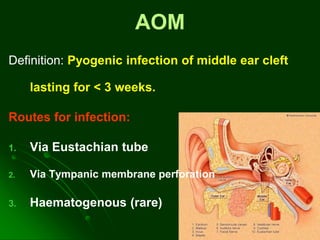
Routes for infection:
1. Via Eustachian tube
2. Via Tympanic membrane perforation
3. Haematogenous (rare)
Predisposing Factors
1. Breast feeding in supine position
2. Recurrent upper respiratory tract infection
3. Nasal allergy
4. Chronic rhinitis & sinusitis
5. Tumours of nose & nasopharynx
6. Exposure to cigarette smoke
7. Cleft palate
Bacteriology
1. Haemophilus influenzae
2. Streptococcus pneumoniae
3. Moraxella catarrhalis
4. Staphylococcus aureus
5.  - Hemolytic streptococci (causes acute
necrotizing otitis media)
Stages
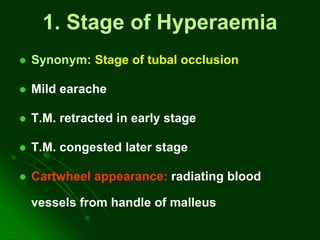
1. Stage of Hyperaemia
 Synonym: Stage of tubal occlusion
 Mild earache
 T.M. retracted in early stage
 T.M. congested later stage
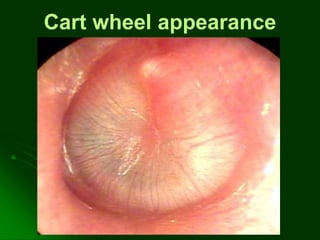
 Cartwheel appearance: radiating blood
vessels from handle of malleus
Cart wheel appearance
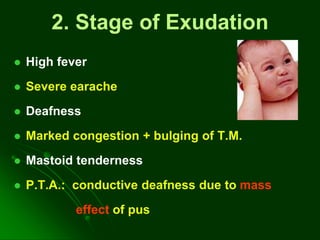
2. Stage of Exudation
 High fever
 Severe earache
 Deafness
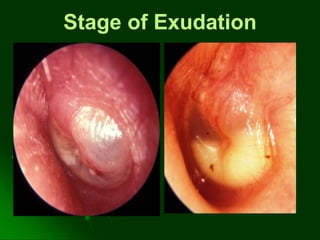
 Marked congestion + bulging of T.M.
 Mastoid tenderness
 P.T.A.: conductive deafness due to mass
effect of pus
Stage of Exudation
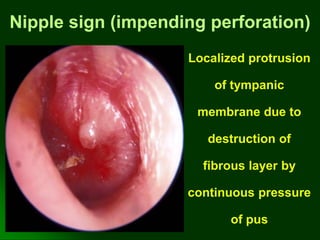
Nipple sign (impending perforation)
Localized protrusion
of tympanic
membrane due to
destruction of
fibrous layer by
continuous pressure
of pus
3. Stage of Suppuration
Symptoms:
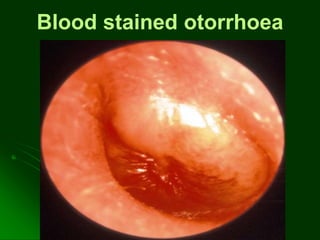
 Ear discharge (blood-stained  purulent)
 Increased deafness
 Decreased fever
 Decreased earache
Blood stained otorrhoea
Signs & Investigations
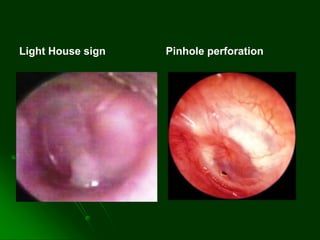
 Pinhole perforation + otorrhoea
 Light house sign: intermittent reflection of light
 Decreased mastoid tenderness
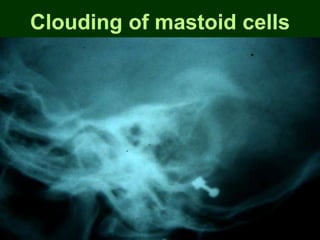
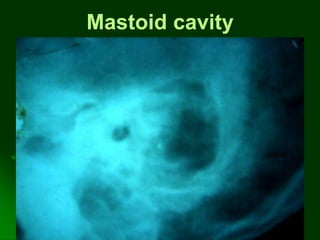
 Clouding of air cells in mastoid X-ray
Light House sign Pinhole perforation
Clouding of mastoid cells
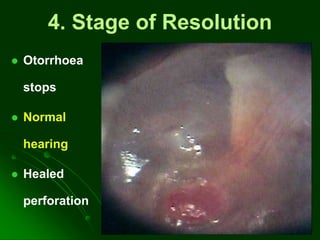
4. Stage of Resolution
 Otorrhoea
stops
 Normal
hearing
 Healed
perforation
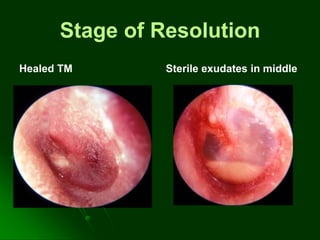
Stage of Resolution
Healed TM Sterile exudates in middle
5. Stage of Complications
 Sub-periosteal abscess
 Vertigo
 Headache + blurred vision + projectile vomiting
 Fever + neck rigidity + irritability
 Drowsiness
 Gradenigo syndrome (apex petrositis)
Coalescent Mastoiditis
 Otorrhoea > 2 weeks, otalgia & deafness
 Mastoid reservoir sign: pus fills up on mopping
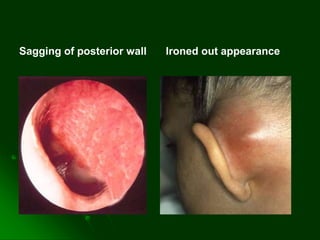
 Sagging of postero-superior canal wall caused by
peri-osteitis due to pus in adjacent mastoid antrum
 Ironed out appearance of skin over mastoid due to
thickened periosteum
Sagging of posterior wall Ironed out appearance
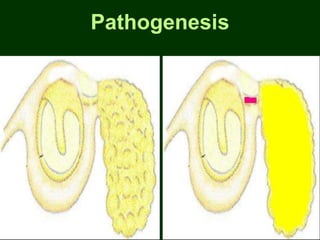
Pathogenesis
Aditus Blockage
 Failure of drainage
 Stasis of secretions
 Hyperemic decalcification
 Resorption of bony septa of air cells
 Coalescence of small air cells to form cavity
 Empyema of mastoid cavity
Pathogenesis
Mastoid cavity
Treatment of AOM
1. Systemic Antibiotic
2. Nasal decongestants (systemic + topical)
3. H1 anti-histamines
4. Analgesic + anti-pyretic
5. Aural toilet for ear discharge
6. Heat application for severe earache
7. Review after 48 hours
On review after 48 hours
 Earache + fever persists: change to higher
antibiotic. If T.M. is bulging  perform myringotomy.
Send ear discharge for C/S.
 Earache + fever subside: continue same
treatment for 10-14 days
 Review after 3 months
On review after 3 months
 No effusion: no further treatment
 Effusion persists: treat as Otitis Media
with Effusion
 Presence of abscess or coalescent
mastoiditis: do cortical mastoidectomy
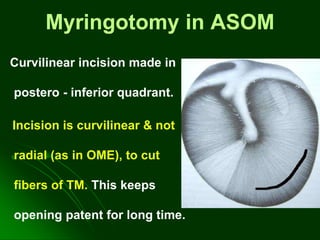
Myringotomy in ASOM
Curvilinear incision made in
postero - inferior quadrant.
Incision is curvilinear & not
radial (as in OME), to cut
fibers of TM. This keeps
opening patent for long time.
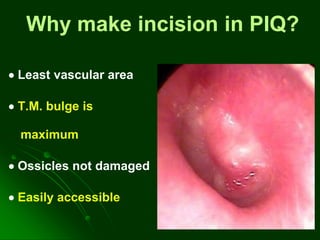
Why make incision in PIQ?
 Least vascular area
 T.M. bulge is
maximum
 Ossicles not damaged
 Easily accessible
Otitis Media with
effusion
 “Presence of middle ear fluid without signs
or symptoms of infection, previously named:
secretory, serous, or glue ear. ”
 Decreased TM mobility and barrier to sound
conduction
What is OME?
Etiology and Epidemiology
 Epidemiology:
 90% of children suffer from OME before
school age (usually 6 months to 4 years)
 30-40% of children with recurrent OME
 5-10% last greater than 1 year
 Etiology:
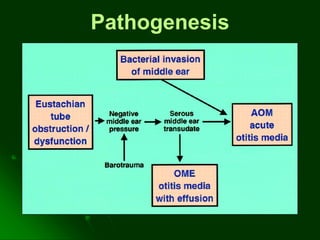
 Poor Eustachian Tube Function
 Inflammatory response following AOM
Pathogenesis
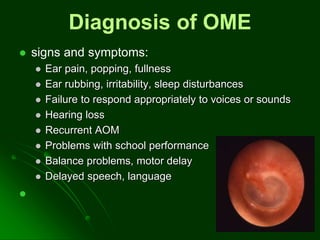
Diagnosis of OME
 signs and symptoms:
 Ear pain, popping, fullness
 Ear rubbing, irritability, sleep disturbances
 Failure to respond appropriately to voices or sounds
 Hearing loss
 Recurrent AOM
 Problems with school performance
 Balance problems, motor delay
 Delayed speech, language

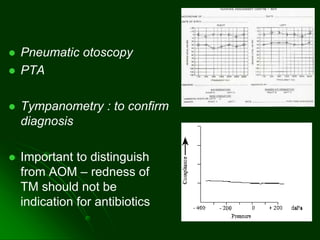
 Pneumatic otoscopy
 PTA
 Tympanometry : to confirm
diagnosis
 Important to distinguish
from AOM – redness of
TM should not be
indication for antibiotics
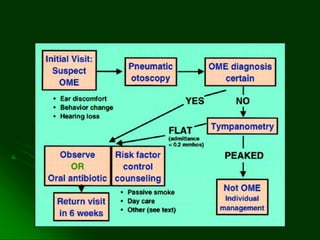
Treatment - OME
 MEE > 3 month or assoc hearing loss, vertigo,
frequency, ME pathology, discomfort
 Antibiotics
 shown to be of benefit,
 Antibiotics + steroid
 21% improvement compared to abx alone
 prednisone 1 mg/kg day x 7 day
 Myringotomy & tympanostomy +/-
adenoidectomy
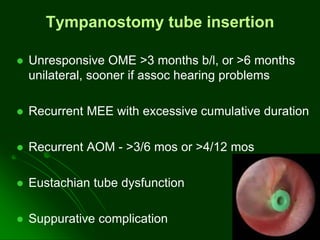
Tympanostomy tube insertion
 Unresponsive OME >3 months b/l, or >6 months
unilateral, sooner if assoc hearing problems
 Recurrent MEE with excessive cumulative duration
 Recurrent AOM - >3/6 mos or >4/12 mos
 Eustachian tube dysfunction
 Suppurative complication
Acute  Otitis Media and effusion.pptx

Acute Otitis Media and effusion.pptx

  • 1.
    Acute Otitis Media & OtitisMedia with effusion Dr. B.P. Shah Associate Professor Dept. ORL & HNS BPKIHS
  • 2.
    AOM Definition: Pyogenic infectionof middle ear cleft lasting for < 3 weeks. Routes for infection: 1. Via Eustachian tube 2. Via Tympanic membrane perforation 3. Haematogenous (rare)
  • 3.
    Predisposing Factors 1. Breastfeeding in supine position 2. Recurrent upper respiratory tract infection 3. Nasal allergy 4. Chronic rhinitis & sinusitis 5. Tumours of nose & nasopharynx 6. Exposure to cigarette smoke 7. Cleft palate
  • 4.
    Bacteriology 1. Haemophilus influenzae 2.Streptococcus pneumoniae 3. Moraxella catarrhalis 4. Staphylococcus aureus 5.  - Hemolytic streptococci (causes acute necrotizing otitis media)
  • 5.
  • 6.
    1. Stage ofHyperaemia  Synonym: Stage of tubal occlusion  Mild earache  T.M. retracted in early stage  T.M. congested later stage  Cartwheel appearance: radiating blood vessels from handle of malleus
  • 7.
  • 8.
    2. Stage ofExudation  High fever  Severe earache  Deafness  Marked congestion + bulging of T.M.  Mastoid tenderness  P.T.A.: conductive deafness due to mass effect of pus
  • 9.
  • 10.
    Nipple sign (impendingperforation) Localized protrusion of tympanic membrane due to destruction of fibrous layer by continuous pressure of pus
  • 11.
    3. Stage ofSuppuration Symptoms:  Ear discharge (blood-stained  purulent)  Increased deafness  Decreased fever  Decreased earache
  • 12.
  • 13.
    Signs & Investigations Pinhole perforation + otorrhoea  Light house sign: intermittent reflection of light  Decreased mastoid tenderness  Clouding of air cells in mastoid X-ray
  • 14.
    Light House signPinhole perforation
  • 15.
  • 16.
    4. Stage ofResolution  Otorrhoea stops  Normal hearing  Healed perforation
  • 17.
    Stage of Resolution HealedTM Sterile exudates in middle
  • 18.
    5. Stage ofComplications  Sub-periosteal abscess  Vertigo  Headache + blurred vision + projectile vomiting  Fever + neck rigidity + irritability  Drowsiness  Gradenigo syndrome (apex petrositis)
  • 19.
    Coalescent Mastoiditis  Otorrhoea> 2 weeks, otalgia & deafness  Mastoid reservoir sign: pus fills up on mopping  Sagging of postero-superior canal wall caused by peri-osteitis due to pus in adjacent mastoid antrum  Ironed out appearance of skin over mastoid due to thickened periosteum
  • 20.
    Sagging of posteriorwall Ironed out appearance
  • 21.
    Pathogenesis Aditus Blockage  Failureof drainage  Stasis of secretions  Hyperemic decalcification  Resorption of bony septa of air cells  Coalescence of small air cells to form cavity  Empyema of mastoid cavity
  • 22.
  • 23.
  • 24.
    Treatment of AOM 1.Systemic Antibiotic 2. Nasal decongestants (systemic + topical) 3. H1 anti-histamines 4. Analgesic + anti-pyretic 5. Aural toilet for ear discharge 6. Heat application for severe earache 7. Review after 48 hours
  • 25.
    On review after48 hours  Earache + fever persists: change to higher antibiotic. If T.M. is bulging  perform myringotomy. Send ear discharge for C/S.  Earache + fever subside: continue same treatment for 10-14 days  Review after 3 months
  • 26.
    On review after3 months  No effusion: no further treatment  Effusion persists: treat as Otitis Media with Effusion  Presence of abscess or coalescent mastoiditis: do cortical mastoidectomy
  • 27.
    Myringotomy in ASOM Curvilinearincision made in postero - inferior quadrant. Incision is curvilinear & not radial (as in OME), to cut fibers of TM. This keeps opening patent for long time.
  • 28.
    Why make incisionin PIQ?  Least vascular area  T.M. bulge is maximum  Ossicles not damaged  Easily accessible
  • 29.
  • 30.
     “Presence ofmiddle ear fluid without signs or symptoms of infection, previously named: secretory, serous, or glue ear. ”  Decreased TM mobility and barrier to sound conduction What is OME?
  • 31.
    Etiology and Epidemiology Epidemiology:  90% of children suffer from OME before school age (usually 6 months to 4 years)  30-40% of children with recurrent OME  5-10% last greater than 1 year  Etiology:  Poor Eustachian Tube Function  Inflammatory response following AOM
  • 32.
  • 33.
    Diagnosis of OME signs and symptoms:  Ear pain, popping, fullness  Ear rubbing, irritability, sleep disturbances  Failure to respond appropriately to voices or sounds  Hearing loss  Recurrent AOM  Problems with school performance  Balance problems, motor delay  Delayed speech, language 
  • 34.
     Pneumatic otoscopy PTA  Tympanometry : to confirm diagnosis  Important to distinguish from AOM – redness of TM should not be indication for antibiotics
  • 35.
    Treatment - OME MEE > 3 month or assoc hearing loss, vertigo, frequency, ME pathology, discomfort  Antibiotics  shown to be of benefit,  Antibiotics + steroid  21% improvement compared to abx alone  prednisone 1 mg/kg day x 7 day  Myringotomy & tympanostomy +/- adenoidectomy
  • 36.
    Tympanostomy tube insertion Unresponsive OME >3 months b/l, or >6 months unilateral, sooner if assoc hearing problems  Recurrent MEE with excessive cumulative duration  Recurrent AOM - >3/6 mos or >4/12 mos  Eustachian tube dysfunction  Suppurative complication