ACUTE LIVER FAILURE
Compiled by : Pratap Sagar Tiwari, MD,
DM RESIDENT, HEPATOLOGY, Hepatology Unit, NAMS, BIR HOSPITAL,
KATHMANDU, NEPAL
Review of Literature
EPIDEMIC HEPATITIS
PRESENT CONTEXT
???/
FULMINANT HEPATITIS
FULMINANT HEPATIC FAILURE
FULMINANT LIVER FAILURE
LATE ONSET HEPATIC FAILURE
SEVERE ACUTE LIVER FAILURE
SUBFULMINANT HEPATITIS
SUBFULMINANT LIVER FAILURE
SUBACUTE LIVER FAILURE
ACUTE LIVER FAILURE
HYPERACUTE LIVER FAILURE
ACUTE/ SUBACUTE HEPATIC FAILURE
Epidemic hepatitis
• Epidemic hepatitis was a worldwide health problem in the early 20th
century, and it was already known, even in the 1920s, that differences
existed in the clinical course and that pts could be divided into those with
fulminant, acute, or chronic forms [1].
• However, the concept of EH changed with the occurrence of WW II;
epidemic hepatitis changed to a hepatitis pandemic during WWar II, with
large outbreaks occurring in many parts of the world, especially in armies.
• In 1946, Lucke and Mallory [1] reported on the outbreak of EH in the US
Army between Aug 1943 & April 1945, in which 104/196 pts (53 %) had a
fatal course and died within 10 days of the onset of the hepatitis symptoms.
Lucke and Mallory named this form of hepatitis, which was probably caused
by HAV or HEV infection, the ‘‘fulminant form’’ of hepatitis.
1. Lucke B, Mallory T. The fulminant form of epidemic hepatitis. Am J Pathol. 1946;22:867–943.
Fulminant hepatitis/ fulminant hepatic failure
• On the other hand, in 1968, Trey et al. [1] reported that drugs such as
halothane may also cause acute liver disease, similar in clinical course to
fulminant hepatitis.
• They evaluated the etiology in 150 pts enrolled from 73 centers, and
revealed that the cause of the hepatitis was presumed viral hepatitis in 70
pts (46.7 %) (including serum hepatitis and epidemic hepatitis in 24 and 46
patients, respectively), and drug-induced liver disease in 48 pts (32.0 %)
(including 36 with halothane exposure as the culprit) [1].
• These observations prompted hepatologists to use the nomenclature of
‘‘fulminant hepatic failure’’ instead of ‘‘fulminant hepatitis’’ for pts
presenting with acute onset of massive liver necrosis.
1. Trey C, Lipworth L, Chalmers TC, Davidson CS, Gottlieb LS, Popper H, Saunders SJ. Fulminant hepatic failure; presumable contribution to halothane. N Engl J Med. 1968;279:798–801.
Fulminant Hepatic failure/ late-onset hepatic failure
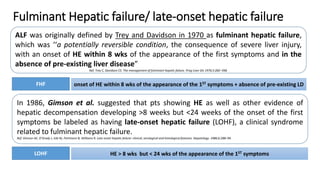
ALF was originally defined by Trey and Davidson in 1970 as fulminant hepatic failure,
which was ‘‘a potentially reversible condition, the consequence of severe liver injury,
with an onset of HE within 8 wks of the appearance of the first symptoms and in the
absence of pre-existing liver disease”
Ref: Trey C, Davidson CS. The management of fulminant hepatic failure. Prog Liver Dis 1970;3:282–398.
In 1986, Gimson et al. suggested that pts showing HE as well as other evidence of
hepatic decompensation developing >8 weeks but <24 weeks of the onset of the first
symptoms be labeled as having late-onset hepatic failure (LOHF), a clinical syndrome
related to fulminant hepatic failure.
Ref: Gimson AE, O’Grady J, Ede RJ, Portmann B, Williams R. Late onset hepatic failure: clinical, serological and histological features. Hepatology. 1986;6:288–94.
onset of HE within 8 wks of the appearance of the 1ST symptoms + absence of pre-existing LD
HE > 8 wks but < 24 wks of the appearance of the 1ST symptoms
FHF
LOHF
• Also, the terminology of ‘‘subacute liver failure’’ was introduced in India in 1982
for pts showing progressive jaundice with ascites of 8 wks’ duration, with
otherwise typical features of acute viral hepatitis; the presence of HE was not a
necessary criterion for the diagnosis of this condition [1].
• Severe ALF can be defined as ALF without HE, but with 50% or more decrease in
coagulation factors manufactured by the liver, in particular Factors II
(prothrombin) and V (proaccelerin). Severe acute liver failure may or may not be
followed by fulminant hepatic failure (FHF).
• FHF can be defined as severe acute liver failure complicated by HE.
• According to the severity of HE, several stages can be distinguished: Asterixis, Confusion, and Coma.[2]
• A 3-week limit is specified by some investigator [2],and 8 weeks by others. [3,4]
1.Tandon BN, Joshi YK, Krishnamurthy L, Tandon HD. Subacute hepatic failure; is it a distinct entity? J Clin Gastroenterol. 1982; 4:343–6.
2.Benhamou JP: Acute hepatic necrosis and fulminant hepatic failure. Gut 14:805-815, 1973.
3.Trey C, Davidson C: The management of fulminant hepatic failure. Pro6 Liver Dis 3:282-298, 1970.
4.Gim,on AES, White YS, Eddleston ALWF, et al: Clinical and prognostic differences in fulm~nant hepatit~s type A, B and non-A, non-B. Gut 24:1194- 1198, 1983.
Benhamou definition 1]
• In 1986, Benamou propose to define FLF as ALF complicated by HE <2 wks after the onset of jaundice
and subfulminant liver failure as ALF complicated by HE 2 weeks to 3 mnths after the onset of jaundice.
• The term "subfulminant liver failure," which clearly denotes the presence of HE, is preferable to that of subacute
liver failure, which has been often used to designate ALF with a protracted course, not necessarily associated with
HE. (note: preexisting liver disease conditions were not excluded)
• The distinction between fulminant and subfulminant liver failure is important for several reasons:
(1) this distinction allows a more accurate description of the course of liver failure;
(2) fulminant and subfulminant liver failure differ, not only in their course, but also in their clinical manifestations,
thus, ascites is less common, and cerebral edema is more common in the former than in the latter;
(3) certain causes of ALF are predominantly associated either with a fulminant or a subfulminant course.
NOTE: Fulminant or subfulminant hepatitis can be defined as acute hepatitis complicated by fulminant or
subfulminant liver failure.
1. Ref: Benhamou et al. Fulminant and Subfulminant Liver Failure: Definitions and Causes. SEMINARS IN LIVER DISEASE-VOL. 6, NO. 2, 1986
O grady definition
• Thus, in 1993, O’Grady et al. [1] redefined such syndromes as ‘‘acute liver failure’’
prefixed with ‘‘hyper’’ and ‘‘sub’’ to describe 2 cohorts at opposite ends of the clinical
spectrum, based on the observation of a large series of pts treated at King’s College
Hospital, London, between 1972-1985.
• According to this proposed classification, pts with HE developing within 7 days of the
onset of jaundice are diagnosed as having ‘‘hyperacute liver failure’’, which is often
caused by acetaminophen intoxication [1].
• In contrast, pts showing HE between 8 and 28 days and those with HE developing >28
days after the first onset of symptoms were diagnosed as having ‘‘acute liver failure’’ and
‘‘subacute liver failure’’, respectively, with HAV or HBV infection and DILI being more
frequently seen in the former , and liver disease of indeterminate etio being seen more
frequently in the latter [1]. (Note: Pre-existing symptomless CLD was not excluded )
NOTE: It should be noted that pts with pre-existing symptomless CLD were included in the disease entity of ‘‘acute liver
failure’’ by O’Grady et al. [1], and in that of ‘‘fulminant liver failure’’ by Bernuau et al. [2], while such pts were excluded
from the entity of ‘‘fulminant hepatic failure’’ by Trey and Davidson [3].
1. O’Grady JG, Schaim SW, Williams R. Acute liver failure: remodeling the syndromes. Lancet. 1993;342:273–5
2. Benhamou et al. Fulminant and Subfulminant Liver Failure: Definitions and Causes. SEMINARS IN LIVER DISEASE-VOL. 6, NO. 2, 1986
3. Trey C, Davidson CS. The management of fulminant hepatic failure. Prog Liver Dis 1970;3:282–398.
International Association for the Study of the Liver (IASL)
• Criticisms were raised regarding the nomenclature and definition of ‘‘acute liver failure’’
proposed by the King’ College Hospital group, especially in France [1] and India [2].
• Thus, the subcommittee of the International Association for the Study of the Liver (IASL)
published revised recommendations on the nomenclature of acute and subacute hepatic
failure in 1999 [3].
• In this recommendation, two distinct disease entities, but not subgroups of a syndrome,
were established; namely, ‘‘acute hepatic failure’’ and ‘‘subacute hepatic failure’’.
• Pts without preexisting liver disease developing HE within 4 weeks of the onset of the disease symptoms are diagnosed as
having acute hepatic failure.
• Acute hepatic failure is a potentially reversible liver disease and is classified into hyperacute and fulminant forms, defined by
the development of HE <10 days and between 10 and 30 days, respectively, after the first onset of the disease symptoms.
• In contrast, pts developing HE between the 5th and 24th weeks after the first onset of symptoms are diagnosed as having
subacute hepatic failure.
1. Bernuau J, Benhamou JP. Classifying acute liver failure. Lancet. 1993;342:252–3.
2. Acharya SK, Dasarathy S, Tandon BN. Should we redefine acute liver failure? Lancet. 1993;342:1421–2.
3. Tandon BN, Bernauau J, O’Grady J, Gupta SD, Krisch RE, Liaw YF, et al. Recommendations of the International Association for the Study of the Liver Subcommittee on nomenclature of acute and subacute liver
failure. J Gastroenterol Hepatol. 1999;14: 403–4.
HE < 10 D
AHF
HYPERACUTE BETWN 10 AND 30 D
HE WITHIN 4 WEEKS + ABSENCE OF PRE-EXISTING LD
FULMINANT HF
SUBACUTE HF HE BETWEEN 5 TH AND 24TH WEEKS
AASLD: 2005
• Consequently, until the beginning of the 21st century, hepatitis showing rapid progression was referred to
by various names, including fulminant hepatitis [1], fulminant hepatic failure [2], fulminant liver failure
[3], acute liver failure [4], acute hepatic failure [5]
• However, ‘‘acute liver failure’’ came to be used predominantly as the most suitable umbrella term, because
it can be assumed to include all of the other disease entities [6].
• Thus, the Practice Guideline Committee of AASLD published a paper for the MX of ‘‘acute liver failure’’ in
2005 [7].
• Acute liver failure is defined as ‘‘liver diseases characterized by the development of HE and coagulation
abnormalities, usually characterized by an INR of ≥1.5, in pts without preexisting cirrhosis, and an illness of
<26 weeks duration’’.
• In this position paper, subgroups classified according to the interval between the onset of HE and the first onset of the disease
symptoms; namely, the hyperacute(<7d), acute(7-21d), and subacute types>21d-26 week), were shown to be not helpful to predict the
outcomes of the pts [7]. For example, hyperacute cases may have a better prognosis but this is because most are due to
acetaminophen toxicity.
1. Lucke B, Mallory T. The fulminant form of epidemic hepatitis. Am J Pathol. 1946;22:867–943.
2. Trey C, Davidson CS. The management of fulminant hepatic failure. In: Popper H, Schaffner F, editors. Progress in liver diseases. New York: Grune & Stratton; 1970. p. 282–98.
3. Bernuau J, Rueff B, Benhamou JP. Fulminant and subfulminant liver failure: definitions and causes. Semin Liver Dis. 1986;6:97–106.
4. O’Grady JG, Schaim SW, Williams R. Acute liver failure: remodeling the syndromes. Lancet. 1993;342:273–5.
5. Tandon BN, Bernauau J, O’Grady J, Gupta SD, Krisch RE, Liaw YF, et al. Recommendations of the International Association for the Study of the Liver Subcommittee on nomenclature of acute and subacute liver
failure. J Gastroenterol Hepatol. 1999;14:403–4.
6. William ML. Acute liver failure. N Engl J Med. 1993;329:1862–72.
7. Polson J, Lee WM. AASLD position paper: the management of acute liver failure. Hepatology. 2005;41:1179–97.
ALF
HYPERACUTE <7D ACUTE 7-21D SUBACUTE >21D – 26 WEEK
HE + INR of ≥1.5, without preexisting cirrhosis, and an illness of <26 weeks duration
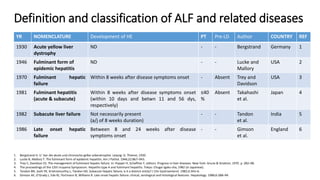
Definition and classification of ALF and related diseases
YR NOMENCLATURE Development of HE PT Pre-LD Author COUNTRY REF
1930 Acute yellow liver
dystrophy
ND - - Bergstrand Germany 1
1946 Fulminant form of
epidemic hepatitis
ND - - Lucke and
Mallory
USA 2
1970 Fulminant hepatic
failure
Within 8 weeks after disease symptoms onset - Absent Trey and
Davidson
USA 3
1981 Fulminant hepatitis
(acute & subacute)
Within 8 weeks after disease symptoms onset
(within 10 days and betwn 11 and 56 dys,
respectively)
≤40
%
Absent Takahashi
et al.
Japan 4
1982 Subacute liver failure Not necessarily present
(a/j of 8 weeks duration)
- - Tandon
et al.
India 5
1986 Late onset hepatic
failure
Between 8 and 24 weeks after disease
symptoms onset
- - Gimson
et al.
England 6
1. Bergstrand H. U¨ ber die akute und chronische gelbe Leberatrophie. Leipzig: G. Thieme; 1930.
2. Lucke B, Mallory T. The fulminant form of epidemic hepatitis. Am J Pathol. 1946;22:867–943.
3. Trey C, Davidson CS. The management of fulminant hepatic failure. In: Popper H, Schaffner F, editors. Progress in liver diseases. New York: Grune & Stratton; 1970. p. 282–98.
4. The proceedings of the 12th Inuyama Symposium. Hepatitis type A and fulminant hepatitis. Tokyo: Chugai Igaku-sha, 1982 (in Japanese).
5. Tandon BN, Joshi YK, Krishnamurthy L, Tandon HD. Subacute hepatic failure; is it a distinct entity? J Clin Gastroenterol. 1982;4:343–6.
6. Gimson AE, O’Grady J, Ede RJ, Portmann B, Williams R. Late onset hepatic failure: clinical, serological and histological features. Hepatology. 1986;6:288–94.
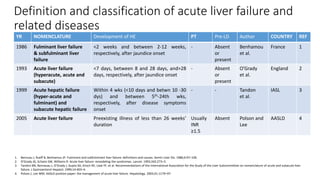
Definition and classification of acute liver failure and
related diseases
YR NOMENCLATURE Development of HE PT Pre-LD Author COUNTRY REF
1986 Fulminant liver failure
& subfulminant liver
failure
<2 weeks and between 2-12 weeks,
respectively, after jaundice onset
- Absent
or
present
Benhamou
et al.
France 1
1993 Acute liver failure
(hyperacute, acute and
subacute)
<7 days, between 8 and 28 days, and>28
days, respectively, after jaundice onset
- Absent
or
present
O’Grady
et al.
England 2
1999 Acute hepatic failure
(hyper-acute and
fulminant) and
subacute hepatic failure
Within 4 wks (<10 days and betwn 10 -30
dys) and between 5th-24th wks,
respectively, after disease symptoms
onset
- - Tandon
et al.
IASL 3
2005 Acute liver failure Preexisting illness of less than 26 weeks’
duration
Usually
INR
≥1.5
Absent Polson and
Lee
AASLD 4
1. Bernuau J, Rueff B, Benhamou JP. Fulminant and subfulminant liver failure: definitions and causes. Semin Liver Dis. 1986;6:97–106.
2. O’Grady JG, Schaim SW, Williams R. Acute liver failure: remodeling the syndromes. Lancet. 1993;342:273–5.
3. Tandon BN, Bernauau J, O’Grady J, Gupta SD, Krisch RE, Liaw YF, et al. Recommendations of the International Association for the Study of the Liver Subcommittee on nomenclature of acute and subacute liver
failure. J Gastroenterol Hepatol. 1999;14:403–4.
4. Polson J, Lee WM. AASLD position paper: the management of acute liver failure. Hepatology. 2005;41:1179–97.
Definition, classification, and diagnostic criteria for fulminant
hepatitis and ALF in Japan: 1981
• The definition and classification of fulminant hepatitis, the representative disease entity a/w ALF in Japan,
were established at the Inuyama Symposium in 1981 [1].
• According to the IS criteria, pts with hepatitis were DX as having fulminant hepatitis when they developed
HE ≥ GII due to severe liver damage, as represented by PT values of ≤40 % of the standardized value, within
8 wks of the onset of the hepatitis symptoms.
• Fulminant hepatitis was further classified into 2 clinical types; that is, the acute and subacute types, on the basis of the
HE developing within 10 dys or betwn 11 -56 days, respectively, after the onset of the hepatitis symptoms.
• FH in Japan is defined as histological evidence of hepatic inflammation, characterized by lymphocytic infiltration of the
liver, associated with ALF. Thus, the etiology of FH comprises viral infections, incl. HBV carriers, autoimmune hepatitis,
drug allergy-induced liver injuries, & hepatitis of indeterminate etiology.
FH HE (GII or more) + PT ≤40 % WITHIN 8 WEEKS OF ONSET OF HEPATITIS SYMPTOMS
BETWEEN 11 AND 8 WEEKSWITHIN 10 DACUTE-FH SUB ACUTE FH
1. The proceedings of the 12th Inuyama Symposium. Hepatitis type A and fulminant hepatitis. Tokyo: Chugai Igaku-sha, 1982 (in Japanese).
Diagnostic criteria for fulminant hepatitis in Japan established by the Intractable Liver Diseases Study Group of
Japan, supported by the Ministry of Health, Welfare and Labour (2003); from reference [1]
Note 1: Pts with CLD/alcoholic hepatitis are excluded from the disease entity of FH, but asymptomatic HBV carriers
developing acute exacerbation are included as cases of FH.
Note 2: ALF with no histological evidence of liver inflammation, such as that caused by drug or chemical intoxication,
circulatory disturbance, acute fatty liver of pregnancy, or Reye’s syndrome is excluded from the disease entity of FH.
Note 3: The grading of HE is based on the criteria presented at the Inuyama Symposium in 1972.
Note 4: The etio of FH is based on the criteria established by Intractable Liver Diseases Study Group of Japan in 2002.
Note 5: Pts with no or grade I HE, but showing PT values of <40 % of the standardized value are diagnosed as having acute hepatitis, severe type. Pts in
whom the HE develops between 8 and 24 weeks after the disease onset, with PT values of <40 % of the standardized value are diagnosed as having late-
onset hepatic failure (LOHF). Both are diseases related to fulminant hepatitis, but are regarded differently from fulminant hepatitis.
1. Fujiwara K, Mochida S, Matsui A, Nakayama N, Nagoshi S, Toda G. Fulminant hepatitis and late onset hepatic failure in Japan. Hepatol Res. 2008;38:646–57.
Fulminant hepatitis : hepatitis with HE ≥ GII that develops in the pts within 8 wks of the onset of disease
symptoms, a/w severe derangement of liver function, including PT <40 % .
FH is classified into 2 subtypes; the acute type and the subacute type, according to whether the HE occurs
within 10 days and later than 11 days till 8 weeks, respectively, after the onset of the symptoms.
ACUTE HEPATITIS, SEVERE
LOHF HE between 8 AND 24 WEEKS + PT <40 %
NO HE or G1 HE + PT <40 %
Classification of HE in adult pts according to the grade of hepatic coma proposed by the
Inuyama Symposium in 1972; [1]
Grade Psychiatric disorder Reference items
I Inversion of sleep pattern
Euphoria and/or occasional depression
Negligent attitude with shortened attention span
Recognized retrospectively
in most cases
II Disorientation of time or place and confusion
Inappropriate behaviors, such as throwing away money or discarding items of value
Occasional somnolent tendency; able to open eyes and respond appropriately to
questions
Makes impolite remarks, but follows doctors’ instructions
Excitation state and, urinary and fecal
incontinence are absent, but
flapping tremor is found on physical
examination
III State of excitation and/or delirium, showing defiant behavior
Somnolent tendency; sleeping most of the time
Opens eyes in response to stimulation, but cannot follow the instructions of doctors,
except for simple orders
Flapping tremor is observed, and the
extent of disorientation is severe
IV Coma; complete loss of consciousness
Response to painful stimuli
Brushes off doctor’s hands if touched
and/or frowns in response to stimuli
V Deep coma
No response to painful stimuli
1. Mochida S, Takikawa Y, Nakayama N, Oketani M, Naiki T, Yamagishi Y, et al. Diagnostic criteria of acute liver failure: a report by the Intractable Hepato-Biliary Diseases Study Group of Japan. Hepatol Res.
2011;41:805–12.
Classification of etiologies of ALF modified from the criteria proposed by the Intractable
Liver Diseases Study Group of Japan in 2002; [1]
I. Viral infection
1 Hepatitis A virus (HAV)
2 Hepatitis B virus (HBV)
(1) Transient infection
(2) Acute exacerbation in HBV carrier
i. Inactive carrier, without drug exposure
ii. Reactivation in inactive carrier by immunosuppressant and/or
anticancer drugs
iii. Reactivation in transiently infected pts by immunosuppressant
and/or anticancer drugs (de-novo hepatitis) [a]
(3) Indeterminate infection patterns
3 Hepatitis C virus (HCV)
4 Hepatitis E virus (HEV)
5 Other viruses
II. Autoimmune hepatitis
III. Drug-induced liver injuries
1. Drug allergy-induced liver injury
2. Drug toxicity-induced liver injury
IV. Circulatory disturbance
V. Infiltration of the liver by malignant cells
VI. Metabolic diseases
VII. Liver injuries after liver resection and transplantation
VIII. Miscellaneous etiologies
IX. Indeterminate etiology despite sufficient examinations
X. Unclassified due to insufficient examinations
Pts with etiologies I, II, and III-1 are diagnosed as having ‘‘fulminant hepatitis’’ as well as ‘‘acute liver failure’’, whereas those with
etiologies III-2 and IV to VIII are diagnosed as having ‘‘acute liver failure’’, but are excluded from the disease entity of ‘‘fulminant
hepatitis’’. Diagnostic criteria for the classification of etiology based on laboratory data should be established in the future
A: Serum hepatitis B surface (HBs) antigen-negative patients following transient infection with HBV are classified as HBV carriers, in
whom HBV reactivation can be induced by immunosuppressant and/ or anticancer drugs; however, the significance of this causative
etiology needs to be evaluated further.
1. Mochida S, Takikawa Y, Nakayama N, Oketani M, Naiki T, Yamagishi Y, et al. Diagnostic criteria of acute liver failure: a report by the Intractable Hepato-Biliary Diseases Study Group of Japan. Hepatol Res.
2011;41:805–12.
• According to the nationwide survey of FH and LOHF conducted by the
Intractable Hepato-Biliary Diseases Study Group in Japan (formally the
Intractable Liver Diseases Study Group of Japan), In this survey, 1,094 pts
with FH, consisting of 543 with the acute type and 551 with the subacute
type of FH were included, and 92 pts with LOHF seen between 1998 and
2009 were enrolled [1-7].
• In regard to the etiology of hepatitis, viral infection accounted for 67.4 and 30.9 % of the patients with the acute and subacute types of FH,
respectively, and for 10.9 % of the patients with LOHF.
• In most pts with FH caused by viral infection, the causative agent was HBV; transient HBV infection was more frequent in pts with the acute
type (39.2 %) as compared to the subacute type (10.0 %) of FH, while the frequency of HBV carriers was greater in pts with the subacute
type (17.9 %) as compared to the acute type (7.2 %) of FH.
• Autoimmune hepatitis was found in 1.8, 12.2, and 19.6 % of pts with the acute and subacute types of FH and LOHF, respectively.
• Drug allergy-induced liver injury was seen in 9.0, 13.1, and 18.7 % of pts with the acute and subacute types of FH and LOHF, respectively.
• It is noteworthy that the etiology was indeterminate in 19.0, 40.8, and 40.2 % of pts with the acute and subacute types of FH and
LOHF, respectively.
Intractable Hepato-Biliary Diseases Study Group in Japan: SURVEY
FH (ACUTE) % FH ( SUBACUTE)% LOHF %
VIRAL INFN 67.4 30.9 10.9
• transient HBV 39.2 10
• HBV carriers 7.2 17.9
AUTOIMMUNE H 1.8 12.2 19.6
DRUG ALLERGY ILI 9 13.1 18.7
UK 19 40.8 40.2
The outcomes of the pts also differed between these disease types. The survival rates of pts receiving
medical Rx(without LT) were 53.7, 24.4, and 11.5 %, respectively, in pts with the acute and subacute types
of FH and LOHF seen between 1998 and 2003 [1], while these rates were 48.7, 24.2, and 13.0 %,
respectively, in the corresponding categories of pts seen between 2004 and 2009 [2–7].
1. Fujiwara K, Mochida S, Matsui A, Nakayama N, Nagoshi S, Toda G. Fulminant hepatitis and late onset hepatic failure in Japan. Hepatol Res. 2008;38:646–57.
2. Tsubouchi H, Oketani M. Fulminant hepatitis and late onset hepatic failure (LOHF) in Japan (2004). Annual Report of the Intractable Hepato-Biliary Diseases Study Group of Japan Supported by the Ministry of Health, Labor, and Welfare; 2006.p. 61–9 (in Japanese).
3. Tsubouchi H, Oketani M, Ido A. Fulminant hepatitis and late onset hepatic failure (LOHF) in Japan (2005). Annual Report of the Intractable Hepato-Biliary Diseases Study Group of Japan Supported by the Ministry of Health, Labor, and Welfare; 2007.p. 90–100 (in Japanese).
4. Tsubouchi H, Oketani M, Ido A. Fulminant hepatitis and late onset hepatic failure (LOHF) in Japan (2006). Annual Report of the Intractable Hepato-Biliary Diseases Study Group of Japan Supported by the Ministry of Health, Labor, and Welfare; 2008.p. 83–94 (in Japanese).
5. Tsubouchi H, Oketani M, Ido A. Fulminant hepatitis and late onset hepatic failure (LOHF) in Japan (2007). Annual Report of the Intractable Hepato-Biliary Diseases Study Group of Japan Supported by the Ministry of Health, Labor, and Welfare; 2009.p. 83–93 (in Japanese).
6. Tsubouchi H, Oketani M. Ido A. Fulminant hepatitis and late onset hepatic failure (LOHF) in Japan (2008). Annual Report of the Intractable Hepato-Biliary Diseases Study Group of Japan Supported by the Ministry of Health, Labor, and Welfare; 2010.p. 95–106 (in Japanese).
7. Tsubouchi H, Oketani M. Ido A. Fulminant hepatitis and late onset hepatic failure (LOHF) in Japan (2009). Annual Report of the Intractable Hepato-Biliary Diseases Study Group of Japan Supported by the Ministry of Health, Labor, and Welfare; 2011. p. 96–113 (in Japanese).
NOTE: In this survey, 1,094 pts with FH, consisting of 543 with the acute type and 551 with the subacute type of FH
were included, and 92 pts with LOHF seen between 1998 and 2009 were enrolled [1-7].
Intractable Hepato-Biliary Diseases Study Group in Japan: 2006
• Although the diagnostic criteria for FH in Japan [1, 2] merit consideration in clinical practice for
the diagnosis of ALF pts, do they need to be revised to fit with the criteria for ALF adopted in
Europe and the US? [3].
• Thus, in 2006, the Intractable Hepato-Biliary Diseases Study Group in Japan constituted a task
force to establish novel diagnostic criteria for ‘‘acute liver failure’’, which includes the disease
entity ‘‘fulminant hepatitis’’.
• To establish such criteria for defining ‘‘acute liver failure’’ in Japan, two types of nationwide
surveys were performed [4]; a survey of the commercial kits used for the measurement of PT at
institutions to which hepatology specialists were affiliated, and a survey of ALF pts who were
excluded from the disease entities of fulminant hepatitis and LOHF.
• Consequently, ‘‘acute liver failure’’ in Japan came to be defined as an acute liver disease
associated with prolongation of the PT, with an INR of ≥1.5.
• To confirm the correspondence between the present criteria and previous criteria, ‘‘PT values of
<40 % of the standardized value’’ was also employed as a cutoff to define pts with ALF. Pts
without HE were also included in the disease entity of ALF, if they showed an INR of ≥1.5.
1. Fujiwara K, Mochida S, Matsui A, Nakayama N, Nagoshi S, Toda G. Fulminant hepatitis and late onset hepatic failure in Japan. Hepatol Res. 2008;38:646–57.
2. The proceedings of the 12th Inuyama Symposium. Hepatitis type A and fulminant hepatitis. Tokyo: Chugai Igaku-sha, 1982 (in Japanese).
3. Polson J, Lee WM. AASLD position paper: the management of acute liver failure. Hepatology. 2005;41:1179–97.
4. Mochida S, Takikawa Y, Nakayama N, Oketani M, Naiki T, Yamagishi Y, et al. Diagnostic criteria of acute liver failure: a report by the Intractable Hepato-Biliary Diseases Study Group of Japan. Hepatol Res.
2011;41:805–12.
Diagnostic criteria for ALF in Japan (2011); [1]
• Pts showing PT ≤40 %, or INR of ≥1.5 due to severe liver damage within 8
weeks of the onset of disease symptoms are diagnosed as having ‘‘acute
liver failure’’, where the liver function prior to the current onset of liver damage is
estimated to have been normal based on blood laboratory data and imaging examinations.
• ‘‘Acute liver failure’’ is classified into ‘‘acute liver failure without hepatic coma’’ and ‘‘acute
liver failure with hepatic coma’’; no or grade I HE is present in the former type, while ≥HE
Grade II is found in the latter type.
• ‘‘Acute liver failure with hepatic coma’’ is further subclassified into 2 disease types; the ‘‘acute
type’’ and ‘‘subacute type’’, with ≥HE Grade II developing <10 days or between 11 and 56 days
after the onset of disease symptoms, respectively, in the two types.
1. Mochida S, Takikawa Y, Nakayama N, Oketani M, Naiki T, Yamagishi Y, et al. Diagnostic criteria of acute liver failure: a report by the Intractable Hepato-Biliary Diseases Study Group of Japan. Hepatol Res.
2011;41:805–12.
ALF
ALF WITHOUT HE NO OR G1 HE
≥HE Grade IIALF WITH HE
PT ≤40 %, or INR of ≥1.5 due to severe liver damage < 8 wks of the OOD symptoms
11 D- 8 WEEKSACUTE < 10 D SUBACUTE
Previously : ACUTE HEPATITIS, SEVERE
11 D- 8 WEEKSLOHF
Diagnostic criteria for ALF in Japan (2011); [1]
• Note 1: HBV carriers and AIH pts showing acute exacerbation of hepatitis in the normal liver are
included under the disease entity of ‘‘ALF’’. In the case of indeterminate previous liver function, the pts who are HBV
carriers and those with AIH are diagnosed as having ‘‘acute liver failure’’ when no liver function impairment preceding the
exacerbation of the liver injury can be confirmed.
• Note 2: In general, alcoholic hepatitis develops in pts with CLD caused by habitual alcohol consumption.
Thus, pts with alcoholic hepatitis are excluded from the disease entity of ‘‘ALF’’. However, pts with fatty
liver caused by alcohol intake and those with metabolic syndrome, including obesity, are diagnosed as
having ‘‘ALF’’ if etiologies other than habitual alcohol consumption are responsible for the acute injury in
the liver, in the absence of prior impairment of liver function.
• Note 3: Pts without histological evidence of hepatitis, such as inflammatory lymphocytic infiltration, are
included under the disease entity of ‘‘ALF’’. Thus, pts with liver damage caused by drug toxicity,
circulatory disturbance, or metabolic disease and acute fatty liver of pregnancy are diagnosed as having
‘‘acute liver failure’’, while they are excluded from the disease entity of ‘‘fulminant hepatitis’’.
1. Mochida S, Takikawa Y, Nakayama N, Oketani M, et al. Diagnostic criteria of acute liver failure: a report by the Intractable Hepato-Biliary Diseases Study Group of Japan. Hepatol Res. 2011;41:805–12.
INCLUDED EXCLUDED
HBV carrier , fatty liver, AIH, Drugs, Circulatory dysfn,
metabolic diseases, AFLOP
Alcoholic hepatitis , CLD
Diagnostic criteria for ALF in Japan (2011)
• Note 4: The severity of HE is diagnosed according to the classification presented at the
Inuyama Symposium in 1972. Also, HE developing in pediatric pts and infants is
classified according to the criteria proposed by the 5th Workshop on Pediatric Liver
Diseases in 1988.
• Note 5: The etiology of ‘‘acute liver failure’’ is classified according to the criteria
proposed by the Intractable Liver Diseases Study Group of Japan in 2002, with some
modifications.
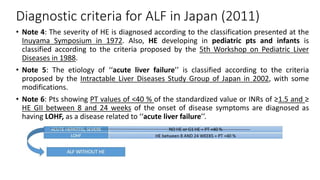
• Note 6: Pts showing PT values of <40 % of the standardized value or INRs of ≥1.5 and ≥
HE GII between 8 and 24 weeks of the onset of disease symptoms are diagnosed as
having LOHF, as a disease related to ‘‘acute liver failure’’.
JAPANESE Definition and classification of LF
YR NOMENCLATURE Development of HE PT Pre-LD Author COUNTRY REF
1981 Fulminant hepatitis
(acute & subacute)
Within 8 weeks after disease symptoms
onset (within 10 days and betwn 11 and
56 dys, respectively)
≤40 % Absent Takahashi
et al.
Japan 1
2011 Acute liver failure
[without or with coma
(acute and subacute)]
Without or with encephalopathy within 8
weeks of disease symptoms onset (within
10 days and between 11 and 56 days,
respectively)
≤40 %
or
INR
C1.5
Absent Mochida
et al.
Japan 2
PT prothrombin time, Pre-LD preexisting symptomless liver diseases, ND not described, IASL International Association for the Study of the Liver, AASLD American Association for the Study of Liver
Diseases
1. The proceedings of the 12th Inuyama Symposium. Hepatitis type A and fulminant hepatitis. Tokyo: Chugai Igaku-sha, 1982 (in Japanese).
2. Mochida S, Takikawa Y, Nakayama N, Oketani M, Naiki T, Yamagishi Y, et al. Diagnostic criteria of acute liver failure: a report by the Intractable Hepato-Biliary Diseases Study Group of Japan.
Hepatol Res. 2011;41:805–12.
EASL 2017
• NOTE: No independent definition of ALF by EASL.
• Severe ALI defines a syndrome characterized by markers of liver damage
(elevated serum AT) and impaired liver function (jaundice and INR >1.5)
which usually precedes clinical HE(evidence level II-2, grade of
recommendation 1).
• Patients with an acute presentation of chronic autoimmune hepatitis,
Wilson disease and Budd-Chiari syndrome are considered as having ALF if
they develop HE, despite the presence of a pre-existing liver disease in the
context of appropriate abnormalities in liver blood tests and coagulation
profile (evidence level II-2, grade of recommendation 1).
• The clinical appearance of HE is crucial for the DX of ALF but mental
alterations may be initially subtle and intensive screening at the first sign of
HE is mandatory (evidence level II-2, grade of recommendation 1).
Grading evidence and recommendations
(adapted from GRADE system).
EASL 2017: Paediatric acute liver failure [1]
• ALF in children is defined as a multisystem syndrome with the following
components to the definition: hepatic-based coagulopathy defined as a
PT >15 s or INR >1.5 not corrected by vitamin K in the presence of clinical
HE, or a PT 20 s or INR 2.0 regardless of the presence or absence of HE.
• An essential component of the definition is the absence of a recognised
underlying chronic liver disease.
• A difference of note is that HE is not considered to be an essential
component of the definition of ALF in children [96]
1. Dhawan A. Acute liver failure in children and adolescents. Clin Res Hepatol Gastroenterol 2012;36:278–283.
In very young children and neonates, ALF may occur in the absence of HE, albeit with a definition that requires a
much greater degree of coagulopathy (INR >4). Bernal W, Auzinger G, Dhawan A, Wendon J. Acute liver failure. Lancet 2010;376:190–201.
Classification of HE in pediatric pts and infants according to the grade of hepatic coma as proposed at the 5th
Workshop on Pediatric Liver Diseases in 1988; from reference [1]
GRADE PEDIATRIC INFANT
I Low-spirited from before (seems lethargic compared
with previous physical activity level)
Does not laugh aloud
II Obedient attitude with somnolent tendency
Disorientation of time or place
Does not laugh even when being
played with Cannot maintain eye
contact with the mother (more
than 3 months after birth)
III Opens eyes in response to loud voice
IV Does not wake up in response to painful stimuli, but frowns and/or brushes off the item producing
the stimulus with his/her hands
V No response to painful stimuli
1. Mochida S, Takikawa Y, Nakayama N, Oketani M, Naiki T, Yamagishi Y, et al. Diagnostic criteria of acute liver failure: a report by the Intractable Hepato-Biliary Diseases Study Group of Japan. Hepatol Res.
2011;41:805–12.
Classification of HE in adult pts according to the grade of hepatic coma proposed by the
Inuyama Symposium in 1972; [1]
Grade Psychiatric disorder Reference items
I Inversion of sleep pattern
Euphoria and/or occasional depression
Negligent attitude with shortened attention span
Recognized retrospectively
in most cases
II Disorientation of time or place and confusion
Inappropriate behaviors, such as throwing away money or discarding items of value
Occasional somnolent tendency; able to open eyes and respond appropriately to
questions
Makes impolite remarks, but follows doctors’ instructions
Excitation state and, urinary and fecal
incontinence are absent, but
flapping tremor is found on physical
examination
III State of excitation and/or delirium, showing defiant behavior
Somnolent tendency; sleeping most of the time
Opens eyes in response to stimulation, but cannot follow the instructions of doctors,
except for simple orders
Flapping tremor is observed, and the
extent of disorientation is severe
IV Coma; complete loss of consciousness
Response to painful stimuli
Brushes off doctor’s hands if touched
and/or frowns in response to stimuli
V Deep coma
No response to painful stimuli
1. Mochida S, Takikawa Y, Nakayama N, Oketani M, Naiki T, Yamagishi Y, et al. Diagnostic criteria of acute liver failure: a report by the Intractable Hepato-Biliary Diseases Study Group of Japan. Hepatol Res.
2011;41:805–12.
Classification of etiologies of ALF modified from the criteria proposed by the Intractable
Liver Diseases Study Group of Japan in 2002; [1]
I. Viral infection
1 Hepatitis A virus (HAV)
2 Hepatitis B virus (HBV)
(1) Transient infection
(2) Acute exacerbation in HBV carrier
i. Inactive carrier, without drug exposure
ii. Reactivation in inactive carrier by immunosuppressant and/or
anticancer drugs
iii. Reactivation in transiently infected pts by immunosuppressant
and/or anticancer drugs (de-novo hepatitis) [a]
(3) Indeterminate infection patterns
3 Hepatitis C virus (HCV)
4 Hepatitis E virus (HEV)
5 Other viruses
II. Autoimmune hepatitis
III. Drug-induced liver injuries
1. Drug allergy-induced liver injury
2. Drug toxicity-induced liver injury
IV. Circulatory disturbance
V. Infiltration of the liver by malignant cells
VI. Metabolic diseases
VII. Liver injuries after liver resection and transplantation
VIII. Miscellaneous etiologies
IX. Indeterminate etiology despite sufficient examinations
X. Unclassified due to insufficient examinations
Pts with etiologies I, II, and III-1 are diagnosed as having ‘‘fulminant hepatitis’’ as well as ‘‘acute liver failure’’, whereas those with
etiologies III-2 and IV to VIII are diagnosed as having ‘‘acute liver failure’’, but are excluded from the disease entity of ‘‘fulminant
hepatitis’’. Diagnostic criteria for the classification of etiology based on laboratory data should be established in the future
A: Serum hepatitis B surface (HBs) antigen-negative patients following transient infection with HBV are classified as HBV carriers, in
whom HBV reactivation can be induced by immunosuppressant and/ or anticancer drugs; however, the significance of this causative
etiology needs to be evaluated further.
1. Mochida S, Takikawa Y, Nakayama N, Oketani M, Naiki T, Yamagishi Y, et al. Diagnostic criteria of acute liver failure: a report by the Intractable Hepato-Biliary Diseases Study Group of Japan. Hepatol Res.
2011;41:805–12.
SUMMARY : PART 1
FULMINANT HEPATIC FAILURE
NO OTHER PARAMETER DEFINED
BERGSTRAND
SUBACUTE
HE Within 8 weeks after disease symptoms onset
ACUTE
FULMINANT FORM OF EPIDEMIC HEPATITIS
ACUTE YELLOW LIVER DYSTROPHY
FULMINANT HEPATITIS
HE Within 8 weeks after disease symptoms onset without pre-existing LD
TREY & DAVIDSON
LUCKE & MALLORY
SUBACUTE LIVER FAILURE
<10 D
TAKAHASHI ET AL.
TANDON ET AL.
11D TILL 56 D
NO OTHER PARAMETER DEFINED
Progressive jaundice with ascites of 8 wks’ duration. HE NOT A CRITERIA
1930
1982
1981
1970
1946
SUMMARY : PART 2
SUMMARY: PART 3
Acute liver failure HE < 26 WEEKS WITH INR ≥1.5 WITHOUT PREEXISTING CLD
MOCHIDA ET AL
POLSON & LEE 2005
2011
End of slides
pratapsagartiwari@gmail.com

Acute liver failure

  • 1.
    ACUTE LIVER FAILURE Compiledby : Pratap Sagar Tiwari, MD, DM RESIDENT, HEPATOLOGY, Hepatology Unit, NAMS, BIR HOSPITAL, KATHMANDU, NEPAL
  • 2.
    Review of Literature EPIDEMICHEPATITIS PRESENT CONTEXT ???/ FULMINANT HEPATITIS FULMINANT HEPATIC FAILURE FULMINANT LIVER FAILURE LATE ONSET HEPATIC FAILURE SEVERE ACUTE LIVER FAILURE SUBFULMINANT HEPATITIS SUBFULMINANT LIVER FAILURE SUBACUTE LIVER FAILURE ACUTE LIVER FAILURE HYPERACUTE LIVER FAILURE ACUTE/ SUBACUTE HEPATIC FAILURE
  • 3.
    Epidemic hepatitis • Epidemichepatitis was a worldwide health problem in the early 20th century, and it was already known, even in the 1920s, that differences existed in the clinical course and that pts could be divided into those with fulminant, acute, or chronic forms [1]. • However, the concept of EH changed with the occurrence of WW II; epidemic hepatitis changed to a hepatitis pandemic during WWar II, with large outbreaks occurring in many parts of the world, especially in armies. • In 1946, Lucke and Mallory [1] reported on the outbreak of EH in the US Army between Aug 1943 & April 1945, in which 104/196 pts (53 %) had a fatal course and died within 10 days of the onset of the hepatitis symptoms. Lucke and Mallory named this form of hepatitis, which was probably caused by HAV or HEV infection, the ‘‘fulminant form’’ of hepatitis. 1. Lucke B, Mallory T. The fulminant form of epidemic hepatitis. Am J Pathol. 1946;22:867–943.
  • 4.
    Fulminant hepatitis/ fulminanthepatic failure • On the other hand, in 1968, Trey et al. [1] reported that drugs such as halothane may also cause acute liver disease, similar in clinical course to fulminant hepatitis. • They evaluated the etiology in 150 pts enrolled from 73 centers, and revealed that the cause of the hepatitis was presumed viral hepatitis in 70 pts (46.7 %) (including serum hepatitis and epidemic hepatitis in 24 and 46 patients, respectively), and drug-induced liver disease in 48 pts (32.0 %) (including 36 with halothane exposure as the culprit) [1]. • These observations prompted hepatologists to use the nomenclature of ‘‘fulminant hepatic failure’’ instead of ‘‘fulminant hepatitis’’ for pts presenting with acute onset of massive liver necrosis. 1. Trey C, Lipworth L, Chalmers TC, Davidson CS, Gottlieb LS, Popper H, Saunders SJ. Fulminant hepatic failure; presumable contribution to halothane. N Engl J Med. 1968;279:798–801.
  • 5.
    Fulminant Hepatic failure/late-onset hepatic failure ALF was originally defined by Trey and Davidson in 1970 as fulminant hepatic failure, which was ‘‘a potentially reversible condition, the consequence of severe liver injury, with an onset of HE within 8 wks of the appearance of the first symptoms and in the absence of pre-existing liver disease” Ref: Trey C, Davidson CS. The management of fulminant hepatic failure. Prog Liver Dis 1970;3:282–398. In 1986, Gimson et al. suggested that pts showing HE as well as other evidence of hepatic decompensation developing >8 weeks but <24 weeks of the onset of the first symptoms be labeled as having late-onset hepatic failure (LOHF), a clinical syndrome related to fulminant hepatic failure. Ref: Gimson AE, O’Grady J, Ede RJ, Portmann B, Williams R. Late onset hepatic failure: clinical, serological and histological features. Hepatology. 1986;6:288–94. onset of HE within 8 wks of the appearance of the 1ST symptoms + absence of pre-existing LD HE > 8 wks but < 24 wks of the appearance of the 1ST symptoms FHF LOHF
  • 6.
    • Also, theterminology of ‘‘subacute liver failure’’ was introduced in India in 1982 for pts showing progressive jaundice with ascites of 8 wks’ duration, with otherwise typical features of acute viral hepatitis; the presence of HE was not a necessary criterion for the diagnosis of this condition [1]. • Severe ALF can be defined as ALF without HE, but with 50% or more decrease in coagulation factors manufactured by the liver, in particular Factors II (prothrombin) and V (proaccelerin). Severe acute liver failure may or may not be followed by fulminant hepatic failure (FHF). • FHF can be defined as severe acute liver failure complicated by HE. • According to the severity of HE, several stages can be distinguished: Asterixis, Confusion, and Coma.[2] • A 3-week limit is specified by some investigator [2],and 8 weeks by others. [3,4] 1.Tandon BN, Joshi YK, Krishnamurthy L, Tandon HD. Subacute hepatic failure; is it a distinct entity? J Clin Gastroenterol. 1982; 4:343–6. 2.Benhamou JP: Acute hepatic necrosis and fulminant hepatic failure. Gut 14:805-815, 1973. 3.Trey C, Davidson C: The management of fulminant hepatic failure. Pro6 Liver Dis 3:282-298, 1970. 4.Gim,on AES, White YS, Eddleston ALWF, et al: Clinical and prognostic differences in fulm~nant hepatit~s type A, B and non-A, non-B. Gut 24:1194- 1198, 1983.
  • 7.
    Benhamou definition 1] •In 1986, Benamou propose to define FLF as ALF complicated by HE <2 wks after the onset of jaundice and subfulminant liver failure as ALF complicated by HE 2 weeks to 3 mnths after the onset of jaundice. • The term "subfulminant liver failure," which clearly denotes the presence of HE, is preferable to that of subacute liver failure, which has been often used to designate ALF with a protracted course, not necessarily associated with HE. (note: preexisting liver disease conditions were not excluded) • The distinction between fulminant and subfulminant liver failure is important for several reasons: (1) this distinction allows a more accurate description of the course of liver failure; (2) fulminant and subfulminant liver failure differ, not only in their course, but also in their clinical manifestations, thus, ascites is less common, and cerebral edema is more common in the former than in the latter; (3) certain causes of ALF are predominantly associated either with a fulminant or a subfulminant course. NOTE: Fulminant or subfulminant hepatitis can be defined as acute hepatitis complicated by fulminant or subfulminant liver failure. 1. Ref: Benhamou et al. Fulminant and Subfulminant Liver Failure: Definitions and Causes. SEMINARS IN LIVER DISEASE-VOL. 6, NO. 2, 1986
  • 8.
    O grady definition •Thus, in 1993, O’Grady et al. [1] redefined such syndromes as ‘‘acute liver failure’’ prefixed with ‘‘hyper’’ and ‘‘sub’’ to describe 2 cohorts at opposite ends of the clinical spectrum, based on the observation of a large series of pts treated at King’s College Hospital, London, between 1972-1985. • According to this proposed classification, pts with HE developing within 7 days of the onset of jaundice are diagnosed as having ‘‘hyperacute liver failure’’, which is often caused by acetaminophen intoxication [1]. • In contrast, pts showing HE between 8 and 28 days and those with HE developing >28 days after the first onset of symptoms were diagnosed as having ‘‘acute liver failure’’ and ‘‘subacute liver failure’’, respectively, with HAV or HBV infection and DILI being more frequently seen in the former , and liver disease of indeterminate etio being seen more frequently in the latter [1]. (Note: Pre-existing symptomless CLD was not excluded ) NOTE: It should be noted that pts with pre-existing symptomless CLD were included in the disease entity of ‘‘acute liver failure’’ by O’Grady et al. [1], and in that of ‘‘fulminant liver failure’’ by Bernuau et al. [2], while such pts were excluded from the entity of ‘‘fulminant hepatic failure’’ by Trey and Davidson [3]. 1. O’Grady JG, Schaim SW, Williams R. Acute liver failure: remodeling the syndromes. Lancet. 1993;342:273–5 2. Benhamou et al. Fulminant and Subfulminant Liver Failure: Definitions and Causes. SEMINARS IN LIVER DISEASE-VOL. 6, NO. 2, 1986 3. Trey C, Davidson CS. The management of fulminant hepatic failure. Prog Liver Dis 1970;3:282–398.
  • 9.
    International Association forthe Study of the Liver (IASL) • Criticisms were raised regarding the nomenclature and definition of ‘‘acute liver failure’’ proposed by the King’ College Hospital group, especially in France [1] and India [2]. • Thus, the subcommittee of the International Association for the Study of the Liver (IASL) published revised recommendations on the nomenclature of acute and subacute hepatic failure in 1999 [3]. • In this recommendation, two distinct disease entities, but not subgroups of a syndrome, were established; namely, ‘‘acute hepatic failure’’ and ‘‘subacute hepatic failure’’. • Pts without preexisting liver disease developing HE within 4 weeks of the onset of the disease symptoms are diagnosed as having acute hepatic failure. • Acute hepatic failure is a potentially reversible liver disease and is classified into hyperacute and fulminant forms, defined by the development of HE <10 days and between 10 and 30 days, respectively, after the first onset of the disease symptoms. • In contrast, pts developing HE between the 5th and 24th weeks after the first onset of symptoms are diagnosed as having subacute hepatic failure. 1. Bernuau J, Benhamou JP. Classifying acute liver failure. Lancet. 1993;342:252–3. 2. Acharya SK, Dasarathy S, Tandon BN. Should we redefine acute liver failure? Lancet. 1993;342:1421–2. 3. Tandon BN, Bernauau J, O’Grady J, Gupta SD, Krisch RE, Liaw YF, et al. Recommendations of the International Association for the Study of the Liver Subcommittee on nomenclature of acute and subacute liver failure. J Gastroenterol Hepatol. 1999;14: 403–4. HE < 10 D AHF HYPERACUTE BETWN 10 AND 30 D HE WITHIN 4 WEEKS + ABSENCE OF PRE-EXISTING LD FULMINANT HF SUBACUTE HF HE BETWEEN 5 TH AND 24TH WEEKS
  • 10.
    AASLD: 2005 • Consequently,until the beginning of the 21st century, hepatitis showing rapid progression was referred to by various names, including fulminant hepatitis [1], fulminant hepatic failure [2], fulminant liver failure [3], acute liver failure [4], acute hepatic failure [5] • However, ‘‘acute liver failure’’ came to be used predominantly as the most suitable umbrella term, because it can be assumed to include all of the other disease entities [6]. • Thus, the Practice Guideline Committee of AASLD published a paper for the MX of ‘‘acute liver failure’’ in 2005 [7]. • Acute liver failure is defined as ‘‘liver diseases characterized by the development of HE and coagulation abnormalities, usually characterized by an INR of ≥1.5, in pts without preexisting cirrhosis, and an illness of <26 weeks duration’’. • In this position paper, subgroups classified according to the interval between the onset of HE and the first onset of the disease symptoms; namely, the hyperacute(<7d), acute(7-21d), and subacute types>21d-26 week), were shown to be not helpful to predict the outcomes of the pts [7]. For example, hyperacute cases may have a better prognosis but this is because most are due to acetaminophen toxicity. 1. Lucke B, Mallory T. The fulminant form of epidemic hepatitis. Am J Pathol. 1946;22:867–943. 2. Trey C, Davidson CS. The management of fulminant hepatic failure. In: Popper H, Schaffner F, editors. Progress in liver diseases. New York: Grune & Stratton; 1970. p. 282–98. 3. Bernuau J, Rueff B, Benhamou JP. Fulminant and subfulminant liver failure: definitions and causes. Semin Liver Dis. 1986;6:97–106. 4. O’Grady JG, Schaim SW, Williams R. Acute liver failure: remodeling the syndromes. Lancet. 1993;342:273–5. 5. Tandon BN, Bernauau J, O’Grady J, Gupta SD, Krisch RE, Liaw YF, et al. Recommendations of the International Association for the Study of the Liver Subcommittee on nomenclature of acute and subacute liver failure. J Gastroenterol Hepatol. 1999;14:403–4. 6. William ML. Acute liver failure. N Engl J Med. 1993;329:1862–72. 7. Polson J, Lee WM. AASLD position paper: the management of acute liver failure. Hepatology. 2005;41:1179–97. ALF HYPERACUTE <7D ACUTE 7-21D SUBACUTE >21D – 26 WEEK HE + INR of ≥1.5, without preexisting cirrhosis, and an illness of <26 weeks duration
  • 11.
    Definition and classificationof ALF and related diseases YR NOMENCLATURE Development of HE PT Pre-LD Author COUNTRY REF 1930 Acute yellow liver dystrophy ND - - Bergstrand Germany 1 1946 Fulminant form of epidemic hepatitis ND - - Lucke and Mallory USA 2 1970 Fulminant hepatic failure Within 8 weeks after disease symptoms onset - Absent Trey and Davidson USA 3 1981 Fulminant hepatitis (acute & subacute) Within 8 weeks after disease symptoms onset (within 10 days and betwn 11 and 56 dys, respectively) ≤40 % Absent Takahashi et al. Japan 4 1982 Subacute liver failure Not necessarily present (a/j of 8 weeks duration) - - Tandon et al. India 5 1986 Late onset hepatic failure Between 8 and 24 weeks after disease symptoms onset - - Gimson et al. England 6 1. Bergstrand H. U¨ ber die akute und chronische gelbe Leberatrophie. Leipzig: G. Thieme; 1930. 2. Lucke B, Mallory T. The fulminant form of epidemic hepatitis. Am J Pathol. 1946;22:867–943. 3. Trey C, Davidson CS. The management of fulminant hepatic failure. In: Popper H, Schaffner F, editors. Progress in liver diseases. New York: Grune & Stratton; 1970. p. 282–98. 4. The proceedings of the 12th Inuyama Symposium. Hepatitis type A and fulminant hepatitis. Tokyo: Chugai Igaku-sha, 1982 (in Japanese). 5. Tandon BN, Joshi YK, Krishnamurthy L, Tandon HD. Subacute hepatic failure; is it a distinct entity? J Clin Gastroenterol. 1982;4:343–6. 6. Gimson AE, O’Grady J, Ede RJ, Portmann B, Williams R. Late onset hepatic failure: clinical, serological and histological features. Hepatology. 1986;6:288–94.
  • 12.
    Definition and classificationof acute liver failure and related diseases YR NOMENCLATURE Development of HE PT Pre-LD Author COUNTRY REF 1986 Fulminant liver failure & subfulminant liver failure <2 weeks and between 2-12 weeks, respectively, after jaundice onset - Absent or present Benhamou et al. France 1 1993 Acute liver failure (hyperacute, acute and subacute) <7 days, between 8 and 28 days, and>28 days, respectively, after jaundice onset - Absent or present O’Grady et al. England 2 1999 Acute hepatic failure (hyper-acute and fulminant) and subacute hepatic failure Within 4 wks (<10 days and betwn 10 -30 dys) and between 5th-24th wks, respectively, after disease symptoms onset - - Tandon et al. IASL 3 2005 Acute liver failure Preexisting illness of less than 26 weeks’ duration Usually INR ≥1.5 Absent Polson and Lee AASLD 4 1. Bernuau J, Rueff B, Benhamou JP. Fulminant and subfulminant liver failure: definitions and causes. Semin Liver Dis. 1986;6:97–106. 2. O’Grady JG, Schaim SW, Williams R. Acute liver failure: remodeling the syndromes. Lancet. 1993;342:273–5. 3. Tandon BN, Bernauau J, O’Grady J, Gupta SD, Krisch RE, Liaw YF, et al. Recommendations of the International Association for the Study of the Liver Subcommittee on nomenclature of acute and subacute liver failure. J Gastroenterol Hepatol. 1999;14:403–4. 4. Polson J, Lee WM. AASLD position paper: the management of acute liver failure. Hepatology. 2005;41:1179–97.
  • 13.
    Definition, classification, anddiagnostic criteria for fulminant hepatitis and ALF in Japan: 1981 • The definition and classification of fulminant hepatitis, the representative disease entity a/w ALF in Japan, were established at the Inuyama Symposium in 1981 [1]. • According to the IS criteria, pts with hepatitis were DX as having fulminant hepatitis when they developed HE ≥ GII due to severe liver damage, as represented by PT values of ≤40 % of the standardized value, within 8 wks of the onset of the hepatitis symptoms. • Fulminant hepatitis was further classified into 2 clinical types; that is, the acute and subacute types, on the basis of the HE developing within 10 dys or betwn 11 -56 days, respectively, after the onset of the hepatitis symptoms. • FH in Japan is defined as histological evidence of hepatic inflammation, characterized by lymphocytic infiltration of the liver, associated with ALF. Thus, the etiology of FH comprises viral infections, incl. HBV carriers, autoimmune hepatitis, drug allergy-induced liver injuries, & hepatitis of indeterminate etiology. FH HE (GII or more) + PT ≤40 % WITHIN 8 WEEKS OF ONSET OF HEPATITIS SYMPTOMS BETWEEN 11 AND 8 WEEKSWITHIN 10 DACUTE-FH SUB ACUTE FH 1. The proceedings of the 12th Inuyama Symposium. Hepatitis type A and fulminant hepatitis. Tokyo: Chugai Igaku-sha, 1982 (in Japanese).
  • 14.
    Diagnostic criteria forfulminant hepatitis in Japan established by the Intractable Liver Diseases Study Group of Japan, supported by the Ministry of Health, Welfare and Labour (2003); from reference [1] Note 1: Pts with CLD/alcoholic hepatitis are excluded from the disease entity of FH, but asymptomatic HBV carriers developing acute exacerbation are included as cases of FH. Note 2: ALF with no histological evidence of liver inflammation, such as that caused by drug or chemical intoxication, circulatory disturbance, acute fatty liver of pregnancy, or Reye’s syndrome is excluded from the disease entity of FH. Note 3: The grading of HE is based on the criteria presented at the Inuyama Symposium in 1972. Note 4: The etio of FH is based on the criteria established by Intractable Liver Diseases Study Group of Japan in 2002. Note 5: Pts with no or grade I HE, but showing PT values of <40 % of the standardized value are diagnosed as having acute hepatitis, severe type. Pts in whom the HE develops between 8 and 24 weeks after the disease onset, with PT values of <40 % of the standardized value are diagnosed as having late- onset hepatic failure (LOHF). Both are diseases related to fulminant hepatitis, but are regarded differently from fulminant hepatitis. 1. Fujiwara K, Mochida S, Matsui A, Nakayama N, Nagoshi S, Toda G. Fulminant hepatitis and late onset hepatic failure in Japan. Hepatol Res. 2008;38:646–57. Fulminant hepatitis : hepatitis with HE ≥ GII that develops in the pts within 8 wks of the onset of disease symptoms, a/w severe derangement of liver function, including PT <40 % . FH is classified into 2 subtypes; the acute type and the subacute type, according to whether the HE occurs within 10 days and later than 11 days till 8 weeks, respectively, after the onset of the symptoms. ACUTE HEPATITIS, SEVERE LOHF HE between 8 AND 24 WEEKS + PT <40 % NO HE or G1 HE + PT <40 %
  • 15.
    Classification of HEin adult pts according to the grade of hepatic coma proposed by the Inuyama Symposium in 1972; [1] Grade Psychiatric disorder Reference items I Inversion of sleep pattern Euphoria and/or occasional depression Negligent attitude with shortened attention span Recognized retrospectively in most cases II Disorientation of time or place and confusion Inappropriate behaviors, such as throwing away money or discarding items of value Occasional somnolent tendency; able to open eyes and respond appropriately to questions Makes impolite remarks, but follows doctors’ instructions Excitation state and, urinary and fecal incontinence are absent, but flapping tremor is found on physical examination III State of excitation and/or delirium, showing defiant behavior Somnolent tendency; sleeping most of the time Opens eyes in response to stimulation, but cannot follow the instructions of doctors, except for simple orders Flapping tremor is observed, and the extent of disorientation is severe IV Coma; complete loss of consciousness Response to painful stimuli Brushes off doctor’s hands if touched and/or frowns in response to stimuli V Deep coma No response to painful stimuli 1. Mochida S, Takikawa Y, Nakayama N, Oketani M, Naiki T, Yamagishi Y, et al. Diagnostic criteria of acute liver failure: a report by the Intractable Hepato-Biliary Diseases Study Group of Japan. Hepatol Res. 2011;41:805–12.
  • 16.
    Classification of etiologiesof ALF modified from the criteria proposed by the Intractable Liver Diseases Study Group of Japan in 2002; [1] I. Viral infection 1 Hepatitis A virus (HAV) 2 Hepatitis B virus (HBV) (1) Transient infection (2) Acute exacerbation in HBV carrier i. Inactive carrier, without drug exposure ii. Reactivation in inactive carrier by immunosuppressant and/or anticancer drugs iii. Reactivation in transiently infected pts by immunosuppressant and/or anticancer drugs (de-novo hepatitis) [a] (3) Indeterminate infection patterns 3 Hepatitis C virus (HCV) 4 Hepatitis E virus (HEV) 5 Other viruses II. Autoimmune hepatitis III. Drug-induced liver injuries 1. Drug allergy-induced liver injury 2. Drug toxicity-induced liver injury IV. Circulatory disturbance V. Infiltration of the liver by malignant cells VI. Metabolic diseases VII. Liver injuries after liver resection and transplantation VIII. Miscellaneous etiologies IX. Indeterminate etiology despite sufficient examinations X. Unclassified due to insufficient examinations Pts with etiologies I, II, and III-1 are diagnosed as having ‘‘fulminant hepatitis’’ as well as ‘‘acute liver failure’’, whereas those with etiologies III-2 and IV to VIII are diagnosed as having ‘‘acute liver failure’’, but are excluded from the disease entity of ‘‘fulminant hepatitis’’. Diagnostic criteria for the classification of etiology based on laboratory data should be established in the future A: Serum hepatitis B surface (HBs) antigen-negative patients following transient infection with HBV are classified as HBV carriers, in whom HBV reactivation can be induced by immunosuppressant and/ or anticancer drugs; however, the significance of this causative etiology needs to be evaluated further. 1. Mochida S, Takikawa Y, Nakayama N, Oketani M, Naiki T, Yamagishi Y, et al. Diagnostic criteria of acute liver failure: a report by the Intractable Hepato-Biliary Diseases Study Group of Japan. Hepatol Res. 2011;41:805–12.
  • 17.
    • According tothe nationwide survey of FH and LOHF conducted by the Intractable Hepato-Biliary Diseases Study Group in Japan (formally the Intractable Liver Diseases Study Group of Japan), In this survey, 1,094 pts with FH, consisting of 543 with the acute type and 551 with the subacute type of FH were included, and 92 pts with LOHF seen between 1998 and 2009 were enrolled [1-7]. • In regard to the etiology of hepatitis, viral infection accounted for 67.4 and 30.9 % of the patients with the acute and subacute types of FH, respectively, and for 10.9 % of the patients with LOHF. • In most pts with FH caused by viral infection, the causative agent was HBV; transient HBV infection was more frequent in pts with the acute type (39.2 %) as compared to the subacute type (10.0 %) of FH, while the frequency of HBV carriers was greater in pts with the subacute type (17.9 %) as compared to the acute type (7.2 %) of FH. • Autoimmune hepatitis was found in 1.8, 12.2, and 19.6 % of pts with the acute and subacute types of FH and LOHF, respectively. • Drug allergy-induced liver injury was seen in 9.0, 13.1, and 18.7 % of pts with the acute and subacute types of FH and LOHF, respectively. • It is noteworthy that the etiology was indeterminate in 19.0, 40.8, and 40.2 % of pts with the acute and subacute types of FH and LOHF, respectively.
  • 18.
    Intractable Hepato-Biliary DiseasesStudy Group in Japan: SURVEY FH (ACUTE) % FH ( SUBACUTE)% LOHF % VIRAL INFN 67.4 30.9 10.9 • transient HBV 39.2 10 • HBV carriers 7.2 17.9 AUTOIMMUNE H 1.8 12.2 19.6 DRUG ALLERGY ILI 9 13.1 18.7 UK 19 40.8 40.2 The outcomes of the pts also differed between these disease types. The survival rates of pts receiving medical Rx(without LT) were 53.7, 24.4, and 11.5 %, respectively, in pts with the acute and subacute types of FH and LOHF seen between 1998 and 2003 [1], while these rates were 48.7, 24.2, and 13.0 %, respectively, in the corresponding categories of pts seen between 2004 and 2009 [2–7]. 1. Fujiwara K, Mochida S, Matsui A, Nakayama N, Nagoshi S, Toda G. Fulminant hepatitis and late onset hepatic failure in Japan. Hepatol Res. 2008;38:646–57. 2. Tsubouchi H, Oketani M. Fulminant hepatitis and late onset hepatic failure (LOHF) in Japan (2004). Annual Report of the Intractable Hepato-Biliary Diseases Study Group of Japan Supported by the Ministry of Health, Labor, and Welfare; 2006.p. 61–9 (in Japanese). 3. Tsubouchi H, Oketani M, Ido A. Fulminant hepatitis and late onset hepatic failure (LOHF) in Japan (2005). Annual Report of the Intractable Hepato-Biliary Diseases Study Group of Japan Supported by the Ministry of Health, Labor, and Welfare; 2007.p. 90–100 (in Japanese). 4. Tsubouchi H, Oketani M, Ido A. Fulminant hepatitis and late onset hepatic failure (LOHF) in Japan (2006). Annual Report of the Intractable Hepato-Biliary Diseases Study Group of Japan Supported by the Ministry of Health, Labor, and Welfare; 2008.p. 83–94 (in Japanese). 5. Tsubouchi H, Oketani M, Ido A. Fulminant hepatitis and late onset hepatic failure (LOHF) in Japan (2007). Annual Report of the Intractable Hepato-Biliary Diseases Study Group of Japan Supported by the Ministry of Health, Labor, and Welfare; 2009.p. 83–93 (in Japanese). 6. Tsubouchi H, Oketani M. Ido A. Fulminant hepatitis and late onset hepatic failure (LOHF) in Japan (2008). Annual Report of the Intractable Hepato-Biliary Diseases Study Group of Japan Supported by the Ministry of Health, Labor, and Welfare; 2010.p. 95–106 (in Japanese). 7. Tsubouchi H, Oketani M. Ido A. Fulminant hepatitis and late onset hepatic failure (LOHF) in Japan (2009). Annual Report of the Intractable Hepato-Biliary Diseases Study Group of Japan Supported by the Ministry of Health, Labor, and Welfare; 2011. p. 96–113 (in Japanese). NOTE: In this survey, 1,094 pts with FH, consisting of 543 with the acute type and 551 with the subacute type of FH were included, and 92 pts with LOHF seen between 1998 and 2009 were enrolled [1-7].
  • 19.
    Intractable Hepato-Biliary DiseasesStudy Group in Japan: 2006 • Although the diagnostic criteria for FH in Japan [1, 2] merit consideration in clinical practice for the diagnosis of ALF pts, do they need to be revised to fit with the criteria for ALF adopted in Europe and the US? [3]. • Thus, in 2006, the Intractable Hepato-Biliary Diseases Study Group in Japan constituted a task force to establish novel diagnostic criteria for ‘‘acute liver failure’’, which includes the disease entity ‘‘fulminant hepatitis’’. • To establish such criteria for defining ‘‘acute liver failure’’ in Japan, two types of nationwide surveys were performed [4]; a survey of the commercial kits used for the measurement of PT at institutions to which hepatology specialists were affiliated, and a survey of ALF pts who were excluded from the disease entities of fulminant hepatitis and LOHF. • Consequently, ‘‘acute liver failure’’ in Japan came to be defined as an acute liver disease associated with prolongation of the PT, with an INR of ≥1.5. • To confirm the correspondence between the present criteria and previous criteria, ‘‘PT values of <40 % of the standardized value’’ was also employed as a cutoff to define pts with ALF. Pts without HE were also included in the disease entity of ALF, if they showed an INR of ≥1.5. 1. Fujiwara K, Mochida S, Matsui A, Nakayama N, Nagoshi S, Toda G. Fulminant hepatitis and late onset hepatic failure in Japan. Hepatol Res. 2008;38:646–57. 2. The proceedings of the 12th Inuyama Symposium. Hepatitis type A and fulminant hepatitis. Tokyo: Chugai Igaku-sha, 1982 (in Japanese). 3. Polson J, Lee WM. AASLD position paper: the management of acute liver failure. Hepatology. 2005;41:1179–97. 4. Mochida S, Takikawa Y, Nakayama N, Oketani M, Naiki T, Yamagishi Y, et al. Diagnostic criteria of acute liver failure: a report by the Intractable Hepato-Biliary Diseases Study Group of Japan. Hepatol Res. 2011;41:805–12.
  • 20.
    Diagnostic criteria forALF in Japan (2011); [1] • Pts showing PT ≤40 %, or INR of ≥1.5 due to severe liver damage within 8 weeks of the onset of disease symptoms are diagnosed as having ‘‘acute liver failure’’, where the liver function prior to the current onset of liver damage is estimated to have been normal based on blood laboratory data and imaging examinations. • ‘‘Acute liver failure’’ is classified into ‘‘acute liver failure without hepatic coma’’ and ‘‘acute liver failure with hepatic coma’’; no or grade I HE is present in the former type, while ≥HE Grade II is found in the latter type. • ‘‘Acute liver failure with hepatic coma’’ is further subclassified into 2 disease types; the ‘‘acute type’’ and ‘‘subacute type’’, with ≥HE Grade II developing <10 days or between 11 and 56 days after the onset of disease symptoms, respectively, in the two types. 1. Mochida S, Takikawa Y, Nakayama N, Oketani M, Naiki T, Yamagishi Y, et al. Diagnostic criteria of acute liver failure: a report by the Intractable Hepato-Biliary Diseases Study Group of Japan. Hepatol Res. 2011;41:805–12. ALF ALF WITHOUT HE NO OR G1 HE ≥HE Grade IIALF WITH HE PT ≤40 %, or INR of ≥1.5 due to severe liver damage < 8 wks of the OOD symptoms 11 D- 8 WEEKSACUTE < 10 D SUBACUTE Previously : ACUTE HEPATITIS, SEVERE 11 D- 8 WEEKSLOHF
  • 21.
    Diagnostic criteria forALF in Japan (2011); [1] • Note 1: HBV carriers and AIH pts showing acute exacerbation of hepatitis in the normal liver are included under the disease entity of ‘‘ALF’’. In the case of indeterminate previous liver function, the pts who are HBV carriers and those with AIH are diagnosed as having ‘‘acute liver failure’’ when no liver function impairment preceding the exacerbation of the liver injury can be confirmed. • Note 2: In general, alcoholic hepatitis develops in pts with CLD caused by habitual alcohol consumption. Thus, pts with alcoholic hepatitis are excluded from the disease entity of ‘‘ALF’’. However, pts with fatty liver caused by alcohol intake and those with metabolic syndrome, including obesity, are diagnosed as having ‘‘ALF’’ if etiologies other than habitual alcohol consumption are responsible for the acute injury in the liver, in the absence of prior impairment of liver function. • Note 3: Pts without histological evidence of hepatitis, such as inflammatory lymphocytic infiltration, are included under the disease entity of ‘‘ALF’’. Thus, pts with liver damage caused by drug toxicity, circulatory disturbance, or metabolic disease and acute fatty liver of pregnancy are diagnosed as having ‘‘acute liver failure’’, while they are excluded from the disease entity of ‘‘fulminant hepatitis’’. 1. Mochida S, Takikawa Y, Nakayama N, Oketani M, et al. Diagnostic criteria of acute liver failure: a report by the Intractable Hepato-Biliary Diseases Study Group of Japan. Hepatol Res. 2011;41:805–12. INCLUDED EXCLUDED HBV carrier , fatty liver, AIH, Drugs, Circulatory dysfn, metabolic diseases, AFLOP Alcoholic hepatitis , CLD
  • 22.
    Diagnostic criteria forALF in Japan (2011) • Note 4: The severity of HE is diagnosed according to the classification presented at the Inuyama Symposium in 1972. Also, HE developing in pediatric pts and infants is classified according to the criteria proposed by the 5th Workshop on Pediatric Liver Diseases in 1988. • Note 5: The etiology of ‘‘acute liver failure’’ is classified according to the criteria proposed by the Intractable Liver Diseases Study Group of Japan in 2002, with some modifications. • Note 6: Pts showing PT values of <40 % of the standardized value or INRs of ≥1.5 and ≥ HE GII between 8 and 24 weeks of the onset of disease symptoms are diagnosed as having LOHF, as a disease related to ‘‘acute liver failure’’.
  • 23.
    JAPANESE Definition andclassification of LF YR NOMENCLATURE Development of HE PT Pre-LD Author COUNTRY REF 1981 Fulminant hepatitis (acute & subacute) Within 8 weeks after disease symptoms onset (within 10 days and betwn 11 and 56 dys, respectively) ≤40 % Absent Takahashi et al. Japan 1 2011 Acute liver failure [without or with coma (acute and subacute)] Without or with encephalopathy within 8 weeks of disease symptoms onset (within 10 days and between 11 and 56 days, respectively) ≤40 % or INR C1.5 Absent Mochida et al. Japan 2 PT prothrombin time, Pre-LD preexisting symptomless liver diseases, ND not described, IASL International Association for the Study of the Liver, AASLD American Association for the Study of Liver Diseases 1. The proceedings of the 12th Inuyama Symposium. Hepatitis type A and fulminant hepatitis. Tokyo: Chugai Igaku-sha, 1982 (in Japanese). 2. Mochida S, Takikawa Y, Nakayama N, Oketani M, Naiki T, Yamagishi Y, et al. Diagnostic criteria of acute liver failure: a report by the Intractable Hepato-Biliary Diseases Study Group of Japan. Hepatol Res. 2011;41:805–12.
  • 24.
    EASL 2017 • NOTE:No independent definition of ALF by EASL. • Severe ALI defines a syndrome characterized by markers of liver damage (elevated serum AT) and impaired liver function (jaundice and INR >1.5) which usually precedes clinical HE(evidence level II-2, grade of recommendation 1). • Patients with an acute presentation of chronic autoimmune hepatitis, Wilson disease and Budd-Chiari syndrome are considered as having ALF if they develop HE, despite the presence of a pre-existing liver disease in the context of appropriate abnormalities in liver blood tests and coagulation profile (evidence level II-2, grade of recommendation 1). • The clinical appearance of HE is crucial for the DX of ALF but mental alterations may be initially subtle and intensive screening at the first sign of HE is mandatory (evidence level II-2, grade of recommendation 1).
  • 25.
    Grading evidence andrecommendations (adapted from GRADE system).
  • 26.
    EASL 2017: Paediatricacute liver failure [1] • ALF in children is defined as a multisystem syndrome with the following components to the definition: hepatic-based coagulopathy defined as a PT >15 s or INR >1.5 not corrected by vitamin K in the presence of clinical HE, or a PT 20 s or INR 2.0 regardless of the presence or absence of HE. • An essential component of the definition is the absence of a recognised underlying chronic liver disease. • A difference of note is that HE is not considered to be an essential component of the definition of ALF in children [96] 1. Dhawan A. Acute liver failure in children and adolescents. Clin Res Hepatol Gastroenterol 2012;36:278–283. In very young children and neonates, ALF may occur in the absence of HE, albeit with a definition that requires a much greater degree of coagulopathy (INR >4). Bernal W, Auzinger G, Dhawan A, Wendon J. Acute liver failure. Lancet 2010;376:190–201.
  • 27.
    Classification of HEin pediatric pts and infants according to the grade of hepatic coma as proposed at the 5th Workshop on Pediatric Liver Diseases in 1988; from reference [1] GRADE PEDIATRIC INFANT I Low-spirited from before (seems lethargic compared with previous physical activity level) Does not laugh aloud II Obedient attitude with somnolent tendency Disorientation of time or place Does not laugh even when being played with Cannot maintain eye contact with the mother (more than 3 months after birth) III Opens eyes in response to loud voice IV Does not wake up in response to painful stimuli, but frowns and/or brushes off the item producing the stimulus with his/her hands V No response to painful stimuli 1. Mochida S, Takikawa Y, Nakayama N, Oketani M, Naiki T, Yamagishi Y, et al. Diagnostic criteria of acute liver failure: a report by the Intractable Hepato-Biliary Diseases Study Group of Japan. Hepatol Res. 2011;41:805–12.
  • 28.
    Classification of HEin adult pts according to the grade of hepatic coma proposed by the Inuyama Symposium in 1972; [1] Grade Psychiatric disorder Reference items I Inversion of sleep pattern Euphoria and/or occasional depression Negligent attitude with shortened attention span Recognized retrospectively in most cases II Disorientation of time or place and confusion Inappropriate behaviors, such as throwing away money or discarding items of value Occasional somnolent tendency; able to open eyes and respond appropriately to questions Makes impolite remarks, but follows doctors’ instructions Excitation state and, urinary and fecal incontinence are absent, but flapping tremor is found on physical examination III State of excitation and/or delirium, showing defiant behavior Somnolent tendency; sleeping most of the time Opens eyes in response to stimulation, but cannot follow the instructions of doctors, except for simple orders Flapping tremor is observed, and the extent of disorientation is severe IV Coma; complete loss of consciousness Response to painful stimuli Brushes off doctor’s hands if touched and/or frowns in response to stimuli V Deep coma No response to painful stimuli 1. Mochida S, Takikawa Y, Nakayama N, Oketani M, Naiki T, Yamagishi Y, et al. Diagnostic criteria of acute liver failure: a report by the Intractable Hepato-Biliary Diseases Study Group of Japan. Hepatol Res. 2011;41:805–12.
  • 29.
    Classification of etiologiesof ALF modified from the criteria proposed by the Intractable Liver Diseases Study Group of Japan in 2002; [1] I. Viral infection 1 Hepatitis A virus (HAV) 2 Hepatitis B virus (HBV) (1) Transient infection (2) Acute exacerbation in HBV carrier i. Inactive carrier, without drug exposure ii. Reactivation in inactive carrier by immunosuppressant and/or anticancer drugs iii. Reactivation in transiently infected pts by immunosuppressant and/or anticancer drugs (de-novo hepatitis) [a] (3) Indeterminate infection patterns 3 Hepatitis C virus (HCV) 4 Hepatitis E virus (HEV) 5 Other viruses II. Autoimmune hepatitis III. Drug-induced liver injuries 1. Drug allergy-induced liver injury 2. Drug toxicity-induced liver injury IV. Circulatory disturbance V. Infiltration of the liver by malignant cells VI. Metabolic diseases VII. Liver injuries after liver resection and transplantation VIII. Miscellaneous etiologies IX. Indeterminate etiology despite sufficient examinations X. Unclassified due to insufficient examinations Pts with etiologies I, II, and III-1 are diagnosed as having ‘‘fulminant hepatitis’’ as well as ‘‘acute liver failure’’, whereas those with etiologies III-2 and IV to VIII are diagnosed as having ‘‘acute liver failure’’, but are excluded from the disease entity of ‘‘fulminant hepatitis’’. Diagnostic criteria for the classification of etiology based on laboratory data should be established in the future A: Serum hepatitis B surface (HBs) antigen-negative patients following transient infection with HBV are classified as HBV carriers, in whom HBV reactivation can be induced by immunosuppressant and/ or anticancer drugs; however, the significance of this causative etiology needs to be evaluated further. 1. Mochida S, Takikawa Y, Nakayama N, Oketani M, Naiki T, Yamagishi Y, et al. Diagnostic criteria of acute liver failure: a report by the Intractable Hepato-Biliary Diseases Study Group of Japan. Hepatol Res. 2011;41:805–12.
  • 30.
    SUMMARY : PART1 FULMINANT HEPATIC FAILURE NO OTHER PARAMETER DEFINED BERGSTRAND SUBACUTE HE Within 8 weeks after disease symptoms onset ACUTE FULMINANT FORM OF EPIDEMIC HEPATITIS ACUTE YELLOW LIVER DYSTROPHY FULMINANT HEPATITIS HE Within 8 weeks after disease symptoms onset without pre-existing LD TREY & DAVIDSON LUCKE & MALLORY SUBACUTE LIVER FAILURE <10 D TAKAHASHI ET AL. TANDON ET AL. 11D TILL 56 D NO OTHER PARAMETER DEFINED Progressive jaundice with ascites of 8 wks’ duration. HE NOT A CRITERIA 1930 1982 1981 1970 1946
  • 31.
  • 32.
    SUMMARY: PART 3 Acuteliver failure HE < 26 WEEKS WITH INR ≥1.5 WITHOUT PREEXISTING CLD MOCHIDA ET AL POLSON & LEE 2005 2011
  • 33.

Editor's Notes

  • #15 Thus, the disease entity of LOHF in Japan differed from that in Europe and the United States [14], because patients with no histological evidence of hepatitis and/or PT values of <40 % of the standardized value were excluded from the diagnosis of LOHF in Japan, even if they had grade II or more severe HE.
  • #21 Similar to the entity of ALF in Europe and the US [1], in Japan pts without histological evidence of inflammation in the liver, such as those with the disease caused by drug toxicity, circulatory disturbances, or metabolic diseases are also included in the disease entity of ALF. In contrast, pts showing impaired liver function due to underlying CLD before the worsening of the liver damage are excluded from the disease entity of ALF. Thus, alcoholic liver disease pts are excluded from this entity, because they show clinical features consistent with acute-on-chronic liver disease. However, pts with underlying CLD such as fatty liver and autoimmune hepatitis are included in the disease entity of ALF, when the liver function impairment is retrospectively estimated to be minimal or absent prior to the current exacerbation of the liver damage. Also, the criteria for classification of HE and etiology of hepatitis have been added as footnotes to the present criteria . In addition, pts with LOHF are defined as those showing PT <40 % of the standardized value or INRs of ≥ 1.5 and HE ≥GII between 8 and 24 weeks of the onset of the disease symptoms, and those without histological evidence of hepatitis are also included in the disease entity of LOHF, similar to the case of ALF. On the other hand, the disease entity of ‘‘acute hepatitis severe type’’ was excluded from the footnote of the present criteria, because pts classified under such a disease entity can also be diagnosed as having ‘‘ALF without HE’’.