Dr Maila K.G
School of Paediatrics and Child Health
University of Limpopo
 Introduction and Epidemiology
 Aetiology
 Pathophysiology
 Signs and symptoms
 Complications
 Work-up including Classification
 Management
 Fluid and Electrolytes
 Feeding and Nutrition
 Prevention
 Define Acute diarrhea and Dysentery
 What causes diarrhea and how?
 Complications of Diarrhea
 Differential Diagnosis
 Develop an approach to management of acute diarrhea
 Complications
 Identify malnourished child and adjust management accordingly
Definitions and Terms:
Acute Gastroenteritis (AGE): diarrheal disease of
rapid onset, with or without accompanying
symptoms, signs, such as nausea, vomiting,
fever, or abdominal pain
Diarrhea: the frequent passage of unformed
liquid stools (3 or more loose, watery stool per
day) for upto 14 days
Dysentery: blood or mucus in stools
 Acute: short in duration of < 14 days
 Persistent diarrhea: starts acutely and lasts longer than 14 days
 One of the most common illness of infancy
 Second to respiratory illness as a cause of childhood deaths WW
 It represents a major cause of morbidity and mortality
 3-10 episodes of diarrhea/year/subject in children <5 yrs and
decreases to < 1 for children >5
 Deaths are usually a result of dehydration but malnutrition
plays an important role as it increases the incidence and severity
of diarrhea
 By 3 years, virtually all children become infected by the most
common agent Rotavirus
 AGE is a clinical syndrome produced by a variety of Viral,
Bacterial and Parasitic enteropathogens.
 AGE is almost entirely caused by infections acquired through
fecal-oral route, but ingestion of contaminated food or water also
plays a role
 We have: Non-enteric, Non-infectious and Infectious causes of
the Gastro-intestinal tract
 Episodes usually last 5-10 days
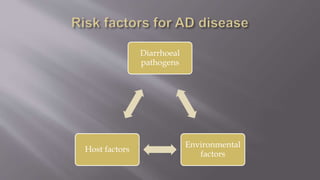
Diarrhoeal
pathogens
Environmental
factors
Host factors
 Non-enteric causes:
 otitis media. Meningitis, sepsis generally
 Non-infectious causes:
 milk/food allergies, drug side effects, malabsorption
 Infections of the gastrointestinal tract
 Viral
 Bacterial
 Protozoal
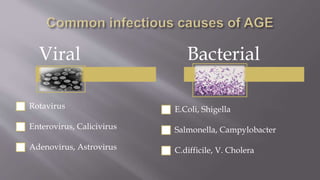
Viral
Rotavirus
Enterovirus, Calicivirus
Adenovirus, Astrovirus
Bacterial
E.Coli, Shigella
Salmonella, Campylobacter
C.difficile, V. Cholera
 Entamoeba Hystolitica
 Giardia lamblia
 Cryptosporidium
 Rotavirus is known to be the most common pathogen in children
 It is more severe than other causes and more often results in
dehydration, Hospitalization, Shock, Metabolic disturbances and
Death
 Bacterial pathogens are more common where poor sanitation,
hygiene and water supply play a role causing dysenterey
 Age: peaks at 6-11 months till 24 months
 Failure to get immunized against rota virus
 Failure of measles vaccination
 Malnutrition
 Behavioural factors
 Not exclusively breastfed for 6/12
 Using infant feeding bottles
 Not washing hands before handling food or after defecation
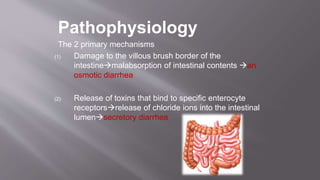
Pathophysiology
The 2 primary mechanisms
(1) Damage to the villous brush border of the
intestinemalabsorption of intestinal contents an
osmotic diarrhea
(2) Release of toxins that bind to specific enterocyte
receptorsrelease of chloride ions into the intestinal
lumensecretory diarrhea
 Rotavirus attach and enter mature enterocytes at the tip of the small
intestinal villi
 Cause structural changes to the bowel mucosa, including villous
shortening and mononuclear inflammatory infiltrates in the lamina
propria
 This virus induce maldigestion of carbohydrates and their
accumulation in the intestinal lumen (in the absence of lactase)
 Malabsorption of nutrients and concomitant inhibition of water
reabsorption can lead to a malabsorption component of diarrhea
 Rotavirus secretes an enterotoxin, NSP4 which leads to a calcium-
dependent chloride secretory mechanism
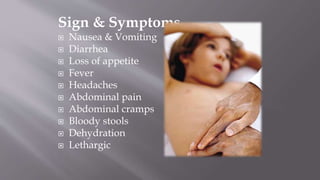
Sign & Symptoms
 Nausea & Vomiting
 Diarrhea
 Loss of appetite
 Fever
 Headaches
 Abdominal pain
 Abdominal cramps
 Bloody stools
 Dehydration
 Lethargic
 Vomiting is largely attributed to local factors and poor gastric
emptying, and should not be treated with antiemetic drugs
 Abdominal pains are usually spasmodic due to disordered
motility or is associated with colitis in dysentery
 Diarrhea is the manifestation of secretion or absorption
disturbance and disordered motility, a symptom of damage
already done in the infected gut.
 Infectious outside the GIT e.g UTI or Meningitis
 Surgical problems: Intussusception
 Underlying immunodeficiency: HIV
 Primary gastrointestinal tract pathology
 Inflammatory bowel disease, cystic fibrosis
 Recognize poor perfusion and other signs of shock
 Cold peripheries
 Depressed LOC
 Increase capillary refill time (>3sec)
 Poor/weak peripheral pulses
 Reduced urine-output
 Hypotension is a late sign
Some dehydration Severe dehydration
Sunken eyes and fontanelle Very sunken eyes and anterior fontanelle
Slow skin turgor Very slow skin turgor >2sec
Patient drinks eagerly Drinks poorly
Irritable/restless lethargic
Dry mucus membranes
 Altered LOC
 Intractable vomiting or ORS failure
 Severe dehydration with/without shock
 Young age <6 months with dehydration
 Dysentery <1 year
 Tender abdomen; suspected surgical diagnoses
 Persistent diarrhoea
 After resuscitation, in children with severe dehydration, shock or
other signs of metabolic, nutritional or other co-morbidities
 Electrolytes and serum acid base determination
 All severely dehydrated patients, mod dehydration with an atypical
presentation, malnourished children
 Blood glucose disturbances occur in severely ill patients as a result of
glycogen depletion with lack of intake, or associated with the stress
response of dehydration
 Stool culture
 Dysentery
 If antibiotics are considered
 Persistent diarrhoea
 To exclude an infectious aetiology
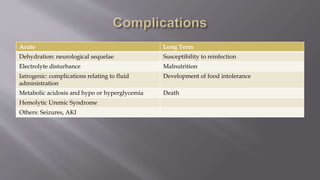
Acute Long Term
Dehydration: neurological sequelae Susceptibility to reinfection
Electrolyte disturbance Malnutrition
Iatrogenic: complications relating to fluid
administration
Development of food intolerance
Metabolic acidosis and hypo or hyperglycemia Death
Hemolytic Uremic Syndrome
Others: Seizures, AKI
 Large amounts of Sodium are lost in diarrheal stools
 In acidosis, a shift of intracellular potassium to EC compartment
results in a spurious elevation of the serum level despite
intracellular potassium loss
 Give K+ to all patients with severe diarrhea until dehydration
and acidosis are corrected
 Sodium disturbances occur frequently
 Sodium content of the stool water varies from plasma-like in
secretory diarrhea , to very low in pure Osmotic diarrhea
 Always SHOUT for HELP
 A…….B…..
 Circulation
 Establish vascular access or IO if failed venous access after 2 good attempts
 Give 20ml/kg of R/L or Normal Saline rapid infusion or 5ml/kg in aliquots X4
is much safer
 Watch for signs of circulatory overload i.e hepatomegaly, gallop rhythm or
basal crackles, puffiness of the eyelids, tachy-pnoea and –cardia.
 Repeat R/L 20ml/kg if patient is still shocked. Re-assess and give more if still
shocked
 Don’t-Ever-Forget-Glucose
 Re-assess ABC and response so far
 Give 1st dose Ceftriaxone 80mg/kg stat to cover sepsis
 ABC still as essential as the normally nourished patients
 Give 15ml/kg infusion over 30 minutes
 Re-assess and repeat if still shocked
 Give up to 4 boluses and thereafter, T/F to HC or ICU
 Patient response should guide further fluid therapy
 When shock has been treated successfully, proceed to the
management of dehydration.
 But remember your patient can go back into shocked if
improperly rehydrated
 Its NB to use solutions with sufficient Na conc. To prevent Hyponatremia
 ½ DD is appropriate if IV route is used, or ORS for enteral replacements
 Where vomiting is the main source of fluid loss, rehydration fluid
(0.45%NaCl and 5% Dextrose) with added K is appropriate
 Dose of ½ DD or ORS for rapid rehydration over 4 hours
 Some Dehydration: 50ml/kg over 4 hrs (12.5ml/kg/hour)
 Severe Dehydration: 100mls/kg/4hours (25mls/kg./hour)
 Rapid rehydration over 4hrs should not be used in severe malnutrition,
cardiac failure, severe pneumonia, encephalopathy etc.
 However, rehydrate over 24hours or even 48 hours
 APPROPRIATE RESPONSE AT 4.docx
 Severely malnourished have a deficient K and elevated Na levels, thus
require a special ORS: ReSolMal
 Should be given enterally wherever possible but intravenously
where nil per Os is absolute
 Fluid restriction to approximately 50-60% of maintenance should
be adhered to, where there is a risk of inadequate secretion e.g in
Renal failure
 NORMAL MAINTENANCE FLUID REQUIREMENTS.docx
 Losses need to be replaced by equal volumes of fluids of similar
composition
 For moderate losses, add 30mls/kg to maintenance requirements. But
give more if there’s a need
 For those taking enterally:
 <2years: 50-100mls AELS
 >2years: 100-200mls AELS
 Small frequent volumes of home based sugar salt solution as little as
5mls every minute, can be effective in preventing dehydration even in
vomiting cases
 Continue Breast feeding and oral feeding once perfusion is restored
 Zinc: reduces the duration and severity of diarrhea
 Antimotility agents like loperamide are C/I due to potentially
serious side effects (malignant hyperpyrexia, lethargy and
dystonia)
 Vit A: reduces the severity of diarrhea, but do not give if a dose
was given in the previous month
 All children with diarrhea get vit A and Zinc according to age
 Other drugs, Any use?
 Hypokalemia (<3): even when the serum K conc. Is normal, these
patients have a depletion of the total body potassium
 Plasma k level doesn’t always provide an accurate est of total
body deficit. There may be K shift from intracellular space to the
plasma.
 <3mmol/l: stat dose oral K <5kg= 250mg. 5-10kg=500mg and
>10kg=1g stat
 Ongoing losses: < 5kg: 125mg, 5-10kg:250mg and >10kg: 500mg tds
 Re-assess after 4 hours
 Stop when abnormal losses stop
K<2>1.5
K<1.5: PARALYSIS, MUSCLE
WEAKNESS,APNOEA
 Attach ECG: prolonged QT and
Flat T waves
 Give stat doses as previous slide
 Oral KCl: 100mg/kg 6hrly with
max dose 3g/day
 Plus IV correction
 Add to iv fluids (200mls): ½ DD=2ms
15%KCl, Saline=4mls 15%KCl
 Recheck in 4hrs and manage
accordingly
 Admit to HC/ICU
 Give stat dose accordingly
 Oral K: 100mg/kg 6hrly
 Plus IV correction
 If ICU: 0.3mml/kg in 50mls N
saline via C.Vein over 1hour
 Recheck in 2hours
 Manage ongoing losses and
replacement
MILD SYMPTOMATIC (120-130) SEVERE SYMPTOMATIC (<120)
 Evaluate pt: if euvolemic, manage
underlying illness
 Dehydrated: rehydrate over 24-48
hours
 Recheck electrolytes 4hourly,
manage ongoing losses
 ABC
 Stop seizures (iv phenobarb
10mg/kg)
 Single dose Hypertonic saline
infusion over 1 hour (formula)
 4ml/kg 3% saline
 Re-check electrolytes in 1 hour
 Manage on-going losses
©2011 MFMER | slide-36
 Passage of mucus and blood in stools
 Shigella is the most common cause in children SA
 Clinical
 Sudden onset
 Abdominal cramps, peritonitis associated with fever
 Meningismus and convulsions may occur
 Exclude intussusception (abdominal pain, bile stained vomitus, red
current jelly like mucus in stools)
 Investigation: Stool culture confirms the diagnosis of Shigellosis
 Treatment…….
 Diarrheal disease causes a significant burden of disease:
increased morbidity and mortality
 Diarrhea is defined as having 3/more watery or loose stools per
day
 Acute diarrhea last less than 2 weeks
 Primary prevention: water sanitation and hygiene
 Rotavirus vaccination
 Handbook of Paediatrics 7th edition pg 121-129, 461-481
 Std Rx guidelines and Essential Medicines List 2013 (Dept
ofHealth) pg 2.9-2.17
 Gastroenteritis presentation by Prof T Rogers Dept of Clinical
Microbiology
 South African medical journal, vol 102,no.2 2012 (Management
guidelines for Acute infective diarrhea in infants) prof F
Wittenburg
 Acute gastroenteritis in children by Dr Alta Terblanche,
Professional Nursing Today 2010
©2011 MFMER | slide-40

Acute diarrhoea Lecture

  • 1.
    Dr Maila K.G Schoolof Paediatrics and Child Health University of Limpopo
  • 2.
     Introduction andEpidemiology  Aetiology  Pathophysiology  Signs and symptoms  Complications  Work-up including Classification  Management  Fluid and Electrolytes  Feeding and Nutrition  Prevention
  • 3.
     Define Acutediarrhea and Dysentery  What causes diarrhea and how?  Complications of Diarrhea  Differential Diagnosis  Develop an approach to management of acute diarrhea  Complications  Identify malnourished child and adjust management accordingly
  • 4.
    Definitions and Terms: AcuteGastroenteritis (AGE): diarrheal disease of rapid onset, with or without accompanying symptoms, signs, such as nausea, vomiting, fever, or abdominal pain Diarrhea: the frequent passage of unformed liquid stools (3 or more loose, watery stool per day) for upto 14 days Dysentery: blood or mucus in stools
  • 5.
     Acute: shortin duration of < 14 days  Persistent diarrhea: starts acutely and lasts longer than 14 days
  • 6.
     One ofthe most common illness of infancy  Second to respiratory illness as a cause of childhood deaths WW  It represents a major cause of morbidity and mortality  3-10 episodes of diarrhea/year/subject in children <5 yrs and decreases to < 1 for children >5  Deaths are usually a result of dehydration but malnutrition plays an important role as it increases the incidence and severity of diarrhea  By 3 years, virtually all children become infected by the most common agent Rotavirus
  • 7.
     AGE isa clinical syndrome produced by a variety of Viral, Bacterial and Parasitic enteropathogens.  AGE is almost entirely caused by infections acquired through fecal-oral route, but ingestion of contaminated food or water also plays a role  We have: Non-enteric, Non-infectious and Infectious causes of the Gastro-intestinal tract  Episodes usually last 5-10 days
  • 8.
  • 9.
     Non-enteric causes: otitis media. Meningitis, sepsis generally  Non-infectious causes:  milk/food allergies, drug side effects, malabsorption  Infections of the gastrointestinal tract  Viral  Bacterial  Protozoal
  • 10.
    Viral Rotavirus Enterovirus, Calicivirus Adenovirus, Astrovirus Bacterial E.Coli,Shigella Salmonella, Campylobacter C.difficile, V. Cholera
  • 11.
     Entamoeba Hystolitica Giardia lamblia  Cryptosporidium
  • 12.
     Rotavirus isknown to be the most common pathogen in children  It is more severe than other causes and more often results in dehydration, Hospitalization, Shock, Metabolic disturbances and Death  Bacterial pathogens are more common where poor sanitation, hygiene and water supply play a role causing dysenterey
  • 13.
     Age: peaksat 6-11 months till 24 months  Failure to get immunized against rota virus  Failure of measles vaccination  Malnutrition  Behavioural factors  Not exclusively breastfed for 6/12  Using infant feeding bottles  Not washing hands before handling food or after defecation
  • 14.
    Pathophysiology The 2 primarymechanisms (1) Damage to the villous brush border of the intestinemalabsorption of intestinal contents an osmotic diarrhea (2) Release of toxins that bind to specific enterocyte receptorsrelease of chloride ions into the intestinal lumensecretory diarrhea
  • 15.
     Rotavirus attachand enter mature enterocytes at the tip of the small intestinal villi  Cause structural changes to the bowel mucosa, including villous shortening and mononuclear inflammatory infiltrates in the lamina propria  This virus induce maldigestion of carbohydrates and their accumulation in the intestinal lumen (in the absence of lactase)  Malabsorption of nutrients and concomitant inhibition of water reabsorption can lead to a malabsorption component of diarrhea  Rotavirus secretes an enterotoxin, NSP4 which leads to a calcium- dependent chloride secretory mechanism
  • 16.
    Sign & Symptoms Nausea & Vomiting  Diarrhea  Loss of appetite  Fever  Headaches  Abdominal pain  Abdominal cramps  Bloody stools  Dehydration  Lethargic
  • 17.
     Vomiting islargely attributed to local factors and poor gastric emptying, and should not be treated with antiemetic drugs  Abdominal pains are usually spasmodic due to disordered motility or is associated with colitis in dysentery  Diarrhea is the manifestation of secretion or absorption disturbance and disordered motility, a symptom of damage already done in the infected gut.
  • 18.
     Infectious outsidethe GIT e.g UTI or Meningitis  Surgical problems: Intussusception  Underlying immunodeficiency: HIV  Primary gastrointestinal tract pathology  Inflammatory bowel disease, cystic fibrosis
  • 19.
     Recognize poorperfusion and other signs of shock  Cold peripheries  Depressed LOC  Increase capillary refill time (>3sec)  Poor/weak peripheral pulses  Reduced urine-output  Hypotension is a late sign
  • 20.
    Some dehydration Severedehydration Sunken eyes and fontanelle Very sunken eyes and anterior fontanelle Slow skin turgor Very slow skin turgor >2sec Patient drinks eagerly Drinks poorly Irritable/restless lethargic Dry mucus membranes
  • 21.
     Altered LOC Intractable vomiting or ORS failure  Severe dehydration with/without shock  Young age <6 months with dehydration  Dysentery <1 year  Tender abdomen; suspected surgical diagnoses  Persistent diarrhoea
  • 22.
     After resuscitation,in children with severe dehydration, shock or other signs of metabolic, nutritional or other co-morbidities  Electrolytes and serum acid base determination  All severely dehydrated patients, mod dehydration with an atypical presentation, malnourished children  Blood glucose disturbances occur in severely ill patients as a result of glycogen depletion with lack of intake, or associated with the stress response of dehydration
  • 23.
     Stool culture Dysentery  If antibiotics are considered  Persistent diarrhoea  To exclude an infectious aetiology
  • 24.
    Acute Long Term Dehydration:neurological sequelae Susceptibility to reinfection Electrolyte disturbance Malnutrition Iatrogenic: complications relating to fluid administration Development of food intolerance Metabolic acidosis and hypo or hyperglycemia Death Hemolytic Uremic Syndrome Others: Seizures, AKI
  • 25.
     Large amountsof Sodium are lost in diarrheal stools  In acidosis, a shift of intracellular potassium to EC compartment results in a spurious elevation of the serum level despite intracellular potassium loss  Give K+ to all patients with severe diarrhea until dehydration and acidosis are corrected  Sodium disturbances occur frequently  Sodium content of the stool water varies from plasma-like in secretory diarrhea , to very low in pure Osmotic diarrhea
  • 27.
     Always SHOUTfor HELP  A…….B…..  Circulation  Establish vascular access or IO if failed venous access after 2 good attempts  Give 20ml/kg of R/L or Normal Saline rapid infusion or 5ml/kg in aliquots X4 is much safer  Watch for signs of circulatory overload i.e hepatomegaly, gallop rhythm or basal crackles, puffiness of the eyelids, tachy-pnoea and –cardia.  Repeat R/L 20ml/kg if patient is still shocked. Re-assess and give more if still shocked  Don’t-Ever-Forget-Glucose  Re-assess ABC and response so far  Give 1st dose Ceftriaxone 80mg/kg stat to cover sepsis
  • 28.
     ABC stillas essential as the normally nourished patients  Give 15ml/kg infusion over 30 minutes  Re-assess and repeat if still shocked  Give up to 4 boluses and thereafter, T/F to HC or ICU  Patient response should guide further fluid therapy  When shock has been treated successfully, proceed to the management of dehydration.  But remember your patient can go back into shocked if improperly rehydrated
  • 29.
     Its NBto use solutions with sufficient Na conc. To prevent Hyponatremia  ½ DD is appropriate if IV route is used, or ORS for enteral replacements  Where vomiting is the main source of fluid loss, rehydration fluid (0.45%NaCl and 5% Dextrose) with added K is appropriate  Dose of ½ DD or ORS for rapid rehydration over 4 hours  Some Dehydration: 50ml/kg over 4 hrs (12.5ml/kg/hour)  Severe Dehydration: 100mls/kg/4hours (25mls/kg./hour)  Rapid rehydration over 4hrs should not be used in severe malnutrition, cardiac failure, severe pneumonia, encephalopathy etc.  However, rehydrate over 24hours or even 48 hours  APPROPRIATE RESPONSE AT 4.docx  Severely malnourished have a deficient K and elevated Na levels, thus require a special ORS: ReSolMal
  • 30.
     Should begiven enterally wherever possible but intravenously where nil per Os is absolute  Fluid restriction to approximately 50-60% of maintenance should be adhered to, where there is a risk of inadequate secretion e.g in Renal failure  NORMAL MAINTENANCE FLUID REQUIREMENTS.docx
  • 31.
     Losses needto be replaced by equal volumes of fluids of similar composition  For moderate losses, add 30mls/kg to maintenance requirements. But give more if there’s a need  For those taking enterally:  <2years: 50-100mls AELS  >2years: 100-200mls AELS  Small frequent volumes of home based sugar salt solution as little as 5mls every minute, can be effective in preventing dehydration even in vomiting cases  Continue Breast feeding and oral feeding once perfusion is restored
  • 32.
     Zinc: reducesthe duration and severity of diarrhea  Antimotility agents like loperamide are C/I due to potentially serious side effects (malignant hyperpyrexia, lethargy and dystonia)  Vit A: reduces the severity of diarrhea, but do not give if a dose was given in the previous month  All children with diarrhea get vit A and Zinc according to age  Other drugs, Any use?
  • 33.
     Hypokalemia (<3):even when the serum K conc. Is normal, these patients have a depletion of the total body potassium  Plasma k level doesn’t always provide an accurate est of total body deficit. There may be K shift from intracellular space to the plasma.  <3mmol/l: stat dose oral K <5kg= 250mg. 5-10kg=500mg and >10kg=1g stat  Ongoing losses: < 5kg: 125mg, 5-10kg:250mg and >10kg: 500mg tds  Re-assess after 4 hours  Stop when abnormal losses stop
  • 34.
    K<2>1.5 K<1.5: PARALYSIS, MUSCLE WEAKNESS,APNOEA Attach ECG: prolonged QT and Flat T waves  Give stat doses as previous slide  Oral KCl: 100mg/kg 6hrly with max dose 3g/day  Plus IV correction  Add to iv fluids (200mls): ½ DD=2ms 15%KCl, Saline=4mls 15%KCl  Recheck in 4hrs and manage accordingly  Admit to HC/ICU  Give stat dose accordingly  Oral K: 100mg/kg 6hrly  Plus IV correction  If ICU: 0.3mml/kg in 50mls N saline via C.Vein over 1hour  Recheck in 2hours  Manage ongoing losses and replacement
  • 35.
    MILD SYMPTOMATIC (120-130)SEVERE SYMPTOMATIC (<120)  Evaluate pt: if euvolemic, manage underlying illness  Dehydrated: rehydrate over 24-48 hours  Recheck electrolytes 4hourly, manage ongoing losses  ABC  Stop seizures (iv phenobarb 10mg/kg)  Single dose Hypertonic saline infusion over 1 hour (formula)  4ml/kg 3% saline  Re-check electrolytes in 1 hour  Manage on-going losses
  • 36.
  • 37.
     Passage ofmucus and blood in stools  Shigella is the most common cause in children SA  Clinical  Sudden onset  Abdominal cramps, peritonitis associated with fever  Meningismus and convulsions may occur  Exclude intussusception (abdominal pain, bile stained vomitus, red current jelly like mucus in stools)  Investigation: Stool culture confirms the diagnosis of Shigellosis  Treatment…….
  • 38.
     Diarrheal diseasecauses a significant burden of disease: increased morbidity and mortality  Diarrhea is defined as having 3/more watery or loose stools per day  Acute diarrhea last less than 2 weeks  Primary prevention: water sanitation and hygiene  Rotavirus vaccination
  • 39.
     Handbook ofPaediatrics 7th edition pg 121-129, 461-481  Std Rx guidelines and Essential Medicines List 2013 (Dept ofHealth) pg 2.9-2.17  Gastroenteritis presentation by Prof T Rogers Dept of Clinical Microbiology  South African medical journal, vol 102,no.2 2012 (Management guidelines for Acute infective diarrhea in infants) prof F Wittenburg  Acute gastroenteritis in children by Dr Alta Terblanche, Professional Nursing Today 2010
  • 40.

Editor's Notes

  • #8 Parasitic are rare
  • #9 The 3 interact to cause AD
  • #14 Biological factors increase susceptibility to AD. Measle predisposes to diarrhoea by damage to intestinal epithelium and immune suppression.
  • #18 Cyclizine and prochloperazine have not been proven useful and may carry a higher risk of toxic side-effects. Aniti-diarrheal formulations aim to reduce intestinal motility, reduce secretion of water and electrolytes, and adsorp fluid and toxins, thereby reducing the number of stools seen in the diaper, but none treat the cause of diarrhoe or the actual pathology and their use can be associated with more side effects.
  • #21 Decreased urine outpu
  • #23 In severe malnutrition, or in the young infant; bacterial co-infection is common therefore do: FBC and C-RP.
  • #25 Hypernatremia. Hyponatremia: common in secretory diarrhoea and malnourished. Hypocalcemia and kalemia. Low magnesium
  • #26 Remember that the loss of water and electrolytes is the principal cause of death. Lets prevent this terrific thing called Death. Treatment therefore focuses on preventing and treating these complications
  • #28 Restore intravascular space
  • #29 Hypovolaemic shock is situation where IV fluids cannot be avoided and where inadequate fluid resuscitation will increase mortality in any patient.
  • #30 Severe dehydration or some dehydration To restore interstitial compartment
  • #35 1ml of 15%=2mmol K
  • #36 Symptoms of Hyponatremia: lerthagic, confusion, seizures, headache, vomiting andcoma