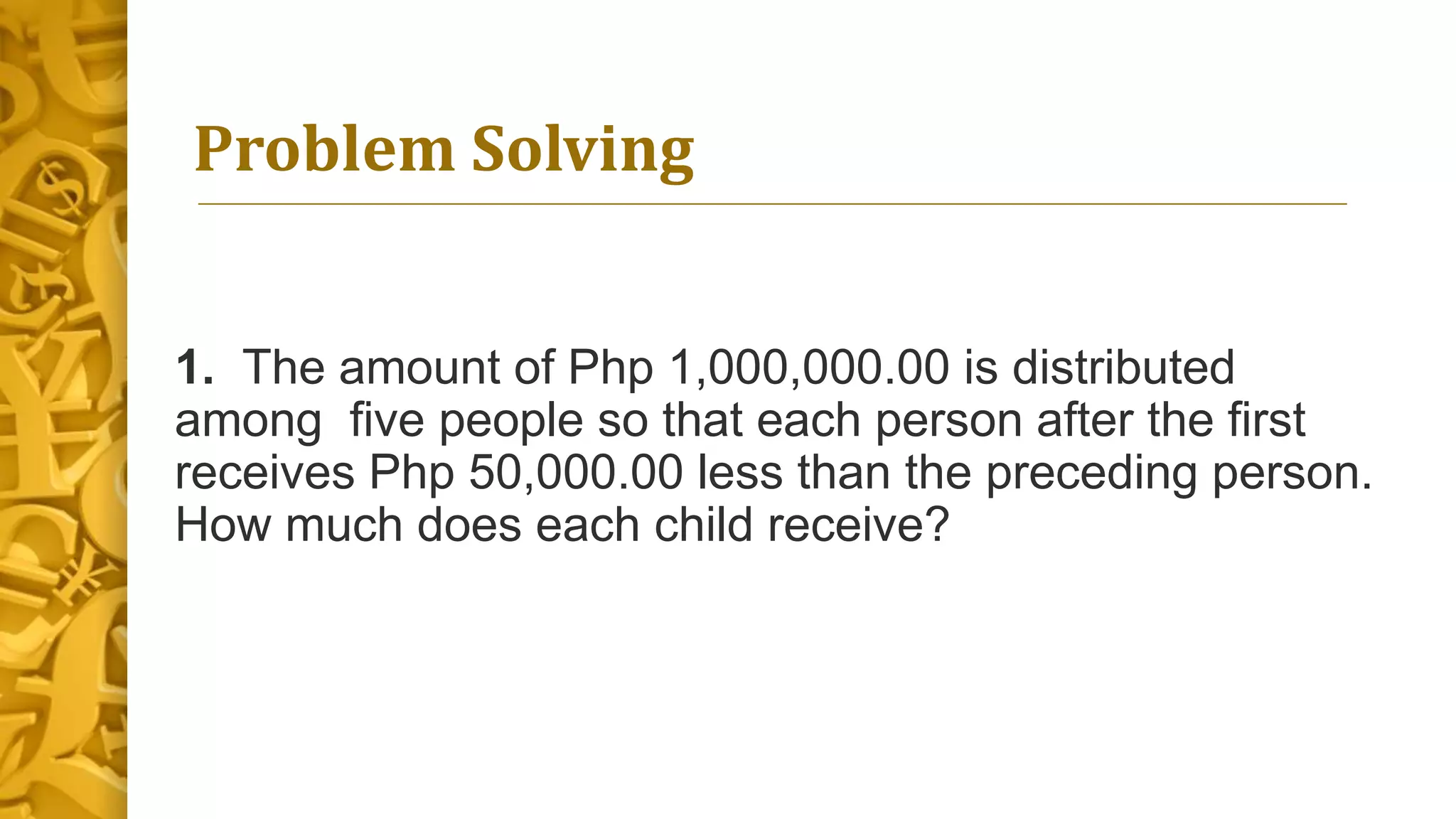
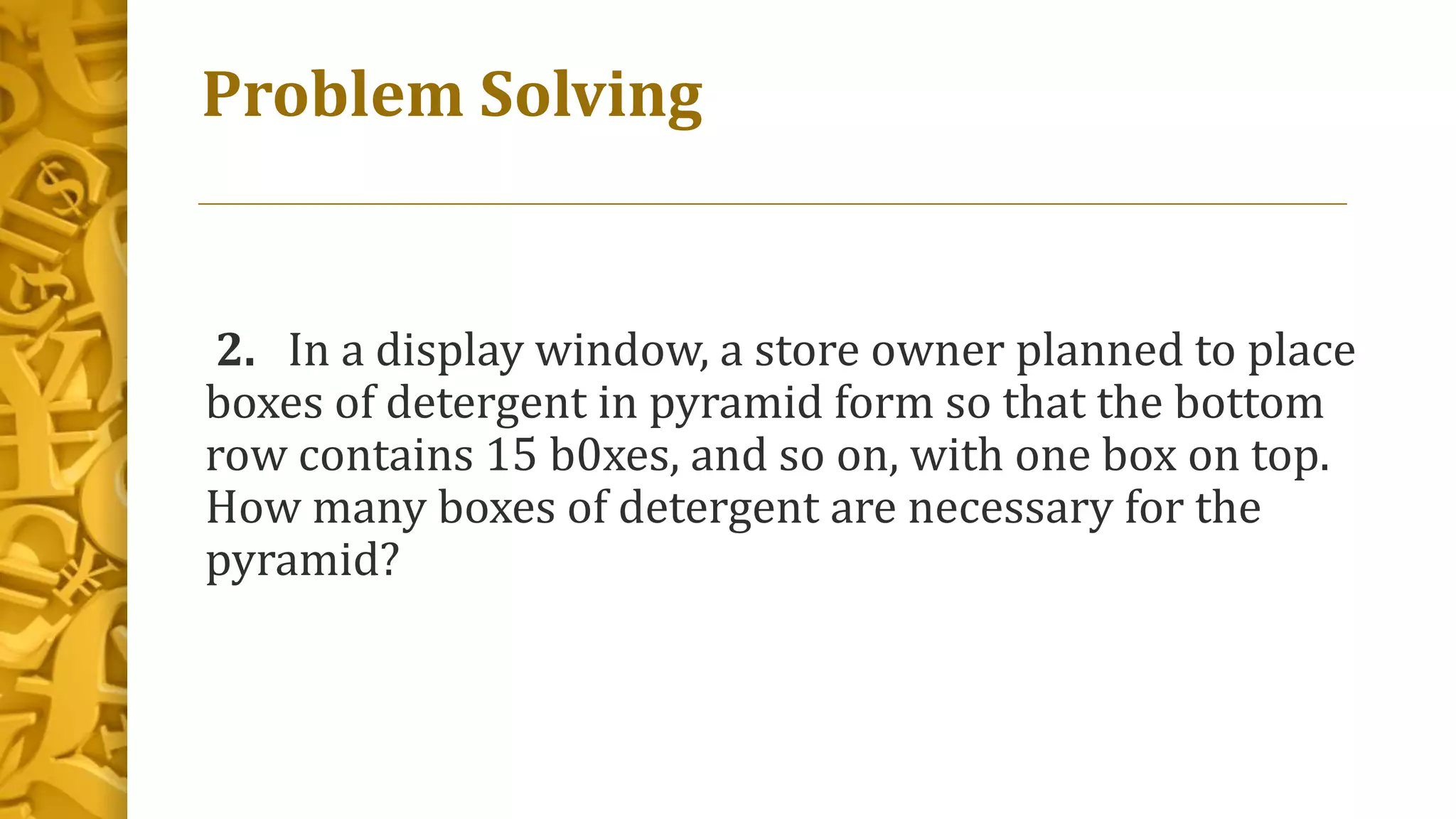
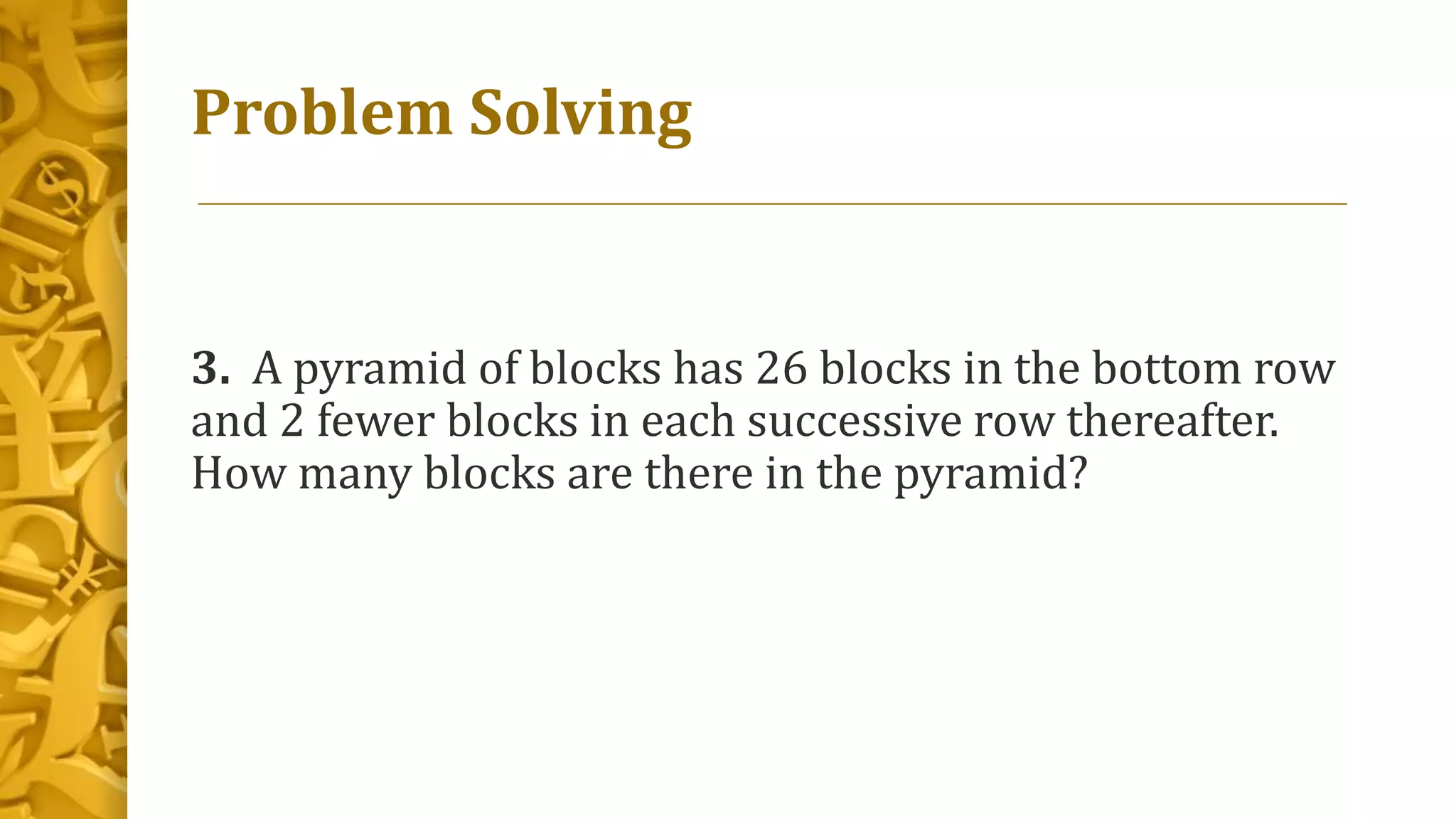
The document contains 3 math word problems involving the distribution of money and items in pyramid formations. The first problem distributes $1,000,000 among 5 people with each subsequent person receiving $50,000 less. It is determined that each person receives $300,000, $250,000, $200,000, $150,000, and $100,000 respectively. The second problem involves placing boxes of detergent in a pyramid formation with 15 boxes on the bottom row, calculating there would be a total of 120 boxes. The third problem has a pyramid of blocks with 26 blocks on the bottom row and 2 fewer blocks per subsequent row, calculating there are a total of 182 blocks.

![Identify the given information:
Sn = Php 1,000,000.00(amount to be
distributed)
n= 5 (number of child)
d = -50,000.00
Solution:
Using the formula:
Sn =
𝑛
2
[ 2A1 + (n – 1)d ]
1,000,000 =
5
2
[ 2A1 + (5 – 1)-50,000]
2,000,000 = 5[ 2A1 + (4)-50,000 ]
2,000,000 = 5[2A1 – 200,000]
2,000,000 = 10A1 – 1,000,000
2,000,000 + 1,000,000 = 10A1
3,000,000 = 10A1
3,000,000
10
= A1
300,000 = A1
A1 = 300,000
A2 = A1 – 50,000 = 250,000
A3 = A2 -50,000 = 200, 000
A4 = A3 – 50,000 = 150,000
A5 = A4 – 50,000 = 100,000
Therefore, each child receives the amount
in the sequence of Php300,000,
Php250,000, Php200,000, Php150,000,
Php100,000](https://image.slidesharecdn.com/activitysequenceandseries-201023024735/75/Activity-sequence-and-series-3-2048.jpg)
![Identify the given information.
An = 15 boxes (last term)
A1 = 1 (first box of 1st element)
d = 1 (common difference)
n= (15 number of rows)
Sn = ?
Solution:
Using the formula:
Sn =
𝒏
𝟐
[ 2A1 + (n – 1)d ]
Sn =
15
2
[ 2(1) + (15 – 1)1 ]
Sn =
15
2
[ 2 + (14)1 ]
Sn =
15
2
[2 + 14]
Sn =
15
2
[16]
Sn = 120
Or using the formula
Sn =
𝒏
𝟐
( A1 + An)
Sn =
15
2
( 1 + 15)
Sn =
15
2
(16)
Sn = 120
The number of boxes of detergent are needed
for the pyramid is 120.](https://image.slidesharecdn.com/activitysequenceandseries-201023024735/75/Activity-sequence-and-series-5-2048.jpg)
![Identify the given information:
d = 2 (common difference)
An= 26
n = 13 = (
26
2
) = since there are 2
fewer blocks in each successive row
thereafter.
A1 = 2
Solution:
Using the formula:
Sn =
𝒏
𝟐
[ 2A1 + (n – 1)d ]
Sn =
13
2
[ 2(2) + (13 – 1)2 ]
Sn =
13
2
[ 4 + (12)2 ]
Sn =
13
2
[ 4 + (24 ]
Sn =
13
2
[ 28 ]
Sn = 182
Or use the formula Sn =
𝑛
2
( A1 + An)
Sn =
13
2
( 2 + 26)
Sn =
13
2
[ 28 ] = Sn = 182
There are 182 blocks in the
pyramid.](https://image.slidesharecdn.com/activitysequenceandseries-201023024735/75/Activity-sequence-and-series-7-2048.jpg)


