Common

Online
Terminologies
Loise Samson

Bachelor of Secondary
Education
University of Santo Tomas
Email
Email or e-mail stands for Electronic
Mail. It is a method of exchanging
digital messages from an author to
one or more receiver or recipients .
Modern email operates across
the internet or other computer
networks.
SOCIAL
NETWORKING
Social Networking has become very
popular during the past few
years, but it can still be very difficult
to understand for someone new to
social networking. The open-ended
nature of social networks add to
this. Once signed onto a social
network, having answered a few
basic profile questions, it is easy to
sit back and wonder what you are
supposed to do next.
BLOG
A blog is a discussion or informational site
published on the World Wide Web and
consisting of discrete entries or
posts, typically it is displayed in reverse
chronological order.
Online Chat
An Online Chat refers to a communication
between two people over the internet.
Through Online Chat two people that are
away from each other may have a
conversation easily.
Social
Bookmarking
A social bookmarking service is a centralized online
service that enables users to add, edit, and
share bookmarks of web documents.
One significant feature of social bookmarking
systems is Tagging. Through Tagging users can
organize their bookmarks in flexible ways.
URL
URL stands for Uniform
Resource Locator,
previously Universal
Resource Locator. It refers
is the unique address for a
file that is accessible on the
Internet. One common way
to get in to a website is by
entering the URL of
its home page file in your
web browser's address
line.
STREAMING
Streaming or also known as media
streaming is a technique for transferring
data so that it can be processed as a
steady and continuous stream.
Streaming technologies are becoming
increasingly important with the growth
of the Internet now a days because most
of the users do not have fast enough
access to download
large multimedia files quickly. In
streaming, the client browser can
immediately start displaying the data
before the entire file has been
transmitted.
WIKI
A wiki is usually a web application which
allows people to modify, add, or delete
content in collaboration with others. Text
is usually written using a simplified mark
up language or a rich-text editor.
It is a type of content management
system, it differs from a blog or most
other such systems in that the content is
created without any defined owner or
leader, and wikis have little implicit
structure, allowing structure to emerge
according to the needs of the users.
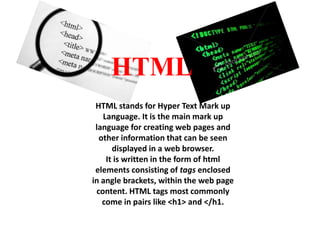
HTML
HTML stands for Hyper Text Mark up
Language. It is the main mark up
language for creating web pages and
other information that can be seen
displayed in a web browser.
It is written in the form of html
elements consisting of tags enclosed
in angle brackets, within the web page
content. HTML tags most commonly
come in pairs like <h1> and </h1.
PODCAST
A podcast or also known
as netcast. It is a digital
medium consisting of an
episodic series
of audio, video, PDF, or ePub
files subscribed to and can
be downloaded through web
syndication or streamed
online to a computer or
mobile device.
VoIP
VoIP stands for Voice over Internet
Protocolis. It is a methodology and group
of technologies for the delivery of voice
communications and multimedia session
s over Internet Protocol (IP)
networks, such as the Internet. Other
terms commonly associated with VoIP
are IP telephony, Internet
telephony, voice over
broadband (VoBB), broadband
telephony, IP
communications, and broadband phone
service.
WWW
WWW stands for World
Wide Web.
It is a collection of blogs,
videoes, social media and
internet resources
It is a primary server.
WEB FEED
A web feed (or news feed) is a data format
used for providing users with frequently
updated content. Content
distributors syndicate a web feed, thereby
allowing users to subscribe to it. Making a
collection of web feeds accessible in one spot
is known as aggregation, which is performed
by an aggregator. A web feed is also
sometimes referred to as a syndicated feed.
http://www.webopedia.com/TERM/S/streaming.
html
http://searchnetworking.techtarget.com/definiti
on/URL
http://en.wikipedia.org/
http://webtrends.about.com/od/socialnetworki
ng/a/social-network.htm

Activity 13 common online terminologies

  • 1.
    Common Online Terminologies Loise Samson Bachelor ofSecondary Education University of Santo Tomas
  • 2.
    Email Email or e-mailstands for Electronic Mail. It is a method of exchanging digital messages from an author to one or more receiver or recipients . Modern email operates across the internet or other computer networks.
  • 3.
    SOCIAL NETWORKING Social Networking hasbecome very popular during the past few years, but it can still be very difficult to understand for someone new to social networking. The open-ended nature of social networks add to this. Once signed onto a social network, having answered a few basic profile questions, it is easy to sit back and wonder what you are supposed to do next.
  • 4.
    BLOG A blog isa discussion or informational site published on the World Wide Web and consisting of discrete entries or posts, typically it is displayed in reverse chronological order.
  • 5.
    Online Chat An OnlineChat refers to a communication between two people over the internet. Through Online Chat two people that are away from each other may have a conversation easily.
  • 6.
    Social Bookmarking A social bookmarkingservice is a centralized online service that enables users to add, edit, and share bookmarks of web documents. One significant feature of social bookmarking systems is Tagging. Through Tagging users can organize their bookmarks in flexible ways.
  • 7.
    URL URL stands forUniform Resource Locator, previously Universal Resource Locator. It refers is the unique address for a file that is accessible on the Internet. One common way to get in to a website is by entering the URL of its home page file in your web browser's address line.
  • 8.
    STREAMING Streaming or alsoknown as media streaming is a technique for transferring data so that it can be processed as a steady and continuous stream. Streaming technologies are becoming increasingly important with the growth of the Internet now a days because most of the users do not have fast enough access to download large multimedia files quickly. In streaming, the client browser can immediately start displaying the data before the entire file has been transmitted.
  • 9.
    WIKI A wiki isusually a web application which allows people to modify, add, or delete content in collaboration with others. Text is usually written using a simplified mark up language or a rich-text editor. It is a type of content management system, it differs from a blog or most other such systems in that the content is created without any defined owner or leader, and wikis have little implicit structure, allowing structure to emerge according to the needs of the users.
  • 10.
    HTML HTML stands forHyper Text Mark up Language. It is the main mark up language for creating web pages and other information that can be seen displayed in a web browser. It is written in the form of html elements consisting of tags enclosed in angle brackets, within the web page content. HTML tags most commonly come in pairs like <h1> and </h1.
  • 11.
    PODCAST A podcast oralso known as netcast. It is a digital medium consisting of an episodic series of audio, video, PDF, or ePub files subscribed to and can be downloaded through web syndication or streamed online to a computer or mobile device.
  • 12.
    VoIP VoIP stands forVoice over Internet Protocolis. It is a methodology and group of technologies for the delivery of voice communications and multimedia session s over Internet Protocol (IP) networks, such as the Internet. Other terms commonly associated with VoIP are IP telephony, Internet telephony, voice over broadband (VoBB), broadband telephony, IP communications, and broadband phone service.
  • 13.
    WWW WWW stands forWorld Wide Web. It is a collection of blogs, videoes, social media and internet resources It is a primary server.
  • 14.
    WEB FEED A webfeed (or news feed) is a data format used for providing users with frequently updated content. Content distributors syndicate a web feed, thereby allowing users to subscribe to it. Making a collection of web feeds accessible in one spot is known as aggregation, which is performed by an aggregator. A web feed is also sometimes referred to as a syndicated feed.
  • 15.