COMMON ONLINE TERMINOLOGIES

Aileene O. Tan
University of Santo Tomas
E-MAIL
-exchanging of digital messages from
an author to one or more recipients.
Blog is actually short for weblog and means a private web
page that is published either by an individual or a group of
people. Many blogs are used as personal journals, or diaries.
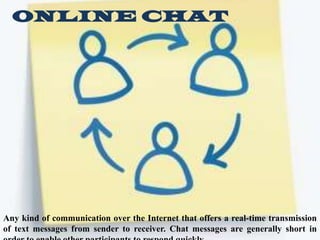
ONLINE CHAT

Any kind of communication over the Internet that offers a real-time transmission
of text messages from sender to receiver. Chat messages are generally short in
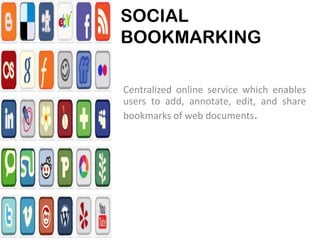
SOCIAL
BOOKMARKING
Centralized online service which enables
users to add, annotate, edit, and share
bookmarks of web documents.
Uniform Resource Locator (URL)

It is the address of a web page. Each page has its own unique web
address (URL). This is how your computer locates the web page that you
are trying to find.
STREAMING
MEDIA
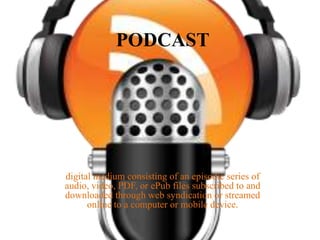
PODCAST

digital medium consisting of an episodic series of
audio, video, PDF, or ePub files subscribed to and
downloaded through web syndication or streamed
online to a computer or mobile device.
WIKI
A collaborative Web site comprises the perpetual collective work of many
authors. Similar to a blog in structure and logic, a wiki allows anyone to
edit, delete or modify content that has been placed on the Web site using a
browser interface, including the work of previous authors. In contrast, a
blog, typically authored by an individual, does not allow visitors to change
the original posted material, only add comments to the original content.
HTML
Stands for "Hyper-Text Markup Language." This is the
language that Web pages are written in. Also known as
hypertext documents, Web pages must conform to the
rules of HTML in order to be displayed correctly in a
Web browser.
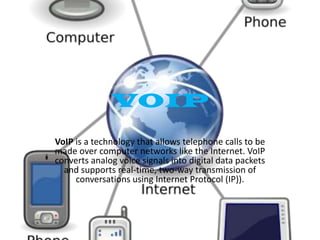
VOIP
VoIP is a technology that allows telephone calls to be
made over computer networks like the Internet. VoIP
converts analog voice signals into digital data packets
and supports real-time, two-way transmission of
conversations using Internet Protocol (IP)).
WORLD WIDE WEB
System of interlinked hypertext documents accessed via the
Internet. With a web browser, one can view web pages that may
contain text, images, videos, and other multimedia and navigate
between them via hyperlinks.
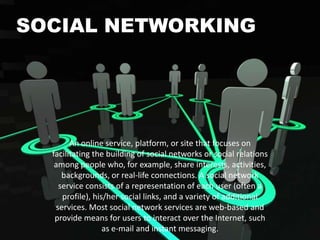
SOCIAL NETWORKING

An online service, platform, or site that focuses on
facilitating the building of social networks or social relations
among people who, for example, share interests, activities,
backgrounds, or real-life connections. A social network
service consists of a representation of each user (often a
profile), his/her social links, and a variety of additional
services. Most social network services are web-based and
provide means for users to interact over the Internet, such
as e-mail and instant messaging.
WEB FEED
A data format used for providing users with frequently
updated content. Content distributors syndicate a web feed,
thereby allowing users to subscribe to it. Making a
collection of web feeds accessible in one spot is known as
aggregation, which is performed by an aggregator. A web
feed is also sometimes referred to as a syndicated feed.

COMMON ONLINE TERMINOLOGIES

  • 1.
    COMMON ONLINE TERMINOLOGIES AileeneO. Tan University of Santo Tomas
  • 2.
    E-MAIL -exchanging of digitalmessages from an author to one or more recipients.
  • 3.
    Blog is actuallyshort for weblog and means a private web page that is published either by an individual or a group of people. Many blogs are used as personal journals, or diaries.
  • 4.
    ONLINE CHAT Any kindof communication over the Internet that offers a real-time transmission of text messages from sender to receiver. Chat messages are generally short in
  • 5.
    SOCIAL BOOKMARKING Centralized online servicewhich enables users to add, annotate, edit, and share bookmarks of web documents.
  • 6.
    Uniform Resource Locator(URL) It is the address of a web page. Each page has its own unique web address (URL). This is how your computer locates the web page that you are trying to find.
  • 7.
  • 8.
    PODCAST digital medium consistingof an episodic series of audio, video, PDF, or ePub files subscribed to and downloaded through web syndication or streamed online to a computer or mobile device.
  • 9.
    WIKI A collaborative Website comprises the perpetual collective work of many authors. Similar to a blog in structure and logic, a wiki allows anyone to edit, delete or modify content that has been placed on the Web site using a browser interface, including the work of previous authors. In contrast, a blog, typically authored by an individual, does not allow visitors to change the original posted material, only add comments to the original content.
  • 10.
    HTML Stands for "Hyper-TextMarkup Language." This is the language that Web pages are written in. Also known as hypertext documents, Web pages must conform to the rules of HTML in order to be displayed correctly in a Web browser.
  • 11.
    VOIP VoIP is atechnology that allows telephone calls to be made over computer networks like the Internet. VoIP converts analog voice signals into digital data packets and supports real-time, two-way transmission of conversations using Internet Protocol (IP)).
  • 12.
    WORLD WIDE WEB Systemof interlinked hypertext documents accessed via the Internet. With a web browser, one can view web pages that may contain text, images, videos, and other multimedia and navigate between them via hyperlinks.
  • 13.
    SOCIAL NETWORKING An onlineservice, platform, or site that focuses on facilitating the building of social networks or social relations among people who, for example, share interests, activities, backgrounds, or real-life connections. A social network service consists of a representation of each user (often a profile), his/her social links, and a variety of additional services. Most social network services are web-based and provide means for users to interact over the Internet, such as e-mail and instant messaging.
  • 14.
    WEB FEED A dataformat used for providing users with frequently updated content. Content distributors syndicate a web feed, thereby allowing users to subscribe to it. Making a collection of web feeds accessible in one spot is known as aggregation, which is performed by an aggregator. A web feed is also sometimes referred to as a syndicated feed.