Active Y


    Shanu Singh (shanuchaudhery@gmail.com)
         Rakesh Sahu (rksahu.83@gmail.com)
Introduction
FPC/JFM community based institution model is replicable since it contribute to:
1. Forest management
2. Aspects of sustainable human development – ecological output, income generation, village infrastructure
    development and community empowerment. These aspects converts into benefit for villagers.

                                                      Maslow’s Positioning For Forest Dweller
                     FD                                Limited avenue of income generation
                                                       Majority of forest and forest fringe dweller have 20-54% income generated
                                                        from NTFS.
                                                       Physiological, safety and security needs are of major concerns
           FPC/JFM
                                                      Physiological Needs          -        JFM Initiative
                          Forest
                      Sustainability &                 Food                            Improved nutrition by helping grow chana,
                          Human
                       Development                                                       soyabean etc
                                                       Water                           Development of irrigation & drinking water
                                                                                         facilities
                                                       Shelter                         Indira Avas Yojana for shelter development


                                                      Security Needs               -        JFM Initiative
                                                       Education                       Introduction of primary school education
                                                       Economies                       Provided direct access to seller market
                                                       Financial                       Introduction of microcredit facility
                                                       Health                          Access to health care

                                                      Safety Needs                 -       JFM Initiative
                                                       Family                          Women up-liftment and empowerment
                                                       Social Stability                Better income level, education level and lesser
                                                                                         crimes
                                                       Forest Property                 Villager are empowered to protect the forest

     Introduction                        Benefits           Challenges                   Structure                  Future Roadmap
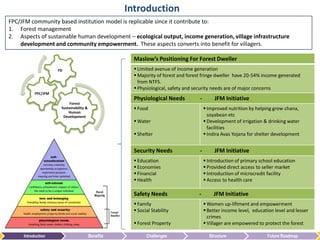
Indirect Benefits (Villager Perspective)                                     Direct Benefits (Villager Perspective)
                                                                                                            Employment
Empowerment                                                                                                 Opportunities
 Villagers are empowered and in better control of their lives                                                                   Shared control and
 Women betterment through their participation in decision making             Enhanced irrigation
                                                                                                                                  decision-making
                                                                              potential for higher
                                                                                                                                   authority over
Ecology Maintenance                                                            crop production
                                                                                                                                    forest-lands
• Protection of forest helps in maintaining the bio-diversity both in
  terms of flora and fauna                                                         Better
                                                                              communication                                          Forest based
Area Coverage                                                                  transport and                                           earning
                                                                                health care
 Land coverage by forest decreases the extent of soil erosion
 It has helped in maintaining ground water level
 Enhanced spring flows                                                             Earnings from Non
                                                                                      Timber Forest                         Daily Wage income
Green Cover                                                                          Products (NTFPs)
 Initiative has helped in improving the forest coverage from 76.52m
  ha in 1997 to 76.96m ha in 2005


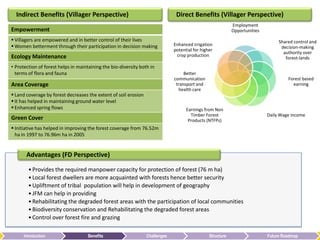
       Advantages (FD Perspective)

        • Provides the required manpower capacity for protection of forest (76 m ha)
        • Local forest dwellers are more acquainted with forests hence better security
        • Upliftment of tribal population will help in development of geography
        • JFM can help in providing
        • Rehabilitating the degraded forest areas with the participation of local communities
        • Biodiversity conservation and Rehabilitating the degraded forest areas
        • Control over forest fire and grazing

      Introduction                   Benefits                    Challenges                     Structure                   Future Roadmap
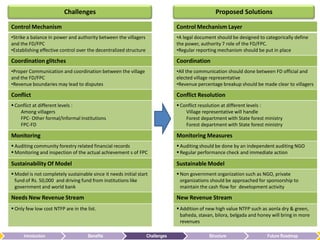
Challenges                                                               Proposed Solutions

Control Mechanism                                                               Control Mechanism Layer
•Strike a balance in power and authority between the villagers                  •A legal document should be designed to categorically define
and the FD/FPC                                                                  the power, authority 7 role of the FD/FPC.
•Establishing effective control over the decentralized structure                •Regular reporting mechanism should be put in place

Coordination glitches                                                           Coordination
•Proper Communication and coordination between the village                      •All the communication should done between FD official and
and the FD/FPC                                                                  elected village representative
•Revenue boundaries may lead to disputes                                        •Revenue percentage breakup should be made clear to villagers

Conflict                                                                        Conflict Resolution
 Conflict at different levels :                                                 Conflict resolution at different levels :
    Among villagers                                                                 Village representative will handle
    FPC- Other formal/Informal Institutions                                         Forest department with State forest ministry
    FPC-FD                                                                          Forest department with State forest ministry

Monitoring                                                                      Monitoring Measures
 Auditing community forestry related financial records                          Auditing should be done by an independent auditing NGO
 Monitoring and inspection of the actual achievement s of FPC                   Regular performance check and immediate action

Sustainability Of Model                                                         Sustainable Model
 Model is not completely sustainable since it needs initial start               Non government organization such as NGO, private
  fund of Rs. 50,000 and driving fund from institutions like                      organizations should be approached for sponsorship to
  government and world bank                                                       maintain the cash flow for development activity

Needs New Revenue Stream                                                        New Revenue Stream
 Only few low cost NTFP are in the list.                                        Addition of new high value NTFP such as aonla dry & green,
                                                                                  baheda, stavan, bilora, belgada and honey will bring in more
                                                                                  revenues

      Introduction                   Benefits                      Challenges                  Structure                  Future Roadmap
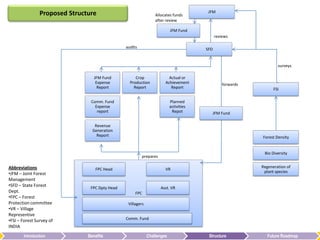
Proposed Structure                                                      JFM
                                                                 Allocates funds
                                                                 after review

                                                                          JFM Fund
                                                                                             reviews

                                                audits                                 SFD


                                                                                                                    surveys

                                  JFM Fund           Crop               Actual or
                                   Expense        Production          Achievement                forwards
                                    Report          Report               Report                                   FSI

                                Comm. Fund                                Planned
                                  Expense                                 activities
                                   report                                  Repot         JFM Fund

                                  Revenue
                                 Generation
                                   Report                                                                   Forest Density


                                                                                                             Bio Diversity
                                                         prepares

Abbreviations                                                                                               Regeneration of
                                  FPC Head                            VR
•JFM – Joint Forest                                                                                          plant species
Management
•SFD – State Forest             FPC Dpty Head                       Asst. VR
Dept.                                                FPC
•FPC – Forest
Protection committee                             Villagers
•VR – Village
Representive
•FSI – Forest Survey of                         Comm. Fund
INDIA
       Introduction            Benefits                      Challenges                 Structure              Future Roadmap
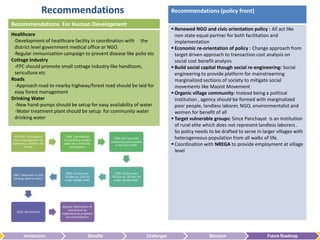
Recommendations                                                          Recommendations (policy front)

Recommendations For Human Development
                                                                                                 Renewed NGO and civic orientation policy : All act like
Healthcare                                                                                        non-state equal partner for both facilitation and
 -Development of healthcare facility in coordination with the                                     implementation
  district level government medical office or NGO.                                               Economic re-orientation of policy : Change approach from
 -Regular immunization campaign to prevent disease like polio etc                                 target driven approach to transaction cost analysis on
Cottage Industry                                                                                  social cost benefit analysis
  -FPC should promote small cottage industry like handloom,                                      Build social capital though social re-engineering: Social
  sericulture etc                                                                                 engineering to provide platform for mainstreaming
Roads                                                                                             marginalized sections of society to mitigate social
  -Approach road to nearby highway/forest road should be laid for                                 movements like Maoist Movement
  easy forest management                                                                         Organic village community: Instead being a political
Drinking Water                                                                                    institution , agency should be formed with marginalized
  -New hand-pumps should be setup for easy availability of water                                  poor people, landless laborer, NGO, environmentalist and
  -Water treatment plant should be setup for community water                                      women for benefit of all
  drinking water                                                                                 Target vulnerable groups: Since Panchayat is an institution
                                                                                                  of rural elite which does not represent landless laborers .
                                                                                                  So policy needs to be drafted to serve in larger villages with
 1970-80: Participatory      1988: The National
 forest management at       Forest Policy created
                                                           1990: GOI launched                     heterogeneous population from all walks of life.
                                                         community participation
Sukhomajri, Arabari, and
         Harda
                            space for community
                                participation
                                                            in the form JFMC                     Coordination with NREGA to provide employment at village
                                                                                                  level


                             2005: Forest cover             1999: Forest cover
 2007: Reduction in JFM
                            76.96m ha, 22m ha             76.52m ha, 10.24m ha
 funding, adverse effect
                            under 106482 JFMC              under 36,160 JFMC.


                            Beyond: Restoration of
                                momentum by
   2010: We are here
                           implementing proposed
                              recommendations


         Introduction                         Benefits                             Challenges                     Structure                   Future Roadmap

Active Y - Omniscient, IIM A

  • 1.
    Active Y Shanu Singh (shanuchaudhery@gmail.com) Rakesh Sahu (rksahu.83@gmail.com)
  • 2.
    Introduction FPC/JFM community basedinstitution model is replicable since it contribute to: 1. Forest management 2. Aspects of sustainable human development – ecological output, income generation, village infrastructure development and community empowerment. These aspects converts into benefit for villagers. Maslow’s Positioning For Forest Dweller FD  Limited avenue of income generation  Majority of forest and forest fringe dweller have 20-54% income generated from NTFS.  Physiological, safety and security needs are of major concerns FPC/JFM Physiological Needs - JFM Initiative Forest Sustainability &  Food  Improved nutrition by helping grow chana, Human Development soyabean etc  Water  Development of irrigation & drinking water facilities  Shelter  Indira Avas Yojana for shelter development Security Needs - JFM Initiative  Education  Introduction of primary school education  Economies  Provided direct access to seller market  Financial  Introduction of microcredit facility  Health  Access to health care Safety Needs - JFM Initiative  Family  Women up-liftment and empowerment  Social Stability  Better income level, education level and lesser crimes  Forest Property  Villager are empowered to protect the forest Introduction Benefits Challenges Structure Future Roadmap
  • 3.
    Indirect Benefits (VillagerPerspective) Direct Benefits (Villager Perspective) Employment Empowerment Opportunities  Villagers are empowered and in better control of their lives Shared control and  Women betterment through their participation in decision making Enhanced irrigation decision-making potential for higher authority over Ecology Maintenance crop production forest-lands • Protection of forest helps in maintaining the bio-diversity both in terms of flora and fauna Better communication Forest based Area Coverage transport and earning health care  Land coverage by forest decreases the extent of soil erosion  It has helped in maintaining ground water level  Enhanced spring flows Earnings from Non Timber Forest Daily Wage income Green Cover Products (NTFPs)  Initiative has helped in improving the forest coverage from 76.52m ha in 1997 to 76.96m ha in 2005 Advantages (FD Perspective) • Provides the required manpower capacity for protection of forest (76 m ha) • Local forest dwellers are more acquainted with forests hence better security • Upliftment of tribal population will help in development of geography • JFM can help in providing • Rehabilitating the degraded forest areas with the participation of local communities • Biodiversity conservation and Rehabilitating the degraded forest areas • Control over forest fire and grazing Introduction Benefits Challenges Structure Future Roadmap
  • 4.
    Challenges Proposed Solutions Control Mechanism Control Mechanism Layer •Strike a balance in power and authority between the villagers •A legal document should be designed to categorically define and the FD/FPC the power, authority 7 role of the FD/FPC. •Establishing effective control over the decentralized structure •Regular reporting mechanism should be put in place Coordination glitches Coordination •Proper Communication and coordination between the village •All the communication should done between FD official and and the FD/FPC elected village representative •Revenue boundaries may lead to disputes •Revenue percentage breakup should be made clear to villagers Conflict Conflict Resolution  Conflict at different levels :  Conflict resolution at different levels : Among villagers Village representative will handle FPC- Other formal/Informal Institutions Forest department with State forest ministry FPC-FD Forest department with State forest ministry Monitoring Monitoring Measures  Auditing community forestry related financial records  Auditing should be done by an independent auditing NGO  Monitoring and inspection of the actual achievement s of FPC  Regular performance check and immediate action Sustainability Of Model Sustainable Model  Model is not completely sustainable since it needs initial start  Non government organization such as NGO, private fund of Rs. 50,000 and driving fund from institutions like organizations should be approached for sponsorship to government and world bank maintain the cash flow for development activity Needs New Revenue Stream New Revenue Stream  Only few low cost NTFP are in the list.  Addition of new high value NTFP such as aonla dry & green, baheda, stavan, bilora, belgada and honey will bring in more revenues Introduction Benefits Challenges Structure Future Roadmap
  • 5.
    Proposed Structure JFM Allocates funds after review JFM Fund reviews audits SFD surveys JFM Fund Crop Actual or Expense Production Achievement forwards Report Report Report FSI Comm. Fund Planned Expense activities report Repot JFM Fund Revenue Generation Report Forest Density Bio Diversity prepares Abbreviations Regeneration of FPC Head VR •JFM – Joint Forest plant species Management •SFD – State Forest FPC Dpty Head Asst. VR Dept. FPC •FPC – Forest Protection committee Villagers •VR – Village Representive •FSI – Forest Survey of Comm. Fund INDIA Introduction Benefits Challenges Structure Future Roadmap
  • 6.
    Recommendations Recommendations (policy front) Recommendations For Human Development  Renewed NGO and civic orientation policy : All act like Healthcare non-state equal partner for both facilitation and -Development of healthcare facility in coordination with the implementation district level government medical office or NGO.  Economic re-orientation of policy : Change approach from -Regular immunization campaign to prevent disease like polio etc target driven approach to transaction cost analysis on Cottage Industry social cost benefit analysis -FPC should promote small cottage industry like handloom,  Build social capital though social re-engineering: Social sericulture etc engineering to provide platform for mainstreaming Roads marginalized sections of society to mitigate social -Approach road to nearby highway/forest road should be laid for movements like Maoist Movement easy forest management  Organic village community: Instead being a political Drinking Water institution , agency should be formed with marginalized -New hand-pumps should be setup for easy availability of water poor people, landless laborer, NGO, environmentalist and -Water treatment plant should be setup for community water women for benefit of all drinking water  Target vulnerable groups: Since Panchayat is an institution of rural elite which does not represent landless laborers . So policy needs to be drafted to serve in larger villages with 1970-80: Participatory 1988: The National forest management at Forest Policy created 1990: GOI launched heterogeneous population from all walks of life. community participation Sukhomajri, Arabari, and Harda space for community participation in the form JFMC  Coordination with NREGA to provide employment at village level 2005: Forest cover 1999: Forest cover 2007: Reduction in JFM 76.96m ha, 22m ha 76.52m ha, 10.24m ha funding, adverse effect under 106482 JFMC under 36,160 JFMC. Beyond: Restoration of momentum by 2010: We are here implementing proposed recommendations Introduction Benefits Challenges Structure Future Roadmap