INSTRUCTOR: SIR ZEEDAN MANZ00R
Active Citizenship
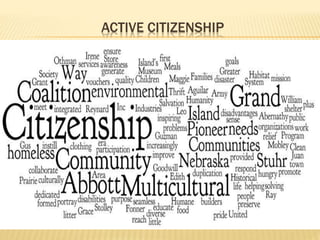
ACTIVE CITIZENSHIP
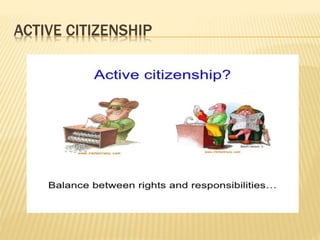
ACTIVE CITIZENSHIP
CONTINUED…..
 Active citizenship is a way of development
greater young citizen responsibility.
 It is a combination of obligations and
responsibilities through involvement in civic
issues.
CONTINUED .…..
 Active Citizenship refers to the voluntary
capacity of citizens and communities
working directly together or through
elected representatives to exercise
economic, social or political power in
pursuit of shared goals.
GUIDING PRINCIPLES
 Active Citizenship concerns everyone.
 We all have rights and responsibilities, and
shared national, continental and global
interests.
 A successful society depends on a
partnership with citizens, civil society, unions,
business, and elected representatives.
 Active Citizens are made, not born.
 Active Citizenship needs leadership.
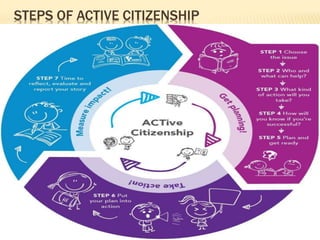
STEPS OF ACTIVE CITIZENSHIP
 Choose the issue
 Who and what can
help to solve the issue
 What kind of action will
you take
 How will you know if
you are successful
STEPS OF ACTIVE CITIZENSHIP
 Plan and get ready for
performance
 Put your plan into
action…
 Time to reflect,
evaluate and report
your story
STEPS OF ACTIVE CITIZENSHIP
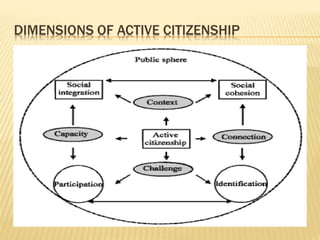
DIMENSIONS
 Active citizenship has four dimensions as
1. Capacity (how people can act based on their
rights),
2. Connection (relationship with others),
3. Challenge (desire of self in practices during
involvement)
4. Context (how people aware of diverse
options during social practices)
DIMENSIONS OF ACTIVE CITIZENSHIP
APPROACHES TO ACTIVE CITIZENSHIP
There are two approaches about citizenship which
can explain active citizenship
 Psychological theories often focus on personal
development in contrast with sociologists’ focus on
social and structural forces and environment in the
course of socialization.
 Sociological theories focus more on teaching
individual at each life stage to socialize them for new
roles riley .Based on this approach, socialization has
two seemingly contradictory functions, one of which
is “fitting people into social roles” and the other of
which is freeing them from it by the way of
“individuation”.
BARRIERS TO ACTIVE CITIZENSHIP
 Time
 New work patterns
 Changing values
and choices
 New leisure
patterns
HOW TO BE AN ACTIVE CITIZEN
BE AN ACTIVE CITIZEN
An active citizen is someone who cares about
their community enough to change it. You can
become an active citizen and help to make your
community a better place in any of the following
ways.
 Join your local community forum
 Volunteer
 Support a local voluntary organization
 Take part in a consultation
 Participation
PARTICIPATION
THANK YOU!!!!!!!!

active citizenship

  • 1.
    INSTRUCTOR: SIR ZEEDANMANZ00R Active Citizenship
  • 2.
  • 3.
  • 4.
    CONTINUED…..  Active citizenshipis a way of development greater young citizen responsibility.  It is a combination of obligations and responsibilities through involvement in civic issues.
  • 6.
    CONTINUED .…..  ActiveCitizenship refers to the voluntary capacity of citizens and communities working directly together or through elected representatives to exercise economic, social or political power in pursuit of shared goals.
  • 7.
    GUIDING PRINCIPLES  ActiveCitizenship concerns everyone.  We all have rights and responsibilities, and shared national, continental and global interests.  A successful society depends on a partnership with citizens, civil society, unions, business, and elected representatives.  Active Citizens are made, not born.  Active Citizenship needs leadership.
  • 8.
    STEPS OF ACTIVECITIZENSHIP  Choose the issue  Who and what can help to solve the issue  What kind of action will you take  How will you know if you are successful
  • 9.
    STEPS OF ACTIVECITIZENSHIP  Plan and get ready for performance  Put your plan into action…  Time to reflect, evaluate and report your story
  • 10.
    STEPS OF ACTIVECITIZENSHIP
  • 11.
    DIMENSIONS  Active citizenshiphas four dimensions as 1. Capacity (how people can act based on their rights), 2. Connection (relationship with others), 3. Challenge (desire of self in practices during involvement) 4. Context (how people aware of diverse options during social practices)
  • 12.
  • 13.
    APPROACHES TO ACTIVECITIZENSHIP There are two approaches about citizenship which can explain active citizenship  Psychological theories often focus on personal development in contrast with sociologists’ focus on social and structural forces and environment in the course of socialization.  Sociological theories focus more on teaching individual at each life stage to socialize them for new roles riley .Based on this approach, socialization has two seemingly contradictory functions, one of which is “fitting people into social roles” and the other of which is freeing them from it by the way of “individuation”.
  • 14.
    BARRIERS TO ACTIVECITIZENSHIP  Time  New work patterns  Changing values and choices  New leisure patterns
  • 15.
    HOW TO BEAN ACTIVE CITIZEN
  • 16.
    BE AN ACTIVECITIZEN An active citizen is someone who cares about their community enough to change it. You can become an active citizen and help to make your community a better place in any of the following ways.  Join your local community forum  Volunteer  Support a local voluntary organization  Take part in a consultation  Participation
  • 17.
  • 18.