ACTIVATOR
Presenter: Afaf Mohammed Rafiq
1
Content
Part 1
• Introduction
• History of activator
• Classification of views
• Effect of activator on dentofacial structures
• Advantages & Disadvantages
• Indications & Contraindications
• Principles of activator
• Types of forces employed in activator
• Effectiveness of activator during sleep
• Muscle activity with activator
• Case Selection for the treatment with the functional
appliance.
• Treatment timing
• Clinical and laboratory steps in fabrication and treatment
of activator
• Construction bite
PART 2
• Modifications of Activator
• Case report
• Conclusion
• Bibliography
2
Introduction
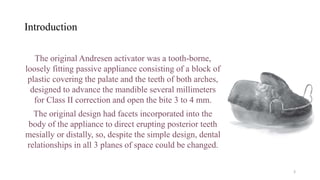
The original Andresen activator was a tooth-borne,
loosely fitting passive appliance consisting of a block of
plastic covering the palate and the teeth of both arches,
designed to advance the mandible several millimeters
for Class II correction and open the bite 3 to 4 mm.
The original design had facets incorporated into the
body of the appliance to direct erupting posterior teeth
mesially or distally, so, despite the simple design, dental
relationships in all 3 planes of space could be changed.
3
History & evolution
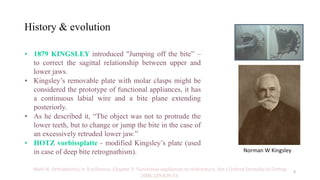
• 1879 KINGSLEY introduced "Jumping off the bite” –
to correct the sagittal relationship between upper and
lower jaws.
• Kingsley’s removable plate with molar clasps might be
considered the prototype of functional appliances, it has
a continuous labial wire and a bite plane extending
posteriorly.
• As he described it, “The object was not to protrude the
lower teeth, but to change or jump the bite in the case of
an excessively retruded lower jaw.”
• HOTZ vorbissplatte - modified Kingsley’s plate (used
in case of deep bite retrognathism).
Wahl N. Orthodontics in 3 millennia. Chapter 9: Functional appliances to midcentury. Am J Orthod Dentofacial Orthop
2006;129:829-33.
Norman W Kingsley
4
• 1902 PIERRE ROBIN - monobloc to position the mandible
forward to prevent occluding the airway in patients of
Glossoptosis.
• It had sharp lingual imprints of the crown surfaces of both
maxillary and mandibular teeth. It incorporated an expansion
screw in the palate to expand the dental arches.
• Robin designed his monobloc specifically for children with
glossoptosis syndrome
• It has since been named the Pierre Robin syndrome.
Doctor Pierre Robin, in
military dress. France. 5
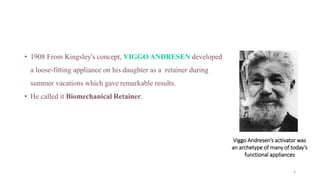
• 1908 From Kingsley's concept, VIGGO ANDRESEN developed
a loose-fitting appliance on his daughter as a retainer during
summer vacations which gave remarkable results.
• He called it Biomechanical Retainer.
Viggo Andresen’s activator was
an archetype of many of today’s
functional appliances
6
• He removed his daughter’s fixed appliances before
she left for her summer vacation, as was customary
at the time, and placed a Hawley-type maxillary
retainer.
• On the mandibular teeth, he placed a lingual
horseshoe flange that guided the mandible forward
about 3 to 4 mm in occlusion.
• On his daughter’s return, he was surprised to see
that night-time wearing of the appliances had
eliminated her Class II malocclusion, and it was
stable.
• Applying this technique to other patients resulted in
significant sagittal corrections that he could not
produce with conventional fixed appliances.
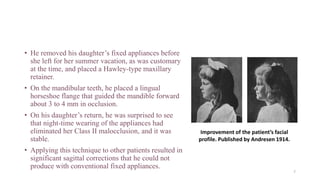
Improvement of the patient’s facial
profile. Published by Andresen 1914.
7
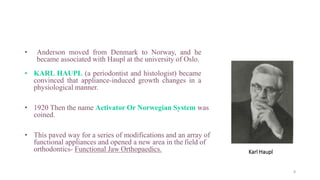
• Anderson moved from Denmark to Norway, and he
became associated with Haupl at the university of Oslo.
• KARL HAUPL (a periodontist and histologist) became
convinced that appliance-induced growth changes in a
physiological manner.
• 1920 Then the name Activator Or Norwegian System was
coined.
• This paved way for a series of modifications and an array of
functional appliances and opened a new area in the field of
orthodontics- Functional Jaw Orthopaedics. Karl Haupl
8
Classification of views
1. Petrovic (1984) & Mcnamara (1973)
• Andresen Haupl's concept that myotatic reflex activity and isometric contraction induce
musculoskeletal adaptation by introducing a new mandibular closing pattern.
• The appliance work by kinetic energy.
• Condylar adaptation- Construction bite not opened beyond postural rest position i.e, generally
not more than 4mm.
(Grude suggests that such adaptation is only possible with a small bite opening)
• Superior head of lateral pterygoid plays an important role in assisting the skeletal adaptations.
(Petrovic's research on condylar cartilage growth stimulation is by activating the lateral pterygoid)
9
2. Selmer - Olsen, Herren 1953, Harvold 1974 & Woodside 1973 do not agree with the
myotatic reflex activity and isometric contraction inducing musculoskeletal adaptation.
• According to their views, viscoelastic properties of soft tissues are decisive for activator
action.
• Not only the muscle contractions but also the viscoelastic properties of soft tissues are
important in stimulating skeletal adaptation.
• Woodside opens the mandible with construction bite as much as 10-15 mm beyond the
postural rest vertical dimension.
• The appliance work using potential energy.
10
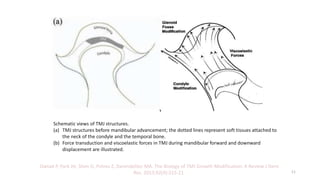
Schematic views of TMJ structures.
(a) TMJ structures before mandibular advancement; the dotted lines represent soft tissues attached to
the neck of the condyle and the temporal bone.
(b) Force transduction and viscoelastic forces in TMJ during mandibular forward and downward
displacement are illustrated.
Owtad P, Park JH, Shen G, Potres Z, Darendeliler MA. The Biology of TMJ Growth Modification: A Review J Dent
Res. 2013;92(4):315-21. 11
3. Between the two extremes-
• Schmuth, Witt, Komposch, and Eschler support high construction bite without the
extreme extension advocated by Woodside.
• Construction bite- greater opening than Andersen Haupl recommends, but they do not
overcompensate as Woodside recommends.
• They used the opening of 4-6 mm.
• Alternately uses muscle contraction and viscoelastic properties of soft tissues.
12
Effects of Activator on the dentofacial structures
• Any skeletal effect from the activator depends on the growth potential.
• Two divergent growth vectors propel the jaw bases in an anterior direction
• The sphenoccipital synchondrosis moves the cranial base and
nasomaxillary complex up & forward.
• The condyle translates the mandible in a downward and forward direction.
• The activator is most effective in controlling the lower vector or the
downward and forward growth of the mandible.
• Johnston (1976) attributes this response to "unloading the condyle."
• Effect: Activator inhibits the horizontal growth of the maxilla and results
in increased growth of the mandible and anterior relocation of the glenoid
fossa.
13
Effects on the mandible:
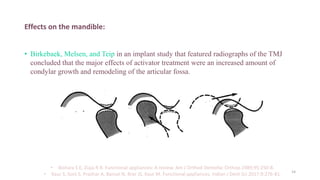
• Birkebaek, Melsen, and Teip in an implant study that featured radiographs of the TMJ
concluded that the major effects of activator treatment were an increased amount of
condylar growth and remodeling of the articular fossa.
• Bishara S E, Ziaja R R. Functional appliances: A review. Am J Orthod Dentofac Orthop.1989;95:250-8.
• Kaur S, Soni S, Prashar A, Bansal N, Brar JS, Kaur M. Functional appliances. Indian J Dent Sci 2017;9:276-81. 14
• Mehta et al. reported that the activator corrects class II malocclusion by increasing
condylar growth and mandibular length (Co- Gn).
• Other investigators also found 1.0 to 2.0 mm incremental increases in the growth of the
mandible after the use of activators.
• Pancherz found that mandibular growth increased by 0.3 mm per year, but this was not
statistically significant. He concluded that the magnitude of mandibular growth was not
affected by activator treatment.
• Some clinical studies found no significant increase in mandibular length with the use of
this device, but other authors reported a significant increase in the length or protrusion of
the mandible using the activator.
15
Effects on the maxilla:
• Several investigators have shown that it is possible to clinically alter the growth direction
of the maxilla.
• Forerg and Odenrick noted a significant decrease in the SNA angle.
• Vargervik and Harvold found that the activator inhibited the horizontal growth of the
maxilla by 2 mm; Pancherz found it was restricted by 1.7 mm.
16
Effects on the dentition:
• Bjork, Calve, Pancherz, Wieslander and Lagerstom observed significant dentoalveolar
change.
• A Class I occlusion was achieved through distal tipping of the maxillary teeth and a
mesial, vertical movement of the mandibular dentition.
• Harvold and Vargervik observed that the appliance also caused 1.4 mm of maxillary incisor
lingual tipping and 0.5 mm of mandibular incisor labial tipping.
• They concluded that the appliance achieved a Class I occlusion by inhibiting maxillary
dentoalveolar vertical development while encouraging mandibular dentoalveolar
mesial and vertical development.
• Pancherz found that more than 70% of the overjet was corrected by incisor tipping.
• Approximately 50% (2.5 mm) of the overjet was reduced by lingual movement of the
maxillary incisor, while 22% (1.1 mm) was reduced by mandibular incisor flaring.
17
Corrective Contribution in Activator Treatment: Contribution of skeletal and dental
changes to molar correction.
Cozza P, De Toffol L, Iacopini L. An Analysis of the Corrective Contribution in Activator Treatment. Angle
Orthod 2004;74:741–748.
• The molar drifts are unfavorable
toward the improvement of the Class
II relationship but are subsumed into
the favorable skeletal changes.
• Thus, the orthopedic effects are
greater than the dental effects in
correcting the posterior occlusal
relationship.
Skeletal
and
dental
changes
in
the
molar
area.
18
Contribution of skeletal and dental changes to overjet correction.
• In the anterior area of the arch, both the
skeletal and dental changes are favorable
toward the sagittal correction, but the skeletal
contribution is greater than the dental
contribution.
• In general, the skeletal contribution (140%)
exceeded the dental correction (60%) and the
mandibular changes (73%) exceeded the
maxillary contribution (27%) both in the
anterior and posterior regions.
Skeletal
and
dental
changes
in
the
incisor
area
19
Effects on soft tissue:
• Forsberg and Odenrick observed that
• Upper lip retrusion was significantly more
prevalent in the treated Class II group.
• Soft-tissue pogonion was significantly further
anteriorly in the treated group.
• Furthermore in the treated group lip balance
was not achieved in patients with relatively
retrognathic profiles or those with steep
mandibular planes.
20
Effect of activator with headgear:
• On mandible: Downward and forward mandibular
growth.
• On maxilla: Restricted maxillary growth.
• On dentition: Upper incisor retrusion & upper molar
distalization, and lower molar mesialization.
• On soft tissue: Reduced soft-tissue facial convexity.
21
Sl.no Advantages Disadvantages
1 Forces employed are physiological and produce no damage to teeth or
supporting tissues.
Careful case selection
2 Intervals between adjustments are less (6 wks). No detailed precise finishing of occlusion
3 Minimum hygiene and oral problems, minimum irritation and damage. Patient compliance is required for
successful treatment.
4 Appliance worn at night.
5 Appointments are brief.
6 Uses existing growth of the jaws to the maximum.
7 It provides a useful preliminary treatment before fixed appliance
mechanotherapy to improve skeletaljaw relationship.
8 Provides excellent control in vertical direction particularly overclosure.
9 Useful in correction of malocclusions associated with habits Thumb
sucking, Tongue thrusting
10 After treatment appliance, itself acts as a retainer saving cost &
professional time.
11 Cost factor is low.
Jergensen S E. Activators in orthodontic treatment: Indications and advantages. Am. J. Orthod. 1974;65(3):260-90.
Advantages & Disadvantages Of Activator Therapy
22
Hirzel H C, Grewe J M. Activators: A practical approach. Am. J. Orthod. November 1914: 557-590.
Sl.no Indications Contraindications
1 Moderate skeletal discrepancy between the midfacial area and the mandible in
actively growing individuals with favourable (horizontal) facial growth patterns.
Has limited application in non-growing individuals.
2 Well-aligned maxillary and mandibular teeth, should be upright over basal bone
structures.
In case where there is mandibular incisor procumbence at
start of treatment.
3 Used In: Class II Div 1, Class II Div 2 after aligning the incisors, Class III, Class I open
bite, Class I deep bite
Not useful in correction of class I and class II malocclusion
with crowding as it doesn't perform detailed tooth
positioning.
4 Children with lack of vertical development in lower face height. In children with extreme lower anterior facial height as it
tends to produce moderate mandibular rotations.
5 It can be indicated for post treatment retention in children with a deep overbite
caused by overclosure.
Children with nasal stenosis caused by structural
problems within the nose or chronic untreated allergy.
6 It can be used for cross bite correction. (Trimming done in such a way that
maxillary molars are moved laterally and mandibular molars lingually).
7 It can serve as a space maintainer in mixed dentition by extending the acrylic in to
the space of missing tooth.
8 Used for opening the space for 1st or 2n premolars by using jack screws.
9 It can be a treatment option for snoring. It was found to be more effective than soft
palate lifter mouth shield. (Swedish Dental Journal 1996).
Indications & Contraindications Of Activator Therapy
23
Selecting cases suitable for treatment with a functional
appliance
Selecting cases suitable for treatment with a functional appliance remains a problem
as much of the relevant literature is anecdotal.
There are also design and methodologic differences between the available studies,
and most studies are limited to the Andresen type of appliance.
The literature suggests that functional appliances are most successful in cases with
an overjet of up to 11 mm, an increased overbite, active facial growth, and good
cooperation.
Barton S, Cook PA. Predicting functional appliance treatment outcome in Class II malocclusion.Am J Orthod
Dentofac Orthop 1997; 112(3):282-6. 24
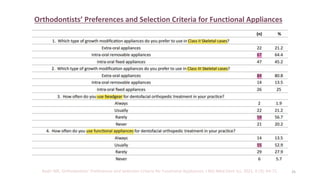
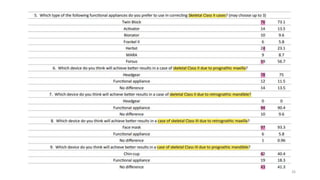
Badri MK, Orthodontists’ Preferences and Selection Criteria for Functional Appliances. J Res Med Dent Sci, 2021, 9 (3): 64-71.
Orthodontists’ Preferences and Selection Criteria for Functional Appliances
25
26
Distribution of different types of functional appliances preference based on
residency training.
27
Two principles employed in modern activator
FORCE APPLICATION - the source is usually muscular.
FORCE ELIMINATION - dentition is shielded from normal and abnormal
functional tissue pressures by pads, shields, and wires.
28
Types Of Forces Employed In Activator Therapy
• Growth potential includes eruption and migration of teeth which produces natural forces
and those can be guided, promoted, and inhibited by the activator.
• Muscle contraction and stretching of soft tissues produce artificial forces effective in all
three planes.
• Sagittal plane: mandible propelled down and forward so that force is delivered to the
condyle.
• Vertical plane: teeth and alveolar process either loaded or relieved of normal forces.
• Transverse plane: forces can be created with midline corrections.
• Various active elements: like springs/ screws- produce an active biomechanical type of
force.
29
Effectiveness of activators during sleep
• Serves as a "Night Guard" preventing deleterious nocturnal parafunctional activity and
stimulating normal muscle activity.
• Protracted, unloaded condyle enhances condylar growth increments and favorable
upward and backward growth direction.
• Hotz, Petrovic, Oudet, and Stuzmann stated that growth increments were greater at
night due to increased growth hormone secretion.
• Selmer-olsen said that the muscles could not be stimulated during sleep as nature has
designed them to be at rest. Swallowing occurred only 4-8 times in an hour during the
night.
30
Muscle activity with activator
Electromyographic study of temporalis and masseter with and without activators (AJO -
Aug 1998)
• It is observed that there was
1. Similar postural activity for both muscles with or without activator.
2. During swallowing of saliva, muscle activity was higher with the activator.
3. During maximal clenching similar activity in anterior temporalis with or without
activator. Higher activity in masseter muscle with the activator.
31
Treatment Timing:
• The arbitrary use of chronological age, typically 10 to 13 years in females and 11 to 14 years in males,
continues to be an acceptable yardstick for the timing of most efficient and effective growth modification in
Class II subjects.
• Little difference in the skeletal effects associated with functional appliances at the age of 10 years relative to a
group treated just after the onset of puberty (mean age 12.9 years) has been shown.
• There is, however, clearly an increase in treatment duration with early treatment.
• This relates to the reduced rate of mandibular growth observed in pre-adolescents and to the requirement for dental eruption to
permit complete and optimal occlusal inter-digitation.
• A period of intermittent appliance wear may be required following an early full-time functional phase to limit relapse of the
initial Class II correction.
Fleming PS. Timing orthodontic treatment: early or late? Aus Dent J.2017;62(1):11–19. 32
• In contrast, when Class II correction is undertaken in the late mixed or early permanent dentition, the fixed
phase can either be undertaken concurrently with Class II correction.
Early treatment
• The early use of myofunctional treatment in an effort to alleviate aberrant neuromuscular behavior has
received some attention, particularly in Europe.
• Treatment is based on the premise that malocclusion is related to muscular behavior and oral function,
although further research is needed to confirm its utility.
33
Long-term mandibular skeletal changes
• Treatment with removable functional appliances at puberty induced a significant long-
term enhancement of mandibular growth with an increase in mandibular ramus height and
protrusion of the chin.
• When treatment was performed before puberty, Class II correction was mostly confined to
the dentoalveolar level, with significant improvements of both overjet and molar
relationships
• Thus, if the aim of treatment is to produce skeletal mandibular changes (effective
mandibular growth stimulation and chin advancement), the onset of intervention with
removable functional appliances should be postponed until puberty. On the other hand, if
the correction of the Class II problem requires mainly dentoalveolar modifications,
treatment timing can be initiated before puberty.
Pavoni C, Lombardo E C, Lione R, Faltin K, McNamara J A, Cozza P, Franchi L. Treatment timing for functional jaw
orthopaedics followed by fixed appliances: a controlled long-term study. Eur J Orthod. 2017:1–7.
34
Other considerations
• In severe cases, where the overjet is greater than 7 mm there is a significantly higher risk
of traumatic damage to the incisors which would be a strong indication for early
treatment.
• The worsening of the bite is a result of the anterior growth rotation of the mandible that
most patients experience during growth.
• However, lower incisors during their eruption make contact with the lingual surfaces of the
upper incisors there is less of a chance that the overbite will deepen during growth, as this now
becomes a “fulcrum point” that can resist the effects of the jaw rotation.
• In those cases, the malocclusion may not need to be corrected early but treatment can be
delayed until all teeth have erupted.
Nielsen I L. Is Early Treatment with Functional Appliances Worth the Effort? A Discussion of the Pros and Cons of Early
Interceptive Treatment. Taiwanese Journal of Orthodontics. 29(3): 155-167, 2017
35
• De Vincenzo: increase in mandibular length during the functional
phase. During the post-functional phase, there was no long-term
additional mandibular length over controls.
• The greatest skeletal effects of the functional appliance seem to
emerge when the pubertal growth spurt was included in the active
treatment period with removable functional appliances.
• A significant increase in total mandibular length (Co–Gn + 5.5 mm),
a significant chin advancement (Pg to N perp + 3.1 mm) and a
significant reduction in the Wits appraisal of −5.8 mm were
observed.
36
Clinical and laboratory steps in fabrication and treatment with
Activator
1. Proper diagnosis of the case by assessing
the followings:
a. Model Analysis
b. Functional analysis
c. Cephalometric analysis
d. Hand wrist X- rays
e. Cervical vertebra analysis for
growth.
2. Visual treatment object (V.T.O)
3. Bite registration in patient’s mouth
4. Recheck the registered bite in the plaster
model
5. Wire framework
6. Articulation of the registered bite
7. Fabrication of the appliance
8. Trimming and polishing of the appliance
9. Insertion of the appliance in the oral
cavity
10. Instruction to the patient
11. Selective trimming and adding of the
resin as an adjustment of the appliance.
37
Diagnosis: Study model analysis
Before constructing the activator, the clinician must consider the following factors, based
on the cast analysis:
1. First permanent molar relationship in habitual occlusion
2. Nature of the midline discrepancy, if any.
3. Symmetry of the dental arches.
4. Curve of Spee
5. Crowding and any dental discrepancies
38
Functional analysis
Before the construction bite is taken, a functional analysis is performed to obtain the
following information:
1. Precise registration of the postural rest position in natural head posture (because the vertical
opening of the construction bite depends on this)
2. Path of closure from postural rest to habitual occlusion(any sagittal or transverse deviations
are recorded)
3. Prematurities, point of initial contact, occlusal interferences, and resultant mandibular
displacement, if any (some of these can be eliminated with the activator, but some require
other therapeutic measures)
4. Sounds such as clicking and crepitus in the TMJ (might indicate a functional abnormality or
the need for some modification of appliance design)
39
4. Respiration (with allergies or disturbed nasal respiration, the patient cannot wear a
bulky appliance; in such cases an open activator or twin block may be used, or the
respiratory abnormalities may be eliminated first)
5. Interocclusal clearance or freeway space (should be checked several times and the
mean amount recorded)
40
Cephalometric analysis
• Important information required to plan construction bite:
1. Direction of growth: average, horizontal/ vertical.
2. Differentiation between position and size of the jaws.
3. Morphologic peculiarities particularly of the mandible may assist in determining the
course of the development.
4. Axial inclination and position of maxillary and mandibular incisors (for determining
the anterior positioning the mandible requires and the details of the appliance design
for incisor area)
41
Hand wrist
• In the young adult, the most advantageous period for
treatment is at the time of the young pubertal growth
spurt, when the sesamoid bone is beginning to show in
radiographs of the hand.
• At this stage, orthodontists can speak with some assurance
about effective “growth-adapting” treatment.
Jergensen S E. Activators in orthodontic treatment: Indications and advantages. Am. J. Orthod. 1974;65(3):260-90. 42
VTO
• VTO helps in determining mandibular position by relocate the jaw in the direction of the
treatment objectives.
• For example, a patient with a sk. class II malocclusion could be instructed to bring into a
normal sagittal relation frequently thereby instantly creating an illusion of having
correction of the malocclusion.
• This clinical procedure helps to realize the improvement.
• Class III (sk.) malocclusion could be similarly trained for improvement.
• VTO helps in the motivation of the patient by visualizing change. This motivates the
patient to use any appliance which is not otherwise aesthetically acceptable.
43
It can be done by
1. By using a mirror
2. By drawing a picture
3. By using cephalogram
4. By comparing before and after treatment
photographs or videos of the treated patient
or
5. Before and after wax bite registration of the
patient.
44
General rules for the construction bite.
• If the forward positioning of the mandible is 7 to 8 mm then the
vertical opening must be slight to moderate (2 to 4 mm).
• If the forward positioning is no more than 3 to 5 mm then the
vertical opening should be 4 to 6 mm.
• The activator can correct lower midline shifts or deviations oan nly
if actual lateral translation of the mandible itself exists. If the
midline abnormality is caused by tooth migration, an attempt to
correct this type of dental problem could lead to iatrogenic
asymmetry.
• Functional crossbites in the functional analysis can be corrected by
taking the proper construction bite.
45
Technique for Low construction bite and markedly forward mandibular
positioning
H - ACTIVATOR
• Activator constructed with low vertical opening and
a markedly forward mandibular positioning is
designated as horizontal or 'H' activator.
Indications:
1. Class II Div 1 with sufficient overjet.
2. Class II Div 1 MO where there is mandibular
overclosure that results in a functional retrusion of
the mandible. In such cases, the activator can act in
the sense of "Jumping the bite"
3. Class II Div 1 MO with posteriorly positioned
mandible due to growth deficiency with
horizontal growth pattern.
46
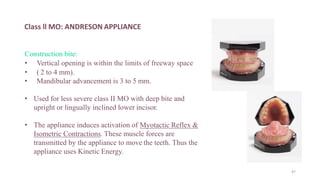
Class ll MO: ANDRESON APPLIANCE
Construction bite:
• Vertical opening is within the limits of freeway space
• ( 2 to 4 mm).
• Mandibular advancement is 3 to 5 mm.
• Used for less severe class II MO with deep bite and
upright or lingually inclined lower incisor.
• The appliance induces activation of Myotactic Reflex &
Isometric Contractions. These muscle forces are
transmitted by the appliance to move the teeth. Thus the
appliance uses Kinetic Energy.
47
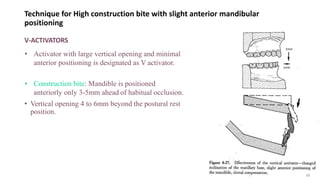
Technique for High construction bite with slight anterior mandibular
positioning
V-ACTIVATORS
• Activator with large vertical opening and minimal
anterior positioning is designated as V activator.
• Construction bite: Mandible is positioned
anteriorly only 3-5mm ahead of habitual occlusion.
• Vertical opening 4 to 6mm beyond the postural rest
position.
48
HARVOLD WOOD-SIDE ACTIVATOR
Construction bite:
• Vertically an extreme separation of 10 to 15mm beyond the
freeway space.
• The mandible is placed approximately 3mm distal to the most
protrusive position sagitally.
• Here the mandible is opened beyond 4mm so it does not work in
the same manner as Anderson's activator but by stretching of soft
tissue - the viscoelastic effect.
• In such cases clasp - knife reflex plays a role.
49
Pterygoid Response Theory: (McNamara and Petrovic 1980)
• When the mandible postures downward and forwards, there is an area of enormous
cellular activity above and behind the condyle which is referred as Tension Zone.
• This area is quickly invaded by proliferating blood vessels and connective tissue.
• A new pattern of muscle behavior is quickly established whereby the patient finds it
difficult and impossible to retract the mandible to its former retruded position. It was
termed as Pterygoid Response’.
50
Technique for construction bite without anterior positioning of mandible.
Deep bite MO
• In dentoalveolar problems, the deep overbite may be due to
infra-occlusion of buccal segments or supra-occlusion of
anterior segments.
• Construction bite may be moderate or high depending on the
freeway space.
• If it is due to supra-occlusion of anterior segments,
interocclusal space is usually small and should resort to high
construction bite.
• Intrusion of incisors is possible to only a limited extent when an
activator is being used.
51
• Skeletal deep bite
• Here the construction bite is high (5 to 6mm beyond the freeway space ).
• Loading the incisors can achieve a slight forward inclination of the maxillary base
• Acrylic cap engages these teeth while freeing the molars to erupt.
• Open bite MO
• Construction Bite is opened 4 to 5mm to develop a sufficient elastic depressing force and
load the molars that are in premature contact.
52
MO with crowding
• Construction bite: should be low because
jaw opening, and growth guidance
(selective trimming) are not desired.
• MO with crowding can sometimes be
treated with the activator and can
accomplish the desired expansion
because it is anchored intermaxillary.
• The appliance works in a manner similar to
that of two active plates with jackscrews in
the upper and lower parts.
53
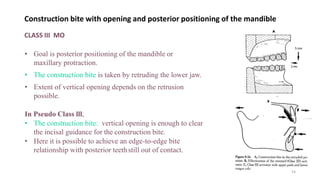
Construction bite with opening and posterior positioning of the mandible
CLASS III MO
• Goal is posterior positioning of the mandible or
maxillary protraction.
• The construction bite is taken by retruding the lower jaw.
• Extent of vertical opening depends on the retrusion
possible.
In Pseudo Class lll,
• The construction bite: vertical opening is enough to clear
the incisal guidance for the construction bite.
• Here it is possible to achieve an edge-to-edge bite
relationship with posterior teethstill out of contact.
54
Fabrication of the activator
• Primary wire elements are the Upper
Or Lower Labial Bow.
• Upper (U) loop starts in lateral incisors canine
embrasure area.
• Lower canine loops start more distally in the
mesial third of the canines.
• Labial bows can be active or passive.
• If active made out of 0.9mm & if
passive made out of 0.8mm.
55
• Fabrication of the acrylic parts consists of Upper
Lower And Inter Occlusal Parts.
• Upper and lower parts consist of Dental And
Gingival Portions.
• Flanges of the upper part extend 8 to 12 mm high in
thegingival area and cover the alveolar crest.
• Flanges of the lower part extend 5 to 12mm in the
gingival area.
• Flange extension is greater in V activators as the
patientsof this category have open mouth postures.
56
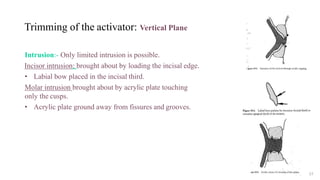
Trimming of the activator: Vertical Plane
Intrusion:- Only limited intrusion is possible.
Incisor intrusion: brought about by loading the incisal edge.
• Labial bow placed in the incisal third.
Molar intrusion brought about by acrylic plate touching
only the cusps.
• Acrylic plate ground away from fissures and grooves.
57
Extrusion: indicated in OPEN BITE
problems.
• Incisor extrusion (Upper incisor)
– Labial bow is placed in the gingival 1/3
– Acrylic contacts gingival 1/3 (below the
concavity) on the lingual surface in the
maxilla.
• Molar extrusion
• Enhancing eruption by grinding the acrylic
plate fromthe occlusal surface.
• Acrylic contacting the gingival 1/3 (below
the convexity) on the lingual surface.
58
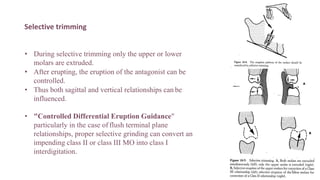
Selective trimming
• During selective trimming only the upper or lower
molars are extruded.
• After erupting, the eruption of the antagonist can be
controlled.
• Thus both sagittal and vertical relationships can be
influenced.
• "Controlled Differential Eruption Guidance"
particularly in the case of flush terminal plane
relationships, proper selective grinding can convert an
impending class II or class III MO into class I
interdigitation.
59
SAGITTAL PLANE
Protrusion:
• Loading the lingual surface with acrylic
contacts.
• Screening away lip strains with a passive
labial bow or lip pads.
60
Retrusion:
• Acrylic trimmed away from behind the incisors.
• Active labial bow.
61
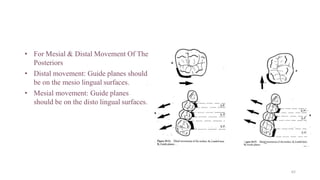
• For Mesial & Distal Movement Of The
Posteriors
• Distal movement: Guide planes should
be on the mesio lingual surfaces.
• Mesial movement: Guide planes
should be on the disto lingual surfaces.
62
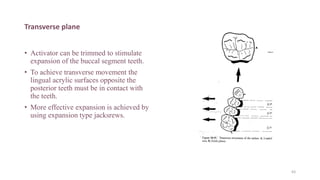
Transverse plane
• Activator can be trimmed to stimulate
expansion of the buccal segment teeth.
• To achieve transverse movement the
lingual acrylic surfaces opposite the
posterior teeth must be in contact with
the teeth.
• More effective expansion is achieved by
using expansion type jacksrews.
63
Tension field of teeth in a differently formed milieu.
Milieu change by insertion of activator.
Herren P, Berne, Switzerland. Activator’s Mode Of Action. Am J Orthod. 1959;45(7):512-27.
Normal functional milieu of teeth in rest position.
The dysfunctional milieu in habitual open-mouth
position:
space remaining after extraction.
64
Activator: Design and rationale
• The muscular forces generated by the forward mandibular positioning were transferred
to the maxilla and mandibular teeth through the acrylic body and the labial bow.
• In theory, these forces were transmitted through the teeth onto the periosteum and bone,
where they produced a restraining effect on the forward growth of the maxilla while
stimulating mandibular growth and causing maxillary-mandibular dentoalveolar
adaptations.
65
• Interocclusal acrylic guide planes were provided to direct the dentoalveolar adaptations
in a desirable direction.
• For a Class II correction, the mandibular posterior segments were directed to erupt vertically
and mesially, while the maxillary teeth were directed distally and buccally. Vertical eruption of
the maxillary teeth was impeded by the acrylic occlusal stops and the intrusive forces
generated by the appliance.
• Incisal acrylic coverage was intended to inhibit the eruption of the maxillary and
mandibular anterior teeth while reducing the flaring of the mandibular anterior teeth.
• Uncontrolled incisor flaring could result in a rapid correction of the overjet, which would
minimize the orthopedic effects of the appliance on the maxilla and mandible.
66
Management Of The Appliance
• If the patient is wearing the activator without difficulty and following instructions,
checkup appointments should be scheduled every 6 weeks.
• During these office visits the clinician should maintain rapport with the patient, reinforce
motivation, and perform the following procedures:
1. All guide planes that have been ground and all areas in contact with the teeth should be
observed for shiny surfaces that indicate whether the appliance is being worn correctly
and is working properly.
2. Reshaping of acrylic guide areas may be required to improve function; it also may be
needed during the course of treatment to ensure continued tooth movement
67
3. Acrylic contact by adding self-curing soft acrylic in a thin layer to maintain the proper
functional activation on the desired teeth.
4. The labial bows and any additional wire elements must be checked for action and
possible deformation. The active bow should touch the teeth. The passive bow should
position away from the teeth but remain in contact with the soft tissues.
5. In expansion treatment the jackscrews are normally activated by the patient at 2-week
intervals. The clinician should check this activation for too-frequent or infrequent
activation. Too much activation prevents the appliance from fitting properly. The
activation interval may need to be changed.
68
PART 2
• Modifications of Activator
• Case reports
• Conclusion
• Bibliography
69
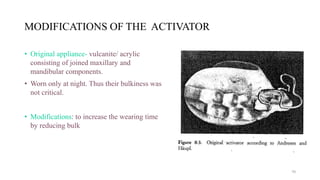
MODIFICATIONS OF THE ACTIVATOR
• Original appliance- vulcanite/ acrylic
consisting of joined maxillary and
mandibular components.
• Worn only at night. Thus their bulkiness was
not critical.
• Modifications: to increase the wearing time
by reducing bulk
70
Modification Rigid Elastic
Features One rigid mass for maxillary and mandibular arches but with
reduced bulk.
Upper and lower joined with wire bows.
Do not impede the movements of the
mandible- increase the wear time with
relative comfort.
Types a. Open activator- restore exteroceptive contact between
tongue and palate
Dis: bite cannot be opned too far vertically
b. Balters bionator: Reduced alveolar regions and cross palatal
wires instead of full acrylic plate.
Dis: Tooth borne- uses limited and difficult management,.
Schwarz double plate
Mode of action Does not permit muscle shortening: isometric contraction
Isometric contraction develops high tension than isotonic
Permits muscle shortening: elicit isotonic
contractions.
Isotonic contractions are of lesser
magnitude- decreases the effectiveness of
the appliance
71
Other modifications
1. Eschler's modification
2. Wunderer's Modifications
3. Bimler appliance 1949
4. Bionator (1950
5. The Kinetor (1951)
6. Herren's activator (1953)
7. Louisiana State University (LSU) or Activator of
Shaye (1953), a modification of Herren activator
by R Shaye.
8. The Bow Activator Of Schwarz A.M. Schwarz in
1956
9. Elastic Open Activator (1960)
10. The Karwetzky Appliance (1964)
11. The Propulsor (1968
12. Hyper Propulsor Activator: (1986)
13. Combined Activator / Hg Orthopedics 1969
1. Pfeiffer & Grobety (1975)
2. Teuscher-Stockli activator/ headgear
combination appliance (1978)
3. Modified Teucher Activator (2006)
4. Van Beek Activator (1982) Headgear-
activator combination appliance.
5. Lehman activator (1988
14. The Reduced Activator (Or) Cybernator Of
Schmuth (1973)
15. Cutout Of Palate Free Activator (1974)
16. Nocturnal airway patency appliance (1987)
17. MAD – Magnetic Activator Device. (1993)
18. Hamilton expansion activator system. (or) Bonded
activator
19. Preformed Activator: Ortho T Activators 72
1. Eschler's Modification
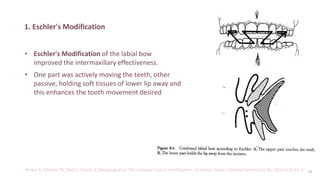
• Eschler's Modification of the labial bow
improved the intermaxillary effectiveness.
• One part was actively moving the teeth, other
passive, holding soft tissues of lower lip away and
this enhances the tooth movement desired
73
Parkar A, Vibhute PK, Patil C, Umale V, Balagangadhar, The activator and its modification - A review. Indian J Orthod Dentofacial Res 2019;5(2):41- 6.
2. Wunderer's Modifications
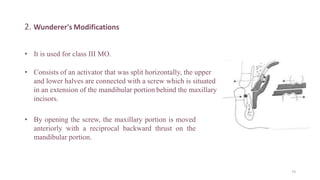
• It is used for class III MO.
• Consists of an activator that was split horizontally, the upper
and lower halves are connected with a screw which is situated
in an extension of the mandibular portion behind the maxillary
incisors.
• By opening the screw, the maxillary portion is moved
anteriorly with a reciprocal backward thrust on the
mandibular portion.
74
3. Bimler appliance (Bite former, Bimler stimulator) (1949)
designed by H.P. Bimler
• There are three kinds of Bimler appliances:
1. Type A – For treating Class II Division-1 Malocclusion
2. Type B -Class II Division-2 Malocclusion
3. Type C - Class III Malocclusion.
75
4. The Bow Activator Of Schwarz A.M. Schwarz in 1956
• Schwarz was influenced by the properties of Bimler's appliance and some
contributions from Wunderer's appliance.
• It consisted of an activator split into half horizontally allowing stepwise
sagittal advancement of the mandible by adjusting the bow. and
connected by an elastic metal bow with a safety pin curve – to absorb the
shock of jaws during closing.
• There is a possibility of activating only the bow on the side of a unilateral
distoclusion.
• Expansion can be attempted by activating the screws.
• Construction bite is minimal forward positioning of the mandible.
• Disadvantage: The appliance gets easily distorted and so the results
achieved are minimal.
76
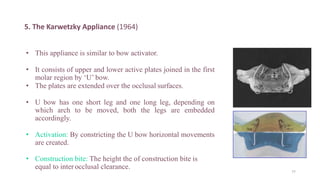
5. The Karwetzky Appliance (1964)
• This appliance is similar to bow activator.
• It consists of upper and lower active plates joined in the first
molar region by ‘U’ bow.
• The plates are extended over the occlusal surfaces.
• U bow has one short leg and one long leg, depending on
which arch to be moved, both the legs are embedded
accordingly.
• Activation: By constricting the U bow horizontal movements
are created.
• Construction bite: The height the of construction bite is
equal to inter occlusal clearance.
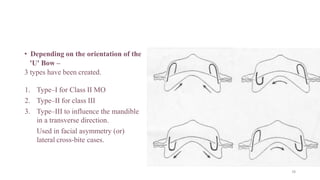
77
• Depending on the orientation of the
'U' Bow –
3 types have been created.
1. Type–I for Class II MO
2. Type–II for class III
3. Type–III to influence the mandible
in a transverse direction.
Used in facial asymmetry (or)
lateral cross-bite cases.
78
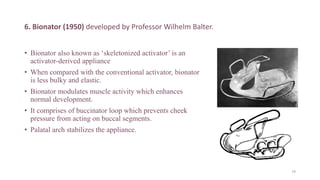
6. Bionator (1950) developed by Professor Wilhelm Balter.
• Bionator also known as ‘skeletonized activator’ is an
activator-derived appliance
• When compared with the conventional activator, bionator
is less bulky and elastic.
• Bionator modulates muscle activity which enhances
normal development.
• It comprises of buccinator loop which prevents cheek
pressure from acting on buccal segments.
• Palatal arch stabilizes the appliance.
79
7. The Reduced Activator (Or) Cybernator Of Schmuth (1973) - designed by
Professor G.P. Schmuth of Bonn.
• Cybernator similar to bionator has reduced acrylic part
in the maxillary anterior area leaving a small flange of
acrylic on palatal slope.
• Consists of labial wire and coffin spring (1.1mm)
• The appliance is made more resistant by a lower labial
bow.
• The lower acrylic part is split in the midline to permit
expansion.
• Construction bite similar to that of an activator was
preferred.
• Head-gear tubes may be incorporated into the
appliance.
80
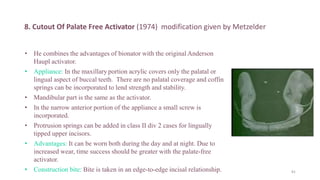
8. Cutout Of Palate Free Activator (1974) modification given by Metzelder
• He combines the advantages of bionator with the original Anderson
Haupl activator.
• Appliance: In the maxillary portion acrylic covers only the palatal or
lingual aspect of buccal teeth. There are no palatal coverage and coffin
springs can be incorporated to lend strength and stability.
• Mandibular part is the same as the activator.
• In the narrow anterior portion of the appliance a small screw is
incorporated.
• Protrusion springs can be added in class II div 2 cases for lingually
tipped upper incisors.
• Advantages: It can be worn both during the day and at night. Due to
increased wear, time success should be greater with the palate-free
activator.
• Construction bite: Bite is taken in an edge-to-edge incisal relationship. 81
9. Elastic Open Activator (1960) designed by G. Klammt. of Gorlitz
• Acrylic bulk is reduced and is replaced by wire.
• Reduction in the acrylic components increases wear time.
• Wire components increase the flexibility of the appliance.
• Isotonic muscle contractions are allowed due to the
flexible design.
• The appliance consists of bilateral acrylic parts (an upper
and lower labial wire, a palatal arch, and guide wires for
the upper and lower anterior).
• It can be used for various MO including extraction cases.
• Flat acrylic surface permits closure of spaces created by
extraction since there is no interference in the
interproximal area.
82
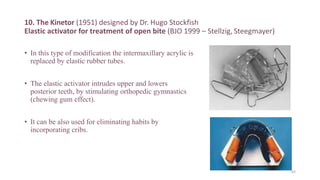
10. The Kinetor (1951) designed by Dr. Hugo Stockfish
Elastic activator for treatment of open bite (BJO 1999 – Stellzig, Steegmayer)
• In this type of modification the intermaxillary acrylic is
replaced by elastic rubber tubes.
• The elastic activator intrudes upper and lowers
posterior teeth, by stimulating orthopedic gymnastics
(chewing gum effect).
• It can be also used for eliminating habits by
incorporating cribs.
83
11. THE PROPULSOR (1968) designed by Muhlemann and refined by Hotz.
• Appliance: It is described as a Hybrid Appliance because of the
features of vestibular screen and monobloc.
• This modification had no wire connecting the upper and lower
parts.
• Acrylic connected the upper and lower parts with acrylic flanges.
• Indication: Commonly used in maxillary dento-alveolar
protrusion.
• Advantage of the propulsor over activator-like appliances: Wide
coverage and the ability to effect changes in the alveolar process.
84
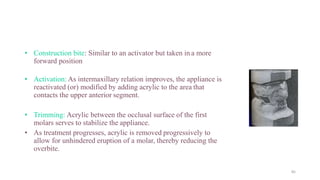
• Construction bite: Similar to an activator but taken in a more
forward position
• Activation: As intermaxillary relation improves, the appliance is
reactivated (or) modified by adding acrylic to the area that
contacts the upper anterior segment.
• Trimming: Acrylic between the occlusal surface of the first
molars serves to stabilize the appliance.
• As treatment progresses, acrylic is removed progressively to
allow for unhindered eruption of a molar, thereby reducing the
overbite.
85
HYPER PROPULSOR ACTIVATOR: (1986 – George Gaumond)
• Appliance: The hyper propulsor activator, developed from
the monobloc of Robin, consists of a bimaxillary block of
acrylic made with the bite open and the mandible in a
forward position.
• An anterior opening is built into the appliance to facilitate
breathing.
• Indication: The splint hyper propulsor activator combined
with extra-oral force is useful in young children with severe
overjet and overbite who suffer from fractured maxillary
incisors at an early age (between 6 to 9).
86
Bonded Activator or Hamilton expansion activator system
• Hamilton termed it as an expansion activation approach.
• Appliance: It is bonded to the maxillary arch and the forward
guidance of the mandible is achieved by proprioceptive guidance
from the lingual flanges of the appliances.
• Indication: It is also useful in the mixed dentition phase.
• Advantage: This achieves dramatic and rapid correction.
87
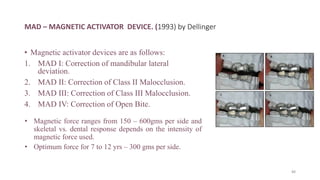
MAD – MAGNETIC ACTIVATOR DEVICE. (1993) by Dellinger
• Magnetic activator devices are as follows:
1. MAD I: Correction of mandibular lateral
deviation.
2. MAD II: Correction of Class II Malocclusion.
3. MAD III: Correction of Class III Malocclusion.
4. MAD IV: Correction of Open Bite.
• Magnetic force ranges from 150 – 600gms per side and
skeletal vs. dental response depends on the intensity of
magnetic force used.
• Optimum force for 7 to 12 yrs – 300 gms per side.
88
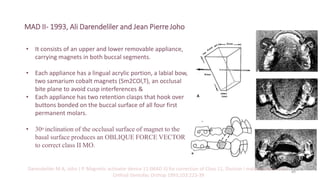
MAD II- 1993, Ali Darendeliler and Jean PierreJoho
• It consists of an upper and lower removable appliance,
carrying magnets in both buccal segments.
• Each appliance has a lingual acrylic portion, a labial bow,
two samarium cobalt magnets (Sm2COl,T), an occlusal
bite plane to avoid cusp interferences &
• Each appliance has two retention clasps that hook over
buttons bonded on the buccal surface of all four first
permanent molars.
• 30o inclination of the occlusal surface of magnet to the
basal surface produces an OBLIQUE FORCE VECTOR
to correct class II MO.
Darendeliler M A, Joho J P. Magnetic activator device 11 (MAD II) for correction of Class 11, Division I malocclusions. Am J
Orthod Dentofac Orthop 1993;103:223-39
89
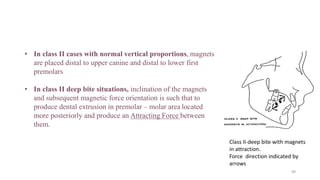
• In class II cases with normal vertical proportions, magnets
are placed distal to upper canine and distal to lower first
premolars
• In class II deep bite situations, inclination of the magnets
and subsequent magnetic force orientation is such that to
produce dental extrusion in premolar – molar area located
more posteriorly and produce an Attracting Force between
them.
Class II-deep bite with magnets
in attraction.
Force direction indicated by
arrows
90
• In class II open bite situation
• A pair of repelling magnets can be used
posteriorly – to produce molar and
premolar intrusion, some distal
movements in the upper arch, pushes the
mandible downward and forward.
• A pair of attracting magnets located at
the retroincisal area help to achieve
symmetry, align the upper and lower
midlines, and stabilize the appliance
against rippling forces. Class II open bite situation in detail. Arrows show dental effects
produced by magnets in repulsion and in attraction, as well as
probable maxillary and mandibular rotations, * and" are center of
resistance of the dentoalveolar segment and the maxillary complex,
respectively. 91
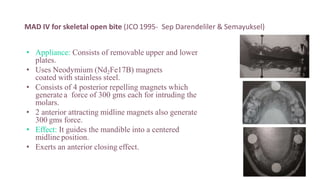
MAD IV for skeletal open bite (JCO 1995- Sep Darendeliler & Semayuksel)
• Appliance: Consists of removable upper and lower
plates.
• Uses Neodymium (Nd2Fe17B) magnets
coated with stainless steel.
• Consists of 4 posterior repelling magnets which
generate a force of 300 gms each for intruding the
molars.
• 2 anterior attracting midline magnets also generate
300 gms force.
• Effect: It guides the mandible into a centered
midline position.
• Exerts an anterior closing effect.
92
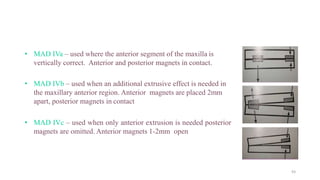
• MAD IVa – used where the anterior segment of the maxilla is
vertically correct. Anterior and posterior magnets in contact.
• MAD IVb – used when an additional extrusive effect is needed in
the maxillary anterior region. Anterior magnets are placed 2mm
apart, posterior magnets in contact
• MAD IVc – used when only anterior extrusion is needed posterior
magnets are omitted. Anterior magnets 1-2mm open
93
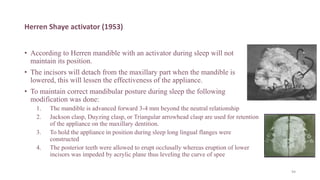
Herren Shaye activator (1953)
• According to Herren mandible with an activator during sleep will not
maintain its position.
• The incisors will detach from the maxillary part when the mandible is
lowered, this will lessen the effectiveness of the appliance.
• To maintain correct mandibular posture during sleep the following
modification was done:
1. The mandible is advanced forward 3-4 mm beyond the neutral relationship
2. Jackson clasp, Duyzing clasp, or Triangular arrowhead clasp are used for retention
of the appliance on the maxillary dentition.
3. To hold the appliance in position during sleep long lingual flanges were
constructed
4. The posterior teeth were allowed to erupt occlusally whereas eruption of lower
incisors was impeded by acrylic plane thus leveling the curve of spee
94
Louisiana State University (LSU) or Activator of Shaye (1953), a modification of
Herren activator by R Shaye.
• LSU activators cause sagittal repositioning of the mandible
to a significant degree and have the following effects:
1. An increase in the forward positioning of the mandible
causes a stretch in the retractor muscles. This new
positioning of the lower jaw leads to a new sensory
engram.
2. This appliance works on the phantom activator
phenomenon.
95
Nocturnal airway patency appliance (1987) Designed by Peter T George.
• NAPA was fabricated to keep the airway
patent during sleep by posturing the tongue
more anteriorly by the mandibular
protrusion.
96
Combined Activator / Hg Orthopedics 1969, Introduced by Hasmond.
• Prime target of treatment concept employing activator and
HG combination is to restrict developmental contributions
that tend towards a Skeletal class II and to enhance
developmental contributions that tend to harmonize the
Anteroposterior relations of maxillo mandibular structures.
97
Activator + Headgear Combinations
Few A/HG combinations appliances are:
1. Pfeiffer Grobetty.
2. Teuscher-Stockli.
Modified Teucher Activator.
3. Van Beek Activator.
4. Lehman activator.
98
Extraoral force levels
1. Full mixed dentition 300 to 400mg
2. Mixed dentition 150 to 250mg
3. Full permanent dentition 400 to 600mg
4. Retention 150 to 400mg
99
1. Pfeiffer & Grobety (1975)
Correction of skeletal class 2 MO
• Promotes mesial movement of lower teeth
• Inhibits maxillary growth
• Cervical EO Force
• Distal movement of anchor molar
• Tipping of anterior
• Extrusion of upper molars- opening bite & rotating
mandible downward and backwards
• Construction bite: 2-3mm short of most protrusive & 3-4mm
beyond freeway space.
100
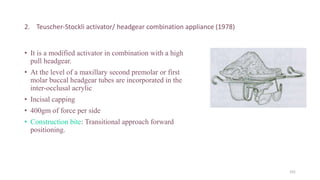
2. Teuscher-Stockli activator/ headgear combination appliance (1978)
• It is a modified activator in combination with a high
pull headgear.
• At the level of a maxillary second premolar or first
molar buccal headgear tubes are incorporated in the
inter-occlusal acrylic
• Incisal capping
• 400gm of force per side
• Construction bite: Transitional approach forward
positioning.
101
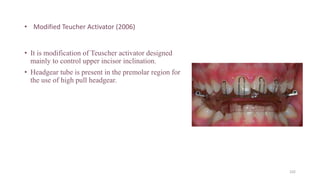
• Modified Teucher Activator (2006)
• It is modification of Teuscher activator designed
mainly to control upper incisor inclination.
• Headgear tube is present in the premolar region for
the use of high pull headgear.
102
3. Van Beek Activator (1982) Headgear-activator combination appliance.
• Between incisors a short and strong outer bow is
embedded in acrylic of the activator.
• Both upper and lower incisors are covered by
acrylic.
• Mandibular position is achieved by lingual flange.
103
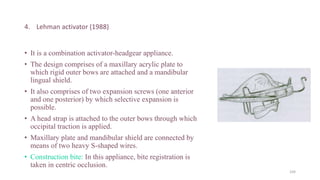
4. Lehman activator (1988)
• It is a combination activator-headgear appliance.
• The design comprises of a maxillary acrylic plate to
which rigid outer bows are attached and a mandibular
lingual shield.
• It also comprises of two expansion screws (one anterior
and one posterior) by which selective expansion is
possible.
• A head strap is attached to the outer bows through which
occipital traction is applied.
• Maxillary plate and mandibular shield are connected by
means of two heavy S-shaped wires.
• Construction bite: In this appliance, bite registration is
taken in centric occlusion.
104
• Regardless of whether headgear activator treatment of excessive overjet was performed in
MD (at the age of 9) or in the LMD (at the age of 11)., the costs and treatment effects
were equal.
• The most pronounced effects of treatment were the reduction of overjet and improved
molar relation, while a modest improvement effect was found on oral health-related
quality of life (OHRQoL), lip closure, and trauma incidences.
• If an early treatment approach is considered, it may be advocated to start treatment as
early as possible, that is, in the MD to enhance trauma prevention.
• However, early treatment for trauma prevention should be initiated soon after the eruption
of the permanent incisors (Koroluk, Tulloch et al. 2003).
Jenny Kallunki J, Bondemark L, Paulsson L. Comparisons of costs and treatment effects— an RCT on headgear activator
treatment of excessive overjet in the mixed and late mixed dentition. Europ J of Orthod.2021:1–9 105
Preformed Activator: Ortho T Activators
• This appliance was constructed by elastomeric material.
• These are preformed activators, used in the treatment
from early through late mixed dentition.
• These appliances coined as EGAs (Eruptive Guidance
Appliance) also function as a positioner and in correction
of overbite and mild to moderate crowding.
106
Case report
• Kahl-Nieke and Fischbach found that activator appliance therapy in hemifacial
microsomia patients showed improvement in function and occlusion & facial
asymmetry were reduced.
• When the construction bite is taken in such cases, the mandible is kept in a slightly
forward and overcompensated position which causes a change in muscle activity
that has led to enhanced bone apposition and optimal growth direction of the
condyle.
Kahl-Nieke B, Fischbach R. Effect of early orthopedic intervention on hemifacial microsomia patients: An approach to a
cooperative evaluation of treatment results. Am J Orthod Dentofacial Orthop 1998;114:538-50. 107
Extraoral view.
Pretreatment, after 1 year, after 3 years and after 5
years of treatment at the age of 10.
Note the continuous improvement of facial symmetry.
Patient with mandibular dysostosis
The three-dimensional display illustrates the reduced length of the right
condylar process and significantly increased length of the coronoid process,
as well as the anteromedial joint position, flattening of both the articular
eminence, and the glenoid fossa.
108
After 2 1/2 years of functional treatment, at the age of 7 years and 5
months, the first axial CT revealed a hypoplastic triangular right and an
ellipsoid left condyle of normal size
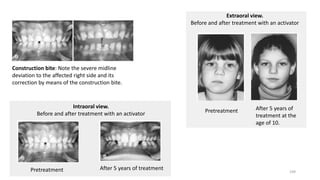
Construction bite: Note the severe midline
deviation to the affected right side and its
correction by means of the construction bite.
After 5 years of treatment
109
Extraoral view.
Before and after treatment with an activator
Pretreatment After 5 years of
treatment at the
age of 10.
Pretreatment
Intraoral view.
Before and after treatment with an activator
Conclusion
Both skeletal and dentoalveolar changes can be achieved in activator functional
appliance therapy.
Depending on the timing and trimming of the appliance, significant facial and
occlusal changes can be achieved.
In addition to the elimination of abnormal perioral muscle function, growth
guidance is the major contributor to the correction of malocclusion.
110
Bibliography
1. Dentofacial orthopedics with functional appliances (Thomas - M.Graber, Thomas Rakosi,
Alexander petrovic)
2. Removable Orthodontic appliances (T.M.Grater Bedrich Neumann)
3. Current orthodontic concepts andTechniques (T.M.Graber, Brainerd .F.Swain)
4. Orthodontics - Current Principles and Techniques (T.M.Graber, Robert L.Vanarsdall )
5. Mohammed K Badri, Orthodontists’ Preferences and Selection Criteria for Functional Appliances, J Res
Med Dent Sci, 2021, 9 (3): 64-71.
6. Bishara S E, Ziaja R R. Functional appliances: A review. Am J Orthod Dentofac Orthop.1989;95:250-8.
7. Kaur S, Soni S, Prashar A, Bansal N, Brar JS, Kaur M. Functional appliances. Indian J Dent Sci
2017;9:276-81.
111
8. Parkar A, Vibhute PK, Patil C, Umale V, Balagangadhar, The activator and its modification - A review.
Indian J Orthod Dentofacial Res 2019;5(2):41- 6.
9. Kahl-Nieke B, Fischbach R. Effect of early orthopedic intervention on hemifacial microsomia patients: An
approach to a cooperative evaluation of treatment results. Am J Orthod Dentofacial Orthop
1998;114:538-50.
10. Mehta F, Patel D, Mehta N. Activator: Simple yet effective functional appliance for skeletal class II
correction: Case report. Int J Healthc Biomed Res 2013;1:180-9.
11. Nielsen I L. Is Early Treatment with Functional Appliances Worth the Effort? A Discussion of the Pros and
Cons of Early Interceptive Treatment. Taiwanese Journal of Orthodontics. 29(3): 155-167, 2017.
12. Fleming PS. Timing orthodontic treatment: early or late? Aus Dent J.2017;62(1):11–19.
112
12. Hirzel H C, Grewe J M. Activators: A practical approach. Am. J. Orthod. November 1914: 557-590.
13. Pavoni C, Lombardo E C, Lione R, Faltin K, McNamara J A, Cozza P, Franchi L. Treatment timing for
functional jaw orthopaedics followed by fixed appliances: a controlled long-term study. Eur J Orthod.
2017:1–7.
14. Cozza P, De Toffol L, Iacopini L. An Analysis of the Corrective Contribution in Activator Treatment. Angle
Orthod 2004;74:741–748.
15. Herren P, Berne, Switzerland. Activator’s Mode Of Action. Am J Orthod. 1959;45(7):512-27.
16. Jergensen S E. Activators in orthodontic treatment: Indications and advantages. Am. J. Orthod.
1974;65(3):260-90.
113
17. S Barton, P A Cook. Predicting functional appliance treatment outcome in Class II malocclusion.Am J
Orthod Dentofac Orthop 1997; 112(3):282-6.
18. Jenny Kallunki J, Bondemark L, Paulsson L. Comparisons of costs and treatment effects— an RCT on
headgear activator treatment of excessive overjet in the mixed and late mixed dentition. Europ J of
Orthod.2021:1–9
19. Wahl N. Orthodontics in 3 millennia. Chapter 9: Functional appliances to midcentury.Am J Orthod
Dentofacial Orthop 2006;129:829-33
20. Chalasani S, Kumar J, Prasad M, Shetty BSK, Kumar TA. An Evaluation of Skeletal Maturation by Hand-
Wrist Bone Analysis and Cervical Vertebral Analysis: A Comparitive Study. J Indian Orthod Soc
2013;47(4):433-437.
21. Darendeliler M A, Joho J P. Magnetic activator device 11 (MAD II) for correction of Class 11, Division I
malocclusions. Am J Orthod Dentofac Orthop 1993;103:223-39
22. Owtad P, Park JH, Shen G, Potres Z, Darendeliler MA. The Biology of TMJ Growth Modification: A
Review J Dent Res. 2013;92(4):315-21.
114
Thank You!
115

Activator- A Functional Appliance. pptx

  • 1.
  • 2.
    Content Part 1 • Introduction •History of activator • Classification of views • Effect of activator on dentofacial structures • Advantages & Disadvantages • Indications & Contraindications • Principles of activator • Types of forces employed in activator • Effectiveness of activator during sleep • Muscle activity with activator • Case Selection for the treatment with the functional appliance. • Treatment timing • Clinical and laboratory steps in fabrication and treatment of activator • Construction bite PART 2 • Modifications of Activator • Case report • Conclusion • Bibliography 2
  • 3.
    Introduction The original Andresenactivator was a tooth-borne, loosely fitting passive appliance consisting of a block of plastic covering the palate and the teeth of both arches, designed to advance the mandible several millimeters for Class II correction and open the bite 3 to 4 mm. The original design had facets incorporated into the body of the appliance to direct erupting posterior teeth mesially or distally, so, despite the simple design, dental relationships in all 3 planes of space could be changed. 3
  • 4.
    History & evolution •1879 KINGSLEY introduced "Jumping off the bite” – to correct the sagittal relationship between upper and lower jaws. • Kingsley’s removable plate with molar clasps might be considered the prototype of functional appliances, it has a continuous labial wire and a bite plane extending posteriorly. • As he described it, “The object was not to protrude the lower teeth, but to change or jump the bite in the case of an excessively retruded lower jaw.” • HOTZ vorbissplatte - modified Kingsley’s plate (used in case of deep bite retrognathism). Wahl N. Orthodontics in 3 millennia. Chapter 9: Functional appliances to midcentury. Am J Orthod Dentofacial Orthop 2006;129:829-33. Norman W Kingsley 4
  • 5.
    • 1902 PIERREROBIN - monobloc to position the mandible forward to prevent occluding the airway in patients of Glossoptosis. • It had sharp lingual imprints of the crown surfaces of both maxillary and mandibular teeth. It incorporated an expansion screw in the palate to expand the dental arches. • Robin designed his monobloc specifically for children with glossoptosis syndrome • It has since been named the Pierre Robin syndrome. Doctor Pierre Robin, in military dress. France. 5
  • 6.
    • 1908 FromKingsley's concept, VIGGO ANDRESEN developed a loose-fitting appliance on his daughter as a retainer during summer vacations which gave remarkable results. • He called it Biomechanical Retainer. Viggo Andresen’s activator was an archetype of many of today’s functional appliances 6
  • 7.
    • He removedhis daughter’s fixed appliances before she left for her summer vacation, as was customary at the time, and placed a Hawley-type maxillary retainer. • On the mandibular teeth, he placed a lingual horseshoe flange that guided the mandible forward about 3 to 4 mm in occlusion. • On his daughter’s return, he was surprised to see that night-time wearing of the appliances had eliminated her Class II malocclusion, and it was stable. • Applying this technique to other patients resulted in significant sagittal corrections that he could not produce with conventional fixed appliances. Improvement of the patient’s facial profile. Published by Andresen 1914. 7
  • 8.
    • Anderson movedfrom Denmark to Norway, and he became associated with Haupl at the university of Oslo. • KARL HAUPL (a periodontist and histologist) became convinced that appliance-induced growth changes in a physiological manner. • 1920 Then the name Activator Or Norwegian System was coined. • This paved way for a series of modifications and an array of functional appliances and opened a new area in the field of orthodontics- Functional Jaw Orthopaedics. Karl Haupl 8
  • 9.
    Classification of views 1.Petrovic (1984) & Mcnamara (1973) • Andresen Haupl's concept that myotatic reflex activity and isometric contraction induce musculoskeletal adaptation by introducing a new mandibular closing pattern. • The appliance work by kinetic energy. • Condylar adaptation- Construction bite not opened beyond postural rest position i.e, generally not more than 4mm. (Grude suggests that such adaptation is only possible with a small bite opening) • Superior head of lateral pterygoid plays an important role in assisting the skeletal adaptations. (Petrovic's research on condylar cartilage growth stimulation is by activating the lateral pterygoid) 9
  • 10.
    2. Selmer -Olsen, Herren 1953, Harvold 1974 & Woodside 1973 do not agree with the myotatic reflex activity and isometric contraction inducing musculoskeletal adaptation. • According to their views, viscoelastic properties of soft tissues are decisive for activator action. • Not only the muscle contractions but also the viscoelastic properties of soft tissues are important in stimulating skeletal adaptation. • Woodside opens the mandible with construction bite as much as 10-15 mm beyond the postural rest vertical dimension. • The appliance work using potential energy. 10
  • 11.
    Schematic views ofTMJ structures. (a) TMJ structures before mandibular advancement; the dotted lines represent soft tissues attached to the neck of the condyle and the temporal bone. (b) Force transduction and viscoelastic forces in TMJ during mandibular forward and downward displacement are illustrated. Owtad P, Park JH, Shen G, Potres Z, Darendeliler MA. The Biology of TMJ Growth Modification: A Review J Dent Res. 2013;92(4):315-21. 11
  • 12.
    3. Between thetwo extremes- • Schmuth, Witt, Komposch, and Eschler support high construction bite without the extreme extension advocated by Woodside. • Construction bite- greater opening than Andersen Haupl recommends, but they do not overcompensate as Woodside recommends. • They used the opening of 4-6 mm. • Alternately uses muscle contraction and viscoelastic properties of soft tissues. 12
  • 13.
    Effects of Activatoron the dentofacial structures • Any skeletal effect from the activator depends on the growth potential. • Two divergent growth vectors propel the jaw bases in an anterior direction • The sphenoccipital synchondrosis moves the cranial base and nasomaxillary complex up & forward. • The condyle translates the mandible in a downward and forward direction. • The activator is most effective in controlling the lower vector or the downward and forward growth of the mandible. • Johnston (1976) attributes this response to "unloading the condyle." • Effect: Activator inhibits the horizontal growth of the maxilla and results in increased growth of the mandible and anterior relocation of the glenoid fossa. 13
  • 14.
    Effects on themandible: • Birkebaek, Melsen, and Teip in an implant study that featured radiographs of the TMJ concluded that the major effects of activator treatment were an increased amount of condylar growth and remodeling of the articular fossa. • Bishara S E, Ziaja R R. Functional appliances: A review. Am J Orthod Dentofac Orthop.1989;95:250-8. • Kaur S, Soni S, Prashar A, Bansal N, Brar JS, Kaur M. Functional appliances. Indian J Dent Sci 2017;9:276-81. 14
  • 15.
    • Mehta etal. reported that the activator corrects class II malocclusion by increasing condylar growth and mandibular length (Co- Gn). • Other investigators also found 1.0 to 2.0 mm incremental increases in the growth of the mandible after the use of activators. • Pancherz found that mandibular growth increased by 0.3 mm per year, but this was not statistically significant. He concluded that the magnitude of mandibular growth was not affected by activator treatment. • Some clinical studies found no significant increase in mandibular length with the use of this device, but other authors reported a significant increase in the length or protrusion of the mandible using the activator. 15
  • 16.
    Effects on themaxilla: • Several investigators have shown that it is possible to clinically alter the growth direction of the maxilla. • Forerg and Odenrick noted a significant decrease in the SNA angle. • Vargervik and Harvold found that the activator inhibited the horizontal growth of the maxilla by 2 mm; Pancherz found it was restricted by 1.7 mm. 16
  • 17.
    Effects on thedentition: • Bjork, Calve, Pancherz, Wieslander and Lagerstom observed significant dentoalveolar change. • A Class I occlusion was achieved through distal tipping of the maxillary teeth and a mesial, vertical movement of the mandibular dentition. • Harvold and Vargervik observed that the appliance also caused 1.4 mm of maxillary incisor lingual tipping and 0.5 mm of mandibular incisor labial tipping. • They concluded that the appliance achieved a Class I occlusion by inhibiting maxillary dentoalveolar vertical development while encouraging mandibular dentoalveolar mesial and vertical development. • Pancherz found that more than 70% of the overjet was corrected by incisor tipping. • Approximately 50% (2.5 mm) of the overjet was reduced by lingual movement of the maxillary incisor, while 22% (1.1 mm) was reduced by mandibular incisor flaring. 17
  • 18.
    Corrective Contribution inActivator Treatment: Contribution of skeletal and dental changes to molar correction. Cozza P, De Toffol L, Iacopini L. An Analysis of the Corrective Contribution in Activator Treatment. Angle Orthod 2004;74:741–748. • The molar drifts are unfavorable toward the improvement of the Class II relationship but are subsumed into the favorable skeletal changes. • Thus, the orthopedic effects are greater than the dental effects in correcting the posterior occlusal relationship. Skeletal and dental changes in the molar area. 18
  • 19.
    Contribution of skeletaland dental changes to overjet correction. • In the anterior area of the arch, both the skeletal and dental changes are favorable toward the sagittal correction, but the skeletal contribution is greater than the dental contribution. • In general, the skeletal contribution (140%) exceeded the dental correction (60%) and the mandibular changes (73%) exceeded the maxillary contribution (27%) both in the anterior and posterior regions. Skeletal and dental changes in the incisor area 19
  • 20.
    Effects on softtissue: • Forsberg and Odenrick observed that • Upper lip retrusion was significantly more prevalent in the treated Class II group. • Soft-tissue pogonion was significantly further anteriorly in the treated group. • Furthermore in the treated group lip balance was not achieved in patients with relatively retrognathic profiles or those with steep mandibular planes. 20
  • 21.
    Effect of activatorwith headgear: • On mandible: Downward and forward mandibular growth. • On maxilla: Restricted maxillary growth. • On dentition: Upper incisor retrusion & upper molar distalization, and lower molar mesialization. • On soft tissue: Reduced soft-tissue facial convexity. 21
  • 22.
    Sl.no Advantages Disadvantages 1Forces employed are physiological and produce no damage to teeth or supporting tissues. Careful case selection 2 Intervals between adjustments are less (6 wks). No detailed precise finishing of occlusion 3 Minimum hygiene and oral problems, minimum irritation and damage. Patient compliance is required for successful treatment. 4 Appliance worn at night. 5 Appointments are brief. 6 Uses existing growth of the jaws to the maximum. 7 It provides a useful preliminary treatment before fixed appliance mechanotherapy to improve skeletaljaw relationship. 8 Provides excellent control in vertical direction particularly overclosure. 9 Useful in correction of malocclusions associated with habits Thumb sucking, Tongue thrusting 10 After treatment appliance, itself acts as a retainer saving cost & professional time. 11 Cost factor is low. Jergensen S E. Activators in orthodontic treatment: Indications and advantages. Am. J. Orthod. 1974;65(3):260-90. Advantages & Disadvantages Of Activator Therapy 22
  • 23.
    Hirzel H C,Grewe J M. Activators: A practical approach. Am. J. Orthod. November 1914: 557-590. Sl.no Indications Contraindications 1 Moderate skeletal discrepancy between the midfacial area and the mandible in actively growing individuals with favourable (horizontal) facial growth patterns. Has limited application in non-growing individuals. 2 Well-aligned maxillary and mandibular teeth, should be upright over basal bone structures. In case where there is mandibular incisor procumbence at start of treatment. 3 Used In: Class II Div 1, Class II Div 2 after aligning the incisors, Class III, Class I open bite, Class I deep bite Not useful in correction of class I and class II malocclusion with crowding as it doesn't perform detailed tooth positioning. 4 Children with lack of vertical development in lower face height. In children with extreme lower anterior facial height as it tends to produce moderate mandibular rotations. 5 It can be indicated for post treatment retention in children with a deep overbite caused by overclosure. Children with nasal stenosis caused by structural problems within the nose or chronic untreated allergy. 6 It can be used for cross bite correction. (Trimming done in such a way that maxillary molars are moved laterally and mandibular molars lingually). 7 It can serve as a space maintainer in mixed dentition by extending the acrylic in to the space of missing tooth. 8 Used for opening the space for 1st or 2n premolars by using jack screws. 9 It can be a treatment option for snoring. It was found to be more effective than soft palate lifter mouth shield. (Swedish Dental Journal 1996). Indications & Contraindications Of Activator Therapy 23
  • 24.
    Selecting cases suitablefor treatment with a functional appliance Selecting cases suitable for treatment with a functional appliance remains a problem as much of the relevant literature is anecdotal. There are also design and methodologic differences between the available studies, and most studies are limited to the Andresen type of appliance. The literature suggests that functional appliances are most successful in cases with an overjet of up to 11 mm, an increased overbite, active facial growth, and good cooperation. Barton S, Cook PA. Predicting functional appliance treatment outcome in Class II malocclusion.Am J Orthod Dentofac Orthop 1997; 112(3):282-6. 24
  • 25.
    Badri MK, Orthodontists’Preferences and Selection Criteria for Functional Appliances. J Res Med Dent Sci, 2021, 9 (3): 64-71. Orthodontists’ Preferences and Selection Criteria for Functional Appliances 25
  • 26.
  • 27.
    Distribution of differenttypes of functional appliances preference based on residency training. 27
  • 28.
    Two principles employedin modern activator FORCE APPLICATION - the source is usually muscular. FORCE ELIMINATION - dentition is shielded from normal and abnormal functional tissue pressures by pads, shields, and wires. 28
  • 29.
    Types Of ForcesEmployed In Activator Therapy • Growth potential includes eruption and migration of teeth which produces natural forces and those can be guided, promoted, and inhibited by the activator. • Muscle contraction and stretching of soft tissues produce artificial forces effective in all three planes. • Sagittal plane: mandible propelled down and forward so that force is delivered to the condyle. • Vertical plane: teeth and alveolar process either loaded or relieved of normal forces. • Transverse plane: forces can be created with midline corrections. • Various active elements: like springs/ screws- produce an active biomechanical type of force. 29
  • 30.
    Effectiveness of activatorsduring sleep • Serves as a "Night Guard" preventing deleterious nocturnal parafunctional activity and stimulating normal muscle activity. • Protracted, unloaded condyle enhances condylar growth increments and favorable upward and backward growth direction. • Hotz, Petrovic, Oudet, and Stuzmann stated that growth increments were greater at night due to increased growth hormone secretion. • Selmer-olsen said that the muscles could not be stimulated during sleep as nature has designed them to be at rest. Swallowing occurred only 4-8 times in an hour during the night. 30
  • 31.
    Muscle activity withactivator Electromyographic study of temporalis and masseter with and without activators (AJO - Aug 1998) • It is observed that there was 1. Similar postural activity for both muscles with or without activator. 2. During swallowing of saliva, muscle activity was higher with the activator. 3. During maximal clenching similar activity in anterior temporalis with or without activator. Higher activity in masseter muscle with the activator. 31
  • 32.
    Treatment Timing: • Thearbitrary use of chronological age, typically 10 to 13 years in females and 11 to 14 years in males, continues to be an acceptable yardstick for the timing of most efficient and effective growth modification in Class II subjects. • Little difference in the skeletal effects associated with functional appliances at the age of 10 years relative to a group treated just after the onset of puberty (mean age 12.9 years) has been shown. • There is, however, clearly an increase in treatment duration with early treatment. • This relates to the reduced rate of mandibular growth observed in pre-adolescents and to the requirement for dental eruption to permit complete and optimal occlusal inter-digitation. • A period of intermittent appliance wear may be required following an early full-time functional phase to limit relapse of the initial Class II correction. Fleming PS. Timing orthodontic treatment: early or late? Aus Dent J.2017;62(1):11–19. 32
  • 33.
    • In contrast,when Class II correction is undertaken in the late mixed or early permanent dentition, the fixed phase can either be undertaken concurrently with Class II correction. Early treatment • The early use of myofunctional treatment in an effort to alleviate aberrant neuromuscular behavior has received some attention, particularly in Europe. • Treatment is based on the premise that malocclusion is related to muscular behavior and oral function, although further research is needed to confirm its utility. 33
  • 34.
    Long-term mandibular skeletalchanges • Treatment with removable functional appliances at puberty induced a significant long- term enhancement of mandibular growth with an increase in mandibular ramus height and protrusion of the chin. • When treatment was performed before puberty, Class II correction was mostly confined to the dentoalveolar level, with significant improvements of both overjet and molar relationships • Thus, if the aim of treatment is to produce skeletal mandibular changes (effective mandibular growth stimulation and chin advancement), the onset of intervention with removable functional appliances should be postponed until puberty. On the other hand, if the correction of the Class II problem requires mainly dentoalveolar modifications, treatment timing can be initiated before puberty. Pavoni C, Lombardo E C, Lione R, Faltin K, McNamara J A, Cozza P, Franchi L. Treatment timing for functional jaw orthopaedics followed by fixed appliances: a controlled long-term study. Eur J Orthod. 2017:1–7. 34
  • 35.
    Other considerations • Insevere cases, where the overjet is greater than 7 mm there is a significantly higher risk of traumatic damage to the incisors which would be a strong indication for early treatment. • The worsening of the bite is a result of the anterior growth rotation of the mandible that most patients experience during growth. • However, lower incisors during their eruption make contact with the lingual surfaces of the upper incisors there is less of a chance that the overbite will deepen during growth, as this now becomes a “fulcrum point” that can resist the effects of the jaw rotation. • In those cases, the malocclusion may not need to be corrected early but treatment can be delayed until all teeth have erupted. Nielsen I L. Is Early Treatment with Functional Appliances Worth the Effort? A Discussion of the Pros and Cons of Early Interceptive Treatment. Taiwanese Journal of Orthodontics. 29(3): 155-167, 2017 35
  • 36.
    • De Vincenzo:increase in mandibular length during the functional phase. During the post-functional phase, there was no long-term additional mandibular length over controls. • The greatest skeletal effects of the functional appliance seem to emerge when the pubertal growth spurt was included in the active treatment period with removable functional appliances. • A significant increase in total mandibular length (Co–Gn + 5.5 mm), a significant chin advancement (Pg to N perp + 3.1 mm) and a significant reduction in the Wits appraisal of −5.8 mm were observed. 36
  • 37.
    Clinical and laboratorysteps in fabrication and treatment with Activator 1. Proper diagnosis of the case by assessing the followings: a. Model Analysis b. Functional analysis c. Cephalometric analysis d. Hand wrist X- rays e. Cervical vertebra analysis for growth. 2. Visual treatment object (V.T.O) 3. Bite registration in patient’s mouth 4. Recheck the registered bite in the plaster model 5. Wire framework 6. Articulation of the registered bite 7. Fabrication of the appliance 8. Trimming and polishing of the appliance 9. Insertion of the appliance in the oral cavity 10. Instruction to the patient 11. Selective trimming and adding of the resin as an adjustment of the appliance. 37
  • 38.
    Diagnosis: Study modelanalysis Before constructing the activator, the clinician must consider the following factors, based on the cast analysis: 1. First permanent molar relationship in habitual occlusion 2. Nature of the midline discrepancy, if any. 3. Symmetry of the dental arches. 4. Curve of Spee 5. Crowding and any dental discrepancies 38
  • 39.
    Functional analysis Before theconstruction bite is taken, a functional analysis is performed to obtain the following information: 1. Precise registration of the postural rest position in natural head posture (because the vertical opening of the construction bite depends on this) 2. Path of closure from postural rest to habitual occlusion(any sagittal or transverse deviations are recorded) 3. Prematurities, point of initial contact, occlusal interferences, and resultant mandibular displacement, if any (some of these can be eliminated with the activator, but some require other therapeutic measures) 4. Sounds such as clicking and crepitus in the TMJ (might indicate a functional abnormality or the need for some modification of appliance design) 39
  • 40.
    4. Respiration (withallergies or disturbed nasal respiration, the patient cannot wear a bulky appliance; in such cases an open activator or twin block may be used, or the respiratory abnormalities may be eliminated first) 5. Interocclusal clearance or freeway space (should be checked several times and the mean amount recorded) 40
  • 41.
    Cephalometric analysis • Importantinformation required to plan construction bite: 1. Direction of growth: average, horizontal/ vertical. 2. Differentiation between position and size of the jaws. 3. Morphologic peculiarities particularly of the mandible may assist in determining the course of the development. 4. Axial inclination and position of maxillary and mandibular incisors (for determining the anterior positioning the mandible requires and the details of the appliance design for incisor area) 41
  • 42.
    Hand wrist • Inthe young adult, the most advantageous period for treatment is at the time of the young pubertal growth spurt, when the sesamoid bone is beginning to show in radiographs of the hand. • At this stage, orthodontists can speak with some assurance about effective “growth-adapting” treatment. Jergensen S E. Activators in orthodontic treatment: Indications and advantages. Am. J. Orthod. 1974;65(3):260-90. 42
  • 43.
    VTO • VTO helpsin determining mandibular position by relocate the jaw in the direction of the treatment objectives. • For example, a patient with a sk. class II malocclusion could be instructed to bring into a normal sagittal relation frequently thereby instantly creating an illusion of having correction of the malocclusion. • This clinical procedure helps to realize the improvement. • Class III (sk.) malocclusion could be similarly trained for improvement. • VTO helps in the motivation of the patient by visualizing change. This motivates the patient to use any appliance which is not otherwise aesthetically acceptable. 43
  • 44.
    It can bedone by 1. By using a mirror 2. By drawing a picture 3. By using cephalogram 4. By comparing before and after treatment photographs or videos of the treated patient or 5. Before and after wax bite registration of the patient. 44
  • 45.
    General rules forthe construction bite. • If the forward positioning of the mandible is 7 to 8 mm then the vertical opening must be slight to moderate (2 to 4 mm). • If the forward positioning is no more than 3 to 5 mm then the vertical opening should be 4 to 6 mm. • The activator can correct lower midline shifts or deviations oan nly if actual lateral translation of the mandible itself exists. If the midline abnormality is caused by tooth migration, an attempt to correct this type of dental problem could lead to iatrogenic asymmetry. • Functional crossbites in the functional analysis can be corrected by taking the proper construction bite. 45
  • 46.
    Technique for Lowconstruction bite and markedly forward mandibular positioning H - ACTIVATOR • Activator constructed with low vertical opening and a markedly forward mandibular positioning is designated as horizontal or 'H' activator. Indications: 1. Class II Div 1 with sufficient overjet. 2. Class II Div 1 MO where there is mandibular overclosure that results in a functional retrusion of the mandible. In such cases, the activator can act in the sense of "Jumping the bite" 3. Class II Div 1 MO with posteriorly positioned mandible due to growth deficiency with horizontal growth pattern. 46
  • 47.
    Class ll MO:ANDRESON APPLIANCE Construction bite: • Vertical opening is within the limits of freeway space • ( 2 to 4 mm). • Mandibular advancement is 3 to 5 mm. • Used for less severe class II MO with deep bite and upright or lingually inclined lower incisor. • The appliance induces activation of Myotactic Reflex & Isometric Contractions. These muscle forces are transmitted by the appliance to move the teeth. Thus the appliance uses Kinetic Energy. 47
  • 48.
    Technique for Highconstruction bite with slight anterior mandibular positioning V-ACTIVATORS • Activator with large vertical opening and minimal anterior positioning is designated as V activator. • Construction bite: Mandible is positioned anteriorly only 3-5mm ahead of habitual occlusion. • Vertical opening 4 to 6mm beyond the postural rest position. 48
  • 49.
    HARVOLD WOOD-SIDE ACTIVATOR Constructionbite: • Vertically an extreme separation of 10 to 15mm beyond the freeway space. • The mandible is placed approximately 3mm distal to the most protrusive position sagitally. • Here the mandible is opened beyond 4mm so it does not work in the same manner as Anderson's activator but by stretching of soft tissue - the viscoelastic effect. • In such cases clasp - knife reflex plays a role. 49
  • 50.
    Pterygoid Response Theory:(McNamara and Petrovic 1980) • When the mandible postures downward and forwards, there is an area of enormous cellular activity above and behind the condyle which is referred as Tension Zone. • This area is quickly invaded by proliferating blood vessels and connective tissue. • A new pattern of muscle behavior is quickly established whereby the patient finds it difficult and impossible to retract the mandible to its former retruded position. It was termed as Pterygoid Response’. 50
  • 51.
    Technique for constructionbite without anterior positioning of mandible. Deep bite MO • In dentoalveolar problems, the deep overbite may be due to infra-occlusion of buccal segments or supra-occlusion of anterior segments. • Construction bite may be moderate or high depending on the freeway space. • If it is due to supra-occlusion of anterior segments, interocclusal space is usually small and should resort to high construction bite. • Intrusion of incisors is possible to only a limited extent when an activator is being used. 51
  • 52.
    • Skeletal deepbite • Here the construction bite is high (5 to 6mm beyond the freeway space ). • Loading the incisors can achieve a slight forward inclination of the maxillary base • Acrylic cap engages these teeth while freeing the molars to erupt. • Open bite MO • Construction Bite is opened 4 to 5mm to develop a sufficient elastic depressing force and load the molars that are in premature contact. 52
  • 53.
    MO with crowding •Construction bite: should be low because jaw opening, and growth guidance (selective trimming) are not desired. • MO with crowding can sometimes be treated with the activator and can accomplish the desired expansion because it is anchored intermaxillary. • The appliance works in a manner similar to that of two active plates with jackscrews in the upper and lower parts. 53
  • 54.
    Construction bite withopening and posterior positioning of the mandible CLASS III MO • Goal is posterior positioning of the mandible or maxillary protraction. • The construction bite is taken by retruding the lower jaw. • Extent of vertical opening depends on the retrusion possible. In Pseudo Class lll, • The construction bite: vertical opening is enough to clear the incisal guidance for the construction bite. • Here it is possible to achieve an edge-to-edge bite relationship with posterior teethstill out of contact. 54
  • 55.
    Fabrication of theactivator • Primary wire elements are the Upper Or Lower Labial Bow. • Upper (U) loop starts in lateral incisors canine embrasure area. • Lower canine loops start more distally in the mesial third of the canines. • Labial bows can be active or passive. • If active made out of 0.9mm & if passive made out of 0.8mm. 55
  • 56.
    • Fabrication ofthe acrylic parts consists of Upper Lower And Inter Occlusal Parts. • Upper and lower parts consist of Dental And Gingival Portions. • Flanges of the upper part extend 8 to 12 mm high in thegingival area and cover the alveolar crest. • Flanges of the lower part extend 5 to 12mm in the gingival area. • Flange extension is greater in V activators as the patientsof this category have open mouth postures. 56
  • 57.
    Trimming of theactivator: Vertical Plane Intrusion:- Only limited intrusion is possible. Incisor intrusion: brought about by loading the incisal edge. • Labial bow placed in the incisal third. Molar intrusion brought about by acrylic plate touching only the cusps. • Acrylic plate ground away from fissures and grooves. 57
  • 58.
    Extrusion: indicated inOPEN BITE problems. • Incisor extrusion (Upper incisor) – Labial bow is placed in the gingival 1/3 – Acrylic contacts gingival 1/3 (below the concavity) on the lingual surface in the maxilla. • Molar extrusion • Enhancing eruption by grinding the acrylic plate fromthe occlusal surface. • Acrylic contacting the gingival 1/3 (below the convexity) on the lingual surface. 58
  • 59.
    Selective trimming • Duringselective trimming only the upper or lower molars are extruded. • After erupting, the eruption of the antagonist can be controlled. • Thus both sagittal and vertical relationships can be influenced. • "Controlled Differential Eruption Guidance" particularly in the case of flush terminal plane relationships, proper selective grinding can convert an impending class II or class III MO into class I interdigitation. 59
  • 60.
    SAGITTAL PLANE Protrusion: • Loadingthe lingual surface with acrylic contacts. • Screening away lip strains with a passive labial bow or lip pads. 60
  • 61.
    Retrusion: • Acrylic trimmedaway from behind the incisors. • Active labial bow. 61
  • 62.
    • For Mesial& Distal Movement Of The Posteriors • Distal movement: Guide planes should be on the mesio lingual surfaces. • Mesial movement: Guide planes should be on the disto lingual surfaces. 62
  • 63.
    Transverse plane • Activatorcan be trimmed to stimulate expansion of the buccal segment teeth. • To achieve transverse movement the lingual acrylic surfaces opposite the posterior teeth must be in contact with the teeth. • More effective expansion is achieved by using expansion type jacksrews. 63
  • 64.
    Tension field ofteeth in a differently formed milieu. Milieu change by insertion of activator. Herren P, Berne, Switzerland. Activator’s Mode Of Action. Am J Orthod. 1959;45(7):512-27. Normal functional milieu of teeth in rest position. The dysfunctional milieu in habitual open-mouth position: space remaining after extraction. 64
  • 65.
    Activator: Design andrationale • The muscular forces generated by the forward mandibular positioning were transferred to the maxilla and mandibular teeth through the acrylic body and the labial bow. • In theory, these forces were transmitted through the teeth onto the periosteum and bone, where they produced a restraining effect on the forward growth of the maxilla while stimulating mandibular growth and causing maxillary-mandibular dentoalveolar adaptations. 65
  • 66.
    • Interocclusal acrylicguide planes were provided to direct the dentoalveolar adaptations in a desirable direction. • For a Class II correction, the mandibular posterior segments were directed to erupt vertically and mesially, while the maxillary teeth were directed distally and buccally. Vertical eruption of the maxillary teeth was impeded by the acrylic occlusal stops and the intrusive forces generated by the appliance. • Incisal acrylic coverage was intended to inhibit the eruption of the maxillary and mandibular anterior teeth while reducing the flaring of the mandibular anterior teeth. • Uncontrolled incisor flaring could result in a rapid correction of the overjet, which would minimize the orthopedic effects of the appliance on the maxilla and mandible. 66
  • 67.
    Management Of TheAppliance • If the patient is wearing the activator without difficulty and following instructions, checkup appointments should be scheduled every 6 weeks. • During these office visits the clinician should maintain rapport with the patient, reinforce motivation, and perform the following procedures: 1. All guide planes that have been ground and all areas in contact with the teeth should be observed for shiny surfaces that indicate whether the appliance is being worn correctly and is working properly. 2. Reshaping of acrylic guide areas may be required to improve function; it also may be needed during the course of treatment to ensure continued tooth movement 67
  • 68.
    3. Acrylic contactby adding self-curing soft acrylic in a thin layer to maintain the proper functional activation on the desired teeth. 4. The labial bows and any additional wire elements must be checked for action and possible deformation. The active bow should touch the teeth. The passive bow should position away from the teeth but remain in contact with the soft tissues. 5. In expansion treatment the jackscrews are normally activated by the patient at 2-week intervals. The clinician should check this activation for too-frequent or infrequent activation. Too much activation prevents the appliance from fitting properly. The activation interval may need to be changed. 68
  • 69.
    PART 2 • Modificationsof Activator • Case reports • Conclusion • Bibliography 69
  • 70.
    MODIFICATIONS OF THEACTIVATOR • Original appliance- vulcanite/ acrylic consisting of joined maxillary and mandibular components. • Worn only at night. Thus their bulkiness was not critical. • Modifications: to increase the wearing time by reducing bulk 70
  • 71.
    Modification Rigid Elastic FeaturesOne rigid mass for maxillary and mandibular arches but with reduced bulk. Upper and lower joined with wire bows. Do not impede the movements of the mandible- increase the wear time with relative comfort. Types a. Open activator- restore exteroceptive contact between tongue and palate Dis: bite cannot be opned too far vertically b. Balters bionator: Reduced alveolar regions and cross palatal wires instead of full acrylic plate. Dis: Tooth borne- uses limited and difficult management,. Schwarz double plate Mode of action Does not permit muscle shortening: isometric contraction Isometric contraction develops high tension than isotonic Permits muscle shortening: elicit isotonic contractions. Isotonic contractions are of lesser magnitude- decreases the effectiveness of the appliance 71
  • 72.
    Other modifications 1. Eschler'smodification 2. Wunderer's Modifications 3. Bimler appliance 1949 4. Bionator (1950 5. The Kinetor (1951) 6. Herren's activator (1953) 7. Louisiana State University (LSU) or Activator of Shaye (1953), a modification of Herren activator by R Shaye. 8. The Bow Activator Of Schwarz A.M. Schwarz in 1956 9. Elastic Open Activator (1960) 10. The Karwetzky Appliance (1964) 11. The Propulsor (1968 12. Hyper Propulsor Activator: (1986) 13. Combined Activator / Hg Orthopedics 1969 1. Pfeiffer & Grobety (1975) 2. Teuscher-Stockli activator/ headgear combination appliance (1978) 3. Modified Teucher Activator (2006) 4. Van Beek Activator (1982) Headgear- activator combination appliance. 5. Lehman activator (1988 14. The Reduced Activator (Or) Cybernator Of Schmuth (1973) 15. Cutout Of Palate Free Activator (1974) 16. Nocturnal airway patency appliance (1987) 17. MAD – Magnetic Activator Device. (1993) 18. Hamilton expansion activator system. (or) Bonded activator 19. Preformed Activator: Ortho T Activators 72
  • 73.
    1. Eschler's Modification •Eschler's Modification of the labial bow improved the intermaxillary effectiveness. • One part was actively moving the teeth, other passive, holding soft tissues of lower lip away and this enhances the tooth movement desired 73 Parkar A, Vibhute PK, Patil C, Umale V, Balagangadhar, The activator and its modification - A review. Indian J Orthod Dentofacial Res 2019;5(2):41- 6.
  • 74.
    2. Wunderer's Modifications •It is used for class III MO. • Consists of an activator that was split horizontally, the upper and lower halves are connected with a screw which is situated in an extension of the mandibular portion behind the maxillary incisors. • By opening the screw, the maxillary portion is moved anteriorly with a reciprocal backward thrust on the mandibular portion. 74
  • 75.
    3. Bimler appliance(Bite former, Bimler stimulator) (1949) designed by H.P. Bimler • There are three kinds of Bimler appliances: 1. Type A – For treating Class II Division-1 Malocclusion 2. Type B -Class II Division-2 Malocclusion 3. Type C - Class III Malocclusion. 75
  • 76.
    4. The BowActivator Of Schwarz A.M. Schwarz in 1956 • Schwarz was influenced by the properties of Bimler's appliance and some contributions from Wunderer's appliance. • It consisted of an activator split into half horizontally allowing stepwise sagittal advancement of the mandible by adjusting the bow. and connected by an elastic metal bow with a safety pin curve – to absorb the shock of jaws during closing. • There is a possibility of activating only the bow on the side of a unilateral distoclusion. • Expansion can be attempted by activating the screws. • Construction bite is minimal forward positioning of the mandible. • Disadvantage: The appliance gets easily distorted and so the results achieved are minimal. 76
  • 77.
    5. The KarwetzkyAppliance (1964) • This appliance is similar to bow activator. • It consists of upper and lower active plates joined in the first molar region by ‘U’ bow. • The plates are extended over the occlusal surfaces. • U bow has one short leg and one long leg, depending on which arch to be moved, both the legs are embedded accordingly. • Activation: By constricting the U bow horizontal movements are created. • Construction bite: The height the of construction bite is equal to inter occlusal clearance. 77
  • 78.
    • Depending onthe orientation of the 'U' Bow – 3 types have been created. 1. Type–I for Class II MO 2. Type–II for class III 3. Type–III to influence the mandible in a transverse direction. Used in facial asymmetry (or) lateral cross-bite cases. 78
  • 79.
    6. Bionator (1950)developed by Professor Wilhelm Balter. • Bionator also known as ‘skeletonized activator’ is an activator-derived appliance • When compared with the conventional activator, bionator is less bulky and elastic. • Bionator modulates muscle activity which enhances normal development. • It comprises of buccinator loop which prevents cheek pressure from acting on buccal segments. • Palatal arch stabilizes the appliance. 79
  • 80.
    7. The ReducedActivator (Or) Cybernator Of Schmuth (1973) - designed by Professor G.P. Schmuth of Bonn. • Cybernator similar to bionator has reduced acrylic part in the maxillary anterior area leaving a small flange of acrylic on palatal slope. • Consists of labial wire and coffin spring (1.1mm) • The appliance is made more resistant by a lower labial bow. • The lower acrylic part is split in the midline to permit expansion. • Construction bite similar to that of an activator was preferred. • Head-gear tubes may be incorporated into the appliance. 80
  • 81.
    8. Cutout OfPalate Free Activator (1974) modification given by Metzelder • He combines the advantages of bionator with the original Anderson Haupl activator. • Appliance: In the maxillary portion acrylic covers only the palatal or lingual aspect of buccal teeth. There are no palatal coverage and coffin springs can be incorporated to lend strength and stability. • Mandibular part is the same as the activator. • In the narrow anterior portion of the appliance a small screw is incorporated. • Protrusion springs can be added in class II div 2 cases for lingually tipped upper incisors. • Advantages: It can be worn both during the day and at night. Due to increased wear, time success should be greater with the palate-free activator. • Construction bite: Bite is taken in an edge-to-edge incisal relationship. 81
  • 82.
    9. Elastic OpenActivator (1960) designed by G. Klammt. of Gorlitz • Acrylic bulk is reduced and is replaced by wire. • Reduction in the acrylic components increases wear time. • Wire components increase the flexibility of the appliance. • Isotonic muscle contractions are allowed due to the flexible design. • The appliance consists of bilateral acrylic parts (an upper and lower labial wire, a palatal arch, and guide wires for the upper and lower anterior). • It can be used for various MO including extraction cases. • Flat acrylic surface permits closure of spaces created by extraction since there is no interference in the interproximal area. 82
  • 83.
    10. The Kinetor(1951) designed by Dr. Hugo Stockfish Elastic activator for treatment of open bite (BJO 1999 – Stellzig, Steegmayer) • In this type of modification the intermaxillary acrylic is replaced by elastic rubber tubes. • The elastic activator intrudes upper and lowers posterior teeth, by stimulating orthopedic gymnastics (chewing gum effect). • It can be also used for eliminating habits by incorporating cribs. 83
  • 84.
    11. THE PROPULSOR(1968) designed by Muhlemann and refined by Hotz. • Appliance: It is described as a Hybrid Appliance because of the features of vestibular screen and monobloc. • This modification had no wire connecting the upper and lower parts. • Acrylic connected the upper and lower parts with acrylic flanges. • Indication: Commonly used in maxillary dento-alveolar protrusion. • Advantage of the propulsor over activator-like appliances: Wide coverage and the ability to effect changes in the alveolar process. 84
  • 85.
    • Construction bite:Similar to an activator but taken in a more forward position • Activation: As intermaxillary relation improves, the appliance is reactivated (or) modified by adding acrylic to the area that contacts the upper anterior segment. • Trimming: Acrylic between the occlusal surface of the first molars serves to stabilize the appliance. • As treatment progresses, acrylic is removed progressively to allow for unhindered eruption of a molar, thereby reducing the overbite. 85
  • 86.
    HYPER PROPULSOR ACTIVATOR:(1986 – George Gaumond) • Appliance: The hyper propulsor activator, developed from the monobloc of Robin, consists of a bimaxillary block of acrylic made with the bite open and the mandible in a forward position. • An anterior opening is built into the appliance to facilitate breathing. • Indication: The splint hyper propulsor activator combined with extra-oral force is useful in young children with severe overjet and overbite who suffer from fractured maxillary incisors at an early age (between 6 to 9). 86
  • 87.
    Bonded Activator orHamilton expansion activator system • Hamilton termed it as an expansion activation approach. • Appliance: It is bonded to the maxillary arch and the forward guidance of the mandible is achieved by proprioceptive guidance from the lingual flanges of the appliances. • Indication: It is also useful in the mixed dentition phase. • Advantage: This achieves dramatic and rapid correction. 87
  • 88.
    MAD – MAGNETICACTIVATOR DEVICE. (1993) by Dellinger • Magnetic activator devices are as follows: 1. MAD I: Correction of mandibular lateral deviation. 2. MAD II: Correction of Class II Malocclusion. 3. MAD III: Correction of Class III Malocclusion. 4. MAD IV: Correction of Open Bite. • Magnetic force ranges from 150 – 600gms per side and skeletal vs. dental response depends on the intensity of magnetic force used. • Optimum force for 7 to 12 yrs – 300 gms per side. 88
  • 89.
    MAD II- 1993,Ali Darendeliler and Jean PierreJoho • It consists of an upper and lower removable appliance, carrying magnets in both buccal segments. • Each appliance has a lingual acrylic portion, a labial bow, two samarium cobalt magnets (Sm2COl,T), an occlusal bite plane to avoid cusp interferences & • Each appliance has two retention clasps that hook over buttons bonded on the buccal surface of all four first permanent molars. • 30o inclination of the occlusal surface of magnet to the basal surface produces an OBLIQUE FORCE VECTOR to correct class II MO. Darendeliler M A, Joho J P. Magnetic activator device 11 (MAD II) for correction of Class 11, Division I malocclusions. Am J Orthod Dentofac Orthop 1993;103:223-39 89
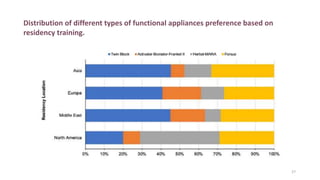
  • 90.
    • In classII cases with normal vertical proportions, magnets are placed distal to upper canine and distal to lower first premolars • In class II deep bite situations, inclination of the magnets and subsequent magnetic force orientation is such that to produce dental extrusion in premolar – molar area located more posteriorly and produce an Attracting Force between them. Class II-deep bite with magnets in attraction. Force direction indicated by arrows 90
  • 91.
    • In classII open bite situation • A pair of repelling magnets can be used posteriorly – to produce molar and premolar intrusion, some distal movements in the upper arch, pushes the mandible downward and forward. • A pair of attracting magnets located at the retroincisal area help to achieve symmetry, align the upper and lower midlines, and stabilize the appliance against rippling forces. Class II open bite situation in detail. Arrows show dental effects produced by magnets in repulsion and in attraction, as well as probable maxillary and mandibular rotations, * and" are center of resistance of the dentoalveolar segment and the maxillary complex, respectively. 91
  • 92.
    MAD IV forskeletal open bite (JCO 1995- Sep Darendeliler & Semayuksel) • Appliance: Consists of removable upper and lower plates. • Uses Neodymium (Nd2Fe17B) magnets coated with stainless steel. • Consists of 4 posterior repelling magnets which generate a force of 300 gms each for intruding the molars. • 2 anterior attracting midline magnets also generate 300 gms force. • Effect: It guides the mandible into a centered midline position. • Exerts an anterior closing effect. 92
  • 93.
    • MAD IVa– used where the anterior segment of the maxilla is vertically correct. Anterior and posterior magnets in contact. • MAD IVb – used when an additional extrusive effect is needed in the maxillary anterior region. Anterior magnets are placed 2mm apart, posterior magnets in contact • MAD IVc – used when only anterior extrusion is needed posterior magnets are omitted. Anterior magnets 1-2mm open 93
  • 94.
    Herren Shaye activator(1953) • According to Herren mandible with an activator during sleep will not maintain its position. • The incisors will detach from the maxillary part when the mandible is lowered, this will lessen the effectiveness of the appliance. • To maintain correct mandibular posture during sleep the following modification was done: 1. The mandible is advanced forward 3-4 mm beyond the neutral relationship 2. Jackson clasp, Duyzing clasp, or Triangular arrowhead clasp are used for retention of the appliance on the maxillary dentition. 3. To hold the appliance in position during sleep long lingual flanges were constructed 4. The posterior teeth were allowed to erupt occlusally whereas eruption of lower incisors was impeded by acrylic plane thus leveling the curve of spee 94
  • 95.
    Louisiana State University(LSU) or Activator of Shaye (1953), a modification of Herren activator by R Shaye. • LSU activators cause sagittal repositioning of the mandible to a significant degree and have the following effects: 1. An increase in the forward positioning of the mandible causes a stretch in the retractor muscles. This new positioning of the lower jaw leads to a new sensory engram. 2. This appliance works on the phantom activator phenomenon. 95
  • 96.
    Nocturnal airway patencyappliance (1987) Designed by Peter T George. • NAPA was fabricated to keep the airway patent during sleep by posturing the tongue more anteriorly by the mandibular protrusion. 96
  • 97.
    Combined Activator /Hg Orthopedics 1969, Introduced by Hasmond. • Prime target of treatment concept employing activator and HG combination is to restrict developmental contributions that tend towards a Skeletal class II and to enhance developmental contributions that tend to harmonize the Anteroposterior relations of maxillo mandibular structures. 97
  • 98.
    Activator + HeadgearCombinations Few A/HG combinations appliances are: 1. Pfeiffer Grobetty. 2. Teuscher-Stockli. Modified Teucher Activator. 3. Van Beek Activator. 4. Lehman activator. 98
  • 99.
    Extraoral force levels 1.Full mixed dentition 300 to 400mg 2. Mixed dentition 150 to 250mg 3. Full permanent dentition 400 to 600mg 4. Retention 150 to 400mg 99
  • 100.
    1. Pfeiffer &Grobety (1975) Correction of skeletal class 2 MO • Promotes mesial movement of lower teeth • Inhibits maxillary growth • Cervical EO Force • Distal movement of anchor molar • Tipping of anterior • Extrusion of upper molars- opening bite & rotating mandible downward and backwards • Construction bite: 2-3mm short of most protrusive & 3-4mm beyond freeway space. 100
  • 101.
    2. Teuscher-Stockli activator/headgear combination appliance (1978) • It is a modified activator in combination with a high pull headgear. • At the level of a maxillary second premolar or first molar buccal headgear tubes are incorporated in the inter-occlusal acrylic • Incisal capping • 400gm of force per side • Construction bite: Transitional approach forward positioning. 101
  • 102.
    • Modified TeucherActivator (2006) • It is modification of Teuscher activator designed mainly to control upper incisor inclination. • Headgear tube is present in the premolar region for the use of high pull headgear. 102
  • 103.
    3. Van BeekActivator (1982) Headgear-activator combination appliance. • Between incisors a short and strong outer bow is embedded in acrylic of the activator. • Both upper and lower incisors are covered by acrylic. • Mandibular position is achieved by lingual flange. 103
  • 104.
    4. Lehman activator(1988) • It is a combination activator-headgear appliance. • The design comprises of a maxillary acrylic plate to which rigid outer bows are attached and a mandibular lingual shield. • It also comprises of two expansion screws (one anterior and one posterior) by which selective expansion is possible. • A head strap is attached to the outer bows through which occipital traction is applied. • Maxillary plate and mandibular shield are connected by means of two heavy S-shaped wires. • Construction bite: In this appliance, bite registration is taken in centric occlusion. 104
  • 105.
    • Regardless ofwhether headgear activator treatment of excessive overjet was performed in MD (at the age of 9) or in the LMD (at the age of 11)., the costs and treatment effects were equal. • The most pronounced effects of treatment were the reduction of overjet and improved molar relation, while a modest improvement effect was found on oral health-related quality of life (OHRQoL), lip closure, and trauma incidences. • If an early treatment approach is considered, it may be advocated to start treatment as early as possible, that is, in the MD to enhance trauma prevention. • However, early treatment for trauma prevention should be initiated soon after the eruption of the permanent incisors (Koroluk, Tulloch et al. 2003). Jenny Kallunki J, Bondemark L, Paulsson L. Comparisons of costs and treatment effects— an RCT on headgear activator treatment of excessive overjet in the mixed and late mixed dentition. Europ J of Orthod.2021:1–9 105
  • 106.
    Preformed Activator: OrthoT Activators • This appliance was constructed by elastomeric material. • These are preformed activators, used in the treatment from early through late mixed dentition. • These appliances coined as EGAs (Eruptive Guidance Appliance) also function as a positioner and in correction of overbite and mild to moderate crowding. 106
  • 107.
    Case report • Kahl-Niekeand Fischbach found that activator appliance therapy in hemifacial microsomia patients showed improvement in function and occlusion & facial asymmetry were reduced. • When the construction bite is taken in such cases, the mandible is kept in a slightly forward and overcompensated position which causes a change in muscle activity that has led to enhanced bone apposition and optimal growth direction of the condyle. Kahl-Nieke B, Fischbach R. Effect of early orthopedic intervention on hemifacial microsomia patients: An approach to a cooperative evaluation of treatment results. Am J Orthod Dentofacial Orthop 1998;114:538-50. 107
  • 108.
    Extraoral view. Pretreatment, after1 year, after 3 years and after 5 years of treatment at the age of 10. Note the continuous improvement of facial symmetry. Patient with mandibular dysostosis The three-dimensional display illustrates the reduced length of the right condylar process and significantly increased length of the coronoid process, as well as the anteromedial joint position, flattening of both the articular eminence, and the glenoid fossa. 108 After 2 1/2 years of functional treatment, at the age of 7 years and 5 months, the first axial CT revealed a hypoplastic triangular right and an ellipsoid left condyle of normal size
  • 109.
    Construction bite: Notethe severe midline deviation to the affected right side and its correction by means of the construction bite. After 5 years of treatment 109 Extraoral view. Before and after treatment with an activator Pretreatment After 5 years of treatment at the age of 10. Pretreatment Intraoral view. Before and after treatment with an activator
  • 110.
    Conclusion Both skeletal anddentoalveolar changes can be achieved in activator functional appliance therapy. Depending on the timing and trimming of the appliance, significant facial and occlusal changes can be achieved. In addition to the elimination of abnormal perioral muscle function, growth guidance is the major contributor to the correction of malocclusion. 110
  • 111.
    Bibliography 1. Dentofacial orthopedicswith functional appliances (Thomas - M.Graber, Thomas Rakosi, Alexander petrovic) 2. Removable Orthodontic appliances (T.M.Grater Bedrich Neumann) 3. Current orthodontic concepts andTechniques (T.M.Graber, Brainerd .F.Swain) 4. Orthodontics - Current Principles and Techniques (T.M.Graber, Robert L.Vanarsdall ) 5. Mohammed K Badri, Orthodontists’ Preferences and Selection Criteria for Functional Appliances, J Res Med Dent Sci, 2021, 9 (3): 64-71. 6. Bishara S E, Ziaja R R. Functional appliances: A review. Am J Orthod Dentofac Orthop.1989;95:250-8. 7. Kaur S, Soni S, Prashar A, Bansal N, Brar JS, Kaur M. Functional appliances. Indian J Dent Sci 2017;9:276-81. 111
  • 112.
    8. Parkar A,Vibhute PK, Patil C, Umale V, Balagangadhar, The activator and its modification - A review. Indian J Orthod Dentofacial Res 2019;5(2):41- 6. 9. Kahl-Nieke B, Fischbach R. Effect of early orthopedic intervention on hemifacial microsomia patients: An approach to a cooperative evaluation of treatment results. Am J Orthod Dentofacial Orthop 1998;114:538-50. 10. Mehta F, Patel D, Mehta N. Activator: Simple yet effective functional appliance for skeletal class II correction: Case report. Int J Healthc Biomed Res 2013;1:180-9. 11. Nielsen I L. Is Early Treatment with Functional Appliances Worth the Effort? A Discussion of the Pros and Cons of Early Interceptive Treatment. Taiwanese Journal of Orthodontics. 29(3): 155-167, 2017. 12. Fleming PS. Timing orthodontic treatment: early or late? Aus Dent J.2017;62(1):11–19. 112
  • 113.
    12. Hirzel HC, Grewe J M. Activators: A practical approach. Am. J. Orthod. November 1914: 557-590. 13. Pavoni C, Lombardo E C, Lione R, Faltin K, McNamara J A, Cozza P, Franchi L. Treatment timing for functional jaw orthopaedics followed by fixed appliances: a controlled long-term study. Eur J Orthod. 2017:1–7. 14. Cozza P, De Toffol L, Iacopini L. An Analysis of the Corrective Contribution in Activator Treatment. Angle Orthod 2004;74:741–748. 15. Herren P, Berne, Switzerland. Activator’s Mode Of Action. Am J Orthod. 1959;45(7):512-27. 16. Jergensen S E. Activators in orthodontic treatment: Indications and advantages. Am. J. Orthod. 1974;65(3):260-90. 113
  • 114.
    17. S Barton,P A Cook. Predicting functional appliance treatment outcome in Class II malocclusion.Am J Orthod Dentofac Orthop 1997; 112(3):282-6. 18. Jenny Kallunki J, Bondemark L, Paulsson L. Comparisons of costs and treatment effects— an RCT on headgear activator treatment of excessive overjet in the mixed and late mixed dentition. Europ J of Orthod.2021:1–9 19. Wahl N. Orthodontics in 3 millennia. Chapter 9: Functional appliances to midcentury.Am J Orthod Dentofacial Orthop 2006;129:829-33 20. Chalasani S, Kumar J, Prasad M, Shetty BSK, Kumar TA. An Evaluation of Skeletal Maturation by Hand- Wrist Bone Analysis and Cervical Vertebral Analysis: A Comparitive Study. J Indian Orthod Soc 2013;47(4):433-437. 21. Darendeliler M A, Joho J P. Magnetic activator device 11 (MAD II) for correction of Class 11, Division I malocclusions. Am J Orthod Dentofac Orthop 1993;103:223-39 22. Owtad P, Park JH, Shen G, Potres Z, Darendeliler MA. The Biology of TMJ Growth Modification: A Review J Dent Res. 2013;92(4):315-21. 114
  • 115.

Editor's Notes

  • #6 Glossoptosis is a medical condition and abnormality which involves the downward displacement or retraction of the tongue. glossoptosis syndrome (ectomorphic constitution, adenoid facies, mouth breathing, high palate, and other problems).
  • #10 Activators with low vertical dimension construction bite. Isometric contractions generate force without changing the length of the muscle
  • #11 Visco elastic property: the property of a substance of exhibiting both elastic and viscous behaviour. Activators with high vertical dimension construction bite
  • #13 Isometric muscle contractions- Kinetic energy Viscoelastic muscle contraction- Potential energy
  • #15  Radiographic technique in which the images of tissues above and below the plane of interest are blurred out to show a specific area more clearly.
  • #27 FORSUS- Fatigue Resistant Device The Mandibular Anterior Repositioning Appliance (MARA)
  • #36 Early mixed dentition (6 to 9 years of age). Late mixed dentition – (10 to 12 years)
  • #44 Forecast the treatment result and Motivates the patient
  • #48 Eschler (1952) termed the condition a pathologic construction bite: An incisor (usually a lateral) has erupted markedly to the lingual, the mandible must be postured anteriorly to an edge-to-edge relationship with the lingually malposed tooth; otherwise, labial movement of this tooth will be impossible.
  • #51 1. Supporting Studies Harvold, Woodside (1983) stated that pterygoid response was due to altered muscular balance resulting in a tension zone‘ distal to the condyle. Limitations: This phenomenon can only be observed with functional appliances that are worn full-time like twin block appliances and fixed functional appliances.
  • #53 A dental alveolar compensation is possible by extrusion of lower molars and distal driving of upper molars with stabilizing wires.
  • #58 If larger occlusal surfaces are loaded, a reflex opening occurs frequently resulting in less depressing action by the appliance.
  • #65 State of equilibrium
  • #75 To enhance appliance retention, the occlusal surface of buccal teeth is covered with acrylic. The construction of such an appliance is facilitated by a screw designed by WEISE.
  • #78 The appliance exerts a delicate influence on the dentition and on the TMJ. Can be combined simultaneously with fixed appliances particularly when there are severe rotations. With patient cooperation correction can be achieved rather quickly in 5 – 8 months in favorable cases. Duration of wear: at least 3 hours during the day and during sleeping hours.
  • #85 Adv: Offsets any functional dominance of posterior temporalis fibers seen in class II div 1 MO, eliminating any functional retrusive tendencies.
  • #88 There is no actual joining of maxillary and mandibular arches.???
  • #93 Enhances Anterior Rotation Of The Mandible.
  • #94 MAD IVa – used where the anterior segment of the maxilla is vertically correct. (or) overdeveloped gummy smile. Anterior and posterior magnets in contact.
  • #96 Patients who wear activators posture their mandibles forward with no conscious effort, even during the daytime when the appliance is not worn. This is what I have referred to as the "phantom activator phenomenon", and it is an early response to treatment. An increase in the forward positioning of the mandible causes a stretch in the retractor muscles whereas the protractor muscles (lateral pterygoid) are slackened. According to Herren wearing of this appliance would not increase lateral pterygoid muscle (LPM) activity.
  • #102 It was designed to avoid the detrimental profile effects of cervical tractions during the treatment of class II malocclusion in growing individuals. ??????
  • #108 Hemifacial microsomia is a condition in which half of one side of the face is underdeveloped and does not grow normally.