JRF/ASCC ‘Simple but not simplistic –
developing evidence enriched practice’
project
JRF ‘A Better Life’ programme
Four strands of work:
• Care homes (My Home Life) – a
three year ‘voice, choice and
control’ project including
leadership programme for
managers
• Housing with care – three main
projects with a view to
supporting development of
seamless care (quality of life,
affordability, relationships)
• Alternative approaches – e.g.
housing co-ops, Shared Lives,
Homeshare, Debenham Project
• Vision and mission – what makes
a better life not just better
services – seven key challenges
http://www.jrf.org.uk/topic/betterlife
http://betterlife.jrf.org.uk/poem.html
http://www.youtube.com/watch?v=Kda
dD6eSFQ4&feature=youtu.be
ASCC ‘Developing Evidence Enriched
Practice (DEEP)’ project
• Working with a number of national and local
agencies to explore the effective use of evidence in
practice
National agencies Local agencies
Social Services Improvement Agency Gwalia
Care Council for Wales Neath & Port Talbot
Care and Social Services Inspectorate
Wales
Bridgend County Borough Council
Older People’s Commissioner Carmarthenshire County Council
Age Cymru (My Home Life Cymru
programme)
Monmouthshire County Council
JRF/ASCC ‘Simple but not Simplistic’
project -what we want to achieve
• An action learning programme of service and
workforce development in each site using the
DEEP principles – focusing on topics that matter
to agencies and practitioners and using ‘A Better
Life’ and other evidence (see later)
• Find out how practitioners engage with evidence
and use it to develop their thinking and practice
• Find out how the organisations they work for can
support or undermine this
Some key principles behind the DEEP
approach
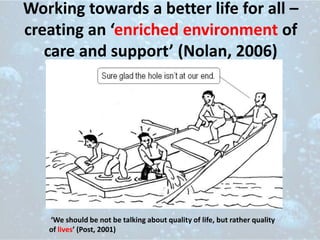
Working towards a better life for all –
creating an ‘enriched environment of
care and support’ (Nolan, 2006)
‘We should be not be talking about quality of life, but rather quality
of lives’ (Post, 2001)
Drawing on Appreciative Inquiry –
building on good practice, not picking
holes
• ‘Appreciative Inquiry is
the co-operative search
for the best in people,
their organisations, and
the world around them.
It involves systematic
discovery of what gives a
system “life” when it is
most effective and
capable’ (Cooperrider et
al. 2007)
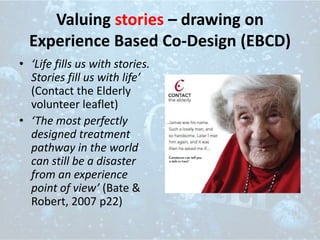
Valuing stories – drawing on
Experience Based Co-Design (EBCD)
• ‘Life fills us with stories.
Stories fill us with life’
(Contact the Elderly
volunteer leaflet)
• ‘The most perfectly
designed treatment
pathway in the world
can still be a disaster
from an experience
point of view’ (Bate &
Robert, 2007 p22)
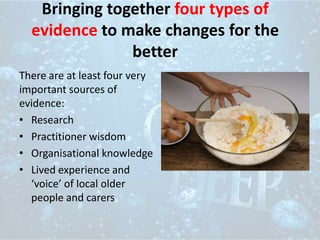
Bringing together four types of
evidence to make changes for the
better
There are at least four very
important sources of
evidence:
• Research
• Practitioner wisdom
• Organisational knowledge
• Lived experience and
‘voice’ of local older
people and carers
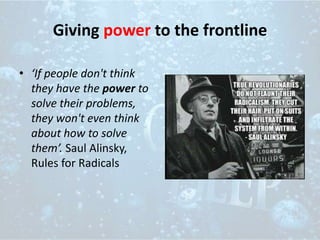
Giving power to the frontline
• ‘If people don't think
they have the power to
solve their problems,
they won't even think
about how to solve
them’. Saul Alinsky,
Rules for Radicals
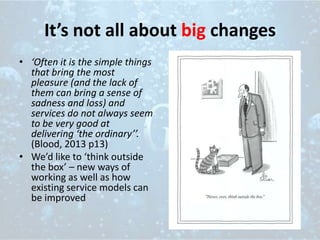
It’s not all about big changes
• ‘Often it is the simple things
that bring the most
pleasure (and the lack of
them can bring a sense of
sadness and loss) and
services do not always seem
to be very good at
delivering ‘the ordinary’’.
(Blood, 2013 p13)
• We’d like to ‘think outside
the box’ – new ways of
working as well as how
existing service models can
be improved
Three things need to be right
• Frontline staff
engagement with
evidence (e.g.
understanding about
loneliness, human
rights approach to risk)
• Embedded systems (e.g.
forms and processes)
• Organisational culture
(e.g. valuing, permissive
and empowering)
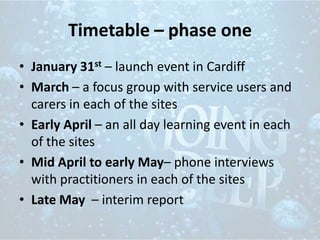
Timetable – phase one
• January 31st – launch event in Cardiff
• March – a focus group with service users and
carers in each of the sites
• Early April – an all day learning event in each
of the sites
• Mid April to early May– phone interviews
with practitioners in each of the sites
• Late May – interim report
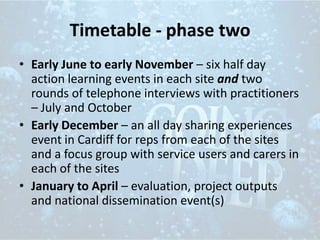
Timetable - phase two
• Early June to early November – six half day
action learning events in each site and two
rounds of telephone interviews with practitioners
– July and October
• Early December – an all day sharing experiences
event in Cardiff for reps from each of the sites
and a focus group with service users and carers in
each of the sites
• January to April – evaluation, project outputs
and national dissemination event(s)

JRF/ASCC ‘Simple but not simplistic – developing evidence enriched practice’ project

  • 1.
    JRF/ASCC ‘Simple butnot simplistic – developing evidence enriched practice’ project
  • 2.
    JRF ‘A BetterLife’ programme Four strands of work: • Care homes (My Home Life) – a three year ‘voice, choice and control’ project including leadership programme for managers • Housing with care – three main projects with a view to supporting development of seamless care (quality of life, affordability, relationships) • Alternative approaches – e.g. housing co-ops, Shared Lives, Homeshare, Debenham Project • Vision and mission – what makes a better life not just better services – seven key challenges http://www.jrf.org.uk/topic/betterlife http://betterlife.jrf.org.uk/poem.html http://www.youtube.com/watch?v=Kda dD6eSFQ4&feature=youtu.be
  • 3.
    ASCC ‘Developing EvidenceEnriched Practice (DEEP)’ project • Working with a number of national and local agencies to explore the effective use of evidence in practice National agencies Local agencies Social Services Improvement Agency Gwalia Care Council for Wales Neath & Port Talbot Care and Social Services Inspectorate Wales Bridgend County Borough Council Older People’s Commissioner Carmarthenshire County Council Age Cymru (My Home Life Cymru programme) Monmouthshire County Council
  • 4.
    JRF/ASCC ‘Simple butnot Simplistic’ project -what we want to achieve • An action learning programme of service and workforce development in each site using the DEEP principles – focusing on topics that matter to agencies and practitioners and using ‘A Better Life’ and other evidence (see later) • Find out how practitioners engage with evidence and use it to develop their thinking and practice • Find out how the organisations they work for can support or undermine this
  • 5.
    Some key principlesbehind the DEEP approach
  • 6.
    Working towards abetter life for all – creating an ‘enriched environment of care and support’ (Nolan, 2006) ‘We should be not be talking about quality of life, but rather quality of lives’ (Post, 2001)
  • 7.
    Drawing on AppreciativeInquiry – building on good practice, not picking holes • ‘Appreciative Inquiry is the co-operative search for the best in people, their organisations, and the world around them. It involves systematic discovery of what gives a system “life” when it is most effective and capable’ (Cooperrider et al. 2007)
  • 8.
    Valuing stories –drawing on Experience Based Co-Design (EBCD) • ‘Life fills us with stories. Stories fill us with life’ (Contact the Elderly volunteer leaflet) • ‘The most perfectly designed treatment pathway in the world can still be a disaster from an experience point of view’ (Bate & Robert, 2007 p22)
  • 9.
    Bringing together fourtypes of evidence to make changes for the better There are at least four very important sources of evidence: • Research • Practitioner wisdom • Organisational knowledge • Lived experience and ‘voice’ of local older people and carers
  • 10.
    Giving power tothe frontline • ‘If people don't think they have the power to solve their problems, they won't even think about how to solve them’. Saul Alinsky, Rules for Radicals
  • 11.
    It’s not allabout big changes • ‘Often it is the simple things that bring the most pleasure (and the lack of them can bring a sense of sadness and loss) and services do not always seem to be very good at delivering ‘the ordinary’’. (Blood, 2013 p13) • We’d like to ‘think outside the box’ – new ways of working as well as how existing service models can be improved
  • 12.
    Three things needto be right • Frontline staff engagement with evidence (e.g. understanding about loneliness, human rights approach to risk) • Embedded systems (e.g. forms and processes) • Organisational culture (e.g. valuing, permissive and empowering)
  • 13.
    Timetable – phaseone • January 31st – launch event in Cardiff • March – a focus group with service users and carers in each of the sites • Early April – an all day learning event in each of the sites • Mid April to early May– phone interviews with practitioners in each of the sites • Late May – interim report
  • 14.
    Timetable - phasetwo • Early June to early November – six half day action learning events in each site and two rounds of telephone interviews with practitioners – July and October • Early December – an all day sharing experiences event in Cardiff for reps from each of the sites and a focus group with service users and carers in each of the sites • January to April – evaluation, project outputs and national dissemination event(s)