Professionals supporting clients – Survey
Richard Allen, Dione Hills and Kerstin Junge
Initial findings
19th May 2020
The survey
• Aimed at professionals who support clients/service users
therapeutically or in other ways
• Explores how the current situation has affected their work –
both positively and negatively
• Number of responses: About 150 so far since 4th May … but
still collecting more so please share the survey
• So far most responses are from UK – but we’ve received
many also from other countries
https://tavistock.eu.qualtrics.com/jfe/form/SV_3WWyuaI87Ezxg
nH
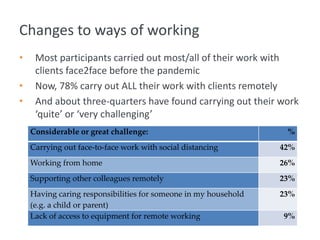
Changes to ways of working
• Most participants carried out most/all of their work with
clients face2face before the pandemic
• Now, 78% carry out ALL their work with clients remotely
• And about three-quarters have found carrying out their work
‘quite’ or ‘very challenging’
Considerable or great challenge: %
Carrying out face-to-face work with social distancing 42%
Working from home 26%
Supporting other colleagues remotely 23%
Having caring responsibilities for someone in my household
(e.g. a child or parent)
23%
Lack of access to equipment for remote working 9%
Examples of challenges experienced:
• “Being able to hold my motivation and the therapeutic frame for
clients when I haven't always felt great. Change to routine, poorer
sleep and diet have all contributed to work and home merging in a
way which hasn't always felt helpful”.
• “Combining work with household chores and looking after and
home schooling primary school aged children”
• “Lack of distraction (chats in the office; gossiping; lunch and coffee
breaks; spontaneous conversations cycling to work) from the
emotions of both work and personal circumstances. It is difficult
to escape from it all and each time I had something challenging to
do I found myself in a very dark place during my preparations”.
Positive aspects of the changes
• “I like the flexibility of the approach and the fact that we can
work internationally and more frequently with clients all over
the world. This has also enabled us to more effectively match
clients to coaches now we are not restricted by geography”.
• “It has enabled us to reach clients more who were previously
anxious to leave their homes or had other commitments
such as childcare or pets that inhibited them from attending
appointments”
• “The opportunity to learn new collaboration tools”.
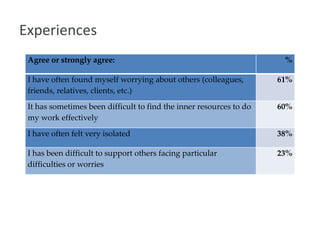
Experiences
Agree or strongly agree: %
I have often found myself worrying about others (colleagues,
friends, relatives, clients, etc.)
61%
It has sometimes been difficult to find the inner resources to do
my work effectively
60%
I have often felt very isolated 38%
I has been difficult to support others facing particular
difficulties or worries
23%
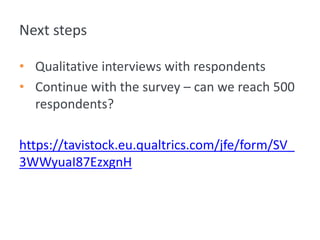
Next steps
• Qualitative interviews with respondents
• Continue with the survey – can we reach 500
respondents?
https://tavistock.eu.qualtrics.com/jfe/form/SV_
3WWyuaI87EzxgnH

Professionals supporting clients

  • 1.
    Professionals supporting clients– Survey Richard Allen, Dione Hills and Kerstin Junge Initial findings 19th May 2020
  • 2.
    The survey • Aimedat professionals who support clients/service users therapeutically or in other ways • Explores how the current situation has affected their work – both positively and negatively • Number of responses: About 150 so far since 4th May … but still collecting more so please share the survey • So far most responses are from UK – but we’ve received many also from other countries https://tavistock.eu.qualtrics.com/jfe/form/SV_3WWyuaI87Ezxg nH
  • 3.
    Changes to waysof working • Most participants carried out most/all of their work with clients face2face before the pandemic • Now, 78% carry out ALL their work with clients remotely • And about three-quarters have found carrying out their work ‘quite’ or ‘very challenging’ Considerable or great challenge: % Carrying out face-to-face work with social distancing 42% Working from home 26% Supporting other colleagues remotely 23% Having caring responsibilities for someone in my household (e.g. a child or parent) 23% Lack of access to equipment for remote working 9%
  • 4.
    Examples of challengesexperienced: • “Being able to hold my motivation and the therapeutic frame for clients when I haven't always felt great. Change to routine, poorer sleep and diet have all contributed to work and home merging in a way which hasn't always felt helpful”. • “Combining work with household chores and looking after and home schooling primary school aged children” • “Lack of distraction (chats in the office; gossiping; lunch and coffee breaks; spontaneous conversations cycling to work) from the emotions of both work and personal circumstances. It is difficult to escape from it all and each time I had something challenging to do I found myself in a very dark place during my preparations”.
  • 5.
    Positive aspects ofthe changes • “I like the flexibility of the approach and the fact that we can work internationally and more frequently with clients all over the world. This has also enabled us to more effectively match clients to coaches now we are not restricted by geography”. • “It has enabled us to reach clients more who were previously anxious to leave their homes or had other commitments such as childcare or pets that inhibited them from attending appointments” • “The opportunity to learn new collaboration tools”.
  • 6.
    Experiences Agree or stronglyagree: % I have often found myself worrying about others (colleagues, friends, relatives, clients, etc.) 61% It has sometimes been difficult to find the inner resources to do my work effectively 60% I have often felt very isolated 38% I has been difficult to support others facing particular difficulties or worries 23%
  • 7.
    Next steps • Qualitativeinterviews with respondents • Continue with the survey – can we reach 500 respondents? https://tavistock.eu.qualtrics.com/jfe/form/SV_ 3WWyuaI87EzxgnH