PARTICIPATORY ACTION RESEARCH
BY : SIXTH GROUP
KABAI ILHAM
AFDALIAH AMIN
A. HALIMAH KHIBAR
Definition of Participatory Action Research
 Participatory action research is systematic
inquiry conducted by teacher researchers,
principals, school counselors, or other
stakeholders in the teaching learning
environment that involves gathering
information about the ways in which their
particular schools operate, the teachers
teach and the students learn.
The purpose of participatory action
research
 The purpose of action research is to provide teacher
researchers with a method for solving everyday
problems in school,’ so that may improve both student
learning and teacher effectiveness
 Action research is research done by teachers, for
themselves, it is not imposed on them by someone
else.
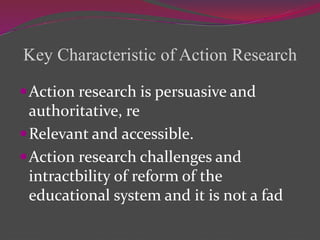
Key Characteristic of Action Research
Action research is persuasive and
authoritative, re
Relevant and accessible.
Action research challenges and
intractbility of reform of the
educational system and it is not a fad
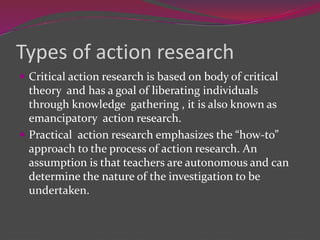
Types of action research
 Critical action research is based on body of critical
theory and has a goal of liberating individuals
through knowledge gathering , it is also known as
emancipatory action research.
 Practical action research emphasizes the “how-to”
approach to the process of action research. An
assumption is that teachers are autonomous and can
determine the nature of the investigation to be
undertaken.
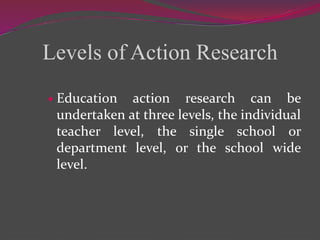
Levels of Action Research
 Education action research can be
undertaken at three levels, the individual
teacher level, the single school or
department level, or the school wide
level.
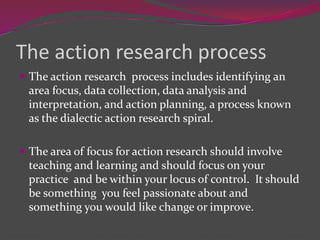
The action research process
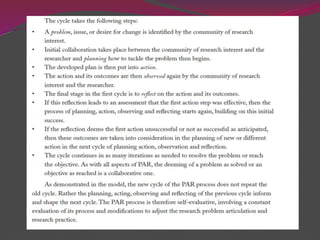
 The action research process includes identifying an
area focus, data collection, data analysis and
interpretation, and action planning, a process known
as the dialectic action research spiral.
 The area of focus for action research should involve
teaching and learning and should focus on your
practice and be within your locus of control. It should
be something you feel passionate about and
something you would like change or improve.
 Insight into an area of focus can be gained through self-
reflection, descriptive activities, and something you would
like to change or improve.
 Insight into an area of focus can be gained through self-
reaction, descriptive activities and explanatory activities.
 Data collection techniques used in action research depend
on the area focus.
 Qualitative data collection techniques are more often
applied to action research problems than are quantitative
methods and design. Teachers do not
 Data Collection techniques used in action research
depend on the area focus.
 Data collection techniques used in action research
depend on the area focus.
 Qualitative data collection techniques are more often
apllied to action research
 'Action research is a process of systematic
reflection,
 enquiry and action carried out by individuals
about their
 own professional practice' (Frost, 2002, p. 25).
 'Action research is a term used to describe
professionals
 studying their own practice in order to improve
it'
 (GTCW, 2002a, p. 15).
 'Educational action research is an enquiry which is
 carried out in order to understand, to evaluate and then
 to change, in order to improve some educational practice'
 (Bassey, 1998, p. 93).
 'Action research combines a substantive act with a
 research procedure; it is action disciplined by enquiry,
 3
 Action Research
 a personal attempt at understanding while engaged in a
 process of improvement and reform' (Hopkins, 2002,
 p. 42).
 'When applied to teaching, [action research] involves
 gathering and interpreting data to better understand an
 aspect of teaching and learning and applying the outcomes
 to improve practice* (GTCW, 2002a, p. 15),
 'Action research is a flexible spiral process which allows
 action (change, improvement) and research (understanding,
 knowledge) to be achieved at the same time' (Dick,
 2002).
 'Action research is ... usually described as cyclic, with
 action and critical reflection taking place in turn. The
 reflection is used to review the previous action and plan
 the next one' (Dick, 1997).
 'Action research is ... an approach which has proved to
 be particularly attractive to educators because of its practical,
 problem-solving emphasis ...' (Bell, 1999, p. 10).

Participatory Action Research

  • 1.
    PARTICIPATORY ACTION RESEARCH BY: SIXTH GROUP KABAI ILHAM AFDALIAH AMIN A. HALIMAH KHIBAR
  • 2.
    Definition of ParticipatoryAction Research  Participatory action research is systematic inquiry conducted by teacher researchers, principals, school counselors, or other stakeholders in the teaching learning environment that involves gathering information about the ways in which their particular schools operate, the teachers teach and the students learn.
  • 3.
    The purpose ofparticipatory action research  The purpose of action research is to provide teacher researchers with a method for solving everyday problems in school,’ so that may improve both student learning and teacher effectiveness  Action research is research done by teachers, for themselves, it is not imposed on them by someone else.
  • 4.
    Key Characteristic ofAction Research Action research is persuasive and authoritative, re Relevant and accessible. Action research challenges and intractbility of reform of the educational system and it is not a fad
  • 5.
    Types of actionresearch  Critical action research is based on body of critical theory and has a goal of liberating individuals through knowledge gathering , it is also known as emancipatory action research.  Practical action research emphasizes the “how-to” approach to the process of action research. An assumption is that teachers are autonomous and can determine the nature of the investigation to be undertaken.
  • 6.
    Levels of ActionResearch  Education action research can be undertaken at three levels, the individual teacher level, the single school or department level, or the school wide level.
  • 7.
    The action researchprocess  The action research process includes identifying an area focus, data collection, data analysis and interpretation, and action planning, a process known as the dialectic action research spiral.  The area of focus for action research should involve teaching and learning and should focus on your practice and be within your locus of control. It should be something you feel passionate about and something you would like change or improve.
  • 8.
     Insight intoan area of focus can be gained through self- reflection, descriptive activities, and something you would like to change or improve.  Insight into an area of focus can be gained through self- reaction, descriptive activities and explanatory activities.  Data collection techniques used in action research depend on the area focus.  Qualitative data collection techniques are more often applied to action research problems than are quantitative methods and design. Teachers do not
  • 9.
     Data Collectiontechniques used in action research depend on the area focus.  Data collection techniques used in action research depend on the area focus.  Qualitative data collection techniques are more often apllied to action research
  • 11.
     'Action researchis a process of systematic reflection,  enquiry and action carried out by individuals about their  own professional practice' (Frost, 2002, p. 25).  'Action research is a term used to describe professionals  studying their own practice in order to improve it'  (GTCW, 2002a, p. 15).
  • 12.
     'Educational actionresearch is an enquiry which is  carried out in order to understand, to evaluate and then  to change, in order to improve some educational practice'  (Bassey, 1998, p. 93).  'Action research combines a substantive act with a  research procedure; it is action disciplined by enquiry,  3  Action Research  a personal attempt at understanding while engaged in a  process of improvement and reform' (Hopkins, 2002,  p. 42).
  • 13.
     'When appliedto teaching, [action research] involves  gathering and interpreting data to better understand an  aspect of teaching and learning and applying the outcomes  to improve practice* (GTCW, 2002a, p. 15),  'Action research is a flexible spiral process which allows  action (change, improvement) and research (understanding,  knowledge) to be achieved at the same time' (Dick,  2002).  'Action research is ... usually described as cyclic, with  action and critical reflection taking place in turn. The  reflection is used to review the previous action and plan  the next one' (Dick, 1997).  'Action research is ... an approach which has proved to  be particularly attractive to educators because of its practical,  problem-solving emphasis ...' (Bell, 1999, p. 10).