Alfredo Bambang
2012 060 193
Klasifikasi Acinetobacter
Kingdom

Bacteria

Phylum

Proteobacteria

Class

Gammaproteobacteria

Order

Pseudomonadales

Family

Moraxellaceae

Genus

Acinetobacter
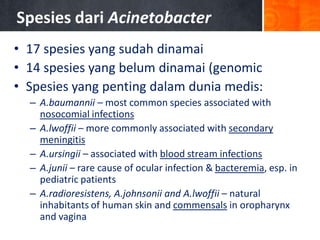
Spesies dari Acinetobacter
• 17 spesies yang sudah dinamai
• 14 spesies yang belum dinamai (genomic
• Spesies yang penting dalam dunia medis:
– A.baumannii – most common species associated with
nosocomial infections
– A.lwoffii – more commonly associated with secondary
meningitis
– A.ursingii – associated with blood stream infections
– A.junii – rare cause of ocular infection & bacteremia, esp. in
pediatric patients
– A.radioresistens, A.johnsonii and A.lwoffii – natural
inhabitants of human skin and commensals in oropharynx
and vagina
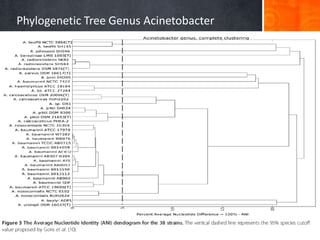
Phylogenetic Tree Genus Acinetobacter
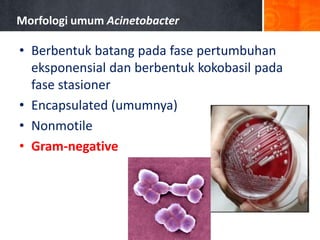
Morfologi umum Acinetobacter

• Berbentuk batang pada fase pertumbuhan
eksponensial dan berbentuk kokobasil pada
fase stasioner
• Encapsulated (umumnya)
• Nonmotile
• Gram-negative
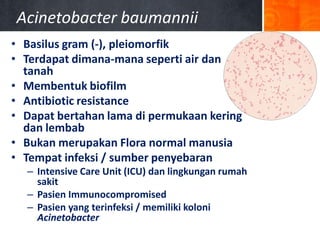
Acinetobacter baumannii
• Basilus gram (-), pleiomorfik
• Terdapat dimana-mana seperti air dan
tanah
• Membentuk biofilm
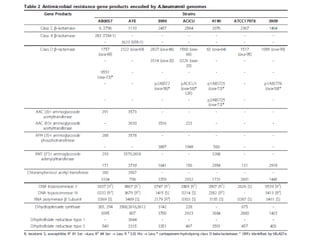
• Antibiotic resistance
• Dapat bertahan lama di permukaan kering
dan lembab
• Bukan merupakan Flora normal manusia
• Tempat infeksi / sumber penyebaran
– Intensive Care Unit (ICU) dan lingkungan rumah
sakit
– Pasien Immunocompromised
– Pasien yang terinfeksi / memiliki koloni
Acinetobacter
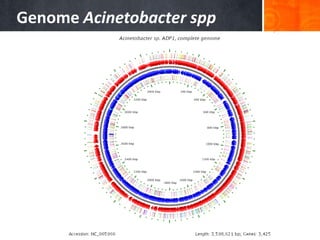
Genome Acinetobacter spp
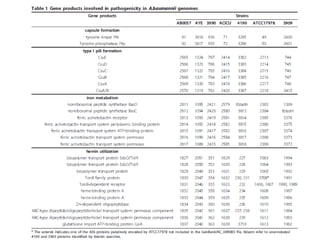
Gen-gen yang berperan dalam patogenitas
Acinetobacter

•
•
•
•

Gen pembentuk kapsul
Gen pili tipe I
Gen metabolisme zat besi (Fe)
Gen yang berperan dalam penggunaan hemin
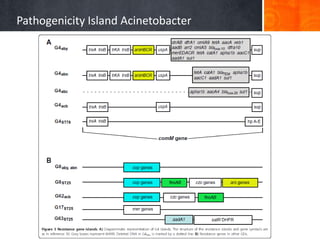
Pathogenicity Island Acinetobacter
Mekanisme transfer materi genetik
•
•
•
•
•
•

Transformasi
Konjugasi
Transduksi
Plasmid
Transposon (gen-gen resistensi antibiotik)
Integron
– Banyak isolat Acinetobacter yang telah diteliti memiliki
integron dalam kromosomnya
– Sebagian besar cassette yang telah diidentifikasi
berhubungan dengan resistensi antibiotik
– Integron adalah komponen genetik yang sifatnya
conserved, integron mengkode komponen site specific
recombination system yang membuat Acinetobacter dapat
melakukan insersi, delesi, dan rearrangement dari genetic
cassettes dalam struktur integron.
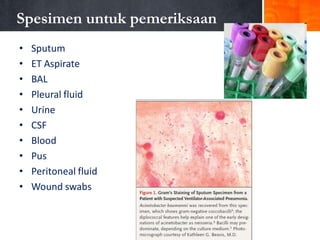
Spesimen untuk pemeriksaan
•
•
•
•
•
•
•
•
•
•

Sputum
ET Aspirate
BAL
Pleural fluid
Urine
CSF
Blood
Pus
Peritoneal fluid
Wound swabs
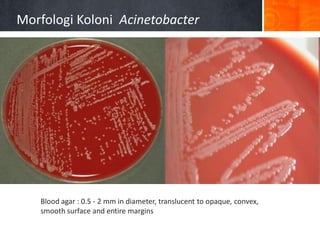
Morfologi Koloni Acinetobacter

Blood agar : 0.5 - 2 mm in diameter, translucent to opaque, convex,
smooth surface and entire margins
MacConkey agar : non lactose fermenting colonies
Media Selektif untuk Acinetobacter
• Herellea agar (modifikasi medium Mandel et al
untuk Acinetobacter)
• Holton’s agar
• Leeds Acinetobacter medium
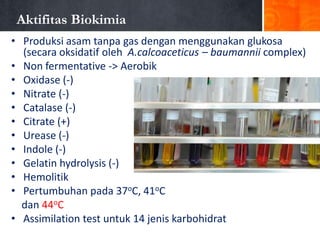
Aktifitas Biokimia
• Produksi asam tanpa gas dengan menggunakan glukosa
(secara oksidatif oleh A.calcoaceticus – baumannii complex)
• Non fermentative -> Aerobik
• Oxidase (-)
• Nitrate (-)
• Catalase (-)
• Citrate (+)
• Urease (-)
• Indole (-)
• Gelatin hydrolysis (-)
• Hemolitik
• Pertumbuhan pada 37oC, 41oC
dan 44oC
• Assimilation test untuk 14 jenis karbohidrat
Diagnosis Molekuler
•
•
•
•
•
•

DNA – DNA hybridization : reference method of choice
Amplified 16S rRNA gene Restriction Analysis (ARDRA)
Amplified Fragment Length Polymorphism (AFLP)
Ribotyping
tRNA spacer fingerprinting
Analisis restriksi dari16S-23S rRNA intergenic spacer
sequences
• Analisis Sekuens gen 16S-23S rRNA gene spacer region
• Deteksi BlaOXA-51 like carbapenemase gene (A.
baumannii)
• gyrB gene based PCR untuk mengidentifikasi
A.baumannii dan genomo-species 13TU
EPIDEMIOLOGICAL TYPING METHODS
•
•
•
•
•
•
•

Biotyping
Antibiograms
Serotyping
Phage typing
Bacteriocin typing
Protein profiles
Pulsed Field Gel Electrophoresis (PFGE) - reference
method of choice
• Multi-locus Enzyme Electrophoretic typing
• Plasmid profiling
• Ribotyping
Identifikasi Species Acinetobacter
• Acinetobacter calcoaceticus-baumanii
complex: glucose-oxidising nonhemolytic,
(A.baumannii dapat diidentifikasi dengan OXA51 typing)
• Acinetobacter lwoffii: glucose-negative
nonhemolytic
• Acinetobacter haemolyticus: haemolytic pada
agar darah
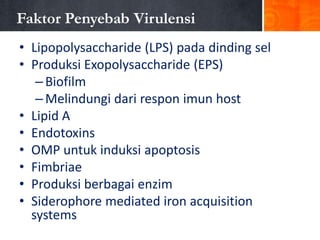
Faktor Penyebab Virulensi
• Lipopolysaccharide (LPS) pada dinding sel
• Produksi Exopolysaccharide (EPS)
– Biofilm
– Melindungi dari respon imun host
• Lipid A
• Endotoxins
• OMP untuk induksi apoptosis
• Fimbriae
• Produksi berbagai enzim
• Siderophore mediated iron acquisition
systems
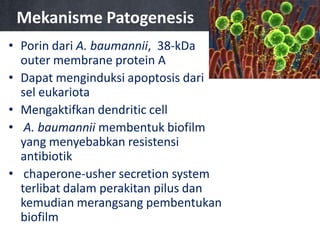
Mekanisme Patogenesis
• Porin dari A. baumannii, 38-kDa
outer membrane protein A
• Dapat menginduksi apoptosis dari
sel eukariota
• Mengaktifkan dendritic cell
• A. baumannii membentuk biofilm
yang menyebabkan resistensi
antibiotik
• chaperone-usher secretion system
terlibat dalam perakitan pilus dan
kemudian merangsang pembentukan
biofilm
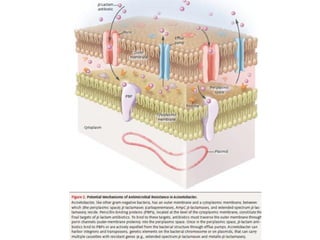
Mekanisme resistensi antibiotik dari A. baumannii

•
•
•
•

Aminoglycosides-modifying enzymes
Broad-spectrum β-lactamases
Carbapenamases
Perubahan baik dari kualitas atau kuantitas
porin membran luar
• Altered penicillin-binding proteins.
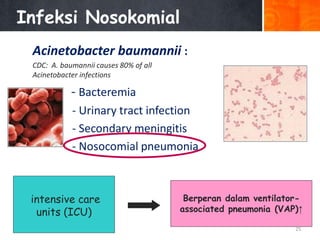
Infeksi Nosokomial
Acinetobacter baumannii :
CDC: A. baumannii causes 80% of all
Acinetobacter infections

- Bacteremia
- Urinary tract infection
- Secondary meningitis
- Nosocomial pneumonia

intensive care
units (ICU)

Berperan dalam ventilatorassociated pneumonia (VAP)↑
25
Infeksi yang disebabkan Acinetobacter
•
•
•
•
•
•
•
•

Ventilator-associated pneumonia
Urinary tract
Bloodstream infection infection
Secondary meningitis
Skin/wound infections
Endocarditis
CAPD-associated peritonitis
Ventriculitis
Acinetobacter Ventilator-Associated Pneumonia

Risk factors:
–
–
–
–
–
–
–

Usia Lanjut
Penyakit Paru Kronis
Immunosuppressi
Operasi
Penggunaan antimikroba
Invasive devices
Dirawat di ICU secara berkepanjangan
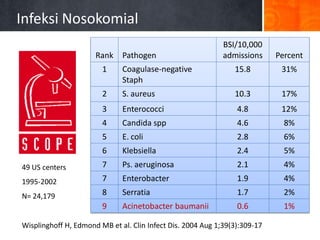
Infeksi Nosokomial
Rank

Pathogen

BSI/10,000
admissions

Percent

1

Coagulase-negative
Staph

15.8

31%

2

S. aureus

10.3

17%

3

Enterococci

4.8

12%

4

Candida spp

4.6

8%

5

E. coli

2.8

6%

6

Klebsiella

2.4

5%

49 US centers

7

Ps. aeruginosa

2.1

4%

1995-2002

7

Enterobacter

1.9

4%

N= 24,179

8

Serratia

1.7

2%

9

Acinetobacter baumanii

0.6

1%

Wisplinghoff H, Edmond MB et al. Clin Infect Dis. 2004 Aug 1;39(3):309-17
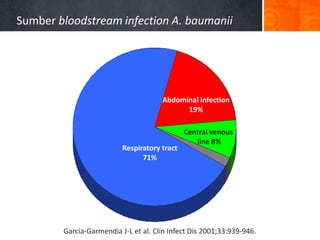
Sumber bloodstream infection A. baumanii

Abdominal infection
19%

Respiratory tract
71%

Central venous
line 8%

N=37
Garcia-Garmendia J-L et al. Clin Infect Dis 2001;33:939-946.
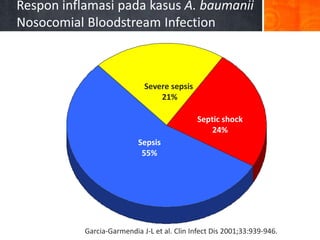
Respon inflamasi pada kasus A. baumanii
Nosocomial Bloodstream Infection

Severe sepsis
21%
Septic shock
24%
Sepsis
55%

N=42
Garcia-Garmendia J-L et al. Clin Infect Dis 2001;33:939-946.
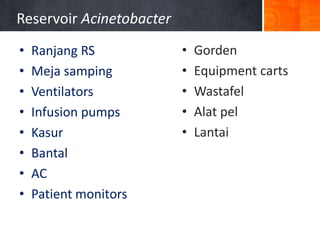
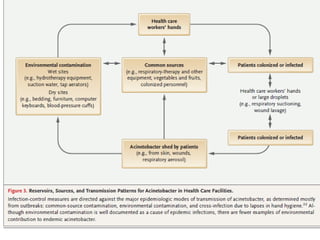
Reservoir Acinetobacter
•
•
•
•
•
•
•
•

Ranjang RS
Meja samping
Ventilators
Infusion pumps
Kasur
Bantal
AC
Patient monitors

•
•
•
•
•

Gorden
Equipment carts
Wastafel
Alat pel
Lantai
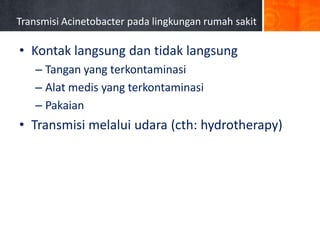
Transmisi Acinetobacter pada lingkungan rumah sakit

• Kontak langsung dan tidak langsung
– Tangan yang terkontaminasi
– Alat medis yang terkontaminasi
– Pakaian

• Transmisi melalui udara (cth: hydrotherapy)

Simor AE et al. Infect Control Hosp Epidemiol 2002;23:261-267.
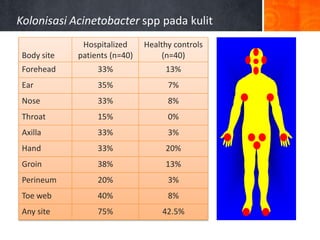
Kolonisasi Acinetobacter spp pada kulit
Body site

Hospitalized
patients (n=40)

Healthy controls
(n=40)

Forehead

33%

13%

Ear

35%

7%

Nose

33%

8%

Throat

15%

0%

Axilla

33%

3%

Hand

33%

20%

Groin

38%

13%

Perineum

20%

3%

Toe web

40%

8%

Any site

75%

42.5%

A. baumanii isolated from 2 patients & 1 control only

Seifert H et al. J Clin Microbiol 1997;
35:2819-2825.
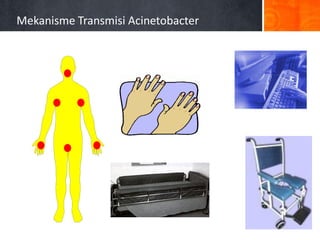
Mekanisme Transmisi Acinetobacter
Referensi
• Chan et al. Defining bacterial species in the genomic era: insights
from the genus Acinetobacter. BMC Microbiology. 2012; 12:302.
• Di Nocera et al. Genome organization of epidemic Acinetobacter
baumannii strains. BMC Microbiology. 2011;11:224.
• Munos-Price LS, Weinstein RA. Acinetobacter infection. N Engl J
Med. 2008; 358:1271-81.
• Brooks JS, Caroll KC, Butel JS, Morse SA, Mietzner TA. Jawetz,
Melnick and Adelberg’s Medical Microbiology 26th edition. 2010
• Dworkin M, Falkow S, Rosenberg E, Schleifer K, Stackebrandt E. The
Prokaryotes: a Handbook on the Biology of Bacteria 3rd edition
volume 6. 2006
• Bailey & Scott’s Diagnostic Microbiology 12th edition
• Mandell, Douglas, and Bennett’s principles and practice of
infectious diseases 7th edition
• Cohen. Infectious Disease 3rd edition. 2010
• Bergey's Manual of Determinative Bacteriology 9th edition

Acinetobacter

  • 1.
  • 2.
  • 3.
    Spesies dari Acinetobacter •17 spesies yang sudah dinamai • 14 spesies yang belum dinamai (genomic • Spesies yang penting dalam dunia medis: – A.baumannii – most common species associated with nosocomial infections – A.lwoffii – more commonly associated with secondary meningitis – A.ursingii – associated with blood stream infections – A.junii – rare cause of ocular infection & bacteremia, esp. in pediatric patients – A.radioresistens, A.johnsonii and A.lwoffii – natural inhabitants of human skin and commensals in oropharynx and vagina
  • 4.
  • 5.
    Morfologi umum Acinetobacter •Berbentuk batang pada fase pertumbuhan eksponensial dan berbentuk kokobasil pada fase stasioner • Encapsulated (umumnya) • Nonmotile • Gram-negative
  • 6.
    Acinetobacter baumannii • Basilusgram (-), pleiomorfik • Terdapat dimana-mana seperti air dan tanah • Membentuk biofilm • Antibiotic resistance • Dapat bertahan lama di permukaan kering dan lembab • Bukan merupakan Flora normal manusia • Tempat infeksi / sumber penyebaran – Intensive Care Unit (ICU) dan lingkungan rumah sakit – Pasien Immunocompromised – Pasien yang terinfeksi / memiliki koloni Acinetobacter
  • 7.
  • 8.
    Gen-gen yang berperandalam patogenitas Acinetobacter • • • • Gen pembentuk kapsul Gen pili tipe I Gen metabolisme zat besi (Fe) Gen yang berperan dalam penggunaan hemin
  • 10.
  • 11.
    Mekanisme transfer materigenetik • • • • • • Transformasi Konjugasi Transduksi Plasmid Transposon (gen-gen resistensi antibiotik) Integron – Banyak isolat Acinetobacter yang telah diteliti memiliki integron dalam kromosomnya – Sebagian besar cassette yang telah diidentifikasi berhubungan dengan resistensi antibiotik – Integron adalah komponen genetik yang sifatnya conserved, integron mengkode komponen site specific recombination system yang membuat Acinetobacter dapat melakukan insersi, delesi, dan rearrangement dari genetic cassettes dalam struktur integron.
  • 12.
    Spesimen untuk pemeriksaan • • • • • • • • • • Sputum ETAspirate BAL Pleural fluid Urine CSF Blood Pus Peritoneal fluid Wound swabs
  • 13.
    Morfologi Koloni Acinetobacter Bloodagar : 0.5 - 2 mm in diameter, translucent to opaque, convex, smooth surface and entire margins
  • 14.
    MacConkey agar :non lactose fermenting colonies
  • 15.
    Media Selektif untukAcinetobacter • Herellea agar (modifikasi medium Mandel et al untuk Acinetobacter) • Holton’s agar • Leeds Acinetobacter medium
  • 16.
    Aktifitas Biokimia • Produksiasam tanpa gas dengan menggunakan glukosa (secara oksidatif oleh A.calcoaceticus – baumannii complex) • Non fermentative -> Aerobik • Oxidase (-) • Nitrate (-) • Catalase (-) • Citrate (+) • Urease (-) • Indole (-) • Gelatin hydrolysis (-) • Hemolitik • Pertumbuhan pada 37oC, 41oC dan 44oC • Assimilation test untuk 14 jenis karbohidrat
  • 17.
    Diagnosis Molekuler • • • • • • DNA –DNA hybridization : reference method of choice Amplified 16S rRNA gene Restriction Analysis (ARDRA) Amplified Fragment Length Polymorphism (AFLP) Ribotyping tRNA spacer fingerprinting Analisis restriksi dari16S-23S rRNA intergenic spacer sequences • Analisis Sekuens gen 16S-23S rRNA gene spacer region • Deteksi BlaOXA-51 like carbapenemase gene (A. baumannii) • gyrB gene based PCR untuk mengidentifikasi A.baumannii dan genomo-species 13TU
  • 18.
    EPIDEMIOLOGICAL TYPING METHODS • • • • • • • Biotyping Antibiograms Serotyping Phagetyping Bacteriocin typing Protein profiles Pulsed Field Gel Electrophoresis (PFGE) - reference method of choice • Multi-locus Enzyme Electrophoretic typing • Plasmid profiling • Ribotyping
  • 19.
    Identifikasi Species Acinetobacter •Acinetobacter calcoaceticus-baumanii complex: glucose-oxidising nonhemolytic, (A.baumannii dapat diidentifikasi dengan OXA51 typing) • Acinetobacter lwoffii: glucose-negative nonhemolytic • Acinetobacter haemolyticus: haemolytic pada agar darah
  • 20.
    Faktor Penyebab Virulensi •Lipopolysaccharide (LPS) pada dinding sel • Produksi Exopolysaccharide (EPS) – Biofilm – Melindungi dari respon imun host • Lipid A • Endotoxins • OMP untuk induksi apoptosis • Fimbriae • Produksi berbagai enzim • Siderophore mediated iron acquisition systems
  • 21.
    Mekanisme Patogenesis • Porindari A. baumannii, 38-kDa outer membrane protein A • Dapat menginduksi apoptosis dari sel eukariota • Mengaktifkan dendritic cell • A. baumannii membentuk biofilm yang menyebabkan resistensi antibiotik • chaperone-usher secretion system terlibat dalam perakitan pilus dan kemudian merangsang pembentukan biofilm
  • 22.
    Mekanisme resistensi antibiotikdari A. baumannii • • • • Aminoglycosides-modifying enzymes Broad-spectrum β-lactamases Carbapenamases Perubahan baik dari kualitas atau kuantitas porin membran luar • Altered penicillin-binding proteins.
  • 25.
    Infeksi Nosokomial Acinetobacter baumannii: CDC: A. baumannii causes 80% of all Acinetobacter infections - Bacteremia - Urinary tract infection - Secondary meningitis - Nosocomial pneumonia intensive care units (ICU) Berperan dalam ventilatorassociated pneumonia (VAP)↑ 25
  • 26.
    Infeksi yang disebabkanAcinetobacter • • • • • • • • Ventilator-associated pneumonia Urinary tract Bloodstream infection infection Secondary meningitis Skin/wound infections Endocarditis CAPD-associated peritonitis Ventriculitis
  • 27.
    Acinetobacter Ventilator-Associated Pneumonia Riskfactors: – – – – – – – Usia Lanjut Penyakit Paru Kronis Immunosuppressi Operasi Penggunaan antimikroba Invasive devices Dirawat di ICU secara berkepanjangan
  • 28.
    Infeksi Nosokomial Rank Pathogen BSI/10,000 admissions Percent 1 Coagulase-negative Staph 15.8 31% 2 S. aureus 10.3 17% 3 Enterococci 4.8 12% 4 Candidaspp 4.6 8% 5 E. coli 2.8 6% 6 Klebsiella 2.4 5% 49 US centers 7 Ps. aeruginosa 2.1 4% 1995-2002 7 Enterobacter 1.9 4% N= 24,179 8 Serratia 1.7 2% 9 Acinetobacter baumanii 0.6 1% Wisplinghoff H, Edmond MB et al. Clin Infect Dis. 2004 Aug 1;39(3):309-17
  • 29.
    Sumber bloodstream infectionA. baumanii Abdominal infection 19% Respiratory tract 71% Central venous line 8% N=37 Garcia-Garmendia J-L et al. Clin Infect Dis 2001;33:939-946.
  • 30.
    Respon inflamasi padakasus A. baumanii Nosocomial Bloodstream Infection Severe sepsis 21% Septic shock 24% Sepsis 55% N=42 Garcia-Garmendia J-L et al. Clin Infect Dis 2001;33:939-946.
  • 31.
    Reservoir Acinetobacter • • • • • • • • Ranjang RS Mejasamping Ventilators Infusion pumps Kasur Bantal AC Patient monitors • • • • • Gorden Equipment carts Wastafel Alat pel Lantai
  • 32.
    Transmisi Acinetobacter padalingkungan rumah sakit • Kontak langsung dan tidak langsung – Tangan yang terkontaminasi – Alat medis yang terkontaminasi – Pakaian • Transmisi melalui udara (cth: hydrotherapy) Simor AE et al. Infect Control Hosp Epidemiol 2002;23:261-267.
  • 33.
    Kolonisasi Acinetobacter spppada kulit Body site Hospitalized patients (n=40) Healthy controls (n=40) Forehead 33% 13% Ear 35% 7% Nose 33% 8% Throat 15% 0% Axilla 33% 3% Hand 33% 20% Groin 38% 13% Perineum 20% 3% Toe web 40% 8% Any site 75% 42.5% A. baumanii isolated from 2 patients & 1 control only Seifert H et al. J Clin Microbiol 1997; 35:2819-2825.
  • 34.
  • 36.
    Referensi • Chan etal. Defining bacterial species in the genomic era: insights from the genus Acinetobacter. BMC Microbiology. 2012; 12:302. • Di Nocera et al. Genome organization of epidemic Acinetobacter baumannii strains. BMC Microbiology. 2011;11:224. • Munos-Price LS, Weinstein RA. Acinetobacter infection. N Engl J Med. 2008; 358:1271-81. • Brooks JS, Caroll KC, Butel JS, Morse SA, Mietzner TA. Jawetz, Melnick and Adelberg’s Medical Microbiology 26th edition. 2010 • Dworkin M, Falkow S, Rosenberg E, Schleifer K, Stackebrandt E. The Prokaryotes: a Handbook on the Biology of Bacteria 3rd edition volume 6. 2006 • Bailey & Scott’s Diagnostic Microbiology 12th edition • Mandell, Douglas, and Bennett’s principles and practice of infectious diseases 7th edition • Cohen. Infectious Disease 3rd edition. 2010 • Bergey's Manual of Determinative Bacteriology 9th edition