Chemical Reaction &
Equation
What is chemical reaction
• The transformation of chemical substance or material into a
new chemical substance or material by making and breaking of
bonds between different atoms is known as Chemical
Reaction
Eg. Burning of magnesium to make magnesium oxide
Reactant and Product
• Those substance which take part in reaction are called reactant and
those which are formed after reaction are called product.
• For example when we burn magnesium, magnesium and oxygen is
reactant and magnesium oxide is product
Magnesium + Oxygen Magnesium oxide
Reactant Product
Characteristic of Chemical Reaction
• Evolution of a Gas
• Formation of a precipitate
• Change in colour
• Change in temperature
• Change in state
Evolution of a Gas
• Some reaction are characterized by the evolution of gas
For eg:-
1. When Zinc react of Dilute sulphuric acid it form zinc sulphate and
evolution of hydrogen gas take place
2. When sodium carbonate react with dilute hydrochloric acid it form
sodium chloride carbon dioxide and water.
Formation of Precipitate
• A Precipitate is a solid product which separates out from the solution
during a chemical reaction. Some chemical reaction are categorized
by formation of a precipitate.
For Eg. Potassium Iodide and lead nitrate react and form yellow ppt of
lead iodide.
• When sulphuric acid and barium chloride react they form white ppt of
barium sulphate
Change inn Colour
• When purple colour potassium per magnate react with citric acid its
colour change purple to colourless
• When turmeric come In contact of ay ase its colour change yellow to
red
Change In Temperature
• After the chemical reaction some time there is a change I temperature if the
reactant absorb heat for reaction we call it endothermic reaction whare as if
the heat is released after reaction it is called exothermic reaction
Eg:- 1. When quick lime is soaked in water it make slake lime and heat is
generated so it is a exothermic reaction
2. When Zinc granule is added dilute sulphuric acid react hey form zinc
sulphate ad heat is generated
3. Barium hydroxide ad ammonium chloride reach together to fprm barium
chloride ammonia and water and the temp. fall down of solution shows it is
endo thermic reaction
Change in state
• Eg. Hydrogen and oxygen are gas when the react and make water
which is liquid
• Burning the solid wax make carbon di oxide gas water vapor and
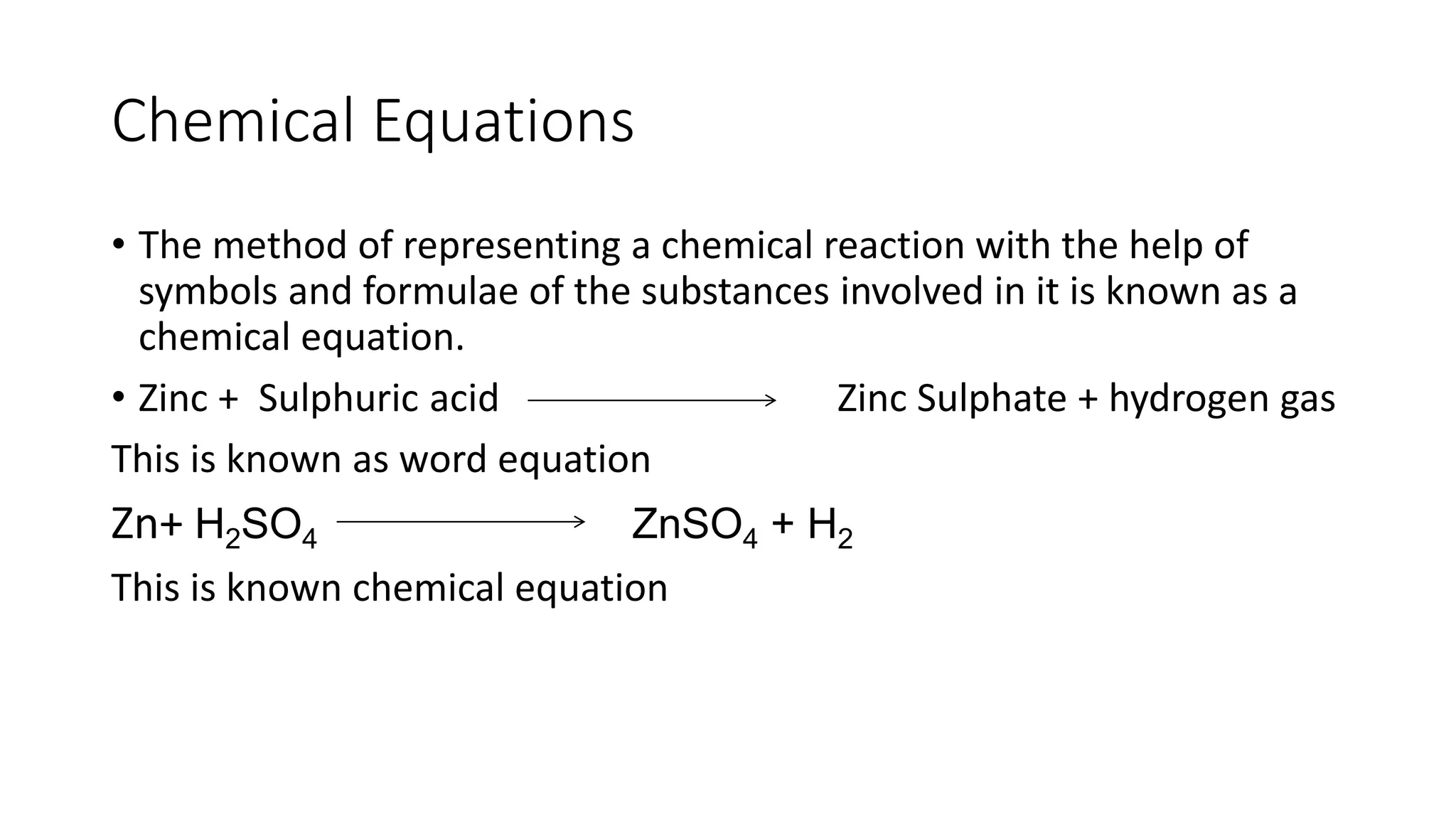
Chemical Equations
• The method of representing a chemical reaction with the help of
symbols and formulae of the substances involved in it is known as a
chemical equation.
• Zinc + Sulphuric acid Zinc Sulphate + hydrogen gas
This is known as word equation
Zn+ H2SO4 ZnSO4 + H2
This is known chemical equation
Balanced & Unbalanced Chemical Equation
A Balanced chemical equation has an equal number of atom of
different elements in the reactant and the products.
Zn+ H2SO4 ZnSO4 + H2
2Mg + O2 2MgO
• Unbalanced Reaction has unequal no of atom of lemet in reactant
and product
• H2 + O2 H2O
• CO2+ H2O C6H12O6+ O2
Balancing the chemical equation
• Balancing the both side of equation is known as balancing the
chemical equation
FeCl3 + MgO ---> Fe2O3 + MgCl2
Li + H3PO4 ---> H2 + Li3PO4
ZnS + O2 ---> ZnO + SO2
FeS2 + Cl2 ---> FeCl3 + S2Cl2
Fe + HC2H3O2 ---> Fe(C2H3O2)3 + H2
HCl(aq) + MnO2(s) ---> MnCl2(aq) + Cl2(g) + H2O(ℓ)
Fe2O3(s) + C(s) ---> Fe(s) + CO2(g)
CO2 + S8 ---> CS2 + SO2
Type of Chemical Reaction
• Combination Reaction
• Decomposition Reaction
• Displacement Reaction
• Double Displacement Reaction
• Oxidation and reduction reaction
Combination Reaction
• When Two or more reactant combine to form single product are
called combination reaction
Decomposition Reaction
• When one substance split to form two or more substance it is called
decomposition reaction. It is just opposite of combination reaction
Displacement Reaction
• Those reaction in which one element take place of another element
in a compound are known as displacement reaction
Why Some element displace another element
• In Displacement reaction a more reactive element displace a less
reactive element from its compound
Double displacement reaction
• Those reaction in which two compound react by exchange of ions to
form new compound are called double displacement reaction
Oxidation and reduction reaction
• When in any reaction if a substance is gained oxygen or loss hydrogen
it is said to be oxidized where are when it loss oxygen or gain
hydrogen it is said to be reduced.
• CuO + H2 Cu + H2O
• ZnO + C Zn + CO
• MnO4 +4HCl MnCl2 + 2H2O + Cl2
• H2S + Cl2 2HCl + S
• 2Al + Fe2O3 Al2O3 + 2Fe
• Those who are oxidized are called reducing agent and those who get reduce are
called oxidizing agent
Effect of oxidation reaction in daily life
• Corrosion of metals
• Rancidity
Corrosion
• Corrosion is the process in which metals are eaten up gradually by the
action of air, moisture or a chemical such as acid on their surface
For eg. Rusting of iron metal is the most common form of corrosion
4Fe + 3O2+2xH2O 2Fe2O3.xH2O
Rusting of Iron is a redox reaction
Corrosion weeknes the Iron and steel objects ad structure such as
Rancidity
• The condition produced by aerial oxidation of a fat and oils in food
marked by unpleasant smell and taste is called ancidity

Chemical Reaction & Equation class 10.pptx

  • 1.
  • 2.
    What is chemicalreaction • The transformation of chemical substance or material into a new chemical substance or material by making and breaking of bonds between different atoms is known as Chemical Reaction Eg. Burning of magnesium to make magnesium oxide
  • 3.
    Reactant and Product •Those substance which take part in reaction are called reactant and those which are formed after reaction are called product. • For example when we burn magnesium, magnesium and oxygen is reactant and magnesium oxide is product Magnesium + Oxygen Magnesium oxide Reactant Product
  • 4.
    Characteristic of ChemicalReaction • Evolution of a Gas • Formation of a precipitate • Change in colour • Change in temperature • Change in state
  • 5.
    Evolution of aGas • Some reaction are characterized by the evolution of gas For eg:- 1. When Zinc react of Dilute sulphuric acid it form zinc sulphate and evolution of hydrogen gas take place 2. When sodium carbonate react with dilute hydrochloric acid it form sodium chloride carbon dioxide and water.
  • 6.
    Formation of Precipitate •A Precipitate is a solid product which separates out from the solution during a chemical reaction. Some chemical reaction are categorized by formation of a precipitate. For Eg. Potassium Iodide and lead nitrate react and form yellow ppt of lead iodide. • When sulphuric acid and barium chloride react they form white ppt of barium sulphate
  • 7.
    Change inn Colour •When purple colour potassium per magnate react with citric acid its colour change purple to colourless • When turmeric come In contact of ay ase its colour change yellow to red
  • 8.
    Change In Temperature •After the chemical reaction some time there is a change I temperature if the reactant absorb heat for reaction we call it endothermic reaction whare as if the heat is released after reaction it is called exothermic reaction Eg:- 1. When quick lime is soaked in water it make slake lime and heat is generated so it is a exothermic reaction 2. When Zinc granule is added dilute sulphuric acid react hey form zinc sulphate ad heat is generated 3. Barium hydroxide ad ammonium chloride reach together to fprm barium chloride ammonia and water and the temp. fall down of solution shows it is endo thermic reaction
  • 9.
    Change in state •Eg. Hydrogen and oxygen are gas when the react and make water which is liquid • Burning the solid wax make carbon di oxide gas water vapor and
  • 10.
    Chemical Equations • Themethod of representing a chemical reaction with the help of symbols and formulae of the substances involved in it is known as a chemical equation. • Zinc + Sulphuric acid Zinc Sulphate + hydrogen gas This is known as word equation Zn+ H2SO4 ZnSO4 + H2 This is known chemical equation
  • 11.
    Balanced & UnbalancedChemical Equation A Balanced chemical equation has an equal number of atom of different elements in the reactant and the products. Zn+ H2SO4 ZnSO4 + H2 2Mg + O2 2MgO
  • 12.
    • Unbalanced Reactionhas unequal no of atom of lemet in reactant and product • H2 + O2 H2O • CO2+ H2O C6H12O6+ O2
  • 13.
    Balancing the chemicalequation • Balancing the both side of equation is known as balancing the chemical equation FeCl3 + MgO ---> Fe2O3 + MgCl2 Li + H3PO4 ---> H2 + Li3PO4 ZnS + O2 ---> ZnO + SO2 FeS2 + Cl2 ---> FeCl3 + S2Cl2 Fe + HC2H3O2 ---> Fe(C2H3O2)3 + H2 HCl(aq) + MnO2(s) ---> MnCl2(aq) + Cl2(g) + H2O(ℓ) Fe2O3(s) + C(s) ---> Fe(s) + CO2(g) CO2 + S8 ---> CS2 + SO2
  • 14.
    Type of ChemicalReaction • Combination Reaction • Decomposition Reaction • Displacement Reaction • Double Displacement Reaction • Oxidation and reduction reaction
  • 15.
    Combination Reaction • WhenTwo or more reactant combine to form single product are called combination reaction
  • 16.
    Decomposition Reaction • Whenone substance split to form two or more substance it is called decomposition reaction. It is just opposite of combination reaction
  • 17.
    Displacement Reaction • Thosereaction in which one element take place of another element in a compound are known as displacement reaction
  • 18.
    Why Some elementdisplace another element • In Displacement reaction a more reactive element displace a less reactive element from its compound
  • 19.
    Double displacement reaction •Those reaction in which two compound react by exchange of ions to form new compound are called double displacement reaction
  • 20.
    Oxidation and reductionreaction • When in any reaction if a substance is gained oxygen or loss hydrogen it is said to be oxidized where are when it loss oxygen or gain hydrogen it is said to be reduced. • CuO + H2 Cu + H2O • ZnO + C Zn + CO • MnO4 +4HCl MnCl2 + 2H2O + Cl2 • H2S + Cl2 2HCl + S • 2Al + Fe2O3 Al2O3 + 2Fe • Those who are oxidized are called reducing agent and those who get reduce are called oxidizing agent
  • 21.
    Effect of oxidationreaction in daily life • Corrosion of metals • Rancidity
  • 22.
    Corrosion • Corrosion isthe process in which metals are eaten up gradually by the action of air, moisture or a chemical such as acid on their surface For eg. Rusting of iron metal is the most common form of corrosion 4Fe + 3O2+2xH2O 2Fe2O3.xH2O Rusting of Iron is a redox reaction Corrosion weeknes the Iron and steel objects ad structure such as
  • 23.
    Rancidity • The conditionproduced by aerial oxidation of a fat and oils in food marked by unpleasant smell and taste is called ancidity