ACID DEPOSITION
 Defined by the pH of the liquid, If ph is Less
than 7 than it is acidic, more than 7 than it is
basic.
 Clean rain has a natural acidity of about 5.2
on the pH scale due to water reacting with
carbon dioxide in the air to form carbonic
acid
H2O + CO2 = H2CO3
2 H2O + H2CO3 = CO3
2− + 2 H3O+
ACID RAIN
Definition
 When the ph of rain water is less than 5.6, it
is called acid rain.
 The natural rain water has ph 5.6 at 20 C
due to formation of carbonic acid due to
dissolution of CO2 in water.
ACID RAIN
CO2 + H2O = H2CO3
 Oxygen, nitrogen and sulphur originating from
industrial operation and fossil fuel combustion
are the major causes of acid rain formation.
2SO2 + O2 = 2SO3
SO3 +H2O =H2SO4
2NO + O2= 2NO2
4NO2 +2H2O + O2 = 4HNO3
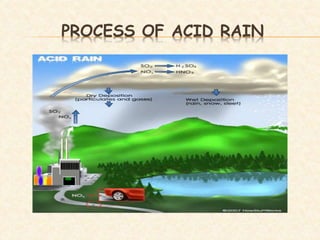
PROCESS OF ACID RAIN
CAUSES OF ACID RAIN
 SO2 and NO2 are mainly responsible for
forming of the acid rain.
 Main sources of the pollutants are
 Fossil fuel based power plants
 Smelting of sulfide ore
 Automobile exhaust
 Industrial plant using sulphuric and nitric
acid
EFFECTS OF ACID RAIN
 Low pH and high aluminum concentrations
can damage or kill fish and aquatic
populations.
 Soils can be damaged by acid rain.
 Increases the oxidation rate of metals such as
copper and bronze so things of metals and
copper are damage.
EFFECTS ON HUMAN HEALTH
 Elevated levels of fine
particles increase illness
and death from heart
and lung disorders such
as asthma.
 Reducing the nitrogen
oxides available to react
with volatile organic
compounds and form
ozone.
AREAS OF HIGHEST ACID RAIN
 Current problem areas
are:
 Eastern United States
 South Western Canada
 Eastern Europe
 Potential future problem
areas:
 Southern India
 West Africa
 Indonesia
 Thailand
CONTROL OF ACID RAIN
 Emission of SO2 and NO2 from industries
and power plants should be reduced by
using pollution control equipments.
 Limiting of lakes and soils should be done to
correct the adverse effects of acid rain.
Acid rain

Acid rain

  • 2.
    ACID DEPOSITION  Definedby the pH of the liquid, If ph is Less than 7 than it is acidic, more than 7 than it is basic.  Clean rain has a natural acidity of about 5.2 on the pH scale due to water reacting with carbon dioxide in the air to form carbonic acid H2O + CO2 = H2CO3 2 H2O + H2CO3 = CO3 2− + 2 H3O+
  • 3.
    ACID RAIN Definition  Whenthe ph of rain water is less than 5.6, it is called acid rain.  The natural rain water has ph 5.6 at 20 C due to formation of carbonic acid due to dissolution of CO2 in water.
  • 4.
    ACID RAIN CO2 +H2O = H2CO3  Oxygen, nitrogen and sulphur originating from industrial operation and fossil fuel combustion are the major causes of acid rain formation. 2SO2 + O2 = 2SO3 SO3 +H2O =H2SO4 2NO + O2= 2NO2 4NO2 +2H2O + O2 = 4HNO3
  • 5.
  • 6.
    CAUSES OF ACIDRAIN  SO2 and NO2 are mainly responsible for forming of the acid rain.  Main sources of the pollutants are  Fossil fuel based power plants  Smelting of sulfide ore  Automobile exhaust  Industrial plant using sulphuric and nitric acid
  • 7.
    EFFECTS OF ACIDRAIN  Low pH and high aluminum concentrations can damage or kill fish and aquatic populations.  Soils can be damaged by acid rain.  Increases the oxidation rate of metals such as copper and bronze so things of metals and copper are damage.
  • 8.
    EFFECTS ON HUMANHEALTH  Elevated levels of fine particles increase illness and death from heart and lung disorders such as asthma.  Reducing the nitrogen oxides available to react with volatile organic compounds and form ozone.
  • 9.
    AREAS OF HIGHESTACID RAIN  Current problem areas are:  Eastern United States  South Western Canada  Eastern Europe  Potential future problem areas:  Southern India  West Africa  Indonesia  Thailand
  • 10.
    CONTROL OF ACIDRAIN  Emission of SO2 and NO2 from industries and power plants should be reduced by using pollution control equipments.  Limiting of lakes and soils should be done to correct the adverse effects of acid rain.

Editor's Notes