Achieving capacities over 1Gbps
Please contact us at
salesna@saftehnika.com
Agenda
 SpectrumAvailability
 Ethernetdatarate& linkbudget
 Mounting mulitple radiostosingle antenna
 Casestudy:1.7Gbpslinks
 Ethernetaggregation types
 Futureof E-bandradios
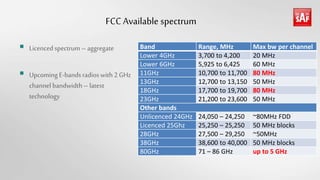
FCCAvailable spectrum
 Licenced spectrum– aggregate
 Upcoming E-bandsradioswith 2GHz
channelbandwidth–latest
technology
Band Range, MHz Max bw per channel
Lower 4GHz 3,700 to 4,200 20 MHz
Lower 6GHz 5,925 to 6,425 60 MHz
11GHz 10,700 to 11,700 80 MHz
13GHz 12,700 to 13,150 50 MHz
18GHz 17,700 to 19,700 80 MHz
23GHz 21,200 to 23,600 50 MHz
Other bands
Unlicenced 24GHz 24,050 – 24,250 ~80MHz FDD
Licenced 25Ghz 25,250 – 25,250 50 MHz blocks
28GHz 27,500 – 29,250 ~50MHz
38GHz 38,600 to 40,000 50 MHz blocks
80GHz 71 – 86 GHz up to 5 GHz
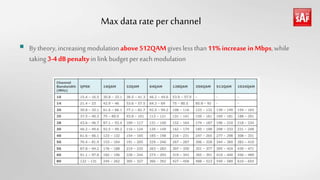
Max data rate per channel
 Bytheory,increasing modulationabove512QAMgives less than11%increase inMbps, while
taking3-4dBpenaltyin link budgetpereachmodulation
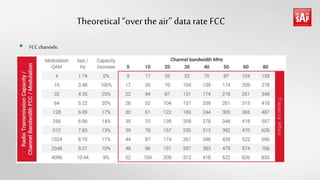
Theoretical“overtheair” data rate FCC
 FCC channels:
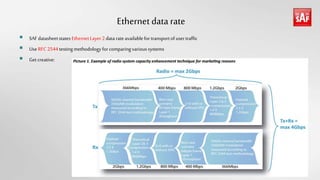
Ethernet data rate
 SAF datasheetstatesEthernet Layer2 data rateavailablefortransportofusertraffic
 Use RFC 2544 testingmethodology forcomparingvarioussystems
 Get creative:
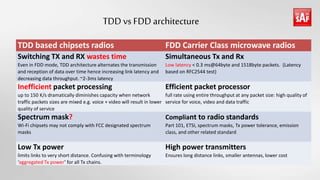
TDD vs FDD architecture
TDD based chipsets radios FDD Carrier Class microwave radios
Switching TX and RX wastes time
Even in FDD mode, TDD architecture alternates the transmission
and reception of data over time hence increasing link latency and
decreasing data throughput. ~2-3ms latency
Simultaneous Tx and Rx
Low latency < 0.3 ms@64byte and 1518byte packets. (Latency
based on RFC2544 test)
Inefficient packet processing
up to 150 K/s dramatically diminishes capacity when network
traffic packets sizes are mixed e.g. voice + video will result in lower
quality of service
Efficient packet processor
full rate using entire throughput at any packet size: high quality of
service for voice, video and data traffic
Spectrum mask?
Wi-Fi chipsets may not comply with FCC designated spectrum
masks
Compliant to radio standards
Part 101, ETSI, spectrum masks, Tx power tolerance, emission
class, and other related standard
Low Tx power
limits links to very short distance. Confusing with terminology
‘aggregated Tx power’ for all Tx chains.
High power transmitters
Ensures long distance links, smaller antennas, lower cost
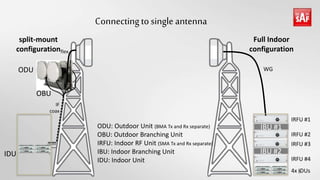
Connectingto single antenna
9
split-mount
configuration
Full Indoor
configuration
WG
flex
IF
coax
ODU
OBU
IRFU #1
IRFU #2
IRFU #3
IRFU #4
4x IDUs
IDU
ODU: Outdoor Unit (BMA Tx and Rx separate)
OBU: Outdoor Branching Unit
IRFU: Indoor RF Unit (SMA Tx and Rx separate)
IBU: Indoor Branching Unit
IDU: Indoor Unit
IBU #1
IBU #2
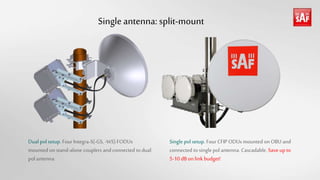
Single antenna: split-mount
Dual pol setup. Four Integra-S(-GS, -WS) FODUs
mounted on stand-alone couplers andconnected todual
pol antenna
Single pol setup. Four CFIP ODUs mounted on OBU and
connected tosingle pol antenna. Cascadable. Save up to
5-10 dBon link budget!
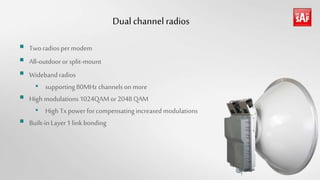
Dual channel radios
 Tworadiospermodem
 All-outdoororsplit-mount
 Widebandradios
• supporting80MHz channelson more
 High modulations1024QAMor2048QAM
• High Txpowerforcompensatingincreasedmodulations
 Built-inLayer1 link bonding
Case study – Cable& Wireless
 7GHz and 8GHzband
 Eachpath with6x1+1 Space Diversityconnecting
islands with XPIC
 Distance ~40milesoverwater,6ft antennas
 6x56MHz@ 128QAM= 6x~287 Mbps = ~1,7Gbps
 RF combined withoutdoor branching unit for bestlink
availability
 Externalaggregation:Layer 1 link bonding
 SAFradios & services:link planning, training,
commissioning,support
Aggregationtypes
 Layer1 - Linkbonding;anydevices(router,switch,PC) canbe connected.
• Traffic is sent over two links per-frame atthe modem level
• Transparent toexternal Ethernet traffic
• In mostcasesitisnotavailplein inLayer2 switchesorLayer3 routers
 Layer2 - Linkaggregationlike LACP (LinkAggregationControl Protocol)orloadbalancingbyVLANs.
• Works bydistributingtrafficamongstradiochannelsbasedonMAC addresses,IP addresses,ports
• AvailablewithbothLayer2and Layer3 switches
• External 10 Gbps Ethernet switch
 Layer3 - Load balancing- IP based.
• Advancedbalancingconfigurations
• Availableinroutersand someLayer3 switches
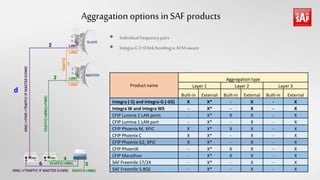
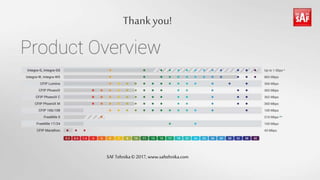
Aggragation options in SAFproducts
 Individualfrequencypairs
 Integra-G2+0link bondingisACM-aware
d
Product name
Aggregation type
Layer 1 Layer 2 Layer 3
Built-in External Built-in External Built-in External
Integra (-S) and Integra-G (-GS) X X* - X - X
Integra W and Integra WS - X* - X - X
CFIP Lumina 2 LAN ports - X* X X - X
CFIP Lumina 1 LAN port - X* - X - X
CFIP Phoenix M, XPIC X X* X X - X
CFIP Phoenix C X X* - X - X
CFIP Phoenix G2, XPIC X X* - X - X
CFIP PhoeniX - X* X X - X
CFIP Marathon - X* X X - X
SAF Freemile 17/24 - X* - X - X
SAF Freemile 5.8GE - X* - X - X
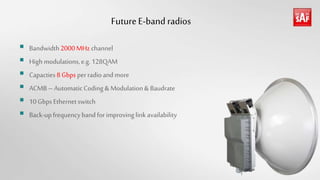
FutureE-band radios
 Bandwidth2000MHz channel
 High modulations,e.g. 128QAM
 Capacties8Gbpsperradioandmore
 ACMB– AutomaticCoding & Modulation& Baudrate
 10GbpsEthernetswitch
 Back-upfrequencybandforimproving linkavailability
SAFTehnika© 2017, www.saftehnika.com
Thankyou!

Achieving capacities above 1 gbps ed02

  • 1.
    Achieving capacities over1Gbps Please contact us at salesna@saftehnika.com
  • 2.
    Agenda  SpectrumAvailability  Ethernetdatarate&linkbudget  Mounting mulitple radiostosingle antenna  Casestudy:1.7Gbpslinks  Ethernetaggregation types  Futureof E-bandradios
  • 3.
    FCCAvailable spectrum  Licencedspectrum– aggregate  Upcoming E-bandsradioswith 2GHz channelbandwidth–latest technology Band Range, MHz Max bw per channel Lower 4GHz 3,700 to 4,200 20 MHz Lower 6GHz 5,925 to 6,425 60 MHz 11GHz 10,700 to 11,700 80 MHz 13GHz 12,700 to 13,150 50 MHz 18GHz 17,700 to 19,700 80 MHz 23GHz 21,200 to 23,600 50 MHz Other bands Unlicenced 24GHz 24,050 – 24,250 ~80MHz FDD Licenced 25Ghz 25,250 – 25,250 50 MHz blocks 28GHz 27,500 – 29,250 ~50MHz 38GHz 38,600 to 40,000 50 MHz blocks 80GHz 71 – 86 GHz up to 5 GHz
  • 4.
    Max data rateper channel  Bytheory,increasing modulationabove512QAMgives less than11%increase inMbps, while taking3-4dBpenaltyin link budgetpereachmodulation
  • 5.
  • 6.
    Ethernet data rate SAF datasheetstatesEthernet Layer2 data rateavailablefortransportofusertraffic  Use RFC 2544 testingmethodology forcomparingvarioussystems  Get creative:
  • 7.
    TDD vs FDDarchitecture TDD based chipsets radios FDD Carrier Class microwave radios Switching TX and RX wastes time Even in FDD mode, TDD architecture alternates the transmission and reception of data over time hence increasing link latency and decreasing data throughput. ~2-3ms latency Simultaneous Tx and Rx Low latency < 0.3 ms@64byte and 1518byte packets. (Latency based on RFC2544 test) Inefficient packet processing up to 150 K/s dramatically diminishes capacity when network traffic packets sizes are mixed e.g. voice + video will result in lower quality of service Efficient packet processor full rate using entire throughput at any packet size: high quality of service for voice, video and data traffic Spectrum mask? Wi-Fi chipsets may not comply with FCC designated spectrum masks Compliant to radio standards Part 101, ETSI, spectrum masks, Tx power tolerance, emission class, and other related standard Low Tx power limits links to very short distance. Confusing with terminology ‘aggregated Tx power’ for all Tx chains. High power transmitters Ensures long distance links, smaller antennas, lower cost
  • 8.
    Connectingto single antenna 9 split-mount configuration FullIndoor configuration WG flex IF coax ODU OBU IRFU #1 IRFU #2 IRFU #3 IRFU #4 4x IDUs IDU ODU: Outdoor Unit (BMA Tx and Rx separate) OBU: Outdoor Branching Unit IRFU: Indoor RF Unit (SMA Tx and Rx separate) IBU: Indoor Branching Unit IDU: Indoor Unit IBU #1 IBU #2
  • 9.
    Single antenna: split-mount Dualpol setup. Four Integra-S(-GS, -WS) FODUs mounted on stand-alone couplers andconnected todual pol antenna Single pol setup. Four CFIP ODUs mounted on OBU and connected tosingle pol antenna. Cascadable. Save up to 5-10 dBon link budget!
  • 10.
    Dual channel radios Tworadiospermodem  All-outdoororsplit-mount  Widebandradios • supporting80MHz channelson more  High modulations1024QAMor2048QAM • High Txpowerforcompensatingincreasedmodulations  Built-inLayer1 link bonding
  • 11.
    Case study –Cable& Wireless  7GHz and 8GHzband  Eachpath with6x1+1 Space Diversityconnecting islands with XPIC  Distance ~40milesoverwater,6ft antennas  6x56MHz@ 128QAM= 6x~287 Mbps = ~1,7Gbps  RF combined withoutdoor branching unit for bestlink availability  Externalaggregation:Layer 1 link bonding  SAFradios & services:link planning, training, commissioning,support
  • 12.
    Aggregationtypes  Layer1 -Linkbonding;anydevices(router,switch,PC) canbe connected. • Traffic is sent over two links per-frame atthe modem level • Transparent toexternal Ethernet traffic • In mostcasesitisnotavailplein inLayer2 switchesorLayer3 routers  Layer2 - Linkaggregationlike LACP (LinkAggregationControl Protocol)orloadbalancingbyVLANs. • Works bydistributingtrafficamongstradiochannelsbasedonMAC addresses,IP addresses,ports • AvailablewithbothLayer2and Layer3 switches • External 10 Gbps Ethernet switch  Layer3 - Load balancing- IP based. • Advancedbalancingconfigurations • Availableinroutersand someLayer3 switches
  • 13.
    Aggragation options inSAFproducts  Individualfrequencypairs  Integra-G2+0link bondingisACM-aware d Product name Aggregation type Layer 1 Layer 2 Layer 3 Built-in External Built-in External Built-in External Integra (-S) and Integra-G (-GS) X X* - X - X Integra W and Integra WS - X* - X - X CFIP Lumina 2 LAN ports - X* X X - X CFIP Lumina 1 LAN port - X* - X - X CFIP Phoenix M, XPIC X X* X X - X CFIP Phoenix C X X* - X - X CFIP Phoenix G2, XPIC X X* - X - X CFIP PhoeniX - X* X X - X CFIP Marathon - X* X X - X SAF Freemile 17/24 - X* - X - X SAF Freemile 5.8GE - X* - X - X
  • 14.
    FutureE-band radios  Bandwidth2000MHzchannel  High modulations,e.g. 128QAM  Capacties8Gbpsperradioandmore  ACMB– AutomaticCoding & Modulation& Baudrate  10GbpsEthernetswitch  Back-upfrequencybandforimproving linkavailability
  • 15.