Achieve CMMI Level 5 Maturity
A CMMI maturity model provides a benchmark rating method that enables you compare
your organization’s capability to its adversary. Company leaders knows the importance
of improving capability, therefore most of the leaders view capability building as one of
the top strategic priorities. Implementing CMMI determines the key capabilities of your
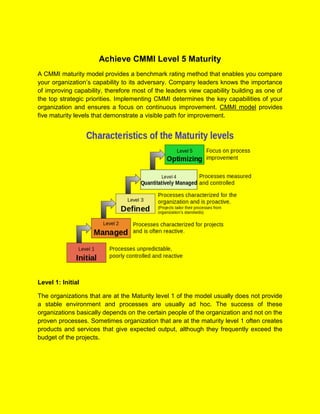
organization and ensures a focus on continuous improvement. CMMI model provides
five maturity levels that demonstrate a visible path for improvement.
Level 1: Initial
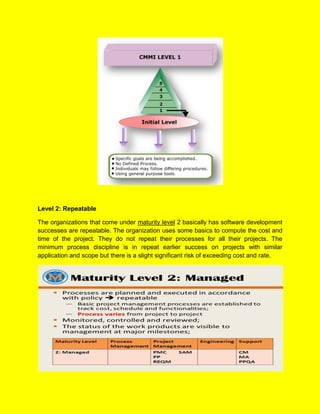
The organizations that are at the Maturity level 1 of the model usually does not provide
a stable environment and processes are usually ad hoc. The success of these
organizations basically depends on the certain people of the organization and not on the
proven processes. Sometimes organization that are at the maturity level 1 often creates
products and services that give expected output, although they frequently exceed the
budget of the projects.
Level 2: Repeatable
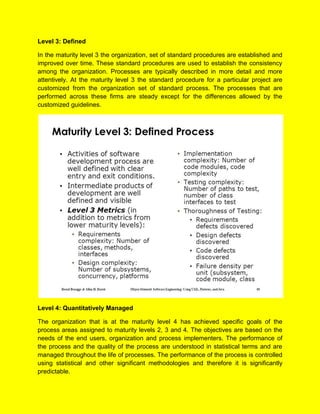
The organizations that come under maturity level 2 basically has software development
successes are repeatable. The organization uses some basics to compute the cost and
time of the project. They do not repeat their processes for all their projects. The
minimum process discipline is in repeat earlier success on projects with similar
application and scope but there is a slight significant risk of exceeding cost and rate.
Level 3: Defined
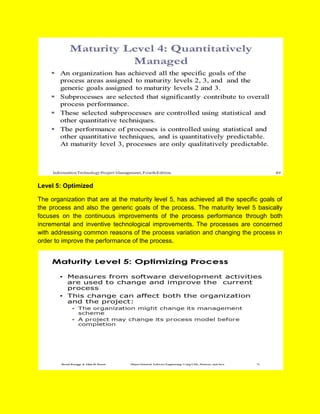
In the maturity level 3 the organization, set of standard procedures are established and
improved over time. These standard procedures are used to establish the consistency
among the organization. Processes are typically described in more detail and more
attentively. At the maturity level 3 the standard procedure for a particular project are
customized from the organization set of standard process. The processes that are
performed across these firms are steady except for the differences allowed by the
customized guidelines.
Level 4: Quantitatively Managed
The organization that is at the maturity level 4 has achieved specific goals of the
process areas assigned to maturity levels 2, 3 and 4. The objectives are based on the
needs of the end users, organization and process implementers. The performance of
the process and the quality of the process are understood in statistical terms and are
managed throughout the life of processes. The performance of the process is controlled
using statistical and other significant methodologies and therefore it is significantly
predictable.
Level 5: Optimized
The organization that are at the maturity level 5, has achieved all the specific goals of
the process and also the generic goals of the process. The maturity level 5 basically
focuses on the continuous improvements of the process performance through both
incremental and inventive technological improvements. The processes are concerned
with addressing common reasons of the process variation and changing the process in
order to improve the performance of the process.
Achieve cmmi level 5 maturity

Achieve cmmi level 5 maturity

  • 1.
    Achieve CMMI Level5 Maturity A CMMI maturity model provides a benchmark rating method that enables you compare your organization’s capability to its adversary. Company leaders knows the importance of improving capability, therefore most of the leaders view capability building as one of the top strategic priorities. Implementing CMMI determines the key capabilities of your organization and ensures a focus on continuous improvement. CMMI model provides five maturity levels that demonstrate a visible path for improvement. Level 1: Initial The organizations that are at the Maturity level 1 of the model usually does not provide a stable environment and processes are usually ad hoc. The success of these organizations basically depends on the certain people of the organization and not on the proven processes. Sometimes organization that are at the maturity level 1 often creates products and services that give expected output, although they frequently exceed the budget of the projects.
  • 2.
    Level 2: Repeatable Theorganizations that come under maturity level 2 basically has software development successes are repeatable. The organization uses some basics to compute the cost and time of the project. They do not repeat their processes for all their projects. The minimum process discipline is in repeat earlier success on projects with similar application and scope but there is a slight significant risk of exceeding cost and rate.
  • 3.
    Level 3: Defined Inthe maturity level 3 the organization, set of standard procedures are established and improved over time. These standard procedures are used to establish the consistency among the organization. Processes are typically described in more detail and more attentively. At the maturity level 3 the standard procedure for a particular project are customized from the organization set of standard process. The processes that are performed across these firms are steady except for the differences allowed by the customized guidelines. Level 4: Quantitatively Managed The organization that is at the maturity level 4 has achieved specific goals of the process areas assigned to maturity levels 2, 3 and 4. The objectives are based on the needs of the end users, organization and process implementers. The performance of the process and the quality of the process are understood in statistical terms and are managed throughout the life of processes. The performance of the process is controlled using statistical and other significant methodologies and therefore it is significantly predictable.
  • 4.
    Level 5: Optimized Theorganization that are at the maturity level 5, has achieved all the specific goals of the process and also the generic goals of the process. The maturity level 5 basically focuses on the continuous improvements of the process performance through both incremental and inventive technological improvements. The processes are concerned with addressing common reasons of the process variation and changing the process in order to improve the performance of the process.