Doors Parts of the Window & Frame Window Operation Types of Window Materials Specifying Windows Hardware / Accessories & Windows
Parts of the Window & Frame Window Operation Window Materials & Specifying Skylights This Lecture: Windows
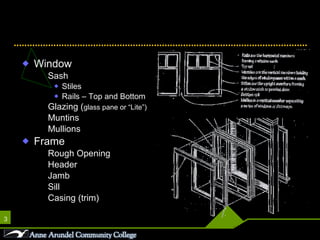
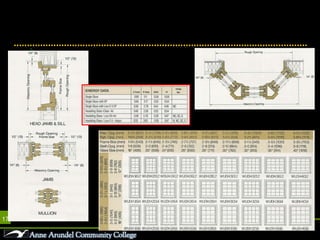
Parts of the Window & Frame Window Sash Stiles Rails – Top and Bottom Glazing ( glass pane or “Lite”) Muntins Mullions Frame Rough Opening Header Jamb Sill Casing (trim)
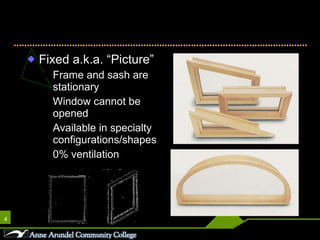
Window Operations Fixed a.k.a. “Picture” Frame and sash are stationary Window cannot be opened Available in specialty configurations/shapes 0% ventilation
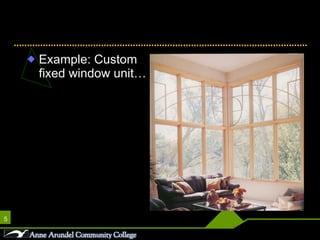
Example: Custom fixed window unit… Window Operations
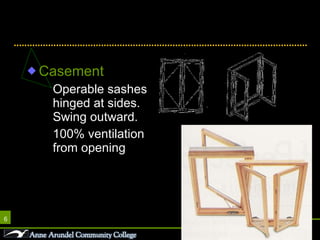
Casement Operable sashes hinged at sides. Swing outward. 100% ventilation from opening Window Operations
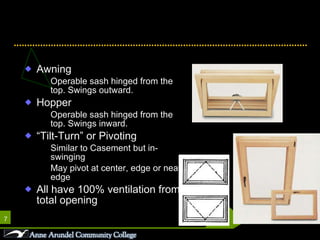
Awning  Operable sash hinged from the top. Swings outward. Hopper Operable sash hinged from the top. Swings inward. “ Tilt-Turn” or Pivoting Similar to Casement but in-swinging  May pivot at center, edge or near edge All have 100% ventilation from total opening Window Operations
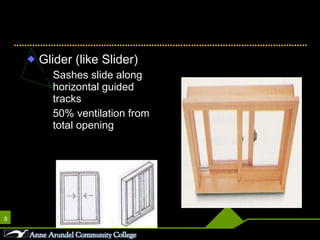
Glider (like Slider) Sashes slide along horizontal guided tracks 50% ventilation from total opening Window Operations
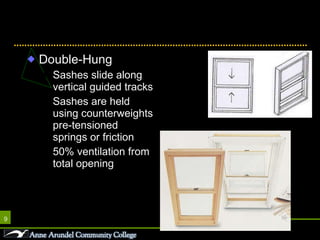
Double-Hung Sashes slide along vertical guided tracks Sashes are held using counterweights pre-tensioned springs or friction 50% ventilation from total opening Window Operations
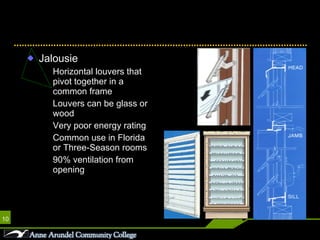
Jalousie Horizontal louvers that pivot together in a common frame Louvers can be glass or wood Very poor energy rating Common use in Florida or Three-Season rooms 90% ventilation from opening Window Operations
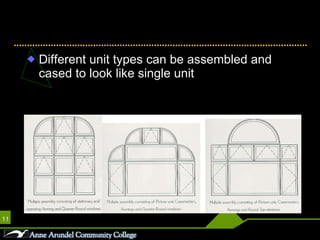
Different unit types can be assembled and cased to look like single unit Window Operations
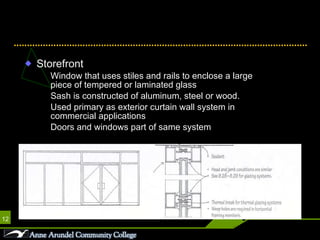
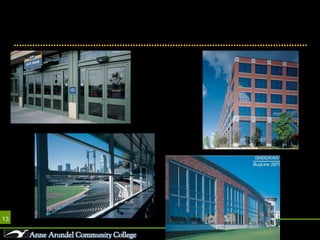
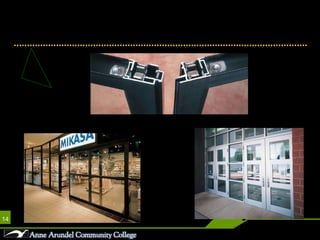
Storefront Window that uses stiles and rails to enclose a large piece of tempered or laminated glass Sash is constructed of aluminum, steel or wood. Used primary as exterior curtain wall system in commercial applications Doors and windows part of same system Window Operations
Window Operations
Window Operations
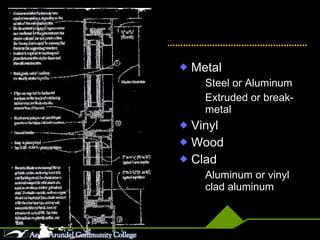
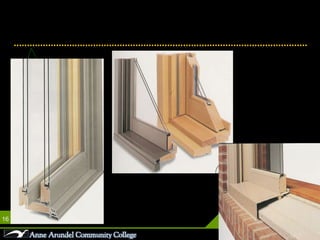
Materials  Metal Steel or Aluminum Extruded or break-metal Vinyl Wood Clad Aluminum or vinyl clad aluminum
Materials
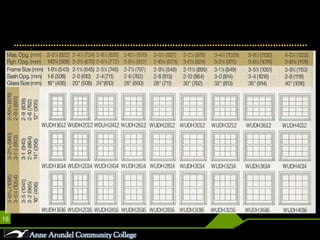
Specifying
Specifying
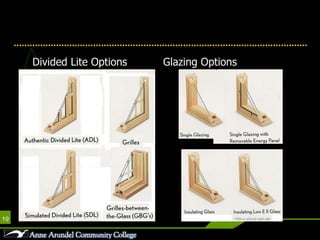
Specifying Divided Lite Options Glazing Options
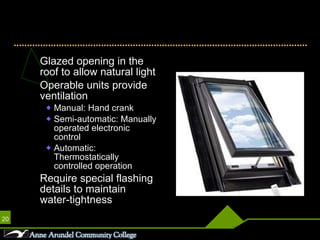
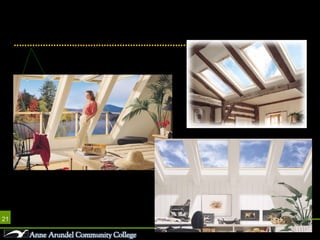
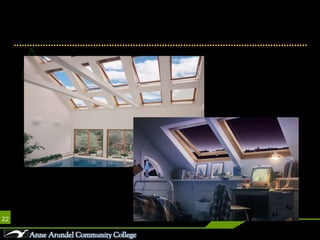
Skylights Glazed opening in the roof to allow natural light  Operable units provide  ventilation Manual: Hand crank Semi-automatic: Manually operated electronic control Automatic: Thermostatically controlled operation Require special flashing details to maintain water-tightness
Skylights
Skylights
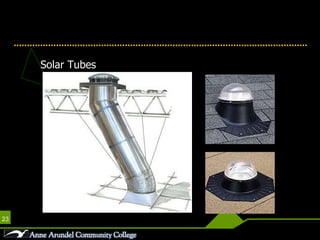
Skylights Solar Tubes
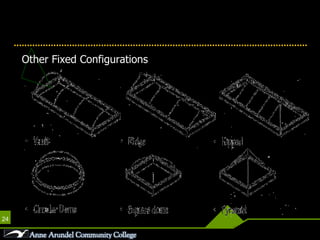
Skylights Other Fixed Configurations

ACH 121 Lecture 12b Windows

  • 1.
    Doors Parts ofthe Window & Frame Window Operation Types of Window Materials Specifying Windows Hardware / Accessories & Windows
  • 2.
    Parts of theWindow & Frame Window Operation Window Materials & Specifying Skylights This Lecture: Windows
  • 3.
    Parts of theWindow & Frame Window Sash Stiles Rails – Top and Bottom Glazing ( glass pane or “Lite”) Muntins Mullions Frame Rough Opening Header Jamb Sill Casing (trim)
  • 4.
    Window Operations Fixeda.k.a. “Picture” Frame and sash are stationary Window cannot be opened Available in specialty configurations/shapes 0% ventilation
  • 5.
    Example: Custom fixedwindow unit… Window Operations
  • 6.
    Casement Operable sasheshinged at sides. Swing outward. 100% ventilation from opening Window Operations
  • 7.
    Awning Operablesash hinged from the top. Swings outward. Hopper Operable sash hinged from the top. Swings inward. “ Tilt-Turn” or Pivoting Similar to Casement but in-swinging May pivot at center, edge or near edge All have 100% ventilation from total opening Window Operations
  • 8.
    Glider (like Slider)Sashes slide along horizontal guided tracks 50% ventilation from total opening Window Operations
  • 9.
    Double-Hung Sashes slidealong vertical guided tracks Sashes are held using counterweights pre-tensioned springs or friction 50% ventilation from total opening Window Operations
  • 10.
    Jalousie Horizontal louversthat pivot together in a common frame Louvers can be glass or wood Very poor energy rating Common use in Florida or Three-Season rooms 90% ventilation from opening Window Operations
  • 11.
    Different unit typescan be assembled and cased to look like single unit Window Operations
  • 12.
    Storefront Window thatuses stiles and rails to enclose a large piece of tempered or laminated glass Sash is constructed of aluminum, steel or wood. Used primary as exterior curtain wall system in commercial applications Doors and windows part of same system Window Operations
  • 13.
  • 14.
  • 15.
    Materials MetalSteel or Aluminum Extruded or break-metal Vinyl Wood Clad Aluminum or vinyl clad aluminum
  • 16.
  • 17.
  • 18.
  • 19.
    Specifying Divided LiteOptions Glazing Options
  • 20.
    Skylights Glazed openingin the roof to allow natural light Operable units provide ventilation Manual: Hand crank Semi-automatic: Manually operated electronic control Automatic: Thermostatically controlled operation Require special flashing details to maintain water-tightness
  • 21.
  • 22.
  • 23.
  • 24.
    Skylights Other FixedConfigurations

Editor's Notes

  • #7 Flush: plywood, hardboard or plastic-laminate face panels bonded to solid or hollow-core Stile-and-rail: vertical and horizontal members enclosing wood, glass, or louver inserts creating panel, sash, storm, screen or louver designs Accordion Fold: assembled from narrow slats that give long, drape-like appearance
  • #8 Increases the dimensional stability of a door Provides thermal insulation, sound insulation & fire resistant Fire rated wood doors range from 20 minutes to 1 ½ hours Solid-core material: wood, particle board, mineral composition or combination
  • #9 Glue-Block Core Most common construction Wood blocks bonded together, with end joints staggered Stiles & rails are bonded to core Entire assembly is sanded to a smooth, uniform thickness Face panels are bonded or glued to the assembly Must meet a min. of 1/12 thickness
  • #10 Glue-Block Core Most common construction Wood blocks bonded together, with end joints staggered Stiles & rails are bonded to core Entire assembly is sanded to a smooth, uniform thickness Face panels are bonded or glued to the assembly Must meet a min. of 1/12 thickness
  • #11 Glue-Block Core Most common construction Wood blocks bonded together, with end joints staggered Stiles & rails are bonded to core Entire assembly is sanded to a smooth, uniform thickness Face panels are bonded or glued to the assembly Must meet a min. of 1/12 thickness
  • #12 Glue-Block Core Most common construction Wood blocks bonded together, with end joints staggered Stiles & rails are bonded to core Entire assembly is sanded to a smooth, uniform thickness Face panels are bonded or glued to the assembly Must meet a min. of 1/12 thickness
  • #13 Glue-Block Core Most common construction Wood blocks bonded together, with end joints staggered Stiles & rails are bonded to core Entire assembly is sanded to a smooth, uniform thickness Face panels are bonded or glued to the assembly Must meet a min. of 1/12 thickness
  • #14 Glue-Block Core Most common construction Wood blocks bonded together, with end joints staggered Stiles & rails are bonded to core Entire assembly is sanded to a smooth, uniform thickness Face panels are bonded or glued to the assembly Must meet a min. of 1/12 thickness
  • #15 Glue-Block Core Most common construction Wood blocks bonded together, with end joints staggered Stiles & rails are bonded to core Entire assembly is sanded to a smooth, uniform thickness Face panels are bonded or glued to the assembly Must meet a min. of 1/12 thickness
  • #21 Do not provide much thermal insulation or sound insulation Used in interior applications
  • #22 Do not provide much thermal insulation or sound insulation Used in interior applications
  • #23 Do not provide much thermal insulation or sound insulation Used in interior applications
  • #24 Do not provide much thermal insulation or sound insulation Used in interior applications
  • #25 Do not provide much thermal insulation or sound insulation Used in interior applications